


John 14:11
Bible text: King James Version (1769 Blayney text) · Public domain
Bible text: Berean Standard Bible · Public domain
Bible text: American Standard Version (1901) · Public domain
Bible text: World English Bible, Messianic edition · Public domain
Bible text: Geneva Bible (1599) · Public domain
Bible text: Young's Literal Translation · Public domain
- πιστεύετέpisteuetedo believeG4100V-PAM-2PVerb Present Active Imperative 2nd Plural
- μοιmoiMeG3165P-1DSPersonal pronoun Dative 1st Singular
- ὅτιhotithatG3754CONJConjunction
- ἐγὼegōI myself [am]G1473P-1NSPersonal pronoun Nominative 1st Singular
- ἐνeninG1722PREPPreposition
- τῷtōtheG3588T-DSMDefinite article Dative Singular Masculine
- πατρὶpatriFatherG3962N-DSM-TNoun Dative Singular Masculine Title
- καὶkaiandG2532CONJConjunction
- ὁhotheG3588T-NSMDefinite article Nominative Singular Masculine
- πατὴρpatērFatherG3962N-NSM-TNoun Nominative Singular Masculine Title
- ἐνeninG1722PREPPreposition
- ἐμοί·emoiMe myselfG1473P-1DSPersonal pronoun Dative 1st Singular
- εἰeilestG1487CONDConjunction
- δὲdethenG1161CONJConjunction
- μήmēexceptG3361PRT-NNegative Particle Negative
- διὰdiabecause ofG1223PREPPreposition
- τὰtatheG3588T-APNDefinite article Accusative Plural Neuter
- ἔργαergaworksG2041N-APNNoun Accusative Plural Neuter
- αὐτὰautathemselvesG846P-APNPersonal pronoun Accusative Plural Neuter
- πιστεύετεpisteuetedo believeG4100V-PAM-2PVerb Present Active Imperative 2nd Plural
- μοιmoito meG3165P-1DSPersonal pronoun Dative 1st Singular
English is a literal word-by-word gloss of the Greek, not the KJV's wording. Why?
This is the original text the KJV's translators worked from — each Greek word with its own literal English meaning in this verse, prepared by scholars at Tyndale House, Cambridge. The KJV translates whole sentences, not word by word, so its wording differs: one Greek word can become several English words, and the KJV may choose “charity” where the gloss reads “love”. Both are faithful — they answer different questions. For the KJV's own rendering, switch to the KJV text.
Details
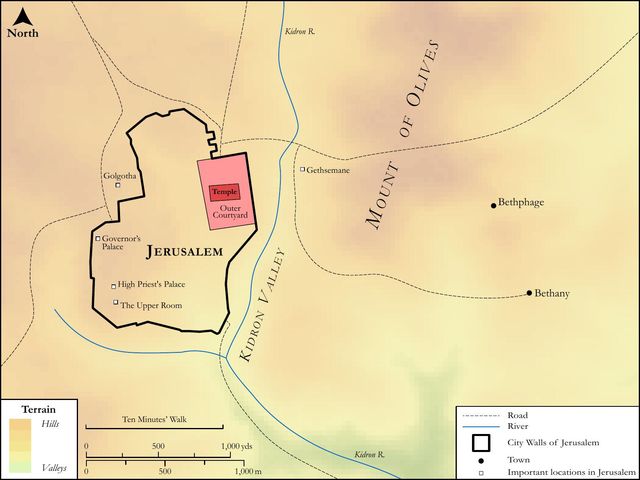
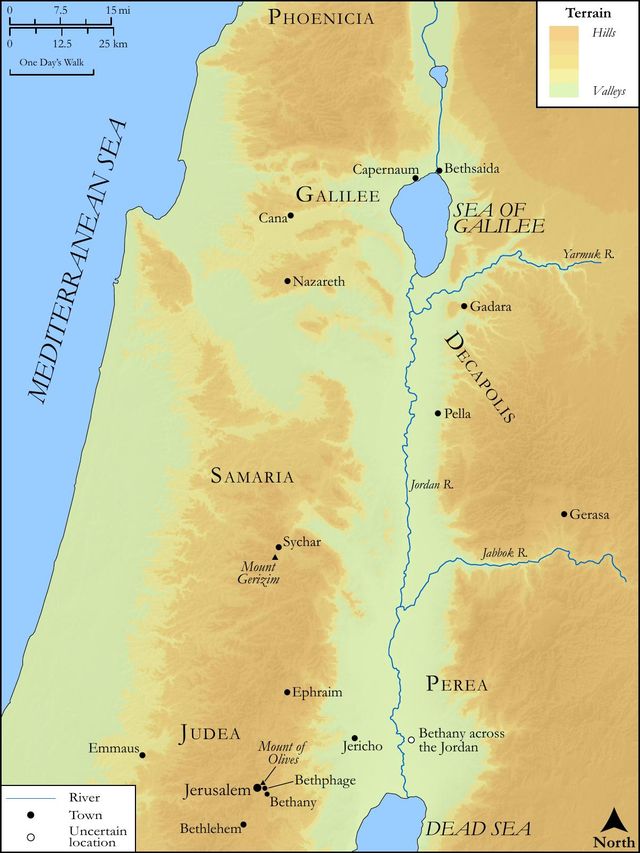
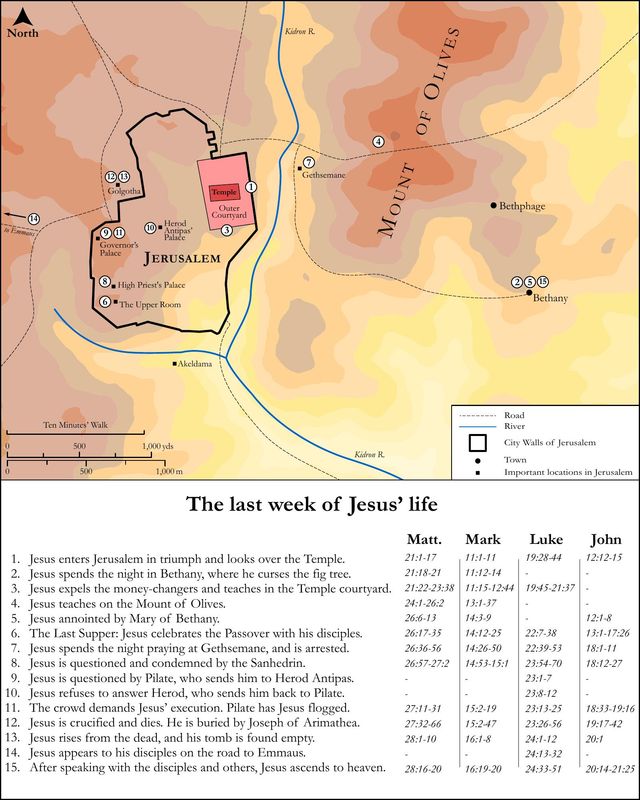
See on the biblical-era maps
Study this verse
Public-domain commentary
Matthew Henry
From his Commentary on the Whole Bible. Henry comments on passages, not single verses — this entry covers John 14:4–11. His four-level outline is real structure in the source text, so it is rendered as structure.
Christ, having set the happiness of heaven before them as the end, here shows them himself as the way to it, and tells them that they were better acquainted both with the end they were to aim at and with the way they were to walk in than they thought they were: You know, that is, 1. "You may know; it is none of the secret things which belong not to you, but one of the things revealed; you need not ascend into heaven, nor go down into the deep, for the word is nigh you (Rom 10:6-8), level to you." 2. "You do know; you know that which is the home and which is the way, though perhaps not as the home and as the way. You have been told it, and cannot but know, if you would recollect and consider it." Note, Jesus Christ is willing to make the best of his people's knowledge, though they are weak and defective in it. He knows the good that is in them better than they do themselves, and is certain that they have that knowledge, and faith, and love, of which they themselves are not sensible, or not certain.
This word of Christ gave occasion to two of his disciples to address themselves to him, and he answers them both.
I.Thomas enquired concerning the way (Joh 14:5), without any apology for contradicting his Master.
1.He said, "Lord, we know not whither thou goest, to what place or what state, and how can we know the way in which we must follow thee? We can neither guess at it, nor enquire it out, but must still be at a loss." Christ's testimony concerning their knowledge made them more sensible of their ignorance, and more inquisitive after further light. Thomas here shows more modesty than Peter, who thought he could follow Christ now. Peter was the more solicitous to know whither Christ went. Thomas here, though he complains that he did not know this, yet seems more solicitous to know the way. Now,
(1.)His confession of his ignorance was commendable enough. If good men be in the dark, and know but in part, yet they are willing to own their defects. But,
(2.)The cause of his ignorance was culpable. They knew not whither Christ went, because they dreamed of a temporal kingdom in external pomp and power, and doted upon this, notwithstanding what he had said again and again to the contrary. Hence it was that, when Christ spoke of going away and their following him, their fancy ran upon his going to some remarkable city or other, Bethlehem, or Nazareth, or Capernaum, or some of the cities of the Gentiles, as David to Hebron, there to be anointed king, and to restore the kingdom to Israel; and which way this place lay, where these castles in the air were to be built, east, west, north, or south, they could not tell, and therefore knew not the way. Thus still we think ourselves more in the dark than we need be concerning the future state of the church, because we expect its worldly prosperity, whereas it is spiritual advancement that the promise points at. Had Thomas understood, as he might have done, that Christ was going to the invisible world, the world of spirits, to which spiritual things only have a reference, he would not have said, Lord, we do not know the way.
II.Now to this complaint of their ignorance, which included a desire to be taught, Christ gives a full answer, Joh 14:6, Joh 14:7.
Thomas had enquired both whither he went and what was the way, and Christ answers both these enquiries and makes good what he had said, that they would have needed no answer if they had understood themselves aright; for they knew him, and he was the way; they knew the Father, and he was the end; and therefore, whither I go you know, and the way you know. Believe in God as the end, and in me as the way (Joh 14:1), and you do all you should do.
(1.)He speaks of himself as the way, Joh 14:6. Dost thou not know the way? I am the way, and I only, for no man comes to the Father but by me. Great things Christ here saith of himself, showing us,
[1.]The nature of his mediation: He is the way, the truth, and the life.
First, Let us consider these first distinctly. 1. Christ is the way, the highway spoken of, Isa 35:8. Christ was his own way, for by his own blood he entered into the holy place (Heb 9:12), and he is our way, for we enter by him. By his doctrine and example he teaches us our duty, by his merit and intercession he procures our happiness, and so he is the way. In him God and man meet, and are brought together. We could not get to the tree of life in the way of innocency; but Christ is another way to it. By Christ, as the way an intercourse is settled and kept up between heaven and earth; the angels of God ascend and descend; our prayers go to God, and his blessings come to us by him; this is the way that leads to rest, the good old way. The disciples followed him, and Christ tells them that they followed the road, and, while they continued following him, they would never be out of their way. 2. He is the truth. (1.) As truth is opposed to figure and shadow. Christ is the substance of all the Old Testament types, which are therefore said to be figures of the true, Heb 9:24. Christ is the true manna (Joh 6:32), the true tabernacle, Heb 8:2. (2.) As truth is opposed to falsehood and error; the doctrine of Christ is true doctrine. When we enquire for truth, we need learn no more than the truth as it is in Jesus. (3.) As truth is opposed to fallacy and deceit; he is true to all that trust in him, as true as truth itself, Co2 1:20. 3. He is the life; for we are alive unto God only in and through Jesus Christ, Rom 6:11. Christ formed in us is that to our souls which our souls are to our bodies. Christ is the resurrection and the life.
Secondly, Let us consider these jointly, and with reference to each other. Christ is the way, the truth, and the life; that is, 1. He is the beginning, the middle, and the end. In him we must set out, go on, and finish. As the truth, he is the guide of our way; as the life, he is the end of it. 2. He is the true and living way (Heb 10:20); there are truth and life in the way, as well as at the end of it. 3. He is the true way to life, the only true way; other ways may seem right, but the end of them is the way of death.
[2.]The necessity of his mediation: No man cometh to the Father but by me. Fallen man must come to God as a Judge, but cannot come to him as a Father, otherwise than by Christ as Mediator. We cannot perform the duty of coming to God, by repentance and the acts of worship, without the Spirit and grace of Christ, nor obtain the happiness of coming to God as our Father without his merit and righteousness; he is the high priest of our profession, our advocate.
(2.)He speaks of his Father as the end (Joh 14:7): "If you had known me aright, you would have known my Father also; and henceforth, by the glory you have seen in me and the doctrine you have heard from me, you know him and have seen him." Here is,
[1.]A tacit rebuke to them for their dulness and carelessness in not acquainting themselves with Jesus Christ, though they had been his constant followers and associates: If you had known me - . They knew him, and yet did not know him so well as they might and should have known him. They knew him to be the Christ, but did not follow on to know God in him. Christ had said to the Jews (Joh 8:19): If you had known me, you would have known my Father also; and here the same to his disciples; for it is hard to say which is more strange, the wilful ignorance of those that are enemies to the light, or the defects and mistakes of the children of light, that have had such opportunities of knowledge. If they had known Christ aright, they would have known that his kingdom is spiritual, and not of this world; that he came down from heaven, and therefore must return to heaven; and then they would have known his Father also, would have known whither he designed to go, when he said, I go to the Father, to a glory in the other world, not in this. If we knew Christianity better, we should better know natural religion.
[2.]A favourable intimation that he was well satisfied concerning their sincerity, notwithstanding the weakness of their understanding: "And henceforth, from my giving you this hint, which will serve as a key to all the instructions I have given you hitherto, let me tell you, you know him, and have seen him, inasmuch as you know me, and have seen me;" for in the face of Christ we see the glory of God, as we see a father in his son that resembles him. Christ tells his disciples that they were not so ignorant as they seemed to be; for, though little children, yet they had known the Father, Jo1 2:13. Note, Many of the disciples of Christ have more knowledge and more grace than they think they have, and Christ takes notice of, and is well pleased with, that good in them which they themselves are not aware of; for those that know God do not all at once know that they know him, Jo1 2:3.
II.Philip enquired concerning the Father (Joh 14:8), and Christ answered him, Joh 14:9-11, where observe,
1.Philip's request for some extraordinary discovery of the Father. He was not so forward to speak as some others of them were, and yet, from an earnest desire of further light, he cries out, Show us the Father. Philip listened to what Christ said to Thomas, and fastened upon the last words, You have seen him. "Nay," says Philip, "that is what we want, that is what we would have: Show us the Father and it sufficeth us." (1.) This supposes an earnest desire of acquaintance with God as a Father. The petition is, "Show us the Father; give us to know him in that relation to us;" and this he begs, not for himself only, but for the rest of the disciples. The plea is, It sufficeth us. He not only professes it himself, but will pass his word for his fellow-disciples. Grant us but one sight of the Father, and we have enough. Jansenius saith, "Though Philip did not mean it, yet the Holy Ghost, by his mouth, designed here to teach us that the satisfaction and happiness of a soul consist in the vision and fruition of God," Psa 16:11; Psa 17:15. In the knowledge of God the understanding rests, and is at the summit of its ambition; in the knowledge of God as our Father the soul is satisfied; a sight of the Father is a heaven upon earth, fills us with joy unspeakable. (2.) As Philip speaks it here, it intimates that he was not satisfied with such a discovery of the Father as Christ thought fit to give them, but he would prescribe to him, and press upon him, something further and no less than some visible appearance of the glory of God, like that to Moses (Exo 33:22), and to the elders of Israel, Exo 24:9-11. "Let us see the Father with our bodily eyes, as we see thee, and it sufficeth us; we will trouble thee with no more questions, Whither goest thou?" And so it manifests not only the weakness of his faith, but his ignorance of the gospel way of manifesting the Father, which is spiritual, and not sensible. Such a sight of God, he thinks, would suffice them, and yet those who did thus see him were not sufficed, but soon corrupted themselves, and made a graven image. Christ's institutions have provided better for the confirmation of our faith than our own inventions would.
2.Christ's reply, referring him to the discoveries already made of the Father, Joh 14:9-11.
(1.)He refers him to what he had seen, Joh 14:9. He upbraids him with his ignorance and inadvertency: "Have I been so long time with you, now above three years intimately conversant with you, and yet hast thou not known me, Philip? Now, he that hath seen me hath seen the Father; and how sayest thou then, Show us the Father? Wilt thou ask for that which thou hast already?" Now here,
[1.]He reproves him for two things: First, For not improving his acquaintance with Christ, as he might have done, to a clear and distinct knowledge of him: "Hast thou not known me, Philip, whom thou hast followed so long, and conversed with so much?" Philip, the first day he came to him, declared that he knew him to be the Messiah (Joh 1:45), and yet to this day did not know the Father in him. Many that have good knowledge in the scripture and divine things fall short of the attainments justly expected from them, for want of compounding the ideas they have, and going on to perfection. Many know Christ, who yet do not know what they might know of him, nor see what they should see in him. That which aggravated Philip's dulness was that he had so long an opportunity of improvement: I have been so long time with thee. Note, The longer we enjoy the means of knowledge and grace, the more inexcusable we are if we be found defective in grace and knowledge. Christ expects that our proficiency should be in some measure according to our standing, that we should not be always babes. Let us thus reason with ourselves: "Have I been so long a hearer of sermons, a student in the scripture, a scholar in the school of Christ, and yet so weak in the knowledge of Christ, and so unskilful in the word of righteousness?" Secondly, He reproves him for his infirmity in the prayer made, Show us the Father. Note, Herein appears much of the weakness of Christ's disciples that they know not what to pray for as they ought (Rom 8:26), but often ask amiss (Jam 4:3), for that which either is not promised or is already bestowed in the sense of the promise, as here.
[2.]He instructs him, and gives him a maxim which not only in general magnifies Christ and leads us to the knowledge of God in him, but justifies what Christ had said (Joh 14:7): You know the Father, and have seen him; and answered what Philip had asked, Show us the Father. Why, saith Christ, the difficulty is soon over, for he that hath seen me hath seen the Father. First, All that saw Christ in the flesh might have seen the Father in him, if Satan had not blinded their minds, and kept them from a sight of Christ, as the image of God, Co2 4:4. Secondly, All that saw Christ by faith did see the Father in him, though they were not suddenly aware that they did so. In the light of Christ's doctrine they saw God as the father of lights; in the miracles they saw God as the God of power, the finger of God. The holiness of God shone in the spotless purity of Christ's life, and his grace in all the acts of grace he did.
(2.)He refers him to what he had reason to believe (Joh 14:10, Joh 14:11): "Believest thou not that I am in the Father, and the Father in me, and therefore that in seeing me thou hast seen the Father? Hast thou not believed this? If not, take my word for it, and believe it now."
[1.]See here what it is which we are to believe: That I am in the Father, and the Father in me; that is, as he had said (Joh 10:30), I and my Father are one. He speaks of the Father and himself as two persons, and yet so one as never any two were or can be. In knowing Christ as God of God, light of light, very God of very God, begotten, not made, and as being of one substance with the Father, by whom all things were made, we know the Father; and in seeing him thus we see the Father. In Christ we behold more of the glory of God than Moses did at Mount Horeb.
[2.]See here what inducements we have to believe this; and they are two: - We must believe it, First, For his word's sake: The words that I speak to you, I speak not of myself. See Joh 7:16, My doctrine is not mine. What he said seemed to them careless as the word of man, speaking his own thought at his own pleasure; but really it was the wisdom of God that indited it and the will of God that enforced it. He spoke not of himself only, but the mind of God according to the eternal counsels. Secondly, For his works' sake: The Father that dwelleth in me, he doeth them; and therefore believe me for their sake. Observe, 1. The Father is said to dwell in him ho en emoi menōn - he abideth in me, by the inseparable union of the divine and human nature: never had God such a temple to dwell in on earth as the body of the Lord Jesus, Joh 2:21. Here was the true Shechinah, of which that in the tabernacle was but a type. The fulness of the Godhead dwelt in him bodily, Col 2:9. The Father so dwells in Christ that in him he may be found, as a man where he dwells. Seek ye the Lord, seek him in Christ, and he will be found, for in him he dwells. 2. He doeth the works. Many words of power, and works of mercy, Christ did, and the Father did them in him; and the work of redemption in general was God's own work. 3. We are bound to believe this, for the very works' sake. As we are to believe the being and perfections of God for the sake of the works of creation, which declare his glory; so we are to believe the revelation of God to man in Jesus Christ for the sake of the works of the Redeemer, those mighty works which, by showing forth themselves (Mat 14:2), Show forth him, and God in him. Note, Christ's miracles are proofs of his divine mission, not only for the conviction of infidels, but for the confirmation of the faith of his own disciples, Joh 2:11; Joh 5:36; Joh 10:37.
Historical interpretation
Two Centuries of Reception
19 surviving comments on this verse. Each one is dated, so this reads as a timeline rather than a list.
Select a marker to jump to its quote. Markers stagger vertically where authors wrote within a few decades of each other.
How, then, could the fruit of ignorance and defect sustain Him who contains the knowledge of all things, and is true and perfect? Or how could that creation which was concealed from the Father, and far removed from Him, have sustained His Word? And if this world were made by the angels (it matters not whether we suppose their ignorance or their cognizance of the Supreme God), when the Lord declared, "For I am in the Father, and the Father in Me"
If, indeed, He meant the Father to be understood as the same with the Son, by saying, "He who seeth me seeth the Father," how is it that He adds immediately afterwards, "Believest thou not that I am in the Father, and the Father in me? " He ought rather to have said: "Believest thou not that I am the Father? "With what view else did He so emphatically dwell on this point, if it Were not to clear up that which He wished men to understand-namely, that He was the Son? And then, again, by saying, "Believest thou not that I am in the Father, and the Father in me," He laid the greater stress on His question on this very account, that He should not, because He had said, "He that hath seen me, hath seen the Father," be supposed to be the Father; because He had never wished Himself to be so regarded, having always professed Himself to be the Son, and to have come from the Father.
"For what man knoweth the things which be in God, but the Spirit which is in Him? " But the Word was formed by the Spirit, and (if I may so express myself) the Spirit is the body of the Word. The Word, therefore, is both always in the Father, as He says, "I am in the Father; " and is always with God, according to what is written, "And the Word was with God; " and never separate from the Father, or other than the Father, since "I and the Father are one.
(vii. de Trin) That the Father dwells in the Son, shows that He is not single, or solitary; that the Father works by the Son, shows that He is not different or alien. As He is not solitary who doth not speak from Himself, so neither is He alien and separable who speaketh by Him. Having shown then that the Father spoke and worked in Him, He formally states this union: Believe Me that I am in the Father, and the Father in Me: that they might not think that the Father worketh and speaketh in the Son as by a mere agent or instrument, not by the unity of nature implied in His Divine birth.
His power belonged to his nature, and his working was the exercise of that power. In the exercise of that power, then, they might recognize in him the unity with the Father's nature. To the extent that anyone recognized him to be God in the power of his nature, that person would come to know God the Father who was present in that mighty nature. The Son, who is equal with the Father, showed by his works that the Father could be seen in him so that when we perceived in the Son a nature like the Father's in its power, we might know that in Father and Son there is no distinction of nature.
"Believest thou not that I am in the Father?" That is, "I am seen in that Essence."
"The words that I speak, I speak not of Myself," Seest thou the exceeding nearness, and the proof of the one Essence?
"The Father that dwelleth in Me, He doeth the works." How, beginning with words, doth He come to works? for that which naturally followed was, that He should say, "the Father speaketh the words." But He putteth two things here, both concerning doctrine and miracles. Or it may have been because the words also were works. How then doeth He them? In another place He saith, "If I do not the works of My Father, believe Me not." How then saith He here that the Father doeth them? To show this same thing, that there is no interval between the Father and the Son. What He saith is this: "The Father would not act in one way, and I in another." Indeed in another place both He and the Father work; "My Father worketh hitherto, and I work"; showing in the first passage the unvaryingness of the works, in the second the identity. And if the obvious meaning of the words denotes humility, marvel not; for after having first said, "Believest thou not?" He then spake thus, showing that He so modeled His words to bring him to the faith; for He walked in their hearts.
What saith Christ? Very reprovingly He saith, "Have I been so long time with you, and hast thou not known Me, Philip?" He said not, "hast thou not seen," but, "hast thou not known Me." "Why," Philip might say, "do I wish to learn concerning Thee? At present I seek to see Thy Father, and Thou sayest unto me, hast thou not known Me?" What connection then hath this with the question? Surely a very close one; for if He is that which the Father is, yet continuing a Son, with reason He showeth in Himself Him who begat Him. Then to distinguish the Persons He saith, "He that hath seen Me hath seen the Father," lest any one should assert that the same is Father, the same Son. For had He been the Father, He would not have said, "He that hath seen Me hath seen Him." Why then did He not reply, "thou askest things impossible, and not allowed to man; to Me alone is this possible"? Because Philip had said, "it sufficeth us," as though knowing Christ, He showeth that he had not even seen Him. For assuredly he would have known the Father, had he been able to know the Son. Wherefore He saith, "He that hath seen Me, hath seen the Father." "If any one hath seen Me, he shall also behold Him." What He saith is of this kind: "It is not possible to see either Me or Him." For Philip sought the knowledge which is by sight, and since he thought that he had so seen Christ, he desired in like manner to see the Father; but Jesus showeth him that he had not even seen Himself.
When Philip said to Christ, "Show us the Father," He replied, "Have I been so long time with you, and hast thou not known Me, Philip?" And yet there are some who even after these words separate the Father from the Son. What proximity dost thou require closer than this? Indeed from this very saying some have fallen into the malady of Sabellius. But let us, leaving both these and those as involved in directly opposite error, consider the exact meaning of the words. "Have I been so long time with you, and hast thou not known Me, Philip?" He saith. What then? replieth Philip, "Art thou the Father after whom I enquire?" "No," He saith. On this account He said not, "hast thou not known Him," but, "hast thou not known Me," declaring nothing else but this, that the Son is no other than what the Father is, yet continuing to be a Son.
And if any one here call knowledge, sight, I do not contradict him, for, "he that hath known Me," saith Christ, "hath known the Father." Yet He did not say this, but desiring to establish the Consubstantiality, declared, "he that knoweth My Essence, knoweth that of the Father also." "And what is this?" saith some one; "for he who is acquainted with creation knoweth also God." Yet all are acquainted with creation, and have seen it, but all do not know God. Besides, let us consider what Philip seeks to see. Is it the wisdom of the Father? Is it His goodness? Not so, but the very whatever God is, the very Essence. To this therefore Christ answereth, "He that hath seen Me." Now he that hath seen the creation, hath not also seen the Essence of God. "If any one hath seen Me, he hath seen the Father," He saith. Now had He been of a different Essence, He would not have spoken thus. But to make use of a grosser argument, no man that knows not what gold is, can discern the substance of gold in silver. For one nature is not shown by another.
But how came Philip to ask this question? Christ had said, "If ye had known Me, ye should have known My Father also" and He had often said the same to the Jews. Since then Peter and the Jews had often asked Him, "Who is the Father?" since Thomas had asked Him, and no one had learnt anything clear, but His words were still not understood; Philip, in order that He might not seem to be importunate and to trouble Him by asking in his turn after the Jews, "Show us the Father," added, "and it sufficeth us," "we seek no more." Yet Christ had said, "If ye had known Me, ye should have known My Father also," and by Himself He declared the Father. But Philip reversed the order, and said, "Show us the Father," as though knowing Christ exactly. But Christ endureth him not, but putteth him in the right way, persuading him to gain the knowledge of the Father through Himself, while Philip desired to see Him with these bodily eyes, having perhaps heard concerning the Prophets, that they "saw God." But those cases, Philip, were acts of condescension. Wherefore Christ said, "No man hath seen God at any time"; and again, "Every man that hath heard and hath learned from God cometh unto Me." "Ye have neither heard His voice at any time, nor seen His shape." And in the Old Testament, "No man shall see My face, and live."
(Hom. lxxiv. 1) Or thus: Philip, because [he thought] he had seen the Son with his bodily eye, wished to see the Father in the same way; perhaps too remembering what the Prophet said, I saw the Lord, and therefore he says, show us the Father. (Isa. 6:1) The Jews had asked, who was His Father; and Peter and Thomas, whither He went; and neither were told plainly. Philip therefore, that he might not seem burdensome, after saying, show us the Father, adds, And it sufficeth us: i. e. we seek for no more. Our Lord in reply does not say, that he asked an impossible thing, but that he had not seen the Son to begin with, for that if he had seen Him, he would have seen the Father: Have I been so long time with you, and yet hast thou not known Me? He does not say, not seen Me, but, not known Me; not known that the Son, being what the Father is, does in Himself fitly show the Father. Then dividing the Persons, He says, He that hath seen Me hath seen the Father; that none might maintain that He was both the Father and the Son. The words show too that even the Son was not seen in a bodily sense. So if any one takes seeing here, for knowing, I will not contradict him, but will take the sentence as if it was, He that hath known Me, hath known the Father. He shows here His consubstantiality with the Father: He that hath seen My substance, hath seen the Father. Whence it is evident He is not a creature: for all know and see the creature, but not all God; Philip, for instance, who wished to see the substance of the Father. If Christ then had been of another substance from the Father, He would never have said, He that hath seen Me, hath seen the Father. A man cannot see the substance of gold in silver: one nature cannot be made apparent by another.
(Hom. lxxiv. 2) Mark the abundant proof of the unity of substance. For He continues; But the Father that dwelleth in Me, He doeth the works. As if He said, My Father and I act together, not differently from each other; agreeing with what He said below: If I do not the works of My Father, believe Me not. But why does He pass from words to works? Why does He not say as we might have expected, He speaketh the words? Because He means to apply what He says both to His doctrine, and to His miracles; or because His words are themselves works.
(Hom. lxxiv. 2) But if this does not suffice to show ray consubstantiality, at least learn it from My works: Or else believe Me for the very works' sake. Ye have seen My miracles, and all the proper signs of My divinity; works which the Father alone worketh, sins remitted, life restored, and the like.
"Believe that I am in the Father and the Father in Me." "Ye ought not, when ye hear of 'Father' and 'Son,' to seek anything else to the establishing of the relationship as to Essence, but if this is not sufficient to prove to you the Condignity and Consubstantiality, ye may learn it even from the works." Had the, "he that hath seen Me, hath seen My Father," been used with respect to works, He would not afterwards have said, "Or else believe Me for the very works' sake." And then to show that He is not only able to do these things, but also other much greater than these, He putteth them with excess. For He saith not, "I can do greater things than these," but, what was much more wonderful, "I can give to others also to do greater things than these."
Wherefore He rightly rebuked him, saying, "Am I so long with you?" Hast thou enjoyed such teaching, hast thou seen miracles wrought with authority, and all belonging to the Godhead, which the Father alone worketh, sins forgiven, secrets published, death retreating, a creation wrought from earth, and hast thou not known Me? Because He was clothed with flesh, therefore He said, "Hast thou not known Me?"
Thou hast seen the Father; seek not to see more; for in Him thou hast seen Me. If thou hast seen Me, be not over-curious; for thou hast also in Me known Him.
The words of the holy Gospel, brethren, are rightly understood only if they are found to be in harmony with those that precede; for the premises ought to agree with the conclusion, when it is the Truth that speaks. The Lord had said before, "And if I go and prepare a place for you, I will come again and receive you unto myself; that where I am, there ye may be also:" and then had added, "And whither I go ye know, and the way ye know;" and showed that all He said was that they knew himself. What, therefore, the meaning was of His going to Himself by Himself,-for He also lets the disciples see that it is by Him that they are to come to Him,-we have already told you, as we could, in our last discourse. When He says, therefore, "That where I am, there ye may be also," where else were they to be but in Himself? In this way is He also in Himself, and they, therefore, are just where He is, that is, in Himself. Accordingly, He Himself is that eternal life which is yet to be ours, when He has received us unto Himself; and as He is that life eternal, so is it in Him, that where He is there shall we be also, that is to say, in Himself. "For as the Father hath life in Himself," and certainly that life which He has is in no wise different from what He is Himself as its possessor, "so hath He given to the Son to have life in Himself," inasmuch as He is the very life which He hath in Himself. But shall we then actually be what He is, (namely), the life, when we shall have begun our existence in that life, that is, in Himself? Certainly not, for He, by His very existence as the life, hath life, and is Himself what He hath; and as the life, is in Him, so is He in Himself: but we are not that life, but partakers of His life, and shall be there in such wise as to be wholly incapable of being in ourselves what He is, but so as, while ourselves not the life, to have Him as our life, who has Himself the life on this very account that He Himself is the life. In short, He both exists unchangeably in Himself and inseparably in the Father. But we, when wishing to exist in ourselves, were thrown into inward trouble regarding ourselves, as is expressed in the words, "My soul is cast down within me:" and changing from bad to worse, cannot even remain as we were. But when by Him we come unto the Father, according to His own words, "No man cometh unto the Father but by me," and abide in Him, no one shall be able to separate us either from the Father or from Him.
Connecting, therefore, His previous words with those that follow, He proceeded to say, "If ye had known me, ye should certainly have known my Father also." This conforms to His previous words, "No man cometh unto the Father but by me." And then He adds: "And from henceforth ye know Him, and have seen Him." But Philip, one of the apostles, not understanding what he had just heard, said, "Lord, show us the Father, and it sufficeth us." And the Lord replied to him, "Have I been so long time with you, and yet have ye not known me, Philip? he that seeth me, seeth also the Father."
Here you see He complains that He had been so long time with them, and yet He was not known. But had He not Himself said, "And whither I go ye know, and the way ye know;" and on their saying that they knew it not, had convinced them that they did know, by adding the words: "I am the way, and the truth, and the life"? How, then, says He now, "Have I been so long time with you, and have ye not known me?" when, in fact, they knew both whither He went and the way, on no other grounds save that they really knew Himself? But this difficulty is easily solved by saying that some of them knew Him, and others did not, and that Philip was one of those who did not know Him; so that, when He said, "And whither I go ye know, and the way ye know," He is understood as having spoken to those that knew, and not to Philip, who has it said to him, "Have I been so long time with you, and have ye not known me, Philip?" To such, then, as already knew the Son, was it now also said of the Father, "And from henceforth ye know Him, and have seen Him:" for such words were used because of the all-sided likeness subsisting between the Father and the Son; so that, because they knew the Son, they might henceforth be said to know the Father.
Already, therefore, they knew the Son, if not all of them, those at least to whom it is said, "And whither I go ye know, and the way ye know;" for He is Himself the way. But they knew not the Father, and so have also to hear, "If ye have known me, ye have known my Father also;" that is, through me ye have known Him also. For I am one, and He another. But that they might not think Him unlike, He adds, "And from henceforth ye know Him, and have seen Him." For they saw His perfectly resembling Son, but needed to have the truth impressed on them, that exactly such as was the Son whom they saw, was the Father also whom they did not see. And to this points what is afterwards said to Philip, "He that seeth me, seeth also the Father." Not that He Himself was Father and Son, which is a notion of the Sabellians, who are also called Patripassians, condemned by the Catholic faith; but that Father and Son are so alike, that he who knoweth one knoweth both. For we are accustomed to speak in this way of two who closely resemble each other, to those who are in the habit of seeing one of them, and wish to know what like the other is, so that we say, In seeing the one, you have seen the other. In this way, then, is it said "He that seeth me, seeth also the Father." Not, certainly, that He who is the Son is also the Father, but that the Son in no respect disagrees with the likeness of the Father. For had not the Father and Son been two persons, it would not have been said, "If ye have known me, ye have known my Father also."
Why, then, Philip, dost thou say, "Show us the Father, and it sufficeth us? Have I been so long time with you, and yet have ye not known me, Philip? He that seeth me, seeth the Father also." If it interests thee much to see this, believe at least what thou seest not. For "how," He says, "sayest thou, Show us the Father?" If thou hast seen me, who am His perfect likeness, thou hast seen Him to whom I am like. And if thou canst not directly see this, "believest thou not," at least, "that I am in the Father, and the Father in me?" But Philip might say here, "I see Thee indeed, and believe Thy full likeness to the Father; but is one to be reproved and rebuked because, when he sees one who bears a likeness to another, he wishes to see that other to whom he is like? I know, indeed, the image, but as yet I know only the one without the other; it is not enough for me, unless I know that other whose likeness he bears. Show us, therefore, the Father, and it sufficeth us." But the Master really reproved the disciple because He saw into the heart of his questioner. For it was with the idea, as if the Father were somehow better than the Son, that Philip had the desire to know the Father: and so he did not even know the Son, because believing that He was inferior to another. It was to correct such a notion that it was said, "He that seeth me, seeth the Father also. How sayest thou, Show us the Father?" I see the meaning of thy words: it is not the original likeness thou seekest to see, but it is that other thou thinkest the superior. "Believest thou not that I am in the Father, and the Father in me?" Why desirest thou to discover some distance between those who are thus alike? why cravest thou the separate knowledge of those who cannot be separated?
But the disciples, still thinking that the Father is something greater than the Son, seeing only the flesh, and not understanding His divinity, said to Him, "Lord, show us the Father and it sufficeth us." As much as to say, "We know Thee already, and bless Thee that we know Thee: for we thank Thee that Thou hast shown Thyself to us. But as yet we know not the Father: therefore our heart is inflamed, and occupied with a certain holy longing of seeing Thy Father who sent Thee. Show us Him, and we shall desire nothing more of Thee: for it sufficeth us when He has been shown, than whom none can be greater." A good longing, a good desire; but small intelligence. Now the Lord Jesus Himself, regarding them as small men seeking great things, and Himself great among the small, and yet small among the small, says to Philip, one of the disciples, who had said this: "Am I so long time with you, and ye have not known me, Philip?" Here Philip might have answered, Thee we have known, but did we say to Thee, Show us Thyself? We have known Thee, but it is the Father we seek to know. He immediately adds, "He that hath seen me, hath seen the Father also." If, then, One equal with the Father has been sent, let us not estimate Him from the weakness of the flesh, but think of the majesty clothed in flesh, but not weighed down by the flesh. For, remaining God with the Father, He was made man among men, that, through Him who was made man, thou mightest become such as to receive God. For man could not receive God. Man could see man; God he could not apprehend. Why could he not apprehend God? Because he had not the eye of the heart, by which to apprehend Him. There was something within disordered, something without sound: man had the eyes of the body sound, but the eyes of the heart sick. He was made man to the eye of the body; so that, believing on Him who could be seen in bodily form, thou mightst be healed for seeing Him whom thou wast not able to see spiritually. "Am I so long time with you, and ye know me not, Philip? He that hath seen me, hath seen the Father also." Why did they not see Him? Lo, they did see Him, and yet saw not the Father: they saw the flesh, but the majesty was concealed. What the disciples who loved Him saw, saw also the Jews who crucified Him. Inwardly, then, was He all; and in such manner inwardly in the flesh, that He remained with the Father when He came to the flesh.
(i. de Trin. c. viii) For to that joy of beholding His face, nothing can be added. Philip understood this, and said, Lord, show us the Father, and it sufficeth us. But he did not yet understand that he could in the same way have said, Lord, show us Thyself, and it sufficeth us. But our Lord's answer enlightens him, Jesus saith unto him, Have I been so long with you, and yet hast thou not known Me, Philip?
(Tr. lxx. 1) But how is this, when our Lord said that they knew whither He was going, and the way, because they knew Him? The question is easily settled by supposing that some of them knew, and others not; among the latter, Philip.
(Tr. lxx) When two persons are very like each, we say, If you have seen the one, you have seen the other. So here, He that hath seen Me, hath seen the Father; not that He is both the Father, and the Son, but that the Son is an absolute likeness of the Father.
(Tr. lxx. 3) But is he to be reproved, who, when he has seen the likeness, wishes to see the man of whom he is the likeness? No: our Lord rebuked the question, only with reference to the mind of the asker. Philip asked, as if the Father were better than the Son; and so showed that He did not know the Son. Which opinion our Lord corrects: Believest thou not that I am in the Father, and the Father in Me? as if He said, If it is a great wish with thee to see the Father, at any rate believe what thou dost not see.
(i. de. Trin. 8) He wished him to live by faith, before he had sight, and therefore says, Believest thou not? Spiritual vision is the reward of faith, vouchsafed to minds purified by faith.
(Tr. lxx. 3. and lxxi. 1) He then addresses all of them, not Philip only: The word that I speak unto you, I speak not of Myself. What is, I speak not of Myself, but, I that speak am not of Myself? He attributes what He does to Him, from whom He Himself, the doer, is.
(Tr. lxx. 1, 2) For he that edifieth his neighbour by speaking, doth a good work. These two sentences are brought against us by different sects of heretics; the Arians saying that the Son is unequal to the Father, because He does not speak of Himself; the Sabellians, that the same who is the Father is the Son. For what is meant, they ask, by, The Father that dwelleth in Me, He doeth the works, but, I that dwell in Myself, do these works.
(Tr. lxxi. 2) Philip alone was reproved before.
(Tr. lxxi. 2) Believe then for My works' sake, that I am in the Father, and the Father in Me; for, were we separated, we could not be working together.
And then He goes on to say, "Believe ye not that I am in the Father, and the Father in me? Or else believe me for the very works' sake." Formerly it was Philip only who was reproved, but now, it is shown that he was not the only one there that needed reproof. "For the very works' sake," He says, "believe ye that I am in the Father, and the Father in me:" for had we been separated, we should have been unable to do any kind of work inseparably.
Or else believe for the very works' sake.
In these words He distinctly says that He could never have worked out and achieved those miracles which were characteristic of the Divine nature alone, if He had not been Himself essentially of that nature. And see on what sure grounds and also with what truth He makes this declaration. He does not claim credence for His words alone, although He knew no deceit, so much as for His actions. And why this is so I will tell you. There would be nothing to prevent any man, however mad and however foolish, from falsely using God-befitting words and speeches, and uttering such expressions in a most reckless manner: but who could ever display a God-befitting power of action? And to whom of created beings will the Father grant that glory which is especially His own? Do we not always say that the power of doing all things and the possession of an all-supreme might is the glory of God alone, attaching to no other being, at least to no one ever numbered among the creatures of God? Therefore it is that Christ, wishing to give a proof of His Divinity resting on cogent and unquestionable arguments, urged them to believe the evidence of His actual works that He was in the Father, and that the Father again was in Him: that is, that he bears in His own substance the nature of the Father, as being His very own Offspring and most truly His Fruit, and appearing in natural relation to Him as Son to Father. But while the Church of Christ, in perfect confidence in the rightness of her teaching, holds in this form her doctrine concerning the Only-begotten, on the other hand the ungodly heretics have attempted to seduce to a different belief those who follow after and attend to their pernicious teachings. For the miserable creatures are furious in their outcries against Christ, and consider one another not to provoke unto godliness, but to the end that each one may appear more godless than another, and may utter something yet more unseemly. For since they drink the wine of Sodom and gather the bitter clusters of Gomorrah, because they receive not from the Divine Spirit their knowledge concerning Him, nor yet by revelation from the Father, but from the dragon himself; they can conceive in their minds nothing that is sound and right, but they utter sayings which bring to absolute wretchedness the souls of those who hear them, hurling them down to Hades and the abyss below. They venture moreover to publish these opinions in books, thus stereotyping their own wickedness for all time. It ought to have been sufficient for us to have said just so much on the present passage as would have been likely to benefit those who may chance to read it, by way of establishing in absolute accuracy the true conception concerning the Son, without making any allusion whatever to the heretical writings. But as it is in no way improbable that some persons of feeble intelligence may, on chancing to meet with their miserable sayings, be carried away by them; I considered it necessary to put an end to the harm that might result from their foolish talk, by exposing the utter weakness of the slanders they wish to raise in their vehement attack on the Son, or rather, for that is the truer way of putting the case, on the whole Divine nature.
I happened then to meet with a pamphlet of our opponents, and on investigating what they had to say on the text now before us, I found, in the course of reading it, these words used after certain others: "The Son therefore being essentially encompassed by the Father, has within Himself the Father, and it is the Father Who utters the words and accomplishes the miracles. This is the interpretation of His words: The things that I speak unto you, I speak not from Myself; but the Father abiding in Me, He doeth the works"
Such are the exact expressions of the author's quibbling jugglery. Now since it is my duty to mention this view, which is opposed to the language of Scripture, and which may very well perplex an inexperienced mind, I make this assertion. As to their phrase, that "the Son is essentially encompassed by the Father," I do not in the least understand what in the world it means, or what it signifies,----I speak the truth, as I feel it my duty to do,----so great is the obscurity of the expression. The real sense of the words seems ashamed of itself, and inclined to veil itself in overmuch dimness, not daring to explain itself openly and clearly. For even as he that doeth ill hateth the light, and cometh not to the light, lest he should be improved, according to the Saviour's word; even so every argument with an ill tendency is wont to move through dark ideas, and will not go towards the light of plain speaking, lest the meanness of its inherent unsoundness should be reproved. What then may we suppose to be the meaning of the Son's being "essentially encompassed by the Father?" For I will spare no pains to discover reasonings which may sift in |268 every possible way the real import of that which is here so dimly expressed, and which perhaps shrinks from being understood lest it may then reveal the folly of its author. If then the meaning be this, that the Son, appearing in the essence of the Father as Consubstantial with Him, displays also in His own Person the Father brilliantly shining in the nature of His Offspring, we also will assent to the truth of the statement: still, the use of the word "encompass" would perchance do more than a slight injustice in its application to the Son. But if this be not the meaning,----and surely it cannot be, for never would it be admitted that the Son is begotten of the essence of the Father by one who has vomited such blasphemy against Him, insisting that like some finite body the nature of the Son is enclosed within that of the Father,----certainly such an one will be convicted of evident blasphemy, and will be shown to be full of the most excessive madness. For while admitting in words that the Son is God, they endeavour most illogically to invest Him with properties peculiar to [created] bodies. For the being parted off by a boundary line and separated by a definitely conceived measure, the starting from a fixed origin and ceasing at a fixed limit, all this surely implies existence conditioned by place and size and fashion and form. And these are surely attributes of [created] bodies. Shall we not then in this way be thinking of Him Who is above us as though He were on a level with us as one of ourselves? Would He not then be a brother to the rest of creation, having henceforth nothing in Himself by way of superiority to it, inasmuch as this theory has come to speak of His existence as merely finite? And, being so, at least according to the foolish supposition of our opponents, why did He vainly reproach us in the words: Ye are from beneath; I am from above, and again: Ye are of this world; I am not of this world? For in saying that He Himself is "from above," He does not simply mean that He came from heaven: else, how would He excel the holy angels, since we shall find that they also are "from above," if we interpret the meaning in a merely local sense? But He signifies that He is the Offspring of that essence which is from above, and which is more excellent than all else in the universe. How then after this can He be speaking the truth, if He possesses the peculiar attributes of [created] bodies in common with all creation, and is "encompassed" by the Father, even as those things that are brought into existence out of nothing? For of course we are ready to agree that no created thing can be situated outside of the Father. And the inspired Psalmist also, speaking surely by the Spirit deep truths and hidden mysteries, says that the Son is all-pervading, attesting thereby His incorporeal and illimitable nature, and that as God He is confined to no one locality. For his words are: Whither can I go from Thy Spirit, and whither can I fly from Thy Presence? If I ascend into heaven, Thou art there; if I descend into Hades, Thou art present: if I take my wings in the morning, and go unto the uttermost parts of the sea, even there also Thy hand shall guide me, and Thy right hand shall hold me. But these heretics, in utter recklessness ranging their own opinions in antagonism to the words of the Spirit, subject the Only-begotten to limitations and boundaries, although they ought to have understood the matter from the cogent and instructive reasoning of this Scripture. For if He has filled the heavens and the uttermost parts of the earth, and therefore also the regions of Hades, is it not excessively unreasonable to apply to Him the word "encompassed," without reflecting that if His Presence, that is, if the Spirit----for the Psalmist calls the Spirit the Presence of the Son----fills all things, it is inconceivable that Christ Himself should be "encompassed" within any boundary, even though it be in the substance of God the Father? Nay, it will be no less outrageous to limit within a confined space that which is incorporeal than to include in a measure that which exists in no finite form. For to say that He is "essentially encompassed by God the Father" is surely nought else than to imply that His essence is finite, exactly like any individual thing of the works that were made by Him: and these we shall safely and truly allow to be capable of being "encompassed ": for they are [created] bodies, even though perchance not all such as ours.
But besides, there is this also to be thought of. If we maintain that it is necessary that whatever is enfolded by anything lies entirely within the limits of that which is said to "encompass" it, will it not certainly follow that we should think of that which is "encompassed" as something less than that which "encompasses" it, and should speak of it as limited thereby, and as it were enclosed within the compass of that which is greater than itself? What sayest thou now, my friend? Here we have Christ presenting Himself before us as a Likeness of God the Father, and plainly saying: He that hath seen Me hath seen the Father, and again straightway adding: I am in the Father, and the Father is in Me. Let us assume then that He means, as you would understand Him to say, that "although I am the Very Image and Likeness of My Father, yet I am essentially encompassed by Him." Surely it is acknowledged by all men that He would have us hold just such ideas concerning the Father as we would conceive concerning Himself also. Therefore it would follow that the Father also is subject to limitation, for He is in the Son: and let the heretic search if he will and find out who or what is greater than the Father; I should deem it impious to express or even to conceive such an idea. The Son can never be a Likeness of the Father in one way and not so in another. For if He has in Himself anything at all that would alter or interfere with His resemblance in all points, He would be, as a consequence of that, a partial and not a perfect Likeness. But where could you show us the Holy Scripture teaching such a doctrine as this? For most certainly we are not going to be led astray by your words so as to reject the plain truth of the Sacred statements. And I wonder how it is they did not shrink in dismay from adding to their former arguments the following: "Just as Paul had Christ speaking in him and effecting the mighty deeds, exactly in the same way also the Son had the Father speaking in Him and working the miracles; wherefore He says: Believe that I am in the Father, and the Father in Me: or else believe Me for the very works' sake." After this, who will any longer allow the name of Christian to one who holds such views and thinks such thoughts concerning Christ? For behold how very evidently he maintains that Christ is no longer truly God: recklessly He invests Him with the limitations properly characteristic of creatures, proclaiming Him to be a sort of God-bearer, or one who participates in God, rather than One begotten God of God. To put it briefly, his aim is throughout the utter severance of Christ, in every way and in every respect, from the essence of God the Father; and to cut Him off altogether from that intimate relationship in nature and essence which He has with God His own Father.
Now what could be conceived to surpass such views as these in the immense amazement they are calculated to excite? How could one refrain from shedding in torrents uncontrollable tears of love over men so utterly abandoned to ungodliness, as though they were already dead and perished? One might say, and that very appropriately: Who will give to my head water, and to mine eyes a fountain of tears, and I will weep for this people day and night? For over those who have chosen to think such thoughts as these, one might fitly shed innumerable tears. But since it is by means of the doctrines of the truth that I conceive we ought to refute their slanders, for the sake of that which is profitable to simple folk, come now, and let us answer them by saying that we have been very jealous for the Lord. For assuredly, my friends, the inspired Paul or any other among the saints, while they had in themselves Christ tabernacled in their hearts by the Spirit, very easily did such things as seemed good unto God, and appeared as workers of miraculous deeds. It is an established fact therefore, and one that thou wouldst thyself admit to be true, that being really human in nature, and different in essence from the Holy Spirit of Christ that dwelt within them, they were fearers of God, and were glorious by reason of the grace bestowed on them by Christ. And thou wilt altogether agree with us in saying that they were at one time destitute of this gift, and were called thereunto when it seemed good to God, Who directs all things well, that thus it should be. It was then not impossible that, by some untoward action, or deed not well done, the blessed Paul, or any other of those similarly favoured, should after being joined unto God be capable of losing again the grace given to him, and being thrust back again to return to the humiliation whence he had arisen. For that which is wholly adventitious and from without may easily be spurned away, and is capable of being taken back even as it was given. Now then, my good sir: for my question is coming back to thee: if it is true, according to thy ignorant notions and most impious imagination, that even as Christ was speaking and working wonders in Paul, so one must admit that the Father is in the Son; what manner of doubt can there be that He must be in no sense whatever in His nature God, but rather something different from the Father indwelling in Him, the Father being God in very truth? For thus it was that Christ was in Paul. So then, [according to you,] the Only-begotten is a sort of instrument or implement [in the hand of the Father], cunningly devised to set forth His glory, in no wise differing from a flute or a lyre, giving utterance to whatsoever the mouth of the player might breathe into it or the touch of his finger call forth in rhythmic melody. And He will be acceptable to the Father as an assistance in the performance of His wonders, as one might conceive of a saw or an axe in the hands of a skilful carpenter. And then what can be more paradoxical than this? For if He is by nature as those heretics say, He must be altogether alien from God the Father; whereas in our opinion He is by nature God, and none other than God. But if the Son is severed from the essence of the Father, as far at least as pertains to His being in nature God, surely we are correct in inferring that the Son Who sits at the Father's right hand is placed in the same rank with the created world, and reckoned among the results of God's workmanship, and regarded in the light of a mechanical instrument, and looked upon henceforth as a servant to ourselves rather than as a master; or indeed that He is in strict truth not actually a Son at all. For never could one regard or accept in the light of a Son a being who was placed in the rank of a mere instrument. The Father, it would appear, has begotten an instrument to show forth His wisdom and skill, and is deemed to have generated something quite different from that which He is Himself. How could this possibly happen? Surely it is the height of folly to conceive such a notion. If therefore thou refusest to surrender that opinion concerning the Son which regards Him as an instrument or a servant, and if thou art unwilling to acknowledge Him as at all in truth a Son, and deniest His ineffable generation from the essence of God the Father; thou wilt be doing injustice to the glory even of the Father Himself: for then the Father will cease to be Father in veritable reality; for how could one who had not begotten a son of his own essence be at all in his nature a father? It would follow that the Holy Trinity is altogether falsely named, if neither the Father is truly Father, nor the Son in His nature Son. And the logical sequence to this view will be blasphemy against the Holy Ghost as well.
It would therefore follow in this case that we have been grossly deceived: our faith is a falsehood: the Holy Scripture is coining a lie when it calls God by the name of the Father. And if the Son is not in His nature God, as having been begotten of God the Father, we have been led astray, and together with us the citizens of the world above have erred also, even the undefiled multitude of the holy angels, when they joined us in glorifying and adoring the Son as One Who is in His nature God; being led on in some mysterious manner to sing the praise of one who (if we speak after the manner of the heretics' accursed folly) is a God-bearing vessel, the work of God's hands. And if the Father ever willed to withdraw from His relationship to the Son and His indwelling in Him, the Son would then be in no respect different from others who have fallen away from their original sovereignty, with nothing to distinguish Him, no trace within His nature of the Father Who begat Him; but rather one like ourselves in all things, who had only been strengthened by the Divine grace, and indeed honoured with the title of sonship, in the same degree as ourselves. Tell me then, why does He not Himself acknowledge His natural relationship to us? Why is it written: We perish for ever, whereas Thou abidest for ever? And why are we "servants" and He "Lord "? For even if we are called the sons of God, yet by acknowledging none the less our own proper nature we do not disgrace the honour done to us: but tell me the reason why----if He is like unto us and not at all superior to His creatures, inasmuch as He is not in nature God (for this is their ignorant opinion)----He does not confess His community with us in being a servant? Eather we find Him investing Himself with the honour and glory that peculiarly befit and are specially ascribed to the Divine nature, and saying to the holy disciples: Ye call Me Lord and Master, and ye say well; for so I am. This is the Saviour's saying: but our illustrious expositors, who introduce these doctrines attacking His Divinity, accept his words and affirmation asserting that He was truly called Lord, and yet thrust Him away from His natural lordship, because they are unwilling to confess Him as in His nature God of God; though they are not bold enough to bring against Him the worst of all the charges that their accursed blasphemy implies.
For that He wills not to be reckoned among those who hold the rank of servants, or even in the category of created objects, but rather that He ever looks to the freedom inherent in Himself by nature, even at the time when He was made in the form of a servant----all this thou wilt learn in the following manner. He had arrived at Capernaum, as we read in the Gospels: the collectors of the legal tribute-money came to Peter, and said: Doth not your Master pay the half-shekel? And when Christ heard of this, it is right that we should notice the question He addressed to Peter: The kings of the earth, from whom do they receive toll or tribute? from their sons or from strangers? And after Peter had wisely and sensibly acknowledged that it was a stranger to the kingdom, as regards birth and kinship as it is reckoned among us, who would be compelled to submit to ordinances and taxation; Christ forthwith brought forward His claim that a God-befitting nature was truly existent in Himself, by adding the words: Therefore the sons are free. Whereas if He had been a fellow-servant, and not a Son truly begotten of the essence of the Father, with no intimate natural relationship to the Father; why is it that, after implying that all besides are subject to the tribute, inasmuch as their nature is foreign to that of Him Who of right receives the tribute, and they are only in the rank of servants, He has claimed freedom for Himself alone? For it is by an inaccurate use of terms that attributes, which mainly and truly are befitting to the Godhead alone, are ascribed to us; whereas in Him they are in very truth inherent. And so if any one were to investigate accurately the nature of things created, he would perceive that to that nature the title as well as the fact of slavery most appropriately belongs; whereas if any like ourselves have been decorated with the glorious name of freedom, an honour that is due to God alone is attributed to them only by an inexact use of language.
Now here again is another question I should be very glad to ask them. Will they allow to Paul the epithet; of God-bearer, seeing that Christ dwells in him through the Holy Spirit, or will they be silly enough to deny this? For if they shall say that he is not in truth a God-bearer, this will be sufficient I think to persuade all men for the future to reject the nonsense they talk, and to hate them utterly, as men who shrink from saying no absurd thing. And if, avoiding this, they shall turn to the duty of saying the truth, and confess him to be truly a God-bearer, because that Christ dwells in him, will they not be convicted of very impiously saying that the Son is alien from the essence of God the Father? For Paul is no longer a God-bearer, if the Son is not in His nature God. But sometimes they blush, and say----for they are also characterised by recklessness and perverseness in argument----that the Son is truly God, yet not in His nature begotten of God. And there is no manner of doubt that any man whatever will exclaim against them on this point too; for how could one who is not in his nature begotten of God be God? Further, we add this. You say that the Son is in His nature God: how then could He Who is in His nature God be a God-bearer or a partaker of God? For no one could ever be a partaker of himself. For to what end will God dwell in God, as though in something different? For if the recipient is in nature just the same as the indweller may be conceived to be, what henceforth becomes of the need of the participation? And if in the same way that Christ dwelt in Paul, the Father also dwelt in Him, will not Christ be a God-bearer in the same way as Paul? And He will not in any other sense possess the quality of being in His nature God, through His having the need of a greater one, namely, the indwelling God. Then again this noble friend of ours goes further in his clever inventions, and by many proofs (as he seems to think them) he attempts to talk people round to his peculiar doctrine. For I think it is worth while to go through all his words in detail, and to make a direct investigation of the impious plot that he has laid, in order that he may be clearly convicted of numbering the Only-begotten among things created. And the wretched man, having buried his impiety towards Christ beneath a heap of cleverly devised conceits, confesses Him to be God, and yet, excluding Him from the Divinity that is truly and naturally His, imagines that he will elude the observation of those who are looking for the real truth.
Accordingly he writes thus: "But even as we, while we are said to be in Him, have our substance in no way mingled with His; in the same way also the Son, while He is in the Father, has His essence entirely different from the Uncreated One."
What lamentable audacity! What extravagant language, and how full of folly, or rather of all perversity and madness! Professing themselves to be wise they in reality became fools; and holding these views concerning the Only-begotten, they denied the Master that bought them, as it is written. For if they say that the Word of God is a man and one like ourselves, there remains nothing that prevents them from saying that He is in God in the same way that we are: but if they believe Him to be God, and have learnt to worship Him as being so by nature, why do they not rather ascribe to Him existence in a God-befitting way in His own Father, and also the possession of the Father in Himself? For this I think would be more fitting for those who are really lovers of God to think and say. And if we find them still cherishing their shamelessness undaunted, and persisting in the words they have uttered,----saying that the Father is in the Son in the same manner as may be the case with any one of us, who have been created out of nothing and formed out of the earth by Him,----why is it not permissible for those who wish to do so, to say henceforth with impunity: He that hath seen me hath seen the Father, and: I am in the Father, and the Father is in me? But I think that in this way any one would be condemned, and very properly, on a charge of the most utter folly possible. For not only is it absurd, but such a thing was never said by any of the saints in the inspired Scripture. On the other hand, they all concede to Him Who is in His nature Lord and God, the Only-begotten, an incomparable excellence above all good men; yea, verily, they proclaim aloud and say: Who among the sons of God shall be likened unto the Lord? How then is the Only-begotten any longer like us, if (according to the language of the saints) no one is His equal or His peer? Whereas if He is in God in just the same way that we are, we shall in consequence be compelled to say that the 3ompany of the saints are untruthful, and to ascribe to Him Who is in His nature Son nothing extraordinary which might distinguish Him as of a different rank from those who are sons only by adoption. Away with the loathsome idea, man! For we will not be so persuaded; God forbid! On the contrary, following the opinions of the holy fathers, we believe that we shall be well-pleasing unto God.
But seeing that they brought forward, as a proof of what they think and say, that well-known saying of Paul, that in God we live, and move, and have our being, arguing that when the Son is said to be in the Father the expression lacks precision, being adopted from our everyday life; come and let us subject their statement to the requisite investigation, and so convict them of deliberately misrepresenting the mind of the holy Apostle and most foolishly perverting to their own views what was said in absolute truth. For when the blessed Paul was at Athens and saw the inhabitants abjectly devoted to polytheistic error, although the people in that city were reputed wise, he attempted to lead them back from their ancient delusion, seeking (by argumentative exhortations to true piety) skilfully to convince them of the necessity for the future of knowing one God and one only, Who bestows on those that have been made by Him the power of moving and living and having their being. For the Creator of all, being in His nature Life, implants life in all, infusing into them by an ineffable process the power of His own Individuality. For in no other way was it possible that things which had received their allotted birth out of nothing should preserve their capability of existence: for surely each would have returned to its own nature, I mean back again to non-existence, unless, by the help of its relationship to the Self-Existent One, it had overcome the weakness of its own condition at birth. Therefore the inspired Paul very rightly and properly said, by way of showing that God is the life of the universe, that in Him we live, and move, and have our being: not at all meaning what the heretics invented for themselves, in corrupting (to suit their own peculiar theories) the true signification of the Holy Scriptures; but rather saying exactly what was true, and also highly profitable for those who were just being trained up to a knowledge of God. And, if it is needful to put it even more plainly, he has never wished to imply that we, who are in our nature men, are yet contained in the essence of the Father, and appear as existing in Him; but rather that we live and move and have our being in God, that is, our life consists in Him.
For notice that Paul did not say simply and unreservedly, "We are in God," and nothing more. This was on account of thy ignorance, my good friend, and most naturally so. But he employed different expressions, by way of interpreting the exact meaning of his words. After beginning with the statement: "We live," he added thereto the further idea: "We move" and thirdly he brought in the phrase: "We have our being;" presenting this also, so as to supplement the meaning of the previous words. And I think that the correct argument we shall use concerning this matter will very probably put to shame the ungodly heretic: but if he insists in his opposition, and drags round the words "in God" to the meaning which pleases himself and no one else, we will set |280 forth the common use of the inspired Scripture. Scripture is wont occasionally to use the words "in God" in the sense of "by God." For let that man tell us what is the meaning of a certain Psalmist's declaration, when he says: "In God" let us do valiantly; and again, addressing God: "In Thee" will we push down our enemies. For surely no one will suppose that the Psalmist means this, that he promises to accomplish something valiantly "in the essence of God," nor even that "in that essence" we shall discover our own enemies and push them down: but he uses the words "in God" in the sense of"by [the help of] God," and again, "in Thee" in the sense of "by Thee." And why also did the blessed Paul say in his letter to the Corinthians: I thank my God concerning you all for the grace which was given you "in Christ Jesus," and again: But of Him are ye "in Christ Jesus," Who was made unto us wisdom from God, and righteousness, and sanctification, and redemption? For will any one reasonably maintain that the Spirit-bearer says that the grace which was bestowed on the Corinthians from above was given "in the actual essence of Christ," or to quote the authority of Paul in support of heterodoxy? Surely such a one would be evidently talking nonsense. Why therefore, setting aside the ordinary usage of terms in the Sacred Scriptures, and misrepresenting the intention of the blessed Paul, dost thou say that we are "in God," that is, "in the essence of the Father," because thou hearest him say to those in Athens, that in Him we live, and move, and have our being?
"Yes," says the defender of the pernicious opinions, "but if it seems to thee right and proper that the words 'in God' should bear and be acknowledged to bear the sense of ' by God,' why dost thou make so much needless ado? And why dost thou bring against us charges of blasphemy when we maintain that the Son was made ' by the Father'? For behold, He Himself says: I am 'in the Father,' in the sense of 'by the Father,' at least according to thy explanation, Sir, and |281 according to the common usage, which thou hast just laid before us in thy quotations from the Sacred Scriptures."
But I say that it is necessary to defend myself again in reply to this, and lay bare their mischievous intentions and pernicious notions. For I am astonished that, after hearing gladly that it is a usage of the Sacred Scripture to use the words "in God" as equivalent to "by God," and after approving and accepting the phrase merely for the sake of being able to say something against the glory of the Only-begotten, they have by no means become conscious of the fact that they will again be convicted of talking as foolishly as before, although they claim to be wise and acute. For if our opponents were the only ones entrusted with the duty of defending from time to time the usage of the inspired Scripture in reference to the essence of the Only-begotten, and of saying that He was made by the Father, because of this, that He says He is "in God," and we have allowed that "in God" is to be understood in the sense of "by God;" then it might have seemed at least probable that their mischievous intention rested on grounds not altogether unreasonable. But if in truth there is nothing which can prevent us also, in our eagerness to refute by a reductio ad absurdum the unsoundness of the sentiments they hold, from carrying on the force of the meaning implied so as to make it refer to the Father Himself, and from saying plainly that since Christ also adds this: The Father is "in Me," we must understand it in the sense of "by Me," so that as a consequence the Father Himself also will be a creature; surely then they, having relied on arguments so very foolish, will be universally condemned as guilty of unmitigated folly. For just as the Son says that He Himself is "in" the Father, so also He said that the Father, is "in" Him: and if they wish the words "in the Father" to be understood in the sense of "by the Father," what is there that prevents us from saying that the words "in the Son" shall be understood in the sense of "by the Son "? But we will not suffer ourselves again to be drawn down with them into such an abyss of folly. For neither will we say that the Son is made by the Father, nor indeed that He from Whom are all things, namely God the Father, was brought into existence by the Son; but rather, referring the usage of the inspired Scripture in due proportion to each occasion or person or circumstance, we shall thus weave together our theory so as to make it on all essential points faultless and indisputable. For with regard to those who out of nothing have been created into being, and have been brought into existence by God, surely it would be most fitting that we should regard them and speak of them as being "in God" in the sense of "by God:" but with regard to Him Who is in His nature Son and Lord, and God and Creator of the universe, this signification could not be specially or truly suitable. The real truth is that He is naturally in the Father, and in Him from the beginning, and has Him in Himself, by reason of His showing Himself to possess identity of essence, and because He is subject to no power that can sever between Them, and divide Them into a diversity of nature.
And perhaps it might seem to minds more open to conviction that this matter has been sufficiently discussed, as indeed I think myself: yet our opponent will by no means assent to this; but he will meet us again with the objection, dishing up again the argument introduced by him at the first, that the Father is in the Son in the same manner, as we are in Him.
"What then," we might say, judiciously rebuking the unsoundness and childishness of his thoughts and words, "dost thou say that the Son is in the Father even as we are in Him? Be it so. What limit to our natural capacity then," we shall reply, "is there, that prevents us from using expressions with respect to ourselves as exalted as any of those which Christ is seen to have used? For He Himself, seeing that He is in the Father and has the Father in Himself, inasmuch as He is thereby both an Exact Likeness and Very Image of Him, uses the expressions: He that hath seen Me hath seen the Father: I and the Father are One. But with regard to ourselves, tell me, if we are in Him and if we have Him in ourselves exactly in the same way that Christ Himself is in the Father and the Father in Him, why do we not extend our necks as much as we can, and, holding our heads high above those around us, say with boldness: "I am in Christ and Christ in me: He that hath seen me hath seen Christ: I and Christ are one "? Then what would come next? No one, I think, would any longer have any just cause for alarm, or any sufficient ground for hesitation, to prevent his speaking as follows, daring henceforth to say concerning the Father Himself: "I and the Father are one." For if the Father is one with the Son, surely such a man, having become an exact image of the Exact Image, namely of the Son, will share henceforth in all the Son's relations to the Father Himself. Who therefore will ever descend to such a depth of madness as to dare to say: "He who hath seen me hath seen Christ: I and Christ are one"? For if thou attributest to the Son the being in the Father and the having the Father in Himself in some non-essential manner and not in His nature, and supposest that we in like manner are in Christ and Christ in us; in the first place the Son will be on the same footing as ourselves, and in the next place there is nothing that prevents us at our pleasure from passing by the Son Himself as though He were an obstacle in our way, and rushing straight on to the Father Himself, and claiming that we are so exactly assimilated to Him that nothing can be found which distinguishes us from Him. For the being said to be one with anything would naturally bear this meaning. Do ye not then see into what a depth of folly and at the same time of impiety their minds have sunk, and of what absurd arguments the wild attack upon us has consisted? What their excuse is therefore for saying and upholding such things, and for buoying themselves up on such rotten arguments, I will now again tell. Their one endeavour is to show that the Son is altogether alien and altogether foreign to the essence of the Father. For we shall know that we are speaking the truth in saying this, by reference to the words that follow after and are closely connected with the heretic's previous blasphemies. For he proceeds thus: "But even as we, while we are in Him, have our substance in no way mingled with His; in the same way also the Son, while He is in the Father, has His essence entirely different from the Unbegotten God." What sayest thou, O infatuated one? Hast thou made thy blasphemy against the Son in such plain language? Will any one therefore venture to say that we are trying to heap upon the heads of the God-opposers groundless and false accusations'? For see clearly, they attribute to Him no superiority whatever over those who have been made of earth and have been by Him brought into existence. And although I can scarcely endure the things which the wretched men have dared to say, I will endeavour to prove this, as being in accordance with the scope of Divine Scripture, namely, that since they deny the Son they deny at the same time the Father also, and thenceforth are without God and without hope in this world, as it is written. And to prove that we are right in saying this, the God-beloved John will come forward as a trustworthy witness on our side, for he wrote thus: He that denieth the Father and the Son. Whosoever denieth the Son, the same hath not the Father; he that confesseth the Son hath the Father also. And surely the Spirit-bearer speaketh very rightly, not failing to make his statement conform fittingly to his argument. For because he knows that [God the Father] is essentially in His nature what He is said to be, namely a Father, and that not merely in name but rather in reality, he consequently says that the One is necessarily denied when the Other is denied. For concurrently in some way or other with One Who is really in His nature a Father and is so conceived of, there must always be the knowledge and manifestation of the Offspring that proceedeth from Him; and One Who has been in very truth begotten involves the Personal existence of Another capable by nature of begetting. For no sooner do we recognise a man as a father than we understand him to have begotten offspring, and we can by no means consider the idea of an offspring without implying that some father has begotten it. Thus by either term the other conception is produced in the minds of those who hear it, and so any one who denies that God is truly a Father makes out the generation of the Son to be altogether impossible, and similarly any one who does not confess the Son to be an Offspring must by implication lose all knowledge of the Father. When therefore, as from a sling, he hurls at us his unholy arguments, and maintains that the Son has His essence quite distinct from that of the Unbegotten God, why does He not openly deny that the Son is really a Son? And if there is not a Son, the Father Himself can no longer be conceived of as truly a Father. For whose Father will He be, if He has not begotten any Offspring? What we say is, that the Son is quite distinct from the Person, but not from the essence, of the Father; not being alien from Him in His nature, as forsooth these God-opposers think, but being possessed of His own Person and His own distinct subsistence, inasmuch as He is Son and not Father. But, if we understand our own mind rightly, we would not ourselves say, nor would we assent to any of the brethren who say, that He is distinct from the Father in regard to essence. For how can distinction exist in that one thing, with reference to which each individual has some special characteristic? For Peter is Peter, and not Paul, and Paul is not Peter; yet they remain without distinction in their nature. For both possess one kind of nature, and the individuals who are associated in a uniformity of nature have that same kind without any difference at all. |286
For what reason are we saying such things as this? We confess that our object is to show that those who hold such blasphemous opinions rob the Son of the Godhead which is His by nature, when they (as we have already explained) ascribe to Him nothing more than a non-essential relationship to God the Father. Else why do they put forward ourselves in illustration of their argument, and say: "Even as we have our substance in no way mingled with His, while we are in Him; so also He Himself has His essence entirely different from God, although He is said to be in Him "? Is not their craftiness patent to all men? Will not any one be right in saying that the man who vomited forth such an abominable statement as this must surely be one of the "mockers" announced beforehand by the Spirit? For what does Jude, the disciple of the Saviour, write to us in his epistle? But ye, beloved, remember ye the words which have been spoken before by the apostles of our Lord Jesus Christ; how that they said to you, that in the last time there shall come mockers, walking after their own ungodly lusts. These are they who make separations, sensual, having not the Spirit. For no man whatsoever, who speaks in the Holy Spirit, will say anything against the glory of the Only-begotten. For I maintain that this is just the same as saying: Jesus is anathema. On the other hand, sensual and worthless men, and those whose hearts are devoid of the Holy Spirit, make separations between the Father and the Son; asserting that the latter is as essentially and completely severed from the former as are created things and each of the works made by Him, and believing Him to be in the Father only in the same way that we are in Him.
And that they who have dared to write such things have thereby reached the furthest verge of folly, let us if you please proceed to show in another way, as is quite possible, from the Divine Scripture; and let us hasten to prove to our hearers that we are in the Son in one way, whereas the Son is in His own Father in another way. For one person is not a likeness of another's substance when he conforms himself to that other by the exercise of a virtuous will, nor is he on that account said to be in the other; but when he is in natural identity with the other, and possesses one essence with him. And let the most wise John be called in as a witness for us on this point, since he says: Yea, and our fellowship is with the Father and with His Son Jesus Christ. How then, pray, do they say, and in what manner do they think fit to assert, that we have fellowship with the Father and with His Son Jesus Christ? For if we are considered to be in Them, as having our own essence commingled with the Divine nature, that is, with the Father and the Son, and if the expression "fellowship" does not rather refer to the similarity of our wills; how can we have it with the Father and with the Son, when (according to these heretics) the Father and the Son are not Consubstantial? For in that case we must hold opinions worthy of ridicule, and say that we have cleft our own nature asunder into two parts, and given one half to the Father and the other to ourselves and to the Son, and thus we consider ourselves to be in Them. Or else we must reject such absurdity of statement, and say that by doing our best to make our own disposition brightly radiant through the exercise of a virtuous will and through conformity to the Divine and ineffable beauty, we obtain for ourselves the grace of fellowship with Them. But shall we therefore say that the Son is in the Father after a similar manner to this, and that He only possesses a non-essential and artificially-added fellowship with the One Who begat Him? And yet, if so, why in the world does He wish, through the similarity and indeed identity of their works, to lead our mind to feel the necessity of believing without any hesitation that He is Himself in the Father, and that He again has also the Father in Himself? For is it not seen by every one to be perfectly evident and true that, wishing the brilliancy of His deeds to be investigated by us, He shows Himself equal in strength to |288 His own Father, as if the severance as regards essence and the difference as to nature no longer maintained their position; since both Himself and the Father glorify themselves by similar achievements"?
For observe how we who constantly strive after conformity with God do (so to say) render ourselves worthy of fellowship with Him, not in such ways as these, but in certain other ways. For when we show pity to one another, are ardently devoted to works of love, and practise all that is truly respectable in our ordinary life, even then we can hardly venture to pronounce ourselves "in God." And John is our witness, saying: Hereby know we that we are in Him: he that saith he abideth in Him ought himself also to walk even as He walked; and again: As for you, he says, let that abide in you which ye heard from the beginning. For if that which ye heard from the beginning abide in you, ye also shall abide in the Son, and in the Father. And what he means by "that which ye heard from the beginning," which he bids to remain in us in order that we may be in God, he himself will make no less clear to us when he says: For this is the command which ye heard from the beginning, that ye should love one another. Thou hearest how we are in God, namely, by practising love one towards another, and striving to the utmost of our power to walk in the footsteps of our Saviour, imitating His virtue. When I say virtue, I do not mean such as was shown by Him in being able to create heaven, and make angels, and set fast the earth, and spread out the sea; nor that which He exhibited when, in His ineffable and simple majesty, by a word He lulled the violence of the winds, and raised up the dead, and graciously bestowed sight on the blind, and with great authority bade the leper be cleansed: but rather that virtue which may be suitable to the capacities of our humanity. We shall find Him, as indeed Paul says, reviled by the unholy Jews, yet not reviling again; instead of that, we see Him suffering, yet not threatening, but rather committing Himself to Him that judgeth righteously. Again, we shall find Him saying: Learn of Me; for I am meek and lowly in heart; and ye shall find rest unto your souls.
So then, when we strive by such conduct as this to imitate Christ Who is our guide unto all virtue, we are said to abide both in the Father and in Him, obtaining this distinction as a reward and compensation for the worthiness of our life. But the Son does not wish us to estimate in this way the brilliance that is inherent in Him: He bids us direct our natural shrewdness of attention to the magnificence of His miracles, and infer from thence the exact resemblance which He has to His own Father; so that henceforth we may believe that, as they are Consubstantial, it is thus that He has in Himself the One Who begat Him, and that He Himself is also in the Father. Or let our opponents come forward and teach, that when the Son is conceived of as being in the Father, He too in common with ourselves has this distinction as a reward, and as a fair payment for conducting His life according to the law of the Gospel. But I suppose that even this appears to them nothing dreadful: for to men by whom no form of talking is unpractised, what expression, however extravagant and monstrous, seems unfit for use? It is possible therefore that they will say even this, that the Son is in the Father and again has also the Father in Himself on this account, namely, because He fashions Himself like to the Father by practising the virtues that are also attainable by us. And we would reply, "Why then, honoured Sirs, when Philip said: Lord, show us the Father, did not the Christ put forward all the holy Apostles as a likeness and accurate representation of Him Whom they meant, and say, 'Have we [all] been so long time with one another, and dost thou not know the Father?" Whereas He does not associate with Himself a single one of the others, but comparing Himself alone to the Father alone, He passes over our attributes as small matters altogether; and not willing that the Divine essence should be thought accurately imaged in human attributes, He has reserved to Himself alone the perfection of resemblance. For He says: He that hath seen Me hath seen the Father. Then to these words He straightway added: Believe that I am in the Father and the Father is in Me. For seeing that He possesses resemblance in the most absolute exactness, He must as a necessary consequence possess in Himself the Father, and be possessed (so to speak) by the Father. For think of something of the same kind, and accept it as an illustration of the words we are considering. If, for instance, any one were by chance to bring into our presence the son of Abraham or of any other man, and then were to question him as to the nature of his parent, desiring to learn precisely who and what kind of person the parent was; would not the youth employ reasonable language if he were to point to his own nature and say, "He that hath seen me hath seen my father: I am in my father, and my father is in me?" Then as a proof of his speaking the truth, would it not be fitting that he should draw attention to the identity with his father exhibited in his human doings and his physical peculiarities, and say: "Believe me for the very works' sake, seeing that I have all the qualities and can perform all the actions which pertain to human nature?" Indeed I think every one will say and will justly allow, both that he speaks the truth and that (in alleging the identity) he puts forward an accurate indication of the relationship involved in their particular actions. Why then do not they, who pervert such things as are right, persuade their own disciples to travel on the straight path of reasoning, instead of thrusting them off from the well-trodden king's highway, and taking an untrodden and rugged route, both deceiving themselves and destroying those who feel it their duty to follow them? We, however, not taking their road, will keep along the direct path; and, giving credit to the Sacred Scriptures, we believe that the Son, Who is in His nature begotten of God the Father, is of equal strength and Consubstantial with the Father, and essentially His Image; and therefore that He is in the Father, and the Father in Him.
Believe that I am in the Father, and the Father is in Me
CHAPTER I. That by reason of the identity of Their nature, the Son is in the Father, and the Father again is in the Son.
He now admits plainly, or rather enjoins on the disciples henceforth, that it is fitting that we should be no otherwise minded than as the Word of Truth Himself may desire. For He is Consubstantial with His Father, nothing whatever intervening or in any way separating One from the Other into a diversity of nature. He is One with Him, so that the Son's nature appears in the essence of the Father, and in the essence of the Offspring appears conspicuously that of God the Father; just as one might see happen in the case of human relations. For we are in no way different in our nature from our offspring, nor are we sundered from them in an alienation of nature, although we are distinguished by a difference of outward personality; in illustration of which, let any man who has looked upon the son begotten by himself consider the history of the blessed Abraham. But in the case of men the difference is often very considerable, each one tending definitely, in a way, towards a retirement and withdrawal of himself into a peculiar line of life and manners, without feeling personally bound up in the other; although their unity of essence may be certain and evident to all. But in the case of God, Who is ever in perfect accordance with His nature, thou wilt believe it to be otherwise. The Father indeed is in individual personality Father and not Son; and again similarly He Who cometh forth from the Father is Son and not Father; and the Spirit is peculiarly Spirit. But since the Holy Trinity is united and joined together into a oneness of Godhead, there is among us One God alone: and it would be impossible to attribute to each one of the Persons here indicated the habit of secession from the others, and neither will ever withdraw into absolute separation; but we believe that each Person is in very substance exactly what we have here entitled Him. We consider that the Son, being of the Father, that is, of His essence, proceeded forth from Him in a manner ineffable, and yet abides in Him. Likewise also concerning the Holy Spirit: He proceeds in very truth from God as He is by nature, and yet is in no wise severed from His essence; but rather proceeds forth from Him, still abiding ever in Him, and is supplied to the saints through Christ; for all things come through the Son by the Holy Spirit. Such is the true and upright teaching that the wisdom of the holy fathers has taught us: thus we have been trained also by the Holy Scriptures themselves to speak and to think. And the Lord would cheer us onward to accept this unreviled faith, when he says: Believe that I am in the Father, and the Father in Me.
Continue studying John 14:11 across the web’s major study libraries — every link below opens this exact verse, chapter, or book on the destination site.
Read & Compare
 BibleGatewayThis verse in more than 200 translations and 70 languages.
 Bible.comThe YouVersion reader — hundreds of translations, reading plans, and highlights.
 ESV.orgCrossway's official English Standard Version reader.
 NET BibleThe NET translation with 60,000+ translators' notes on every rendering decision.
 STEP BibleTyndale House's free study tool — original text, vocabulary, and scholarly resources.
 BibliaLogos Bible Software's free web reader.
 USCCBThe New American Bible (Revised Edition) with the U.S. bishops' study notes.
Commentaries
 BibleHub CommentariesDozens of classic commentaries on this verse, gathered on one page.
 StudyLightMore than 100 commentary sets — the largest collection on the web.
 BibleRefPlain-English commentary on what this verse means, verse by verse.
 Enduring WordDavid Guzik's free commentary on this chapter, widely used by Bible teachers.
 Bible Study ToolsVerse commentary alongside Greek and Hebrew study aids.
Original Language & Research
- BibleHub InterlinearThe verse word by word — original language, transliteration, and English.
- BibleHub LexiconEvery word's original-language definition and Strong's entry.
 Blue Letter BibleDeep-study tools — Strong's numbers, concordance, and word studies.
 CNTR CollationThe earliest Greek manuscripts of this verse, collated letter by letter.
Sermons, Hymns & Audio


TrulyRandomVerse is not affiliated with these sites and doesn’t control their content. They’re linked because they’re genuinely useful.
Summary
John 14:11 encapsulates Jesus' dual appeal for belief in His unique, intimate union with God the Father. Following Philip's request to see the Father, Jesus asserts His mutual indwelling with the Father, presenting His direct testimony as the primary basis for faith. Recognizing the profound nature of this claim, He then offers an alternative, yet equally compelling, ground for conviction: the undeniable evidence of His miraculous works, which serve as tangible manifestations of the Father's power operating through Him. This verse is central to understanding Jesus' divine identity and the foundation of faith in Him.
Context
ShowHideLiterary Context
John 14:11 is deeply embedded within Jesus' Farewell Discourse (John 13-17), delivered to His disciples on the eve of His crucifixion. Specifically, it follows Philip's earnest, yet somewhat naive, request in John 14:8, "Lord, shew us the Father, and it sufficeth us." Jesus responds directly to Philip in John 14:9-10, stating that whoever has seen Him has seen the Father, because He is in the Father and the Father is in Him. Verse 11 serves as a summation and reinforcement of this profound theological truth, offering two distinct, yet complementary, pathways to belief: accepting His direct word or observing the irrefutable evidence of His miraculous deeds. This dual appeal underscores Jesus' patient pedagogy and His desire for His disciples to grasp the essential nature of His divine personhood before His departure.
Historical & Cultural Context
First-century Jewish thought, while strictly monotheistic, grappled with the concept of divine manifestation. While prophets spoke for God, the idea of God dwelling "in" a human being in such an intimate and mutual way was revolutionary and potentially blasphemous to some, especially those who rigidly adhered to a transcendent view of God. Jesus' claims of unity with the Father challenged conventional understandings of God's relationship with humanity. The "works" (miracles, healings, exorcisms) were not merely displays of power but were understood within the Jewish context as signs (σημεῖα, sēmeia) that authenticated a prophet or messenger from God. For instance, the works of Moses in Exodus 4:1-9 or Elijah's miracles in 1 Kings 18 served to validate their divine commission. Jesus' appeal to His works thus tapped into a recognized cultural framework for discerning divine authority, even as His claims transcended it.
Key Themes
ShowHideThis verse powerfully articulates several core themes prevalent in the Gospel of John. Firstly, Divine Union and Mutual Indwelling is paramount, emphasizing the inseparable unity of the Father and the Son. This concept, often expressed as "I am in the Father, and the Father in me," is a cornerstone of Johannine Christology, affirming Jesus' co-equality and co-eternality with God. Secondly, the theme of Authenticating Testimony and Basis for Belief is central, as Jesus provides two distinct, yet equally valid, grounds for accepting His divine claims: His own authoritative word and the tangible evidence of His miraculous "works." This highlights God's condescension in providing multiple avenues for humanity to come to faith. Thirdly, the Significance of Jesus' Works is underscored. Throughout John's Gospel, Jesus' miracles are presented not merely as acts of power but as "signs" that reveal His glory and point to His divine identity, as seen in the transformation of water into wine in John 2:11 or the raising of Lazarus in John 11:40-42. These works are the Father's works, performed through the Son, bearing witness to the truth of Jesus' claims, as Jesus articulates in John 5:36.
Exposition and Analysis
ShowHideKey Word Analysis
ShowHideThis verb signifies "to have faith (in, upon, or with respect to, a person or thing), i.e. credit; by implication, to entrust (especially one's spiritual well-being to Christ)." In John 14:11, Jesus uses it as an imperative ("Believe me"), a direct command or strong exhortation. It implies not just intellectual assent but a profound trust and reliance on His person and claims. The repetition of "believe me" underscores the urgency and importance of this faith.
This primary preposition denotes "fixed position (in place, time or state), and (by implication) instrumentality." In the phrase "I am in the Father, and the Father in me," it describes a profound, reciprocal indwelling and intimate union. It's not merely proximity but an essential, ontological unity, indicating that Jesus' very being and actions are fully aligned with and originate from the Father, and vice versa.
This noun refers to "toil (as an effort or occupation); by implication, an act." In the context of Jesus' ministry, "works" specifically refers to His miraculous deeds, healings, and authoritative teachings that demonstrate divine power and authority. These are not just human actions but divine acts performed through Him, serving as tangible, undeniable evidence of His unique relationship with the Father and the truth of His claims.
Verse Breakdown
ShowHide"Believe me that I [am] in the Father,"
This initial clause presents Jesus' direct assertion of His divine identity and intimate union with God the Father. The imperative "Believe me" is a call to accept His personal testimony as truth. The phrase "I am in the Father" speaks to a profound ontological unity, where Jesus' essence, will, and power are perfectly aligned with and derived from the Father. It signifies a mutual indwelling, a concept central to Johannine theology, highlighting Jesus' co-equality and co-eternality with God.
"and the Father in me:"
This second clause completes the statement of mutual indwelling, emphasizing the reciprocal nature of their relationship. Just as Jesus is in the Father, the Father is in Him, meaning the Father's presence, power, and purpose are fully manifested and active in Jesus. This mutual indwelling is the basis for Jesus' authority and the divine nature of His words and deeds. It underscores that Jesus is not merely a prophet speaking for God, but God Himself acting in human form.
"or else believe me for the very works' sake."
Recognizing the extraordinary nature of His claims, Jesus offers an alternative, empirical basis for belief. If His direct testimony of divine union is too abstract or difficult to accept on its own, then the undeniable evidence of His "works" (miracles, healings, authoritative teachings) should compel belief. The phrase "for the very works' sake" emphasizes that these deeds are not random acts but purposeful demonstrations of divine power, serving as irrefutable proof that He is sent by the Father and acts in the Father's authority and presence. They are visible manifestations of the invisible Father working through the Son.
Literary Devices
ShowHideJohn 14:11 employs several powerful literary devices to convey its profound theological message. Repetition is evident in the phrase "Believe me," which appears twice, emphasizing the urgency and importance of the disciples' faith. This repetition acts as a rhetorical appeal, urging conviction. Furthermore, the balanced structure of "I am in the Father, and the Father in me" exemplifies Chiasm or Parallelism, creating a symmetrical and memorable statement that highlights the perfect, reciprocal, and mutual indwelling of the Son and the Father. This literary mirroring underscores the profound unity and co-equality within the Godhead. The verse also utilizes Argumentation or Rhetorical Appeal, as Jesus presents two distinct, yet complementary, lines of evidence for His claims: His direct, authoritative testimony and the empirical evidence of His miraculous "works." This dual approach demonstrates Jesus' pedagogical wisdom, offering different pathways to belief to accommodate varying levels of understanding or initial skepticism. The phrase "for the very works' sake" also functions as a form of Emphasis, drawing the listener's attention to the undeniable, tangible proof that validates Jesus' divine identity and mission.
Theological and Thematic Connections
ShowHideJohn 14:11 profoundly articulates the doctrine of the Trinity, specifically the intimate, mutual indwelling (perichoresis) of the Father and the Son. This verse asserts Jesus' full deity and His co-equality with God, not merely as a messenger or prophet, but as the very embodiment of God's presence and power. The "works" Jesus performs are not just human acts, but divine actions, serving as tangible proof of the Father's active presence in Him. This concept is foundational to understanding the nature of God as a unified yet distinct three-person being, where the Son perfectly reveals the Father. It also underscores that belief in Jesus is not blind faith but is grounded in both His authoritative self-revelation and the empirical evidence of His divine power demonstrated through His ministry.
Reflection and Application
ShowHideJohn 14:11 invites us to deeply consider the foundations of our faith. Jesus understands that people come to belief through different pathways. For some, the sheer authority and truth of His word are sufficient; they accept His claims about His identity and relationship with the Father because He is Jesus, the Son of God. For others, a more empirical approach is necessary, and Jesus graciously provides it through the evidence of His "works." This verse challenges us to examine the evidence: not only the historical accounts of His miracles but also the ongoing "works" of Christ in the world today—the transformation of lives, the power of the Holy Spirit, the enduring truth of His teachings, and the profound impact of His death and resurrection throughout history. Our belief is not a leap into the void but a reasoned response to overwhelming testimony, both spoken and demonstrated. We are called to trust in His word and to observe the undeniable signs of His divine power and presence, which continue to manifest in the lives of believers and the unfolding of His redemptive plan.
Questions for Reflection
ShowHideFAQ
ShowHideWhy does Jesus offer two reasons for belief: His word and His works?
ShowHideJesus offers two reasons for belief—His direct testimony ("Believe me that I am in the Father, and the Father in me") and the evidence of His works ("or else believe me for the very works' sake")—because He understands that people process truth and come to conviction in different ways. For some, the authoritative claim of a divine person is sufficient. For others, particularly those who might struggle with such a profound theological concept as mutual indwelling, tangible evidence is crucial. The "works" (miracles, healings, authoritative teachings) serve as undeniable, visible proof that His claims are true and that the Father is indeed working through Him. This dual approach provides multiple, complementary pathways to faith, catering to varying levels of understanding and skepticism, ensuring that belief is well-founded, whether on direct revelation or empirical demonstration. As Jesus states in John 10:38, even if one does not believe His words, they should "believe the works: that ye may know, and believe, that the Father is in me, and I in him."
Christ-Centered Fulfillment
ShowHideJohn 14:11 is profoundly Christ-centered, revealing the very essence of who Jesus is and His indispensable role in God's redemptive plan. Jesus' declaration, "I am in the Father, and the Father in me," is a direct assertion of His unique divine nature and His perfect, unbroken communion with God. This mutual indwelling is the theological bedrock upon which the entire Christian faith rests. His "works," which He appeals to as evidence, are not mere magic tricks but are the very signs of the Kingdom of God breaking into human history, demonstrating His power over sickness, sin, and death. These works culminate in His ultimate work on the cross, where He accomplished salvation (as declared in John 19:30), and His resurrection, which powerfully validated His divine identity and authority (as seen in Romans 1:4). Jesus is the perfect revelation of the Father, the one through whom all creation was made (John 1:3) and through whom all redemption is accomplished. To believe in Him, whether by His word or His works, is to believe in God Himself, leading to eternal life (John 3:16). His promise of the Holy Spirit in subsequent verses (John 14:16-17) ensures that His "works" continue through His disciples, further testifying to His living presence and ongoing mission in the world until His return (Acts 1:8).