


Jonah 1:4
Bible text: King James Version (1769 Blayney text) · Public domain
Bible text: Berean Standard Bible · Public domain
Bible text: American Standard Version (1901) · Public domain
Bible text: World English Bible, Messianic edition · Public domain
Bible text: Geneva Bible (1599) · Public domain
Bible text: Young's Literal Translation · Public domain
- וַיהוָהva·Yah·wehand YahwehH3068Conj-w ¦ N-properNoun Proper TitleוַandיהוָהYahweh
- הֵטִילhe·Tilhe threwH2904V-Hiphil-Perf-3msVerb Hiphil Perfect 3rd Singular Masculine
- רוּחַRu·acha windH7307N-fsNoun Singular Feminine Absolute
- גְּדוֹלָהge·do·LahgreatH1419Adj-fsAdjective Singular Feminine Absolute
- אֶל'eltoH413PrepPreposition
- הַיָּםhai·Yamthe seaH3220Art ¦ N-msNoun Singular Masculine Absoluteהַtheיָּםsea
- וַיְהִיvay·Hiand it wasH1961Conj-w ¦ V-Qal-ConsecImperf-3msVerb Qal Consecutive Imperfect 3rd Singular Masculineוַandיְהִיit was
- סַעַרsa·'ara stormH5591N-msNoun Singular Masculine Absolute
- גָּדוֹלga·DolgreatH1419Adj-msAdjective Singular Masculine Absolute
- בַּיָּםbai·Yamon the seaH3220Prep-b ¦ N-msNoun Singular Masculine Absoluteבַּon theיָּםsea
- וְהָאֳנִיָּהve·Ho·'o·ni·Yahand the shipH591Conj-w ¦ Art ¦ N-fsNoun Singular Feminine Absoluteוְandהָtheאֳנִיָּהship
- חִשְּׁבָהchi·she·Vahit thoughtH2803V-Piel-Perf-3fsVerb Piel Perfect 3rd Singular Feminine
- לְהִשָּׁבֵרle·hi·sha·Verto be brokenH7665Prep-l ¦ V-Niphal-InfVerb Niphal Infinitive Constructלְtoהִשָּׁבֵרbe broken
English is a literal word-by-word gloss of the Hebrew, not the KJV's wording. Why?
This is the original text the KJV's translators worked from — each Hebrew word with its own literal English meaning in this verse, prepared by scholars at Tyndale House, Cambridge. The KJV translates whole sentences, not word by word, so its wording differs: one Hebrew word can become several English words, and the KJV may choose “the LORD” where the gloss reads “Yahweh”. Both are faithful — they answer different questions. For the KJV's own rendering, switch to the KJV text.
Details
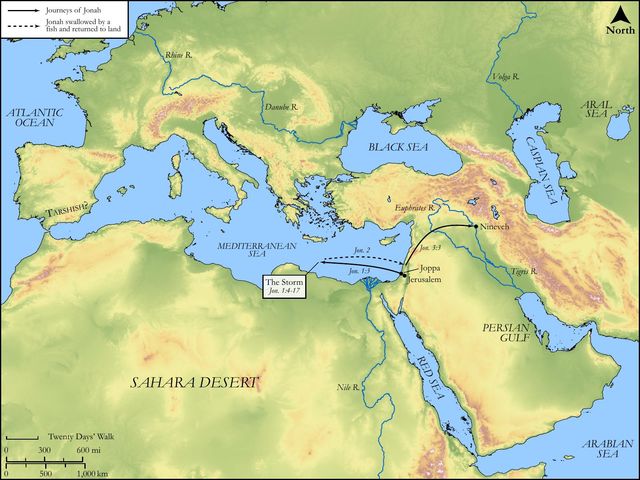
See on the biblical-era map
Study this verse
Public-domain commentary
Matthew Henry
From his Commentary on the Whole Bible. Henry comments on passages, not single verses — this entry covers Jonah 1:4–10. His three-level outline is real structure in the source text, so it is rendered as structure.
When Jonah was set on ship-board, and under sail for Tarshish, he thought himself safe enough; but here we find him pursued and overtaken, discovered and convicted as a deserter from God, as one that had run his colours.
I.God sends a pursuer after him, a mighty tempest in the sea, Jon 1:4.
God has the winds in his treasure (Psa 135:7), and out of these treasures God sent forth, he cast forth (so the word is), with force and violence, a great wind into the sea; even stormy winds fulfil his word, and are often the messengers of his wrath; he gathers the winds in his fist (Pro 30:4), where he holds them, and whence he squeezes them when he pleases; for though, as to us, the wind blows where it listeth, yet not as to God, but where he directs. The effect of this wind as a mighty tempest; for when the winds rise the waves rise. Note, Sin brings storms and tempests into the soul, into the family, into churches and nations; it is a disquieting disturbing thing. The tempest prevailed to such a degree that the ship was likely to be broken; the mariners expected no other; that ship (so some read it), that and no other. Other ships were upon the same sea at the same time, yet, it should seem, that ship in which Jonah was was tossed more than any other and was more in danger. This wind was sent after Jonah, to fetch him back again to God and to his duty; and it is a great mercy to be reclaimed and called home when we go astray, though it be by a tempest.
II.The ship's crew were alarmed by this mighty tempest, but Jonah only, the person concerned, was unconcerned, Jon 1:5.
The mariners were affected with their danger, though it was not with them that God has this controversy.
1.They were afraid; though, their business leading them to be very much conversant with dangers of this kind, they used to make light of them, yet now the oldest and stoutest of them began to tremble, being apprehensive that there was something more than ordinary in this tempest, so suddenly did it rise, so strongly did it rage. Note, God can strike a terror upon the most daring, and make even great men and chief captains call for shelter from rocks and mountains.
2.They cried every man unto his god; this was the effect of their fear. Many will not be brought to prayer till they are frightened to it; he that would learn to pray, let him go to sea. Lord, in trouble they have visited thee. Every man of them prayed; they were not some praying and others reviling, but every man engaged; as the danger was general, so was the address to heaven; there was not one praying for them all, but every one for himself. They cried every man to his god, the god of his country or city, or his own tutelar deity; it is a testimony against atheism that every man had a god, and had the belief of a God; but it is an instance of the folly of paganism that they had gods many, every man the god he had a fancy for, whereas there can be but one God, there needs to be no more. But, though they had lost that dictate of the light of nature that there is but one God, they still were governed by that direction of the law of nature that God is to be prayed to (Should not a people seek under their God? Isa 8:19), and that he is especially to be prayed to when we are in distress and danger. Call upon me in the time of trouble. Is any afflicted? Is any frightened? Let him pray.
3.Their prayers for deliverance were seconded with endeavours, and, having called upon their gods to help them, they did what they could to help themselves; for that is the rule, Help thyself and God will help thee. They cast forth the wares that were in the ship into the sea, to lighten it of them, as Paul's mariners in a like case cast forth even the tackling of the ship, and the wheat, Act 27:18, Act 27:19, Act 27:38. They were making a trading voyage, as it should seem, and were laden with many goods and much merchandise, by which they hoped to get gain; but now they are content to suffer loss by throwing them overboard. to save their lives. See how powerful the natural love of life is. Skin for skin, and all that a man has, will he give for it. And shall we not put a like value upon the spiritual life, the life of the soul, reckoning that the gain of all the world cannot countervail the loss of the soul? See the vanity of worldly wealth, and the uncertainty of its continuance with us. Riches make themselves wings and fly away; nay, and the case may be such that we may be under a necessity of making wings for them, and driving them away, as here, when they could not be kept for the owners thereof but to their hurt, so that they themselves are glad to be rid of them, and sink that which otherwise would sink them, though they have no prospect of ever recovering it. Oh that men would be thus wise for their souls, and would be willing to part with that wealth, pleasure, and honour which they cannot keep without making shipwreck of faith and a good conscience and ruining their souls for ever! Those that thus quit their temporal interests for the securing of their spiritual welfare will be unspeakable gainers at last; for what they lose upon those terms they shall find again to life eternal. But where is Jonah all this while? One would have expected gone down into his cabin, nay, into the hold, between the sides of the ship, and there he lies, and is fast asleep; neither the noise without, for the sense of guilt within, awoke him. Perhaps for some time before he had avoiding sleeping, for fear of God's speaking to him again in a dream; and now that he imagined himself out of the reach of that danger, he slept so much the more soundly. Note, Sin is of a stupifying nature, and we are concerned to take heed lest at any time our hearts be hardened by the deceitfulness of it. It is the policy of Satan, when by his temptations he has drawn men from God and their duty, to rock them asleep in carnal security, that they may not be sensible of their misery and danger. It concerns us all to watch therefore.
III.The master of the ship called Jonah up to his prayers, Jon 1:6.
The ship-master came to him, and bade him for shame get up, both to pray for life and to prepare for death; he gave him,
1.A just and necessary chiding: What meanest thou, O sleeper? Here we commend the ship-master, who gave him this reproof; for, though he was a stranger to him, he was, for the present, as one of his family; and whoever has a precious soul we must help, as we can, to save it from death. We pity Jonah, who needed this reproof; as a prophet of the Lord, if he had been in his place, he might have been reproving the king of Nineveh, but, being out of the way of his duty, he does himself lie open to the reproofs of a sorry ship-master. See how men by their sin and folly diminish themselves and make themselves mean. Yet we must admire God's goodness in sending him this seasonable reproof, for it was the first step towards his recovery, as the crowing of the cock was to Peter. Note, Those that sleep in a storm may well be asked what they mean.
2.A pertinent word of advice: "Arise, call upon thy God; we are here crying every man to his god, why dost not thou get up and cry to thine? Art not thou equally concerned with the rest both in the danger dreaded and in the deliverance desired?" Note, The devotions of others should quicken ours; and those who hope to share in a common mercy ought in all reason to contribute their quota towards the prayers and supplications that are made for it. In times of public distress, if we have any interest at the throne of grace, we ought to improve it for the public good. And the servants of God themselves have sometimes need to be called and stirred up to this part of their duty.
3.A good reason for this advice: If so be that God will think upon us, that we perish not. It should seem, the many gods they called upon were considered by them only as mediators between them and the supreme God, and intercessors for them with him; for the ship-master speaks of one God still, from whom he expected relief. To engage prayer, he suggested that the danger was very great and imminent: "We are all likely to perish; there is but a step between us and death, and that just ready to be stepped." Yet he suggested that there was some hope remaining that their destruction might be prevented and they might not perish. While there is still life there is hope, and while there is hope there is room for prayer. He suggested also that it was God only that could effect their deliverance, and it must come from his power and his pity. "If he think upon us, and act for us, we may yet be saved." And therefore to him we must look, and in him we must put our trust, when the danger is ever so imminent.
IV.Jonah is found out to be the cause of the storm.
1.The mariners observed so much peculiar and uncommon either in the storm itself or in their own distress by it that they concluded it was a messenger of divine justice sent to arrest some one of those that were in that ship, as having been guilty of some enormous crime, judging as the barbarous people (Act 28:4), "no doubt one of us is a murderer, or guilty of sacrilege, or perjury, or the like, who is thus pursued by the vengeance of the sea, and it is for his sake that we all suffer." Even the light of nature teaches that in extraordinary judgments the wrath of God is revealed from heaven against some extraordinary sins and sinners. Whatever evil is upon us at any time we must conclude there is a cause for it; there is evil done by us, or else this evil would not be upon us; there is a ground for God's controversy.
2.They determined to refer it to the lot which of them was the criminal that had occasioned this storm: Let us cast lots, that we may know for whose cause the evil is upon us. None of them suspected himself, or said, Is it I, Lord; is it I? But they suspected one another, and would find out the man. Note, It is a desirable thing, when any evil is upon us, to know for what cause it is upon us, that what is amiss may be amended, and, the grievance being redressed, the grief may be removed. In order to this we must look up to heaven, and pray, Lord, show me wherefore thou contendest with me; that which I see not teach thou me. These mariners desired to know the person that was the dead weight in their ship, the accursed thing, that that one man might die for the people and that the whole ship might not be lost; this was not only expedient, but highly just. In order to this they cast lots, by which they appealed to the judgment of God, to whom all hearts are open, and from whom no secret is hid, agreeing to acquiesce in his discovery and determination, and to take that for true which the lot spoke; for they knew by the light of nature, what the scripture tells us, that the lot is cast into the lap, but the whole disposal thereof is of the Lord. Even the heathen looked upon the casting of lots to be a sacred thing, to be done with seriousness and solemnity, and not to be made a sport of. It is a shame for Christians if they have not a like reverence for an appeal to Providence.
3.The lot fell upon Jonah, who could have saved them this trouble if he would but have told them what his own conscience told him, Thou are the man; but as is usual with criminals, he never confesses till he finds he cannot help it, till the lot falls upon him. We may suppose there were those in the ship who, upon other accounts, were greater sinners than Jonah, and yet he is the man that the tempest pursues and that the lot pitches upon; for it is his own child, his own servant, that the parent, that the master, corrects, if they do amiss; others that offend he leaves to the law. The storm is sent after Jonah, because God has work for him to do, and it is sent to fetch him back to it. Note, God has many ways of bringing to light concealed sins and sinners, and making manifest that folly which was thought to be hidden from the eyes of all living. God's right hand will find out all his servants that desert him, as well as all his enemies that have designs against him; yea, though they flee to the uttermost parts of the sea, or go down to the sides of the ship.
4.Jonah is hereupon brought under examination before the master and mariners. He was a stranger; none of them could say that they knew the prisoner, or had any thing to lay to his charge, and therefore they must extort a confession from him and judge him out of his own mouth; and for this there needed no rack, the shipwreck they were in danger of was sufficient to frighten him, so as to make him tell the truth. Though it was discovered by the lot that he was the person for whose sake they were thus damaged and exposed, yet they did not fly outrageously upon him, as one would fear they might have done, but calmly and mildly enquired into his case. There is a compassion due to offenders when they are discovered and convicted. They give him no hard words, but, "Tell us, we pray thee, what is the matter?" Two things they enquire of him: - (1.) Whether he would himself own that he was the person for whose sake the storm was sent, as the lot had intimated: "Tell us for whose cause this evil is upon us; is it indeed for thy cause, and, if so, for what cause? What is this offence for which thou art thus prosecuted?" Perhaps the gravity and decency of Jonah's aspect and behaviour made them suspect that the lot had missed its man, had missed its mark, and therefore they would not trust it, unless he would himself own his guilt; they therefore begged of him that he would satisfy them in this matter. Note, Those that would find out the cause of their troubles must not only begin, but pursue the enquiry, must descend to particulars and accomplish a diligent search. (2.) What his character was, both as to his calling and as to his country. [1.] They enquire concerning his calling: What is thy occupation? This was a proper question to be put to a vagrant. Perhaps they suspected his calling to be such as might bring this trouble upon them: "Art thou a diviner, a sorcerer, a student in the black art? Hast thou been conjuring for this wind? Or what business are thou now going on? It is like Balaam's, to curse any of God's people, and is this wind send to stop thee?" [2.] They enquire concerning his country. One asked, Whence comest thou? Another, not having patience to stay for an answer to that, asked, What is thy country? A third to the same purport, "Of what people art thou? Art thou of the Chaldeans," that were noted for divination, "or of the Arabians," that were noted for stealing? They wished to know of what country he was, that, knowing who was the god of his country, they might guess whether he was one that could do them any kindness in this storm.
5.In answer to these interrogatories Jonah makes a full discovery.
(1.)Did they enquire concerning his country? He tells them he is a Hebrew (Jon 1:9), not only of the nation of Israel, but of their religion, which they received from their fathers. He is a Hebrew, and therefore is the more ashamed to own that he is a criminal; for the sins of Hebrews, that make such a profession of religion and enjoy such privileges, are greater than the sins of others, and more exceedingly sinful.
(2.)Did they enquire concerning his calling - What is thy occupation? In answer to that he gives an account of his religion, for that was his calling, that was his occupation, that was it that he made a business of: "I fear the Lord Jehovah; that is the God I worship, the God I pray to, even the God of heaven, the sovereign Lord of all, that has made the sea and the dry land and has command of both." Not the god of one particular country, which they enquired after, and such as the gods were that they had been every man calling upon, but the God of the whole earth, who, having made both the sea and the dry land, makes what work he pleases in both and makes what use he pleases of both. This he mentions, not only as condemning himself for his folly, in fleeing from the presence of this God, but as designing to bring these mariners from the worship and service of their many gods to the knowledge and obedience of the one only living and true God. When we are among those that are strangers to us we should do what we can to bring them acquainted with God, by being ready upon all occasions to own our relation to him and our reverence for him.
(3.)Did they enquire concerning his crime, for which he is now persecuted? He owns that he fled from the presence of the Lord, that he was here running away from his duty, and the storm was sent to fetch him back. We have reason to think that he told them this with sorrow and shame, justifying God and condemning himself and intimating to the mariners what a great God Jehovah is, who could send such a messenger as this tempest was after a runagate servant.
6.We are told what impression this made upon the mariners: The men were exceedingly afraid, and justly, for they perceived,
(1.)That God was angry, even that God that made the sea and the dry land. This tempest comes from the hand of an offended justice, and therefore they have reason to fear it will go hard with them. Judgments inflicted for some particular sin have a peculiar weight and terror in them.
(2.)That God was angry with one that feared and worshipped him, only for once running from his work in particular instance; this made them afraid for themselves. "If a prophet of the Lord be thus severely punished for one offence, what will become of us that have been guilty of so many, and great, and heinous offences?" If the righteous be thus scarcely saved, and for a single act of disobedience thus closely pursued, where shall the ungodly and the sinner appear? Pe1 4:17, Pe1 4:18. They said to him, "Why hast thou done this? If thou fearest the God that made the sea and the dry land, why wast thou such a fool as to think thou couldst flee from his presence? What an absurd unaccountable thing is it!" Thus he was reproved, as Abraham by Abimelech (Gen 20:16); for if the professors of religion do a wrong thing they must expect to hear of it from those that make no such profession. "Why hast thou done this to us?" (so it may be taken) "Why has thou involved us in the prosecution?" Note, Those that commit a willful sin know not how far the mischievous consequences of it may reach, nor what mischief may be done by it.
Historical interpretation
Historical reception
1 surviving comment on this verse from the historical church.
"But the LORD sent out a great wind into the sea, and there was a mighty tempest in the sea, so that the ship was like to be broken." LXX: "and the Lord induced a great wind over the sea and a great storm was over the sea, and the boat threatened to break up." The flight of the prophet can be related to man in general, who, forsaking the commands of God, flees from his face and goes out into the world. But in consequence a storm of wickedness and the shipwreck of the entire world are sent against him, and he is made to pay attention to God and to return to that which he had fled. From this we can understand that what appears to be advantageous to mankind, turns into their downfall by God's will. And not only is their aid no use to those whom it is offered, but even those who offer it are destroyed. Therefore we read that the Assyrians conquered Egypt because she helped Israel against the will of the Lord [Is. 20:3-6]. The boat is in danger because it has taken on board a dangerous passenger. The waves are aroused by the wind, a storm begins over a calm sea. When God is opposed nothing is safe.
Continue studying Jonah 1:4 across the web’s major study libraries — every link below opens this exact verse, chapter, or book on the destination site.
Read & Compare
 BibleGatewayThis verse in more than 200 translations and 70 languages.
 Bible.comThe YouVersion reader — hundreds of translations, reading plans, and highlights.
 ESV.orgCrossway's official English Standard Version reader.
 NET BibleThe NET translation with 60,000+ translators' notes on every rendering decision.
 STEP BibleTyndale House's free study tool — original text, vocabulary, and scholarly resources.
 BibliaLogos Bible Software's free web reader.
 USCCBThe New American Bible (Revised Edition) with the U.S. bishops' study notes.
Commentaries
 BibleHub CommentariesDozens of classic commentaries on this verse, gathered on one page.
 StudyLightMore than 100 commentary sets — the largest collection on the web.
 BibleRefPlain-English commentary on what this verse means, verse by verse.
 Enduring WordDavid Guzik's free commentary on this chapter, widely used by Bible teachers.
 Bible Study ToolsVerse commentary alongside Greek and Hebrew study aids.
Original Language & Research
- BibleHub InterlinearThe verse word by word — original language, transliteration, and English.
- BibleHub LexiconEvery word's original-language definition and Strong's entry.
 Blue Letter BibleDeep-study tools — Strong's numbers, concordance, and word studies.
 SefariaThe Hebrew text with Rashi and centuries of Jewish commentary.
Sermons, Hymns & Audio


TrulyRandomVerse is not affiliated with these sites and doesn’t control their content. They’re linked because they’re genuinely useful.
Summary
Jonah 1:4 dramatically narrates God's direct and powerful intervention in response to Jonah's disobedience. As the prophet attempts to flee from the Lord's command to go to Nineveh, God actively "sends out" a colossal wind, unleashing an overwhelming tempest upon the sea. This divine act immediately threatens to shatter the ship carrying Jonah, initiating a series of events designed to redirect His wayward servant and underscore His inescapable sovereignty over all creation.
Context
ShowHideLiterary Context
This verse marks a critical turning point in the book of Jonah, immediately following Jonah's deliberate act of rebellion. Jonah 1:1-2 establishes God's clear call to Jonah to preach in Nineveh, a city hostile to Israel. Instead of obeying, Jonah 1:3 describes Jonah's flight to Tarshish, explicitly stated as an attempt to "flee from the presence of the LORD." Jonah 1:4 is God's swift and direct response to this disobedience, demonstrating that His will cannot be evaded. It sets the stage for the dramatic confrontation between God's power and Jonah's rebellion, leading directly into the sailors' desperate actions and Jonah's eventual encounter with the great fish in Jonah 1:5-17.
Historical & Cultural Context
The setting is the Mediterranean Sea, a vital trade route in Jonah's day. Seafaring was perilous, and sailors, often polytheistic, were acutely aware of the power of the elements and attributed storms to the wrath of various deities. For the Israelite prophet Jonah, fleeing to Tarshish (likely in modern-day Spain) meant traveling to the known edge of the world, symbolically putting as much distance as possible between himself and Yahweh's perceived sphere of influence. This act of God sending a specific storm would have been understood by ancient audiences not as a random weather event, but as a direct, purposeful act of a deity, challenging both Jonah's perception of God's limits and the pagan sailors' understanding of their own gods. The narrative subtly contrasts the pagan sailors' desperate prayers to their own gods with the singular, overwhelming power of Yahweh.
Key Themes
ShowHideJonah 1:4 powerfully contributes to several overarching themes in the book. Firstly, it highlights Divine Sovereignty, emphasizing that God is not confined by geographical boundaries or human will; He actively governs all creation, including the natural elements, to accomplish His purposes. This resonates with themes found in Psalm 139:7-12 and Amos 9:2-3. Secondly, it underscores the Consequences of Disobedience, demonstrating that rebellion against God's command has immediate and severe repercussions, not only for the disobedient individual but also, tragically, for innocent bystanders. Finally, the verse introduces the theme of God's Relentless Pursuit and Corrective Love. The storm is not merely punitive but redemptive, serving as God's instrument to bring Jonah back to obedience and fulfill His divine mission, a concept echoed in Hebrews 12:6-11.
Exposition and Analysis
ShowHideKey Word Analysis
ShowHideThis is the covenant name of God, Yahweh (H3068), emphasizing His self-existent, eternal, and personal nature. The use of this specific name here is crucial, signifying that the storm is not a random act of nature or a generic divine intervention, but a direct, intentional act by the sovereign God of Israel, the one with whom Jonah has a covenant relationship and from whom he is attempting to flee. It highlights God's personal involvement in Jonah's life and His unwavering commitment to His purposes.
The Hebrew verb (H2904) means "to pitch over or reel," and transitively, "to cast down or out," or "to hurl." This word conveys a sense of deliberate, forceful action. God doesn't merely allow a storm to happen; He actively and powerfully "hurls" or "casts" the wind into the sea. This emphasizes the direct, intentional, and overwhelming nature of God's intervention, making it clear that the storm is a divinely orchestrated event, not a natural coincidence.
This word (H5591) denotes a "hurricane" or "whirlwind." Coupled with the adjective "mighty" (H1419, gâdôwl), it describes a storm of immense power and destructive force. The choice of this strong term, rather than a milder word for wind or storm, underscores the severity and life-threatening nature of the divine judgment unleashed upon the ship, vividly portraying the immediate danger faced by Jonah and the sailors.
Verse Breakdown
ShowHide"But the LORD sent out a great wind into the sea"
This opening clause immediately establishes the divine agency behind the unfolding crisis. The conjunction "But" signals a direct counter-action to Jonah's flight. The "LORD" (Yahweh) is the subject, demonstrating His absolute sovereignty. The verb "sent out" (H2904, ṭûwl) conveys a forceful, deliberate act of "hurling" or "casting," indicating that this was no natural occurrence but a direct, intentional dispatch of a "great wind" (H1419, gâdôwl, H7307, rûwach) into the very environment Jonah chose for his escape.
"and there was a mighty tempest in the sea"
This clause describes the immediate and overwhelming effect of God's action. The "great wind" rapidly escalates into a "mighty tempest" (H1419, gâdôwl, H5591, çaʻar), a hurricane-force storm. The repetition of "great" (H1419) emphasizes the extraordinary and terrifying power of the storm, making it clear that this was an unprecedented and divinely orchestrated event that far exceeded normal maritime hazards. The sea, Jonah's chosen escape route, now becomes the instrument of his divine confrontation.
"so that the ship was like to be broken"
This final clause vividly portrays the dire consequences of the tempest. The ship (H591, ʼŏnîyâh), the very vessel of Jonah's rebellion, is on the verge of destruction. The phrase "like to be broken" (H2803, châshab, "reckoned," "thought," "devised"; H7665, shâbar, "to burst," "break") indicates that the ship was not merely damaged but was literally on the verge of shattering into pieces. This highlights the extreme peril faced by everyone on board and underscores the severity of God's judgment and His determination to halt Jonah's flight.
Literary Devices
ShowHideJonah 1:4 is rich with literary devices that amplify its theological message. Anthropomorphism is evident in the depiction of God "sending out" or "hurling" the wind, attributing human-like action to the divine to convey His active and personal involvement in creation. The use of Hyperbole is clear in the descriptions "great wind" and "mighty tempest," and the ship being "like to be broken," emphasizing the extraordinary and overwhelming nature of the storm, far beyond ordinary weather. This exaggeration serves to underscore the divine power at work. There is also a strong sense of Irony in Jonah's attempt to flee God by sea, only to find God's power manifest most terrifyingly in that very element. The storm itself acts as a form of Divine Retribution, directly responding to Jonah's disobedience. Furthermore, the verse employs Foreshadowing, hinting at the greater display of God's power over the sea and its creatures that will soon follow, specifically the "great fish" that swallows Jonah, demonstrating God's complete mastery over all creation.
Theological and Thematic Connections
ShowHideJonah 1:4 profoundly illustrates the active and inescapable sovereignty of God over all creation, particularly over the natural elements. It reveals that God is not a distant deity but one who intimately interacts with His world and His people, even to the point of orchestrating natural phenomena to achieve His divine will. This storm is a powerful demonstration that no one can truly flee from the omnipresent God, and that His purposes will ultimately prevail. It underscores that God's corrective actions, though sometimes severe, are often rooted in a desire for His servants to return to obedience and fulfill their calling, ultimately for His glory and their good. The immediate and dramatic consequence of Jonah's disobedience also highlights the ripple effect of sin, showing how one person's rebellion can bring peril and suffering to others.
Reflection and Application
ShowHideJonah 1:4 serves as a stark and powerful reminder that we cannot outrun God's call or escape His presence. Like Jonah, we may attempt to flee from uncomfortable truths, challenging assignments, or the path God has set for us, seeking refuge in what we perceive as safe distances or alternative destinations. However, this verse teaches us that God is sovereign over every aspect of our lives and the world around us. When we resist His will, He may intervene, sometimes through difficult or disruptive circumstances, to redirect our course. This intervention is not punitive in a vengeful sense, but rather a loving, corrective act designed to bring us back into alignment with His perfect plan. It prompts us to honestly examine our own lives: Are there areas where we are actively resisting God's leading? Are we causing unintended harm to others through our disobedience? Ultimately, God's pursuit, even through a "mighty tempest," is an invitation to surrender, trust, and return to the path of obedience, knowing that His ultimate desire is our restoration and flourishing within His divine purpose.
Questions for Reflection
ShowHideFAQ
ShowHideWas the storm in Jonah 1:4 a natural phenomenon or a miraculous event?
ShowHideWhile storms are natural occurrences, the biblical text strongly indicates that this particular "great wind" and "mighty tempest" were a direct, miraculous intervention by God. The phrase "the LORD sent out" (H2904, ṭûwl, meaning "to hurl" or "cast") emphasizes divine agency and purpose. It was not a random weather event but a divinely orchestrated act, specifically designed to confront Jonah's disobedience and halt his flight. This is further underscored by the immediate and extreme severity of the storm, which threatened to break the ship, and by the subsequent actions of the pagan sailors who recognized a supernatural force at work, as described in Jonah 1:7-10.
Why did God allow innocent sailors to suffer because of Jonah's disobedience?
ShowHideThis question highlights a common theological dilemma regarding the consequences of sin. While God directly intervened to address Jonah's rebellion, the suffering of the innocent sailors underscores the pervasive and far-reaching impact of sin. Disobedience often has ripple effects that extend beyond the individual, affecting families, communities, and even those who are seemingly unconnected. The narrative uses the sailors' plight to heighten the drama and demonstrate the seriousness of Jonah's sin, but it also showcases God's compassion, as He eventually delivers them after Jonah is cast overboard (Jonah 1:15-16). Furthermore, the sailors' experience ultimately leads them to fear the Lord and offer sacrifices, suggesting that God can use even difficult circumstances to draw people to Himself (Jonah 1:16).
Christ-Centered Fulfillment
ShowHideJonah 1:4, with its vivid portrayal of God's absolute sovereignty over creation, powerfully foreshadows the authority of Jesus Christ. Just as the LORD "sent out" a great wind to control the sea, Jesus, the Son of God, demonstrated His divine power by rebuking the wind and calming a furious storm with a mere command, causing His disciples to marvel, "Who then is this, that even the wind and the sea obey him?" (Mark 4:39-41). This parallel reveals that the same divine authority that orchestrated the tempest against Jonah resides fully in Christ. Furthermore, God's relentless pursuit of Jonah, even through a life-threatening storm, points to the greater pursuit of humanity by God through Christ. While Jonah fled from his mission, Jesus willingly embraced His mission to seek and save the lost (Luke 19:10), even enduring the "tempest" of God's wrath on the cross for our sake. The "sign of Jonah"—his three days and three nights in the belly of the great fish—is explicitly linked by Jesus to His own death and resurrection, identifying Himself as "something greater than Jonah" (Matthew 12:40-41). Thus, the storm in Jonah 1:4 is not merely an act of judgment but a testament to God's unwavering control, a control ultimately manifested and perfectly exercised in the person and work of Jesus Christ, who reigns supreme over all creation and all human rebellion.