


Matthew 8:24
Bible text: King James Version (1769 Blayney text) · Public domain
Bible text: King James Version with Strong's numbers · Public domain
Bible text: Berean Standard Bible · Public domain
Bible text: American Standard Version (1901) · Public domain
Bible text: World English Bible, Messianic edition · Public domain
Bible text: Geneva Bible (1599) · Public domain
Bible text: Young's Literal Translation · Public domain
- καὶkaiAndG2532CONJConjunction
- ἰδοὺidoubeholdG2400INJInterjection
- σεισμὸςseismosa stormG4578N-NSMNoun Nominative Singular Masculine
- μέγαςmegasgreatG3173A-NSMAdjective Nominative Singular Masculine
- ἐγένετοegenetoaroseG1096V-2ADI-3SVerb 2nd Aorist Middle Deponent Indicative 3rd Singular
- ἐνeninG1722PREPPreposition
- τῇtēatheG3588T-DSFDefinite article Dative Singular Feminine
- θαλάσσῃthalassēseaG2281N-DSFNoun Dative Singular Feminine
- ὥστεhōsteso thatG5620CONJConjunction
- τὸtotheG3588T-ASNDefinite article Accusative Singular Neuter
- πλοῖονploionboatG4143N-ASNNoun Accusative Singular Neuter
- καλύπτεσθαιkaluptesthaibeing swampedG2572V-PPNVerb Present Passive Infinitive
- ὑπὸhupobyG5259PREPPreposition
- τῶνtōntheG3588T-GPNDefinite article Genitive Plural Neuter
- κυμάτων·kumatōnwavesG2949N-GPNNoun Genitive Plural Neuter
- αὐτὸςautosHe HimselfG846P-NSMPersonal pronoun Nominative Singular Masculine
- δὲdehoweverG1161CONJConjunction
- ἐκάθευδενekatheudenwas sleepingG2518V-IAI-3SVerb Imperfect Active Indicative 3rd Singular
English is a literal word-by-word gloss of the Greek, not the KJV's wording. Why?
This is the original text the KJV's translators worked from — each Greek word with its own literal English meaning in this verse, prepared by scholars at Tyndale House, Cambridge. The KJV translates whole sentences, not word by word, so its wording differs: one Greek word can become several English words, and the KJV may choose “charity” where the gloss reads “love”. Both are faithful — they answer different questions. For the KJV's own rendering, switch to the KJV text.
Details
See on the biblical-era maps
Study this verse
Public-domain commentary
Matthew Henry
From his Commentary on the Whole Bible. Henry comments on passages, not single verses — this entry covers Matthew 8:23–27. His three-level outline is real structure in the source text, so it is rendered as structure.
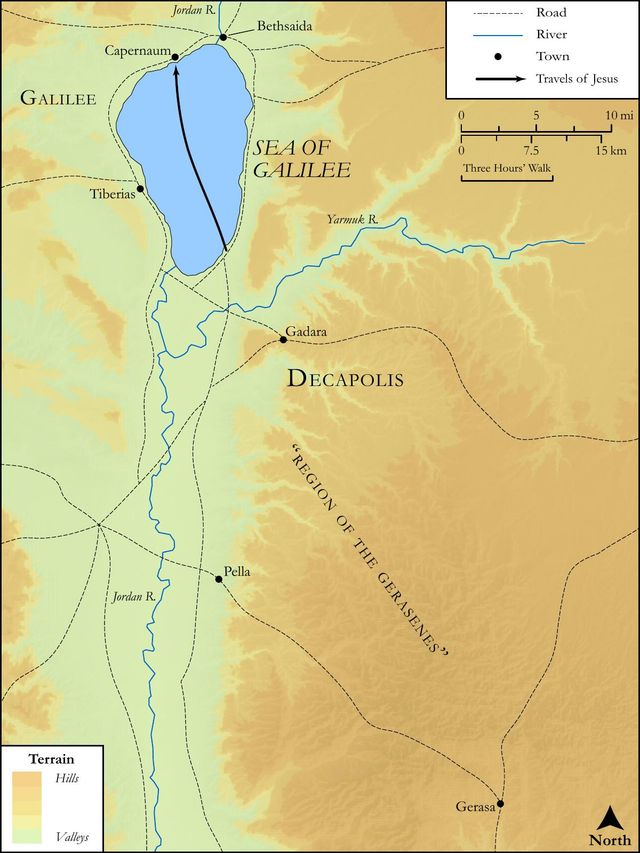
Christ had given sailing orders to his disciples (Mat 8:18), that they should depart to the other side of the sea of Tiberias, into the country of Gadara, in the tribe of Gad, which lay east of Jordan; thither he would go to rescue a poor creature that was possessed with a legion of devils, though he foresaw how he should be affronted there. Now. 1. He chose to go by water. It had not been much about, if he had gone by land; but he chose to cross the lake, that he might have occasion to manifest himself the God of the sea as well as of the dry land, and to show that all power is his, both in heaven and in earth. It is a comfort to those who go down to the sea in ships, and are often in perils there, to reflect that they have a Saviour to trust in, and pray to, who knows what it is to be at sea, and to be in storms there. But observe, when he went to sea, he had no yacht or pleasure-boat to attend him, but made use of his disciples' fishing-boats; so poorly was he accommodated in all respects. 2. His disciples followed him; the twelve kept close to him, when others staid behind upon the terra firma, where there was sure footing. Note, They, and they only, will be found the true disciples of Christ, that are willing to go to sea with him, to follow him into dangers and difficulties. Many would be content to go the land-way to heaven, that will rather stand still, or go back, than venture upon a dangerous sea; but those that would rest with Christ hereafter must follow him now wherever he leads them, into a ship or into a prison, as well as into a palace. Now observe here,
I.The peril and perplexity of the disciples in this voyage; and in this appeared the truth of what Christ had just now said, that those who follow him must count upon difficulties, Mat 8:20.
1.There arose a very great storm, Mat 8:24. Christ could have prevented this storm, and have ordered them a pleasant passage, but that would not have been so much for his glory and the confirmation of their faith as their deliverance was: this storm was for their sakes, as Joh 11:4. One would have expected, that having Christ with them, they should have had a very favourable gale, but it is quite otherwise; for Christ would show that they who are passing with him over the ocean of this world to the other side, must expect storms by the way. The church is tossed with tempests (Isa 54:11); it is only the upper region that enjoys a perpetual calm, this lower one is ever and anon disturbed and disturbing.
2.Jesus Christ was asleep in this storm. We never read of Christ's sleeping but at this time; he was in watchings often, and continued all night in prayer to God: this was a sleep, not of security, like Jonah's in a storm, but of holy serenity, and dependence upon his Father: he slept to show that he was really and truly man, and subject to the sinless infirmities of our nature: his work made him weary and sleepy, and he had no guilt, no fear within, to disturb his repose. Those that can lay their heads upon the pillow of a clear conscience, may sleep quietly and sweetly in a storm (Psa 4:8), as Peter, Act 12:6. He slept at this time, to try the faith of his disciples, whether they could trust him when he seemed to slight them. He slept not so much with a desire to be refreshed, as with a design to be awaked.
3.The poor disciples, though used to the sea, were in a great fright, and in their fear came to their Master, Mat 8:25. Whither else should they go? It was well they had him so near them. They awoke him with their prayers; Lord, save us, we perish. Note, They who would learn to pray must go to sea. Imminent and sensible dangers will drive people to him who alone can help in time of need. Their prayer has life in it, Lord, save us, we perish.
(1.)Their petition is, Lord, save us. They believed he could save them; they begged he would, Christ's errand into the world was to save, but those only shall be saved that call on the name of the Lord, Act 2:21. They who by faith are interested in the eternal salvation wrought out by Christ, may with a humble confidence apply themselves to him for temporal deliverances. Observe, They call him, Lord, and then pray, Save us. Note, Christ will save none but those that are willing to take him for their Lord; for he is a Prince and a Saviour.
(2.)Their plea is, We perish; which was, [1.] The language of their fear; they looked upon their case as desperate, and gave up all for lost; they had received a sentence of death within themselves, and this they plead, "We perish, if thou dost not save us; look upon us therefore with pity." [2.] It was the language of their fervency; they pray as men in earnest, that beg for their lives; it becomes us thus to strive and wrestle in prayer; therefore Christ slept, that he might draw out this importunity.
II.The power and grace of Jesus Christ put forth for their succour:
then the Lord Jesus awaked, as one refreshed, Psa 78:65. Christ may sleep when his church is in a storm, but he will not outsleep himself: the time, the set time to favour his distressed church, will come, Psa 102:13.
1.He rebuked the disciples (Mat 8:26); Why are ye fearful, O ye of little faith? He does not chide them for disturbing him with their prayers, but for disturbing themselves with their fears. Christ reproved them first, and then delivered them; this is his method, to prepare us for a mercy, and then to give it us. Observe, (1.) His dislike of their fears; "Why are ye fearful? Ye, my disciples? Let the sinners in Zion be afraid, let heathen mariners tremble in a storm, but you shall not be so. Enquire into the reasons of your fear, and weigh them." (2.) His discovery of the cause and spring of their fears; O ye of little faith. Many that have true faith are weak in it, and it does but little. Note, [1.] Christ's disciples are apt to be disquieted with fears in a stormy day, to torment themselves with jealousies that things are bad with them, and dismal conclusions that they will be worse. [2.] The prevalence of our inordinate fears in a stormy day is owing to the weakness of our faith, which would be as an anchor to the soul, and would ply the oar of prayer. By faith we might see through the storm to the quiet shore, and encourage ourselves with hope that we shall weather our point. [3.] The fearfulness of Christ's disciples in a storm, and their unbelief, the cause of it, are very displeasing to the Lord Jesus, for they reflect dishonour upon him, and create disturbance to themselves.
2.He rebukes the wind; the former he did as the God of grace, and the Sovereign of the heart, who can do what he pleases in us; this he did as the God of nature, the Sovereign of the world, who can do what he pleases for us. It is the same power that stills the noise of the sea, and the tumult of fear, Psa 65:7. See,
(1.)How easily this was done, with a word's speaking. Moses commanded the waters with a rod; Joshua, with the ark of the covenant; Elisha, with the prophet's mantle; but Christ with a word. See his absolute dominion over all the creatures, which bespeaks both his honour, and the happiness of those that have him on their side.
(2.)How effectually it was done? There was a great calm, all of a sudden. Ordinarily, after a storm, there is such a fret of the waters, that it is a good while ere they can settle; but if Christ speak the word, not only the storm ceases, but all the effects of it, all the remains of it. Great storms of doubt, and fear in the soul, under the power of the spirit of bondage, sometimes end in a wonderful calm, created and spoken by the Spirit of adoption.
3.This excited their astonishment (Mat 8:27); The men marvelled. They had been long acquainted with the sea, and never saw a storm so immediately turned into a perfect calm, in all their lives. It has all the marks and signatures of a miracle upon it; it is the Lord's doing, and is marvellous in their eyes. Observe,
(1.)Their admiration of Christ; What manner of man is this! Note, Christ is a Nonsuch; every thing in him is admirable: none so wise, so mighty, so amiable, as he.
(2.)The reason of it; Even the winds and the sea obey him. Upon this account, Christ is to be admired, that he has a commanding power even over winds and seas. Others pretended to cure diseases, but he only undertook to command the winds. We know not the way of the wind (Joh 3:8), much less can we control it; but he that bringeth forth the wind out of his treasury (Psa 135:7), when it is out, gathers it into his fists, Pro 30:4. He that can do this, can do any thing, can do enough to encourage our confidence and comfort in him, in the most stormy day, within or without, Isa 26:4. The Lord sits upon the floods, and is mightier than the noise of many waters. Christ, by commanding the seas, showed himself to be the same that made the world, when, at his rebuke, the waters fled (Psa 104:7, Psa 104:8), as now, at his rebuke, they fell.
Historical interpretation
Eleven Centuries of Reception
14 surviving comments on this verse. Each one is dated, so this reads as a timeline rather than a list.
Select a marker to jump to its quote. Markers stagger vertically where authors wrote within a few decades of each other.
(ubi sup.) Therefore, having entered into the boat He caused the sea to rise; And, lo, there arose a great tempest in the sea, so that the boat was covered by the waves. This tempest did not arise of itself, but in obedience to the power of Him Who gave commandment, who brings the winds out of his treasures. (Jer. 10:13.) There arose a great tempest, that a great work might be wrought; because by how much the more the waves rushed into the boat, so much the more were the disciples troubled, and sought to be delivered by the wonderful power of the Saviour.
Others make the suggestion (forced enough, clearly "that the apostles then served the turn of baptism when in their little ship, were sprinkled and covered with the waves: that Peter himself also was immersed enough when he walked on the sea." It is, however, as I think, one thing to be sprinkled or intercepted by the violence of the sea; another thing to be baptized in obedience to the discipline of religion.
Or; He sleeps, because by our sloth He is cast asleep in us. This is done that we may hope aid from God in fear of danger; and that hope though late may be confident that it shall escape danger by the might of Christ watching within.
And while Matthew merely mentioned that "He was asleep," Luke saith that it was "on a pillow;" signifying both His freedom from pride, and to teach us hereby a high degree of austerity.
The tempest therefore being thoroughly excited, and the sea raging, "They awake Him, saying, Lord, save us: we perish." But He rebuked them before He rebuked the sea. Because as I said, for discipline these things were permitted, and they were a type of the temptations that were to overtake them. Yea, for after these things again, He often suffered them to fall into more grievous tempests of fortune, and bare long with them. Wherefore Paul also said, "I would not, brethren, have you ignorant, that we were pressed out of measure beyond strength, insomuch that we despaired even of life;" and after this again, "Who delivered us from so great deaths." Signifying therefore hereby, that they ought to be confident, though the waves rise high, and that He orders all things for good, He first of all reproves them. For indeed their very alarm was a profitable occurrence, that the miracle might appear greater, and their remembrance of the event be rendered lasting. Since when anything strange is about to happen, there are prepared beforehand many things to cause remembrance, lest after the miracle hath passed by, men should sink into forgetfulness.
Thus Moses also first is in fear of the serpent, and not merely in fear, but even with much distress: and then he sees that strange thing come to pass. So these too, having first looked to perish, were then saved, that having confessed the danger, they might learn the greatness of the miracle.
Therefore also He sleeps: for had He been awake when it happened, either they would not have feared, or they would not have besought Him, or they would not so much as have thought of His being able to do any such thing. Therefore He sleeps, to give occasion for their timidity, and to make their perception of what was happening more distinct. For a man looks not with the same eyes on what happens in the persons of others, as in his own. Therefore since they had seen all benefitted, while themselves had enjoyed no benefit, and were supine (for neither were they lame, nor had they any other such infirmity); and it was meet they should enjoy His benefits by their own perception: He permits the storm, that by their deliverance they might attain to a clearer perception of the benefit.
Therefore neither doth He this in the presence of the multitudes, that they might not be condemned for little faith, but He has them apart, and corrects them, and before the tempest of the waters He puts an end to the tempests of their soul, rebuking them, and saying, "Why are ye fearful, O ye of little faith:" instructing them also, that men's fear is wrought not by the approach of the temptations, but by the weakness of their mind.
But should any one say, that it was not fearfulness, or little faith, to come near and awaken Him; I would say this, that that very thing was an especial sign of their wanting the right opinion concerning Him. That is, His power to rebuke when awakened they knew, but that He could do so even sleeping, they knew not as yet.
(Hom. xxviii.) He took His disciples with Him, and in a boat, that they might learn two lessons; first, not to be confounded in dangers, secondly, to think lowly of themselves in honour. That they should not think great things of themselves because He kept them while He sent the rest away, He suffers them to be tossed by the waves. Where miracles were to be shown, He suffers the people to be present; where temptations and fears were to be stilled, there He takes with Him only the victors of the world, whom He would prepare for strife.
They had seen others made partakers of Christ's mercies, but forasmuch as no man has so strong a sense of those things that are done in the person of another as of what is done to himself, it behoved that in their own bodies they should feel Christ's mercies. Therefore He willed that this tempest should arise, that in their deliverance they might have a more lively sense of His goodness. This tossing of the sea was a type of their future trials of which Paul speaks, I would not have you ignorant, brethren, how that we were troubled beyond our strength. (2 Cor. 1:8.) But that there might be time for their fear to arise, it follows, But he was asleep. For if the storm had arisen while He was awake, they would either not have feared, or not have prayed Him, or would not have believed that He had the power to still it.
If any should say, that this was a sign of no small faith to go and rouse Jesus; it is rather a sign that they had not a right opinion concerning Him. They knew that when wakened He could rebuke the waves, but they did not yet know that He could do it while sleeping. For this cause He did not do this wonder in the presence of the multitudes, that they should not be charged with their little faith; but He takes His disciples apart to correct them, and first stills the raging of the waters. Then he arose, and rebuked the winds and the sea, and there was a great calm.
Observe also that the storm is stilled at once entirely, and no trace of disturbance appears; which is beyond nature; for when a storm ceases in the course of nature, yet the water is wont to be agitated for some time longer, but here all is tranquillity at once. Thus what is said of the Father, He spake, and the storm of wind ceased, (Ps. 107:25.) this Christ fulfilled in deed; for by His word and bidding only He stayed and checked the waters. For from His appearance, from His sleeping, and His using a boat, they that were present supposed Him a man only, and on this account they fell into admiration of Him; And the men marvelled, saying, What manner of man is this, for the winds and the sea obey him?
The multitudes then He sent on, but the disciples He took with Himself: for the others mention this too. And He took them with Him, not for nought, nor at hazard, but in order to make them spectators of the miracle that was to take place. For like a most excellent trainer, He was anointing them with a view to both objects; as well to be undismayed in dangers, as to be modest in honors. Thus, that they might not be high minded, because having sent away the rest, He retained them, He suffers them to be tossed with the tempest; at once correcting this, and disciplining them to bear trials nobly.
For great indeed were the former miracles too, but this contained also in it a kind of discipline, and that no inconsiderable one, and was a sign akin to that of old. For this cause He takes the disciples only with Himself. For as, when there was a display of miracles, He suffers the people also to be present; so when trial and terrors were rising up against Him, then He takes with Him none but the champions of the whole world, whom He was to disciple.
"They marvelled, saying, What manner of man is this, that even the sea and the winds obey Him?"
But Christ chode not with them for calling Him a man, but waited to teach them by His signs, that their supposition was mistaken. But from what did they think Him a man? First from His appearance, then from His sleeping, and His making use of a ship. So on this account they were cast into perplexity, saying, "What manner of man is this?" since while the sleep and the outward appearance showed man, the sea and the calm declared Him God.
For because Moses had once done some such thing, in this regard also doth He signify His own superiority, and that the one works miracles as a slave, the other as Lord. Thus, He put forth no rod, as Moses did, neither did He stretch forth His hands to Heaven, nor did He need any prayer, but, as was meet for a master commanding His handmaid, or a creator His creature, so did He quiet and curb it by word and command only; and all the surge was straightway at an end, and not one trace of the disturbance remained. For this the evangelist declared saying, "And there was a great calm." And that which had been spoken of the Father as a great thing, this He showed forth again by His works. And what had been said concerning Him? "He spake," it saith, "and the stormy wind ceased." So here likewise, He spake, and "there was a great calm." And for this most of all did the multitudes marvel at him; who would not have marvelled, had He done it in such manner as did Moses.
(Verse 24, 25.) But He was sleeping. And they came to Him and woke Him, saying, 'Lord, save us, we are perishing!' And Jesus said to them, 'Why are you afraid, you of little faith?' We read the foreshadowing of this sign in Jonah (Jonah 1), when, as the others were in danger, he was secure, and slept, and was awakened; and by the power and mystery of his passion, he saved those who woke him.
Of this miracle we have a type in Jonah, who while all are in danger is himself unconcerned, sleeps, and is awakened.
From this passage we understand, that all creation is conscious of its Creator; for what may be rebuked and commanded is conscious of the mind commanding. I do not mean as some heretics hold, that the whole creation is animatec—but by the power of the Maker things which to us have no consciousness have to Him.
But if any shall contend that it was the disciples who wondered, we shall answer they are rightly spoken of as 'the men,' seeing they had not yet learnt the power of the Saviour.
The sea offered its heaving back for Christ to walk upon. Now it leveled its crests to a plain, checked its swelling and bound up its billows. It provided rocklike firmness, so he could walk across the waterway. Why did the seas heave so, and toss and pitch, even as if threatening its Creator? And why did Christ himself, who knows all the future, seem so unaware of the present that he gave no thought to the onrushing storm, the moment of its height and the time of its peril? While all the rest were awake, he alone was fast asleep even with utter doom threatening both himself and his dear ones. Why? It is not a calm sky, beloved, but the storm which tests a pilot’s skill. When the breeze is mild even the poorest sailor can manage the ship. But in the crosswinds of a tempest, we want the best pilot with all his skill.
(in loc.) Or; The boat is the present Church, in which Christ passes over the sea of this world with His own, and stills the waves of persecution. Wherefore we may wonder, and give thanks.
Otherwise; The sea is the turmoil of the world; the boat in which Christ is embarked is to be understood the tree of the cross, by the aid of which the faithful having passed the waves of the world, arrive in their heavenly country, as on a safe shore, whither Christ goes with His own; whence He says below, He that will come after me, let him deny himself, and take up his cross, and follow me. (Mat. 16:24.) When then Christ was fixed on the cross, a great commotion was raised, the minds of His disciples being troubled at His passion, and the boat was covered by the waves. For the whole strength of persecution was around the cross of Christ, on which He died; as it is here, But he was asleep. His sleep is death. The disciples awaken the Lord, when troubled at His death; they seek His resurrection with earnest prayers, saying, Save us, by rising again; we perish, by our trouble at Thy death. He rises again, and rebukes the hardness of their hearts, as we read in other places. He commands the winds, in that He overthrew the power of the Devil; He commanded the sea, in that He disappointed the malice of the Jews; and there was a great calm, because the minds of the disciples were calmed when they beheld His resurrection.
. He took only His disciples, so that they could see the miracle. He allows them to be tossed by the waves so as to train them to endure trials and temptations, and also so that their faith would be even greater as a result of the miracle. Jesus slept so that when they had become terrified they would recognize their own weakness and call upon Him. Accordingly the evangelist says:
(non occ.) Chrysostom explains thus, What manner of man is this? His sleeping and His appearance showed the man; the sea and the calm pointed out the God.
Continue studying Matthew 8:24 across the web’s major study libraries — every link below opens this exact verse, chapter, or book on the destination site.
Read & Compare
 BibleGatewayThis verse in more than 200 translations and 70 languages.
 Bible.comThe YouVersion reader — hundreds of translations, reading plans, and highlights.
 ESV.orgCrossway's official English Standard Version reader.
 NET BibleThe NET translation with 60,000+ translators' notes on every rendering decision.
 STEP BibleTyndale House's free study tool — original text, vocabulary, and scholarly resources.
 BibliaLogos Bible Software's free web reader.
 USCCBThe New American Bible (Revised Edition) with the U.S. bishops' study notes.
Commentaries
 BibleHub CommentariesDozens of classic commentaries on this verse, gathered on one page.
 StudyLightMore than 100 commentary sets — the largest collection on the web.
 BibleRefPlain-English commentary on what this verse means, verse by verse.
 Enduring WordDavid Guzik's free commentary on this chapter, widely used by Bible teachers.
 Bible Study ToolsVerse commentary alongside Greek and Hebrew study aids.
Original Language & Research
- BibleHub InterlinearThe verse word by word — original language, transliteration, and English.
- BibleHub LexiconEvery word's original-language definition and Strong's entry.
 Blue Letter BibleDeep-study tools — Strong's numbers, concordance, and word studies.
 CNTR CollationThe earliest Greek manuscripts of this verse, collated letter by letter.
Sermons, Hymns & Audio


TrulyRandomVerse is not affiliated with these sites and doesn’t control their content. They’re linked because they’re genuinely useful.
Summary
Matthew 8:24 vividly portrays a sudden and violent tempest on the Sea of Galilee, threatening to engulf the boat carrying Jesus and His disciples. This dramatic scene highlights the stark contrast between the raging natural elements and the profound serenity of Jesus, who remained deeply asleep amidst the chaos, setting the stage for a powerful demonstration of His divine authority over creation and His disciples' burgeoning faith.
Context
ShowHideLiterary Context
This pericope (Matthew 8:23-27) immediately follows a series of compelling demonstrations of Jesus' authority over sickness and demonic forces (Matthew 8:1-22). Having just healed a leper, the centurion's servant, Peter's mother-in-law, and many others, Jesus now transitions from displaying power over physical ailments and spiritual oppression to demonstrating His sovereignty over the natural world. This narrative serves as a climactic capstone to the preceding miracles, illustrating the comprehensive scope of His divine power and preparing the disciples for further revelations of His identity. The preceding verses also include two individuals expressing a desire to follow Jesus, prompting His warnings about the cost of discipleship, which this storm narrative then powerfully illustrates in a practical, experiential way.
Historical & Cultural Context
The Sea of Galilee, a freshwater lake approximately 13 miles long and 8 miles wide, is situated in a deep basin surrounded by hills. This unique geographical configuration makes it highly susceptible to sudden, violent squalls. Cold air descending from the surrounding hills can rapidly collide with the warmer air over the lake, creating intense downdrafts and turbulent conditions without much warning. Fishing was a primary industry on the lake, and many of Jesus' disciples were experienced fishermen, making their fear in this "great tempest" particularly significant. This historical reality underscores the severity of the storm, suggesting it was far beyond a typical squall, thus amplifying the miraculous nature of Jesus' subsequent calming of the sea.
Key Themes
ShowHideThis incident contributes significantly to several overarching themes within Matthew's Gospel. Firstly, it powerfully underscores Jesus' absolute authority not only over disease and demons but also over the very forces of nature, aligning with the broader theme of Him being the promised Messiah with all authority in heaven and on earth (Matthew 28:18). Secondly, it highlights the disciples' developing, yet still nascent, faith. Their fear in the face of the storm, contrasted with Jesus' tranquility, sets up the subsequent rebuke concerning their "little faith" (Matthew 8:26). This episode serves as a crucible, testing their understanding of who Jesus truly is and their reliance on Him. Finally, the narrative foreshadows the challenges and trials that discipleship entails, reminding believers that following Jesus does not guarantee an absence of storms, but rather His sovereign presence within them, echoing the broader message of enduring persecution for righteousness' sake found in the Sermon on the Mount.
Exposition and Analysis
ShowHideKey Word Analysis
ShowHideThis is an interjection used to draw attention to something striking or unexpected. Here, it signals the sudden and dramatic appearance of the tempest, emphasizing the immediate shift in atmosphere from the calm of the journey to the terror of the storm. It invites the reader to witness the unfolding drama.
This term denotes a violent commotion or shaking. While often translated as "earthquake" (as in Matthew 27:54), its use here for a storm implies an extraordinary, almost seismic, disturbance of the sea. This is not merely a strong wind but a profound, earth-shaking-like event, indicating the extreme intensity and destructive potential of the weather phenomenon.
Meaning "to lie down to rest" or "to fall asleep." This word emphasizes the depth and peace of Jesus' slumber amidst the chaotic and life-threatening storm. It highlights His profound human fatigue but also, by contrast with the disciples' panic, His divine tranquility and inherent authority that allowed Him to rest undisturbed by the raging elements.
Verse Breakdown
ShowHide"And, behold, there arose a great tempest in the sea"
This clause immediately establishes the dramatic setting. The "behold" (idoú) draws the reader's attention to the sudden, unexpected, and severe nature of the storm. The use of "great tempest" (seismós mégas) conveys an extraordinary, violent disturbance, far beyond a typical squall on the Sea of Galilee, suggesting a force that was truly terrifying and life-threatening.
"insomuch that the ship was covered with the waves"
This phrase details the immediate, dire consequence of the tempest. The ship being "covered with the waves" (kalýptō hypó kŷma) indicates that it was being swamped, taking on water, and on the verge of sinking. This imagery vividly portrays the extreme danger faced by those on board, underscoring the immediate threat to their lives and the severity of the situation.
"but he was asleep"
This final clause presents a stark and powerful contrast to the preceding chaos. While the disciples are undoubtedly in a state of terror, Jesus is depicted in a state of profound and peaceful slumber. The adversative "but" (dé) emphasizes this striking juxtaposition, highlighting Jesus' unique tranquility and inherent authority even in the face of overwhelming natural forces, setting the stage for the disciples' desperate plea and Jesus' subsequent display of power.
Literary Devices
ShowHideMatthew 8:24 masterfully employs several literary devices to heighten its dramatic impact and theological significance. Contrast is perhaps the most prominent, juxtaposing the violent, life-threatening storm with Jesus' profound, undisturbed sleep. This sharp difference underscores Jesus' unique nature and authority. The detail of Jesus being "asleep" also introduces Irony; the one who possesses all power over creation appears to be utterly passive and vulnerable, yet it is precisely this state that highlights His divine peace and sets up the dramatic revelation of His power. The "great tempest" itself functions as Symbolism, representing the overwhelming trials, fears, and chaotic forces that disciples encounter in life. The narrative also employs Foreshadowing, hinting at the greater spiritual storms the disciples would face and the ultimate authority Jesus would wield over sin, death, and the powers of darkness, demonstrating that even in the most dire circumstances, His presence guarantees ultimate safety and peace.
Theological and Thematic Connections
ShowHideMatthew 8:24 introduces a profound theological truth: the immanent presence of God's sovereign power, even when it appears dormant or hidden. Jesus' ability to sleep through such a tempest speaks not only to His genuine humanity and fatigue but, more significantly, to His inherent divine peace and absolute authority over creation. This scene challenges the disciples' (and our) perception of divine intervention, reminding us that God is actively present in our "storms," even when He seems silent or inactive. It sets the stage for understanding that true security comes not from the absence of trials, but from the unwavering presence and power of Christ within them. This episode serves as a foundational lesson in trusting God's control over all circumstances, even when our senses tell us otherwise, and it prepares us to recognize His power in unexpected ways.
Reflection and Application
ShowHideMatthew 8:24 offers profound encouragement for believers navigating the inevitable "storms" of life—be they personal crises, financial struggles, relational turmoil, or periods of spiritual doubt. Just as Jesus was physically present in the boat with His disciples, He promises His abiding presence with us, even when it seems He is "asleep" or unaware of our distress. This narrative reminds us that our perception of His activity does not diminish His sovereignty or His power. It calls us to cultivate a deep, unwavering faith that trusts in Christ's sovereign control over all circumstances, even when the waves threaten to overwhelm us. His presence in our boat, even when seemingly dormant, is the ultimate guarantee of our safety and the source of true peace that transcends all understanding. This passage challenges us to move beyond fear and to anchor our hope in the One who commands the wind and the waves.
Questions for Reflection
ShowHideFAQ
ShowHideWhy was Jesus asleep during such a violent storm?
ShowHideJesus' sleep during the tempest highlights His genuine humanity and the physical fatigue He experienced. As fully human, He needed rest. However, His ability to sleep so profoundly and peacefully amidst a life-threatening storm also underscores His divine tranquility and inherent authority. It demonstrates that He was completely at peace, fully trusting in His Father's sovereignty, and perhaps even allowing the disciples to confront their own fears and faith before He intervened. It was not a sleep of unawareness, but one of profound peace and divine rest.
What does the "great tempest" symbolize in our lives?
ShowHideThe "great tempest" (Greek, seismós, implying a violent shaking or earthquake) serves as a powerful symbol for the overwhelming and often terrifying trials, crises, and challenges that believers face in life. These can include personal tragedies, financial ruin, relational breakdowns, health crises, or periods of intense spiritual doubt. Just as the storm threatened to capsize the disciples' boat, life's storms can feel overwhelming, threatening to destabilize our faith and sense of security. The narrative reminds us that such storms are a reality, but Jesus' presence within them changes everything.
Christ-Centered Fulfillment
ShowHideMatthew 8:24, with its vivid depiction of Jesus asleep amidst a raging storm, profoundly points to Christ's unique identity as both fully human and fully divine, a truth central to the Gospel. His deep slumber reveals His genuine humanity, experiencing fatigue just as we do, yet His subsequent calming of the storm (Matthew 8:26) unequivocally declares His divine power over all creation. This episode foreshadows Jesus' ultimate triumph over the greatest storms of humanity: sin, death, and the power of the grave. Just as He brought peace to the turbulent waters, He is the one who brings true spiritual peace to our tumultuous souls, a peace that surpasses all understanding (Philippians 4:7). His presence in the boat with His disciples, even when seemingly inactive, assures us that He is with us through every trial, fulfilling His promise to never leave or forsake us (Hebrews 13:5). Ultimately, this narrative points to Jesus as the sovereign Lord, the very Son of God, who has conquered all hostile powers, providing ultimate salvation and eternal security for all who trust in Him, enabling us to rest in His finished work even amidst the fiercest storms of life (Colossians 2:15).