


Mark 4:38
Bible text: King James Version (1769 Blayney text) · Public domain
Bible text: King James Version with Strong's numbers · Public domain
Bible text: Berean Standard Bible · Public domain
Bible text: American Standard Version (1901) · Public domain
Bible text: World English Bible, Messianic edition · Public domain
Bible text: Geneva Bible (1599) · Public domain
Bible text: Young's Literal Translation · Public domain
- καὶkaiAndG2532CONJConjunction
- αὐτὸςautosHe himselfG846P-NSMPersonal pronoun Nominative Singular Masculine
- ἦνēnwasG1510V-IAI-3SVerb Imperfect Active Indicative 3rd Singular
- ἐνeninG1722PREPPreposition
- τῇtēatheG3588T-DSFDefinite article Dative Singular Feminine
- πρύμνῃprumnēsternG4403N-DSFNoun Dative Singular Feminine
- ἐπὶepionG1909PREPPreposition
- τὸtotheG3588T-ASNDefinite article Accusative Singular Neuter
- προσκεφάλαιονproskephalaioncushionG4344N-ASNNoun Accusative Singular Neuter
- καθεύδωνkatheudōnsleepingG2518V-PAP-NSMVerb Present Active Participle Nominative Singular Masculine
- καὶkaiAndG2532CONJConjunction
- ἐγείρουσινegeirousinthey wakeG1453V-PAI-3PVerb Present Active Indicative 3rd Plural
- αὐτὸνautonHimG846P-ASMPersonal pronoun Accusative Singular Masculine
- καὶkaiandG2532CONJConjunction
- λέγουσινlegousinsayG3004V-PAI-3PVerb Present Active Indicative 3rd Plural
- αὐτῷ·autōto HimG846P-DSMPersonal pronoun Dative Singular Masculine
- διδάσκαλεdidaskaleTeacherG1320N-VSM-TNoun Vocative Singular Masculine Person Gentilic
- οὐounotG3756PRT-NNegative Particle Negative
- μέλειmeleiis it concernG3199V-PAI-3SVerb Present Active Indicative 3rd Singular
- σοιsoito YouG4771P-2DSPersonal pronoun Dative 2nd Singular
- ὅτιhotithatG3754CONJConjunction
- ἀπολλύμεθα;apollumethawe perish?G622V-PMI-1PVerb Present Middle Indicative 1st Plural
English is a literal word-by-word gloss of the Greek, not the KJV's wording. Why?
This is the original text the KJV's translators worked from — each Greek word with its own literal English meaning in this verse, prepared by scholars at Tyndale House, Cambridge. The KJV translates whole sentences, not word by word, so its wording differs: one Greek word can become several English words, and the KJV may choose “charity” where the gloss reads “love”. Both are faithful — they answer different questions. For the KJV's own rendering, switch to the KJV text.
Details
See on the biblical-era maps
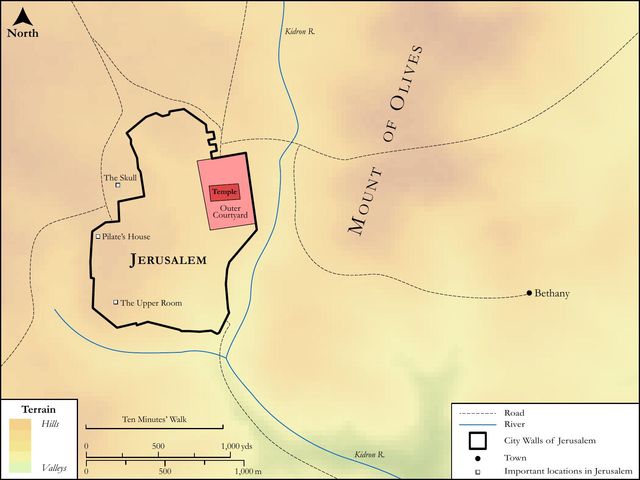
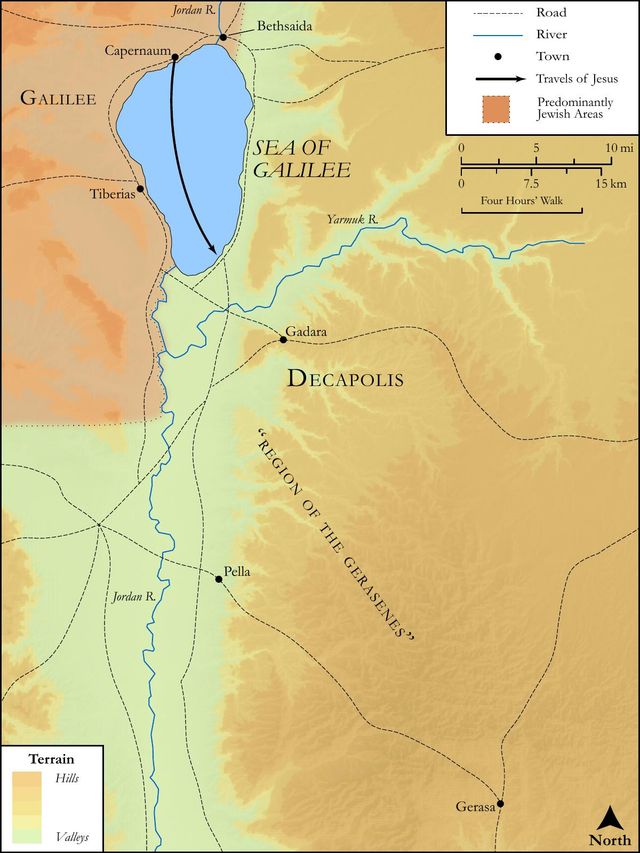
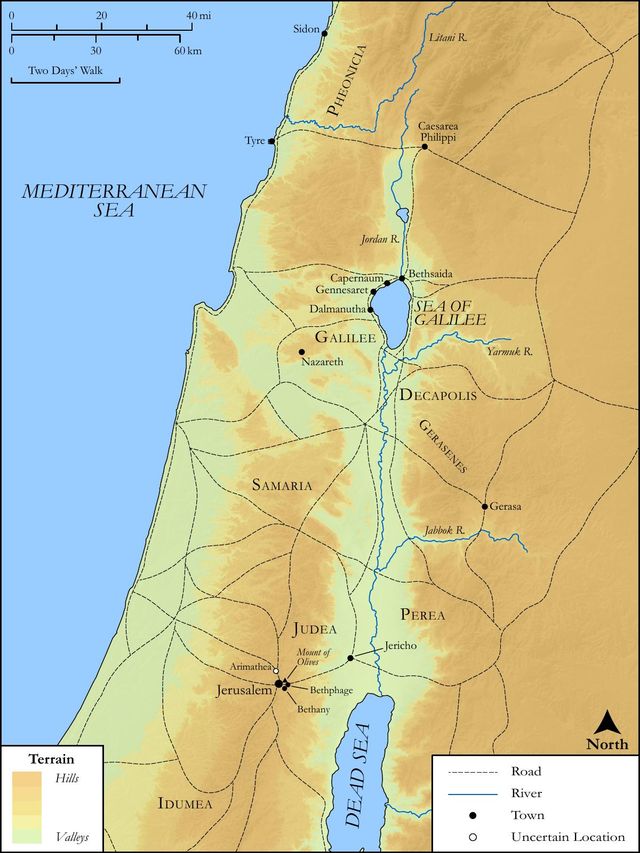
Study this verse
Public-domain commentary
Matthew Henry
From his Commentary on the Whole Bible. Henry comments on passages, not single verses — this entry covers Mark 4:35–41. His three-level outline is real structure in the source text, so it is rendered as structure.
This miracle which Christ wrought for the relief of his disciples, in stilling the storm, we had before (Mat 8:23, etc.); but it is here more fully related. Observe,
1.It was the same day that he had preached out of a ship, when the even was come, Mar 4:35. When he had been labouring in the word and doctrine all day, instead of reposing himself, he exposeth himself, to teach us not to think of a constant remaining rest till we come to heaven. The end of a toil may perhaps be but the beginning of a toss. But observe, the ship that Christ made his pulpit is taken under his special protection, and, though in danger, cannot sink. What is used for Christ, he will take particular care of.
2.He himself proposed putting to sea at night, because he would lose no time; Let us pass over to the other side; for we shall find, in the next chapter, he has work to do there. Christ went about doing good, and no difficulties in his way should hinder him; thus industrious we should be in serving him, and our generation according to his will.
3.They did not put to sea, till they had sent away the multitude, that is, had given to each of them that which they came for, and answered all their requests; for he sent none home complaining that they had attended him in vain. Or, They sent them away with a solemn blessing; for Christ came into the world, not only to pronounce, but to command, and to give, the blessing.
4.They took him even as he was, that is, in the same dress that he was in when he preached, without any cloak to throw over him, which he ought to have had, to keep him warm, when he went to sea at night, especially after preaching. We must not hence infer that we may be careless of our health, but we may learn hence not to be over nice and solicitous about the body.
5.The storm was so great, that the ship was full of water (Mar 4:37), not by springing a leak, but perhaps partly with the shower, for the word here used signifies a tempest of wind with rain; however, the ship being little, the waves beat into it so that it was full. Note, It is no new thing for that ship to be greatly hurried and endangered, in which Christ and his disciples, Christ and his name and gospel, are embarked.
6.There were with him other little ships, which, no doubt, shared in the distress and danger. Probably, these little ships carried those who were desirous to go along with Christ, for the benefit of his preaching and miracles on the other side. The multitude went away when he put to sea, but some there were, that would venture upon the water with him. Those follow the Lamb aright, that follow him wherever he goes. And those that hope for a happiness in Christ, must be willing to take their lot with him, and run the same risks that he runs. One may boldly and cheerfully put to sea in Christ's company, yea though we foresee a storm.
7.Christ was asleep in this storm; and here we are told that it was in the hinder part of the ship, the pilot's place: he lay at the helm, to intimate that, as Mr. George Herbert expresses it,
When winds and waves assault my keel,
He doth preserve it, he doth steer,
Ev'n when the boat seems most to reel.
Storms are the triumph of his art;
Though he may close his eyes, yet not his heart.
He had a pillow there, such a one as a fisherman's ship would furnish him with. And he slept, to try the faith of his disciples and to stir up prayer: upon the trial, their faith appeared weak, and their prayers strong. Note, Sometimes when the church is in a storm, Christ seems as if he were asleep, unconcerned in the troubles of his people, and regardless of their prayers, and doth not presently appear for their relief. Verily he is a God that hideth himself, Isa 45:15. But as, when he tarries, he doth not tarry (Hab 2:3), so when he sleeps he doth not sleep; the keeper of Israel doth not so much as slumber (Psa 121:3, Psa 121:4); he slept, but his heart was awake, as the spouse, Sol 5:2.
8.His disciples encouraged themselves with their having his presence, and thought it the best way to improve that, and appeal to that, and ply the oar of prayer rather than their other oars. Their confidence lay in this, that they had their Master with them; and the ship that has Christ in it, though it may be tossed, cannot sink; the bush that has God in it, though it may burn, shall not consume. Caesar encouraged the master of the ship, that had him on board, with this, Caesarem vehis, et fortunam Caesaris - Thou hast Caesar on board, and Caesar's fortune. They awoke Christ. Had not the necessity of the case called for it, they would not have stirred up or awoke their Master, till he had pleased (Sol 2:7); but they knew he would forgive them this wrong. When Christ seems as if he slept in a storm, he is awaked by the prayers of his people; when we know not what to do, our eye must be to him (Ch2 20:12); we may be at our wits' end, but not at our faith's end, while we have such a Saviour to go to. Their address to Christ is here expressed very emphatically; Master, carest thou not that we perish? I confess this sounds somewhat harsh, rather like chiding him for sleeping than begging him to awake. I know no excuse for it, but the great familiarity which he was pleased to admit them into, and the freedom he allowed them; and the present distress they were in, which put them into such a fright, that they knew not what they said. They do Christ a deal of wrong, who suspect him to be careless of his people in distress. The matter is not so; he is not willing that any should perish, much less any of his little ones, Mat 18:14.
9.The word of command with which Christ rebuked the storm, we have here, and had not in Matthew, Mar 4:39. He says, Peace, be still - Siōpa,̇pephimōso - be silent, be dumb. Let not the wind any longer roar, nor the sea rage. Thus he stills the noise of the sea, the noise of her waves; a particular emphasis is laid upon the noisiness of them, Psa 65:7, and Psa 93:3, Psa 93:4. The noise is threatening and terrifying; let us hear no more of it. This is,
(1.)A word of command to us; when our wicked hearts are like the troubled sea which cannot rest (Isa 57:20); when our passions are up, and are unruly, let us think we hear the law of Christ, saying, Be silent, be dumb. Think not confusedly, speak not unadvisedly; but be still.
(2.)A word of comfort to us, that, be the storm of trouble ever so loud, ever so strong, Jesus Christ can lay it with a word's speaking. When without are fightings, and within are fears, and the spirits are in a tumult, Christ can create the fruit of the lips, peace. If he say, Peace, be still, there is a great calm presently. It is spoken of as God's prerogative to command the seas, Jer 31:35. By this therefore Christ proves himself to be God. He that made the seas, can make them quiet.
10.The reproof Christ gave them for their fears, is here carried further than in Matthew. There it is, Why are ye fearful? Here, Why are ye so fearful? Though there may be cause for some fear, yet not for fear to such a degree as this. There it is, O ye of little faith. Here it is, How is it that ye have no faith? Not that the disciples were without faith. No, they believed that Jesus is the Christ, the Son of God; but at this time their fears prevailed so that they seemed to have no faith at all. It was out of the way, when they had occasion for it, and so it was as if they had not had it. "How is it, that in this matter ye have no faith, that ye think I would not come in with seasonable and effectual relief?" Those may suspect their faith, who can entertain such a thought as that Christ careth not though his people perish, and Christ justly takes it ill.
Lastly, The impression this miracle made upon the disciples, is here differently expressed. In Matthew it is said, The men marvelled; here it is said, They feared greatly. They feared a great fear; so the original reads it. Now their fear was rectified by their faith. When they feared the winds and the seas, it was for want of the reverence they ought to have had for Christ. But now that they saw a demonstration of his power over them, they feared them less, and him more. They feared lest they had offended Christ by their unbelieving fears; and therefore studied now to give him honour. They had feared the power and wrath of the Creator in the storm, and that fear had torment and amazement in it; but now they feared the power and grace of the Redeemer in the calm; they feared the Lord and his goodness, and it had pleasure and satisfaction in it, and by it they gave glory to Christ, as Jonah's mariners, who, when the sea ceased from her raging, feared the Lord exceedingly, and offered a sacrifice unto the Lord, Jon 1:16. This sacrifice they offered to the honour of Christ; they said, What manner of man is this? Surely more than a man, for even the winds and the seas obey him.
Historical interpretation
Ten Centuries of Reception
11 surviving comments on this verse. Each one is dated, so this reads as a timeline rather than a list.
Select a marker to jump to its quote. Markers stagger vertically where authors wrote within a few decades of each other.
For they were worthy to hear mysteries apart, in the most secret haunt of wisdom, for they were men, who, removed from the crowds of evil thoughts, remained in the solitude of virtue; and wisdom is received in a time of quiet.
After His teaching, they come from that place to the sea, and are tossed by the waves. Wherefore it is said, And the same day, when the even was come, &c.
Mystically, however, the hinder part of the ship is the beginning of the Church, in which the Lord sleeps in the body only, for He never sleepeth who keepeth Israel; for the ship with its skins of dead animals keeps in the living, and keeps out the waves, and is bound together by wood, that is, by the cross and the death of the Lord the Church is saved. The pillow is the body of the Lord, on which His Divinity, which is as His head, has come down. But the wind and the sea are devils and persecutors, to whom He says Peace, when He restrains the edicts of impious kings, as He will. The great calm is the peace of the Church after oppression, or a contemplative after an active life.
For as many as are in the little ship of faith are sailing with the Lord; as many as are in the bark of holy church will voyage with the Lord across this wave-tossed life; though the Lord himself may sleep in holy quiet, he is but watching your patience and endurance: looking forward to the repentance, and to the conversion of those who have sinned. Come then to him eagerly, instant in prayer.
Now, therefore, you may see that it is being told you of the unerring glory of God in providence; yet, as far as my small capacity shall be able, I will endeavour to set it forth. That He might re-create that Adam by means of the week, and bring aid to His entire creation, was accomplished by the nativity of His Son Jesus Christ our Lord. Who, then, that is taught in the law of God, who that is filled with the Holy Spirit, does not see in his heart, that on the same day on which the dragon seduced Eve, the angel Gabriel brought the glad tidings to the Virgin Mary; that on the same day the Holy Spirit overflowed the Virgin Mary, on which He made light; that on that day He was incarnate in flesh, in which He made the land and water; that on the same day He was put to the breast, on which He made the stars; that on the same day He was circumcised, on which the land and water brought forth their offspring; that on the same day He was incarnated, on which He formed man out of the ground; that on the same day Christ was born, on which He formed man; that on that day He suffered, on which Adam fell; that on the same day He rose again from the dead, on which He created light? He, moreover, consummates His humanity in the number seven: of His nativity, His infancy, His boyhood, His youth, His young-manhood, His mature age, His death. I have also set forth His humanity to the Jews in these manners: since He is hungry, is thirsty; since He gave food and drink; since He walks, and retired; since He slept upon a pillow; since, moreover, He walks upon the stormy seas with His feet, He commands the winds, He cures the sick and restores the lame, He raises the blind by His speech, -see ye that He declares Himself to them to be the Lord.
He was tired—yet he is the “rest” of the weary and the burdened. He was overcome by heavy sleep—yet he goes lightly over the sea, rebukes the winds, and relieves the drowning Peter. Oration , On the Son
(Hom. in Matt. 28) The Lord took the disciples indeed, that they might be spectators of the miracle which was coming, but He took them alone, that no others might see that they were of such little faith. Wherefore, to show that others went across separately, it is said, And there were also with him other ships. Lest again the disciples might be proud of being alone taken, He permits them to be in danger; and besides this, in order that they might learn to bear temptations manfully. Wherefore it goes on, And there arose a great storm of wind; and that He might impress upon them a greater sense of the miracle which was to be done, He gives time for their fear, by sleeping. Wherefore there follows, And he was himself in the hinder part of the ship, &c. For if He had been awake, they would either not have feared, nor have asked Him to save them when the storm arose, or they would not have thought that He could do any such things.
(Hom. in Matt. 28) showing His humility, and thus teaching us many lessons of wisdom. But not yet did the disciples who remained about Him know His glory; they thought indeed that if He arose He could command the winds, but could by no means do so reposing or asleep. And therefore there follows, And they awake him, and say unto him, Master, carest thou not that we perish?
And so he sleeps, leaving them in fear, in which their senses would be sharpened to perceive the significance of what was to come. For no one feels what takes place in another’s body as acutely as that which happens in his own.
For the Lord is said to have had three places of refuge, namely, the ship, the mountain, and the desert. As often as He was pressed upon by the multitude, he used to fly to one of these. When therefore the Lord saw many crowds about Him, as man, He wished to avoid their importunity, and ordered His disciples to go over to the other side. There follows: And sending away the multitudes, they took him, &c,
(ubi sup.) Or else the ship into which He embarked, is taken to mean the tree of His passion, by which the faithful attain to the security of the safe shore. The other ships which are said to have been with the Lord, signify those, who are imbued with faith in the cross of Christ, and are not beaten about by the whirlwind of tribulation; or who, after the storms of temptation, are enjoying the serenity of peace. And whilst His disciples are sailing on, Christ is asleep, because the time of our Lord's Passion came on His faithful ones, when they were meditating on the rest of His future reign. Wherefore it is related, that it took place late, that not only the sleep of our Lord, but the hour itself of departing light, might signify the setting of the true Sun. Again, when He ascended the cross, of which the stern of the ship was a type, His blaspheming persecutors rose like the waves against Him, driven on by the storms of the devils, by which, however, His own patience is not disturbed, but His foolish disciples are struck with amazement. The disciples awake the Lord, because they sought, with most earnest wishes, the resurrection of Him whom they had seen die. Rising up, He threatened the wind, because when He had triumphed in His resurrection, He prostrated the pride of the devil. He ordered the sea to be still, that is, in rising again, He cast down the rage of the Jews. The disciples are blamed, because after His resurrection, He chid them for their unbelief. And we also when being marked with the sign of the Lord's cross, we determine to quit the world, embark in the ship with Christ; we attempt to cross the sea; but, He goes to sleep, as we are sailing amidst the roaring of the waters, when amidst the strivings of our virtues, or amidst the attacks of evil spirits, of wicked men, or of our own thoughts, the flame of our love grows cold. Amongst storms of this sort, let us diligently strive to awake Him; He will soon restrain the tempest, pour down peace upon us, give us the harbour of salvation.
And they woke him up and said to him: Teacher, do you not care that we are perishing? And the disciples woke the Lord, so that they would not perish by the savagery of the waves while he slept, because they most eagerly sought his resurrection, whose death they had seen, lest their minds perish forever in spiritual death if he himself were to sleep in the death of the flesh any longer. Hence it well follows:
Therefore He allowed them to fall into the fear of danger, that they might experience His power in themselves, who saw others benefitted by Him. But He was sleeping upon the pillow of the ship, that is, on a wooden one.
But He arising, rebukes first the wind, which was raising the tempest of the sea, and causing the waves to swell, and this is expressed in what follows, And he arose, and rebuked the wind; then He commands the sea; wherefore it goes on, And he said to the sea, Peace, be still.
He rebuked His disciples, for not having faith; for it goes on, And he said unto them, Why are ye so fearful? How is it that ye have not faith? For if they had had faith, they would have believed that even when sleeping, He could preserve them safe. There follows, And they feared with a great fear, and said one to another, &c. For they were in doubt about Him, for since He stilled the sea, not with a rod like Moses, nor with prayers as Elisha at the Jordan, nor with the ark as Joshua, the son of Nun, on this account they thought Him truly God, but since He was asleep, they thought Him a man.
(non occ.) For from the troubling of the sea there arises a certain sound, which appears to be its voice threatening danger, and therefore, by a sort of metaphor, He fitly commands tranquillity by a word signifying silence: just as in the restraining of the winds, which trouble the sea with their violence, He uses a rebuke. For men who are in power are accustomed to curb those, who rudely disturb the peace of mankind, by threatening to punish them; by this, therefore, we are given to understand, that, as a king can repress violent men by threats, and by his edicts sooth the murmurs of his people, so Christ, the King of all creatures, by His threats restrained the violence of the winds, and compelled the sea to be silent. And immediately the effect followed, for it continues, And the wind ceased, which He had threatened, and there arose a great calm, that is, in the sea, to which He had commanded silence.
Continue studying Mark 4:38 across the web’s major study libraries — every link below opens this exact verse, chapter, or book on the destination site.
Read & Compare
 BibleGatewayThis verse in more than 200 translations and 70 languages.
 Bible.comThe YouVersion reader — hundreds of translations, reading plans, and highlights.
 ESV.orgCrossway's official English Standard Version reader.
 NET BibleThe NET translation with 60,000+ translators' notes on every rendering decision.
 STEP BibleTyndale House's free study tool — original text, vocabulary, and scholarly resources.
 BibliaLogos Bible Software's free web reader.
 USCCBThe New American Bible (Revised Edition) with the U.S. bishops' study notes.
Commentaries
 BibleHub CommentariesDozens of classic commentaries on this verse, gathered on one page.
 StudyLightMore than 100 commentary sets — the largest collection on the web.
 BibleRefPlain-English commentary on what this verse means, verse by verse.
 Enduring WordDavid Guzik's free commentary on this chapter, widely used by Bible teachers.
 Bible Study ToolsVerse commentary alongside Greek and Hebrew study aids.
Original Language & Research
- BibleHub InterlinearThe verse word by word — original language, transliteration, and English.
- BibleHub LexiconEvery word's original-language definition and Strong's entry.
 Blue Letter BibleDeep-study tools — Strong's numbers, concordance, and word studies.
 CNTR CollationThe earliest Greek manuscripts of this verse, collated letter by letter.
Sermons, Hymns & Audio


TrulyRandomVerse is not affiliated with these sites and doesn’t control their content. They’re linked because they’re genuinely useful.
Summary
Mark 4:38 vividly portrays Jesus' profound humanity and the disciples' desperate fear amidst a violent storm on the Sea of Galilee. While the boat is being swamped, Jesus remains deeply asleep on a pillow in the stern, a striking image of peace or exhaustion. Overwhelmed by the imminent danger, the terrified disciples awaken Him with a poignant, almost accusatory question, "Master, carest thou not that we perish?", revealing their panic and a momentary lapse in their understanding of His divine power and care.
Context
ShowHideLiterary Context
This verse is an integral part of the narrative found in Mark 4:35-41, immediately following a significant section where Jesus teaches extensively through parables, particularly the Parable of the Sower and its explanation, and the Parable of the Lamp. Having spent a long day ministering and teaching, Jesus proposes crossing the Sea of Galilee to the other side. The sudden, violent storm that erupts serves as a dramatic transition from His verbal teaching to a powerful demonstration of His authority, challenging the disciples' understanding of who He truly is. Their desperate cry in Mark 4:38 sets the stage for Jesus' subsequent rebuke of the wind and waves, and then of their lack of faith in Mark 4:39-40.
Historical & Cultural Context
The Sea of Galilee, a freshwater lake situated in a deep basin surrounded by hills, is notorious for sudden, violent storms. Cold air currents sweeping down from the surrounding mountains and gorges can rapidly converge with warmer air over the lake, creating unpredictable and dangerous squalls, even for experienced fishermen. The boats of that era were relatively small, open vessels, making them highly vulnerable to such tempestuous conditions. The disciples, many of whom were seasoned fishermen, would have been intimately familiar with the lake's dangers, and their terror indicates that this was no ordinary storm but one that genuinely threatened their lives, highlighting the severity of the situation depicted in Mark 4:37.
Key Themes
ShowHideMark 4:38 contributes significantly to several overarching themes within the Gospel of Mark and broader biblical theology. It starkly contrasts Faith vs. Fear, as the disciples' panic is set against Jesus' serene sleep, prompting His later question about their faith in Mark 4:40. The verse also underscores Jesus' Humanity, demonstrating His physical exhaustion and need for rest, even as it simultaneously sets the stage for the revelation of His Authority over Nature in the subsequent verses. Furthermore, it touches upon the theme of Discipleship, illustrating the process by which the disciples, despite their proximity to Jesus, still struggled to fully grasp His identity and power, learning to Trust God in Trials even when circumstances seem overwhelming, a lesson echoed throughout the Gospel of Mark.
Exposition and Analysis
ShowHideKey Word Analysis
ShowHideThis word, meaning "to lie down to rest" or "to fall asleep," emphasizes the depth of Jesus' slumber. It highlights His genuine humanity and physical exhaustion after a day of intense ministry and teaching. His ability to sleep so soundly amidst such a violent storm is remarkable, suggesting either profound peace or extreme fatigue, or perhaps both.
This term refers to a cushion or bolster, specifically "something for the head." In the context of a boat, it likely refers to a cushion used by the helmsman or a part of the boat's standard equipment. This detail adds a touch of realism to the scene, underscoring Jesus' physical presence and comfort even in the midst of chaos.
The disciples address Jesus as "Master," meaning "instructor" or "teacher." This title acknowledges His authority in teaching and His role as their spiritual guide. However, their subsequent question reveals a disconnect between their intellectual acknowledgment of Him as a teacher and their full comprehension of His divine power and care in a life-threatening situation.
This verb signifies "to destroy fully," or reflexively, "to perish" or "lose." The disciples' use of this word conveys the absolute terror and conviction that their lives were truly in jeopardy. It underscores the severity of the storm and their utter helplessness, contrasting sharply with Jesus' peaceful state and foreshadowing His power over death itself.
Verse Breakdown
ShowHide"And he was in the hinder part of the ship, asleep on a pillow:"
This clause sets the scene, placing Jesus in the stern (the "hinder part") of the boat. His position, typically where the helmsman would sit, and His state of deep sleep on a cushion, create a striking image of calm amidst the brewing chaos. It emphasizes His human vulnerability, needing rest, yet also hints at a profound peace that transcends the external turmoil.
"and they awake him, and say unto him,"
This action highlights the disciples' desperation. They are not merely seeking comfort but are actively rousing Him from sleep, indicating that their fear has reached a critical point where they see Him as their only hope, even if they don't fully understand how He might help. Their awakening of Him is a direct plea for intervention.
"Master, carest thou not that we perish?"
This is the emotional core of the verse. The disciples' question is a rhetorical one, born out of panic and a sense of abandonment. It expresses not just fear of death, but also a profound doubt about Jesus' concern for their well-being. It's a common human cry in crisis: "Do you not see what we are going through? Do you not care?" This question reveals their limited faith at that moment, despite having witnessed His miracles and heard His teachings.
Literary Devices
ShowHideThe passage in Mark 4:38 is rich with Contrast, most notably between the raging tempest and the profound tranquility of Jesus' sleep. This juxtaposition amplifies the disciples' terror and highlights Jesus' unique composure. There is also a strong element of Irony: the experienced fishermen are utterly terrified and helpless, while Jesus, a carpenter by trade, is completely undisturbed. The disciples' question, "Carest thou not that we perish?", functions as a Rhetorical Question, expressing their desperation, accusation, and doubt rather than genuinely seeking information. Furthermore, the entire scene carries significant Symbolism: the storm often symbolizes the trials, tribulations, and chaos of life; the boat can represent the community of believers or the individual's journey of faith; and Jesus' presence in the boat, even when seemingly inactive, symbolizes His constant presence with His people through all difficulties.
Theological and Thematic Connections
ShowHideMark 4:38 serves as a powerful theological statement about the dual nature of Christ and the nature of faith. Jesus' sleep underscores His true humanity, subject to physical needs and exhaustion, yet His ability to sleep through such a storm hints at a divine peace and control that transcends human limitations. The disciples' question, born of fear, challenges Jesus' care and concern, mirroring humanity's frequent doubt in God's providence during times of crisis. This passage ultimately teaches that true faith is trusting in Jesus' presence and power, even when He seems silent or distant, knowing that He is sovereign over all circumstances, including the most terrifying storms of life. It emphasizes that God is not indifferent to our suffering, even if His immediate action is not what we expect.
Reflection and Application
ShowHideThe scene in Mark 4:38 resonates deeply with the human experience of facing overwhelming difficulties. Like the disciples, we often find ourselves in "storms" – crises of health, finance, relationships, or faith – where we feel swamped and on the verge of perishing. In such moments, it is natural to feel fear, panic, and even to question God's presence or care. We might cry out, "Lord, do you not care that I am perishing?" This verse reminds us that even when Jesus seems "asleep" or unresponsive to our immediate pleas, He is undeniably present in the "boat" of our lives. Our call is not to succumb to despair but to turn to Him, even with our raw, fearful questions. It is in the act of awakening Him, of crying out, that we acknowledge His ultimate authority and our dependence on His power to bring calm to our chaos. This passage encourages us to move beyond our immediate fear to a deeper trust that the One who controls the winds and waves is also intimately concerned with our well-being.
Questions for Reflection
ShowHideFAQ
ShowHideWhy was Jesus asleep during such a violent storm?
ShowHideJesus' sleep in the midst of the storm highlights several aspects of His person. Primarily, it underscores His genuine humanity. After a long day of teaching and ministry, He was physically exhausted and needed rest, just like any human being. His deep sleep also suggests a profound peace and trust in His Father's sovereignty, demonstrating that even in the face of life-threatening chaos, He remained undisturbed. It was a testament to His perfect peace that transcended the external circumstances, setting a stark contrast to the disciples' panic and preparing the ground for the miraculous demonstration of His divine authority over creation in Mark 4:39.
What does the disciples' question "Carest thou not that we perish?" reveal about their faith?
ShowHideThe disciples' question, "Master, carest thou not that we perish?", reveals a significant, albeit temporary, lapse in their faith and understanding of Jesus' identity and power. While they acknowledged Him as "Master" (teacher), their desperate plea indicates that they had not yet fully grasped His divine authority over creation or His unwavering care for them. Their question is born out of fear and a feeling of abandonment, suggesting that they perceived Jesus as indifferent to their plight. This moment of doubt and fear, however, becomes a crucial teaching opportunity, leading to Jesus' rebuke of their lack of faith in Mark 4:40, and subsequently, a deeper revelation of His divine nature to them.
Christ-Centered Fulfillment
ShowHideMark 4:38, with Jesus asleep amidst the raging storm, powerfully foreshadows His ultimate victory over the chaos of sin and death. His serene slumber, even as the forces of nature threaten to overwhelm, speaks to His inherent divine authority and the peace that He alone can offer. This is not merely a man exhausted, but the Son of God, who by His very nature sustains all things, as affirmed in Colossians 1:17. The disciples' desperate cry, "Carest thou not that we perish?", echoes humanity's cry for deliverance from the storms of life and the ultimate storm of sin. Jesus' subsequent calming of the storm in Mark 4:39 is a microcosm of His greater work: He came to bring peace not just to the physical world, but to the human heart, offering a peace that "surpasses all understanding" (Philippians 4:7). He is the one who, through His death and resurrection, has conquered the ultimate forces of chaos—sin and death—and now offers true rest and security to all who trust in Him, assuring us, "My peace I give you" (John 14:27). His presence in the boat with His disciples, even when seemingly inactive, symbolizes His enduring presence with His church, promising that He will never abandon us, even in the most terrifying of life's storms.