


Amos 4:13
Bible text: King James Version (1769 Blayney text) · Public domain
Bible text: King James Version with Strong's numbers · Public domain
Bible text: Berean Standard Bible · Public domain
Bible text: American Standard Version (1901) · Public domain
Bible text: World English Bible, Messianic edition · Public domain
Bible text: Geneva Bible (1599) · Public domain
Bible text: Young's Literal Translation · Public domain
- כִּיkiforH3588PrtParticle Conditional
- הִנֵּהhi·Nehhere!H2009PrtParticle Interjection
- יוֹצֵרyo·Tzer[one who] formedH3335V-Qal-Prtcpl-msVerb Qal Participle Singular Masculine Absolute
- הָרִיםha·RimmountainsH2022N-mpNoun Plural Masculine Absolute
- וּבֹרֵאu·vo·Re'and [one who] createdH1254Conj-w ¦ V-Qal-Prtcpl-msVerb Qal Participle Singular Masculine Absoluteוּandבֹרֵא[one who] created
- רוּחַRu·achwindH7307N-fsNoun Singular Feminine Absolute
- וּמַגִּידu·ma·Gidand [one who] tellsH5046Conj-w ¦ V-Hiphil-Prtcpl-msVerb Hiphil Participle Singular Masculine Absoluteוּandמַגִּיד[one who] tells
- לְאָדָםle·'a·Damto humankindH120Prep-l ¦ N-msNoun Singular Masculine Absoluteלְtoאָדָםhumankind
- מַהmahwhat?H4100InterrogPronoun Interrogative
- שֵּׂחוֹse·Cho[is] his thoughtH7808N-msc ¦ 3msNoun Singular Masculine Constructשֵּׂח[is] thoughtוֹhis
- עֹשֵׂה'o·Seh[one who] makesH6213V-Qal-Prtcpl-msVerb Qal Participle Singular Masculine Construct
- שַׁחַרsha·char<of> dawnH7837N-msNoun Singular Masculine Absolute
- עֵיפָה'ei·FahdarknessH5890N-fsNoun Singular Feminine Absolute
- וְדֹרֵךְve·do·Rekhand [one who] treadsH1869Conj-w ¦ V-Qal-Prtcpl-msVerb Qal Participle Singular Masculine Absoluteוְandדֹרֵךְ[one who] treads
- עַל'alonH5921PrepPreposition
- בָּמֳתֵיBo·mo·tei[the] high places ofH1116N-fpcNoun Plural Feminine Construct
- אָרֶץ'A·retz[the] earthH776N-fsNoun Singular Feminine Absolute
- יְהוָהYah·weh[is] YahwehH3068N-properNoun Proper Title
- אֱלֹהֵי'e·lo·heiGod ofH430N-mpcNoun Plural Masculine Construct
- צְבָאוֹתtze·va·'othostsH6635N-fpNoun Plural Feminine Absolute
- שְׁמוֹshe·Mohis nameH8034N-msc ¦ 3msNoun Singular Masculine Constructשְׁמnameוֹhis
English is a literal word-by-word gloss of the Hebrew, not the KJV's wording. Why?
This is the original text the KJV's translators worked from — each Hebrew word with its own literal English meaning in this verse, prepared by scholars at Tyndale House, Cambridge. The KJV translates whole sentences, not word by word, so its wording differs: one Hebrew word can become several English words, and the KJV may choose “the LORD” where the gloss reads “Yahweh”. Both are faithful — they answer different questions. For the KJV's own rendering, switch to the KJV text.
Details
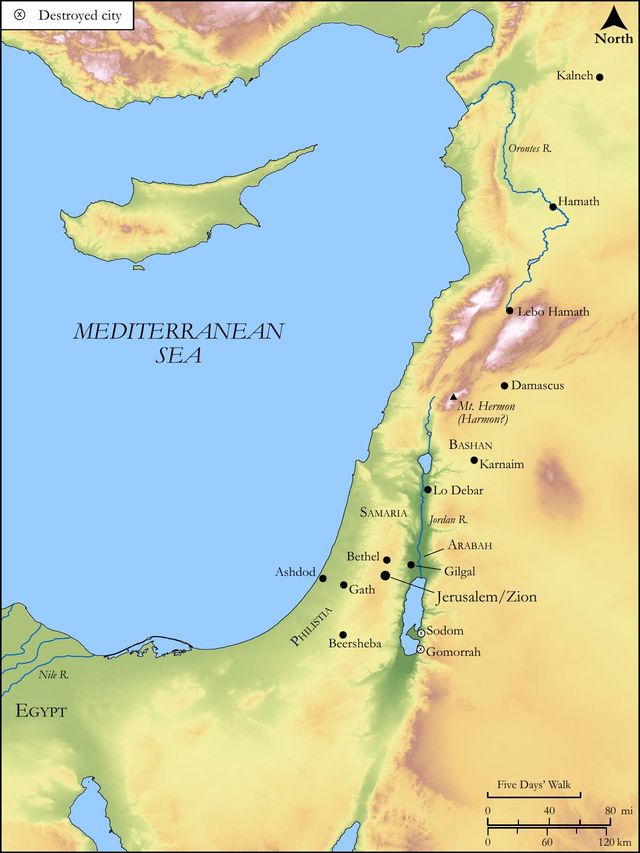
See on the biblical-era map
Study this verse
Public-domain commentary
Matthew Henry
From his Commentary on the Whole Bible. Henry comments on passages, not single verses — this entry covers Amos 4:6–13. His four-level outline is real structure in the source text, so it is rendered as structure.
Here, I. God complains of his people's incorrigibleness under the judgments which he had brought upon them in order to their humiliation and reformation. He had by several tokens intimated to them his displeasure, with this design, that they might by repentance make their peace with him; but it had not that effect.
1.It is five times repeated in these verses, as the burden of the charge, "Yet have you not returned unto me, saith the Lord; you have been several times corrected, but in vain; you are not reclaimed, there is no sign of amendment. You have been sent for by one messenger after another, but you have not come back, you have not come home." (1.) This intimates that that which God designed in all his providential rebukes was to reduce them to their allegiance, to influence them to return to him. (2.) That, if they had returned to their God, they would have been accepted, he would have bidden them welcome, and the troubles they were in would have been removed. (3.) That the reason why God sent further troubles was because former troubles had not done the work, otherwise it is no pleasure to the Almighty that he should afflict. (4.) That God was grieved at their obstinacy, and took it unkindly that they should force him to do that which he did so unwillingly: "You have not returned to me from whom you have revolted, to me with whom you are in covenant, to me who stands ready to receive you, to me who have so often called you." Now,
2.To aggravate their incorrigibleness, and to justify himself in inflicting greater judgments, he recounts the less judgments with which he had tried to bring them to repentance.
(1.)There had sometimes been a scarcity of provisions, though there was no visible cause of it (Amo 4:6): "I have given you cleanness of teeth in all your cities, for you had no meat to chew, whereby your teeth might be fouled," especially no flesh, which dirties the teeth. Or, I have given you emptiness of teeth, nothing to fill your mouths with. "Bread, the staff of life, has been wanting, for you have sown much and brought in little," as Hag 1:9. Some think this refers to that seven years' famine that was in Elisha's time, which we read of Kg2 8:1. Now when God thus took away their corn in the season thereof, because they had prepared it for Baal, they should have said, We will go and return to our first husband, having paid dearly for leaving him; but it had not that effect. They have not returned to me, saith the Lord.
(2.)Sometimes they had wanted rain, and then of course they wanted the fruits of the earth. This evil was of the Lord: I have withholden the rain from you. God has the key of the clouds, and, if he shut up, who can open? Amo 4:7. The rain was withheld when there were yet three months to the harvest, at the time when they used to have it, and therefore the withholding of it was an extraordinary thing, and, if the course of nature was altered, they must therein own the hand of the God of nature; and it was at a time when they most needed it, and therefore the want of it was a very sore judgment, and blasted their expectations of a crop at harvest. And one circumstance which made this very remarkable was that when there were some places that wanted rain, and withered for want of it, there were other places near adjoining that had it in abundance. God caused it to rain upon one city, and not upon another, in the same country; nay, he caused it to rain upon one field, one piece of a field, and it was thereby made fruitful and flourishing, but on the next field, on the other side of the hedge, nay, on another part of the same field, it rained not at all, and it was so long without rain that all the products of it withered. No doubt this was literally true, and there were many instances of it which were generally taken notice of. Now,
[1.]By this it appeared that the withholding of the rain was not casual, but by a divine direction and disposal, and that the cloud which waters the earth is turned round about by the counsels of God, to do whatsoever he commands it, whether for correction, or for his land, or for his mercy, Job 37:12-18. Rain does not go by planets (as common people speak), but as God sends it by his winds.
[2.]We have reason to think that those cities on which it rained not were the most infamous for wickedness, such as Bethel and Gilgal (Amo 4:4), and that those on which it rained were such as retained something of religion and virtue among them. And so in the town-fields it rained or rained not, upon the piece, according as the owner was; for we are sure the curse of the Lord is in the house, and upon the ground, of the wicked, but he blesses the habitation of the just, and his field is a field that the Lord has blessed.
[3.]It would be the greater grief and vexation to those whose fields withered for want of rain to see their neighbours' fields well watered and flourishing. My servants shall eat, but you shall be hungry, Isa 65:13. The wicked shall see it, and be grieved. Probably those that were oppressed were rained upon, and so they recovered their losses, while the oppressors withered, and so lost their gains.
[4.]Yet, as to the nation in general, it was a mixture of mercy with the judgment, and, consequently, strengthened the call to repentance and reformation, and encouraged them to hope for all mercy, in their returns to God, since there was so much mercy even in God's rebukes of them. But, because they did not make good use of this gracious allay to the extremity of the judgment, they had not the benefit of it, which otherwise they might have had, for (Amo 4:8) two or three cities wandered at uncertainty, as beggars, unto one city, to drink water, and, if possible, to have some to carry home with them, but they were not satisfied; it was but here and there one city that had water, while many wanted, and then it was not, as usual, Usus communis aquarum - Water is free to all. Those that had it had occasion for it, or knew not how soon they might, and therefore could afford but little to those that wanted, saying, Lest there be not enough for us and you. Those that came drank water, but they were not satisfied, because they drank it by measure, and with astonishment; and those that drink of this water shall thirst again, Joh 4:13. They were not satisfied, because their desires were greedy, and what they had God did not bless to them, Hag 1:6. And now, one would think, when they met with all this disappointment, they should have considered their ways and repented; but it had not that effect: "Yet have you not returned to me, no, not so much as to pray in a right manner for the former and latter rain," Zac 10:1. See the folly of carnal hearts; they will wander from city to city, from one creature to another, in pursuit of satisfaction, and still they miss of it; they labour for that which satisfies not (Isa 55:2), and yet, after all, they will not return to God, will not incline their ear to him in whom they might have satisfaction. The preaching of the gospel is as rain; God sometimes blesses one place with it more than another; some countries, some cities, are, like Gideon's fleece, wet with this dew, while the ground about is dry; all withers where this rain is wanting. But it were well if people were but as wise for their souls as they are for their bodies, and, when they have not this rain near them, would go and seek it where it is to be had; and, if they seek aright, they shall not seek in vain.
(3.)Sometimes the fruits of their ground were eaten up by caterpillars, or blasted with mildew, Amo 4:9. Heaven and earth are armed against those who have made God their enemy. When God pleased, that is, when he was displeased,
[1.]They suffered by a malignant air, the influence of which, either too hot or too cold, blasted their fruits, with a force that could be neither discerned nor resisted, and against which there was no defence.
[2.]They suffered by malignant animals. Their vineyards and gardens yielded their increase in great abundance, so did their fig-trees and olive-trees; but the palmer-worm devoured them before the fruits were ripe, and fit to be gathered in. This was either the same judgment with that which we read of Joe 1:4-6, or a less judgment of the same nature, sent before to give warning of that. But they did not take warning: Yet have you not returned unto me.
(4.)Sometimes the plague had raged among them, and the sword of war had cut off multitudes, Amo 4:10. The pestilence is God's messenger; this he sent among them, with directions whom to strike dead, and it was done. It was a pestilence after the manner of Egypt; deaths were scattered among them by the hand of a destroying angel at midnight. And perhaps this pestilence, as that of Egypt, fastened upon the first-born. In the way of Egypt (so the margin); when they were making their escape to Egypt, or going thither to seek for aid, the pestilence seized them by the way and stopped their journey. The sword of war is likewise the sword of the Lord; this was drawn among them with commission; and then it slew their young men, the strength of the present generation and the seed of the next. God says, I have slain them; he avows the execution. The slain of the Lord are many. The enemy took away their horses, and converted them to their own use; and the dead carcases of those that were slain either with sword or pestilence were so many, and for want of surviving friends were left so long unburied, that the stench of their camps came up into their nostrils, and was both noisome and dangerous, and might put them in mind of the offensiveness of their sin to God. And yet this did not prevail to humble and reclaim them: You have not returned to him that smites you. Such a rueful woeful sight as this prevailed not to make them religious.
(5.)In these and other judgments some were remarkably cut off, and made monuments of justice, others were remarkably spared, and made monuments of mercy, the setting of which the one over against the other one would have thought likely to work upon them, but it had not its effect, Amo 4:11.
[1.]Some were quite ruined, their families destroyed, and themselves in them: I have overthrown some of you, as God overthrew Sodom and Gomorrah. Perhaps they were consumed with lightning, as Sodom was, or the houses were, in some other way, burnt to the ground, and the inhabitants in them. Sodom and Gomorrah are said to be condemned with an overthrow, and so made an example, Pe2 2:6. God had threatened to destroy the whole land with such an overthrow as that of Sodom, Deu 29:23. But he began with some particular places first, to give them warning, or perhaps with some particular persons, whose sins went beforehand to judgment.
[2.]Others very narrowly escaped: "You were many of you as a firebrand plucked out of the burning, like Lot out of Sodom, when the fire had already kindled upon you; and yet you hate sin never the more for the danger it has brought you to, nor love God ever the more for the deliverance he wrought for you. You that have been so signally delivered, and in such a distinguishing way, have not returned unto me."
II.God, in the close, calls upon his people, now at length, in this their day, to understand the things that belong to their peace, before they were hidden from their eyes, Amo 4:12, Amo 4:13. Observe here,
1.How God threatens them with sorer judgments than any they had yet been under: "Therefore, seeing you have not been wrought upon by correction hitherto, thus will I do unto thee, O Israel!" He does not say how he will do, but it shall be something worse than had come yet, Joh 5:14. Or, "Thus I will go on to do unto thee, following one judgment with another, like the plagues of Egypt, till I have made a full end." Nothing but reformation will prevent the ruin of a sinful people. If they turn not to him, his anger is not turned away, but his hand is stretched out still. I will punish you yet seven times more, if you will not be reformed; so it was written in the law, Lev 26:23, Lev 26:24.
2.How he awakens them therefore to think of making their peace with God: "Seeing I will do this unto thee, and there is no remedy, prepare to meet they God, O Israel!" that is, (1.) "Consider how unable thou art to meet him as a combatant." Some make it to be spoken by way of irony or challenge: "Prepare to meet God, who is coming forth to contend with thee. What armour of proof canst thou put on? What courage canst thou steel thyself with? Alas! it is but putting briers and thorns before a consuming fire, Isa 27:4, Isa 27:5. Art thou able with less than 10,000 to meet him that comes forth against thee with more than 20,000?" Luk 14:31. (2.) "Resolve therefore to meet him as a penitent, as a humble suppliant, to meet him as thy God, in covenant with thee, to submit, and stand it out no longer." We must prepare to meet God in the way of his judgments (Isa 26:8), to take hold on his strength, that we may make peace. Note, Since we cannot flee from God we are concerned to prepare to meet him; and therefore he gives us warning, that we may prepare. When we are to meet him in his ordinances we must prepare to meet him, prepare to seek him.
3.How he sets forth the greatness and power of God as a reason why we should prepare to meet him, Amo 4:13. If he be such a God as he is here described to be, it is folly to contend with him, and our duty and interest to make our peace with him; it is good having him our friend and bad having him our enemy.
(1.)He formed the mountains, made the earth, the strongest stateliest parts of it, and by the word of his power still upholds it and them. Whatever are the products of the everlasting mountains, he formed them; whatever salvation is hoped for from hills and mountains, he is the founder of it, Psa 89:11, Psa 89:12. He that formed the great mountains can make them plain, when they stand in the way of his people's salvation.
(2.)He creates the wind. The power of the air is derived from him, and directed by him; he brings the wind out of his treasures, and orders from what point of the compass it shall blow; and he that made it rules it; even the winds and the seas obey him.
(3.)He declares unto man what is his thought. He makes known his counsel by his servants the prophets to the children of men, the thought of his justice against impenitent sinners, and the thought of good he thinks towards those that repent. He can also make known, for he perfectly knows, the thought that is in man's heart; he understands it afar off, and in the day of conviction will set the evil thoughts among the other sins of sinners in order before them.
(4.)He often makes the morning darkness, by thick clouds overspreading the sky immediately after the sun rose bright and glorious; so when we look for prosperity and joy he can dash our expectations with some unlooked-for calamity.
(5.)He treads upon the high places of the earth, is not only higher than the highest, but has dominion over all, tramples upon proud men, and upon the idols that were worshipped in the highest places.
(6.)Jehovah the God of hosts is his name, for he has his being of himself, and is the fountain of all being, and all the hosts of heaven and earth are at his command. Let us humble ourselves before this God, prepare to meet him, and give all diligence to make him our God, for happy are the people whose God he is, who have all this power engaged for them.
Historical interpretation
Historical reception
4 surviving comments on this verse. Each one is dated, so this reads as a timeline rather than a list.
Select a marker to jump to its quote. Markers stagger vertically where authors wrote within a few decades of each other.
When Christ came, the people of the old covenant denied him, but the devils confessed him. His forefather David was not ignorant of him when he said, “I will place a lamp for my anointed.” Some have interpreted “lamp” as the splendor of prophecy; others have understood by the lamp the flesh he assumed of the Virgin, according to the words of the apostle: “But we carry this treasure in vessels of clay.” The prophet was not ignorant of him when he said, “And declaring his Christ to men.” Moses also knew him, and Isaiah and Jeremiah as well. None of the prophets was ignorant of him. Even the devils acknowledged him, for he rebuked them, and Scripture adds, “Because they knew that he was the Christ.”
But if any one thinks that the word of the prophet is to be explained with reference to the Holy Spirit, because it is said, “declaring unto men his Christ,” he will explain it more easily of the Lord’s Sun of justice. For if it troubles you that he said Spirit, and therefore you think that this cannot well be explained of the mystery of the taking of human nature, read on in the Scriptures, and you will find that all agrees most excellently with Christ. Of [Christ] it is thoroughly fitting to think that he established the thunders by his coming, that is, the force and sound of the heavenly Scriptures, by the thunder, as it were, of which our minds are struck with astonishment, so that we learn to be afraid and pay respect to the heavenly oracles.
Nor does it escape my notice that heretics have been prone to object that the Holy Spirit appears to be a creature, because many of them use as an argument for establishing their impiety that passage of Amos, where he spoke of the blowing of the wind, as the words of the prophet made clear. For you read thus: “Behold, I am he that establishes the thunder and creates the wind and declare unto man his Christ, that make light and mist, and ascend upon high places, the Lord God Almighty is his name.”
(Verse 12, 13.) Therefore, I will do these things to you, Israel: but after I have done these things to you, prepare to meet your God, O Israel. For behold, he who forms the mountains and creates the wind, and declares to man what is his thought, who makes the morning darkness, and treads on the heights of the earth - the Lord, the God of hosts, is his name. LXX: Therefore, I will do these things to you, Israel: but because I will do these things to you, prepare to call upon your God, O Israel. For behold, He who strengthens the thunder, and creates the spirit, and proclaims His Christ among men, making morning, and mist, and ascending above the heights of the earth: The Lord God Almighty is His name. Because we have interpreted, after it is written in Hebrew 'Eceb', and Aquila interpreted it as 'afterwards', and Theodotion as 'finally', and the Septuagint yet 'in Hebrew it can be read as: Therefore I will do these things to you, Israel, afterwards, that is, much later, and in the last times, so that it may begin again from another beginning: And when I will do this to you, prepare to meet your God, O Israel.' And again, in that place where the Septuagint translated, prepare to invoke your God, and we have set it according to Theodotion, prepare to encounter your God, Symmachus and the Fifth Edition have translated, prepare to oppose your God: which is said in Hebrew, Hechin Lacerath Eloica (). Also, for the mountains which are called Arim in Hebrew, the Seventy alone translated it as thunder. But the reason why they said 'spirit' and we said 'wind', which is called Rua in Hebrew, is clear, because both wind and spirit are referred to by this word. And what follows, proclaiming his message to humanity, which we translate as interpreters, only the Seventy translated it, proclaiming his Christ to humanity: deceived by the similarity and ambiguity of words. For if we read his Christ, which in Hebrew is called Messiah (מָשִׁיחַ), it is written with the letters Mem, Sin, Yod, Het, and Vav, which the Seventy presumed. But if, as in Hebrew, it is according to Aquila 'his speech', according to Symmachus 'his voice', according to Theodotion 'his word', according to the fifth edition 'his eloquence', all of which can be interpreted as 'his speech', it will be written with these letters: Mem, He, which is called Ma (מָה), which means 'what' or 'something'. Then Sin, Iod, Heth, which we read as Sia (Σία), that is, eloquence. But O, which is written with the single letter Vau, αὐτοῦ, that is, his, signifies, and at the same time is read mixed with Masio (Μασίω), having the second letter from the word He with more. We have talked about the variety of interpretation, which will be troublesome for the negligent and pleasing for the studious: now let's move on to the meaning of what has been written. I gave astonishment to your teeth, and you did not return to me, says the Lord. I withheld rain from you, and it rained on one city and not on another; one field had rain, but another had none and withered. So two or three cities staggered to one city to drink water, but were not satisfied; yet you did not return to me, declares the Lord. I struck you with blight and mildew; your many gardens and vineyards, your fig trees and olive trees the locust devoured; yet you did not return to me, declares the Lord. I sent among you a pestilence after the manner of Egypt; I killed your young men with the sword, and carried away your horses, and I made the stench of your camp go up into your nostrils; yet you did not return to me, declares the Lord. I will overthrow you as the Lord overthrew Sodom and Gomorrah, and you have become like a brand plucked from the fire, and yet you have not returned to me, says the Lord. Therefore, I will do this to you, O Israel; because you have despised the past, at least be corrected for what I am about to bring upon you. And when he says, 'I will do this to you,' he remains silent about what he will do, so that while Israel hangs in uncertainty about each specific type of punishment (which is all the more terrifying because they suspect everything), they may repent and so God does not inflict what he threatens. But after I have done what I promise you I will do, prepare to invoke the Lord your God. For everyone who calls upon the name of the Lord shall be saved (Joel 2). Whether you prepare to meet your God, and eagerly receive the Lord coming to you with all your heart. It is he who strengthens the thunder, or confirms the mountains, at whose voice the pillars of heaven and the foundations of the earth tremble (Eccl 16). It is he who creates the spirit, not the Holy Spirit in this place, as heretics suspect; but we understand it as the wind, or the spirit of man: for no one knows what is in man except the spirit that is within him; and the same spirit intercedes for us with inexpressible groanings (Rom 8). Certainly, we must receive the spirit, the soul, according to what is written: 'You will take away their spirit, and they will perish and return to their dust' (Ps. 104:29). And: 'Father, into your hands I commend my spirit,' and saying this, he breathed his last (Luke 23:46). And when he creates the spirit, he proclaims his word to mankind, or he proclaims the word of him who knows the secrets of thoughts, and understands what the hidden mind ponders in silent speech, according to what we read in Jeremiah according to the Hebrew: 'The heart of man (or of all and of every man) is small and unfathomable, who can know it?' I am the Lord, searching the heart and testing the reins (Jer. XVII, 9, 10). This is also testified in the one hundred and thirty-eighth psalm: Your eyes have seen my imperfect form. The meaning is: Before I was formed, before I was deformed in limbs, while I was still contained in the seed, your eyes saw me. And Jeremiah hears from the Lord: Before I formed you in the womb, I knew you, and before you came forth from the womb, I sanctified you, and I appointed you as a prophet to the nations (Jerem. I, 5). And the evangelist, seeing, said, 'The Lord knows their thoughts' (Luke 11:17). But if we read further, proclaiming man's speech according to what was said above, in which he says, 'The Lord God will not speak unless he has revealed his secret to his servants the prophets' (Isaiah 3:7). But the one who proclaims man's thoughts and speech, whether his own or another's, he is the one who makes the dawn and the sunrise, and covers everything with clouds, and walks above the heights of the earth; his name is the Lord God Almighty. For in the Septuagint it is read: Announcing in men his Christ: under which occasion heretics, want to create the Holy Spirit in order: creating the spirit, and announcing in men his Christ: so that he may be created, he may be announced in the peoples. To these things we will respond according to their meaning, and to the Vulgate edition: Who is the creator of all, and establishes the thunder, or forms the mountains, consequently brings forth the winds from his treasures, and as the founder of the universe, promises his Son Christ to men. But when Christ has been proclaimed, then the light of truth is opened to us, not perfectly; for now we see in part, and we know in part, and through a mirror and an image we contemplate those things that are to come (I Cor. XIII). Hence it follows: making morning and mist, and rising above the heights of the earth. For the Lord is high above the high things, and does not dwell in the lowly, He who is high; but the creator of mountains ascends to the mountains, in those who have a share in heavenly things, and walking in the flesh they do not live according to the flesh, but according to the spirit. But if we read according to Symmachus and Aquila: these things I will do to you, O Israel, afterwards, and when I have done these things to you, prepare yourself to oppose your God, it is to be understood thus: I have done this to correct you, as the past speech described, and because you did not want to return to me, I will do to you what is contained in my secret. You have killed the servants whom I sent to you: finally I will send my Son: but you, according to your usual custom, by which you always oppose the will of the Lord, prepare yourself to contradict and oppose your God: according to what is written: Behold, this child is destined for the fall and rise of many, and for a sign that will be contradicted (Luke 2:34). And he says this, not because he commands what should be done; but rather he foretells what he will do willingly, as if reproaching and accusing, so that at least when corrected he does not do what was foretold.
Continue studying Amos 4:13 across the web’s major study libraries — every link below opens this exact verse, chapter, or book on the destination site.
Read & Compare
 BibleGatewayThis verse in more than 200 translations and 70 languages.
 Bible.comThe YouVersion reader — hundreds of translations, reading plans, and highlights.
 ESV.orgCrossway's official English Standard Version reader.
 NET BibleThe NET translation with 60,000+ translators' notes on every rendering decision.
 STEP BibleTyndale House's free study tool — original text, vocabulary, and scholarly resources.
 BibliaLogos Bible Software's free web reader.
 USCCBThe New American Bible (Revised Edition) with the U.S. bishops' study notes.
Commentaries
 BibleHub CommentariesDozens of classic commentaries on this verse, gathered on one page.
 StudyLightMore than 100 commentary sets — the largest collection on the web.
 BibleRefPlain-English commentary on what this verse means, verse by verse.
 Enduring WordDavid Guzik's free commentary on this chapter, widely used by Bible teachers.
 Bible Study ToolsVerse commentary alongside Greek and Hebrew study aids.
Original Language & Research
- BibleHub InterlinearThe verse word by word — original language, transliteration, and English.
- BibleHub LexiconEvery word's original-language definition and Strong's entry.
 Blue Letter BibleDeep-study tools — Strong's numbers, concordance, and word studies.
 SefariaThe Hebrew text with Rashi and centuries of Jewish commentary.
Sermons, Hymns & Audio


TrulyRandomVerse is not affiliated with these sites and doesn’t control their content. They’re linked because they’re genuinely useful.
Summary
Amos 4:13 serves as a climactic declaration of God's unparalleled power, omniscience, and sovereignty, concluding a series of judgments designed to call Israel to repentance. It portrays the Lord as the ultimate Creator, intimately involved in forming the natural world and knowing the deepest thoughts of humanity, while also asserting His absolute dominion over all creation and His capacity to execute judgment. The verse culminates in the emphatic revelation of His majestic and formidable name, underscoring the futility of resisting such a God and the imperative to return to Him.
Context
ShowHideLiterary Context
Amos 4:13 functions as a powerful, poetic doxology that punctuates a section detailing God's successive, yet unheeded, judgments upon Israel. Prior to this verse, Amos recounts five specific instances where God sent various calamities—famine (Amos 4:6), drought (Amos 4:7-8), blight and locusts (Amos 4:9), pestilence and war (Amos 4:10), and destruction akin to Sodom and Gomorrah (Amos 4:11). Each of these divine interventions is met with the recurring refrain, "yet have ye not returned unto me," highlighting Israel's stubborn rebellion. Verse 12 then issues a stark warning: "Therefore thus will I do unto thee, O Israel: and because I will do this unto thee, prepare to meet thy God, O Israel." Amos 4:13 immediately follows this chilling summons, providing the theological foundation for the impending encounter—it is a confrontation with the all-powerful, all-knowing, and utterly sovereign God. It is a reminder of who Israel is being called to meet, emphasizing the gravity of their unrepentant state.
Historical & Cultural Context
Amos prophesied during a period of relative prosperity and political stability in both Judah and Israel, specifically during the reigns of Uzziah in Judah and Jeroboam II in Israel (c. 760-750 BC). Despite outward success, Israel was plagued by oppression, moral decay, and widespread idolatry, often incorporating pagan practices into their worship of Yahweh. The "high places" mentioned in the verse often refer to elevated sites used for worship, which, while sometimes legitimate in early Israelite history, had largely become centers for syncretistic or idolatrous practices by Amos's time. The ability to "form the mountains" and "create the wind" would have resonated deeply with an agrarian society dependent on natural forces, but also one that often attributed such forces to Baal or other Canaanite deities. Amos's declaration reasserts Yahweh's exclusive control over these elements, directly challenging the false gods and the people's misplaced trust. The concept of God declaring His "thought" would have been significant in a culture where divine revelation was understood to be mediated through prophets, underscoring God's active communication with humanity, even when His people refused to listen.
Key Themes
ShowHideThe overarching theme of Amos 4:13 is the absolute sovereignty and omnipotence of Yahweh. This verse powerfully underscores God's creative power, demonstrating His mastery over the physical world, from the grandest mountains to the invisible wind. It also highlights His omniscience, revealing His intimate knowledge of human thoughts and His capacity to disclose His own divine will. Furthermore, the verse emphasizes God's judicial authority and dominion over nature, illustrated by His ability to turn morning into darkness and His "treading upon the high places"—a metaphorical expression of His ultimate control over all earthly powers and idolatrous strongholds. This declaration serves as a stark reminder of the accountability of humanity to their Creator and Judge, a theme central to Amos's prophetic message, particularly in light of Israel's persistent refusal to "return unto me" (Amos 4:6-11). The majestic title "The LORD, The God of hosts" encapsulates His covenant faithfulness (Exodus 3:14) and His formidable power as commander of all spiritual and earthly forces, reinforcing the gravity of the call to "prepare to meet thy God" (Amos 4:12).
Exposition and Analysis
ShowHideKey Word Analysis
ShowHideThis verb describes the deliberate, intentional act of shaping or molding, much like a potter forms clay. It implies careful design and purpose, not accidental creation. When applied to God forming the mountains, it speaks to His meticulous craftsmanship and sovereign will in establishing the very foundations of the earth, indicating an active, ongoing, and personal involvement in creation.
This root means "to stand boldly out opposite" or "to manifest." In this context, it signifies God's active communication and revelation. It's not merely that God has thoughts, but that He makes them known to humanity. This emphasizes His initiative in disclosing His plans, moral expectations, and even His judgments, highlighting His communicative nature and the responsibility of humanity to heed His revealed word.
This word refers to a mass of persons or things, often organized for war, an army, or a campaign. When combined with "God" (Elohim) or "LORD" (YHWH), as "The God of hosts," it portrays God as the supreme commander of all heavenly and earthly armies, forces, and phenomena. It emphasizes His immense power, authority, and ability to marshal all creation—whether angels, natural elements, or human armies—to accomplish His divine will, making Him an irresistible force.
Verse Breakdown
ShowHide"For, lo, he that formeth the mountains, and createth the wind"
This opening clause immediately establishes God's identity as the ultimate Creator. "Formeth the mountains" speaks to His power over the massive, tangible, and seemingly immutable aspects of the earth, implying deliberate design and stability. "Createth the wind" highlights His dominion over the invisible, intangible, and dynamic forces of nature, emphasizing His control over even the most elusive elements. Together, these phrases encompass the totality of creation, from the grandest to the most subtle, asserting God's comprehensive sovereignty over all that exists.
"and declareth unto man what [is] his thought"
This clause shifts from God's power over creation to His unique relationship with humanity. It underscores God's omniscience, meaning He knows the deepest intentions and meditations of the human heart. More profoundly, it highlights His capacity and willingness to reveal His own divine intentions, purposes, and moral will to mankind. Unlike human beings whose thoughts are often hidden, God actively communicates His mind, making His expectations and judgments clear.
"that maketh the morning darkness, and treadeth upon the high places of the earth"
This part of the verse illustrates God's sovereign control over natural phenomena and His judicial authority. "Maketh the morning darkness" signifies a dramatic, supernatural reversal of the natural order, possibly alluding to miraculous events (like the plague of darkness in Egypt) or serving as a powerful metaphor for divine judgment, where light and hope are replaced by gloom and despair. "Treadeth upon the high places of the earth" asserts God's ultimate dominion over the most elevated and seemingly secure places, which were often symbols of human pride, pagan worship, or fortified strongholds. This imagery conveys His absolute authority to conquer, judge, and bring low any power or entity that opposes Him.
"The LORD, The God of hosts, [is] his name"
This culminating declaration emphatically states the identity of this all-powerful, all-knowing, and sovereign being. "The LORD" (YHWH) is God's covenant name, signifying His self-existence, eternal nature, and faithfulness to His promises made to Israel. "The God of hosts" (YHWH Tsebaoth) is a majestic title that portrays Him as the commander of heavenly armies and all creation, emphasizing His immense power, authority, and ability to execute His will through countless spiritual and physical forces. This final pronouncement serves as a powerful summary of His identity, reinforcing the gravity of the preceding verses and the imperative for Israel to acknowledge and return to Him.
Literary Devices
ShowHideAmos 4:13 is rich with literary devices that amplify its message of divine majesty. The most prominent is Parallelism, specifically synonymous and synthetic parallelism, seen in the repeated structure of divine actions: "formeth the mountains, and createth the wind," and "maketh the morning darkness, and treadeth upon the high places." This repetition emphasizes the breadth and consistency of God's power. The use of Active Participles ("formeth," "createth," "declareth," "maketh," "treadeth") throughout the verse creates a sense of continuous, dynamic, and immediate divine action, portraying God not as a distant deity but as an ever-active agent. Merism is employed by mentioning "mountains" (the highest, most solid) and "wind" (the invisible, most elusive) to represent the entirety of creation, indicating God's comprehensive control over all things. The phrase "maketh the morning darkness" is a powerful Metaphor for divine judgment and a dramatic Hyperbole, illustrating God's ability to reverse the natural order and bring about profound change or calamity. Finally, the verse builds to a Climax with the emphatic declaration of God's full title, "The LORD, The God of hosts, is his name," which serves as a majestic Divine Epithet, summarizing His covenantal faithfulness and His supreme authority over armies and over all creation.
Theological and Thematic Connections
ShowHideAmos 4:13 profoundly articulates the biblical doctrine of God's aseity (His self-existence and independence), omnipotence (all-power), omniscience (all-knowing), and sovereignty (supreme rule). It presents a God who is not merely a distant observer but an active, intentional Creator and Controller of all things, from the heavens and the earth to the inner workings of the human mind. This comprehensive portrait of God's attributes serves as the theological bedrock for His right to judge and His expectation of repentance. The verse highlights that the same God who establishes the natural order is also the one who disrupts it for His purposes, whether in judgment or revelation. His knowledge of human "thought" underscores His moral authority and the inescapable accountability of humanity. The majestic name "The LORD, The God of hosts," encapsulates His covenant faithfulness and His irresistible power, compelling His people to acknowledge His unique identity and respond in reverent obedience.
Reflection and Application
ShowHideAmos 4:13 stands as an enduring testament to the majesty and might of God, offering profound implications for contemporary believers. For a world often tempted to relegate God to the sidelines or to diminish His power, this verse thunders with the truth of His active, sovereign involvement in every aspect of existence. It calls us to a deep humility, recognizing that we stand before the Creator of mountains and wind, the One who knows our every thought. This knowledge should cultivate a profound sense of awe and reverence, prompting us to align our lives with His revealed will rather than resisting His call. Furthermore, it offers immense comfort and security: the God who commands the universe is the same God who is intimately aware of our individual lives, our struggles, and our deepest thoughts. We can trust His perfect plan and surrender our anxieties to the One who holds all things in His hands. This verse is a powerful invitation to abandon self-reliance and turn wholeheartedly to the only true and living God, the "LORD, The God of hosts," whose name signifies His eternal faithfulness and irresistible power.
Questions for Reflection
ShowHideFAQ
ShowHideWhat is the significance of God being called "The God of hosts" in Amos 4:13?
ShowHideThe title "The God of hosts" (Hebrew: YHWH Tsebaoth or Elohim Tsebaoth) is profoundly significant. "Hosts" (Hebrew: tsâbâʼ - H6635) refers to armies, forces, or multitudes. When applied to God, it portrays Him as the supreme commander of all heavenly armies (angels) and earthly forces. It emphasizes His immense power, authority, and ability to marshal all creation—whether celestial bodies, natural phenomena, or human nations—to accomplish His divine will. In Amos, this title underscores God's irresistible might and His capacity to execute judgment, making it a formidable declaration to a rebellious Israel. It asserts that the God they have forsaken is not a local deity but the sovereign Lord of all creation, making their resistance futile and their accountability absolute.
How does Amos 4:13 relate to the broader message of the book of Amos?
ShowHideAmos 4:13 is a climactic summary of the core message of the entire book of Amos. The book of Amos is largely a prophetic indictment against Israel for their oppression, moral corruption, and idolatry, culminating in a declaration of impending judgment. Throughout the preceding chapters, Amos details God's righteous anger and His various attempts to bring Israel to repentance through a series of escalating judgments, each met with the lament, "yet have ye not returned unto me" (Amos 4:6-11). Verse 12 then warns Israel to "prepare to meet thy God" (Amos 4:12). Amos 4:13 then answers the implicit question: Who is this God they must meet? It is the all-powerful Creator, the omniscient revealer of truth, and the sovereign Lord of all forces. This doxology serves to justify the severity of the coming judgment by highlighting the unparalleled majesty and authority of the One who is judging them, reinforcing the absolute necessity of repentance and submission to His divine will.
Christ-Centered Fulfillment
ShowHideAmos 4:13, though a powerful Old Testament declaration of God's sovereignty, finds its ultimate and most profound fulfillment in the person and work of Jesus Christ. The God who "formeth the mountains, and createth the wind" is revealed in the New Testament as the Father, through whom all things were made by the Son. John 1:3 declares, "All things were made by him; and without him was not any thing made that was made," unequivocally identifying Christ as the active agent in creation. The One who "declareth unto man what is his thought" is perfectly embodied in Jesus, who is the ultimate revelation of God's heart and mind. As John 1:18 states, "No man hath seen God at any time; the only begotten Son, which is in the bosom of the Father, he hath declared him." Christ not only knows the thoughts of men (Mark 2:8) but also perfectly reveals the Father's thoughts and will. Furthermore, the Lord who "maketh the morning darkness, and treadeth upon the high places of the earth" demonstrates His sovereign power over nature and all earthly dominion through Christ. Jesus calmed storms with a word (Mark 4:39) and asserted His authority over all powers and principalities (Colossians 2:15). The declaration "The LORD, The God of hosts, is his name" resonates with Christ's identity as the Lord of Glory (1 Corinthians 2:8) and the ultimate commander of heaven's armies, who will return as the King of Kings and Lord of Lords to execute final judgment and establish His eternal reign (Revelation 19:11-16). Thus, Amos 4:13 points forward to the comprehensive divine authority and majesty fully manifested in Jesus Christ, the one whom Israel was truly called to meet.