


Amos 4:6
Bible text: King James Version (1769 Blayney text) · Public domain
Bible text: King James Version with Strong's numbers · Public domain
Bible text: Berean Standard Bible · Public domain
Bible text: American Standard Version (1901) · Public domain
Bible text: World English Bible, Messianic edition · Public domain
Bible text: Geneva Bible (1599) · Public domain
Bible text: Young's Literal Translation · Public domain
- וְגַםve·gamand alsoH1571Conj-w ¦ AdvAdverbוְandגַםalso
- אֲנִי'a·NiIH589Pro-1csPronoun Personal 1st Singular common gender
- נָתַתִּיna·Ta·tiI gaveH5414V-Qal-Perf-1csVerb Qal Perfect 1st Singular common gender
- לָכֶםla·Khemto youPrep-l ¦ 2mpSuffix Personal 2nd Plural Masculineלָtoכֶםyou
- נִקְיוֹןnik·Yoncleanness ofH5356N-mscNoun Singular Masculine Construct
- שִׁנַּיִםshi·Na·yimteethH8127N-fdNoun Dual Feminine Absolute
- בְּכָלbe·kholin allH3605Prep-b ¦ N-mscNoun Singular Masculine Constructבְּinכָלall
- עָרֵיכֶם'a·rei·Khemyour citiesH5892N-mpc ¦ 2mpNoun Plural Masculine Constructעָרֵיcitiesכֶםyour
- וְחֹסֶרve·Cho·serand lack ofH2640Conj-w ¦ N-mscNoun Singular Masculine Constructוְandחֹסֶרlack of
- לֶחֶםLe·chembreadH3899N-msNoun Singular Masculine Absolute
- בְּכֹלbe·Kholin allH3605Prep-b ¦ N-mscNoun Singular Masculine Constructבְּinכֹלall
- מְקוֹמֹתֵיכֶםme·ko·mo·tei·Khemyour placesH4725N-fpc ¦ 2mpNoun Plural Feminine Constructמְקוֹמֹתֵיplacesכֶםyour
- וְלֹאve·lo'and notH3808Conj-w ¦ NegParticle Negativeוְandלֹאnot
- שַׁבְתֶּםshav·Temyou returnedH7725V-Qal-Perf-2mpVerb Qal Perfect 2nd Plural Masculine
- עָדַי'a·Daito meH5704Prep ¦ 1csPrepositionעָדַtoיme
- נְאֻםne·'um[the] utterance ofH5002N-mscNoun Singular Masculine Construct
- יְהוָהYah·wehYahwehH3068N-properNoun Proper Title
English is a literal word-by-word gloss of the Hebrew, not the KJV's wording. Why?
This is the original text the KJV's translators worked from — each Hebrew word with its own literal English meaning in this verse, prepared by scholars at Tyndale House, Cambridge. The KJV translates whole sentences, not word by word, so its wording differs: one Hebrew word can become several English words, and the KJV may choose “the LORD” where the gloss reads “Yahweh”. Both are faithful — they answer different questions. For the KJV's own rendering, switch to the KJV text.
Details
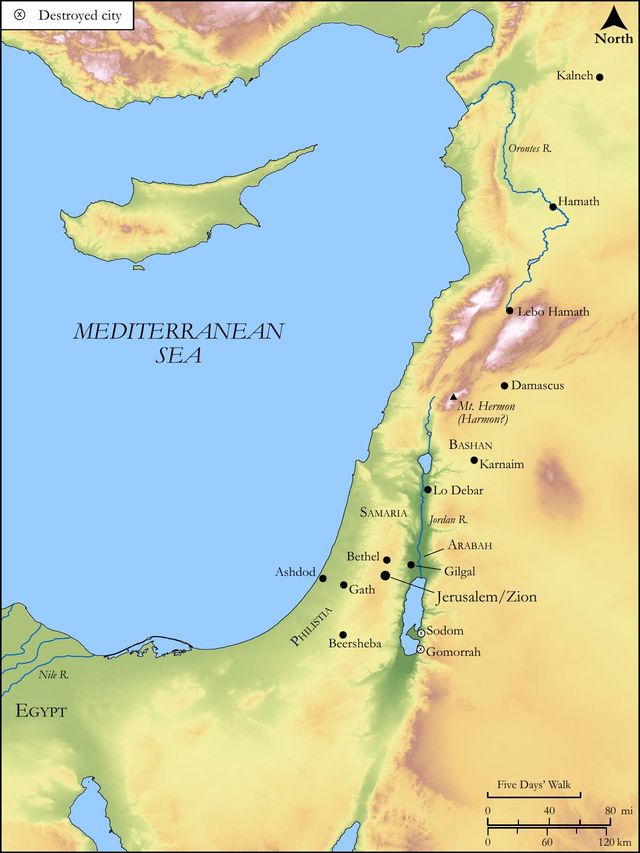
See on the biblical-era map
Study this verse
Public-domain commentary
Matthew Henry
From his Commentary on the Whole Bible. Henry comments on passages, not single verses — this entry covers Amos 4:6–13. His four-level outline is real structure in the source text, so it is rendered as structure.
Here, I. God complains of his people's incorrigibleness under the judgments which he had brought upon them in order to their humiliation and reformation. He had by several tokens intimated to them his displeasure, with this design, that they might by repentance make their peace with him; but it had not that effect.
1.It is five times repeated in these verses, as the burden of the charge, "Yet have you not returned unto me, saith the Lord; you have been several times corrected, but in vain; you are not reclaimed, there is no sign of amendment. You have been sent for by one messenger after another, but you have not come back, you have not come home." (1.) This intimates that that which God designed in all his providential rebukes was to reduce them to their allegiance, to influence them to return to him. (2.) That, if they had returned to their God, they would have been accepted, he would have bidden them welcome, and the troubles they were in would have been removed. (3.) That the reason why God sent further troubles was because former troubles had not done the work, otherwise it is no pleasure to the Almighty that he should afflict. (4.) That God was grieved at their obstinacy, and took it unkindly that they should force him to do that which he did so unwillingly: "You have not returned to me from whom you have revolted, to me with whom you are in covenant, to me who stands ready to receive you, to me who have so often called you." Now,
2.To aggravate their incorrigibleness, and to justify himself in inflicting greater judgments, he recounts the less judgments with which he had tried to bring them to repentance.
(1.)There had sometimes been a scarcity of provisions, though there was no visible cause of it (Amo 4:6): "I have given you cleanness of teeth in all your cities, for you had no meat to chew, whereby your teeth might be fouled," especially no flesh, which dirties the teeth. Or, I have given you emptiness of teeth, nothing to fill your mouths with. "Bread, the staff of life, has been wanting, for you have sown much and brought in little," as Hag 1:9. Some think this refers to that seven years' famine that was in Elisha's time, which we read of Kg2 8:1. Now when God thus took away their corn in the season thereof, because they had prepared it for Baal, they should have said, We will go and return to our first husband, having paid dearly for leaving him; but it had not that effect. They have not returned to me, saith the Lord.
(2.)Sometimes they had wanted rain, and then of course they wanted the fruits of the earth. This evil was of the Lord: I have withholden the rain from you. God has the key of the clouds, and, if he shut up, who can open? Amo 4:7. The rain was withheld when there were yet three months to the harvest, at the time when they used to have it, and therefore the withholding of it was an extraordinary thing, and, if the course of nature was altered, they must therein own the hand of the God of nature; and it was at a time when they most needed it, and therefore the want of it was a very sore judgment, and blasted their expectations of a crop at harvest. And one circumstance which made this very remarkable was that when there were some places that wanted rain, and withered for want of it, there were other places near adjoining that had it in abundance. God caused it to rain upon one city, and not upon another, in the same country; nay, he caused it to rain upon one field, one piece of a field, and it was thereby made fruitful and flourishing, but on the next field, on the other side of the hedge, nay, on another part of the same field, it rained not at all, and it was so long without rain that all the products of it withered. No doubt this was literally true, and there were many instances of it which were generally taken notice of. Now,
[1.]By this it appeared that the withholding of the rain was not casual, but by a divine direction and disposal, and that the cloud which waters the earth is turned round about by the counsels of God, to do whatsoever he commands it, whether for correction, or for his land, or for his mercy, Job 37:12-18. Rain does not go by planets (as common people speak), but as God sends it by his winds.
[2.]We have reason to think that those cities on which it rained not were the most infamous for wickedness, such as Bethel and Gilgal (Amo 4:4), and that those on which it rained were such as retained something of religion and virtue among them. And so in the town-fields it rained or rained not, upon the piece, according as the owner was; for we are sure the curse of the Lord is in the house, and upon the ground, of the wicked, but he blesses the habitation of the just, and his field is a field that the Lord has blessed.
[3.]It would be the greater grief and vexation to those whose fields withered for want of rain to see their neighbours' fields well watered and flourishing. My servants shall eat, but you shall be hungry, Isa 65:13. The wicked shall see it, and be grieved. Probably those that were oppressed were rained upon, and so they recovered their losses, while the oppressors withered, and so lost their gains.
[4.]Yet, as to the nation in general, it was a mixture of mercy with the judgment, and, consequently, strengthened the call to repentance and reformation, and encouraged them to hope for all mercy, in their returns to God, since there was so much mercy even in God's rebukes of them. But, because they did not make good use of this gracious allay to the extremity of the judgment, they had not the benefit of it, which otherwise they might have had, for (Amo 4:8) two or three cities wandered at uncertainty, as beggars, unto one city, to drink water, and, if possible, to have some to carry home with them, but they were not satisfied; it was but here and there one city that had water, while many wanted, and then it was not, as usual, Usus communis aquarum - Water is free to all. Those that had it had occasion for it, or knew not how soon they might, and therefore could afford but little to those that wanted, saying, Lest there be not enough for us and you. Those that came drank water, but they were not satisfied, because they drank it by measure, and with astonishment; and those that drink of this water shall thirst again, Joh 4:13. They were not satisfied, because their desires were greedy, and what they had God did not bless to them, Hag 1:6. And now, one would think, when they met with all this disappointment, they should have considered their ways and repented; but it had not that effect: "Yet have you not returned to me, no, not so much as to pray in a right manner for the former and latter rain," Zac 10:1. See the folly of carnal hearts; they will wander from city to city, from one creature to another, in pursuit of satisfaction, and still they miss of it; they labour for that which satisfies not (Isa 55:2), and yet, after all, they will not return to God, will not incline their ear to him in whom they might have satisfaction. The preaching of the gospel is as rain; God sometimes blesses one place with it more than another; some countries, some cities, are, like Gideon's fleece, wet with this dew, while the ground about is dry; all withers where this rain is wanting. But it were well if people were but as wise for their souls as they are for their bodies, and, when they have not this rain near them, would go and seek it where it is to be had; and, if they seek aright, they shall not seek in vain.
(3.)Sometimes the fruits of their ground were eaten up by caterpillars, or blasted with mildew, Amo 4:9. Heaven and earth are armed against those who have made God their enemy. When God pleased, that is, when he was displeased,
[1.]They suffered by a malignant air, the influence of which, either too hot or too cold, blasted their fruits, with a force that could be neither discerned nor resisted, and against which there was no defence.
[2.]They suffered by malignant animals. Their vineyards and gardens yielded their increase in great abundance, so did their fig-trees and olive-trees; but the palmer-worm devoured them before the fruits were ripe, and fit to be gathered in. This was either the same judgment with that which we read of Joe 1:4-6, or a less judgment of the same nature, sent before to give warning of that. But they did not take warning: Yet have you not returned unto me.
(4.)Sometimes the plague had raged among them, and the sword of war had cut off multitudes, Amo 4:10. The pestilence is God's messenger; this he sent among them, with directions whom to strike dead, and it was done. It was a pestilence after the manner of Egypt; deaths were scattered among them by the hand of a destroying angel at midnight. And perhaps this pestilence, as that of Egypt, fastened upon the first-born. In the way of Egypt (so the margin); when they were making their escape to Egypt, or going thither to seek for aid, the pestilence seized them by the way and stopped their journey. The sword of war is likewise the sword of the Lord; this was drawn among them with commission; and then it slew their young men, the strength of the present generation and the seed of the next. God says, I have slain them; he avows the execution. The slain of the Lord are many. The enemy took away their horses, and converted them to their own use; and the dead carcases of those that were slain either with sword or pestilence were so many, and for want of surviving friends were left so long unburied, that the stench of their camps came up into their nostrils, and was both noisome and dangerous, and might put them in mind of the offensiveness of their sin to God. And yet this did not prevail to humble and reclaim them: You have not returned to him that smites you. Such a rueful woeful sight as this prevailed not to make them religious.
(5.)In these and other judgments some were remarkably cut off, and made monuments of justice, others were remarkably spared, and made monuments of mercy, the setting of which the one over against the other one would have thought likely to work upon them, but it had not its effect, Amo 4:11.
[1.]Some were quite ruined, their families destroyed, and themselves in them: I have overthrown some of you, as God overthrew Sodom and Gomorrah. Perhaps they were consumed with lightning, as Sodom was, or the houses were, in some other way, burnt to the ground, and the inhabitants in them. Sodom and Gomorrah are said to be condemned with an overthrow, and so made an example, Pe2 2:6. God had threatened to destroy the whole land with such an overthrow as that of Sodom, Deu 29:23. But he began with some particular places first, to give them warning, or perhaps with some particular persons, whose sins went beforehand to judgment.
[2.]Others very narrowly escaped: "You were many of you as a firebrand plucked out of the burning, like Lot out of Sodom, when the fire had already kindled upon you; and yet you hate sin never the more for the danger it has brought you to, nor love God ever the more for the deliverance he wrought for you. You that have been so signally delivered, and in such a distinguishing way, have not returned unto me."
II.God, in the close, calls upon his people, now at length, in this their day, to understand the things that belong to their peace, before they were hidden from their eyes, Amo 4:12, Amo 4:13. Observe here,
1.How God threatens them with sorer judgments than any they had yet been under: "Therefore, seeing you have not been wrought upon by correction hitherto, thus will I do unto thee, O Israel!" He does not say how he will do, but it shall be something worse than had come yet, Joh 5:14. Or, "Thus I will go on to do unto thee, following one judgment with another, like the plagues of Egypt, till I have made a full end." Nothing but reformation will prevent the ruin of a sinful people. If they turn not to him, his anger is not turned away, but his hand is stretched out still. I will punish you yet seven times more, if you will not be reformed; so it was written in the law, Lev 26:23, Lev 26:24.
2.How he awakens them therefore to think of making their peace with God: "Seeing I will do this unto thee, and there is no remedy, prepare to meet they God, O Israel!" that is, (1.) "Consider how unable thou art to meet him as a combatant." Some make it to be spoken by way of irony or challenge: "Prepare to meet God, who is coming forth to contend with thee. What armour of proof canst thou put on? What courage canst thou steel thyself with? Alas! it is but putting briers and thorns before a consuming fire, Isa 27:4, Isa 27:5. Art thou able with less than 10,000 to meet him that comes forth against thee with more than 20,000?" Luk 14:31. (2.) "Resolve therefore to meet him as a penitent, as a humble suppliant, to meet him as thy God, in covenant with thee, to submit, and stand it out no longer." We must prepare to meet God in the way of his judgments (Isa 26:8), to take hold on his strength, that we may make peace. Note, Since we cannot flee from God we are concerned to prepare to meet him; and therefore he gives us warning, that we may prepare. When we are to meet him in his ordinances we must prepare to meet him, prepare to seek him.
3.How he sets forth the greatness and power of God as a reason why we should prepare to meet him, Amo 4:13. If he be such a God as he is here described to be, it is folly to contend with him, and our duty and interest to make our peace with him; it is good having him our friend and bad having him our enemy.
(1.)He formed the mountains, made the earth, the strongest stateliest parts of it, and by the word of his power still upholds it and them. Whatever are the products of the everlasting mountains, he formed them; whatever salvation is hoped for from hills and mountains, he is the founder of it, Psa 89:11, Psa 89:12. He that formed the great mountains can make them plain, when they stand in the way of his people's salvation.
(2.)He creates the wind. The power of the air is derived from him, and directed by him; he brings the wind out of his treasures, and orders from what point of the compass it shall blow; and he that made it rules it; even the winds and the seas obey him.
(3.)He declares unto man what is his thought. He makes known his counsel by his servants the prophets to the children of men, the thought of his justice against impenitent sinners, and the thought of good he thinks towards those that repent. He can also make known, for he perfectly knows, the thought that is in man's heart; he understands it afar off, and in the day of conviction will set the evil thoughts among the other sins of sinners in order before them.
(4.)He often makes the morning darkness, by thick clouds overspreading the sky immediately after the sun rose bright and glorious; so when we look for prosperity and joy he can dash our expectations with some unlooked-for calamity.
(5.)He treads upon the high places of the earth, is not only higher than the highest, but has dominion over all, tramples upon proud men, and upon the idols that were worshipped in the highest places.
(6.)Jehovah the God of hosts is his name, for he has his being of himself, and is the fountain of all being, and all the hosts of heaven and earth are at his command. Let us humble ourselves before this God, prepare to meet him, and give all diligence to make him our God, for happy are the people whose God he is, who have all this power engaged for them.
Historical interpretation
Historical reception
1 surviving comment on this verse from the historical church.
(Verse 4 and following) Come to Bethel, and act wickedly: to Gilgal, and multiply transgression, and bring your morning sacrifices, your tithes for three days. And offer praise with leaven (Vulgate: with fermented dough), and call for voluntary offerings, and proclaim. For thus you have desired, O children of Israel, says the Lord God. Therefore, I have given you the stench of decay in all your cities and the lack of bread in all your places; and you have not returned to me, says the Lord. You entered Bethel and acted wickedly in Gilgal, multiplying your impious acts. And you brought your offerings in the morning, your tithes on the third day. And you read the law outside and made confessions. Proclaim that the children of Israel have loved these things, says the Lord God. And I will give you the astonishment of teeth in all your cities, and the lack of bread in all your places, and you have not returned to me, says the Lord. Let us lay the foundations of history first: O wretched Israel, captivity is now near to you, the Assyrian army is now advancing: do whatever you please, act impiously: freely fornicate with idols, so that the more shameless you are, the more just my sentence will appear above your torments. 'Come,' he says, 'to Bethel, where you have set up a golden calf, and act impiously towards God. Come to Gilgal, the place of idolatry, of which I spoke through Hosea: 'All their wickedness is in Gilgal' (Hosea 9:15).' And again in the same place: They were in vain in Gilgal, sacrificing to cows (Ibid., XII, 11). And when you come to Gilgal: multiply transgression. For whatever you do there is transgression against God, to whom you prefer idols. And bring your offerings in the morning, lest there be any delay in wickedness. On the third day, give your tithe: or, as Symmachus interpreted, give your tithe on the third day. The explanation of this place seems to us to be: in the Book of Leviticus it is commanded (Lev. VII) that certain offerings should not be reserved for another day, and that others should not remain until the third day: if they do, they shall be unclean. So the meaning is: Sacrifice unclean victims every day, and offer polluted sacrifices, and make a sacrifice of leaven as praise, which is not completely offered to God according to the precepts of Moses. For praise, Eucharist has been interpreted as thanksgiving, which in Hebrew is called Todah (). And he says to call them voluntary offerings, which the Hebrews call Nadaboth (), meaning spontaneous. But a voluntary sacrifice belongs to joy: which in Latin we can call a feast. And when you have done this, announce your impiety to everyone: so that you not only seem to have done it, but also to have taught others. But I command this, and I speak in an imperative manner, in order to satisfy your wishes, because you have acted and desired this way, O children of Israel, says the Lord God. Therefore, I have also given you a shock of teeth, which the Septuagint translated as 'astonishment', whom we have followed in this place because of the simplicity of the word: either the cleanliness of teeth, as Aquila and Symmachus interpreted it, in order to demonstrate the magnitude of hunger through clean teeth. And I made a scarcity of bread, not in one city, but in all your cities; neither in one place, but in all your places. And when I did this, it was not to punish, but to give an opportunity for repentance; yet you did not turn back to Me, says the Lord. This is what we have said according to the Hebrew text: let us now turn to the Seventy Interpreters, and briefly discuss what seems to us, according to the anagogical interpretation, in each (verse); for the greatness of the books does not allow us to say both in each edition. You entered into Bethel, that is, the house of God, which is understood as the Church: and you acted impiously towards the Lord, trampling upon His commandments. But in Galgala, which means revelation or scroll, you have multiplied impieties, claiming knowledge of the holy Scriptures for yourselves: and while you are exalting yourselves in pride, you have fallen to the lowest filth. Moreover, you have brought your morning offerings, your tithes on the third day, transformed into an angel of light: and you have confined the triple understanding of the Scriptures (which we have been commanded to write in our hearts in three ways) into a single interpretation. For we must understand Holy Scripture, first according to the letter, doing whatever precepts are in ethics. Secondly, according to the allegory, that is, the spiritual understanding. Thirdly, according to the future blessedness. But you, despising the first and the second day, compose for yourselves certain spiritual figments without foundation, and place a roof upon them without walls. Nor are they heretics, concerning whom and to whom it is said, being content with the end of ungodliness: but they have read outside the Church the law of God, and have attempted to join together confessions and testimonies to their own perverted heart: or they have sacrificed of the leaven, concerning which it is said in the Gospel, 'Beware of the leaven,' that is, the doctrine of the Pharisees. And they did these things not by error, but by study: not by chance will, but by the fullest charity of their ancestors. Hence the Lord threatens vengeance upon them: I will give you the astonishment of teeth, which in Greek is called 'γομφιασμός'. For if anyone, according to Ezekiel (Ezek. 18), eats a sour grape, his teeth will be astonished: so that those who abuse the testimonies of the holy scriptures, consuming them immature and without their sweetness, may lose the strength of their teeth: so that they are unable to chew tough things, which are beneficial to the whole body, and pass into the stomach. I will give you this wonder of teeth and scarcity of food in all cities, and in all your places, so that you may suffer the hunger of the Word of God, and its bread which descended from heaven (John VI), and of which it is written in the Psalms: Man ate the bread of angels (Psalm LXXVII, 15). All these things I have done not out of cruelty and savagery, as heretics may calumniate, but out of severity and seriousness of judgment, so that you may convert to me, according to what is written: I have struck your children in vain, they did not receive discipline (Jeremiah II, 30).
Continue studying Amos 4:6 across the web’s major study libraries — every link below opens this exact verse, chapter, or book on the destination site.
Read & Compare
 BibleGatewayThis verse in more than 200 translations and 70 languages.
 Bible.comThe YouVersion reader — hundreds of translations, reading plans, and highlights.
 ESV.orgCrossway's official English Standard Version reader.
 NET BibleThe NET translation with 60,000+ translators' notes on every rendering decision.
 STEP BibleTyndale House's free study tool — original text, vocabulary, and scholarly resources.
 BibliaLogos Bible Software's free web reader.
 USCCBThe New American Bible (Revised Edition) with the U.S. bishops' study notes.
Commentaries
 BibleHub CommentariesDozens of classic commentaries on this verse, gathered on one page.
 StudyLightMore than 100 commentary sets — the largest collection on the web.
 BibleRefPlain-English commentary on what this verse means, verse by verse.
 Enduring WordDavid Guzik's free commentary on this chapter, widely used by Bible teachers.
 Bible Study ToolsVerse commentary alongside Greek and Hebrew study aids.
Original Language & Research
- BibleHub InterlinearThe verse word by word — original language, transliteration, and English.
- BibleHub LexiconEvery word's original-language definition and Strong's entry.
 Blue Letter BibleDeep-study tools — Strong's numbers, concordance, and word studies.
 SefariaThe Hebrew text with Rashi and centuries of Jewish commentary.
Sermons, Hymns & Audio


TrulyRandomVerse is not affiliated with these sites and doesn’t control their content. They’re linked because they’re genuinely useful.
Summary
Amos 4:6 initiates a series of divine pronouncements detailing God's disciplinary judgments against the Northern Kingdom of Israel, beginning with a severe and widespread famine. This verse highlights the Lord's deliberate action in withholding sustenance, not as an act of arbitrary punishment, but as a merciful yet firm attempt to call His wayward people to repentance and restore their covenant relationship, a call to which they stubbornly failed to respond.
Context
ShowHideLiterary Context
Amos 4:6 marks the beginning of a poignant and repetitive refrain throughout the chapter, "yet have ye not returned unto me, saith the LORD." This phrase concludes five distinct accounts of divine judgment (famine in Amos 4:6, drought in Amos 4:7-8, blight and locusts in Amos 4:9, plague and war in Amos 4:10, and overthrow like Sodom in Amos 4:11). Each judgment is described as a specific act of God, designed to elicit a spiritual response from Israel, yet each is met with their unyielding stubbornness. The repetition of the concluding phrase underscores Israel's spiritual blindness and the escalating nature of God's disciplinary measures.
Historical & Cultural Context
The prophet Amos ministered to Israel (the Northern Kingdom) during the reign of Jeroboam II (c. 793-753 BC), a period characterized by remarkable economic prosperity and territorial expansion. However, this outward success masked profound spiritual decay, rampant oppression, and widespread idolatry, particularly the worship of golden calves at Bethel and Dan, and Baal worship. Famine was a well-understood covenant curse for disobedience, explicitly outlined in texts like Deuteronomy 28:15-68. The "cleanness of teeth" idiom would have been immediately understood by the original audience as a stark depiction of starvation, a direct consequence of God withholding the rain and blessing necessary for agricultural prosperity.
Key Themes
ShowHideThe overarching theme of Amos 4 is God's persistent yet ultimately unheeded call to repentance. This chapter vividly illustrates the theme of Divine Discipline as Redemptive Opportunity, where God's judgments are not merely punitive but are intended to bring His people back into covenant faithfulness. It also powerfully portrays Israel's Stubborn Unresponsiveness, highlighting their deep-seated apostasy despite escalating hardships. This unresponsiveness underscores the theme of Covenant Faithfulness and Consequences, demonstrating that God holds His people accountable to the covenant He made with them, and disobedience inevitably leads to severe repercussions, even if those repercussions are initially designed to prompt a "return" to Him. The phrase "saith the LORD" (Amos 4:8, Amos 4:9, etc.) emphasizes the divine authority behind these pronouncements and actions.
Exposition and Analysis
ShowHideKey Word Analysis
ShowHideMeaning "clearness (literally or figuratively); cleanness, innocency." In the context of "cleanness of teeth," it refers to teeth that are unnaturally clean due, not to hygiene, but to the complete absence of food. This word starkly conveys the severity of the famine, highlighting a state of absolute deprivation where there is nothing to eat that would stain or dirty the teeth.
Meaning "poverty; in want of." This term directly describes the state of scarcity and destitution that the famine brought upon Israel. It emphasizes the lack, the deficiency, and the dire need for basic sustenance, reinforcing the widespread nature of the hunger that permeated "all your places."
A primitive root meaning "to turn back (hence, away) transitively or intransitively, literally or figuratively (not necessarily with the idea of return to the starting point); generally to retreat; often adverbial, again." In this context, "returned unto me" signifies a spiritual turning, a repentance, a turning away from idolatry and injustice back to the covenant relationship with Yahweh. It is the desired outcome of God's disciplinary actions, highlighting His persistent desire for His people's restoration.
Verse Breakdown
ShowHide"And I also have given you cleanness of teeth in all your cities"
This clause reveals the divine hand behind the affliction. The famine was not a random natural disaster but a direct act of God ("I also have given"). "Cleanness of teeth" is a vivid idiom for extreme starvation, implying that there was no food to chew, leaving teeth unnaturally clean. The phrase "in all your cities" emphasizes the widespread and pervasive nature of this famine, affecting urban centers where food supplies might typically be more stable.
"and want of bread in all your places"
This phrase reiterates and amplifies the previous one, specifying the nature of the "cleanness of teeth" – a severe "want of bread," which represents all basic foodstuffs. "In all your places" broadens the scope beyond just cities to encompass every locality, underscoring the comprehensive and inescapable nature of the famine across the entire Northern Kingdom.
"yet have ye not returned unto me, saith the LORD."
This is the crucial concluding indictment and the central message of the verse. Despite the undeniable and severe judgment of famine, Israel had failed to repent, to turn back to Yahweh their God. The phrase "saith the LORD" (Yahweh, H3068) asserts the divine authority and certainty of this declaration, emphasizing that it is the covenant God Himself who is speaking and lamenting their stubbornness.
Literary Devices
ShowHideAmos 4:6 employs several powerful literary devices. The most prominent is Idiom, specifically "cleanness of teeth," which is a graphic and culturally resonant expression for extreme famine. This idiom evokes a stark image of starvation, where teeth remain unnaturally clean due to the complete absence of food. The verse also utilizes Repetition, as the concluding phrase "yet have ye not returned unto me, saith the LORD" becomes a recurring refrain throughout Amos 4, emphasizing Israel's persistent unresponsiveness to God's escalating judgments. This repetition creates a powerful rhetorical effect, highlighting the Lord's lament and the people's stubbornness. Furthermore, the phrase "saith the LORD" functions as a Divine Oracle Formula, lending absolute authority and divine origin to the pronouncement, underscoring that these are not mere human observations but direct words from God Himself. The entire verse also functions as a form of Rhetorical Indictment, where God presents evidence of His disciplinary actions and Israel's failure to respond, setting the stage for further judgment.
Theological and Thematic Connections
ShowHideAmos 4:6 profoundly illustrates God's active involvement in the lives of His covenant people, even through hardship. The famine was not an arbitrary misfortune but a divinely ordained consequence, a purposeful act of discipline aimed at eliciting repentance. This reflects a consistent biblical truth that God uses various means, including adversity, to draw His people back to Himself and to remind them of their covenant obligations. His patience, despite their stubbornness, underscores His enduring love and desire for their restoration rather than their annihilation. The failure of Israel to "return" highlights the human tendency towards spiritual blindness and hardened hearts, even in the face of clear divine intervention.
Reflection and Application
ShowHideAmos 4:6 serves as a timeless mirror for self-examination, prompting us to consider our own responses when faced with difficulties and hardships. Just as God disciplined Israel out of love, He often allows or sends challenging circumstances into our lives, not to punish us vindictively, but to refine our faith, reveal hidden idols, and draw us into deeper dependence on Him. These "cleanness of teeth" moments can be divine invitations to pause, assess our spiritual state, and re-evaluate our priorities. Do we, like ancient Israel, harden our hearts and persist in our self-reliance, or do we humble ourselves, acknowledge God's hand, and genuinely "return unto Him"? True wisdom lies in recognizing God's voice in the midst of adversity and responding with sincere repentance and renewed commitment to His will.
Questions for Reflection
ShowHideFAQ
ShowHideWhat does "cleanness of teeth" mean in Amos 4:6?
ShowHide"Cleanness of teeth" is an ancient idiom used to describe a severe famine or starvation. In times of plenty, one's teeth would be stained or dirty from constant eating. Therefore, "cleanness of teeth" implies that there was no food to eat, leaving the teeth unnaturally clean. This vivid imagery underscores the widespread and acute hunger that afflicted Israel, as there was a "want of bread in all your places" (Amos 4:6).
Why did God send famine and other judgments upon Israel in Amos 4?
ShowHideGod sent famine and other judgments (like drought, blight, and plague, as described in Amos 4:7-11) upon Israel primarily as a form of disciplinary love, not immediate destruction. His purpose was to call His wayward people to repentance and to turn them back to their covenant relationship with Him. The repeated refrain, "yet have ye not returned unto me, saith the LORD," highlights God's persistent desire for their spiritual restoration, even as it laments their stubborn unresponsiveness. These were covenant curses (Deuteronomy 28) designed to awaken their conscience and prompt a spiritual "return."
Christ-Centered Fulfillment
ShowHideThe unresponsiveness of Israel to God's escalating discipline in Amos 4:6 and subsequent verses foreshadows humanity's persistent rebellion and the ultimate need for a more profound intervention than mere temporal judgments. While God's patience in the Old Testament sought a "return" through external pressures, the New Covenant reveals the ultimate "return" made possible through Christ. Israel's inability to turn back on their own underscores the deep-seated sinfulness of the human heart, a condition that only the atoning work of Jesus could remedy. The "want of bread" in Amos points to humanity's spiritual hunger and the ultimate provision of the "Bread of Life," Jesus Christ, who declared, "I am the bread of life; whoever comes to me shall not hunger, and whoever believes in me shall never thirst" (John 6:35). God's desire for His people to "return unto me" finds its perfect fulfillment in the gospel, where through Christ's sacrifice, we are reconciled to God and given a new heart that desires to obey and follow Him (Ezekiel 36:26-27). Thus, the discipline in Amos, though severe, served as a painful but necessary prelude, revealing the depth of human need that only the grace of Christ could fully satisfy, bringing about a true and lasting return to God.