


Revelation 16:10
- ΚαὶKaiAndG2532CONJConjunction
- ὁhotheG3588T-NSMDefinite article Nominative Singular Masculine
- πέμπτοςpemptosfifthG3991A-NSMAdjective Nominative Singular Masculine
- ἄγγελοςangelosangelG32N-NSMNoun Nominative Singular Masculine
- ἐξέχεενexecheenpoured outG1632V-AAI-3SVerb Aorist Active Indicative 3rd Singular
- τὴνtēntheG3588T-ASFDefinite article Accusative Singular Feminine
- φιάληνphialēnbowlG5357N-ASFNoun Accusative Singular Feminine
- αὐτοῦautouof himG846P-GSMPersonal pronoun Genitive Singular Masculine
- ἐπὶepiuponG1909PREPPreposition
- τὸνtontheG3588T-ASMDefinite article Accusative Singular Masculine
- θρόνονthrononthroneG2362N-ASMNoun Accusative Singular Masculine
- τοῦtouof theG3588T-GSNDefinite article Genitive Singular Neuter
- θηρίουthērioubeastG2342N-GSNNoun Genitive Singular Neuter
- καὶkaiandG2532CONJConjunction
- ἐγένετοegenetobecameG1096V-2ADI-3SVerb 2nd Aorist Middle Deponent Indicative 3rd Singular
- ἡhētheG3588T-NSFDefinite article Nominative Singular Feminine
- βασιλείαbasileiakingdomG932N-NSFNoun Nominative Singular Feminine
- αὐτοῦautouof itG846P-GSNPersonal pronoun Genitive Singular Neuter
- ἐσκοτωμένηeskotōmenēdarkenedG4656V-RPP-NSFVerb Perfect Passive Participle Nominative Singular Feminine
- καὶkaiandG2532CONJConjunction
- ἐμασῶντοemasōntothey were gnawingG3145V-INI-3PVerb Imperfect Middle Or Passive Deponent Indicative 3rd Plural
- τὰςtastheG3588T-APFDefinite article Accusative Plural Feminine
- γλώσσαςglōssastonguesG1100N-APFNoun Accusative Plural Feminine
- αὐτῶνautōnof themG846P-GPMPersonal pronoun Genitive Plural Masculine
- ἐκekforG1537PREPPreposition
- τοῦtoutheG3588T-GSMDefinite article Genitive Singular Masculine
- πόνουponoudistressG4192N-GSMNoun Genitive Singular Masculine
English is a literal word-by-word gloss of the Greek, not the KJV's wording. Why?
This is the original text the KJV's translators worked from — each Greek word with its own literal English meaning in this verse, prepared by scholars at Tyndale House, Cambridge. The KJV translates whole sentences, not word by word, so its wording differs: one Greek word can become several English words, and the KJV may choose “charity” where the gloss reads “love”. Both are faithful — they answer different questions. For the KJV's own rendering, switch to the KJV text.
Details
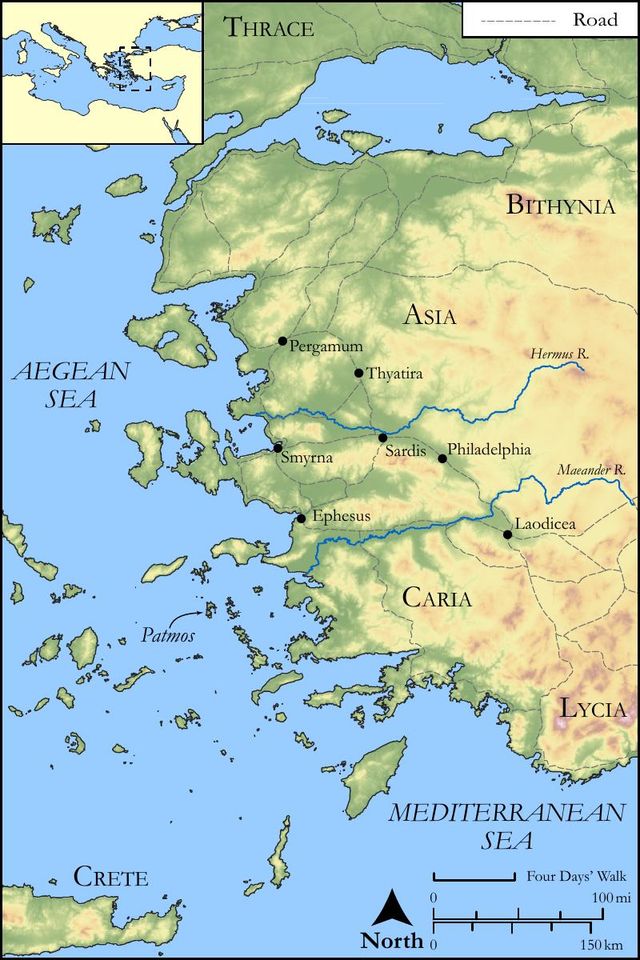
See on the biblical-era map

Study this verse
Public-domain commentary
Matthew Henry
From his Commentary on the Whole Bible. Henry comments on passages, not single verses — this entry covers Revelation 16:8–11.
In these verses we see the work going on in the appointed order. The fourth angel poured out his vial, and that fell upon the sun; that is, say some, upon some eminent prince of the popish communion, who should renounce their false religion a little while before his utter downfall; and some expect it will be the German emperor. And now what will be the consequence of this? That sun which before cherished them with warm and benign influences shall now grow hot against these idolaters, and shall scorch them. Princes shall use their power and authority to suppress them, which yet will be so far from bringing them to repentance, that it will cause them to curse God and their king, and look upward, throwing out their blasphemous speeches against the God of heaven; they will be hardened to their ruin. The fifth angel poured out his vial, Rev 16:10. And observe, 1. Where this fell - upon the seat of the beast, upon Rome itself, the mystical Babylon, the head of the antichristian empire. 2. What effect it had there: The whole kingdom of the beast was full of darkness and distress. That very city which was the seat of their policy, the source of all their learning, and all their knowledge, and all their pomp and pleasure, now becomes a source of darkness, and pain, and anguish. Darkness was one of the plagues of Egypt, and it is opposed to lustre and honour, and so forebodes the contempt and scorn to which the antichristian interest should be exposed. Darkness is opposed to wisdom and penetration, and forbodes the confusion and folly which the idolaters should discover at that time. It is opposed to pleasure and joy, and so signifies their anguish and vexation of Spirit, when their calamities thus came upon them.
Historical interpretation
Four Centuries of Reception
5 surviving comments on this verse. Each one is dated, so this reads as a timeline rather than a list.
Select a marker to jump to its quote. Markers stagger vertically where authors wrote within a few decades of each other.
The throne of the beast, or his kingdom, as it were, his judicial authority, is said to be darkened, because [its followers] are darkened by the joy of earthly happiness. And although they heartily rejoice in their present good rather than in the possessing of the highest blessedness, they “suppress the truth by wickedness,” and so gnaw at their own tongues. The psalm adds its voice to this understanding when it says, “whose mouths speak lies and whose right hand is a right hand of iniquity,” and “they spoke iniquity from on high.” Just like smoke, they rise by the arrogance of their temporary prosperity, from which they ought to turn in repentance, and although they are in the dark, they rejoice. As Job said, “They spend their days in prosperity, and in a moment they go down to hell.”
Pouring the bowl on the throne of the beast signifies the pouring out of a great wrath upon the kingdom of the antichrist. This kingdom is shown to be in darkness, that is, it is bereft of the light of the “sun of righteousness.” The gnawing of tongues reveals the intensity of the pain that those who have been deceived by him will have when they are struck by these plagues sent from God. These things will occur so that they might recognize that he whom they have worshiped as God is a fraud and so might want to be free from their deception. However, they will not turn from this to repentance. Rather, they will turn to further blasphemy.
And the fifth poured out his bowl, etc. The seat of the beast, that is, his kingdom, like judicial power, is darkened by such plagues, that is, the false joy of earthly happiness, and it becomes devoid of light, as the Psalm says: You cast them down as they were lifted up (Psalm LXXIII). For he did not say, after they were elevated.
And they gnawed their tongues because of pain. Just as the righteous will eat the labors of their fruits, so the wicked, exposed to the worthy punishments of their blasphemy, are as if satiated with their own tongues. They harmed themselves by blaspheming out of God's wrath, in which they thought they found joy.
And the bowl of the fifth angel was poured out, he says, upon the throne of the beast; and his kingdom became darkened. For it is written concerning the apostle about the Antichrist, "whom the Lord will consume by the breath of His mouth," (2 Thess. 2:8) and concerning Isaiah: "Let the wicked be taken away that he may not see the glory of the Lord," (Isa. 26:10) "the glory" that calls the Lord's glorious presence.
The previous statement that the bowl was poured out upon the throne of the beast indicates that the godlessness of the Antichrist will receive a tyrannical end, his ruin being wretchedly effected, and that darkness will seize all those placed under him with unexpected punishment of the accursed; for they remain in darkness of thoughts, perplexed by what has happened.
Continue studying Revelation 16:10 across the web’s major study libraries — every link below opens this exact verse, chapter, or book on the destination site.
Read & Compare
 BibleGatewayThis verse in more than 200 translations and 70 languages.
 Bible.comThe YouVersion reader — hundreds of translations, reading plans, and highlights.
 ESV.orgCrossway's official English Standard Version reader.
 NET BibleThe NET translation with 60,000+ translators' notes on every rendering decision.
 STEP BibleTyndale House's free study tool — original text, vocabulary, and scholarly resources.
 BibliaLogos Bible Software's free web reader.
 USCCBThe New American Bible (Revised Edition) with the U.S. bishops' study notes.
Commentaries
 BibleHub CommentariesDozens of classic commentaries on this verse, gathered on one page.
 StudyLightMore than 100 commentary sets — the largest collection on the web.
 BibleRefPlain-English commentary on what this verse means, verse by verse.
 Enduring WordDavid Guzik's free commentary on this chapter, widely used by Bible teachers.
 Bible Study ToolsVerse commentary alongside Greek and Hebrew study aids.
Original Language & Research
- BibleHub InterlinearThe verse word by word — original language, transliteration, and English.
- BibleHub LexiconEvery word's original-language definition and Strong's entry.
 Blue Letter BibleDeep-study tools — Strong's numbers, concordance, and word studies.
 CNTR CollationThe earliest Greek manuscripts of this verse, collated letter by letter.
Sermons, Hymns & Audio


TrulyRandomVerse is not affiliated with these sites and doesn’t control their content. They’re linked because they’re genuinely useful.
Summary
Revelation 16:10 describes the pouring out of the fifth bowl of God's wrath, a severe judgment targeting the very seat of the beast's authority. This divine act plunges the beast's kingdom into profound darkness, causing its adherents to experience excruciating pain, so intense that they gnaw their tongues in agony. This scene vividly portrays the escalating divine retribution against those who have aligned themselves with the anti-God system, highlighting the futility of rebellion against the Almighty.
Context
ShowHideLiterary Context
Revelation 16:10 is strategically placed within the sequence of the seven bowl judgments, which constitute the final and most intense series of God's wrath upon the earth's inhabitants during the end times. These bowls are unleashed after the seven trumpets and the seven signs, representing the culmination of divine retribution against a rebellious world. The preceding bowls targeted the earth (sores), the sea (blood), rivers and springs (blood), and the sun (scorching heat). The fifth bowl, therefore, marks a significant escalation, shifting the focus from the natural world to the direct center of the beast's power, signifying a direct assault on its dominion and authority, immediately preceding the drying of the Euphrates and the gathering for Armageddon.
Historical & Cultural Context
The imagery of a "seat" or "throne" (Greek thronos) would have resonated deeply with John's original audience, who lived under the pervasive power of the Roman Empire. Rome, with its imperial cult and emperor worship, represented a system that demanded ultimate allegiance, often in direct opposition to the worship of God. The "seat of the beast" likely alludes to the very capital or center of this oppressive, anti-God political and spiritual power. The concept of "darkness" as a divine judgment is deeply rooted in Old Testament narratives, most notably the ninth plague upon Egypt, where a palpable, oppressive gloom symbolized God's judgment and the spiritual blindness of Pharaoh and his people. The "gnawing of tongues for pain" vividly communicates a level of suffering so extreme that it drives individuals to self-destructive acts, a common ancient expression of utter despair and agony.
Key Themes
ShowHideThis verse powerfully contributes to several overarching themes in Revelation. Firstly, it underscores the theme of Divine Sovereignty and Judgment, demonstrating that even the most formidable earthly powers, like the beast's kingdom, are ultimately subject to God's ultimate authority and judgment. The direct targeting of the beast's "seat" emphasizes that no power can withstand God's wrath. Secondly, it highlights the theme of Spiritual Darkness and Blindness, portraying not only a physical absence of light but also a profound spiritual void and the removal of God's favor, leading to confusion and despair, echoing the spiritual state of those who reject God's truth, as described in Revelation 16:11. Finally, the intense suffering coupled with the lack of repentance (as seen in John 3:19-20) reinforces the theme of Hardened Hearts, illustrating the tragic reality that even overwhelming judgment does not automatically lead to turning towards God for those whose hearts are set against Him.
Exposition and Analysis
ShowHideKey Word Analysis
ShowHideThis verb signifies a forceful and complete emptying, often implying an irreversible action. In the context of the bowl judgments, it conveys the unreserved and absolute nature of God's wrath being fully dispensed, leaving nothing held back. It is not a sprinkling or a gentle flow, but a decisive outpouring, emphasizing the finality and intensity of the judgment.
While literally meaning a "stately seat," thrónos in this context carries the profound implication of a "throne," symbolizing power, authority, and dominion. The judgment is not merely a general affliction upon the beast's followers, but a direct, targeted strike at the very source and center of its usurped authority, demonstrating God's ultimate challenge to its claim of kingship.
This term means "to obscure or blind," whether literally or figuratively. Here, it describes a state of being completely enveloped in darkness. This is not merely the absence of light but an active state of spiritual and existential gloom, symbolizing confusion, despair, divine abandonment, and the spiritual blindness that afflicts those who oppose God. It is a judgment that removes any sense of divine presence or guidance.
Verse Breakdown
ShowHide"And the fifth angel poured out his vial upon the seat of the beast;"
This clause initiates the specific judgment, identifying the agent (the fifth angel), the instrument (his vial, or bowl), and the precise target: the very center of the beast's power and authority. This indicates a direct, strategic strike against the anti-God system's governing core, rather than a general affliction.
"and his kingdom was full of darkness;"
Following the pouring out of the bowl, the immediate consequence is a pervasive, oppressive darkness that engulfs the beast's entire domain. This darkness is both a physical manifestation of judgment and a profound spiritual state, symbolizing the absence of divine light, truth, and favor, leading to confusion, despair, and a foretaste of eternal separation from God.
"and they gnawed their tongues for pain,"
This vivid and chilling imagery describes the extreme, unbearable agony experienced by those within the beast's kingdom. To "gnaw their tongues" is a graphic depiction of intense, unmitigated suffering and frustration, so severe that it drives the afflicted to self-mutilation or desperate, futile acts in response to their torment. It underscores the severity of the judgment and the utter desperation of the unrepentant.
Literary Devices
ShowHideRevelation 16:10 employs several powerful literary devices to convey its message. Symbolism is paramount, with the "vial" or bowl representing God's contained wrath, ready to be unleashed. The "seat of the beast" is symbolic of the anti-Christian power's central authority and dominion, while "darkness" symbolizes divine judgment, spiritual blindness, and the absence of God's light and favor. The "beast" itself is a profound symbol of oppressive, anti-God political and spiritual power throughout Revelation. Hyperbole is evident in the phrase "they gnawed their tongues for pain," which is an exaggerated expression to convey the extreme, unbearable intensity of the suffering, emphasizing the utter desperation and agony of those afflicted. Furthermore, there is a clear Allusion to the Old Testament plagues, particularly the plague of darkness in Egypt, drawing a parallel between God's judgments in the past and His final judgments in the end times, reinforcing the continuity of divine justice.
Theological and Thematic Connections
ShowHideRevelation 16:10 profoundly illustrates the theological truth of God's unyielding justice and His ultimate sovereignty over all earthly powers, no matter how formidable or oppressive they may seem. The direct targeting of the "seat of the beast" signifies that no authority, human or demonic, can ultimately withstand the righteous judgment of the Almighty. This judgment is not arbitrary but a just response to persistent rebellion, idolatry, and the persecution of God's people. The resulting darkness symbolizes the spiritual consequences of rejecting divine light and truth, leading to an experiential void of God's presence and favor. Despite the excruciating pain, the lack of repentance highlighted in the subsequent verse (Revelation 16:11) underscores the tragic reality of hardened hearts that prefer rebellion over reconciliation, even in the face of overwhelming divine wrath.
Reflection and Application
ShowHideRevelation 16:10, though depicting future eschatological events, offers profound insights for believers today. It serves as a stark reminder that all earthly powers, especially those that oppose God, are finite and ultimately subject to His supreme authority. The judgment of darkness and pain underscores the severe consequences of persistent rebellion against divine truth and righteousness. For us, it should cultivate a deep reverence for God's justice and a sober understanding of the gravity of sin. It challenges us to examine our own allegiances: are we aligning ourselves with the transient powers of this world or with the eternal kingdom of God? The unrepentant suffering depicted here is a powerful call to embrace the opportunity for repentance and faith while it is still available, recognizing that a hardened heart, even under duress, may refuse to turn to God. Ultimately, this verse reinforces the importance of living in the light of Christ, choosing truth over spiritual darkness, and trusting in God's ultimate triumph over all evil.
Questions for Reflection
ShowHideFAQ
ShowHideWhat is the "seat of the beast" and why is it targeted by this judgment?
ShowHideThe "seat of the beast" refers to the center of the anti-God power's authority, dominion, and influence. In Revelation, the "beast" symbolizes a powerful, oppressive, and blasphemous political and spiritual system that opposes God and persecutes His people. By pouring the bowl directly "upon the seat of the beast," God is not merely afflicting its followers generally, but directly striking at the very core of its power structure, its headquarters, or its source of authority. This targeted judgment demonstrates God's ultimate sovereignty and His direct challenge to the beast's usurped claim to kingship and control, signifying that He is dismantling its dominion from its very foundation. It's a precise and devastating blow to the heart of the rebellion.
Christ-Centered Fulfillment
ShowHideWhile Revelation 16:10 vividly portrays the intense judgment upon the beast's kingdom, its ultimate Christ-centered fulfillment lies in the stark contrast it presents to the redemptive work of Jesus Christ. The darkness that engulfs the beast's kingdom and the agonizing pain of its inhabitants highlight the consequences of rejecting the true Light of the World. In contrast, Jesus Christ is the one who came to shine in the darkness, to deliver humanity from the domain of darkness and transfer us to the kingdom of His beloved Son. The gnawing pain of the unrepentant stands in stark opposition to the peace and healing offered through Christ's atoning sacrifice, where by His wounds we are healed. Ultimately, the judgment on the beast's throne foreshadows the triumphant return of Christ, who will overthrow all earthly powers and establish His eternal kingdom, where there will be no darkness, no pain, and no tears, but only the glorious light of His presence, as described in Revelation 21:4. Thus, this verse, in its depiction of judgment, serves to magnify the surpassing grace, power, and ultimate victory of our Lord Jesus Christ.