


Amos 4:5
Bible text: King James Version (1769 Blayney text) · Public domain
Bible text: King James Version with Strong's numbers · Public domain
Bible text: Berean Standard Bible · Public domain
Bible text: American Standard Version (1901) · Public domain
Bible text: World English Bible, Messianic edition · Public domain
Bible text: Geneva Bible (1599) · Public domain
Bible text: Young's Literal Translation · Public domain
- וְקַטֵּרve·ka·Terand make smokeH6999Conj-w ¦ V-Piel-Imp-2msVerb Piel Imperative 2nd Singular Masculineוְandקַטֵּרmake smoke
- מֵחָמֵץme·cha·Metzfrom a thing leavenedH2557Prep-m ¦ Adj-msAdjective Singular Masculine Absoluteמֵfromחָמֵץa thing leavened
- תּוֹדָהto·Daha thank-offeringH8426N-fsNoun Singular Feminine Absolute
- וְקִרְאוּve·kir·'Uand proclaimH7121Conj-w ¦ V-Qal-Imp-2mpVerb Qal Imperative 2nd Plural Masculineוְandקִרְאוּproclaim
- נְדָבוֹתne·da·Votfreewill offeringsH5071N-fpNoun Plural Feminine Absolute
- הַשְׁמִיעוּhash·Mi·'umake [them] heardH8085V-Hiphil-Imp-2mpVerb Hiphil Imperative 2nd Plural Masculine
- כִּיkiforH3588PrtParticle Conditional
- כֵןkhenthusH3651AdvAdverb
- אֲהַבְתֶּם'a·hav·Temyou loveH157V-Qal-Perf-2mpVerb Qal Perfect 2nd Plural Masculine
- בְּנֵיbe·NeiO people ofH1121N-mpcNoun Plural Masculine Construct
- יִשְׂרָאֵלYis·ra·'ElIsraelH3478N-properNoun Proper Location
- נְאֻםne·'Um[the] utterance ofH5002N-mscNoun Singular Masculine Construct
- אֲדֹנָי'a·do·Nai[the] LordH136N-properNoun Proper Title
- יְהוִהYah·wehYahwehH3069N-properNoun Proper Title
English is a literal word-by-word gloss of the Hebrew, not the KJV's wording. Why?
This is the original text the KJV's translators worked from — each Hebrew word with its own literal English meaning in this verse, prepared by scholars at Tyndale House, Cambridge. The KJV translates whole sentences, not word by word, so its wording differs: one Hebrew word can become several English words, and the KJV may choose “the LORD” where the gloss reads “Yahweh”. Both are faithful — they answer different questions. For the KJV's own rendering, switch to the KJV text.
Details
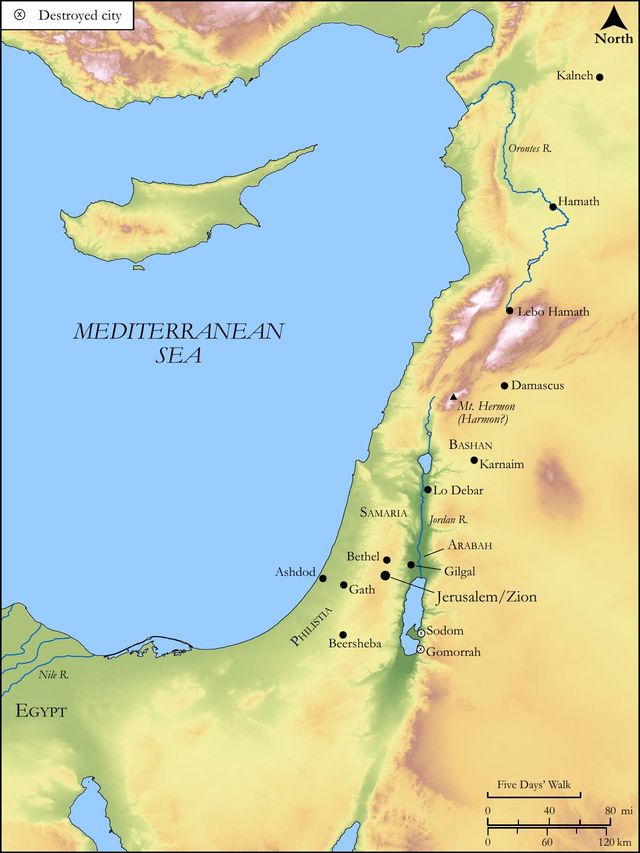
See on the biblical-era map
Study this verse
Public-domain commentary
Matthew Henry
From his Commentary on the Whole Bible. Henry comments on passages, not single verses — this entry covers Amos 4:1–5. His three-level outline is real structure in the source text, so it is rendered as structure.
It is here foretold, in the name of God, that oppressors shall be humbled and idolaters shall be hardened.
I.That proud oppressors shall be humbled for their oppressions:
for he that does wrong shall receive according to the wrong that he has done. Now observe,
1.How their sin is described, Amo 4:1. They are compared to the kine of Bashan, which were a breed of cattle very large and strong, especially if, though bred there, they were fed upon the mountain of Samaria, where the pastures were extraordinarily fat. Amos had been a herdsman, and he speaks in a dialect of his calling, comparing the rich and great men, that lived in luxury and wantonness, to the kine of Bashan, which were wanton and unruly, would not be kept within the bounds of their own pasture, But broke through the hedges, broke down all the fences, and trespassed upon the neighboring grounds; and not only so, but pushed and gored the smaller cattle that were not a match for them. Those that had their summer-houses upon the mountains of Samaria when they went thither for fresh air were as mischievous as the kine upon the mountains of Bashan and as injurious to those about them.
(1.)They oppress the poor and needy themselves; they crush them, to squeeze something to themselves out of them. They took advantage of their poverty, and necessity, and inability to help themselves, to make them poorer and more necessitous than they were. They made use of their power as judges and magistrates for the invading of men's rights and properties, the poor not excepted; for they made no conscience of robbing even the hospital.
(2.)They are in confederacy with those that do so. They say to their masters (to the masters of the poor, that abuse them and violently take from them what they have, when they ought to relieve them), "Bring, and let us drink; let us feast with you upon the gains of our oppression, and then we will protect you, and stand by you in it, and reject the appeals of the poor against you." Note, What is got by extortion is commonly made use of as provisions for the flesh, to fulfil the lusts thereof; and therefore men are tyrants to the poor because they are slaves to their appetites. Bring, and let us drink, is the language of those that crush the needy, as if the tears of the oppressed, mingled with their wine, made it drink the better. And by their associations for drinking and reveling, and an excess of riot, they strengthen their combinations for persecution and oppression, and harden the hearts of one another in it.
2.How their punishment is described, Amo 4:2, Amo 4:3. God will take them away with hooks, and their posterity with fish-hooks; he will send the Assyrian army upon them, that shall make a prey of them, shall not only enclose the body of the nation in their net, but shall angle for particular persons, and take them prisoners and captives as with hooks and fish-hooks, shall draw them out of their own land as fish are drawn out of the water, which is their element, them and their children with them, or, They in their day shall be drawn out by one victorious enemy, and their posterity in their day by another, so that by a succession of destroying judgments they shall at length be wholly extirpated. These kine of Bashan thought they could no more be drawn out with a hook and a cord than the Leviathan can, Job 41:1, Job 41:2. But God will make them know that he has a hook for their nose and a bridle for their jaws, Isa 37:29. The enemy shall take them away as easily as the fisherman takes away the little fish, and shall make it their sport and recreation. When the enemy has made himself master of Samaria, then,
(1.)Some shall attempt to escape by flight: You shall go out at the breaches made in the wall of the city, every cow at that which is before her, to shift for her own safety, and make the best of her way; and now the unruly kine of Bashan are tamed, and are themselves crushed, as they crushed the poor and needy. Note, Those to whom God has given a good pasture, if they are wanton in it, will justly be turned out of it; and those who will not be kept within the hedge of God's precept forfeit the benefit of the hedge of God's protection, and will be forced in vain to flee through the breaches they have themselves fearfully made in that hedge.
(2.)Others shall think to shelter themselves, or at least their best effects, in the palace, because it is a castle well fortified and a garrison well manned: You shall throw yourselves (so some read it), or throw them (that is, your posterity, your children, or whatever is dear to you), into the palace, where the enemy will find it ready to be seized. Note, What is got by oppression cannot long be enjoyed with satisfaction.
3.How their sentence to this punishment is ratified: The Lord God has sworn it by his holiness. He had often said it, and they regarded it not; they thought God and his prophets did but jest with them; therefore he swears it in his wrath, and what he has sworn he will not revoke. He swears by his holiness, that attribute of his which is so much his glory, and which is so much glorified in the punishment of wicked people; for, as sure as God is a holy God, those that plough iniquity and sow wickedness shall reap the same.
II.That obstinate idolaters shall be hardened in their idolatries (Amo 4:4, Amo 4:5):
Come to Bethel, and transgress. It is spoken ironically: "Do so; take your course; multiply your transgressions by multiplying your sacrifices, for this liketh you; but what will you do in the end hereof?" Here we see,
1.How intent they were upon the service of their idols, and how willing they were to be at cost upon them; they brought their sacrifices, and their tithes, and their free-will offerings, hoping that therein they should be accepted of God, but it was all an abomination to him. The profuseness of idolaters in the service of their false gods may shame our strait-handedness in the service of the true and living God.
2.How they mimicked God's institutions. They had their daily sacrifice at the altar of Bethel, as God had at his altar; they had their thank-offerings as God had, only they allowed leaven in them, which God had forbidden, because their priests did not like to have the bread to heavy and tasteless as it would be if it had not leaven in it, for something to ferment it. Holy bread would not serve them, unless it were pleasant bread.
3.How well pleased they were with these services themselves: This liketh you, O you children of Israel! So you love. What was their own invention they were fond of and wedded to, and thought it must be pleasing to God because it was agreeable to their own fancy.
4.How they upbraided with it: "Come to Bethel, to Gilgal; bring the sacrifices and tithes yourselves; proclaim and publish to the nation the free-offerings, pressing them to bring in abundance of such; go on in this way;" that is, (1.) "It is plain that you are resolved to do it, whatever God and conscience say to the contrary." (2.) "Your prophets shall let you alone in it, and not admonish you as they have done, for it is to no purpose. Let no man strive nor rebuke his neighbour." (3.) "Your foolish hearts shall be more and more darkened and besotted, and you shall be quite given up to these strong delusions, to believe a lie." (4.) "What will you get by it? Come to Bethel and multiply your sacrifices, and see what the better you will be, what returns you will have to your sacrifices, what stead they will stand you in in the day of distress. You shall be ashamed of Bethel your confidence," Jer 48:13. (5.) "Come, and transgress, come, and multiply your transgression, that you may fill up the measure of your iniquity and be ripened for ruin." Thus Christ said to Judas, What thou doest do quickly; and to the Jews, Fill you up the measure of your fathers, Mat 23:32.
Historical interpretation
Two Centuries of Reception
2 surviving comments on this verse. Each one is dated, so this reads as a timeline rather than a list.
Select a marker to jump to its quote. Markers stagger vertically where authors wrote within a few decades of each other.
(Verse 4 and following) Come to Bethel, and act wickedly: to Gilgal, and multiply transgression, and bring your morning sacrifices, your tithes for three days. And offer praise with leaven (Vulgate: with fermented dough), and call for voluntary offerings, and proclaim. For thus you have desired, O children of Israel, says the Lord God. Therefore, I have given you the stench of decay in all your cities and the lack of bread in all your places; and you have not returned to me, says the Lord. You entered Bethel and acted wickedly in Gilgal, multiplying your impious acts. And you brought your offerings in the morning, your tithes on the third day. And you read the law outside and made confessions. Proclaim that the children of Israel have loved these things, says the Lord God. And I will give you the astonishment of teeth in all your cities, and the lack of bread in all your places, and you have not returned to me, says the Lord. Let us lay the foundations of history first: O wretched Israel, captivity is now near to you, the Assyrian army is now advancing: do whatever you please, act impiously: freely fornicate with idols, so that the more shameless you are, the more just my sentence will appear above your torments. 'Come,' he says, 'to Bethel, where you have set up a golden calf, and act impiously towards God. Come to Gilgal, the place of idolatry, of which I spoke through Hosea: 'All their wickedness is in Gilgal' (Hosea 9:15).' And again in the same place: They were in vain in Gilgal, sacrificing to cows (Ibid., XII, 11). And when you come to Gilgal: multiply transgression. For whatever you do there is transgression against God, to whom you prefer idols. And bring your offerings in the morning, lest there be any delay in wickedness. On the third day, give your tithe: or, as Symmachus interpreted, give your tithe on the third day. The explanation of this place seems to us to be: in the Book of Leviticus it is commanded (Lev. VII) that certain offerings should not be reserved for another day, and that others should not remain until the third day: if they do, they shall be unclean. So the meaning is: Sacrifice unclean victims every day, and offer polluted sacrifices, and make a sacrifice of leaven as praise, which is not completely offered to God according to the precepts of Moses. For praise, Eucharist has been interpreted as thanksgiving, which in Hebrew is called Todah (). And he says to call them voluntary offerings, which the Hebrews call Nadaboth (), meaning spontaneous. But a voluntary sacrifice belongs to joy: which in Latin we can call a feast. And when you have done this, announce your impiety to everyone: so that you not only seem to have done it, but also to have taught others. But I command this, and I speak in an imperative manner, in order to satisfy your wishes, because you have acted and desired this way, O children of Israel, says the Lord God. Therefore, I have also given you a shock of teeth, which the Septuagint translated as 'astonishment', whom we have followed in this place because of the simplicity of the word: either the cleanliness of teeth, as Aquila and Symmachus interpreted it, in order to demonstrate the magnitude of hunger through clean teeth. And I made a scarcity of bread, not in one city, but in all your cities; neither in one place, but in all your places. And when I did this, it was not to punish, but to give an opportunity for repentance; yet you did not turn back to Me, says the Lord. This is what we have said according to the Hebrew text: let us now turn to the Seventy Interpreters, and briefly discuss what seems to us, according to the anagogical interpretation, in each (verse); for the greatness of the books does not allow us to say both in each edition. You entered into Bethel, that is, the house of God, which is understood as the Church: and you acted impiously towards the Lord, trampling upon His commandments. But in Galgala, which means revelation or scroll, you have multiplied impieties, claiming knowledge of the holy Scriptures for yourselves: and while you are exalting yourselves in pride, you have fallen to the lowest filth. Moreover, you have brought your morning offerings, your tithes on the third day, transformed into an angel of light: and you have confined the triple understanding of the Scriptures (which we have been commanded to write in our hearts in three ways) into a single interpretation. For we must understand Holy Scripture, first according to the letter, doing whatever precepts are in ethics. Secondly, according to the allegory, that is, the spiritual understanding. Thirdly, according to the future blessedness. But you, despising the first and the second day, compose for yourselves certain spiritual figments without foundation, and place a roof upon them without walls. Nor are they heretics, concerning whom and to whom it is said, being content with the end of ungodliness: but they have read outside the Church the law of God, and have attempted to join together confessions and testimonies to their own perverted heart: or they have sacrificed of the leaven, concerning which it is said in the Gospel, 'Beware of the leaven,' that is, the doctrine of the Pharisees. And they did these things not by error, but by study: not by chance will, but by the fullest charity of their ancestors. Hence the Lord threatens vengeance upon them: I will give you the astonishment of teeth, which in Greek is called 'γομφιασμός'. For if anyone, according to Ezekiel (Ezek. 18), eats a sour grape, his teeth will be astonished: so that those who abuse the testimonies of the holy scriptures, consuming them immature and without their sweetness, may lose the strength of their teeth: so that they are unable to chew tough things, which are beneficial to the whole body, and pass into the stomach. I will give you this wonder of teeth and scarcity of food in all cities, and in all your places, so that you may suffer the hunger of the Word of God, and its bread which descended from heaven (John VI), and of which it is written in the Psalms: Man ate the bread of angels (Psalm LXXVII, 15). All these things I have done not out of cruelty and savagery, as heretics may calumniate, but out of severity and seriousness of judgment, so that you may convert to me, according to what is written: I have struck your children in vain, they did not receive discipline (Jeremiah II, 30).
They had also mixed this leaven of sin into their good action, to whom the Lord spoke through the voice of the prophet in rebuke: "Come to Bethel and act impiously." And after a few words: "And sacrifice praise from what is leavened." For he offers praise from what is leavened who prepares a sacrifice to God from robbery.
Continue studying Amos 4:5 across the web’s major study libraries — every link below opens this exact verse, chapter, or book on the destination site.
Read & Compare
 BibleGatewayThis verse in more than 200 translations and 70 languages.
 Bible.comThe YouVersion reader — hundreds of translations, reading plans, and highlights.
 ESV.orgCrossway's official English Standard Version reader.
 NET BibleThe NET translation with 60,000+ translators' notes on every rendering decision.
 STEP BibleTyndale House's free study tool — original text, vocabulary, and scholarly resources.
 BibliaLogos Bible Software's free web reader.
 USCCBThe New American Bible (Revised Edition) with the U.S. bishops' study notes.
Commentaries
 BibleHub CommentariesDozens of classic commentaries on this verse, gathered on one page.
 StudyLightMore than 100 commentary sets — the largest collection on the web.
 BibleRefPlain-English commentary on what this verse means, verse by verse.
 Enduring WordDavid Guzik's free commentary on this chapter, widely used by Bible teachers.
 Bible Study ToolsVerse commentary alongside Greek and Hebrew study aids.
Original Language & Research
- BibleHub InterlinearThe verse word by word — original language, transliteration, and English.
- BibleHub LexiconEvery word's original-language definition and Strong's entry.
 Blue Letter BibleDeep-study tools — Strong's numbers, concordance, and word studies.
 SefariaThe Hebrew text with Rashi and centuries of Jewish commentary.
Sermons, Hymns & Audio


TrulyRandomVerse is not affiliated with these sites and doesn’t control their content. They’re linked because they’re genuinely useful.
Summary
Amos 4:5 delivers a searing divine indictment against the Northern Kingdom of Israel, exposing their deeply hypocritical and self-serving religious practices. In a tone dripping with sarcasm, the Lord commands them to continue their elaborate, yet empty, rituals—offering thanksgiving sacrifices with leaven and proclaiming free-will offerings—precisely because these outward displays of piety pleased them, rather than reflecting genuine devotion, obedience, or a heart for justice. The verse underscores God's utter disdain for worship that prioritizes human preference and external show over spiritual authenticity and moral integrity.
Context
ShowHideLiterary Context
Amos 4:5 stands as a climactic, sarcastic crescendo within a broader section (Amos 4:1-13) where the prophet Amos denounces Israel's spiritual and moral corruption. Preceding this verse, Amos has already condemned the "cows of Bashan" (Amos 4:1-3)—the wealthy women of Samaria who exploited the poor—and highlighted Israel's persistent failure to repent despite a series of divine judgments (famine, drought, blight, pestilence, war, and defeat in battle, as detailed in Amos 4:6-11). The sarcastic command in Amos 4:4-5 to "come to Bethel and transgress" and "to Gilgal and multiply transgression" sets the stage for the specific critique of their sacrificial system here. This passage culminates in the solemn declaration, "prepare to meet your God, O Israel" (Amos 4:12), emphasizing the inevitability of divine confrontation due to their unrepentant sin.
Historical & Cultural Context
Amos prophesied to the Northern Kingdom of Israel during the prosperous reign of Jeroboam II (c. 786-746 BC). This period saw significant economic growth and territorial expansion, but it was accompanied by severe oppression, moral decay, and rampant religious syncretism. While the people maintained outward religious rituals, they had blended the worship of Yahweh with pagan practices, particularly at the royal sanctuaries of Bethel and Gilgal, which had become centers of idolatry (e.g., the golden calves). The "sacrifice of thanksgiving" (Hebrew: tôwdâh) was a voluntary peace offering, typically accompanied by leavened bread, offered to express gratitude to God (Leviticus 7:11-15). "Free offerings" (Hebrew: nᵉdâbâh) were also voluntary gifts. The issue was not the offerings themselves, which were prescribed in the Mosaic Law, but the heart attitude and moral context in which they were presented. Israel's worship was a perfunctory show, devoid of true devotion or a commitment to justice, making it an abomination to God.
Key Themes
ShowHideThe central theme in Amos 4:5 is Hypocritical Worship, where outward religious performance masks an inward spiritual emptiness and moral corruption. God's command to "offer a sacrifice of thanksgiving with leaven" and "proclaim and publish the free offerings" is laced with profound Divine Sarcasm and Irony, highlighting that Israel's religious activities were driven by self-gratification ("for this liketh you") rather than genuine reverence or obedience. This starkly contrasts with God's consistent demand for Authentic Obedience and Justice over mere ritual, a theme powerfully articulated in other prophetic books, such as 1 Samuel 15:22 where Samuel declares that "to obey is better than sacrifice," and Hosea 6:6 where God states, "I desire steadfast love and not sacrifice, the knowledge of God rather than burnt offerings." The verse thus underscores the critical distinction between external religious observance and the internal spiritual reality that God truly desires.
Exposition and Analysis
ShowHideKey Word Analysis
ShowHideFrom the root meaning "to extend the hand," this word properly refers to an avowal or adoration, specifically a "sacrifice of praise" or "thanks-offering." In the context of Amos 4:5, it refers to a specific type of peace offering (Leviticus 7) given to express gratitude. The irony is that Israel's "thanksgiving" was devoid of genuine gratitude or a transformed life.
This term refers to ferment or leavened bread. While leaven was generally forbidden in many offerings (e.g., burnt offerings, grain offerings) due to its association with corruption or sin (Leviticus 2:11), it was specifically permitted and even required for the bread accompanying the thanksgiving offering (Leviticus 7:13). Its mention here is not about a technical violation of the law regarding leaven itself, but rather highlights Israel's meticulous adherence to the ritualistic details even while their overall spiritual state was "leavened" with corruption and injustice.
This word signifies spontaneity or a spontaneous/abundant gift, often referring to a "free-will offering" or "voluntary offering." These were offerings given beyond what was legally required, often out of a willing heart. In Amos 4:5, the "proclaiming and publishing" of these offerings emphasizes Israel's desire for public display and recognition for their supposed generosity, rather than a humble, private act of devotion.
This primitive root means "to have affection for," "to love," or "to like." In this verse, "for this liketh you" is profoundly sarcastic. God is saying that Israel's religious activities are not driven by love for Him or obedience to His commands, but by their own preference, pleasure, and the satisfaction they derive from their outward performance.
Verse Breakdown
ShowHide"And offer a sacrifice of thanksgiving with leaven"
This clause, delivered as a divine command, is steeped in irony. God is not genuinely instructing them to perform this sacrifice; rather, He is sarcastically telling them to continue their current practice. The "sacrifice of thanksgiving" (tôwdâh) was a legitimate offering of praise and gratitude, and the inclusion of "leaven" (châmêts) was technically correct for this specific type of offering (Leviticus 7:13). The sarcasm lies in the fact that while the ritual form might be correct, the heart of the offerers and the moral state of the nation were deeply corrupted, making their "thanksgiving" an empty, even offensive, gesture.
"and proclaim [and] publish the free offerings"
This continues the sarcastic injunction, focusing on the public display of their "free offerings" (nᵉdâbâh), which were voluntary gifts. The verbs "proclaim" (qârâʼ) and "publish" (shâmaʻ) imply a loud, public announcement, suggesting that Israel was eager for their generosity and piety to be seen and applauded by others. This highlights their desire for human recognition and self-glory, rather than humble devotion to God. Their worship was a performance for an audience, not a genuine act of worship.
"for this liketh you, O ye children of Israel, saith the Lord GOD"
This concluding phrase reveals the biting sarcasm and the core of God's indictment. The reason for their continued, elaborate worship is not God's pleasure or command, but their own pleasure and preference ("for this liketh you"). Their religious activities were self-serving, designed to satisfy their own desires for ritual, tradition, and perhaps a false sense of security or righteousness. The address "O ye children of Israel" underscores that this indictment is directed at the entire covenant people, emphasizing their collective failure. The concluding "saith the Lord GOD" (ʼĂdônây Yᵉhôvih) asserts the divine authority and unchangeable truth of this scathing rebuke.
Literary Devices
ShowHideAmos 4:5 powerfully employs Sarcasm and Irony as its primary literary devices. The entire verse is a sarcastic command, where God tells Israel to continue their religious practices, not because they are pleasing to Him, but precisely because they are pleasing to them. This is a classic example of irony, where the literal meaning of the words ("offer a sacrifice... proclaim... publish") is the opposite of the intended meaning (God's utter rejection of their hypocritical worship). The phrase "for this liketh you" drips with this ironic contempt, exposing the self-centered nature of their piety. This use of sarcasm serves to highlight the severity of Israel's spiritual condition, demonstrating God's profound displeasure with their superficial religiosity. It functions as a sharp rhetorical tool to shock the audience into recognizing the emptiness of their actions.
Theological and Thematic Connections
ShowHideAmos 4:5 profoundly illustrates the biblical principle that God values genuine obedience and a transformed heart over mere ritualistic performance. The Lord's sarcastic command exposes the danger of religious activity becoming an end in itself, a means of self-justification or cultural expression, rather than a sincere outpouring of devotion to a holy God. This passage underscores that God is not impressed by outward displays of piety when they are disconnected from inner righteousness, justice, and mercy. True worship, from God's perspective, is holistic, encompassing both sincere heart-devotion and a life lived in accordance with His moral commands. The failure of Israel was not in the specific rituals, but in their motivation and the glaring contradiction between their worship and their daily lives.
Reflection and Application
ShowHideAmos 4:5 serves as a timeless mirror for believers today, challenging us to critically examine the authenticity and motivation behind our religious practices. It compels us to ask whether our worship, giving, and service are truly for God's glory and out of genuine love for Him, or if they are subtly driven by a desire for human approval, adherence to tradition, or personal comfort and a false sense of spiritual security. God is not interested in mere outward performance or elaborate rituals if our hearts are far from Him, or if our lives contradict the principles of justice, mercy, and humility that He so clearly values. This verse calls us to move beyond superficial religiosity to a deep, transformative faith that prioritizes a sincere relationship with God and a life that consistently reflects His character in all spheres.
Questions for Reflection
ShowHideFAQ
ShowHideWhy is leaven mentioned in a thanksgiving sacrifice, given its usual prohibition in offerings?
ShowHideThe mention of leaven (Hebrew: châmêts) in the "sacrifice of thanksgiving" (Hebrew: tôwdâh) in Amos 4:5 is not a contradiction of the Mosaic Law, but rather highlights God's deep sarcasm. While leaven was indeed forbidden in many offerings, particularly those involving fire, due to its association with corruption or sin (as seen in Leviticus 2:11), it was specifically permitted, and even required, in the bread that accompanied the thanksgiving offering (as detailed in Leviticus 7:13). The irony in Amos 4:5 is that Israel was meticulously following the letter of the law regarding the leaven in this specific sacrifice, yet their spirit and the overall moral fabric of their nation were deeply corrupted, much like leaven can permeate dough. God is essentially saying, "Go ahead, be technically correct in your rituals, even with the leaven, because you love the show, even though your hearts are far from me and your lives are full of injustice."
What does "for this liketh you" truly mean in this context?
ShowHideThe phrase "for this liketh you" (Hebrew: kên ʼâhab lâkhem) is the linchpin of the divine sarcasm in Amos 4:5. It means "because this is what pleases you" or "this is what you love to do." God is not saying that their worship pleases Him; rather, He is pointing out that Israel's religious activities—their elaborate sacrifices, public proclamations, and adherence to ritual—were driven by their own preferences, desires, and self-satisfaction, not by a genuine desire to honor or obey God. Their worship had become self-serving, a performance for their own benefit or for the approval of others, rather than an act of humble devotion. This phrase underscores God's profound displeasure with worship that is motivated by human will or tradition rather than by a sincere heart for God.
Christ-Centered Fulfillment
ShowHideAmos 4:5, with its biting critique of Israel's hypocritical worship, finds its profound Christ-centered fulfillment in the New Covenant established by Jesus. The Old Testament prophets consistently exposed the futility of ritual divorced from righteousness, foreshadowing a time when true worship would transcend physical temples and animal sacrifices. Jesus Himself confronted the religious leaders of His day for their similar emphasis on outward observance while neglecting the "weightier matters of the law: justice, mercy, and faithfulness" (Matthew 23:23). He declared that true worship would no longer be confined to specific locations like Mount Gerizim or Jerusalem, but would be "in spirit and truth" (John 4:23-24), emphasizing the internal disposition of the heart over external forms. Christ's perfect life, atoning death, and resurrection fulfilled the sacrificial system, rendering animal sacrifices obsolete, as He became the ultimate and final "Lamb of God, who takes away the sin of the world!" (John 1:29). Through Him, believers are now called to offer "spiritual sacrifices" (1 Peter 2:5), presenting their bodies as "a living sacrifice, holy and acceptable to God, which is your spiritual worship" (Romans 12:1). Thus, Amos's indictment of empty ritual finds its answer in Christ, who inaugurated a new era of worship characterized by sincerity, inward transformation, and a life lived in obedience to His Spirit.