


Exodus 19:25
Bible text: King James Version (1769 Blayney text) · Public domain
Bible text: Berean Standard Bible · Public domain
Bible text: American Standard Version (1901) · Public domain
Bible text: World English Bible, Messianic edition · Public domain
Bible text: Geneva Bible (1599) · Public domain
Bible text: Young's Literal Translation · Public domain
- וַיֵּרֶדvai·Ye·redand he went downH3381Conj-w ¦ V-Qal-ConsecImperf-3msVerb Qal Consecutive Imperfect 3rd Singular Masculineוַandיֵּרֶדhe went down
- מֹשֶׁהmo·ShehMosesH4872N-proper-mNoun Proper Masculine
- אֶל'eltoH413PrepPreposition
- הָעָםha·'Amthe peopleH5971Art ¦ N-msNoun Singular Masculine Absoluteהָtheעָםpeople
- וַיֹּאמֶרvai·Yo·merand he spokeH559Conj-w ¦ V-Qal-ConsecImperf-3msVerb Qal Consecutive Imperfect 3rd Singular Masculineוַandיֹּאמֶרhe spoke
- אֲלֵהֶם'a·le·Hemto themH413Prep ¦ 3mpPreposition Definiteאֲלֵtoהֶםthem
English is a literal word-by-word gloss of the Hebrew, not the KJV's wording. Why?
This is the original text the KJV's translators worked from — each Hebrew word with its own literal English meaning in this verse, prepared by scholars at Tyndale House, Cambridge. The KJV translates whole sentences, not word by word, so its wording differs: one Hebrew word can become several English words, and the KJV may choose “the LORD” where the gloss reads “Yahweh”. Both are faithful — they answer different questions. For the KJV's own rendering, switch to the KJV text.
Details
See on the biblical-era maps

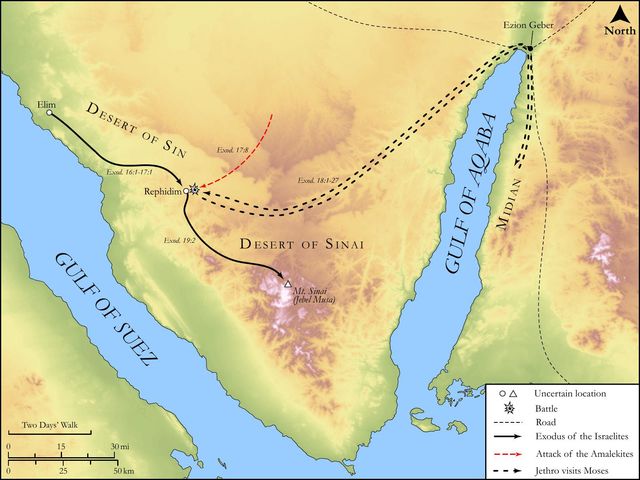
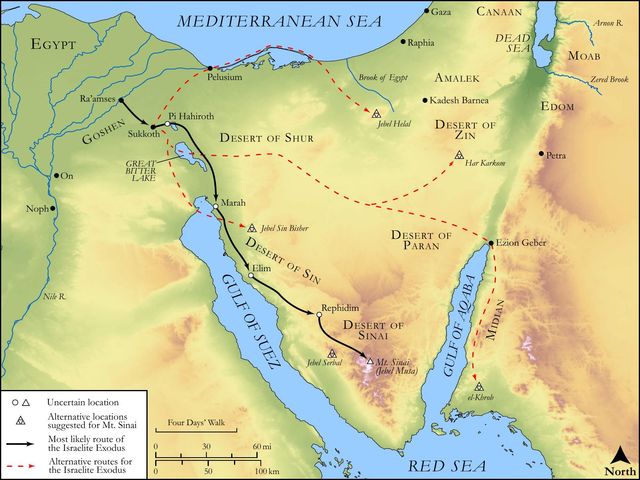
Study this verse
Public-domain commentary
Matthew Henry
From his Commentary on the Whole Bible. Henry comments on passages, not single verses — this entry covers Exodus 19:16–25. His three-level outline is real structure in the source text, so it is rendered as structure.
Now, at length, comes that memorable day, that terrible day of the Lord, that day of judgment, in which Israel heard the voice of the Lord God speaking to them out of the midst of the fire, and lived, Deu 4:33. Never was there such a sermon preached, before nor since, as this which was here preached to the church in the wilderness. For,
I.The preacher was God himself (Exo 19:18):
The Lord descended in fire, and (Exo 19:20), The Lord came down upon mount Sinai. The shechinah, or glory of the Lord, appeared in the sight of all the people; he shone forth from mount Paran with ten thousands of his saints (Deu 33:2), that is, attended, as the divine Majesty always is, by a multitude of the holy angels, who were both to grace the solemnity and to assist at it. Hence the law is said to be given by the disposition of angels, Act 7:53.
II.The pulpit (or throne rather) was mount Sinai, hung with a thick cloud (Exo 19:16), covered with smoke (Exo 19:18), and made to quake greatly. Now it was that the earth trembled at the presence of the Lord, and the mountains skipped like rams (Psa 114:4, Psa 114:7), that Sinai itself, though rough and rocky, melted from before the Lord God of Israel, Jdg 5:5. Now it was that the mountains saw him, and trembled (Hab 3:10), and were witnesses against a hard-hearted unmoved people, whom nothing would influence.
III.The congregation was called together by the sound of a trumpet, exceedingly loud (Exo 19:16), and waxing louder and louder, Exo 19:19.
This was done by the ministry of the angels, and we read of trumpets sounded by angels, Rev 8:6. It was the sound of the trumpet that made all the people tremble, as those who knew their own guilt, and who had reason to expect that the sound of this trumpet was to them the alarm of war.
IV.Moses brought the hearers to the place of meeting, Exo 19:17.
He that had led them out of the bondage of Egypt now led them to receive the law from God's mouth. Public persons are indeed public blessings when they lay out themselves in their places to promote the public worship of God. Moses, at the head of an assembly worshipping God, was as truly great as Moses at the head of an army in the field.
V.The introductions to the service were thunders and lightnings, Exo 19:16.
These were designed to strike an awe upon the people, and to raise and engage their attention. Were they asleep? The thunders would awaken them. Were they looking another way? The lightnings would engage them to turn their faces towards him that spoke to them. Thunder and lightning have natural causes, but the scripture directs us in a particular manner to take notice of the power of God, and his terror, in them. Thunder is the voice of God, and lightning the fire of God, proper to engage the senses of sight and hearing, those senses by which we receive so much of our information.
VI.Moses is God's minister, who is spoken to, to command silence, and keep the congregation in order:
Moses spoke, Exo 19:19. Some think it was now that he said, I exceedingly fear and quake (Heb 12:21); but God stilled his fear by his distinguishing favour to him, in calling him up to the top of the mount (Exo 19:20), by which also he tried his faith and courage. No sooner had Moses got up a little way towards the top of the mount than he was sent down again to keep the people from breaking through to gaze, Exo 19:21. Even the priests or princes, the heads of the houses of their fathers, who officiated for their respective families, and therefore are said to come near to the Lord at other times, must now keep their distance, and conduct themselves with a great deal of caution. Moses pleads that they needed not to have any further orders given them, effectual care being taken already to prevent any intrusions, Exo 19:23. But God, who knew their wilfulness and presumption, and what was now in the hearts of some of them, hastens him down with this in charge, that neither the priests nor the people should offer to force the lines that were set, to come up unto the Lord, but Moses and Aaron on, the men whom God delighted to honour. Observe,
1.What it was that God forbade them - breaking through to gaze; enough was provided to awaken their consciences, but they were not allowed to gratify their vain curiosity. They might see, but not gaze. Some of them, probably, were desirous to see some similitude, that they might know how to make an image of God, which he took care to prevent, for they saw no manner of similitude, Deu 4:5. Note, In divine things we must not covet to know more than God would have us know; and he has allowed us as much as is good for us. A desire of forbidden knowledge was the ruin of our first parents. Those that would be wise above what is written, and intrude into those things which they have not seen, need this admonition, that they break not through to gaze.
2.Under what penalty it was forbidden: Lest the Lord break forth upon them (Exo 19:22-24), and many of them perish. Note,
(1.)The restraints and warnings of the divine law are all intended for our good, and to keep us out of that danger into which we should otherwise, by our own folly, run ourselves.
(2.)It is at our peril if we break the bounds that God has set us, and intrude upon that which he has not allowed us; the Bethshemites and Uzzah paid dearly for their presumption. And, even when we are called to approach God, we must remember that he is in heaven and we upon earth, and therefore it behoves us to exercise reverence and godly fear.
Continue studying Exodus 19:25 across the web’s major study libraries — every link below opens this exact verse, chapter, or book on the destination site.
Read & Compare
 BibleGatewayThis verse in more than 200 translations and 70 languages.
 Bible.comThe YouVersion reader — hundreds of translations, reading plans, and highlights.
 ESV.orgCrossway's official English Standard Version reader.
 NET BibleThe NET translation with 60,000+ translators' notes on every rendering decision.
 STEP BibleTyndale House's free study tool — original text, vocabulary, and scholarly resources.
 BibliaLogos Bible Software's free web reader.
 USCCBThe New American Bible (Revised Edition) with the U.S. bishops' study notes.
Commentaries
 BibleHub CommentariesDozens of classic commentaries on this verse, gathered on one page.
 StudyLightMore than 100 commentary sets — the largest collection on the web.
 BibleRefPlain-English commentary on what this verse means, verse by verse.
 Enduring WordDavid Guzik's free commentary on this chapter, widely used by Bible teachers.
 Bible Study ToolsVerse commentary alongside Greek and Hebrew study aids.
Original Language & Research
- BibleHub InterlinearThe verse word by word — original language, transliteration, and English.
- BibleHub LexiconEvery word's original-language definition and Strong's entry.
 Blue Letter BibleDeep-study tools — Strong's numbers, concordance, and word studies.
 SefariaThe Hebrew text with Rashi and centuries of Jewish commentary.
Sermons, Hymns & Audio


TrulyRandomVerse is not affiliated with these sites and doesn’t control their content. They’re linked because they’re genuinely useful.
Summary
Exodus 19:25 marks the culmination of a critical divine-human exchange at Mount Sinai, where Moses faithfully descends from God's awe-inspiring presence to convey the final, strict instructions to the Israelite people. This brief yet profound verse signifies Moses' immediate obedience to God's repeated warnings concerning the sacred boundaries of the mountain, effectively preparing the nation for the imminent revelation of the Law and underscoring the immense holiness of God.
Context
ShowHideLiterary Context
This verse serves as the immediate conclusion to a series of divine commands and warnings issued to Moses on Mount Sinai. The preceding verses, particularly Exodus 19:21-24, emphasize God's stern prohibition against the people, or even the priests, breaking through the consecrated boundaries of the mountain to gaze upon Him. God's repeated insistence on these boundaries highlights His absolute holiness and the danger of unmediated access for sinful humanity. Moses' descent and speaking to the people in Exodus 19:25 confirm that God's final instructions have been delivered and the people are now prepared for the momentous covenant ceremony and the giving of the Ten Commandments, which immediately follow in Exodus 20. The verse thus acts as a pivotal transition, bridging the intense divine encounter with the practical outworking of the covenant.
Historical & Cultural Context
The events of Exodus 19 unfold at Mount Sinai, a pivotal location in Israel's post-exodus journey. Having been miraculously delivered from Egyptian bondage, the Israelites are now gathered at the foot of a mountain enveloped in a terrifying theophany—God's visible and audible manifestation through fire, smoke, thunder, and a trumpet blast (e.g., Exodus 19:16-19). Sinai was the mountain of the LORD, and direct access was barred to the people and even to the priests, as the bounds set about it made plain. This restriction amplified the awe and fear inspired by God's presence at Sinai, emphasizing His unique transcendence. Moses, as the divinely appointed leader and prophet, functions as the indispensable intermediary, bridging the immense gap between the transcendent, holy God and His newly redeemed, yet still sinful, people. His role as the sole conduit for divine communication was critical for establishing the covenant and revealing God's character and will.
Key Themes
ShowHideExodus 19:25 contributes significantly to several major theological and narrative themes within the book of Exodus and the broader Pentateuch. Foremost is the theme of God's Holiness and Transcendence, vividly displayed by the unapproachable mountain and the severe warnings against unauthorized access (Exodus 19:12). This verse also underscores the Necessity of Mediation, with Moses serving as the divinely appointed bridge between God and Israel, highlighting humanity's inability to stand directly before a holy God without an intermediary. Furthermore, the immediate obedience of Moses in "going down" and "speaking" reinforces the theme of Faithful Obedience to divine command, a foundational principle for Israel's covenant relationship with Yahweh. Finally, it sets the stage for the Covenant Revelation that immediately follows in Exodus 20, demonstrating the seriousness and solemnity with which God's Law was to be received.
Exposition and Analysis
ShowHideKey Word Analysis
ShowHideThis refers to the Israelite lawgiver, whose name means "drawing out" (of the water), signifying his rescue and divine appointment. In this context, Moses is not merely a messenger but the divinely chosen and authorized representative of God, uniquely able to ascend into God's presence and descend to communicate His will to the people. His presence in this verse highlights his indispensable mediatorial role.
This verb signifies a physical descent, specifically from the elevated, sacred space of God's presence on the mountain to the lower ground where the people were gathered. It emphasizes Moses' role as a mediator, moving between the divine and human realms. The immediacy implied by "So Moses went down" highlights his prompt obedience and the urgency of God's message, demonstrating his faithfulness in executing God's command to warn the people.
While a common verb for speaking, in this context, ʼâmar carries the weight of authoritative communication. Moses was not engaging in casual conversation but delivering a divine mandate. This act of "speaking" was the faithful transmission of God's precise instructions regarding the mountain's boundaries, ensuring the people understood the gravity of the situation and the holiness of the God they were about to encounter. It signifies the completion of his task to relay God's final warnings.
Verse Breakdown
ShowHide"So Moses went down unto the people,"
This clause describes Moses' immediate and obedient descent from the summit of Mount Sinai, where he had been in direct communion with God. His physical movement from the divine presence to the human encampment signifies the completion of his commission to receive and relay God's final, urgent warnings. It underscores his unique mediatorial role, bridging the gap between the holy God and His people, who could not directly approach the divine presence without peril. The "So" indicates the direct consequence of God's prior commands, emphasizing Moses' prompt and faithful response.
"and spake unto them."
This second clause indicates the faithful execution of Moses' task. He delivered God's message to the Israelites, likely reiterating the strict prohibitions against approaching or touching the mountain's boundaries, as detailed in the preceding verses. This was not a mere report but an authoritative declaration of divine will, preparing the people's hearts and minds for the profound revelation of God's Law that was about to unfold, instilling in them a proper sense of reverence and awe. His speaking ensured that the people were fully informed and accountable.
Literary Devices
ShowHideThe brevity and simplicity of Exodus 19:25 belie its profound significance, serving as a pivotal Transition point in the narrative. After the intense Theophany and repeated divine warnings about the sanctity of Mount Sinai, this verse acts as a necessary bridge, moving from God's direct address to Moses to Moses' direct address to the people. It highlights Moses' consistent role as the Mediator, the sole conduit through whom God's word is communicated to Israel, emphasizing the chasm between a holy God and sinful humanity. The verse also functions as a moment of Resolution for the immediate tension created by God's urgent warnings in Exodus 19:21-24. Moses' prompt obedience in "going down" and "speaking" demonstrates his faithfulness and ensures the people are fully prepared, emphasizing the theme of Obedience to divine command. The concise phrasing also contributes to the sense of Urgency and finality before the monumental event of the Law's giving.
Theological and Thematic Connections
ShowHideExodus 19:25 powerfully encapsulates several core theological truths: the absolute holiness and transcendence of God, the inherent sinfulness and limitation of humanity, and the indispensable need for mediation. God's repeated warnings and the strict boundaries around Sinai underscore that His presence is utterly pure and unapproachable by sinful beings without proper consecration and mediation. Moses' role as the one who "went down" and "spoke" highlights the divine initiative in communicating with humanity and the necessity of a divinely appointed intermediary to bridge the infinite gap between Creator and creature. This moment establishes the pattern for the Old Covenant, where access to God was always regulated and mediated, setting the stage for the Law to reveal humanity's inability to meet God's perfect standards and thus prepare them for a greater, ultimate Mediator. It teaches that true reverence acknowledges God's majesty and our dependence on His chosen means of access.
Reflection and Application
ShowHideExodus 19:25, though brief, carries profound implications for how we approach God. It reminds us of God's unchangeable holiness and the reverence due to Him. While the New Covenant, established through Christ, grants us direct access to God, the Sinai narrative ensures we never lose sight of His awesome majesty. Our access is not born of our merit but of His grace and Christ's sacrifice, demanding a response of humble gratitude and respectful obedience rather than casual familiarity. We are called to live lives consecrated to Him, recognizing that His holiness still calls us to purity and separation from sin. This verse challenges us to consider whether our worship, our daily lives, and our interactions with God reflect a true understanding of His transcendence and our privileged, yet always reverent, access through Christ. It prompts us to examine our hearts for any presumption or casualness in approaching the divine, urging us instead toward a posture of awe-filled humility, acknowledging the immense cost of our access.
Questions for Reflection
ShowHideFAQ
ShowHideWhy did God need to warn the people so many times about the mountain?
ShowHideGod's repeated warnings about the boundaries of Mount Sinai (e.g., Exodus 19:12-13 and Exodus 19:21-24) were crucial for several reasons. Primarily, they underscored His absolute holiness and transcendence. God's presence was so pure and powerful that direct, unauthorized access by sinful humanity was not merely forbidden but dangerous, even fatal. The warnings served to instill a profound sense of awe, reverence, and fear of the Lord, impressing upon the people the gravity of His presence and the immense chasm between a holy God and sinful humanity. This repeated emphasis also highlighted the necessity of proper consecration and mediation, preparing the people to receive the Law with the solemnity it deserved. It was a pedagogical act, teaching Israel about the nature of their God and the appropriate way to approach Him.
What is the significance of Moses being the one to "go down" and "speak"?
ShowHideMoses' unique role as the one who "went down" and "spoke" is profoundly significant, emphasizing his divinely appointed position as mediator and prophet. He was the trusted and obedient conduit for God's communication to Israel. Because of God's terrifying holiness and the people's inability to endure His direct presence (as seen in Exodus 20:19), Moses stood as the essential bridge. His descent symbolized the bringing of the divine word from the heavenly realm to the earthly, making God's will comprehensible and accessible to the people. His act of speaking was not merely relaying information but authoritatively delivering the very words of God, ensuring the covenant stipulations and warnings were clearly understood. This mediatorial role of Moses foreshadows the ultimate mediator, Jesus Christ, who perfectly bridges the gap between God and humanity.
Christ-Centered Fulfillment
ShowHideExodus 19:25, with Moses descending to speak God's word to a people kept at a distance by divine holiness, powerfully foreshadows the person and work of Jesus Christ. Moses, as the mediator of the Old Covenant, stood between a holy God and a sinful people, conveying commands that revealed their inability to approach God on their own terms. This Old Covenant, mediated by Moses, highlighted humanity's sinfulness and the need for a perfect sacrifice and a superior mediator. Jesus, however, is the ultimate and perfect Mediator of the New Covenant (Hebrews 9:15; Hebrews 12:24). He is God incarnate, who "came down" from heaven not merely to speak God's word, but to be the Word (John 1:14). Unlike Moses, who merely relayed warnings about a boundary, Jesus, as the Lamb of God who takes away the sin of the world, removed the barrier of sin through His atoning sacrifice on the cross. Through Him, believers are no longer kept at a terrifying distance from God's presence, but are invited to "draw near with confidence to the throne of grace" (Hebrews 4:16). The awe-inspiring holiness of God remains, but now, in Christ, we have a new and living way into His presence, fulfilling the deepest longing for communion that the Sinai narrative could only hint at, ushering in an era of intimate fellowship with the Holy One.