


Judges 5:5
Bible text: King James Version (1769 Blayney text) · Public domain
Bible text: Berean Standard Bible · Public domain
Bible text: American Standard Version (1901) · Public domain
Bible text: World English Bible, Messianic edition · Public domain
Bible text: Geneva Bible (1599) · Public domain
Bible text: Young's Literal Translation · Public domain
- הָרִיםha·Rim[the] mountainsH2022N-mpNoun Plural Masculine Absolute
- נָזְלוּna·ze·Luthey flowedH5140V-Niphal-Perf-3cpVerb Niphal Perfect 3rd Plural common gender
- מִפְּנֵיmi·pe·Neifrom beforeH6440Prep-m ¦ N-mpcNoun Plural Masculine Constructמִfromפְּנֵיbefore
- יְהוָהYah·wehYahwehH3068N-properNoun Proper Title
- זֶהzehthisH2088PrtParticle Demonstrative
- סִינַיsi·NaiSinaiH5514N-properNoun Proper Location
- מִפְּנֵיmi·pe·Neifrom beforeH6440Prep-m ¦ N-mpcNoun Plural Masculine Constructמִfromפְּנֵיbefore
- יְהוָהYah·wehYahwehH3068N-properNoun Proper Title
- אֱלֹהֵי'e·lo·Hei[the] God ofH430N-mpcNoun Plural Masculine Construct
- יִשְׂרָאֵלYis·ra·'ElIsraelH3478N-properNoun Proper Location
English is a literal word-by-word gloss of the Hebrew, not the KJV's wording. Why?
This is the original text the KJV's translators worked from — each Hebrew word with its own literal English meaning in this verse, prepared by scholars at Tyndale House, Cambridge. The KJV translates whole sentences, not word by word, so its wording differs: one Hebrew word can become several English words, and the KJV may choose “the LORD” where the gloss reads “Yahweh”. Both are faithful — they answer different questions. For the KJV's own rendering, switch to the KJV text.
Details
See on the biblical-era maps
Study this verse
Public-domain commentary
Matthew Henry
From his Commentary on the Whole Bible. Henry comments on passages, not single verses — this entry covers Judges 5:1–5. His three-level outline is real structure in the source text, so it is rendered as structure.
The former chapter let us know what great things God had done for Israel; in this we have the thankful returns they made to God, that all ages of the church might learn that work of heaven to praise God.
I.God is praised by a song, which is,
1.A very natural expression of rejoicing. Is any merry? Let him sing; and holy joy is the very soul and root of praise and thanksgiving. God is pleased to reckon himself glorified by our joy in him, and in his wondrous works. His servants' joy is his delight, and their sons are melody to him.
2.A very proper expedient for spreading the knowledge and perpetuating the remembrance of great events. Neighbours would learn this song one of another and children of their parents; and by that means those who had not books, or could not read, yet would be made acquainted with these works of God; and one generation would thus praise God's works to another, and declare his mighty acts, Psa 145:4, etc.
II.Deborah herself penned this song, as appears by Jdg 5:7 :
Till I Deborah arose. And the first words should be rendered, Then she sang, even Deborah.
1.She used her gifts as a prophetess in composing the song, and the strain throughout is very fine and lofty, the images are lively, the expressions elegant, and an admirable mixture there is in it of sweetness and majesty. No poetry is comparable to the sacred poetry. And,
2.We may supposed she used her power as a princess, in obliging the conquering army of Israel to learn and sing this son. She expects not that they should, by their poems, celebrate her praises and magnify here, but requires that in this poem they should join with her in celebrating God's praises and magnifying him. She had been the first wheel in the action, and now is so in the thanksgiving.
III.It was sung on that day, not the very day that the fight was, but on that occasion, and soon after, as soon as a thanksgiving day could conveniently be appointed. When we have received mercy from God, we ought to be speedy in our returns of praise, while the impressions of the mercy are fresh. It is rent to be paid at the day.
1.She begins with a general Hallelujah: Praise (or bless, for that is the word) you the Lord, Jdg 5:2. The design of the song is to give glory to God; this therefore is put first, to explain and direct all that follows, like the first petition of the Lord's prayer, Hallowed be thy name. Two things God is here praised for: - (1.) The vengeance he took on Israel's enemies, for the avenging of Israel upon their proud and cruel oppressors, recompensing into their bosoms all the injuries they had done to his people. The Lord is known as a righteous God, and the God to whom vengeance belongs by the judgments which he executeth. (2.) The grace he gave to Israel's friends, when the people willingly offered themselves to serve in this war. God is to have the glory of all the good offices that are at any time done us; and the more willingly they are done the more is to be observed of that grace which gives both to will and to do. For these two things she resolves to leave this song upon record, to the honour of the everlasting God (Jdg 5:3): I, even I, will sing unto the Lord, Jehovah, that God of incontestable sovereignty and irresistible power, even to the Lord God of Israel, who governs all for the good of the church.
2.She calls to the great ones of the world, that sit at the upper end of its table, to attend to her song, and take notice of the subject of it: Hear, O you kings! give ear, O you princes!
(1.)She would have them know that as great and as high as they were there was one above them with whom it is folly to contend, and to whom it was their interest to submit, that horses and chariots are vain things for safety.
(2.)She would have them to join with her in praising the God of Israel, and no longer to praise their counterfeit deities, as Belshazzar did. Dan 5:4, He praised the gods of gold and silver. She bespeaks them as the psalmist (Psa 2:10, Psa 2:11), Be wise now therefore, O you kings! serve the Lord with fear.
(3.)She would have them take warning by Sisera's fate, and not dare to offer any injury to the people of God, whose cause, sooner or later, God will plead with jealousy.
3.She looks back upon God's former appearances, and compares this with them, the more to magnify the glorious author of this great salvation. What God is doing should bring to our mind what he has done; for he is the same yesterday, today, and for ever (Jdg 5:4): Lord, when thou wentest our of Seir. This may be understood either,
(1.)Of the appearances of God's power and justice against the enemies of Israel to subdue and conquer them; and so Hab 3:3, Hab 3:4, etc., is parallel to it, where the destruction of the church's enemies is thus described. When God had led his people Israel from the country of Edom he brought down under their feet Sihom and Og, striking them and their armies with such terror and amazement that they seemed apprehensive heaven and earth were coming together. Their hearts melted, as if all the world had been melting round about them. Or it notes the glorious displays of the divine majesty; and the surprising effects of the divine power, enough to make the earth tremble, the heavens drop like snow before the sun, and the mountains to melt. Compare Psa 18:7. God's counsels are so far from being hindered by any creature that, when the time of their accomplishment comes, that which seemed to stand in their way will not only yield before them, but be made to serve them. See Isa 64:1, Isa 64:2. Or,
(2.)It is meant of the appearances of God's glory and majesty to Israel, when he gave them his law at Mount Sinai. It was then literally true, the earth trembled, and the heavens dropped, etc. Compare Deu 33:2; Psa 68:7, Psa 68:8. Let all the kings and princes know that this is the God whom Deborah praises, and not such mean and impotent deities as they paid their homage to. The Chaldee paraphrase applies it to the giving of the law, but has a strange descant on those words, the mountains melted. Tabor, Hermon, and Carmel, contended among themselves: one said, Let the divine majesty dwell upon me; the other said, Let it dwell upon me; but God made it to dwell upon Mount Sinai, the meanest and least of all the mountains. I suppose it means the least valuable, because barren and rocky.
Historical interpretation
Historical reception
1 surviving comment on this verse from the historical church.
(Judges 5:4-5) Lord, when you went out from Seir and passed through the regions of Edom, the earth trembled, the heavens and clouds poured down with water. It is said that the Lord went out from Seir and passed through Edom because the Edomites refused to receive his law, so he gave the law of Israel on Mount Sinai. The earth trembled, the heavens and clouds poured down with water. The earthquake of Mount Sinai is described. And when it says, 'The heavens and clouds poured down with water,' it means that in the presence of the Lord, the heavens, as if in fear, emitted sweat, which is said to have dripped down like water. Similarly, the mountains flowed from the presence of the Lord. And what follows, 'Sinai from the presence of the Lord God of Israel,' must be understood: it trembled and smoked.
Continue studying Judges 5:5 across the web’s major study libraries — every link below opens this exact verse, chapter, or book on the destination site.
Read & Compare
 BibleGatewayThis verse in more than 200 translations and 70 languages.
 Bible.comThe YouVersion reader — hundreds of translations, reading plans, and highlights.
 ESV.orgCrossway's official English Standard Version reader.
 NET BibleThe NET translation with 60,000+ translators' notes on every rendering decision.
 STEP BibleTyndale House's free study tool — original text, vocabulary, and scholarly resources.
 BibliaLogos Bible Software's free web reader.
 USCCBThe New American Bible (Revised Edition) with the U.S. bishops' study notes.
Commentaries
 BibleHub CommentariesDozens of classic commentaries on this verse, gathered on one page.
 StudyLightMore than 100 commentary sets — the largest collection on the web.
 BibleRefPlain-English commentary on what this verse means, verse by verse.
 Enduring WordDavid Guzik's free commentary on this chapter, widely used by Bible teachers.
 Bible Study ToolsVerse commentary alongside Greek and Hebrew study aids.
Original Language & Research
- BibleHub InterlinearThe verse word by word — original language, transliteration, and English.
- BibleHub LexiconEvery word's original-language definition and Strong's entry.
 Blue Letter BibleDeep-study tools — Strong's numbers, concordance, and word studies.
 SefariaThe Hebrew text with Rashi and centuries of Jewish commentary.
Sermons, Hymns & Audio


TrulyRandomVerse is not affiliated with these sites and doesn’t control their content. They’re linked because they’re genuinely useful.
Summary
Judges 5:5, a powerful poetic declaration within the "Song of Deborah and Barak," vividly portrays the overwhelming majesty and irresistible power of the Lord. It serves as a profound theological statement, recalling the awe-inspiring theophany at Mount Sinai to emphasize that the same divine might that established Israel's covenant is actively present and victorious in their contemporary battles, demonstrating that no earthly obstacle can stand before the God of Israel. This verse anchors the immediate triumph in the foundational acts of God, reinforcing His unchanging character and unwavering commitment to His people.
Context
ShowHideLiterary Context
Judges 5:5 is a pivotal line within the "Song of Deborah and Barak" (Judges 5), one of the oldest and most significant poetic passages in the Old Testament. This triumphant ode celebrates Israel's decisive victory over the Canaanite forces led by Sisera, following a period of severe oppression. The song functions as a retrospective hymn of praise, recounting the events of the battle from a divine perspective. Verse 5 specifically serves as a flashback or an anchoring theological statement, drawing a direct parallel between the present manifestation of God's power in battle and the foundational display of His might at Mount Sinai, thereby framing the victory as a continuation of God's covenant faithfulness and active intervention on behalf of His people. It sets the stage for the subsequent recounting of the battle's details by establishing the ultimate source of Israel's triumph.
Historical & Cultural Context
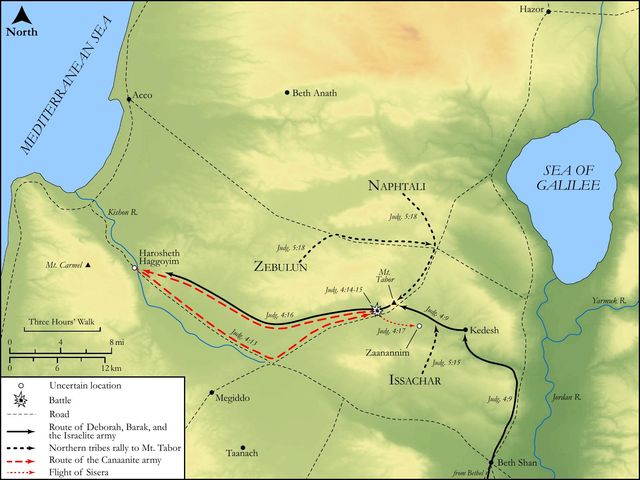
The events described in Judges 4 and 5 take place during the period of the Judges, a time characterized by cyclical apostasy, oppression, and divine deliverance. Israel was under the harsh rule of King Jabin of Hazor, whose military commander, Sisera, possessed formidable iron chariots. This technological superiority posed a significant threat to the nascent Israelite tribes. The battle occurred near the Kishon River, a strategic location in the Jezreel Valley, where Sisera's chariots would be disadvantaged by the terrain, especially after heavy rains. Culturally, the song reflects early Israelite worship and warfare, emphasizing the role of the Lord as the divine warrior. The reference to Sinai evokes the most foundational moment in Israel's history—the giving of the Law and the establishment of the covenant, a memory deeply embedded in their collective consciousness as the ultimate demonstration of God's power and presence among them.
Key Themes
ShowHideJudges 5:5 contributes significantly to several key themes within the book of Judges and the broader Old Testament narrative. Primarily, it underscores the Divine Majesty and Power of Yahweh, depicting Him as capable of shaking the very foundations of the earth, an irresistible force before whom even mountains dissolve. This imagery reinforces the theme of God's Active Presence (Theophany), specifically by recalling the awe-inspiring manifestation of God at Mount Sinai, where He descended in fire, smoke, and thunder to give the Law. This connection serves to remind the audience that the same powerful God who established the covenant is actively involved in their current struggles and triumphs, fulfilling His promises as seen in passages like Deuteronomy 33:2. Furthermore, the verse reinforces the theme of God as the Divine Warrior, who fights on behalf of His people, illustrating that the victory over the Canaanites is not merely a human triumph but a direct demonstration of God's unwavering commitment to His covenant with Israel, echoing the sentiment found in Exodus 15:3.
Exposition and Analysis
ShowHideKey Word Analysis
ShowHideThis verb, derived from the primitive root נזל (nâzal), means "to flow," "to trickle," "to dissolve," or "to drip." In the context of "melted," it conveys a powerful, dramatic, and forceful dissolution, not a gentle melting. It suggests an overwhelming, uncontainable, and irresistible force that causes even the most solid and imposing elements of creation—the mountains—to lose their substance and flow away. This imagery emphasizes the sheer, unbridled power of God's presence.
The divine personal name of God, often rendered as "Yahweh" or "Jehovah," signifies God's covenantal faithfulness, His self-existence, and His active presence in the world. The repetition of "from before the LORD" emphasizes that the melting of the mountains is not a natural phenomenon but a direct, intentional act caused solely by the awesome and terrifying presence of the sovereign God of Israel. This highlights His unique identity and unparalleled authority.
This proper noun refers to the specific mountain where God revealed Himself to Moses and gave the Law to Israel (Exodus 19-Exodus 20). Its explicit mention serves as an iconic, foundational reference point for God's overwhelming glory, covenantal power, and theophany. By invoking Sinai, the song immediately connects the present victory to the bedrock of Israel's identity and the most profound demonstration of God's power in their history, underscoring the continuity of God's mighty acts.
Verse Breakdown
ShowHide"The mountains melted from before the LORD"
This clause uses vivid, hyperbolic imagery to describe the profound impact of God's presence. "The mountains" represent stability, permanence, and immense power in the natural world. Their "melting" signifies their utter inability to withstand or remain unchanged in the face of the Lord's overwhelming power and majesty. It is a poetic way of expressing the absolute supremacy and irresistible force of God, before whom all creation is mutable and subservient. The phrase "from before the LORD" directly attributes this dramatic transformation to His immediate, active presence.
"[even] that Sinai from before the LORD God of Israel"
This second clause functions as an appositional clarification and intensification of the first. "That Sinai" specifically identifies the archetypal mountain where God's presence was most famously and terrifyingly manifested to Israel. It grounds the general statement about "the mountains" in a concrete, historical, and deeply significant event for the Israelite audience. The repetition of "from before the LORD" reinforces the direct divine causation, while the full title "LORD God of Israel" emphasizes God's unique covenant relationship with His people, highlighting His particular care and intervention on their behalf. This clause underscores the continuity of God's power from the foundational covenant event to the present moment of victory.
Literary Devices
ShowHideJudges 5:5 is rich in literary devices that amplify its theological message. The most prominent is Hyperbole, where the melting of mountains is an exaggerated statement not meant to be taken literally, but to emphasize the immense, uncontainable, and irresistible power of God's presence. This dramatic overstatement effectively conveys a sense of awe and terror. Closely related is the concept of Theophany, the visible manifestation of God to humankind, which the verse explicitly references by recalling the events at Sinai. The imagery of mountains dissolving is a poetic depiction of the earth trembling and reacting to the divine presence, consistent with other biblical accounts of God's appearance. Furthermore, the verse employs Parallelism, specifically synonymous parallelism, where the second clause "[even] that Sinai from before the LORD God of Israel" echoes and intensifies the meaning of the first clause "The mountains melted from before the LORD." This repetition with slight variation reinforces the central idea of God's overwhelming power and His specific connection to Israel through the Sinai covenant. The use of Synecdoche can also be argued, where "Sinai" stands for the entire event of the covenant revelation, encompassing God's power, law-giving, and establishment of Israel as His people.
Theological and Thematic Connections
ShowHideJudges 5:5 profoundly articulates the biblical truth of God's absolute sovereignty and terrifying majesty. It posits that the Lord is not merely a distant deity but an active, dynamic, and irresistible force who intervenes directly in human history. The imagery of mountains melting before Him establishes His supremacy over all creation and all earthly powers, underscoring that no obstacle, however formidable, can stand in the way of His purposes or His people when He acts. This verse connects the present victory of Deborah and Barak to the foundational covenantal act at Sinai, asserting a continuity of divine power and faithfulness across generations, reminding Israel that the God who delivered them from Egypt and gave them His Law is the same God who fights their battles today. It cultivates a spirit of awe, reverence, and unwavering trust in God's power to overcome.
Reflection and Application
ShowHideJudges 5:5 offers profound encouragement and a powerful challenge for believers today. It serves as a vivid reminder that the God we worship is not a distant, passive observer but an active, sovereign, and all-powerful Lord whose presence alone can cause the most formidable obstacles to dissolve. Just as He demonstrated His uncontainable might at Sinai and in the miraculous defeat of Sisera, He continues to be present and powerful in the lives of His people, capable of overcoming any "mountain" that stands in our way—be it personal struggles, societal injustices, or spiritual strongholds. This verse calls us to cultivate a deep sense of awe and reverence for God's majesty, recognizing that true victory and deliverance come from His hand alone. It invites us to trust implicitly in His active presence, knowing that His power is sufficient for every challenge, fostering both humility and unwavering confidence in His divine strength.
Questions for Reflection
ShowHideFAQ
ShowHideWhat is the significance of the specific mention of "Sinai" in this verse?
ShowHideThe mention of "Sinai" is profoundly significant because it anchors the present victory in the most foundational and awe-inspiring event in Israel's history: the giving of the Law and the establishment of the covenant with God (see Exodus 19 and Exodus 20). By recalling the theophany at Sinai, where God's presence caused the mountain to tremble and be enveloped in fire and smoke, the song emphasizes that the same all-powerful, covenant-keeping God who revealed Himself there is actively fighting on behalf of Israel in the battle against Sisera. It serves as a powerful reminder of God's consistent character, His unwavering commitment to His people, and the continuity of His mighty acts throughout their history. It elevates the victory over Sisera from a mere military triumph to another demonstration of Yahweh's unparalleled power.
Christ-Centered Fulfillment
ShowHideJudges 5:5, with its awe-inspiring depiction of God's overwhelming presence causing mountains to melt, finds its ultimate fulfillment and most profound revelation in the person of Jesus Christ. The terrifying glory of God that descended upon Mount Sinai, causing the earth to tremble and people to fear, is fully embodied in Christ, who is "the radiance of God's glory and the exact representation of his being" (Hebrews 1:3). While Sinai revealed God's power through fire and earthquake, Christ reveals God's power through self-giving love, ultimate authority over creation, and victory over sin and death. The "LORD God of Israel" before whom mountains melted is the same God who, in Christ, "emptied himself, by taking the form of a servant" (Philippians 2:7). Yet, this humility does not diminish His power; rather, it demonstrates its depth. Before Christ, the true Lamb of God (John 1:29), the "mountains" of sin, death, and the law's condemnation melt away, as He fulfills the law and brings a new covenant. His resurrection is the ultimate demonstration that no force, not even the grave, can stand "before the LORD God of Israel" now revealed in the resurrected Christ, before whom "every knee should bow, in heaven and on earth and under the earth" (Philippians 2:10).