


1 Corinthians 7:4
Bible text: King James Version (1769 Blayney text) · Public domain
Bible text: King James Version with Strong's numbers · Public domain
Bible text: Berean Standard Bible · Public domain
Bible text: American Standard Version (1901) · Public domain
Bible text: World English Bible, Messianic edition · Public domain
Bible text: Geneva Bible (1599) · Public domain
Bible text: Young's Literal Translation · Public domain
- ἡhēTheG3588T-NSFDefinite article Nominative Singular Feminine
- γυνὴgunēwifeG1135N-NSFNoun Nominative Singular Feminine
- τοῦtou<the>G3588T-GSNDefinite article Genitive Singular Neuter
- ἰδίουidiou[her] ownG2398A-GSNAdjective Genitive Singular Neuter
- σώματοςsōmatosbodyG4983N-GSNNoun Genitive Singular Neuter
- οὐκouknotG3756PRT-NNegative Particle Negative
- ἐξουσιάζειexousiazeihas authority overG1850V-PAI-3SVerb Present Active Indicative 3rd Singular
- ἀλλ᾽all᾽butG235CONJConjunction
- ὁhotheG3588T-NSMDefinite article Nominative Singular Masculine
- ἀνήρ·anērhusbandG435N-NSMNoun Nominative Singular Masculine
- ὁμοίωςhomoiōslikewiseG3668ADVAdverb
- δὲdenowG1161CONJConjunction
- καὶkaialsoG2532CONJConjunction
- ὁhotheG3588T-NSMDefinite article Nominative Singular Masculine
- ἀνὴρanērhusbandG435N-NSMNoun Nominative Singular Masculine
- τοῦtou<the>G3588T-GSNDefinite article Genitive Singular Neuter
- ἰδίουidiou[his] ownG2398A-GSNAdjective Genitive Singular Neuter
- σώματοςsōmatosbodyG4983N-GSNNoun Genitive Singular Neuter
- οὐκouknotG3756PRT-NNegative Particle Negative
- ἐξουσιάζειexousiazeihas authority overG1850V-PAI-3SVerb Present Active Indicative 3rd Singular
- ἀλλ᾽all᾽butG235CONJConjunction
- ἡhētheG3588T-NSFDefinite article Nominative Singular Feminine
- γυνήgunēwifeG1135N-NSFNoun Nominative Singular Feminine
English is a literal word-by-word gloss of the Greek, not the KJV's wording. Why?
This is the original text the KJV's translators worked from — each Greek word with its own literal English meaning in this verse, prepared by scholars at Tyndale House, Cambridge. The KJV translates whole sentences, not word by word, so its wording differs: one Greek word can become several English words, and the KJV may choose “charity” where the gloss reads “love”. Both are faithful — they answer different questions. For the KJV's own rendering, switch to the KJV text.
Details
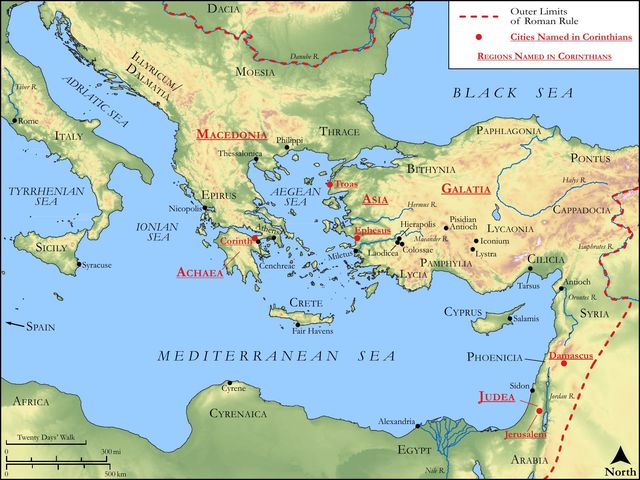
See on the biblical-era maps

Study this verse
Public-domain commentary
Matthew Henry
From his Commentary on the Whole Bible. Henry comments on passages, not single verses — this entry covers 1 Corinthians 7:1–9.
The apostle comes now, as a faithful and skilful casuist, to answer some cases of conscience which the Corinthians had proposed to him. Those were things whereof they wrote to him, Co1 7:1. As the lips of ministers should keep knowledge, so the people should ask the law at their mouths. The apostle was as ready to resolve as they were to propose their doubts. In the former chapter, he warns them to avoid fornication; here he gives some directions about marriage, the remedy God had appointed for it. He tells them in general,
I.That it was good, in that juncture of time at least, to abstain from marriage altogether:
It is good for a man not to touch a woman (not to take her to wife), by good here not understanding what is so conformable to the mind and will of God as if to do otherwise were sin, an extreme into which many of the ancients have run in favour of celibacy and virginity. Should the apostle be understood in this sense, he would contradict much of the rest of his discourse. But it is good, that is, either abstracting from circumstances there are many things in which the state of celibacy has the advantage above the marriage state; or else at this juncture, by reason of the distress of the Christian church, it would be a convenience for Christians to keep themselves single, provided they have the gift of continency, and at the same time can keep themselves chaste. The expression also may carry in it an intimation that Christians must avoid all occasions of this sin, and flee all fleshly lusts, and incentives to them; must neither look on nor touch a woman, so as to provoke lustful inclinations. Yet,
II.He informs them that marriage, and the comforts and satisfactions of that state, are by divine wisdom prescribed for preventing fornication (Co1 7:2), Porneias - Fornications, all sorts of lawless lust. To avoid these, Let every man, says he, have his own wife, and every woman her own husband; that is, marry, and confine themselves to their own mates. And, when they are married, let each render the other due benevolence (Co1 7:3), consider the disposition and exigency of each other, and render conjugal duty, which is owing to each other. For, as the apostle argues (Co1 7:4), in the married state neither person has power over his own body, but has delivered it into the power of the other, the wife hers into the power of the husband, the husband his into the power of the wife. Note, Polygamy, or the marriage of more persons than one, as well as adultery, must be a breach of marriage-covenants, and a violation of the partner's rights. And therefore they should not defraud one another of the use of their bodies, nor any other of the comforts of the conjugal state, appointed of God for keeping the vessel in sanctification and honour, and preventing the lusts of uncleanness, except it be with mutual consent (Co1 7:5) and for a time only, while they employ themselves in some extraordinary duties of religion, or give themselves to fasting and prayer. Note, Seasons of deep humiliation require abstinence from lawful pleasures. But this separation between husband and wife must not be for a continuance, lest they expose themselves to Satan's temptations, by reason of their incontinence, or inability to contain. Note, Persons expose themselves to great danger by attempting to perform what is above their strength, and at the same time not bound upon them by any law of God. If they abstain from lawful enjoyments, they may be ensnared into unlawful ones. The remedies God hath provided against sinful inclinations are certainly best.
III.The apostle limits what he had said about every man's having his own wife, etc.
(Co1 7:2): I speak this by permission, not of command. He did not lay it as an injunction upon every man to marry without exception. Any man might marry. No law of God prohibited the thing. But, on the other hand, not law bound a man to marry so that he sinned if he did not; I mean, unless his circumstances required it for preventing the lust of uncleanness. It was a thing in which men, by the laws of God, were in a great measure left at liberty. And therefore Paul did not bind every man to marry, though every man had an allowance. No, he could wish all men were as himself (Co1 7:7), that is, single, and capable of living continently in that state. There were several conveniences in it, which at that season, if not at others, made it more eligible in itself. Note, It is a mark of true goodness to wish all men as happy as ourselves. But it did not answer the intentions of divine Providence as well for all men to have as much command of this appetite as Paul had. It was a gift vouchsafed to such persons as Infinite Wisdom thought proper: Every one hath his proper gift of God, one after this manner and another after that. Natural constitutions vary; and, where there may not be much difference in the constitution, different degrees of grace are vouchsafed, which may give some a greater victory over natural inclination than others. Note, The gifts of God, both in nature and grace, are variously distributed. Some have them after this manner and some after that. Paul could wish all men were as himself, but all men cannot receive such a saying, save those to whom it is given, Mat 19:11.
IV.He sums up his sense on this head (Co1 7:9, Co1 7:10):
I say therefore to the unmarried and widows, to those in a state of virginity or widowhood, It is good for them if they abide even as I. There are many conveniences, and especially at this juncture, in a single state, to render it preferable to a married one. It is convenient therefore that the unmarried abide as I, which plainly implies that Paul was at that time unmarried. But, if they cannot contain, let them marry; for it is better to marry than to burn. This is God's remedy for lust. The fire may be quenched by the means he has appointed. And marriage, with all its inconveniences, is much better than to burn with impure and lustful desires. Marriage is honourable in all; but it is a duty in those who cannot contain nor conquer those inclinations.
Historical interpretation
Two Centuries of Reception
2 surviving comments on this verse. Each one is dated, so this reads as a timeline rather than a list.
Select a marker to jump to its quote. Markers stagger vertically where authors wrote within a few decades of each other.
If this is so, a man should be able to refrain from exercising his authority [to receive his spouse’s body]. And isn’t a woman capable of doing likewise?
Now what is the meaning of "the due honor? The wife hath not power over her own body;" but is both the slave and the mistress of the husband. And if you decline the service which is due, you have offended God. But if thou wish to withdraw thyself, it must be with the husband's permission, though it be but a for short time. For this is why he calls the matter a debt, to shew that no one is master of himself but that they are servants to each other.
When therefore thou seest an harlot tempting thee, say, "My body is not mine, but my wife's." The same also let the woman say to those who would undermine her chastity, "My body is not mine, but my husband's."
Now if neither husband nor wife hath power even over their own body, much less have they over their property. Hear ye, all that have husbands and all that have wives: that if you must not count your body your own, much less your money.
Elsewhere I grant He gives to the husband abundant precedence, both in the New Testament, and the Old saying, "Thy turning shall be towards thy husband, and he shall rule over thee." Paul doth so too by making a distinction thus, and writing, "Husbands, love your wives; and let the wife see that she reverence her husband." But in this place we hear no more of greater and less, but it is one and the same right. Now why is this? Because his speech was about chastity. "In all other things," says he, "let the husband have the prerogative; but not so where the question is about chastity." "The husband hath no power over his own body, neither the wife." There is great equality of honor, and no prerogative.
Continue studying 1 Corinthians 7:4 across the web’s major study libraries — every link below opens this exact verse, chapter, or book on the destination site.
Read & Compare
 BibleGatewayThis verse in more than 200 translations and 70 languages.
 Bible.comThe YouVersion reader — hundreds of translations, reading plans, and highlights.
 ESV.orgCrossway's official English Standard Version reader.
 NET BibleThe NET translation with 60,000+ translators' notes on every rendering decision.
 STEP BibleTyndale House's free study tool — original text, vocabulary, and scholarly resources.
 BibliaLogos Bible Software's free web reader.
 USCCBThe New American Bible (Revised Edition) with the U.S. bishops' study notes.
Commentaries
 BibleHub CommentariesDozens of classic commentaries on this verse, gathered on one page.
 StudyLightMore than 100 commentary sets — the largest collection on the web.
 BibleRefPlain-English commentary on what this verse means, verse by verse.
 Enduring WordDavid Guzik's free commentary on this chapter, widely used by Bible teachers.
 Bible Study ToolsVerse commentary alongside Greek and Hebrew study aids.
Original Language & Research
- BibleHub InterlinearThe verse word by word — original language, transliteration, and English.
- BibleHub LexiconEvery word's original-language definition and Strong's entry.
 Blue Letter BibleDeep-study tools — Strong's numbers, concordance, and word studies.
 CNTR CollationThe earliest Greek manuscripts of this verse, collated letter by letter.
Sermons, Hymns & Audio


TrulyRandomVerse is not affiliated with these sites and doesn’t control their content. They’re linked because they’re genuinely useful.
Summary
First Corinthians 7:4 is a foundational statement on marital intimacy, articulating a profound principle of mutual ownership and reciprocal authority within the covenant of marriage. The Apostle Paul declares that neither spouse retains exclusive control over their own body; rather, each surrenders this authority to the other, establishing a framework of selfless giving and shared responsibility for physical intimacy within the marital bond. This verse underscores the deep unity and interdependence that should characterize a Christian marriage.
Context
ShowHideLiterary Context
This verse is situated within a larger discourse in 1 Corinthians 7, where Paul directly addresses specific questions and concerns raised by the Corinthian believers regarding marriage, celibacy, and sexual ethics. Following his instruction in 1 Corinthians 7:3 for spouses to fulfill their "conjugal rights" or "marital duty" to one another, verse 4 provides the theological basis for this duty: a mutual surrender of bodily autonomy. The immediate context of 1 Corinthians 7:5 further clarifies that this mutual giving is intended to prevent sexual temptation and maintain purity, allowing for temporary abstinence only by mutual consent for prayer. Thus, 1 Corinthians 7:4 serves as the linchpin establishing the principle of shared physical authority that undergirds Paul's subsequent practical advice on marital relations.
Historical & Cultural Context
The city of Corinth was a bustling Roman port city, notorious for its rampant immorality and diverse religious practices, including the worship of Aphrodite, which often involved temple prostitution. This environment posed significant challenges for the nascent Christian community, as believers grappled with how to live out their faith in stark contrast to the prevailing culture. Among the Greeks and Romans, women generally held a subordinate legal and social status, and a husband typically had significant authority over his wife and household. Against this backdrop, Paul's declaration of mutual bodily authority in 1 Corinthians 7:4 was remarkable in its world, placing husband and wife on an equal footing regarding sexual rights and responsibilities within marriage. This radical equality would have been counter-cultural and profoundly impactful for the Corinthian believers.
Key Themes
ShowHideFirst Corinthians 7 as a whole explores several key themes to which 1 Corinthians 7:4 contributes significantly. Mutual Obligation and Reciprocity is paramount, as the verse explicitly applies the same principle to both husband and wife, emphasizing a shared responsibility for marital intimacy. This directly supports the theme of Bodily Surrender in Marriage, where neither spouse retains exclusive authority over their own body, but rather each body is given over to the other within the covenant. This concept echoes the foundational truth of Genesis 2:24, where two become "one flesh." Furthermore, Paul's broader concern for Prevention of Immorality is addressed, as the mutual access and satisfaction within marriage, as outlined in this verse and 1 Corinthians 7:5, serves as a safeguard against sexual temptation and sin, reinforcing the call to flee sexual immorality found earlier in the epistle.
Exposition and Analysis
ShowHideKey Word Analysis
ShowHideThis term (G1135) refers to a woman, and specifically in this context, a wife. Its usage here highlights the specific relational dynamic within marriage, emphasizing the role of the female spouse in the reciprocal exchange of bodily authority.
Derived from exousia (authority), this verb (G1850) means "to control" or "to exercise authority upon." In this verse, it is used in the negative ("hath not power") to assert that neither spouse has independent, exclusive authority over their own body. Instead, the authority is transferred and shared mutually within the marital union, underscoring a relational control rather than individualistic autonomy.
This word (G435) denotes a man, particularly an individual male, and in this context, the male spouse. Paul's parallel application of the principle of mutual bodily authority to both the gynḗ (wife) and the anḗr (husband) is crucial for understanding the radical equality he advocates within Christian marriage.
This term (G4983) refers to the physical body, but in a broader sense, it can encompass the entire person. In this context, it specifically denotes the physical self, particularly in relation to sexual intimacy. The mutual surrender of the "body" signifies the complete giving of one's physical self to the other in the marital covenant, reinforcing the concept of unity and shared ownership.
Verse Breakdown
ShowHide"The wife hath not power of her own body, but the husband"
This clause establishes the principle for the wife, stating that her body is not solely under her own authority once married. Instead, that authority is now shared with, or given over to, her husband. This is a profound statement of self-giving within the marital covenant, challenging any notion of individualistic control over one's physical self within the union. It implies a responsibility to be available to the husband.
"and likewise also the husband hath not power of his own body, but the wife"
This parallel clause immediately applies the identical principle to the husband. The phrase "and likewise also" (Greek homoíōs kaí) emphasizes the absolute reciprocity and equality of this principle. Just as the wife's body is given to the husband, so too is the husband's body given to the wife. This revolutionary statement, especially in a patriarchal society, underscores Paul's vision of mutual submission and shared responsibility in Christian marriage, ensuring that neither partner can unilaterally withhold intimacy or demand it without considering the other.
Literary Devices
ShowHideThe primary literary device at play in 1 Corinthians 7:4 is Chiasm. The structure of the verse follows an A-B-B'-A' pattern: "The wife (A) hath not power of her own body (B), but the husband (B'): and likewise also the husband (A') hath not power of his own body (B), but the wife (B')." This chiastic structure serves to highlight the central point of Reciprocity and Equality between husband and wife. By mirroring the two halves of the statement, Paul emphatically communicates that the principle applies identically to both spouses, underscoring the mutual nature of their bodily authority within marriage. Furthermore, the use of Parallelism reinforces this equality, presenting the same concept twice, first for the wife and then for the husband, ensuring that the message of shared ownership and responsibility is clear and unambiguous for both parties.
Theological and Thematic Connections
ShowHideThe theological implications of 1 Corinthians 7:4 are profound, establishing a radical paradigm of self-giving and mutual submission within Christian marriage. It moves beyond a transactional view of rights to a covenantal understanding of shared personhood, where the physical body, often seen as a private domain, becomes a shared space of intimacy and responsibility. This mutual surrender is not a loss of autonomy but a profound act of love and commitment, reflecting the Trinitarian nature of God where persons exist in loving interdependence. It challenges individualistic tendencies and calls spouses to prioritize the needs and well-being of their partner, fostering a relationship marked by selfless generosity rather than self-serving demands.
Reflection and Application
ShowHideFirst Corinthians 7:4 offers a timeless and counter-cultural challenge to married couples today. In a world that often champions individual rights and personal autonomy above all else, Paul's teaching calls us to a radical self-giving within the context of marriage. It means understanding that one's body, in the marital union, is not exclusively one's own to control or withhold, but is given in love to the spouse. This principle fosters a profound sense of shared responsibility for intimacy, encouraging open and honest communication about desires, needs, and boundaries. It promotes a selfless approach to marital relations, where each partner seeks to serve and satisfy the other, not out of obligation, but out of a deep, Christ-like love. Embracing this truth can transform marital intimacy from a potential source of conflict or neglect into a powerful expression of unity, vulnerability, and mutual blessing, safeguarding the marriage from external temptations and strengthening the bond.
Questions for Reflection
ShowHideFAQ
ShowHideDoes 1 Corinthians 7:4 imply that spouses have no personal boundaries or right to refuse intimacy?
ShowHideWhile 1 Corinthians 7:4 emphasizes mutual bodily authority, it's crucial to interpret it within the broader biblical context of love, respect, and mutual submission (Ephesians 5:21). It does not negate the importance of consent, communication, or the sanctity of the individual. Instead, it frames marital intimacy as a shared responsibility and a mutual giving, rather than a unilateral right or demand. The "power" (Greek exousia) is reciprocal, meaning both spouses are equally called to consider the other's needs and well-being. This mutual surrender should be exercised in love, understanding, and open dialogue, not in a way that is coercive or disrespectful. As 1 Corinthians 7:5 clarifies, even temporary abstinence should be "by agreement" (KJV: "with consent"), highlighting the necessity of mutual understanding and agreement in all aspects of marital intimacy. The verse promotes a selfless approach, where each partner prioritizes the other's needs within a loving and respectful relationship.
Christ-Centered Fulfillment
ShowHideWhile 1 Corinthians 7:4 directly addresses the dynamics of human marriage, it finds its ultimate fulfillment and deepest meaning in the self-giving love of Christ for His Church. Just as the husband and wife are called to surrender their bodies to one another in love and service, so Christ completely gave Himself for His bride, the Church. He "loved the church, and gave himself for it" (Ephesians 5:25). This profound act of self-sacrifice, culminating in His death on the cross, demonstrates the ultimate "power" given over for the sake of another – not a power of control or domination, but a power of redemptive love and service. In Christ, we see the perfect embodiment of the selfless, reciprocal love that Paul encourages in marriage. Our bodies, as members of Christ, are no longer our own, but are bought with a price (1 Corinthians 6:19-20), consecrated to His service. Thus, the mutual bodily surrender in marriage becomes a tangible, earthly reflection of the spiritual reality of our union with Christ and His complete devotion to us, calling us to live out our marital vows in imitation of His divine love.