


Philippians 4:12
Bible text: King James Version (1769 Blayney text) · Public domain
Bible text: King James Version with Strong's numbers · Public domain
Bible text: Berean Standard Bible · Public domain
Bible text: American Standard Version (1901) · Public domain
Bible text: World English Bible, Messianic edition · Public domain
Bible text: Geneva Bible (1599) · Public domain
Bible text: Young's Literal Translation · Public domain
- οἶδαoidaI knowG1492V-PAI-1SVerb Present Active Indicative 1st Singular
- καὶkaialsoG2532CONJConjunction
- ταπεινοῦσθαιtapeinousthai[how] to be brought lowG5013V-PPNVerb Present Passive Infinitive
- οἶδαoidaI knowG1492V-PAI-1SVerb Present Active Indicative 1st Singular
- καὶkaialsoG2532CONJConjunction
- περισσεύειν·perisseuein[how] to aboundG4052V-PANVerb Present Active Infinitive
- ἐνenInG1722PREPPreposition
- παντὶpantieverythingG3956A-DSNAdjective Dative Singular Neuter
- καὶkaiandG2532CONJConjunction
- ἐνeninG1722PREPPreposition
- πᾶσινpasinall thingsG3956A-DPNAdjective Dative Plural Neuter
- μεμύημαιmemuēmaiI have learned the secretG3453V-RPI-1SVerb Perfect Passive Indicative 1st Singular
- καὶkaialsoG2532CONJConjunction
- χορτάζεσθαιchortazesthaito be fullG5526V-PPNVerb Present Passive Infinitive
- καὶkaiandG2532CONJConjunction
- πεινᾶνpeinanto hungerG3983V-PANVerb Present Active Infinitive
- καὶkaialsoG2532CONJConjunction
- περισσεύεινperisseueinto aboundG4052V-PANVerb Present Active Infinitive
- καὶkaiandG2532CONJConjunction
- ὑστερεῖσθαι·hustereisthaito be deficientG5302V-PPNVerb Present Passive Infinitive
English is a literal word-by-word gloss of the Greek, not the KJV's wording. Why?
This is the original text the KJV's translators worked from — each Greek word with its own literal English meaning in this verse, prepared by scholars at Tyndale House, Cambridge. The KJV translates whole sentences, not word by word, so its wording differs: one Greek word can become several English words, and the KJV may choose “charity” where the gloss reads “love”. Both are faithful — they answer different questions. For the KJV's own rendering, switch to the KJV text.
Details
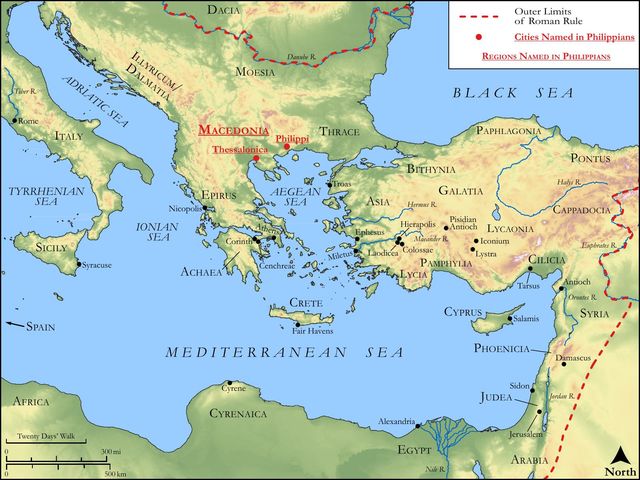
See on the biblical-era maps

Study this verse
Public-domain commentary
Matthew Henry
From his Commentary on the Whole Bible. Henry comments on passages, not single verses — this entry covers Philippians 4:10–19. His two-level outline is real structure in the source text, so it is rendered as structure.
In these verses we have the thankful grateful acknowledgment which the apostle makes of the kindness of the Philippians in sending him a present for his support, now that he was a prisoner at Rome. And here,
I.He takes occasion to acknowledge their former kindnesses to him, and to make mention of them, Phi 4:15, Phi 4:16.
Paul had a grateful spirit; for, though what his friends did for him was nothing in comparison of what he deserved from them and the obligations he had laid upon them, yet he speaks of their kindness as if it had been a piece of generous charity, when it was really far short of a just debt. If they had each of them contributed half their estates to him, they had not given him too much, since they owed to him even their own souls; and yet, when they send a small present to him, how kindly does he take it, how thankfully does he mention it, even in this epistle which was to be left upon record, and read in the churches, through all ages; so that wherever this epistle shall be read there shall this which they did to Paul be told for a memorial of them. Surely never was present so well repaid. He reminds them that in the beginning of the gospel no church communicated with him as to giving and receiving but they only, Phi 4:15. They not only maintained him comfortably while he was with them, but when he departed from Macedonia they sent tokens of their kindness after him; and this when no other church did so. None besides sent after him of their carnal things, in consideration of what they had reaped of his spiritual things. In works of charity, we are ready to ask what other people do. But the church of the Philippians never considered that. It redounded so much the more to their honour that they were the only church who were thus just and generous. Even in Thessalonica (after he had departed from Macedonia) you sent once and again to my necessity, Phi 4:16. Observe,
1.It was but little which they sent; they sent only to his necessity, just such things as he had need of; perhaps it was according to their ability, and he did not desire superfluities nor dainties.
2.It is an excellent thing to see those to whom God has abounded in the gifts of his grace abounding in grateful returns to his people and ministers, according to their own ability and their necessity: You sent once and again. Many people make it an excuse for their charity that they have given once; why should the charge come upon them again? But the Philippians sent once and again; they often relieved and refreshed him in his necessities. He makes this mention of their former kindness, not only out of gratitude, but for their encouragement.
II.He excuses their neglect of late.
It seems, for some time they had not sent to enquire after him, or sent him any present; but now at the last their care of him flourished again (Phi 4:10), like a tree in the spring, which seemed all the winter to be quite dead. Now, in conformity to the example of his great Master, instead of upbraiding them for their neglect, he makes an excuse for them: Wherein you were also careful, but you lacked opportunity. How could they lack opportunity, if they had been resolved upon it? They might have sent a messenger on purpose. But the apostle is willing to suppose, in favour of them, that they would have done it if a fair opportunity had offered. How contrary is this to the behaviour of many to their friends, by whom neglects which really are excusable are resented very heinously, when Paul excused that which he had reason enough to resent.
III.He commends their present liberality:
Notwithstanding, you have well done that you did communicate with my affliction, Phi 4:14. It is a good work to succour and help a good minister in trouble. Here see what is the nature of true Christian sympathy; not only to be concerned for our friends in their troubles, but to do what we can to help them. They communicated with his affliction, in relieving him under it. He who says, Be you warmed, be you filled, and giveth not those things they have need of, what doth it profit? Jam 2:16. He rejoiced greatly in it (Phi 4:10), because it was an evidence of their affection to him and the success of his ministry among them. When the fruit of their charity abounded towards the apostle, it appeared that the fruit of his ministry abounded among them.
IV.He takes care to obviate the bad use some might make of his taking so much notice of what was sent him.
It did not proceed either from discontent and distrust (Phi 4:11) or from covetousness and love of the world, Phi 4:12. 1. It did not come from discontent, or distrust of Providence: Not that I speak in respect of want (Phi 4:11); not in respect of any want he felt, nor of any want he feared. As to the former, he was content with the little he had, and that satisfied him; as to the latter, he depended upon the providence of God to provide for him from day to day, and that satisfied him: so that he did not speak in respect of want any way. For I have learned, in whatsoever state I am, therewith to be content. We have here an account of Paul's learning, not that which he got at the feet of Gamaliel, but that which he got at the feet of Christ. He had learnt to be content; and that was the lesson he had as much need to learn as most men, considering the hardships and sufferings with which he was exercised. He was in bonds, and imprisonments, and necessities, often; but in all he had learnt to be content, that is, to bring his mind to his condition, and make the best of it. - I know both how to be abased and I know how to abound, Phi 4:12. This is a special act of grace, to accommodate ourselves to every condition of life, and carry an equal temper of mind through all the varieties of our state. (1.) To accommodate ourselves to an afflicted condition - to know how to be abased, how to be hungry, how to suffer want, so as not to be overcome by the temptations of it, either to lose our comfort in God or distrust his providence, or to take any indirect course for our own supply. (2.) To a prosperous condition - to know how to abound, how to be full, so as not to be proud, or secure, or luxurious. And this is as hard a lesson as the other; for the temptations of fulness and prosperity are not less than those of affliction and want. But how must we learn it? I can do all things through Christ who strengthens me, Phi 4:13. We have need of strength from Christ, to enable us to perform not only those duties which are purely Christian, but even those which are the fruit of moral virtue. We need his strength to teach us to be content in every condition. The apostle had seemed to boast of himself, and of his own strength: I know how to be abased (Phi 4:12); but here he transfers all the praise to Christ. "What do I talk of knowing how to be abased, and how to abound? It is only through Christ who strengthens me that I can do it, not in my own strength." So we are required to be strong in the Lord, and in the power of his might (Eph 6:10), and to be strong in the grace which is in Christ Jesus (Ti2 2:1); and we are strengthened with might by his Spirit in the inner man, Eph 3:16. The word in the original is a participle of the present tense, en tō endunamounti me Christō, and denotes a present and continued act; as if he had said, "Through Christ, who is strengthening me, and does continually strengthen me; it is by his constant and renewed strength I am enabled to act in every thing; I wholly depend upon him for all my spiritual power." 2. It did not come from covetousness, or an affection to worldly wealth: "Not because I desired a gift (Phi 4:17): that is, I welcome your kindness, not because it adds to my enjoyments, but because it adds to your account." He desired not so much for his own sake, but theirs: "I desire fruit that may abound to your account, that is, that you may be enabled to make such a good use of your worldly possessions that you may give an account of them with joy." It is not with any design to draw more from you, but to encourage you to such an exercise of beneficence as will meet with a glorious reward hereafter. "For my part," says he, "I have all, and abound, Phi 4:18. What can a man desire more than enough? I do not desire a gift for the gift's sake, for I have all, and abound." They sent him a small token, and he desired no more; he was not solicitous for a present superfluity, or a future supply: I am full, having received from Epaphroditus the things which were sent by you. Note, A good man will soon have enough of this world; not only of living in it, but of receiving from it. A covetous worldling, if he has ever so much, would still have more; but a heavenly Christian, though he has little, has enough.
V.The apostle assures them that God did accept, and would recompense, their kindness to him.
1.He did accept it: It is an odour of a sweet smell, a sacrifice acceptable, well-pleasing to God. Not a sacrifice of atonement, for none makes atonement for sin but Christ; but a sacrifice of acknowledgment, and well-pleasing to God. It was more acceptable to God as it was the fruit of their grace than it was to Paul as it was the supply of his want. With such sacrifices God is well pleased, Heb 13:16.
2.He would recompense it: But my God shall supply all your wants according to his riches in glory by Christ Jesus, Phi 4:19. He does as it were draw a bill upon the exchequer in heaven, and leaves it to God to make them amends for the kindness they had shown him. "He shall do it, not only as your God, but as my God, who takes what is done to me as done to himself. You supplied my needs, according to your poverty; and he shall supply yours, according to his riches." But still it is by Christ Jesus; through him we have grace to do that which is good, and through him we must expect the reward of it. Not of debt, but of grace; for the more we do for God the more we are indebted to him, because we receive the more from him.
Historical interpretation
Two Centuries of Reception
4 surviving comments on this verse. Each one is dated, so this reads as a timeline rather than a list.
Select a marker to jump to its quote. Markers stagger vertically where authors wrote within a few decades of each other.
And the divine apostle furnishes the rule for the Gnostic in these words, writing as follows: "For I have learned, in whatsoever state I am, to be content. I know both how to be abased, and I know how to abound. Everywhere and in all things I am instructed both to be full and to be hungry, both to abound and to lack. I can do all things through Him who strengtheneth me."
Suffering poverty is often thought to be a tribulation, but abundance also may be an occasion for tribulation. The wise person restrains himself from being enervated by abundance.
"In whatsoever state I am," saith he, "therein to be content. I know how to be abased, and I know also how to abound. In everything and in all things have I learned the secret." That is, I know how to use little, to bear hunger and want. "Both to abound, and to suffer need." "But, says one, there is no need of wisdom or of virtue in order to abound." There is great need of virtue, not less than in the other case. For as want inclines us to do many evil things, so too doth plenty. For many ofttimes, coming into plenty, have become indolent, and have not known how to bear their good fortune. Many men have taken it as an occasion of no longer working. But Paul did not so, for what he received he consumed on others, and emptied himself for them. This is to know. He was in nowise relaxed, nor did he exult at his abundance; but was the same in want and in plenty, he was neither oppressed on the one hand, nor rendered a boaster on the other. "Both to be filled," saith he "and to be hungry, both to abound, and to be in want." Many know not how to be full, as for example, the Israelites, "ate, and kicked," but I am equally well ordered in all. He showeth that he neither is now elated, nor was before grieved: or if he grieved, it was on their account, not on his own, for he himself was similarly affected.
"In everything," saith he, "and in all things I have learned the secret," i.e. I have had experience of all things in this long time, and these things have all succeeded with me.
All sorts of people indeed can suffer poverty, but to “know how to suffer poverty” is a mark of greatness. Likewise, who is there who may not abound? But to “know how to abound” belongs to none but those who are not corrupted by abundance.
Continue studying Philippians 4:12 across the web’s major study libraries — every link below opens this exact verse, chapter, or book on the destination site.
Read & Compare
 BibleGatewayThis verse in more than 200 translations and 70 languages.
 Bible.comThe YouVersion reader — hundreds of translations, reading plans, and highlights.
 ESV.orgCrossway's official English Standard Version reader.
 NET BibleThe NET translation with 60,000+ translators' notes on every rendering decision.
 STEP BibleTyndale House's free study tool — original text, vocabulary, and scholarly resources.
 BibliaLogos Bible Software's free web reader.
 USCCBThe New American Bible (Revised Edition) with the U.S. bishops' study notes.
Commentaries
 BibleHub CommentariesDozens of classic commentaries on this verse, gathered on one page.
 StudyLightMore than 100 commentary sets — the largest collection on the web.
 BibleRefPlain-English commentary on what this verse means, verse by verse.
 Enduring WordDavid Guzik's free commentary on this chapter, widely used by Bible teachers.
 Bible Study ToolsVerse commentary alongside Greek and Hebrew study aids.
Original Language & Research
- BibleHub InterlinearThe verse word by word — original language, transliteration, and English.
- BibleHub LexiconEvery word's original-language definition and Strong's entry.
 Blue Letter BibleDeep-study tools — Strong's numbers, concordance, and word studies.
 CNTR CollationThe earliest Greek manuscripts of this verse, collated letter by letter.
Sermons, Hymns & Audio


TrulyRandomVerse is not affiliated with these sites and doesn’t control their content. They’re linked because they’re genuinely useful.
Summary
The Apostle Paul, in Philippians 4:12, articulates a profound spiritual maturity, declaring his learned ability to navigate extreme life circumstances with contentment. He reveals that he has been "initiated" into the secret of thriving in both scarcity and abundance, whether experiencing deep poverty or overflowing provision. This verse underscores the internal, Christ-centered source of his stability, independent of external material conditions, setting the stage for his subsequent declaration of strength found in Christ.
Context
ShowHideLiterary Context
Philippians 4:12 stands as a powerful elaboration on the preceding verse, where Paul states, "Not that I speak in respect of want: for I have learned, in whatsoever state I am, therewith to be content" (Philippians 4:11). This sets the immediate stage for Paul to explain how he has learned this profound contentment. The verse immediately following, Philippians 4:13, then reveals the ultimate source of his strength and adaptability, forming a climactic statement about his reliance on Christ. Together, these verses present a cohesive argument for a contentment rooted not in circumstances, but in Christ.
Historical & Cultural Context
Paul wrote the letter to the Philippians from prison, likely in Rome, around A.D. 60-62. His life as an apostle was marked by extreme fluctuations in material provision, as evidenced by his own accounts of shipwrecks, beatings, hunger, and thirst (2 Corinthians 11:23-27). The Philippian church, known for its generosity, had recently sent a financial gift to Paul (Philippians 4:10), prompting this reflection on his ability to be content regardless of their support. This context highlights the real-world challenges Paul faced and the genuine nature of his learned contentment, which was not theoretical but forged in the crucible of apostolic ministry.
Key Themes
ShowHideThis verse powerfully contributes to several overarching themes in Philippians and Paul's broader theology. It exemplifies Christian contentment, demonstrating that true peace and satisfaction are not contingent on external circumstances but are an internal disposition cultivated through faith. It speaks to the theme of spiritual maturity, showcasing Paul's growth beyond dependence on material comfort. Furthermore, it underscores the sufficiency of Christ, subtly preparing the reader for the explicit declaration in Philippians 4:13, where Paul attributes his ability to navigate all situations to Christ's empowering strength. This adaptability and reliance on Christ are central to Paul's understanding of the Christian life.
Exposition and Analysis
ShowHideKey Word Analysis
ShowHideThis verb, G3453, means "to initiate, i.e. (by implication) to teach." It implies a deep, experiential learning, akin to being initiated into a mystery or a secret. Paul is not merely saying he has "learned" in a casual sense, but that he has been profoundly taught or initiated into the "secret" of living contentedly through all conditions. This suggests a divine instruction, a spiritual revelation gained through his walk with God and the trials he endured.
Meaning "to depress; figuratively, to humiliate (in condition or heart)." This term vividly describes the experience of being brought low, whether through poverty, lack of resources, suffering, or social humiliation. It encompasses moments of genuine need and vulnerability, highlighting the extreme end of Paul's varied experiences.
Meaning "to superabound (in quantity or quality), be in excess, be superfluous; also (transitively) to cause to superabound or excel." This word stands in stark contrast to "abased," signifying times of plenty, prosperity, and having more than enough. Paul's ability to handle both extremes with equanimity speaks to a spiritual freedom from the demands of either scarcity or excess.
Verse Breakdown
ShowHide"I know both how to be abased, and I know how to abound"
Paul begins by asserting his experiential knowledge of both ends of the economic and social spectrum. "To be abased" refers to times of material deprivation, humility, or even suffering, while "to abound" signifies periods of plenty, prosperity, or having more than enough. This dual experience forms the foundation of his profound contentment.
"every where and in all things I am instructed"
This phrase emphasizes the comprehensiveness and universality of Paul's learning. His instruction was not limited to specific situations but applied "every where" (geographically, circumstantially) and "in all things" (in every kind of situation or condition). The passive voice "I am instructed" (from myéō) suggests that this learning was not merely self-taught but divinely imparted or revealed through his life's journey.
"both to be full and to be hungry, both to abound and to suffer need"
Paul reiterates and amplifies the contrast, using synonymous pairs to underscore the breadth of his experience. "To be full" (chortázō, literally "to be fed to the full," like animals being fed in a stall, implying complete satisfaction) and "to be hungry" are physical states of provision or lack. "To abound" and "to suffer need" (hysteréō, "to fall short, be deficient, lack, be in want") describe broader states of having more than enough or experiencing deprivation. These parallel clauses reinforce the idea that Paul's contentment transcends all material conditions.
Literary Devices
ShowHidePaul employs several literary devices to convey his message. Antithesis is prominent, with repeated pairings of opposing concepts: "abased" and "abound," "full" and "hungry," "abound" and "suffer need." This stark contrast highlights the extreme range of experiences Paul has mastered. The phrase "every where and in all things" functions as a hyperbole or amplification, emphasizing the universal applicability of his learned contentment, suggesting no circumstance is outside its scope. The use of the passive voice for "I am instructed" implies a divine agent or a profound, almost mystical, process of learning, hinting at a wisdom not of human origin but imparted through spiritual experience.
Theological and Thematic Connections
ShowHidePhilippians 4:12 offers profound theological insights into the nature of Christian contentment and the sufficiency of God's grace. It challenges the common human tendency to seek security and happiness in external circumstances, whether through accumulating wealth or avoiding hardship. Instead, Paul demonstrates that true spiritual well-being is an internal disposition, cultivated through a deep reliance on Christ that transcends material conditions. This contentment is not stoicism or apathy, but a dynamic, Spirit-empowered ability to find peace and purpose in all seasons of life, recognizing God's sovereignty and provision even in scarcity.
Reflection and Application
ShowHidePaul's declaration in Philippians 4:12 serves as a powerful model for believers in every generation. It calls us to examine the true source of our security and satisfaction. In a world that often measures success by abundance and shuns suffering, Paul's life demonstrates that the Christian's peace is not found in the presence of plenty or the absence of want, but in a profound, learned dependence on Christ. This means cultivating a heart that is not anxious when resources are scarce, nor complacent when they are plentiful. It encourages us to embrace every season of life as an opportunity for spiritual growth and to trust in God's unfailing provision and strength, knowing that He is sufficient for all our needs, whether physical, emotional, or spiritual. Our goal should be to find our "fullness" in Him, regardless of our external circumstances.
Questions for Reflection
ShowHideFAQ
ShowHideWhat does Paul mean by "I am instructed" in this verse?
ShowHideWhen Paul says "I am instructed" (KJV), he uses the Greek word myéō (G3453), which signifies a deep, experiential learning, akin to being initiated into a secret or a mystery. It's not just intellectual understanding, but a profound, lived knowledge gained through divine teaching and personal experience. Paul is essentially saying he has been "initiated into the secret" of how to live contentedly and effectively in every conceivable circumstance, whether in abundance or in dire need. This secret was revealed to him through his walk with God and the varied trials and triumphs of his apostolic ministry.
Christ-Centered Fulfillment
ShowHideWhile Philippians 4:12 speaks to Paul's personal experience of contentment, it finds its ultimate Christ-centered fulfillment in the person and work of Jesus Himself. Christ perfectly embodied the ability to navigate both abasement and abundance, yet His focus was always on fulfilling the Father's will. He "emptied himself, by taking the form of a servant, being born in the likeness of men" (Philippians 2:7), experiencing profound abasement, homelessness (Matthew 8:20), and ultimately, the ultimate suffering and death on the cross (Philippians 2:8). Yet, He also demonstrated authority over creation, providing abundance for thousands (Matthew 14:13-21), and receiving the worship of multitudes. Jesus' life demonstrates that true power and contentment come not from external conditions, but from perfect obedience and reliance on God. His resurrection and ascension to glory (Philippians 2:9-11) show that the path through abasement can lead to ultimate abundance and exaltation, providing the pattern and the power for believers to likewise find strength in Him for every circumstance, as Paul affirms in Philippians 4:13.