


Romans 8:36
Bible text: King James Version (1769 Blayney text) · Public domain
Bible text: Berean Standard Bible · Public domain
Bible text: American Standard Version (1901) · Public domain
Bible text: World English Bible, Messianic edition · Public domain
Bible text: Geneva Bible (1599) · Public domain
Bible text: Young's Literal Translation · Public domain
- καθὼςkathōsEven asG2531CONJConjunction
- γέγραπταιgegraptaiit has been writtenG1125V-RPI-3SVerb Perfect Passive Indicative 3rd Singular
- ὅτιhotithatG3754CONJConjunction
- ἕνεκενhenekenFor the sakeG1752PREPPreposition
- σοῦsouof youG4771P-2GSPersonal pronoun Genitive 2nd Singular
- θανατούμεθαthanatoumethawe face deathG2289V-PPI-1PVerb Present Passive Indicative 1st Plural
- ὅληνholēnallG3650A-ASFAdjective Accusative Singular Feminine
- τὴνtēntheG3588T-ASFDefinite article Accusative Singular Feminine
- ἡμέρανhēmerandayG2250N-ASFNoun Accusative Singular Feminine
- ἐλογίσθημενelogisthēmenwe were regardedG3049V-API-1PVerb Aorist Passive Indicative 1st Plural
- ὡςhōsasG5613PRTParticle or Disjunctive
- πρόβαταprobatasheepG4263N-NPNNoun Nominative Plural Neuter
- σφαγῆςsphagēsof slaughterG4967N-GSFNoun Genitive Singular Feminine
English is a literal word-by-word gloss of the Greek, not the KJV's wording. Why?
This is the original text the KJV's translators worked from — each Greek word with its own literal English meaning in this verse, prepared by scholars at Tyndale House, Cambridge. The KJV translates whole sentences, not word by word, so its wording differs: one Greek word can become several English words, and the KJV may choose “charity” where the gloss reads “love”. Both are faithful — they answer different questions. For the KJV's own rendering, switch to the KJV text.
Details
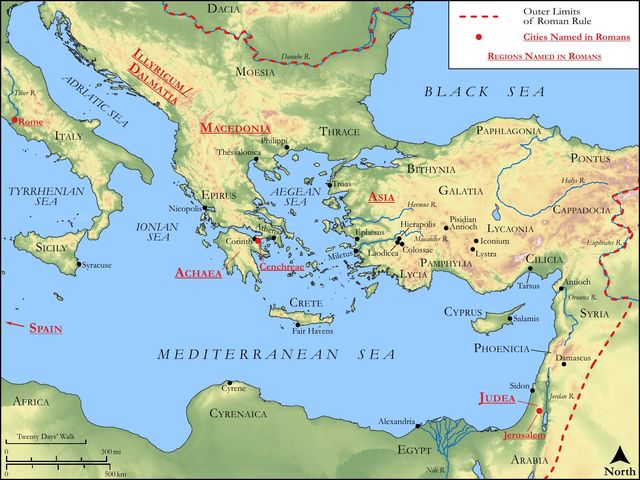
See on the biblical-era maps

Study this verse
Public-domain commentary
Matthew Henry
From his Commentary on the Whole Bible. Henry comments on passages, not single verses — this entry covers Romans 8:31–39. His four-level outline is real structure in the source text, so it is rendered as structure.
The apostle closes this excellent discourse upon the privileges of believers with a holy triumph, in the name of all the saints. Having largely set forth the mystery of God's love to us in Christ, and the exceedingly great and precious privileges we enjoy by him, he concludes like an orator: What shall we then say to these things? What use shall we make of all that has been said? He speaks as one amazed and swallowed up with the contemplation and admiration of it, wondering at the height and depth, and length and breadth, of the love of Christ, which passeth knowledge. The more we know of other things the less we wonder at them; but the further we are led into an acquaintance with gospel mysteries the more we are affected with the admiration of them. If Paul was at a loss what to say to these things, no marvel if we be. And what does he say? Why, if ever Paul rode in a triumphant chariot on this side of heaven, here it was: with such a holy height and bravery of spirit, with such a fluency and copiousness of expression, does he here comfort himself and all the people of God, upon the consideration of these privileges. In general, he here makes a challenge, throws down the gauntlet, as it were, dares all the enemies of the saints to do their worst: If God be for us, who can be against us? The ground of the challenge is God's being for us; in this he sums up all our privileges. This includes all, that God is for us; not only reconciled to us, and so not against us, but in covenant with us, and so engaged for us - all his attributes for us, his promises for us. All that he is, and has, and does, is for his people. He performs all things for them. He is for them, even when he seems to act against them. And, if so, who can be against us, so as to prevail against us, so as to hinder our happiness? Be they ever so great and strong, ever so many, ever so might, ever so malicious, what can they do? While God is for us, and we keep in his love, we may with a holy boldness defy all the powers of darkness. Let Satan do his worst, he is chained; let the world do its worst, it is conquered: principalities and powers are spoiled and disarmed, and triumphed over, in the cross of Christ. Who then dares fight against us, while God himself is fighting for us? And this we say to these things, this is the inference we draw from these premises. More particularly.
I.We have supplies ready in all our wants (Rom 8:32):
He that spared, etc. Who can be against us, to strip us, to deprive us of our comforts? Who can cut off our streams, while we have a fountain to go to?
1.Observe what God has done for us, on which our hopes are built: He spared not his own Son. When he was to undertake our salvation, the Father was willing to part with him, did not think him too precious a gift to bestow for the salvation of poor souls; now we may know that he loves us, in that he hath not withheld his Son, his own Son, his only Son, from us, as he said of Abraham, Gen 22:12. If nothing less will save man, rather than man shall perish let him go, though it were out of his bosom. Thus did he deliver him up for us all, that is, for all the elect; for us all, not only for our good, but in our stead, as a sacrifice of atonement to be a propitiation for sin. When he had undertaken it, he did not spare him. Though he was his own Son, yet, being made sin for us, it pleased the Lord to bruise him. Ouk epheisato - he did not abate him a farthing of that great debt, but charged it home. Awake, O sword. He did not spare his own Son that served him, that he might spare us, though we have done him so much disservice.
2.What we may therefore expect he will do: He will with him freely give us all things.
(1.)It is implied that he will give us Christ, for other things are bestowed with him: not only with him given for us, but with him given to us. He that put himself to so much charge to make the purchase for us surely will not hesitate at making the application to us.
(2.)He will with him freely give us all things, all things that he sees to be needful and necessary for us, all good things, and more we should not desire, Psa 34:10. And Infinite Wisdom shall be the judge whether it be good for us and needful for us or no. Freely give - freely, without reluctancy; he is ready to give, meets us with his favours; - and freely, without recompence, without money, and without price. How shall he not? Can it be imagined that he should do the greater and not do the less? that he should give so great a gift for us when we were enemies, and should deny us any good thing, now that through him we are friends and children? Thus may we by faith argue against our fears of want. he that hath prepared a crown and kingdom for us will be sure to give us enough to bear our charges in the way to it. He that hath designed us for the inheritance of sons when we come to age will not let us want necessaries in the mean time.
II.We have an answer ready to all accusations and a security against all condemnations (Rom 8:33, Rom 8:34):
Who shall lay any thing? Doth the law accuse them? Do their own consciences accuse them? Is the devil, the accuser of the brethren, accusing them before our God day and night? This is enough to answer all those accusations, It is God that justifieth. Men may justify themselves, as the Pharisees did, and yet the accusations may be in full force against them; but, if God justifies, this answers all. He is the judge, the king, the party offended, and his judgment is according to truth, and sooner or later all the world will be brought to be of his mind; so that we may challenge all our accusers to come and put in their charge. This overthrows them all; it is God, the righteous faithful God, that justifieth. Who is he that condemneth? Though they cannot make good the charge yet they will be ready to condemn; but we have a plea ready to move in arrest of judgment, a plea which cannot be overruled. It is Christ that died, etc. It is by virtue of our interest in Christ, our relation to him, and our union with him, that we are thus secured.
1.His death: It is Christ that died. By the merit of his death he paid our debt; and the surety's payment is a good plea to an action of debt. It is Christ, an able all-sufficient Saviour.
2.His resurrection: Yea, rather, that has risen again. This is a much greater encouragement, for it is a convincing evidence that divine justice was satisfied by the merit of his death. His resurrection was his acquittance, it was a legal discharge. Therefore the apostle mentions it with a yea, rather. If he had died, and not risen again, we had been where we were.
3.His sitting at the right hand of God: He is even at the right hand of God - a further evidence that he has done his work, and a mighty encouragement to us in reference to all accusations, that we have a friend, such a friend, in court. At the right hand of God, which denotes that he is ready there - always at hand; and that he is ruling there - all power is given to him. Our friend is himself the judge.
4.The intercession which he makes there. He is there, not unconcerned about us, not forgetful of us, but making intercession. He is agent for us there, an advocate for us, to answer all accusations, to put in our plea, and to prosecute it with effect, to appear for us and to present our petitions. And is not this abundant matter for comfort? What shall we say to these things? Is this the manner of men, O Lord God? What room is left for doubting and disquietment? Why art thou cast down, O my soul? Some understand the accusation and condemnation here spoken of of that which the suffering saints met with from men. The primitive Christians had many black crimes laid to their charge - heresy, sedition, rebellion, and what not? For these the ruling powers condemned them: "But no matter for that" (says the apostle); "while we stand right at God's bar it is of no great moment how we stand at men's. To all the hard censures, the malicious calumnies, and the unjust and unrighteous sentences of men, we may with comfort oppose our justification before God through Christ Jesus as that which doth abundantly countervail," Co1 4:3, Co1 4:4.
III.We have good assurance of our preservation and continuance in this blessed state, Rom 8:35, to the end.
The fears of the saints lest they should lose their hold of Christ are often very discouraging and disquieting, and create them a great deal of disturbance; but here is that which may silence their fears, and still such storms, that nothing can separate them. We have here from the apostle,
1.A daring challenge to all the enemies of the saints to separate them, if they could, from the love of Christ. Who shall? None shall, Rom 8:35-37. God having manifested his love in giving his own Son for us, and not hesitating at that, can we imagine that any thing else should divert or dissolve that love? Observe here,
(1.)The present calamities of Christ's beloved ones supposed - that they meet with tribulation on all hands, are in distress, know not which way to look for any succour and relief in this world, are followed with persecution from an angry malicious world that always hated those whom Christ loved, pinched with famine, and starved with nakedness, when stripped of all creature-comforts, exposed to the greatest perils, the sword of the magistrate drawn against them, ready to be sheathed in their bowels, bathed in their blood. Can a case be supposed more black and dismal? It is illustrated (Rom 8:36) by a passage quoted from Psa 44:22, For thy sake we are killed all the day long, which intimates that we are not to think strange, no not concerning the fiery bloody trial. We see the Old Testament saints had the same lot; so persecuted they the prophets that were before us. Killed all the day long, that is, continually exposed to and expecting the fatal stroke. There is still every day, and all the day long, one or other of the people of God bleeding and dying under the rage of persecuting enemies. Accounted as sheep for the slaughter; they make no more of killing a Christian than of butchering a sheep. Sheep are killed, not because they are hurtful while they live, but because they are useful when they are dead. They kill the Christians to please themselves, to be food to their malice. They eat up my people as they eat bread, Psa 14:4.
(2.)The inability of all these things to separate us from the love of Christ. Shall they, can they, do it? No, by no means. All this will not cut the bond of love and friendship that is between Christ and true believers.
[1.]Christ doth not, will not, love us the less for all this. All these troubles are very consistent with the strong and constant love of the Lord Jesus. They are neither a cause nor an evidence of the abatement of his love. When Paul was whipped, and beaten, and imprisoned, and stoned, did Christ love him ever the less? Were his favours intermitted? his smiles any whit suspended? his visits more shy? By no means, but the contrary. These things separate us from the love of other friends. When Paul was brought before Nero all men forsook him, but then the Lord stood by him, Ti2 4:16, Ti2 4:17. Whatever persecuting enemies may rob us of, they cannot rob us of the love of Christ, they cannot intercept his love-tokens, they cannot interrupt nor exclude his visits: and therefore, let them do their worst, they cannot make a true believer miserable.
[2.]We do not, will not, love him the less for this; and that for this reason, because we do not think that he loves us the less. Charity thinks no evil, entertains no misgiving thoughts, makes no hard conclusions, no unkind constructions, takes all in good part that comes from love. A true Christian loves Christ never the less though he suffer for him, thinks never the worse of Christ through he lose all for him.
(3.)The triumph of believers in this (Rom 8:37): Nay, in all these things we are more than conquerors.
[1.]We are conquerors: though killed all the day long, yet conquerors. A strange way of conquering, but it was Christ's way; thus he triumphed over principalities and powers in his cross. It is a surer and a nobler way of conquest by faith and patience than by fire and sword. The enemies have sometimes confessed themselves baffled and overcome by the invincible courage and constancy of the martyrs, who thus overcame the most victorious princes by not loving their lives to the death, Rev 12:11.
[2.]We are more than conquerors. In our patiently bearing these trials we are not only conquerors, but more than conquerors, that is, triumphers. Those are more than conquerors that conquer, First, With little loss. Many conquests are dearly bought; but what do the suffering saints lose? Why, they lose that which the gold loses in the furnace, nothing but the dross. It is no great loss to lose things which are not - a body that is of the earth, earthy. Secondly, With great gain. The spoils are exceedingly rich; glory, honour, and peace, a crown of righteousness that fades not away. In this the suffering saints have triumphed; not only have not been separated from the love of Christ, but have been taken into the most sensible endearments and embraces of it. As afflictions abound, consolations much more abound, Co2 1:5. There is one more than a conqueror, when pressed above measure. He that embraced the stake, and said, "Welcome the cross of Christ, welcome everlasting life," - he that dated his letter from the delectable orchard of the Leonine prison, - he that said, "In these flames I feel no more pain than if I were upon a bed of down," - she who, a little before her martyrdom, being asked how she did, said, "Well and merry, and going to heaven," - those that have gone smiling to the stake, and stood singing in the flames - these were more than conquerors.
[3.]It is only through Christ that loved us, the merit of his death taking the sting out of all these troubles, the Spirit of his grace strengthening us, and enabling us to bear them with holy courage and constancy, and coming in with special comforts and supports. Thus we are conquerors, not in our own strength, but in the grace that is in Christ Jesus. We are conquerors by virtue of our interest in Christ's victory. He hath overcome the world for us (Joh 16:33), both the good things and the evil things of it; so that we have nothing to do but to pursue the victory, and to divide the spoil, and so are more than conquerors.
2.A direct and positive conclusion of the whole matter: For I am persuaded, Rom 8:38, Rom 8:39. It denotes a full, and strong, and affectionate persuasion, arising from the experience of the strength and sweetness of the divine love. And here he enumerates all those things which might be supposed likely to separate between Christ and believers, and concludes that it could not be done.
(1.)Neither death nor life - neither the terrors of death on the one hand nor the comforts and pleasures of life on the other, neither the fear of death nor the hope of life. Or, We shall not be separated from that love either in death or in life.
(2.)Nor angels, nor principalities, nor powers. Both the good angels and the bad are called principalities and powers: the good, Eph 1:21; Col 1:16; the bad, Eph 6:12; Col 2:15. And neither shall do it. The good angels will not, the bad shall not; and neither can. The good angels are engaged friends, the bad are restrained enemies.
(3.)Nor things present, nor things to come - neither the sense of troubles present nor the fear of troubles to come. Time shall not separate us, eternity shall not. Things present separate us from things to come, and things to come separate and cut us off from things present; but neither from the love of Christ, whose favour is twisted in with both present things and things to come.
(4.)Nor height, nor depth - neither the height of prosperity and preferment, nor the depth of adversity and disgrace; nothing from heaven above, no storms, no tempests; nothing on earth below, no rocks, no seas, no dungeons.
(5.)Nor any other creature - any thing that can be named or thought of. It will not, it cannot, separate us from the love of God, which is in Christ Jesus our Lord. It cannot cut off or impair our love to God, or God's to us; nothing does it, can do it, but sin. Observe, The love that exists between God and true believers is through Christ. He is the Mediator of our love: it is in and through him that God can love us and that we dare love God. This is the ground of the stedfastness of the love; therefore God rests in his love (Zep 3:17), because Jesus Christ, in whom he loves us, is the same yesterday, today, and for ever.
Mr. Hugh Kennedy, an eminent Christian of Ayr, in Scotland, when he was dying, called for a Bible; but, finding his sight gone, he said, "Turn me to the eighty of the Romans, and set my finger at these words, I am persuaded that neither death nor life," etc. "Now," said he, "is my finger upon them?" And, when they told him it was, without speaking any more, he said, "Now, God be with you, my children; I have breakfasted with you, and shall sup with my Lord Jesus Christ this night;" and so departed.
Historical interpretation
Two Centuries of Reception
6 surviving comments on this verse. Each one is dated, so this reads as a timeline rather than a list.
Select a marker to jump to its quote. Markers stagger vertically where authors wrote within a few decades of each other.
This present time, in which men are called and saved by the Lord, is properly understood to be denoted by "the acceptable year of the Lord;" and there follows on this "the day of retribution," that is, the judgment. And the time thus referred to is not called "a year" only, but is also named "a day" both by the prophet and by Paul, of whom the apostle, calling to mind the Scripture, says in the Epistle addressed to the Romans, "As it is written, for thy sake we are killed all the day long, we are counted as sheep for the slaughter." But here the expression "all the day long" is put for all this time during which we suffer persecution, and are killed as sheep. As then this day does not signify one which consists of twelve hours, but the whole time during which believers in Christ suffer and are put to death for His sake, so also the year there mentioned does not denote one which consists of twelve months, but the whole time of faith during which men hear and believe the preaching of the Gospel.
As it is written, "Because for Thy sake we are killed all the day long; we are accounted as sheep for the slaughter. Nay, in all these things we are more than conquerors, through Him that loved us."
Christ, he means, the wisdom and power of God the Father, hath builded His house, i.e., His nature in the flesh derived from the Virgin, even as he (John) hath said beforetime, "The Word became flesh, and dwelt among us." As likewise the wise prophet testifies: Wisdom that was before the world, and is the source of life, the infinite "Wisdom of God, hath builded her house" by a mother who knew no man,-to wit, as He assumed the temple of the body. "And hath raised her seven pillars; "that is, the fragrant grace of the all-holy Spirit, as Isaiah says: "And the seven spirits of God shall rest upon Him," But others say that the seven pillars are the seven divine orders which sustain the creation by His holy and inspired teaching; to wit, me prophets, the apostles, the martyrs, the hierarchs, the hermits, the saints, and the righteous. And the phrase, "She hath killed her beasts," denotes the prophets and martyrs who in every city and country are slain like sheep every day by the unbelieving, in behalf of the truth, and cry aloud, "For thy sake we are killed all the day long, we were counted as sheep for the slaughter." And again, "She hath mingled her wine" in the bowl, by which is meant, that the Saviour, uniting his Godhead, like pure wine, with the flesh in the Virgin, was born of her at once God and man without confusion of the one in the other. "And she hath furnished her table: "that denotes the promised knowledge of the Holy Trinity; it also refers to His honoured and undefiled body and blood, which day by day are administered and offered sacrificially at the spiritual divine table, as a memorial of that first and ever-memorable table of the spiritual divine supper. And again, "She bath sent forth her servants: "Wisdom, that is to say, has done so-Christ, to wit-summoning them with lofty announcement. "Whoso is simple, Let him turn to me," she says, alluding manifestly to the holy apostles, who traversed the whole world, and called the nations to the knowledge of Him in truth, with their lofty and divine preaching. And again, "And to those that want understanding she said"-that is, to those who have not yet obtained the power of the Holy Ghost-"Come, eat of my bread, and drink of the wine which I have mingled for you; "by which is meant, that He gave His divine flesh and honoured blood to us, to eat and to drink it for the remission of sins.
It is not enough for me to die or be crucified with Christ at one time only but “all the day long,” i.e., throughout my entire life.
"For Thy sake we are killed all the day long, we are accounted as sheep for the slaughter." That is, we are exposed to all to be evil entreated of them. But yet against so many and so great dangers and these recent horrors, the object of our conflicts is given as a sufficient consolation, or rather not sufficient only, but even much more. For it is not for men, nor for any other of the things of this life that we suffer, but for the King of the universe.
But this is not the only crown, for he encircles them with another besides, and that varied and manifold. Since then, as they were men they could not have deaths without number to undergo, he shows that in this way the prize is none the less. For even if by nature it were fated to die once, by choice God hath granted us to suffer this every day, if we be so minded. Whence it is plain that we shall depart with as many crowns as we have lived days, or rather with many more. For it is possible in a day to die not once alone or twice, but many times. For he who is always ready unto this, keeps continually receiving a full reward.
This then is what the Psalmist hints at, when he says, "all the day." And for this reason the Apostle also brought him before them to rouse them up the more. For if, he means, those in the old dispensation, who had the land as their reward, and the other things which come to a close along with this life, did so look down upon the present life and the temptations and dangers of it, what pardon should we find if we deal so languidly after the promise of Heaven, and the Kingdom above, and its unutterable blessings, so as not to come even up to the same measure as they?
We suffer not for any crime but for the sake of him who said: “Blessed are you when men shall persecute you, etc.” This is especially fulfilled in Christians, for we are not permitted to defend ourselves but must endure all attacks with the greatest patience, according to the example of our Lord and teacher, who was led like a sheep to the slaughter.
Continue studying Romans 8:36 across the web’s major study libraries — every link below opens this exact verse, chapter, or book on the destination site.
Read & Compare
 BibleGatewayThis verse in more than 200 translations and 70 languages.
 Bible.comThe YouVersion reader — hundreds of translations, reading plans, and highlights.
 ESV.orgCrossway's official English Standard Version reader.
 NET BibleThe NET translation with 60,000+ translators' notes on every rendering decision.
 STEP BibleTyndale House's free study tool — original text, vocabulary, and scholarly resources.
 BibliaLogos Bible Software's free web reader.
 USCCBThe New American Bible (Revised Edition) with the U.S. bishops' study notes.
Commentaries
 BibleHub CommentariesDozens of classic commentaries on this verse, gathered on one page.
 StudyLightMore than 100 commentary sets — the largest collection on the web.
 BibleRefPlain-English commentary on what this verse means, verse by verse.
 Enduring WordDavid Guzik's free commentary on this chapter, widely used by Bible teachers.
 Bible Study ToolsVerse commentary alongside Greek and Hebrew study aids.
Original Language & Research
- BibleHub InterlinearThe verse word by word — original language, transliteration, and English.
- BibleHub LexiconEvery word's original-language definition and Strong's entry.
 Blue Letter BibleDeep-study tools — Strong's numbers, concordance, and word studies.
 CNTR CollationThe earliest Greek manuscripts of this verse, collated letter by letter.
Sermons, Hymns & Audio


TrulyRandomVerse is not affiliated with these sites and doesn’t control their content. They’re linked because they’re genuinely useful.
Summary
Romans 8:36, a direct quotation from Psalm 44:22, powerfully articulates the profound reality of suffering and persecution endured by believers for their faith. This verse underscores that commitment to Christ can lead to constant vulnerability, even death, portraying Christians as defenseless sheep destined for slaughter, yet it serves as a foundational premise for Paul's subsequent triumphant declaration of God's unyielding love and ultimate victory over all adversity.
Context
ShowHideLiterary Context
This verse is strategically placed at the climax of Romans 8, a chapter renowned for its profound theological exposition on the security and assurance of believers in Christ. Immediately preceding it, Romans 8:35 lists a series of formidable challenges—tribulation, distress, persecution, famine, nakedness, peril, or sword—that Paul asserts cannot separate believers from the love of Christ. Verse 36, by quoting Psalm 44:22, acknowledges the grim reality that these threats are not hypothetical but are actively experienced, often leading to martyrdom. It sets the stage for the triumphant crescendo of Romans 8:37-39, where Paul declares that in all these things, believers are "more than conquerors." Thus, the verse functions as a sobering acknowledgment of present suffering that magnifies the subsequent declaration of ultimate, Christ-secured victory.
Historical & Cultural Context
Paul's audience, particularly in Rome, faced significant pressures. While widespread, systematic Roman persecution of Christians had not yet fully begun in the intensity that would characterize later centuries (e.g., under Nero), local and sporadic persecution was already a reality. Christians were often misunderstood, accused of various crimes (like cannibalism for communion, or atheism for rejecting Roman gods), and faced social ostracism, economic hardship, and even violence from both Roman authorities and hostile Jewish factions. The imagery of "sheep for the slaughter" would resonate deeply with a people familiar with animal sacrifice and the vulnerability of livestock. Furthermore, the Old Testament quote from Psalm 44 would evoke the historical suffering of Israel, who often faced oppression and death despite their covenant faithfulness, thereby connecting the contemporary plight of Christians to the historical narrative of God's suffering people.
Key Themes
ShowHideRomans 8:36 contributes to several overarching themes within Romans and the broader Pauline corpus. It starkly highlights the theme of Suffering for Christ, emphasizing that faithfulness to the gospel does not exempt believers from hardship, but rather often invites it, even to the point of death, as seen in the experiences of the early church and foretold by Jesus in Matthew 10:22. The quotation from Psalm 44:22 reinforces the theme of Identification with God's Suffering People, drawing a direct parallel between the experiences of Old Testament Israel and New Testament believers, suggesting a continuity in the experience of those who bear God's name. Finally, the verse subtly introduces the theme of Divine Sovereignty Amidst Adversity, as the suffering is endured "for thy sake," implying a purpose and a divine allowance, which ultimately serves to magnify God's love and power as articulated in the subsequent verses of Romans 8.
Exposition and Analysis
ShowHideKey Word Analysis
ShowHideThis primary verb signifies "to grave" or "to write," and figuratively, "to describe." Its use here, "As it is written," functions as a formulaic introduction to a scriptural quotation, indicating that Paul is appealing to the authority of the Old Testament (specifically Psalm 44:22) to validate the experience of suffering among believers. It underscores the continuity of God's redemptive narrative and the enduring truth of His word.
Derived from the word for "death" (thanatos), this verb means "to kill" literally or figuratively, "to put to death," or "to mortify." In this context, it refers to the literal experience of martyrdom or the constant threat of death faced by believers. It conveys the extreme vulnerability and mortal danger inherent in living faithfully for Christ in a hostile world, highlighting the ultimate sacrifice some are called to make.
This middle voice verb means "to take an inventory," "to estimate," "to reckon," or "to impute." Here, it indicates that believers are perceived or treated "as sheep for the slaughter." It's not that they literally are sheep, but that they are regarded or counted as such—vulnerable, defenseless, and destined for sacrifice. This word emphasizes the societal perception and the practical reality of their precarious position.
Verse Breakdown
ShowHide"As it is written,"
This introductory phrase, kathōs gegraptai in Greek, is a standard formula used by New Testament authors to introduce a direct quotation from the Old Testament, signaling its divine authority and relevance. Here, it points to Psalm 44:22, establishing a continuity between the suffering of ancient Israel and that of early Christians.
"For thy sake we are killed all the day long;"
This clause, directly from the Septuagint translation of Psalm 44:22, expresses the reason for the suffering: "for thy sake," meaning for the sake of God, or for the sake of Christ. The phrase "all the day long" (Greek: holēn tēn hēmeran) is a hyperbole signifying constant, unremitting exposure to mortal danger or the perpetual readiness for death. It portrays a life lived under the shadow of persecution, where death is a continuous possibility rather than a distant threat.
"we are accounted as sheep for the slaughter."
This powerful simile further illustrates the vulnerability of believers. To be "accounted as sheep for the slaughter" means to be regarded or treated as defenseless animals led to their inevitable doom. It vividly conveys the lack of resistance, the innocent nature of the victims, and the grim certainty of their fate in the eyes of their persecutors. This imagery emphasizes not only the severity of the persecution but also the passive, sacrificial posture believers might be called to adopt.
Literary Devices
ShowHidePaul's use of literary devices in Romans 8:36 significantly enhances its impact. The most prominent is Quotation, specifically from Psalm 44:22. By quoting the Old Testament, Paul grounds the contemporary experience of Christian suffering in the historical narrative of God's people, lending it theological weight and demonstrating the continuity of divine purpose through different dispensations. This also serves as an Allusion, connecting the reader's understanding of Israel's lament to the church's present reality. Furthermore, the phrase "we are accounted as sheep for the slaughter" employs a vivid Metaphor (or Simile, given "as"). This imagery powerfully conveys the extreme vulnerability, defenselessness, and sacrificial nature of the believers' plight, evoking strong emotional resonance. The phrase "all the day long" is an example of Hyperbole, an exaggeration used for emphasis. It does not mean literally every moment of every day, but rather that the threat of death is constant, pervasive, and ever-present, highlighting the profound and continuous nature of the persecution endured by those who follow Christ.
Theological and Thematic Connections
ShowHideRomans 8:36 serves as a stark reminder that the Christian life, while marked by divine love and assurance, is not immune to profound suffering and persecution. Theologically, it underscores the cost of discipleship and the reality that following Christ can lead to societal rejection and even martyrdom, echoing the suffering of Christ himself. This verse challenges any notion of a "prosperity gospel" that promises an easy, pain-free existence, instead aligning with the biblical truth that suffering is often an integral part of sanctification and identification with Christ. However, it is crucial to interpret this verse not as a statement of abandonment by God, but as a testament to the depth of commitment required and the paradoxical strength found in weakness, setting the stage for the triumphant declaration that follows regarding God's unshakeable love.
Reflection and Application
ShowHideRomans 8:36 calls believers to a sober recognition of the potential cost of discipleship, reminding us that faithfulness to Christ may entail genuine hardship, persecution, and even the threat of death. In a world that often seeks comfort and ease, this verse serves as a powerful counter-narrative, challenging us to consider our readiness to endure suffering for the sake of the gospel. It invites us to cultivate a resilient faith that is not shaken by adversity but finds its strength in Christ's unwavering love. While the specific forms of "being killed all the day long" may differ across contexts—from overt martyrdom to social ostracism, professional setbacks, or verbal abuse—the principle remains: our identification with Christ may lead to opposition. This verse, however, is not meant to instill fear, but to prepare us for reality, knowing that such suffering is seen by God and does not diminish His love or our ultimate victory in Him. It encourages us to live with an eternal perspective, understanding that our present afflictions are temporary and serve a greater purpose in God's sovereign plan.
Questions for Reflection
ShowHideFAQ
ShowHideDoes Romans 8:36 mean that all Christians will face literal death or martyrdom?
ShowHideWhile Romans 8:36, by quoting Psalm 44:22, speaks of being "killed all the day long" and "accounted as sheep for the slaughter," it does not necessarily mean that every single Christian will face literal martyrdom. The phrase "all the day long" is a hyperbole, emphasizing the constant and pervasive nature of the threat or the readiness for it, rather than a literal twenty-four-hour execution. It signifies a life lived under the shadow of potential persecution and the willingness to lay down one's life for Christ. Historically and globally, many Christians have indeed faced martyrdom, and many still do. For others, the "killing" might be metaphorical, referring to the constant social, emotional, or spiritual "death" of self, reputation, or comfort that comes with faithfully following Christ in a hostile world. The verse highlights the reality and potential of extreme suffering for Christ's sake, reminding believers of the cost of discipleship and preparing them to endure, knowing that their suffering is seen and purposed by God.
Christ-Centered Fulfillment
ShowHideRomans 8:36 finds its ultimate Christ-centered fulfillment not only in the shared experience of suffering with Christ but, more profoundly, in Christ Himself as the quintessential "Lamb for the slaughter." The imagery of "sheep for the slaughter" is a direct echo of the prophetic descriptions of the Suffering Servant in Isaiah 53:7, who "was oppressed and He was afflicted, yet He opened not His mouth; like a lamb that is led to the slaughter, and like a sheep that before its shearers is silent, so He opened not His mouth." Jesus perfectly embodied this vulnerability and sacrificial obedience, willingly laying down His life "for our sake," as the ultimate atoning sacrifice for sin (John 1:29 and 1 Peter 1:18-19). Therefore, when believers are "killed all the day long" and "accounted as sheep for the slaughter," they are not just suffering for Christ, but also suffering with Christ, participating in His redemptive pattern of suffering leading to glory (Philippians 3:10). Their vulnerability mirrors His, and their steadfastness, even unto death, becomes a testament to the power of His resurrection that enables them to be "more than conquerors" through Him who loved them (Romans 8:37).