


1 Samuel 17:34
- וַיֹּאמֶרvai·Yo·merand he saidH559Conj-w ¦ V-Qal-ConsecImperf-3msVerb Qal Consecutive Imperfect 3rd Singular Masculineוַandיֹּאמֶרhe said
- דָּוִדda·VidDavidH1732N-proper-mNoun Proper Masculine
- אֶל'eltoH413PrepPreposition
- שָׁאוּלsha·'UlSaulH7586N-proper-mNoun Proper Masculine
- רֹעֶהro·'EhshepherdingH7462V-Qal-Prtcpl-msVerb Qal Participle Singular Masculine Absolute
- הָיָהha·Yahhe wasH1961V-Qal-Perf-3msVerb Qal Perfect 3rd Singular Masculine
- עַבְדְּךָ'av·de·Khayour servantH5650N-msc ¦ 2msNoun Singular Masculine Constructעַבְדְּservantךָyour
- לְאָבִיוle·'a·Vivfor his fatherH1Prep-l ¦ N-msc ¦ 3msNoun Singular Masculine Constructלְforאָבִיfatherוhis
- בַּצֹּאןba·Tzon<in> the flockH6629Prep-b ¦ N-csNoun Singular common gender Absoluteבַּ<in> theצֹּאןflock
- וּבָאu·Va'and it cameH935Conj-w ¦ V-Qal-ConsecPerf-3msVerb Qal Consecutive Perfect 3rd Singular Masculineוּandבָאit came
- הָאֲרִיha·'a·Rithe lionH738Art ¦ N-msNoun Singular Masculine Absoluteהָtheאֲרִיlion
- וְאֶתve·'Etand withH854Conj-w ¦ PrepPrepositionוְandאֶתwith
- הַדּוֹבha·Dovthe bearH1677Art ¦ N-csNoun Singular common gender Absoluteהַtheדּוֹבbear
- וְנָשָׂאve·na·Sa'and it carried offH5375Conj-w ¦ V-Qal-ConsecPerf-3msVerb Qal Consecutive Perfect 3rd Singular Masculineוְandנָשָׂאit carried off
- שֶׂהseha sheepH7716N-csNoun Singular common gender Absolute
- מֵהָעֵדֶרme·ha·'E·derfrom the flockH5739Prep-m ¦ Art ¦ N-msNoun Singular Masculine Absoluteמֵfromהָtheעֵדֶרflock
English is a literal word-by-word gloss of the Hebrew, not the KJV's wording. Why?
This is the original text the KJV's translators worked from — each Hebrew word with its own literal English meaning in this verse, prepared by scholars at Tyndale House, Cambridge. The KJV translates whole sentences, not word by word, so its wording differs: one Hebrew word can become several English words, and the KJV may choose “the LORD” where the gloss reads “Yahweh”. Both are faithful — they answer different questions. For the KJV's own rendering, switch to the KJV text.
Details
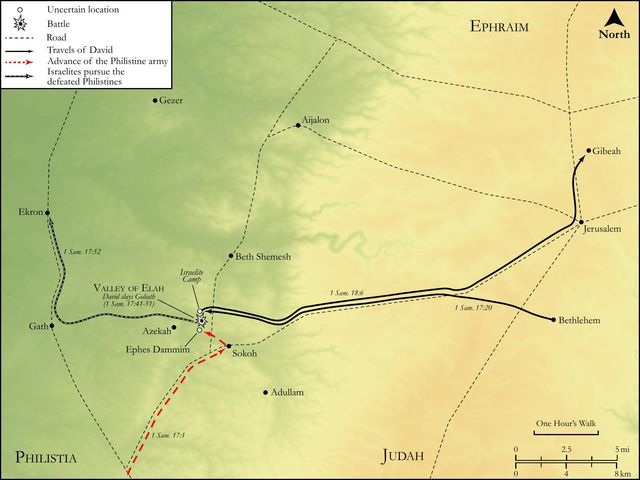
See on the biblical-era map
Study this verse
Public-domain commentary
Matthew Henry
From his Commentary on the Whole Bible. Henry comments on passages, not single verses — this entry covers 1 Samuel 17:31–39. His three-level outline is real structure in the source text, so it is rendered as structure.
David is at length presented to Saul for his champion (Sa1 17:31) and he bravely undertakes to fight the Philistine (Sa1 17:32): Let no man's heart fail because of him. It would have reflected too much upon the valour of his prince if he had said, Let not thy heart fail; therefore he speaks generally: Let no man's heart fail. A little shepherd, come but this morning from keeping sheep, has more courage than all the mighty men of Israel, and encourages them. Thus does God often send good words to his Israel, and do great things for them, by the weak and foolish things of the world. David only desires a commission from Saul to go and fight with the Philistine, but says nothing to him of the reward he had proposed, because that was not the thing he was ambitious of, but only the honour of serving God and his country: nor would he seem to question Saul's generosity. Two things David had to do with Saul: -
I.To get clear of the objection Saul made against his undertaking.
"Alas!" says Saul, "thou hast a good heart to it, but art by no means an equal match for this Philistine. To engage with him is to throw away a life which may better be reserved for more agreeable services. Thou art but a youth, rash and inconsiderate, weak and unversed in arms: he is a man that has the head and hands of a man, a man of war, trained up and inured to it from his youth (Sa1 17:33), and how canst thou expect but that he will be too hard for thee?" David, as he had answered his brother's passion with meekness, so he answered Saul's fear with faith, and gives a reason of the hope which was in him that he should conquer the Philistine, to the satisfaction of Saul. We have reason to fear that Saul had no great acquaintance with nor regard to the word of God, and therefore David, in reasoning with him, fetched not his arguments and encouragements thence, how much soever he had an eye to it in his own mind. But he argues from experience; though he was but a youth, and never in the wars, yet perhaps he had done as much as the killing of Goliath came to, for he had had, by divine assistance, spirit enough to encounter and strength enough to subdue a lion once and another time a bear that robbed him of his lambs, Sa1 17:34-36. To these he compares this uncircumcised Philistine, looks upon him to be as much a ravenous beast as either of them, and therefore doubts not but to deal as easily with him; and hereby he gives Saul to understand that he was not so inexperienced in hazardous combats as he took him to be.
1.He tells his story like a man of spirit. He is not ashamed to own that he kept his father's sheep, which his brother had just now upbraided him with. So far is he from concealing it that from his employment as a shepherd he fetches the experience that now animated him. But he lets those about him know that he was no ordinary shepherd. Whatever our profession or calling is, be it ever so mean, we should labour to excel in it, and do the business of it in the best manner. When David kept sheep,
(1.)He approved himself very careful and tender of his flock, though it was not his own, but his father's. He could not see a lamb in distress but he would venture his life to rescue it. This temper made him fit to be a king, to whom the lives of subjects should be dear and their blood precious (Psa 72:14), and fit to be a type of Christ, the good Shepherd, who gathers the lambs in his arms and carries them in his bosom (Isa 40:11), and who not only ventured, but laid down his life for his sheep. Thus too was David fit to be an example to ministers with the utmost care and diligence to watch for souls, that they be not a prey to the roaring lion.
(2.)He approved himself very bold and brave in the defence of his flock. This was that which he was now concerned to give proof of, and better evidence could not be demanded than this: "Thy servant not only rescued the lambs, but, to revenge the injury, slew both the lion and the bear."
2.He applies his story like a man of faith. He owns (Sa1 17:37) it was the Lord that delivered him from the lion and the bear; to him he gives the praise of that great achievement, and thence he infers, He will deliver me out of the hand of this Philistine. "The lion and the bear were enemies only to me and my sheep, and it was in defence of my own interest that I attacked them; but this Philistine is an enemy to God and Israel, defies the armies of the living God, and it is for their honour that I attack him." Note,
(1.)Our experiences ought to be improved by us as our encouragements to trust in God and venture in the way of duty. He that has delivered does and will.
(2.)By the care which common Providence takes of the inferior creatures, and the protection they are under, we may be encouraged to depend upon that special Providence which surrounds the Israel of God. He that sets bounds to the waves of the sea and the rage of wild beasts can and will restrain the wrath of wicked men. Paul seems to allude to this of David (Ti2 4:17, Ti2 4:18), I was delivered out of the mouth of the lion, and therefore, I trust, the Lord shall deliver me. And perhaps David here thought of the story of Samson, and encouraged himself with it; for his slaying a lion was a happy presage of his many illustrious victories over the Philistines in single combat. Thus David took off Saul's objection against his undertaking, and gained a commission to fight the Philistine, with which Saul gave him a hearty good wish; since he would not venture himself, he prayed for him that would: Go, and the Lord be with thee, a good word, if it was not spoken customarily, and in a formal manner, as too often it is. But David has somewhat to do likewise,
II.To get clear of the armour wherewith Saul would, by all means, have him dressed up when he went upon this great action (Sa1 17:38):
He armed David with his armour, not that which he wore himself, the disproportion of his stature would not admit that, but some that he kept in his armoury, little thinking that he on whom he now put his helmet and coat of mail must shortly inherit his crown and robe. David, being not yet resolved which way to attack his enemy, girded on his sword, not knowing, as yet, but he should have occasion to make use of it; but he found the armour would but encumber him, and would be rather his burden than his defence, and therefore he desires leave of Saul to put them off again: I cannot go with these, for I have not proved them, that is, "I have never been accustomed to such accoutrements as these." We may suppose Saul's armour was both very fine and very firm, but what good would it do David if it were not fit, or if he knew not how to manage himself in it? Those that aim at things above their education and usage, and covet the attire and armour of princes, forget that that is the best for us which we are fit for and accustomed to; if we had our desire, we should wish to be in our own coat again, and should say, "We cannot go with these;" we had therefore better go without them.
Historical interpretation
Two Centuries of Reception
2 surviving comments on this verse. Each one is dated, so this reads as a timeline rather than a list.
Select a marker to jump to its quote. Markers stagger vertically where authors wrote within a few decades of each other.
When David had been anointed by blessed Samuel before he came here, he had killed a lion and a bear without any weapons, as he himself told King Saul. Both the lion and the bear typified the devil, for they had been strangled by the strength of David for having dared to attack some of his sheep. All that we read prefigured in David at that time, dearly beloved, we know was accomplished in our Lord Jesus Christ; for he strangled the lion and the bear when he descended into hell to free all the saints from their jaws. Moreover, listen to the prophet entreating the person of our Lord: “Rescue my soul from the sword, my loneliness from the grip of the dog. Save me from the lion’s mouth.” Since a bear possesses his strength in his paw and a lion has his in his mouth, the same devil is prefigured in those two beasts. Thus, this was said concerning the person of Christ, in order that his sole church might be removed from the hand, that is, the power or mouth of the devil.
And David said to Saul: Your servant was tending, etc. The Lord strengthens the weak in faith, calls unbelievers to faith, urging modestly that amidst the frailties of His humanity, by which He took on our pains, even the exalted aspects of His Divinity, by which He is capable of healing those pains, may be recognized. He Himself, he says, now deformed in the habit of a servant, for the sake of your salvation, was feeding from eternity with heavenly aliments the hearts of all the faithful, namely the flock of My Father. And one of the unclean spirits would come, either exceedingly powerful by strength or cunning with deceit. For both the lion and the bear, although each excels both by strength, yet the bear has more deceit and the lion more strength; and thus one expresses the deceit, the other the violence, each the wickedness of the demons figuratively. They came, he says, and by deceiving they would take away some of the strong leaders of the Church, drawing him into sin from the midst of brotherly society. But I, either through angels or men by openly testifying, or by myself inwardly pricking, such men, having defeated the evil spirits, would call them back to the path of salvation; but these spirits, gravely annoyed, turning their fury to tear at the souls of the faithful that were snatched from their darkness, to blaspheme the worship of My name, promptly turned their rage of madness; whose blasphemy I, by bringing to light and revealing through my prophets, would utterly reduce the whole ritual of idolatry to nothing; catching the wise in their craftiness, I was closing the mouths of the damnable profession, saying: For all the gods of the nations are demons: but the Lord made the heavens (Psalm 95). And: The idols of the nations are silver and gold, the work of men's hands. They have mouths, but they shall not speak, and so forth (Psalm 113). But also by another prophet: The gods that have not made the heavens and the earth shall perish from the earth, and from those things that are under heaven (Wisdom 15); for both all the power and wisdom of the profane, which are wont to be shown through them or through men deceived by them, I was powerfully nullifying myself, who always remaining in the divinity of God, appearing temporarily in humanity to serve the salvation of men. Therefore, this inventor and source of all evil will be as one of his henchmen, that is, he will be caught in his own snares; who dared once to provoke angels in heaven, and afterward men on earth, to curse the Creator; but also unjustly always exacerbate with darts of cursing those who persist in the faith of their Creator, as though they do not serve the true God, the worshipers and devotees of Him, of whom it is said: For as the Father hath life in himself, so hath he given to the Son to have life in himself (John 5). Which he will never cease to say through Gentiles, Jews, and heretics.
Continue studying 1 Samuel 17:34 across the web’s major study libraries — every link below opens this exact verse, chapter, or book on the destination site.
Read & Compare
 BibleGatewayThis verse in more than 200 translations and 70 languages.
 Bible.comThe YouVersion reader — hundreds of translations, reading plans, and highlights.
 ESV.orgCrossway's official English Standard Version reader.
 NET BibleThe NET translation with 60,000+ translators' notes on every rendering decision.
 STEP BibleTyndale House's free study tool — original text, vocabulary, and scholarly resources.
 BibliaLogos Bible Software's free web reader.
 USCCBThe New American Bible (Revised Edition) with the U.S. bishops' study notes.
Commentaries
 BibleHub CommentariesDozens of classic commentaries on this verse, gathered on one page.
 StudyLightMore than 100 commentary sets — the largest collection on the web.
 BibleRefPlain-English commentary on what this verse means, verse by verse.
 Enduring WordDavid Guzik's free commentary on this chapter, widely used by Bible teachers.
 Bible Study ToolsVerse commentary alongside Greek and Hebrew study aids.
Original Language & Research
- BibleHub InterlinearThe verse word by word — original language, transliteration, and English.
- BibleHub LexiconEvery word's original-language definition and Strong's entry.
 Blue Letter BibleDeep-study tools — Strong's numbers, concordance, and word studies.
 SefariaThe Hebrew text with Rashi and centuries of Jewish commentary.
Sermons, Hymns & Audio


TrulyRandomVerse is not affiliated with these sites and doesn’t control their content. They’re linked because they’re genuinely useful.
Summary
In 1 Samuel 17:34, David, a young shepherd, presents a compelling account to King Saul of his past encounters with a lion and a bear, both of which had seized a lamb from his flock. This pivotal declaration serves as David's humble yet profound justification for his audacious offer to confront the Philistine giant Goliath, powerfully demonstrating his unwavering faith in God's protective power and his readiness for the seemingly impossible task ahead, all rooted in his diligent faithfulness in seemingly mundane duties.
Context
ShowHideLiterary Context
This verse is strategically placed within the dramatic narrative of David's confrontation with Goliath, immediately following Goliath's prolonged and blasphemous taunts against the armies of Israel and Saul's paralyzed inability to find a champion. David, having arrived at the battlefield to deliver provisions to his brothers, is deeply provoked by Goliath's defiance of the living God. When he expresses his willingness to fight the giant, he is brought before Saul. Saul, observing David's youth and lack of military experience, expresses understandable skepticism. David's response, commencing in this verse and continuing through 1 Samuel 17:37, is a personal testimony. It is a concise recounting of divine interventions in his shepherd life that serve as a prophetic indicator of God's future deliverance. This testimony establishes David's character not as a reckless youth, but as a divinely prepared warrior whose profound confidence stems from God's consistent faithfulness in his past.
Historical & Cultural Context
Shepherd life in ancient Israel was far from idyllic; it was a demanding, solitary, and often perilous occupation. Shepherds bore immense responsibility for the welfare of their flock, which frequently represented a significant portion of a family's wealth. They were expected to defend their sheep against a range of predators, including formidable animals like lions, bears, and wolves, as well as human thieves. Such encounters were inherently dangerous, often requiring immense courage, physical strength, and keen situational awareness. David's account of personally engaging and defeating these powerful beasts highlights his exceptional bravery and physical prowess, which would have been recognized as extraordinary even for an adult, let alone a young man. This background underscores the gravity of the threats he faced and the remarkable nature of his victories, lending significant credibility to his claims before Saul and the assembled Israelite and Philistine armies. Furthermore, the Philistine threat, epitomized by Goliath, was a chronic and existential danger to Israel's national security, making the need for a deliverer incredibly urgent and profound.
Key Themes
ShowHideThe verse powerfully contributes to several foundational themes within the book of 1 Samuel and the broader biblical narrative. Firstly, it exemplifies Divine Preparation, illustrating how God sovereignly uses seemingly ordinary or humble circumstances—like tending sheep in the wilderness—to train and equip His chosen instruments for extraordinary purposes. David's faithfulness in protecting his flock from literal predators foreshadows his future role as the shepherd of Israel, called to protect God's people from spiritual and physical enemies. Secondly, it highlights the crucial theme of Faith in God as Deliverer. David does not boast of his own strength or skill but implicitly attributes his past victories to God's direct intervention, setting the stage for his explicit declaration in 1 Samuel 17:37. This stands in stark contrast to Saul's fear and reliance on human strength and military might, underscoring God's preference for those who trust wholeheartedly in Him rather than their own power, a principle powerfully echoed in Zechariah 4:6. Lastly, the verse introduces the profound theme of Courage Rooted in Faith, demonstrating that true bravery is not an absence of fear, but a confident reliance on God's unwavering power in the face of overwhelming odds.
Exposition and Analysis
ShowHideKey Word Analysis
ShowHideThis verb (H7462), often translated as "to shepherd," "to pasture," or "to tend," carries a deep sense of active care, diligent oversight, and devoted protection. It implies far more than simply leading sheep to graze; it encompasses actively guarding them, ensuring their well-being, and defending them from all harm. David's use of this word emphasizes his diligent and responsible stewardship of his father's flock, highlighting his faithfulness in his assigned duties, which precisely prepared him for greater responsibilities as king and shepherd of Israel.
This noun (H738) refers to a formidable predator, the lion, which was a potent symbol of strength, ferocity, and danger in the ancient Near East. Encountering and defeating a lion single-handedly would have been an astonishing and life-threatening feat, signifying immense courage, physical prowess, and divine aid. Its inclusion immediately establishes the severity of the threat David faced and the extraordinary nature of his past victories, setting a high bar for his credibility before King Saul.
This verb (H5375) means "to lift," "to bear," or "to carry away." In this context, it vividly conveys the swift, decisive, and violent action of the predators. The lamb was not merely threatened but had already been seized and carried off, implying that David's intervention was not merely preventative but a direct, life-threatening confrontation to reclaim what was lost. This underscores the immediate danger and the daring, sacrificial nature of his rescue.
Verse Breakdown
ShowHide"And David said unto Saul"
This opening phrase immediately establishes the speaker and the recipient of this crucial testimony. David, a young, seemingly insignificant shepherd, is addressing the reigning king of Israel, a moment of immense significance that elevates his humble background to a position of national importance. It sets the stage for a personal confession of faith and experience that will determine the course of Israel's history.
"Thy servant kept his father's sheep"
David identifies himself not by any military title or noble lineage, but by his humble, everyday occupation. The phrase "Thy servant" demonstrates appropriate respect for Saul's authority, while "kept his father's sheep" underscores his faithfulness and diligence in his domestic duties. This highlights God's consistent pattern of choosing the overlooked and preparing them through ordinary, often obscure tasks for extraordinary, divine callings.
"and there came a lion, and a bear"
This clause introduces the immediate, life-threatening challenges David faced in his pastoral role. The mention of both a lion and a bear emphasizes the recurring, diverse, and formidable dangers of shepherd life in the wilderness. These were not isolated incidents but represent a pattern of divine protection and David's tested courage in the face of overwhelming natural threats.
"and took a lamb out of the flock"
This specifies the direct consequence of the predators' attack and the profound motivation for David's heroic intervention. The loss of even a single lamb was a tangible and significant blow to the flock, representing a failure of the shepherd's sacred duty. David's willingness to risk his own life for one lamb demonstrates his profound commitment to his responsibilities and the immense value he placed on each member of his flock, foreshadowing his future role as a caring king.
Literary Devices
ShowHide1 Samuel 17:34 employs several potent literary devices that enrich its meaning and impact. Testimony is central, as David recounts his personal, divinely-aided experiences to persuade Saul, lending profound credibility and emotional weight to his audacious proposal to fight Goliath. The mention of "a lion, and a bear" functions as powerful Symbolism, representing the formidable, overwhelming obstacles David has faced and overcome through God's aid, directly foreshadowing the even greater "giant" of Goliath. This also serves as direct Foreshadowing, as David's past victories over these literal beasts directly prefigure his future victory over the metaphorical "beast" of Goliath. There is a subtle but impactful element of Understatement in David's concise recounting; while the words are simple and direct, the actions they describe are extraordinary, life-threatening, and heroic, amplifying the impact of his quiet confidence. Finally, the narrative establishes a powerful Parallelism between David's faithful role as a shepherd protecting his flock and his future, divinely appointed role as king, protecting the nation of Israel.
Theological and Thematic Connections
ShowHideThis verse is a profound testament to God's sovereign preparation and unwavering faithfulness. It reveals a consistent biblical principle: God often trains His chosen instruments in obscurity, using seemingly mundane or difficult circumstances to forge character, develop essential skills, and deepen their faith. David's willingness to risk his life for a single lamb demonstrates the heart of a true shepherd—a quality that would later define his kingship and his compassionate leadership of Israel. His confidence in facing Goliath was not born of youthful arrogance but from a tested and proven faith, built upon a history of God's miraculous deliverance from literal, deadly beasts. This foundational experience instilled in David the unshakeable conviction that the same God who protected him from a lion and a bear would also deliver him from the Philistine giant, illustrating the timeless principle that faithfulness in small things profoundly prepares one for greater responsibilities and larger battles.
Reflection and Application
ShowHideDavid's testimony in 1 Samuel 17:34 offers a timeless and deeply encouraging blueprint for how God prepares and uses His people. It serves as a powerful reminder that our seemingly ordinary experiences, even the most challenging or dangerous ones, are often divine training grounds where God builds our character, hones our skills, and deepens our reliance on Him. The resilience, courage, and faith we develop in smaller, personal trials are precisely what God uses to equip us for larger battles and greater callings in His kingdom. We are profoundly encouraged to recognize God's hand in our past victories, no matter how small or insignificant they may have seemed at the time, and to draw confidence from them as we face new "giants" in our lives. True courage, as exemplified by David, is not the absence of fear, but an unwavering and confident trust in God's abiding presence and omnipotent power, even when the odds seem insurmountable. Our faithfulness in our current responsibilities, however humble or unseen, is a crucial part of God's sovereign preparation for our ultimate purpose and divine destiny.
Questions for Reflection
ShowHideFAQ
ShowHideWhy did David recount these specific incidents to Saul?
ShowHideDavid recounted these incidents to Saul primarily to establish his credibility and demonstrate that his confidence in facing Goliath was not mere youthful bravado or recklessness, but was rooted in actual, divinely-empowered experiences. He was showing Saul that God had already proven Himself faithful and powerful in protecting David from formidable, life-threatening predators while David was simply performing his duty as a shepherd. This personal testimony served as a prophetic assurance that the same God who delivered him from the lion and the bear would also deliver him from Goliath, as he explicitly states in 1 Samuel 17:37. It was a humble yet profoundly powerful argument for his divine anointing and preparation for the task at hand.
Was it common for shepherds to fight lions and bears in ancient Israel?
ShowHideWhile not an everyday occurrence, encounters with dangerous predators like lions and bears were a very real and significant threat to shepherds and their flocks in ancient Israel. The wilderness areas and hilly regions provided natural habitats for these animals, and a shepherd's duty inherently included defending the flock, often at great personal risk. However, successfully killing a lion or a bear single-handedly, as David did, was an extraordinary feat, indicative of exceptional courage, strength, and, critically, divine assistance. It was certainly not a common outcome for every shepherd who faced such a threat, making David's testimony all the more remarkable, convincing, and unique in its demonstration of God's hand upon him.
Christ-Centered Fulfillment
ShowHideDavid's courageous defense of his flock against the lion and the bear, risking his own life for a single lamb, profoundly foreshadows the ultimate Shepherd, Jesus Christ. Just as David, the humble shepherd, delivered his flock from deadly predators, so too does Jesus, the Good Shepherd, lay down His very life for His sheep, delivering them from the ultimate predator, sin and death. David's willingness to confront overwhelming odds for the sake of his flock finds its perfect fulfillment in Christ's unparalleled sacrificial love, as declared in John 10:11. The supernatural strength and divine deliverance David experienced from God prefigure the redemptive power of Christ, who, through His death and glorious resurrection, decisively conquered the spiritual enemies that held humanity captive, triumphing over "principalities and powers" (Colossians 2:15). David's confidence that the God who delivered him from literal beasts would deliver him from Goliath points directly to the believer's unwavering confidence in Christ, who has already secured the decisive victory over sin, death, and evil, enabling us to face any challenge through Him who strengthens us (Philippians 4:13). Thus, David's shepherd-warrior act is a vivid Old Testament type of the Lamb of God who is also the Lion of Judah, securing eternal salvation for His beloved flock.