


Zephaniah 3:15
Bible text: King James Version (1769 Blayney text) · Public domain
Bible text: King James Version with Strong's numbers · Public domain
Bible text: Berean Standard Bible · Public domain
Bible text: American Standard Version (1901) · Public domain
Bible text: World English Bible, Messianic edition · Public domain
Bible text: Geneva Bible (1599) · Public domain
Bible text: Young's Literal Translation · Public domain
- הֵסִירhe·Sirhe has removedH5493V-Hiphil-Perf-3msVerb Hiphil Perfect 3rd Singular Masculine
- יְהוָהYah·wehYahwehH3068N-properNoun Proper Title
- מִשְׁפָּטַיִךְmish·pa·Ta·yikhyour judgmentsH4941N-mpc ¦ 2fsNoun Plural Masculine Constructמִשְׁפָּטַיִjudgmentsךְyour
- פִּנָּהpi·Nahhe has cleared awayH6437V-Piel-Perf-3msVerb Piel Perfect 3rd Singular Masculine
- אֹיְבֵךְ'o·ye·Vekhyour enemyH341V-Qal-Prtcpl-ms ¦ 2fsVerb Qal Participle Singular Masculine Constructאֹיְבֵenemyךְyour
- מֶלֶךְMe·lekh[the] king ofH4428N-mscNoun Singular Masculine Construct
- יִשְׂרָאֵלYis·ra·'ElIsraelH3478N-properNoun Proper Location
- יְהוָהYah·wehYahwehH3068N-properNoun Proper Title
- בְּקִרְבֵּךְbe·kir·Bekh[is] in your midstH7130Prep-b ¦ N-msc ¦ 2fsNoun Singular Masculine Constructבְּ[is] inקִרְבֵּmidstךְyour
- לֹאlo'notH3808NegParticle Negative
- תִירְאִיtir·'Iyou will fearH3372V-Qal-Imperf-2fsVerb Qal Imperfect 2nd Singular Feminine
- רָעra'evilH7451Adj-msAdjective Singular Masculine Absolute
- עוֹדodagainH5750Adj-msAdjective Numerical Singular Masculine Absolute
English is a literal word-by-word gloss of the Hebrew, not the KJV's wording. Why?
This is the original text the KJV's translators worked from — each Hebrew word with its own literal English meaning in this verse, prepared by scholars at Tyndale House, Cambridge. The KJV translates whole sentences, not word by word, so its wording differs: one Hebrew word can become several English words, and the KJV may choose “the LORD” where the gloss reads “Yahweh”. Both are faithful — they answer different questions. For the KJV's own rendering, switch to the KJV text.
Details
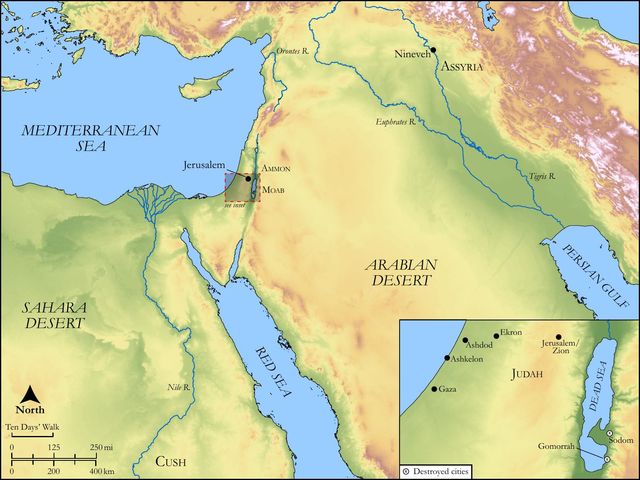
See on the biblical-era map
Study this verse
Public-domain commentary
Matthew Henry
From his Commentary on the Whole Bible. Henry comments on passages, not single verses — this entry covers Zephaniah 3:14–20. His three-level outline is real structure in the source text, so it is rendered as structure.
After the promises of the taking away of sin, here follow promises of the taking away of trouble; for when the cause is removed the effect will cease. What makes a people holy will make them happy of course. The precious promises here made to the purified people were to have their full accomplishment in the comforts of the gospel, in the hope, and much more in the enjoyment, of which, they are here called upon, 1. To rejoice and sing (Zep 3:14): Sing, O daughter of Zion! sing for joy; Shout, O Israel! in a holy transport and exultation; be glad and rejoice with all the heart; let the joy be inward, let it be great. Those that love God with all their heart have occasion with all their heart to rejoice in him. It was promised (Zep 3:13) that their sins should be mortified and their fears silenced, and then follows, Sing and rejoice. Note, Those that reform have cause to rejoice, whereas Israel cannot rejoice for joy as other people, while she goes a whoring from her God. God's promises, applied by faith, furnish the saints with constant and abundant matter for joy; they are filled with joy and peace in believing them. 2. To throw off all their discouragements (Zep 3:16): In that day it shall be said to Jerusalem (God will say it by his prophets, by his providences, their neighbours shall say it, they shall say it to one another), "Fear thou not, be not disposed to fear, do not easily admit the impressions of it; when things are bad, fear not their being worse, but hope they will mend; frighten not thyself upon every occasion. Let not thy hands be slack or faint; wring not thy hands in despair; drop not thy hands in despondence; disfit not thyself for thy work and warfare by giving way to doubts and fears. Pluck up thy spirits, and, in token of that, lift up thy hands, the hands that hung down, Heb 12:12; Isa 35:3. Lift up thy hands in prayer to God; lift up thy hands to help thyself." Fear makes the hands slack, but faith and hope make them vigorous, and the joy of the Lord will be our strength both for doing and suffering.
Let us now see what these precious promises are which are here made to the people of God, for the banishing of their griefs and fears and the encouraging of their hopes and joys; and to us are these promises made as well as to them.
I.An end shall be put to all their troubles and distresses (Zep 3:15):
"The Lord has taken away thy judgments, has removed all the calamities thou hast been groaning under, which were the punishments of thy sin; the noise of war shall be silenced, the reproach of famine done away, and the captivity brought back. Though some grievances remain, they shall be only afflictions, and not judgments, for sin shall be pardoned. He has cast out thy enemy, that has thrust himself into thy land, and triumphed over thee. He has swept out thy enemy" (so some read it), "as dirt is swept out of the house to the dunghill." When they sweep out their sins with the besom of reformation God will sweep out their enemies with the besom of destruction. If they should need correction, they shall fall into the hands of the Lord, whose mercies are great, and shall not again fall into the hands of man, whose tender mercies are cruel: "Thou shalt not see evil any more, not such evil days as thou hast seen." Note, The way to get clear of the evil of trouble is to keep clear from the evil of sin; and to those that do so trouble has no real evil in it.
II.God will give them the tokens of his presence with them; though he has long seemed to stand at a distance (they having provoked him to withdraw), he will make it to appear that he is with them of a truth: "The Lord is in the midst of thee, O Zion! of thee, O Jerusalem! as the sun in the centre of the universe, to diffuse his light and influence upon every part. He is in the midst of thee, to preside in all thy affairs and to take care of all thy interests." And, 1. "He is the King of Israel (Zep 3:15) and is in the midst of thee as a king in the midst of his people." With an eye to this, our Lord Jesus is called the King of Israel (Joh 1:49); and he is, and will be, in the midst of his church always, even to the end of the world, to receive the homage of his subjects, and to give out his favours to them, even where but two or three are gathered together in his name. 2. "He is the Lord thy God, thine in covenant, and he is in the midst of thee as thy God, whom thou hast an interest in and whose own thou art. He has put himself into dear relations to thee, laid himself by promise under obligations to thee, and, that thou mayest have abundant comfort in both, he is in the midst of thee, nigh at hand to answer both." 3. "He that is in the midst of thee as thy God and King is mighty, is almighty, is able to do all that for thee that thou needest and canst desire." 4. "He has engaged his power for thy succour: He will save. He will be Jesus, will answer the name, for he will save his people from their sins."
III.God will take delight in them, and in doing them good.
The expressions of this are very lively and affecting (Zep 3:17): He will rejoice over thee with joy, will not only be well pleased with thee, upon thy repentance and reformation, and take thee into favour, but will take a complacency in thee, as the bridegroom does in his bride, or the bride in her ornaments, Isa 62:3-5. The conversion of sinners and the consolation of saints are the joy of angels, for they are the joy of God him-self. The church should be the joy of the whole earth (Psa 48:2), for it is the joy of the whole heaven. He will rest in his love, will be silent in his love, so the word is. "I will not rebuke thee as I have done, for thy sins; I will acquiesce in thee, and in my relation to thee." I know not where there is the like expression of Christ's love to his church, unless in that song of songs, Sol 4:9, Thou hast ravished my heart, my sister, my spouse, with one of thy eyes. O the condescensions of divine grace! The great God not only loves his saints, but he loves to love them, is pleased that he has pitched upon these objects of his love. He will joy over them with singing. He that is grieved for the sin of sinners rejoices in the graces and services of the saints, and is ready to express that joy by singing over them. The Lord takes pleasure in those that fear him, and in them Jesus Christ will shortly be glorified and admired.
IV.God will comfort Zion's mourners, who sympathize with her in her griefs, and will wipe away their tears (Zep 3:18):
I will gather those who are sorrowful for the solemn assemblies, to whom the reproach of it was a burden. See,
1.Who those are whom God will rejoice in and make to rejoice. They are such as are sorrowful. Those only must expect to reap in joy that sow in tears. The sorrowful now shall be for ever joyful.
2.What is the great matter of sorrow to Zion's mourners, when Zion is in mourning. Many are her calamities. The city is ruined, and the palaces are demolished; trade is at an end, and the administration of public justice; but all these are nothing to them in comparison with the desolations of the sanctuary, the destruction of the temple and the altar, to attend on which, in solemn feasts, all Israel used to come together three times a year. It is for those sacred solemn assemblies that they are sorrowful,
(1.)Because they are dispersed; there is no temple to come up to, or, if there were, no people to come up to it; so that the solemn feasts and sabbaths are forgotten in Zion, Lam 2:6. Note, The restraining of public assemblies for religious worship, the scattering of them by their enemies, or the forsaking of them by their friends, so that either there are no assemblies or not solemn ones, is a very sorrowful thing to all good people. If the ways of Zion mourn, the sons of Zion mourn too. And hereby they make it to appear that they are indeed of Zion, living members of that body with the grievances of which they are so sensibly affected.
(2.)Because they are despised; the reproach of the solemn assemblies is a burden to them. It had been the lot of the solemn assemblies to lie under a great deal of reproach. Satan and his instruments having a particular spite at them, as the great support of the interest of God's kingdom among men. Black and odious characters have been put upon those assemblies; and this is a burden to all those that have a cordial concern for the glory of God and the welfare of the souls of men. They reckon that the reproaches of those who reproach the solemn assemblies fall upon them, fall foul upon them.
V.God will recover the captives out of the hands of their oppressors, and bring home the banished that seemed to be expelled, Zep 3:19, Zep 3:20.
1.Their enemies shall be disabled to detain them in bondage: "At that time I will undo all that afflict thee, will break their power, and blast their counsels, so that they shall be forced to surrender the prey they have taken." Conficiam - I will take them to task; "I will be doing with them shortly, and so as to make an end of them." Note, Those that abuse and oppress God's people take the ready way to undo themselves.
2.They shall be enabled to assert and recover their liberty, and all the difficulties in the way of it shall be surmounted. Is the church weak and wounded? I will save her that halts, as was promised, Mic 4:7. He will help her when she cannot help herself; even the lame shall take the prey, Isa 33:23. Is she dispersed, and not likely to incorporate for her common benefit? I will gather her that was driven out, and bring her again at the time that I gather her. One act of mercy and grace shall serve both to collect them out of their dispersions and to conduct them to their own land. When the people's hearts are prepared, the work will be done suddenly; and who can hinder it if God undertake to effect it? "I will turn back your captivity before your eyes, saith the Lord; you shall plainly discern the hand of God in it, and say, This is the Lord's doing."
VI.God will by all this put honour upon them and gain them respect from all about them.
Israel was at first made high above all nations in praise and fame, Deu 26:19. The reproach brought upon them was therefore one of the sorest of their grievances (nothing cuts deeper to those that are in honour than disgrace does); and therefore when God returns, in mercy, to his church, it is here promised that she shall regain her credit; all the reproach shall be for ever rolled way, as Israel's at Gilgal, Jos 5:9. The church shall be as honourable as ever she had been despicable.
1.Even those that reproached her shall be made to respect her: "I will get them praise and fame in every land, where they have been put to shame, that the same who were the witnesses of their disgrace may see cause to change their mind concerning them." Those that said, "This is Zion whom no man looks after," shall say, "This is Zion whom the great God looks after." And she that was looked upon to be the offscouring of the earth now appears to be the darling of heaven.
2.Even those that never knew her shall be brought to honour her (Zep 3:20): I will make you a name and a praise among all people of the earth. So the Jewish church was when the fear of the Jews fell upon their neighbours (Est 8:17), and some of all nations said, we will go with you, for we have heard that God is with you, Zac 8:23. So the Christian church was when it was made to flourish in the world, for there is that in it which may justly recommend it to the value and esteem of all the people of the earth. And so the universal church of the firstborn will be in the great day, when the saints shall be brought together to Christ, that he may be admired and glorified in them, and they admired and glorified in him before angels and men. Then will God's Israel be made a name and a praise to eternity.
Historical interpretation
Historical reception
4 surviving comments on this verse. Each one is dated, so this reads as a timeline rather than a list.
Select a marker to jump to its quote. Markers stagger vertically where authors wrote within a few decades of each other.
Take heart, O Jerusalem, the Lord will take away your iniquities. The Lord will wash away the filth of his sons and daughters by the spirit of judgment and the spirit of burning. He will pour upon you clean water, and you shall be cleansed from all your sins. Choiring angels shall encircle you, chanting, “Who is it that comes up all white and leaning upon her beloved?” For the soul that was formerly a slave has now accounted its Lord as its kinsman, and he, acknowledging its sincere purpose, will answer, “Ah, you are beautiful, my beloved, ah, you are beautiful … your teeth are like a flock of ewes to be shorn”—a sincere confession is a spiritual shearing. And further: “all of them big with twins,” signifying the twofold grace, either that perfected by water and the Spirit or that announced in the Old and in the New Testament. God grant that all of you, your course of fasting finished, mindful of the teaching, fruitful in good works, standing blameless before the spiritual bridegroom, may obtain the remission of your sins from God, in Christ Jesus our Lord, to whom be the glory forever and ever. Amen.
(Verse 14 and following) Praise, daughter of Zion, shout for joy, Israel, rejoice and exult with all your heart, daughter of Jerusalem. The Lord has taken away your judgment, he has turned away your enemies: the Lord, the King of Israel, is in your midst, you will no longer fear evil. On that day, it will be said, Jerusalem, do not be afraid: Zion, let your hands not be weak: the Lord your God, in your midst, is mighty he will save, he will rejoice over you with gladness, he will quiet you with his love: he will exult over you with praise. I will gather those who turned away from the law, because they were from you, so that you will no longer have reproach against them. Rejoice, daughter of Zion; proclaim, daughter of Jerusalem, rejoice and delight with all your heart, daughter of Jerusalem. The Lord has taken away your iniquities, he has redeemed you from the hand of your enemies, the Lord, the king of Israel, is in your midst: you will no longer see evil. In that time, says the Lord, Jerusalem, have confidence, Zion, let your hands not be weak: the Lord your God, who is mighty, will save you, he will bring joy upon you, and renew you in his love, and he will rejoice over you with delight, as on a solemn day: I will gather your broken ones. Woe to anyone who receives reproach upon it. It does not seem strange, as we have often said, that Hebrew chapters end differently from the Greek Septuagint and the Latin. For where there is a different sense of translation, there must necessarily be different beginnings or endings. The Jews, who expect Christ to come, promise themselves all these things, which we who have received Christ have already obtained with him. Therefore, if anyone, especially among the new wise men of the Christians, whose names I will not mention in order not to appear to harm anyone, thinks that prophecy has not yet been fulfilled, let him know that he falsely bears the name of Christ and has a Jewish soul, having only the circumcision of the body. For if these things have not yet been done, but are to come, we have believed in vain in the coming of the Savior. But in vain do we understand that the mystery, which has been kept secret from eternal times, is fulfilled in us who do not believe, and is now manifested through the prophetic Scriptures and the coming of our Lord Jesus Christ. Finally, let us consider the order of the reading, and we will see that it is said to pertain not to the Jews, but to the Church of Christ. For after that which went before (My judgement concerning the nations, that they might receive kings, even unto that place where it is said: They shall call upon the name of the Lord, and shall serve him under one yoke. And I will take of my dispersed into Ethiopia, and they shall offer to me victims. And in that day there shall be no more a Pharao in the land of Egypt: but the Assyrian shall be his king, because they would not be converted. And the remnant of the house of Israel, and they that shall escape of the house of Jacob, shall lean upon the Lord, the Holy One of Israel, in truth. A remnant shall be converted, the remnant, I say, of Jacob, to the mighty God. For if thy people, O Israel, shall be as the sand of the sea, a remnant of them shall be converted. Consummation, and that determined, shall overflow justice. Because the Lord God of hosts shall make a consumption, and an abridgment in the midst of all the land. The Holy Spirit, preaching about the general consummation of the world, speaks: Rejoice, daughter of Zion, proclaim, daughter of Jerusalem, be glad and delight with all your heart, daughter of Jerusalem. For every soul of the Church, which is established on the watchtower and contemplates peace, rejoices and is glad that its iniquities have been removed and redeemed by Him who redeemed all with His precious blood. For Christ has become wisdom for us from God, and righteousness, and sanctification, and redemption (I Cor. I, 30). And the king of Israel, who dwells among us, redeemed us, saying: I and my Father will come, and we will make our abode with him (John XIV, 23); and I will dwell and walk among them (Lev. XXVI, 12): and we will no longer see evil, but only think and do virtues. In that day, says the Lord, we will see peace, and placed on high, let not your hands be dissolved, who also said through Isaiah: Strengthen the weak hands, and let your works be strong (Isaiah XXXV, 3). For the Lord is strong, against whom no one can resist: your savior, he himself will restore to you the joy that you have lost, and after casting off the old man, he will make you walk in the new, and he will do all this out of his love: not because of your merit, but because of his mercy. And he will rejoice in you, and delight in you, receiving your salvation like a rich sacrifice of your solemnity; and he himself will say to you: I will gather your contrite ones; for a contrite and humble heart, God will not despise. (Psalm 50:19); and, a crushed reed he will not break. (Isaiah 42). But for now, if we want to understand the second coming of the Savior. Moreover, because the prophet Zechariah encourages Zion and Jerusalem to similar joy, and Matthew says that this same prophecy was fulfilled in the first coming of Christ (Matt. 21), we are compelled by necessity, or rather we are led by the very order of truth, which is said in Zephaniah, not to hope for what is to come, but for what has already happened. For it is written in Zechariah: Rejoice greatly, O daughter of Zion; proclaim, O daughter of Jerusalem: behold, your king comes to you, righteous and saving: he is humble and riding on a donkey (or a colt) (Zech. 9:9). These things are said according to the Septuagint. However, according to the Hebrew, the Church is commanded to praise and Israel is commanded to rejoice, perceiving God with understanding, and to exult and be joyful with their whole heart in the place of peace, to which it was said: Peace I give to you, my peace I leave with you (John 14:27). For in the end and consummation of the world, he took away his judgment, by no means judging or reproving it, but saving it; and he turned away his enemies, the hordes of demons. The Lord God of Israel will be in its midst: it will no longer fear evil. On that day it will be said to Jerusalem: O thou free city, thou shalt no longer serve with thy sons, but thou shalt be the mother of the saints (Galatians IV). Fear not, O Zion (for thou art indeed Jerusalem): none of thy works shall be destroyed, nor shalt thou mourn for the things which thou hast done (or, shalt thou lament, Isaiah 54:9). The Lord thy God, who will save thee, is strong and mighty: he himself will dwell in the midst of thee, he will rejoice over thee with gladness and joy, and he will silence thy sins with love (or, with peace), wherewith he hath loved thee: and he will exult over thee with praise, either because thou art praiseworthy, or because thou singest praises with thine own (people). Just as the Eagle, or, as it is interpreted, the Aquila, gathers those who have strayed from you, because they were from you, that is, those who had fled from your bosom through vice and sin, and had come under the power of demons, when the state of all things is restored, they will come to you, and you will no longer allow any reproach against your lost children. Let us know that what we have said is nonsense (), in Hebrew it is the same as the Latin language, and therefore it is placed by us as it was in Hebrew: so that we may know that the Hebrew language is the mother of all languages, which is not for this time to discuss. But I marvel at Aquila and the Septuagint, because we translated them, in that place namely where we said: I will gather because they were from you: instead of, they were, they translated it as woe, or οἴ: which Aquila always puts not for lamenting, but for calling and crying out: Haja (), for the beginning of the word signifies 'they were,' the past tense in the plural number, either were or had been. I know that this will be bothersome to the reader, who, if he notices, will not accuse me of writing controversies and declamations, nor of rejoicing in commonplaces: but rather will criticize me for playing in the manner of rhetoricians, rather than blame me for dwelling in so great obscurities, as is worthy of one lingering.
Live now in utter delight, O Jerusalem, living in complete happiness and satisfaction; for God has removed all your lawless deeds and of necessity has rescued you from the power of the foe, to whom you were subjected in paying the penalty of punishment. The Lord will now be in your midst, showing his kingship by his care for you, so that trouble will no longer be able to approach you.
The spiritual and holy Zion—that is, the church, the holy multitude of the believers—is justified in Christ and only in him. By him and through him we are also saved as we escape from the harm of the invisible enemies, for we have a Mediator who was incarnated in our form, the king of all, that is, the Word of God the Father. Thanks to him, we do not see evil anymore, for we have been delivered from the powers of evil. He [the Word] is the armor of good will, the peace, the wall, the one who bestows incorruption, the arbiter of the crowns, who shut down the war of the incorporeal Assyrians and made void the schemes of the demons.
Continue studying Zephaniah 3:15 across the web’s major study libraries — every link below opens this exact verse, chapter, or book on the destination site.
Read & Compare
 BibleGatewayThis verse in more than 200 translations and 70 languages.
 Bible.comThe YouVersion reader — hundreds of translations, reading plans, and highlights.
 ESV.orgCrossway's official English Standard Version reader.
 NET BibleThe NET translation with 60,000+ translators' notes on every rendering decision.
 STEP BibleTyndale House's free study tool — original text, vocabulary, and scholarly resources.
 BibliaLogos Bible Software's free web reader.
 USCCBThe New American Bible (Revised Edition) with the U.S. bishops' study notes.
Commentaries
 BibleHub CommentariesDozens of classic commentaries on this verse, gathered on one page.
 StudyLightMore than 100 commentary sets — the largest collection on the web.
 BibleRefPlain-English commentary on what this verse means, verse by verse.
 Enduring WordDavid Guzik's free commentary on this chapter, widely used by Bible teachers.
 Bible Study ToolsVerse commentary alongside Greek and Hebrew study aids.
Original Language & Research
- BibleHub InterlinearThe verse word by word — original language, transliteration, and English.
- BibleHub LexiconEvery word's original-language definition and Strong's entry.
 Blue Letter BibleDeep-study tools — Strong's numbers, concordance, and word studies.
 SefariaThe Hebrew text with Rashi and centuries of Jewish commentary.
Sermons, Hymns & Audio


TrulyRandomVerse is not affiliated with these sites and doesn’t control their content. They’re linked because they’re genuinely useful.
Summary
Zephaniah 3:15 proclaims a profound message of divine restoration and ultimate deliverance for God's people, Jerusalem. It declares that the Lord has removed the judgments previously imposed due to their sin and has decisively defeated their adversaries. Central to this promise is the affirmation of God's active, sovereign presence as the King of Israel dwelling intimately in their midst, ensuring a future free from the experience of evil and calamity. This verse encapsulates the transition from prophetic judgment to glorious eschatological hope, highlighting God's faithfulness and redemptive power.
Context
ShowHideLiterary Context
The book of Zephaniah, a minor prophet, largely focuses on the impending "Day of the Lord," a time of severe judgment upon Judah and surrounding nations due to their widespread idolatry, corruption, and injustice (e.g., Zephaniah 1). However, chapter 3 marks a dramatic and glorious shift. After pronouncing judgment on Jerusalem's wicked leaders and inhabitants in the opening verses of chapter 3, the prophecy pivots from verse 8 onward to a vision of purification, restoration, and salvation for a righteous remnant. Zephaniah 3:15 stands as a pivotal declaration within this section, specifically following a call to rejoice in Zephaniah 3:14 and preceding further promises of God's delight in His people and their future renown (Zephaniah 3:16-20). It serves as the foundational reason for the joy and hope expressed, signaling the end of divine wrath and the beginning of a new era under God's direct kingship.
Historical & Cultural Context
Zephaniah prophesied during the reign of King Josiah (circa 640-609 BC), a period marked by significant religious reform following decades of apostasy under Manasseh and Amon. Despite Josiah's efforts, deep-seated idolatry and oppression persisted in Judah, drawing God's wrath. The nation also faced external threats, particularly from the rising Neo-Babylonian Empire, which would eventually lead to the Babylonian exile. Culturally, the concept of a divine king dwelling among His people was deeply rooted in Israelite theology, recalling God's presence in the tabernacle and temple. The promise of God casting out enemies and removing judgments would have resonated powerfully with a people who had experienced military defeat, social decay, and the consequences of their unfaithfulness, offering a vision of security and flourishing under divine protection.
Key Themes
ShowHideZephaniah 3:15 contributes significantly to several major theological themes. Firstly, it underscores Divine Restoration and Forgiveness, demonstrating God's merciful character in reversing the "judgments" (punishments) He had brought upon His people. This highlights His willingness not only to punish sin but also to forgive and restore, echoing themes found in Isaiah 43:25 and Psalm 103:10-12. Secondly, the declaration "the king of Israel, even the LORD, is in the midst of thee" powerfully emphasizes God's Active Presence and Sovereignty. This is not merely a theological truth but a promise of tangible, protective, and redemptive presence, anticipating the ultimate fulfillment of God dwelling with His people in the new creation as described in Revelation 21:3. Thirdly, the promises "he hath cast out thine enemy" and "thou shalt not see evil any more" speak to Ultimate Deliverance and Peace. This comprehensive liberation from adversaries and the cessation of all forms of suffering (physical, spiritual, and social) points towards an eschatological hope where God's people will live in perfect security, a vision of peace that transcends mere political stability and encompasses a holistic well-being, as seen in Revelation 21:4.
Exposition and Analysis
ShowHideKey Word Analysis
ShowHideThis word encompasses a wide semantic range, including a verdict, sentence, formal decree, law, justice, or even a right/privilege. In the context of "taken away thy judgments," it primarily refers to the divine decrees of punishment or the punitive consequences that God had brought upon Judah due to their sin and rebellion. Its removal signifies a profound act of divine mercy and a reversal of the punitive phase, not a denial of justice but an application of grace that satisfies justice.
This term denotes an adversary or foe, derived from a root meaning "to hate." Here, it refers to the external nations and internal forces that opposed God's people, both militarily and spiritually. The declaration that God "hath cast out thine enemy" signifies a decisive and complete victory over all hostile forces, ensuring the security and peace of the restored community.
This word literally means "the nearest part" or "the center." Its use in "in the midst of thee" emphasizes God's intimate, active, and central presence among His people. It is not merely a distant oversight but a tangible, indwelling reality, signifying protection, guidance, and the source of their renewed life and security. This highlights the covenantal relationship where God delights to be with His people.
Verse Breakdown
ShowHide"The LORD hath taken away thy judgments"
This opening clause declares God's decisive action to remove the divine sentences or punitive consequences that had been imposed upon Judah for their unfaithfulness. It signifies an end to the period of divine wrath and a profound act of forgiveness and grace, initiating a new phase of restoration and favor.
"he hath cast out thine enemy"
Following the removal of internal divine judgment, this clause promises God's active intervention against external adversaries. It assures a complete and decisive victory over all hostile forces that threatened Judah, guaranteeing their security and freedom from oppression.
"the king of Israel, [even] the LORD, [is] in the midst of thee"
This central declaration identifies the source of all these blessings: the Lord Himself, uniquely identified as the sovereign "King of Israel." The phrase "in the midst of thee" emphasizes His intimate, active, and abiding presence within His people, not as a distant ruler but as an immanent protector and guide, the very core of their identity and security.
"thou shalt not see evil any more"
This concluding promise is the comprehensive result of God's actions. "Evil" (Hebrew ra'ah) encompasses not only moral wrongdoing but also calamity, distress, suffering, and misfortune. The assurance that they "shalt not see evil any more" signifies a future state of complete peace, security, and well-being, where all forms of harm and adversity are absent due to God's sovereign presence and protection.
Literary Devices
ShowHideZephaniah 3:15 employs several powerful literary devices to convey its message of hope and restoration. Personification is evident in the active verbs ascribed to the LORD: "taken away," "cast out," and "is in the midst." These actions portray God not as an abstract deity but as a dynamic, involved agent in the affairs of His people. The phrase "the king of Israel, even the LORD" uses Apposition to emphasize God's unique and sovereign kingship over His chosen nation, reinforcing His authority and covenantal relationship. There is also a strong sense of Parallelism, particularly between the removal of "judgments" and the casting out of "enemy," suggesting a comprehensive liberation from both internal divine discipline and external hostile forces. Finally, the concluding promise "thou shalt not see evil any more" functions as Hyperbole, not necessarily implying an absolute absence of all minor discomforts, but rather a complete and decisive end to the pervasive, oppressive, and calamitous "evil" that had plagued Judah, promising an era of profound and lasting peace under God's direct rule. This hyperbole magnifies the scope of God's redemptive work.
Theological and Thematic Connections
ShowHideZephaniah 3:15 stands as a powerful testament to God's unwavering covenant faithfulness and His ultimate redemptive purpose for His people. It beautifully illustrates the divine paradox of a God who justly judges sin yet mercifully provides forgiveness and restoration. The removal of "judgments" and the casting out of "enemies" speak to God's comprehensive salvation, addressing both the internal consequence of sin and external threats. Most profoundly, the declaration of the LORD as "King of Israel" dwelling "in the midst" underscores the foundational truth that true security and flourishing derive from God's sovereign, intimate presence. This verse anticipates the eschatological hope of a new heaven and new earth where God fully tabernacles with humanity, bringing an end to all sorrow and evil, and establishing His kingdom in perfect peace.
Reflection and Application
ShowHideZephaniah 3:15 offers profound and enduring hope for believers today, reminding us of the comprehensive nature of God's salvation. In a world fraught with personal struggles, societal injustices, and spiritual battles, this verse assures us that our God is actively engaged. He is the one who has taken away the ultimate judgment of our sin through Christ, and He continues to cast out our spiritual enemies, providing liberation from the power of darkness. The truth that "the LORD is in the midst of thee" means that we do not face life's challenges alone; His sovereign, protective, and empowering presence indwells us through the Holy Spirit. This should instill a deep sense of peace and confidence, knowing that our ultimate future is secure in Him, leading to a life where, in an ultimate sense, we "shall not see evil any more." This promise encourages us to trust in His ongoing work of sanctification and to look forward with eager anticipation to the day when His kingdom is fully realized, and all forms of evil are forever vanquished.
Questions for Reflection
ShowHideFAQ
ShowHideDoes "thou shalt not see evil any more" mean believers will never experience hardship or suffering?
ShowHideWhile the verse promises a comprehensive end to "evil" (ra'ah), which includes calamity and distress, its primary fulfillment is eschatological and ultimate. In the immediate context for Israel, it meant an end to the divine judgments and the oppressive presence of enemies that had plagued them. For believers today, it assures ultimate deliverance from the power and presence of evil in the new heaven and new earth, where God wipes away every tear (Revelation 21:4). In this present age, Christians are not exempt from suffering (John 16:33), but they have the assurance that God is with them in their suffering, working all things for good (Romans 8:28), and that ultimately, evil will have no dominion over them. The promise points to a future, perfect state of peace and security.
How does God being "King of Israel, even the LORD, is in the midst of thee" relate to His omnipresence?
ShowHideWhile God is indeed omnipresent, meaning He is everywhere at all times (Psalm 139:7-10), the phrase "in the midst of thee" in Zephaniah 3:15 speaks to a special, covenantal, and active presence. It's not just that God is there, but that He is actively present as King, exercising His sovereign power for the protection, guidance, and blessing of His people. This emphasizes His immanence and His personal involvement in their lives and destiny, signifying a relationship of intimate care and powerful intervention. It's a promise of His saving and sustaining presence within the community, distinct from His general presence throughout creation.
Christ-Centered Fulfillment
ShowHideZephaniah 3:15 finds its ultimate and most profound fulfillment in Jesus Christ. He is the true "King of Israel" (John 1:49) whose coming inaugurates the era of God's definitive salvation. Through His sacrificial death on the cross, Jesus bore the "judgments" for our sins, taking away the wrath of God that was due to humanity (Romans 3:25). His resurrection and ascension signify His decisive victory over "thine enemy" – Satan, sin, and death – disarming the powers and authorities (Colossians 2:15). Moreover, the promise that "the LORD is in the midst of thee" is realized in Christ's indwelling presence through the Holy Spirit in every believer (John 14:16-17) and in the Church as His body (Ephesians 1:22-23). The final assurance, "thou shalt not see evil any more," points directly to the new heavens and new earth, established by Christ's return, where He will wipe away every tear, and there will be no more death, sorrow, crying, or pain, for the former things will have passed away (Revelation 21:1-4). Thus, Zephaniah 3:15 is a prophetic glimpse of the comprehensive redemption and eternal peace secured and perfectly embodied by our Lord Jesus Christ.