


Joel 3:21
Bible text: King James Version (1769 Blayney text) · Public domain
Bible text: Berean Standard Bible · Public domain
Bible text: American Standard Version (1901) · Public domain
Bible text: World English Bible, Messianic edition · Public domain
Bible text: Geneva Bible (1599) · Public domain
Bible text: Young's Literal Translation · Public domain
- וְנִקֵּיתִיve·ni·Kei·tiand I will leave unpunishedH5352Conj-w ¦ V-Piel-ConsecPerf-1csVerb Piel Consecutive Perfect 1st Singular common genderוְandנִקֵּיתִיI will leave unpunished
- דָּמָםda·Mamtheir bloodH1818N-msc ¦ 3mpNoun Singular Masculine Constructדָּמָbloodםtheir
- לֹאlo'[which] notH3808NegParticle Negative
- נִקֵּיתִיni·Kei·tiI left unpunishedH5352V-Piel-Perf-1csVerb Piel Perfect 1st Singular common gender
- וַיהוָהva·Yah·wehand YahwehH3068Conj-w ¦ N-properNoun Proper TitleוַandיהוָהYahweh
- שֹׁכֵןsho·Khen[is] dwellingH7931V-Qal-Prtcpl-msVerb Qal Participle Singular Masculine Absolute
- בְּצִיּוֹןbe·tzi·Yonin ZionH6726Prep-b ¦ N-properNoun Proper LocationבְּinצִיּוֹןZion
English is a literal word-by-word gloss of the Hebrew, not the KJV's wording. Why?
This is the original text the KJV's translators worked from — each Hebrew word with its own literal English meaning in this verse, prepared by scholars at Tyndale House, Cambridge. The KJV translates whole sentences, not word by word, so its wording differs: one Hebrew word can become several English words, and the KJV may choose “the LORD” where the gloss reads “Yahweh”. Both are faithful — they answer different questions. For the KJV's own rendering, switch to the KJV text.
Details
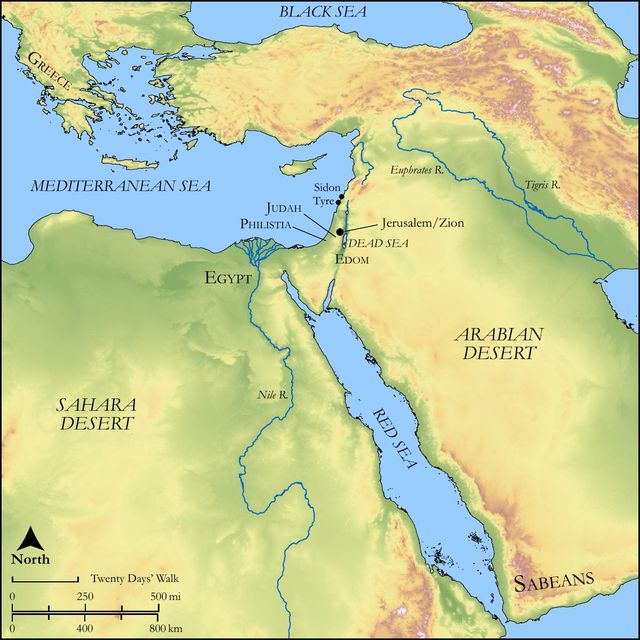
See on the biblical-era map
Study this verse
Public-domain commentary
Matthew Henry
From his Commentary on the Whole Bible. Henry comments on passages, not single verses — this entry covers Joel 3:18–21. His three-level outline is real structure in the source text, so it is rendered as structure.
These promises with which this prophecy concludes have their accomplishments in part in the kingdom of grace, and the comforts and graces of all the faithful subjects of that kingdom, but will have their full accomplishment in the kingdom of glory; for, as to the Jewish church, we know not of any event concerning that which answers to the extent of these promises, and what instances of peace and prosperity they were blessed with, which they may be supposed to be a hyperbolical description of, they were but figures of better things reserved for us, that they in their best estate without us might not be made perfect.
I.It is promised that the enemies of the church shall be vanquished and brought down, Joe 3:19.
Egypt, that old enemy of Israel, and Edom, which had an inveterate enmity to Israel, derived from Esau, these shall be a desolation, a desolate wilderness, no more to be inhabited; they have become the people of God's curse; so the Idumeans were, Isa 34:5. No strength nor wealth of a nation is a defence against the judgment of God. But what is the quarrel God has with these potent kingdoms? It is for their violence against the children of Judah, and the injuries they had done them; see Eze 25:3, Eze 25:8, Eze 25:12, Eze 25:15; Eze 26:2. They had shed the innocent blood of the Jews that fled to them for shelter or were making their escape through their country. Note, The innocent blood of God's people is very precious to him, and not a drop of it shall be shed but it shall be reckoned for. In the last day this earth, which has been filled with violence against the people of God, shall be made a desolation, when it and all the works that are therein shall be burnt up. And, sooner or later, the oppressors and persecutors of God's Israel shall be brought down and laid in the dust, nay, they will at length be brought down and laid in the flames.
II.It is promised that the church shall be very happy; and truly happy it is in spiritual privileges, even during its militant state, but much more when it comes to be triumphant. Three things are here promised it: -
1.Purity. This is put last here, as a reason for the rest (Joe 3:21); but we may consider it first, as the ground and foundation of the rest: I will cleanse their blood that I have not cleansed, that is, their bloody heinous sins, especially shedding innocent blood; that filth and guilt they had contracted by sin, which rendered them unfit for communion with God, and made them odious to his holiness and obnoxious to his justice; this they shall be washed from in the fountain opened, Zac 13:1. That shall be cleansed by the blood of Christ which could not be cleansed by the sacrifices and purifications of the ceremonial law. Or, if we apply it to the happiness of a future state, it intimates the cleansing of the saints from all these corruptions from which they were not cleansed either by ordinances or providences in the world; there shall not be the least remains of sin in them there. Here, though they are washing daily, there is still something that is not cleansed; but in heaven, even that also shall be done away. Ands the reason is because the Lord dwells in Zion, dwells with his church, and much more gloriously with that in heaven, and holiness becomes his house for ever, for which reason, where he dwells there must be, there shall be, a perfection of holiness. Note, Though the refining and reforming of the church is work that goes on slowly, and still there is something we complain of that is not cleansed, yet there is a day coming when every thing that is amiss shall be amended, and the church shall be all fair, and no spot, no stain in her; and we must wait for that day.
2.Plenty, Joe 3:18. This is put first, because it is the reverse of the judgment threatened in the foregoing chapters.
(1.)The streams of this plenty overflow the land and enrich it: The mountains shall drop new wine and the hills shall flow with milk, such great abundance shall they have of suitable provision, both for babes and for strong men. It intimates the abundance of vineyards, and all fruitful; and the abundance of cattle in the pastures that fill them with milk. And, to make the corn-land fruitful, the rivers of Judah shall flow with water, so that the country shall be like the garden of Eden, well-watered every where and greatly enriched, Psa 65:9. But this seems to be meant spiritually; the graces and comforts of the new covenant are compared to wine and milk (Isa 55:1), and the Spirit to rivers of living water, Joh 7:38. And these gifts abound much more under the New Testament than they did under the Old; when believers receive grace for grace from Christ's fulness, when they are enriched with everlasting consolations, and filled with joy and peace in believing, then the mountains drop new wine, and the hills flow with milk. Drink you, drink abundantly, O beloved! When there is plentiful effusion of the Spirit of grace, then the rivers of Judah flow with water, and make glad, not only the city of our God (Psa 46:4), but the whole land.
(2.)The fountain of this plenty is in the house of God, whence the streams take their rise, as those waters of the sanctuary (Eze 47:1) from under the threshold of the house, and the river of life out of the throne of God and the Lamb, Rev 22:1. The psalmist, speaking of Zion, says, All my springs are in thee, Psa 87:7. Those that take temporal blessings to be meant in the former part of the verse, yet by this fountain out of the house of the Lord understand the grace of God, which, if we abound in temporal blessings, we have so much more need of, that we may not abuse them. Christ himself is the fountain; his merit and grace cleanse us, refresh us, and make us fruitful. This is said to water the valley of Shittim, which lay a great way off from the temple at Jerusalem, on the other side of Jordan, and was a dry and barren valley, which intimates that gospel-grace, flowing from Christ, shall reach far, even to the Gentile world, to the most remote regions of it, and shall make those to abound in the fruits of righteousness who had long lain as the barren wilderness. This grace is a fountain overflowing, ever-flowing, from which we may be continually drawing, and yet need not fear its being drawn dry. This fountain comes out of the house of the Lord above, from his temple in heaven, flows all that good which here we are daily tasting the streams of, but hope to be shortly, hope to be eternally, drinking at the fountain-head of.
3.Perpetuity. This crowns all the rest (Joe 3:20): Judah shall dwell for ever (when Egypt and Edom are made a desolation), and Jerusalem shall continue from generation to generation. This is a promise, and a precious promise it is,
(1.)That the church of Christ shall continue in the world to the end of time. As one generation of professing Christians passes away, another shall come, in whom the throne of Christ shall endure for ever, and the gates of hell shall not prevail against it.
(2.)That all the living members of that church (Judah and Jerusalem are put for the inhabitants of that city and country, Mat 3:5) shall be established in their happiness to the utmost ages of eternity. This new Jerusalem shall be from generation to generation, for it is a city that has foundations, not made with hands, but eternal in the heavens.
Historical interpretation
Historical reception
1 surviving comment on this verse from the historical church.
(Vers. 20 seqq.) And Judaea shall be inhabited forever, and Jerusalem from generation to generation; and I will cleanse their blood, which I have not cleansed: and the Lord will dwell in Zion. LXX: But Judaea shall be inhabited forever, and Jerusalem from generation to generation, and I will require their blood, which I have not yet avenged, and the Lord will dwell in Zion. It is not this Judaea, which we see desolate, that shall be inhabited forever; nor is it this Jerusalem, whose ruins we behold; but it is that Judaea, whose daughters have rejoiced and been glad in all the judgments of the Lord. And at the end of the fiftieth psalm we read: Do good, O Lord, in your good pleasure to Zion, that the walls of Jerusalem may be built up. In this province of confession and glory, and in this city where the peace of the Lord is seen, there will be an eternal dwelling, not in one, or in three, or in many generations, but from generation to generation, that is, in two generations of those who have believed, both from the Jews and from the Gentiles. And the Lord will cleanse the blood of all sins, which He had not cleansed before, so that He may cleanse them in the Gospel, whom He had left impure as sinners in the Law. For He has concluded all under sin, so that He may have mercy on all (Rom. 11); whether He avenges the blood of His servants, which they shed in martyrdom for the confession of His name. And the Lord will dwell in Zion, of which it is written: Its foundations are in the holy mountains; the Lord loves the gates of Zion more than all the dwellings of Jacob (Ps. 68:1).
Continue studying Joel 3:21 across the web’s major study libraries — every link below opens this exact verse, chapter, or book on the destination site.
Read & Compare
 BibleGatewayThis verse in more than 200 translations and 70 languages.
 Bible.comThe YouVersion reader — hundreds of translations, reading plans, and highlights.
 ESV.orgCrossway's official English Standard Version reader.
 NET BibleThe NET translation with 60,000+ translators' notes on every rendering decision.
 STEP BibleTyndale House's free study tool — original text, vocabulary, and scholarly resources.
 BibliaLogos Bible Software's free web reader.
 USCCBThe New American Bible (Revised Edition) with the U.S. bishops' study notes.
Commentaries
 BibleHub CommentariesDozens of classic commentaries on this verse, gathered on one page.
 StudyLightMore than 100 commentary sets — the largest collection on the web.
 BibleRefPlain-English commentary on what this verse means, verse by verse.
 Enduring WordDavid Guzik's free commentary on this chapter, widely used by Bible teachers.
 Bible Study ToolsVerse commentary alongside Greek and Hebrew study aids.
Original Language & Research
- BibleHub InterlinearThe verse word by word — original language, transliteration, and English.
- BibleHub LexiconEvery word's original-language definition and Strong's entry.
 Blue Letter BibleDeep-study tools — Strong's numbers, concordance, and word studies.
 SefariaThe Hebrew text with Rashi and centuries of Jewish commentary.
Sermons, Hymns & Audio


TrulyRandomVerse is not affiliated with these sites and doesn’t control their content. They’re linked because they’re genuinely useful.
Summary
Joel 3:21 stands as the triumphant capstone of the prophet's message, declaring God's unwavering commitment to divine justice and His eternal presence among His people. Following pronouncements of judgment against the nations and promises of restoration for Judah, this verse assures a complete purification from all unavenged wrongs, particularly the shedding of innocent blood, culminating in the foundational truth that the LORD Himself will dwell permanently in Zion, guaranteeing ultimate peace, security, and holiness for His chosen.
Context
ShowHideLiterary Context
Joel 3:21 brings the book of Joel to a climactic close, shifting from earlier descriptions of a devastating locust plague and drought (Joel 1-2) to a grand eschatological vision of God's judgment and restoration. Chapter 3, often referred to as the "Valley of Jehoshaphat" chapter, details God's gathering of the nations for judgment due to their mistreatment of Judah and Jerusalem, specifically their scattering of God's people and division of His land. Verses 3:19-20 explicitly contrast the desolation of Egypt and Edom—nations that committed violence against Judah—with Judah's enduring habitation. Verse 21, therefore, serves as the ultimate resolution and divine declaration, solidifying the promise of God's permanent dwelling and the complete purification of His people and land, establishing a new era of righteousness and peace. It answers the cries for justice and sets the stage for a purified, divinely indwelt future.
Historical & Cultural Context
The historical backdrop for Joel's prophecy is debated, but the themes resonate with periods of national distress, foreign oppression, and the longing for divine intervention. The concept of "blood" in ancient Israelite culture was deeply significant, representing life itself and, when shed, demanding justice or atonement. Unavenged bloodshed defiled the land, requiring divine action to cleanse it (e.g., Numbers 35:33-34). The "Day of the Lord" (Joel 2:31) was a well-established prophetic theme, signifying a time of God's decisive intervention, bringing judgment upon His enemies and salvation for His people. Zion (Jerusalem) was not merely a geographical location but the spiritual and political heart of Israel, the chosen place for God's temple and His dwelling among His people (Psalm 9:11). The promise of God dwelling in Zion was the ultimate assurance of security, blessing, and covenant faithfulness, signifying His active presence and sovereignty over His people and the entire earth.
Key Themes
ShowHideJoel 3:21 encapsulates several profound themes that run throughout the book and the broader prophetic tradition. Firstly, it underscores Divine Justice and Retribution, affirming that God will not leave unpunished the violence and injustices committed against His people. The cleansing of "blood" points to God's ultimate avenging of innocent lives and the purification of the land from the stain of sin and violence. Secondly, the verse highlights God's Sovereign Presence and Covenant Faithfulness. The declaration "for the LORD dwelleth in Zion" is the bedrock of Israel's hope, signifying God's unwavering commitment to His covenant promises and His active, protective, and redemptive presence among His chosen people. This divine indwelling guarantees their security and future. Finally, it speaks to Ultimate Restoration and Purification. The cleansing of "blood" implies a complete and final purification, not only of the land but also of the relationship between God and His people, leading to an era of holiness and peace. This restoration is a direct result of God's righteous judgment and His powerful, cleansing work, as seen in other prophetic visions of a renewed people and land, such as Ezekiel 36:25.
Exposition and Analysis
ShowHideKey Word Analysis
ShowHideA primitive root meaning "to be (or make) clean (literally or figuratively); by implication (in an adverse sense) to be bare, i.e. extirpated." It carries the sense of being acquitted, blameless, or held guiltless. In the context of blood, it often implies avenging innocent bloodshed or purifying from the guilt associated with it. When God declares He will "cleanse" blood He has not cleansed, it signifies His active intervention to remove the stain of guilt and ensure justice is served, holding accountable those responsible for unpunished violence.
Meaning "blood (as that which when shed causes death) of man or an animal; by analogy, the juice of the grape; figuratively (especially in the plural) bloodshed." This term is powerfully evocative, representing life itself. In the context of Joel 3:21, it primarily refers to the innocent bloodshed and violence perpetrated against God's people by the nations, which has defiled the land and cried out for divine retribution and purification.
A primitive root meaning "to reside or permanently stay (literally or figuratively)." It conveys the idea of having a habitation, remaining, or resting. This word is significant as it often describes God's presence among His people, particularly in the Tabernacle or Temple. Its use here emphasizes the permanent, unwavering nature of God's presence in Zion, guaranteeing security, blessing, and the fulfillment of His covenant promises.
Verse Breakdown
ShowHide"For I will cleanse their blood [that] I have not cleansed"
This powerful declaration signifies God's ultimate commitment to justice. The "blood" refers to the innocent lives taken and the violence perpetrated against Judah by the surrounding nations, which, from a human perspective, had gone unavenged or unpunished. God asserts His sovereign right and intention to rectify these historical wrongs. The repetition of "cleansed" (or "not cleansed") emphasizes that God is taking direct action to purify the land and His people from the defilement of unpunished sin and bloodshed, ensuring that no injustice escapes His notice or His righteous judgment. This is an act of divine vindication for His suffering people.
"for the LORD dwelleth in Zion"
This clause provides the foundational reason and ultimate assurance for the preceding promise of cleansing and justice. God's permanent dwelling in Zion (Jerusalem) signifies His unwavering presence, His covenant faithfulness, and His active sovereignty over His people and the earth. His dwelling place is the center of His rule, the source of His protection, and the guarantee of His redemptive work. It implies that because God is eternally present and sovereign in His holy city, He will indeed bring about the promised purification, restoration, and peace, ensuring that His people are secure under His divine governance.
Literary Devices
ShowHideJoel 3:21 effectively employs several literary devices to convey its profound message. Parallelism is evident in the two clauses, where the first clause, a promise of divine cleansing, is directly supported and explained by the second, a declaration of God's permanent dwelling. The cleansing of blood is a direct consequence of the LORD's presence in Zion. Symbolism is central, with "blood" representing not only life but also the unavenged violence and injustice that defile. "Zion" symbolizes God's chosen dwelling place, the spiritual and political center of His kingdom, and the locus of His sovereign rule and protection. The entire verse functions as a Divine Fiat, a powerful declaration of God's will and intention, emphasizing His absolute authority and ability to bring about what He declares. This authoritative statement serves as a triumphant conclusion, leaving no doubt about God's ultimate victory and the secure future of His people.
Theological and Thematic Connections
ShowHideJoel 3:21 is a profound statement on God's character and His eschatological plan. It underscores the absolute certainty of divine justice, asserting that no wrong, especially the shedding of innocent blood, will ultimately go unpunished by God. This speaks to God's inherent righteousness and His commitment to moral order in His creation. Furthermore, the declaration that "the LORD dwelleth in Zion" is a powerful affirmation of God's covenant faithfulness and His permanent, active presence among His people. This divine indwelling is the ultimate source of security, purity, and blessing, transforming a world marred by injustice into a realm governed by God's perfect will. It points forward to a time when God's presence will fully purify and restore all things, establishing His kingdom in its fullness.
Reflection and Application
ShowHideJoel 3:21 offers profound comfort and a call to trust in God's sovereign justice and enduring presence. In a world often marked by unpunished injustices, suffering, and violence, this verse assures us that God sees, God remembers, and God will ultimately act. We are reminded that no sin, no act of oppression, no innocent blood shed, escapes His divine notice or His righteous judgment. This truth should inspire patience and perseverance in the face of evil, knowing that God's timetable for justice is perfect. Moreover, the declaration that "the LORD dwelleth in Zion" is a powerful anchor for our hope. It signifies that God is not distant or disengaged but intimately present with His people, actively working to bring about His purposes of purification and peace. This presence is the source of our security, our cleansing, and our ultimate restoration. It encourages us to live in light of His indwelling Spirit, striving for personal holiness and participating in His work of justice and reconciliation in the world, knowing that His ultimate dwelling with humanity in the new creation is our blessed hope.
Questions for Reflection
ShowHideFAQ
ShowHideWhat is the significance of God cleansing "blood that I have not cleansed"?
ShowHideThis phrase highlights God's absolute sovereignty and His commitment to ultimate justice. In ancient Israel, unavenged bloodshed defiled the land and cried out for divine retribution (e.g., Numbers 35:33). When God declares He will cleanse blood He has not yet cleansed, it means He is taking personal responsibility to rectify all past and present injustices, particularly the shedding of innocent lives, that have gone unpunished by human means. It signifies that no crime or violence against His people will escape His divine judgment and purification. This is a promise of vindication for His people and a declaration of His righteous character.
How does God "dwelling in Zion" relate to His promises for His people?
ShowHideGod "dwelling in Zion" (Jerusalem) is a foundational theological truth throughout the Old Testament, signifying His covenant faithfulness and His permanent, active presence among His chosen people. Zion was where His Temple was built, the place He chose to make His name dwell (1 Kings 8:29). This divine indwelling guarantees the security, blessing, and ultimate restoration of His people. It means that God is actively governing, protecting, and purifying His people and their land. It's the ultimate assurance that His promises will be fulfilled, His justice will prevail, and His kingdom will be established in its fullness, bringing peace and holiness to His creation.
Christ-Centered Fulfillment
ShowHideJoel 3:21 finds its ultimate and most profound fulfillment in Jesus Christ. The promise, "For I will cleanse their blood [that] I have not cleansed," points forward to the perfect and final atonement accomplished through the shedding of Christ's own innocent blood. While Joel speaks of the avenging of innocent blood and the purification of the land from defilement, Christ's sacrifice on the cross not only atones for the sins of humanity, cleansing us from all unrighteousness (1 John 1:7), but also inaugurates the new covenant where true spiritual cleansing is offered to all who believe. Furthermore, the declaration "for the LORD dwelleth in Zion" is fulfilled in Christ in a multi-faceted way. Jesus Himself is the ultimate Temple, the dwelling place of God among humanity (John 1:14). Through His death and resurrection, He established a new, spiritual Zion—the Church—where God now dwells by His Spirit in the hearts of believers (Ephesians 2:21-22). Ultimately, this promise culminates in the new heavens and new earth, where God's dwelling place will be fully with humanity, and He will wipe away every tear, signifying the complete and final cleansing of all sin and sorrow (Revelation 21:3-4). Thus, Joel's vision of divine justice and God's permanent presence is perfectly realized in the person and work of Jesus Christ.