


Zephaniah 3:5
“Judgment on Jerusalem’s Wickedness”Zephaniah 3:1–7
Bible text: King James Version (1769 Blayney text) · Public domain
Bible text: King James Version with Strong's numbers · Public domain
Bible text: Berean Standard Bible · Public domain
Bible text: American Standard Version (1901) · Public domain
Bible text: World English Bible, Messianic edition · Public domain
Bible text: Geneva Bible (1599) · Public domain
Bible text: Young's Literal Translation · Public domain
- יְהוָהYah·wehYahwehH3068N-properNoun Proper Title
- צַדִּיקtza·Dik[is] righteousH6662Adj-msAdjective Singular Masculine Absolute
- בְּקִרְבָּהּbe·kir·Bahin its midstH7130Prep-b ¦ N-msc ¦ 3fsNoun Singular Masculine Construct with suffixבְּinקִרְבָּmidstהּits
- לֹאlo'notH3808NegParticle Negative
- יַעֲשֶׂהya·'a·Sehhe doesH6213V-Qal-Imperf-3msVerb Qal Imperfect 3rd Singular Masculine
- עַוְלָה'av·LahinjusticeH5766N-fsNoun Singular Feminine Absolute
- בַּבֹּקֶרba·Bo·kerin the morningH1242Prep-b ¦ N-msNoun Singular Masculine Absoluteבַּin theבֹּקֶרmorning
- בַּבֹּקֶרba·Bo·kerin the morningH1242Prep-b ¦ N-msNoun Singular Masculine Absoluteבַּin theבֹּקֶרmorning
- מִשְׁפָּטוֹmish·pa·Tohis judgmentH4941N-msc ¦ 3msNoun Singular Masculine Construct with suffixמִשְׁפָּטjudgmentוֹhis
- יִתֵּןyi·Tenhe givesH5414V-Qal-Imperf-3msVerb Qal Imperfect 3rd Singular Masculine
- לָאוֹרla·'Orto the lightH216Prep-l ¦ N-fsNoun Singular Feminine Absoluteלָto theאוֹרlight
- לֹאlo'notH3808NegParticle Negative
- נֶעְדָּרne'·Darhe failsH5737V-Niphal-Prtcpl-msVerb Niphal Participle Singular Masculine Absolute
- וְלֹאve·lo'and notH3808Conj-w ¦ NegParticle Negativeוְandלֹאnot
- יוֹדֵעַyo·De·a'[is] knowingH3045V-Qal-Prtcpl-msVerb Qal Participle Singular Masculine Absolute
- עַוָּל'a·Valan unrighteous personH5767N-msNoun Singular Masculine Absolute
- בֹּשֶׁתBo·shetshameH1322N-fsNoun Singular Feminine Absolute
English is a literal word-by-word gloss of the Hebrew, not the KJV's wording. Why?
This is the Hebrew Masoretic text, the same tradition the KJV’s translators worked from, with each word given its own literal English meaning in this verse. The word-by-word meanings were prepared by scholars at Tyndale House, Cambridge. The KJV translates whole sentences rather than single words, so its wording often differs: one Hebrew word can become several English words, and the KJV may say “the LORD” where the word-by-word meaning reads “Yahweh”. The two are made for different purposes, and both are faithful to the Hebrew. To read the KJV’s own wording, switch to the KJV text.
Words in [ ] are added by the English.
- judgment (KJV) / justice (BSB) מִשְׁפָּט
Details
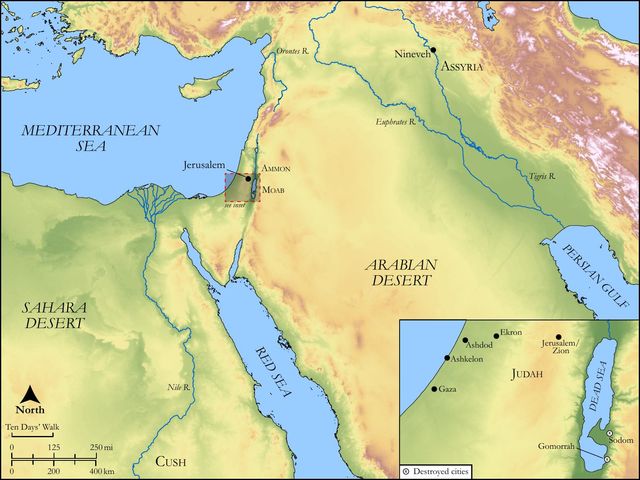
See on the biblical-era map
Study this verse
Public-domain commentary
Matthew Henry
From his Commentary on the Whole Bible. Henry wrote on whole passages, and this entry covers Zephaniah 3:1–7. He set out his notes in a three-level outline, kept here as he numbered it.
One would wonder that Jerusalem, the holy city, where God was known, and his name was great, should be the city of which this black character is here given, that a place which enjoyed such abundance of the means of grace should become so very corrupt and vicious, and that God should permit it to be so; yet so it is, to show that the law made nothing perfect; but if this be the true character of Jerusalem, as no doubt it is (for God's judgments will make none worse than they are), it is no wonder that the prophet begins with woe to her. For the holy God hates sin in those that are nearest to him, nay, in them he hates it most. A sinful state is, and will be, a woeful state.
I.Here is a very bad character given of the city in general. How has the faithful city become a harlot!
1.She shames herself; she is filthy and polluted (Zephaniah 3:1), has made herself infamous (so some read it), the gluttonous city (so the margin), always cramming, and making provision for the flesh, to fulfil the lusts of it. Sin is the filthiness and pollution of persons and places, and makes them odious in the sight of the holy God.
2.She wrongs her neighbours and inhabitants; she is the oppressing city. Never any place had statutes and judgments so righteous as this city had, and yet, in the administration of the government, never was more unrighteousness.
3.She is very provoking to her God, and in every respect walks contrary to him, Zephaniah 3:2. He had given his law, and spoken to her by his servants the prophets, telling her what was the good she should do and what the evil she should avoid; but she obeyed not his voice, nor made conscience of doing as he commanded her, in any thing. He had taken her under an excellent discipline, both of the word and of the rod; but she did not receive the instruction of the one nor the correction of the other, did not submit to God's will nor answer his end in either. He encouraged her to depend upon him, and his power and promise, for deliverance from evil and supply with good; but she trusted not in the Lord; her confidence was placed in her alliances with the nations more than in her covenant with God. He gave her tokens of his presence, and instituted ordinances of communion for her with himself; but she drew not near to her God, did not meet him where he appointed and where he promised to meet her. She stood at a distance, and said to the Almighty, Depart.
II.Here is a very bad character of the leading men in it; those that should by their influence suppress vice and profaneness there are the great patterns and patrons of wickedness, and those that should be her physicians are really her worst disease.
1.Her princes are ravenous and barbarous as roaring lions that make a prey of all about them, and they are universally feared and hated; they use their power for destruction, and not for edification.
2.Her judges, who should be the protectors of injured innocence, are evening wolves, rapacious and greedy, and their cruelty and covetousness both insatiable: They gnaw not the bones till the morrow; they take so much delight and pleasure in cruelty and oppression that when they have devoured a good man they reserve the bones, as it were, for a sweet morsel, to be gnawed the next morning, Job 31:31.
3.Her prophets, who pretend to be special messengers from heaven to them, are light and treacherous persons, fanciful, and of a vain imagination, frothy and airy, and of a loose conversation, men of no consistency with themselves, in whom one can put no confidence. They were so given to bantering that it was hard to say when they were serious. Their pretended prophecies were all a sham, and they secretly laughed at those that were deluded by them.
4.Her priests, who are teachers by office and have the charge of the holy things, are false to their trust and betray it. They were to preserve the purity of the sanctuary, but they did themselves pollute it, and the sacred offices of it, which they were to attend upon - such priests as Hophni and Phinehas, who by their wicked lives made the sacrifices of the Lord to be abhorred. They were to expound and apply the law, and to judge according to it; but, in their explications and applications of it, they did violence to the law; they corrupted the sense of it, and perverted it to the patronising of that which was directly contrary to it. By forced constructions, they made the law to speak what they pleased, to serve a turn, and so, in effect, made void the law.
III.We have here the aggravations of this general corruption of all orders and degrees of men in Jerusalem.
1.They had the tokens of God's presence among them, and all the advantages that could be of knowing his will, with the strongest inducements possible to do it, and yet they persisted in their disobedience, Zephaniah 3:5. (1.) They had the honour and privilege of the Shechinah, God's dwelling in their land, so as he dwelt not with any other people: "The just Lord is in the midst of thee, to take cognizance of all thou doest amiss and give countenance to all thou doest well; he is in the midst of thee as a holy God, and therefore thy pollutions are the more offensive, Deuteronomy 23:14. He is in the midst of you as a just God, and therefore will punish the affronts you put upon him, and the wrongs and injuries you do to one another." (2.) They had God's own example set before them, in the discovery he made of himself to them, that they might conform to it: "He will not do iniquity, and therefore you should not;" for this was the great rule of their institution, "Be you holy, for I am holy. God will be true to you; be not you then false to him." (3.) He sent to them his prophets, rising up early and sending them: Every morning he brings his judgment to light, as duly as the morning comes; he fails not. He shows them plainly what the good is which he requires of them, and puts them in mind of it; he wakens morning by morning (Isaiah 50:4), wakens his prophets with the rising sun, to bring to light the things which belong to their peace. So that, upon the whole matter, what more could have been done to his vineyard, to make it fruitful? Isaiah 5:4. And yet, after all, the unjust know no shame; those that have been unjust are unjust still, and are not ashamed of their unrighteousness, neither can they blush. If they had any sense of honour, any shame left in them, they would not go so directly contrary to their profession and to the instructions given them. But those that are past shame are past cure.
2.God had set before their eyes some remarkable monuments of his justice, which were designed for warning to them (Zephaniah 3:6): I have cut off the nations, the seven nations of Canaan, which the land spewed out for their wickedness, upon which they had this caution given them, to take heed lest it spew them out also, Leviticus 18:28. Or it may refer to some of the neighbouring nations that were made desolate for their wickedness, especially to the nations of Israel, the ten tribes. Their towers were desolate, their high towers, their strong towers, their pride and power broken; their streets were wasted, so that none passed along through them; their cities were destroyed and laid in ruins; no man was to be found in them, no inhabitant, all were slain or carried into captivity. The enemies did it, but God avows it: I cut them off, says he. And God designed this for an admonition to Jerusalem (Ezekiel 23:9, Ezekiel 23:11): "I said, Surely thou wilt fear me; surely these judgments upon others will deter thee from the like wicked practices; surely thou wilt receive instruction by these providences; it ought to be expected that thou wouldst not continue to sin like the nations when thou seest the ruin which their sin brought upon them." They could not but see their own house in danger when their neighbour's was on fire; and, when we are frightened, God should be feared.
3.He had set before them life and death, good and evil, both in his word and in his providence.
(1.)He had assured them of the continuance of their prosperity if they would fear him and receive instruction, for so their dwelling would not be cut off as their neighbour's was; if they took the warning given them, and reformed, what was past should be pardoned, and their tranquility lengthened out.
(2.)He had made them feel the smart of the rod, though he reprieved them from the sword: Howsoever I punished them, that, being chastened, they might not be condemned. Such various methods did God take with them, to reclaim them, but all in vain; they were not won upon by gentle methods, nor had severe ones any effect, for they rose early, and corrupted all their doings; they were more resolute and eager in their wicked courses than ever, more studious and solicitous in making provision for their lusts, and let slip no opportunity for the gratification of them. God rose up early, to send them his prophets, to reduce and reclaim them, but they were up before him, to shut and bolt the door against them. Their wickedness was universal: All their doings were corrupted; and it was all owing to themselves; they could not lay the blame upon the tempter, but they alone must bear it; they themselves wilfully and designedly corrupted all their doings; for every man is tempted when he is drawn aside of his own lust and enticed.
Historical interpretation
Historical reception
1 surviving comment on this verse from the historical church.
(Chapter 3, verses 1 onwards) Woe to the provoking and redeemed city: the dove did not hear the voice and did not receive discipline. It did not trust in the Lord and did not approach its God. Its princes are in its midst, like roaring lions. Its judges are wolves of the evening, they do not leave anything for the morning. Its prophets are insane, unfaithful men. Its priests have defiled the holy, they have acted unjustly against the law. The Lord is righteous; he will not do injustice. Every morning he brings his justice to light; it does not fail. But the wicked know no shame. I have cut off nations; their battlements are in ruins. I laid waste their streets, so that no one walks in them; their cities have been made desolate, without a man, without an inhabitant. I said, 'Surely you will fear me; you will accept correction. Then your dwelling would not be cut off according to all that I have appointed against you.' But all the more they were eager to make all their deeds corrupt. However, rising at dawn, they corrupted all their thoughts. LXX: O illustrious and redeemed city, the dove did not hear a voice, nor receive discipline: it did not trust in the Lord, nor did it approach its Lord. Its princes in it are like roaring lions; its judges are like Arabian wolves, not leaving anything until morning; its prophets are men who carry the spirit, contemptible men; its priests defile the holy things and act impiously against the law: but the Lord is righteous in its midst, and will not do iniquity. In the morning, it will give its judgment in the light, and it is not hidden, and it does not know iniquity in its demands, nor eternal injustice: I have removed the proud, their corners are scattered: I have destroyed their paths so that they may not pass: their cities have failed, because no one remains, nor does anybody dwell. I have said, nevertheless you will fear me, and you will receive discipline, and you will not perish from my sight in all the ways in which I have taken vengeance upon her. Prepare, rise early in the morning: all their buds have been destroyed. Many people think that because of the context of the discourse, it is said against Nineveh, about which it was said above: And he will destroy Assyria, and make Nineveh a wasteland. But the Scripture never called Nineveh a dove: although in Jeremiah, some think that what was said about the doves fleeing from the face of the sword of Nebuchadnezzar (Jer. 15) can refer to Nineveh. But it should be known that others assert the opposite, that instead of dove, it could be understood as Greece, so that the meaning is, from the face of the sword of Jonah, that is, from the face of the sword of Greece: for Jonah signifies both a dove and Greece. And to this day the Greeks still call it the Ionian sea, and the Hebrews retain their ancient word. And even the Roman emperors, when dealing with foreign nations, retain the ancient title of Caesar. So all talk about Jerusalem is: Alas for that city which was once a dove, always sinning and handed over to captivity, but redeemed again by the Lord. Alas for that provocative city, which in Hebrew is more significantly called Mara, meaning 'bitterness', which we can interpret as making God bitter, that is, turning a sweet and merciful Lord into bitterness because of your fault, so that he who desires to show mercy is compelled to punish. She did not hear the command of the Lord, and she refused to accept discipline; she also trusted in the Lord her God in times of distress; she did not walk after His back; and when He said, 'I am the approaching Lord, not from afar' (Jer. XXIII, 23), she wanted to approach Him. Her princes, judges, prophets, and priests are also described, so that in the city we may consider them as the people, and in the names of these dignities that I have mentioned, we may take them as princes. Therefore, his princes were like lions always prowling in the prey and shedding the blood of their subjects. His judges were rapacious, not leaving anything for others to plunder. His prophets raved or were stunned, which in Hebrew is called 'Phoezim', and Aquila translated it as 'astonishing'. They spoke as if from the mouth of the Lord, and they proclaimed everything against the Lord. The priests in the holy place committed sacrilege, and while acting against the law, they offered sacrifices according to the law. Therefore, because they acted unjustly, the Lord, who is just, will not do iniquity; but he will restore to the wicked city what it deserves. Morning, morning, that is, clearly and without any ambiguity, he will pass judgment on it, and there will be nothing that can be hidden from him. And the Lord will do this so that the reformed city may turn to better ways. But the wicked people of Israel did not recognize their own confusion, nor did they understand the punishments inflicted upon them, in order to repent. I have avenged you, he said afterwards, on the nations, and I have destroyed their empires, so that those who did not feel me through blows might at least recognize me through favors. Or certainly it should be understood thus: I have scattered all your cities, O Judah, and all the towns and tribes subject to you, and the diverse borders, and there was such a vast number of people that there was no one to dwell in your cities; and after I did this, I sent my prophets, rising early and calling for repentance, and I said: I have indeed done these things to you, O Jerusalem, but I have done it so that you might fear me and accept discipline, and so that your dwelling place, that is, the temple, might not perish because of all the crimes you have committed. On the contrary, the inhabitants of Jerusalem, provoked by me to repentance, intentionally and competitively rose early in the morning, so that they could fulfill all their thoughts and demonstrate in action what they had conceived in their minds. This is according to the Hebrew. Furthermore, the illustrious and redeemed city of Christ by blood is clearly understood as the Church, which is also called a dove, because of the simplicity of the multitude of believers in it. She did not hear the voice of the Lord, nor was she willing to receive discipline, nor did she trust in the Lord, because she did not want to draw near to her Lord God, in order to deserve forgiveness of sins. For in vain does anyone say that they hear the voice of their Lord God, and trust in the Lord, when they destroy faith with their actions, and are more joined to money than to their Lord God, and approach Him with a double heart, believing they can serve two masters, the world and God. The leaders of this [country] are like roaring lions. We have no doubt about the roar of the lions and the actions: when we see its leaders thundering against the subjected people, and crushing the commoners with tyrannical voices and raging insults, you would think they are barking like lions among little sheep. Its judges too, like Arabian wolves, prey in the evening and leave nothing in the morning: not looking towards the rising sun, but always lingering in darkness, and turning the possessions of the Church and the things that are contributed to God's gifts into their own profit, so that the poor have nothing to eat in the morning, who, like in the night and with no one watching, plunder everything; and like wolves, they snatched away everything, not even leaving small meals for the needy. Even the prophets, that is, the teachers who think they can teach the people and speak about the Scriptures, are carriers of the spirit, or spiritual (and this should be read ironically): they are men of contempt. For it is fitting for them to act in the Church, not to destroy words with deeds. However, when you teach someone else and you yourself do not do it, you are to be called not a teacher, but a despiser, as is written in Habakkuk: See, you scoffers, be astounded and perish (Habakkuk 1:5). Moreover, the priests who serve the Eucharist and distribute the blood of the Lord to his people act impiously against the law of Christ. They think that the words of the one who offers the Eucharist are more important than a virtuous life, and they believe that only a solemn prayer is necessary, not the merits of the priests. As it is said: 'And the priest who has a blemish shall not come near to offer the oblations to the Lord' (Leviticus 21, according to the Septuagint). Despite the fact that the princes, judges, prophets, and priests of Jerusalem do these things, the Lord remains merciful and just. Clement, in that he does not depart from his Church: just, in that he renders to everyone what they deserve. For when the morning comes, and the night of this age passes away, he will give his judgement in the light, and he will not hide himself or his judgement. And when he begins to demand the money that he entrusted to each person, he will not be unjust, nor will he allow injustice to prevail forever; but he will remove the proud rulers, whom God opposes, from their thrones, and from the heights they held, and their angles, that is, their wicked desires, will be dispersed, and they will deviate from the right path, on which the Pharisees always used to pray, with the cornerstone rejected. But I think that it is advantageous for the proud to be detracted from their arrogance, and for their narrow and winding paths to be scattered, so that afterwards they may walk on a straight path. Finally, it follows: And I will make their ways deserted, because there is no one who will pass through them; according to what is written in the first psalm: And the way of the wicked will perish (Psalm 1:6). Likewise, in Hosea, where it is said about Jerusalem fornicating: Behold, I will close her paths with thorns, and obstruct her ways, and she will not find her path, and she will pursue her lovers, and will not apprehend them, and she will seek them, and will not find them; and she will say: I will go and return to my former husband, for it was better for me then than now (Hosea 2:6-7). Note that unless the roads had been closed, and the paths blocked, and unless the Lord had destroyed their ways, the adulterous soul would never have been able to say: I will go and return to my former husband. Therefore, let the paths of the proud be scattered and their corners, so that they do not walk in pride and wickedness, and their cities, which were built poorly in arrogance and pride, are destroyed, so that they do not remain and have the most wretched inhabitants. So that no one thinks that we are using force on the Scripture, let them learn from the following: But I have done these things, he says, so that I may say to them: Behold, the paths of evil have been destroyed, from now on fear me and learn ((or receive)) my teaching, lest my teaching perish and I find no fruit of conversion in you; and let everything be in vain through which I wanted to correct you, and that the word written in Jeremiah may be applied to you: I have struck your sons without cause, you have not received discipline (Jer. II, 30). Indeed, fear me and accept discipline, so that all things may not perish from the sight of Jerusalem, and so that they may not be completely led into desolation because of these evils in which I have threatened her. Let it not trouble anyone (as I have often said) that these things are interpreted as being against the Church, since it is known that Jerusalem always has a typological meaning for the Church in the holy Scriptures: from which whoever sins is either led into Babylon or, if they willingly desire to descend, is wounded by thieves in Jericho. For what Church is so illustrious, which is founded throughout the whole world, so redeemed by the blood of Christ and called together from the nations by the dove for the grace of the Holy Spirit? In it, there are many who claim to believe in Christ but have not heard His voice, have not received His teaching, and do not wish to be close to Him. But what is said: 'Its leaders in it are like roaring lions,' I know that this will offend many because they interpret it as referring to bishops and priests, when in fact there are wicked priests who desired to violate Susanna, but they do not condemn the other priests who have lived uprightly. And the evil princes, whom the prophetic discourse describes, are not an insult to good princes: For when a fool is flogged, he becomes wiser, as it is written: 'When the ignorant is punished, the fool becomes wiser' (Prov. XIX, 15); if the fool becomes wiser, how much more so the wise? But his judges and princes, accepting bribes and selling justice, are they not rightly called 'Arabian wolves' or 'evening wolves', as Symmachus translated? For they do not deserve to be called 'Benjamin's wolves' who snatch in the morning and give food in the evening (Gen. XLIX); but 'evening wolves' who feed at night and leave nothing in the morning. But moving on to what follows: His prophets are spirit-bearers, that is, bearers of the spirit, men of contempt. Let it not bother us that, while interpreting the doctors, we also refer to them as prophets and men of contempt, since the Apostle also instructs us: Do not grieve the Holy Spirit of God, in whom you were sealed for the day of redemption (Ephesians 4:30). And let David speak in the fiftieth psalm: Do not take away your Holy Spirit from me (Psalm 51:13). For if the Holy Spirit had not been grieved and accustomed to flee from a place first, and to leave his dwelling, never would Paul have commanded what I have said above; and David, after committing adultery, would not have been afraid of losing what he had received, about which it is also written to the Hebrews: How much do you think he deserves worse punishments, who has trampled on the Son of God, and has esteemed the blood of the testament as unclean, in which he was sanctified, and has insulted the Spirit of grace (Heb. X, 29)? But it is also written in the third book of Kings: 'The man of God, undoubtedly a prophet, who spoke at the altar in Samaria, saying: Altar, altar, thus says the Lord: Behold, a son shall be born to David' (3 Kings 13:2) and so on; because he despised the words of the Lord and ate with the false prophet (for this is how Josephus explained this passage), he was killed by a lion. And so that it would not be thought of as a chance occurrence and not the judgment of the Lord, the false prophet who deceived him predicted that this would happen, and the lion itself, punishing the despiser, spared the donkey. Therefore it is not surprising that the doctors who were filled with the Holy Spirit could become contemptuous, since among the negligent ones who do not keep their hearts with all diligence, this very cause often gives rise to pride in the Lord and contempt, because they have knowledge of God and know His great goodness, which He hides from those who fear Him, and they despise the riches of His goodness, treasuring up for themselves wrath on the day of wrath and revelation. The priests also (who give baptism and pray for the advent of the Lord at the Eucharist: make the oil of chrism: impose hands; instruct catechumens: appoint Levites and other priests) do not despise us as we explain and prophesy, but rather they pray to the Lord and diligently strive that those priests who violate the holy things of the Lord do not deserve to be. For it is not the dignity and the names of dignities, but the work of dignity, that is accustomed to save princes, judges, prophets, and priests: 'He who desires the episcopate,' it says, 'desires a good work' (1 Timothy 3). See what he said: a good work desires, but not dignity. However, if, despising the work, he only looks at dignity, the tower in Siloam quickly falls, and the tall cedars are struck by lightning, and the raised neck is broken, and the swan, with its neck stretched out and reaching high, is counted among unclean birds. Furthermore, what we have set forth according to the Hebrew: Nevertheless, rising at dawn, they corrupted all their thoughts, for which it is written in the Septuagint: prepare, rise at dawn, their foliage is scattered, because it deviates greatly from the Hebrew, and it seems to agree more with the subsequent versions, which we will explain in what follows.
Continue studying Zephaniah 3:5 across the web’s major study libraries — every link below opens this exact verse, chapter, or book on the destination site.
Read & Compare
 BibleGatewayThis verse in more than 200 translations and 70 languages.
 Bible.comThe YouVersion reader — hundreds of translations, reading plans, and highlights.
 ESV.orgCrossway's official English Standard Version reader.
 NET BibleThe NET translation with 60,000+ translators' notes on every rendering decision.
 STEP BibleTyndale House's free study tool — original text, vocabulary, and scholarly resources.
 BibliaLogos Bible Software's free web reader.
 USCCBThe New American Bible (Revised Edition) with the U.S. bishops' study notes.
Commentaries
 BibleHub CommentariesDozens of classic commentaries on this verse, gathered on one page.
 StudyLightMore than 100 commentary sets — the largest collection on the web.
 BibleRefPlain-English commentary on what this verse means, verse by verse.
 Enduring WordDavid Guzik's free commentary on this chapter, widely used by Bible teachers.
 Bible Study ToolsVerse commentary alongside Greek and Hebrew study aids.
Original Language & Research
- BibleHub InterlinearThe verse word by word — original language, transliteration, and English.
- BibleHub LexiconEvery word's original-language definition and Strong's entry.
 Blue Letter BibleDeep-study tools — Strong's numbers, concordance, and word studies.
 SefariaThe Hebrew text with Rashi and centuries of Jewish commentary.
Sermons, Hymns & Audio


TrulyRandomVerse is not affiliated with these sites and does not control their content.
Written with AI assistance. Always check it against Scripture.
This verse
The just LORD is in the midst of the city and never does wrong, bringing his judgment to light every morning, yet the unjust feel no shame.
“The just LORD is in the midst thereof;”
The righteous God is at the center of the very city that has turned from him.
“he will not do iniquity:”
His own conduct is wholly right, the opposite of the city’s leaders.
“every morning doth he bring his judgment to light, he faileth not;”
Like the sunrise, his justice is shown again each day, and he is never missing.
“but the unjust knoweth no shame.”
The wicked see that light and still feel no shame.
Passage studyZephaniah 3:1–7
Woe to the Oppressing City
Summary
Zephaniah turns from the nations to Jerusalem itself and cries woe over the city that should have been the holiest on earth. She rebels against God, she is defiled, and she oppresses her own people. She has refused his voice and his correction, and she has not trusted him or come near to him. Her princes and judges devour like lions and wolves, her prophets are men of no weight, and her priests profane what is holy and do violence to the law. In the middle of all this the just LORD is present, doing no wrong and bringing his judgment to light morning after morning, while the wicked feel no shame. God had cut off other nations as a warning, and he hoped Jerusalem would fear him and receive his instruction so that her dwelling would be spared. Her people rose early instead, to corrupt everything they did. In seven verses we see God’s holiness and justice, his nearness to a people who had wandered from him, and the patience of his correction.
Jerusalem in the days of Josiah
These verses open Zephaniah’s last and sharpest charge, aimed at the capital, after the judgment on Judah in Zephaniah 1 and on the nations around her in Zephaniah 2. By singling out Jerusalem, the prophet shows that the very heart of God’s people has gone bad. The rest of Zephaniah 3 then moves from this charge to the promises of purifying, restoring and rejoicing that close the book (Zephaniah 3:9–20), and the darkness of these verses makes that ending all the brighter.
Zephaniah prophesied in the reign of King Josiah (c. 640–609 BC). Before him Manasseh and Amon had filled the land with idols, and in Jerusalem people worshipped Baal, Molech and the host of heaven, some of them on their rooftops (Zephaniah 1:4–5). Josiah purged the pagan worship and restored the law of Moses (2 Kings 22–23). Zephaniah’s words may come from early in that reign, before the great reform of 622 BC. Either way they show that the people and their leaders had kept their hearts far from God: corruption, oppression and an outward show of religion carried on. Many had grown complacent, sure that the LORD would do neither good nor evil (Zephaniah 1:12). Around them, Assyria was weakening and would lose its capital Nineveh in 612 BC, while Babylon and Egypt were rising.
Woe to the rebellious and oppressing city
“Woe” is hôwy, a cry of “ah!” or “alas!”, the sound of grief over suffering that is on its way. The city goes unnamed in this verse, yet the princes, priests and sanctuary of the verses that follow show that it is Jerusalem. She is spoken of as a woman, “her”, answerable for what she has done.
Three words describe her. The word behind “filthy”, mârâʼ, means here to be rebellious, so the first thing said of the city is that she has risen against her God. “Polluted”, gâʼal, means soiled or defiled, a holy thing made unclean. “Oppressing”, yânâh, means to rage or be violent, and so to maltreat and crush. Jerusalem was chosen to be God’s dwelling place and a home of justice, and she had become rebellious, unclean and cruel to the poor, the widows and the orphans within her walls.
The prophets often joined false worship and injustice in one charge. Isaiah mourns that the faithful city has become a harlot (Isaiah 1:21) and speaks of hands defiled with blood (Isaiah 59:3). Ezekiel lists Jerusalem’s sins and uncleanness (Ezekiel 22:1–16). Amos condemns those who hate the one who rebukes in the gate and who trample the poor (Amos 5:10–12), and he calls for justice to run down like waters (Amos 5:24). God’s worship and the way his people treat their neighbours belong together, and Zephaniah’s three words hold both.
Why would God speak so harshly of his chosen city?
Jerusalem had been given more than any other city: the temple, the covenant, the law and the prophets. Those gifts made her answerable for what she did with them. God says through Amos that because he has known Israel alone of all the families of the earth, he will punish her for her iniquities (Amos 3:2). His favour gave his people no shelter for their sin, and their privilege made their unfaithfulness the graver betrayal.
What Jerusalem refused to do
Verse 2 gives four failures, each with its own “not”, and together they cover the whole of a people’s life with God.
“She obeyed not the voice.” The verb is shâmaʻ, to hear with attention, which in Hebrew carries the sense of obeying what is heard. The voice, qôwl, is God speaking through the law of Moses, through the priests and through the prophets. Moses had told Israel to hear and do what God commanded so that it would go well with them (Deuteronomy 6:1–3), and had set before them a blessing for obedience and a curse for disobedience (Deuteronomy 11:26–28, Deuteronomy 28). Jeremiah recalls the same command, “Obey my voice”, and the same refusal (Jeremiah 7:23–24).
“She received not correction.” Mûwçâr means chastisement, and from that reproof, warning and instruction. God had disciplined and taught his people again and again, and Jerusalem would not learn from it. Proverbs says that whoever refuses instruction despises his own soul (Proverbs 15:32), and Hosea grieves that God’s people are destroyed for lack of knowledge (Hosea 4:6).
“She trusted not in the LORD.” Bâṭach properly means to hurry to a place of refuge, and so to trust or feel secure. The one she should have run to is Yᵉhôvâh, the LORD, Israel’s covenant God, who had proved his faithfulness from the crossing of the sea (Exodus 14) to the wilderness. Looking for safety in alliances, idols or her own strength broke the first commandment (Exodus 20:3). A psalm gives the right way: “Some trust in chariots, and some in horses: but we will remember the name of the LORD our God” (Psalm 20:7).
“She drew not near to her God.” Qârab means to approach or come near. The word for God, ʼĕlôhîym, is plural in form, a plural of majesty when it names the true God. The small word “her” carries the sorrow of the verse, because he was still her God, and she kept away from him. James gives the promise she turned from: “Draw nigh to God, and he will draw nigh to you” (James 4:8).
Lions and wolves in the seats of power
Verse 3 turns to those who governed the city. Her princes, sar, were her officials and rulers, and they are “within her”, in the very center of the city. They are roaring lions: shâʼag is the lion’s roar and ʼărîy the lion. Proverbs uses the same picture: a wicked ruler over the poor is like a roaring lion (Proverbs 28:15). Those who should have guarded the people terrified and devoured them.
Her judges, from shâphaṭ, to judge or pronounce sentence, should have defended the helpless in court. They are “evening wolves”. Zᵉʼêb is the wolf and ʻereb is evening or dusk, so the picture is of hungry wolves on the prowl at nightfall, fierce and ruthless. Ezekiel says the same of Jerusalem’s princes, that they are like wolves tearing the prey (Ezekiel 22:27), and Micah charges the leaders with eating the flesh of God’s people (Micah 3:2–3).
What does “they gnaw not the bones till the morrow” mean?
These wolves devour their prey so completely and so quickly that nothing is left over for the morning, bôqer. The verb gâram means to strip a bone bare. The judges’ greed takes everything at once, leaving their victims stripped and with nothing to recover. Their appetite knows no restraint, no mercy and no end.
Prophets without weight and priests who profane
Verse 4 names the two offices that should have kept the nation close to God. The prophets, nâbîyʼ, were to speak God’s word. These prophets are “light”, pâchaz, a word that pictures water frothing up as it boils and so means unimportant, men without weight. They are also “treacherous persons”, bôgᵉdôwth, faithless men who betray the trust placed in them. They spoke lies, pursued their own ends or offered false comfort. Jeremiah stands as the faithful contrast, delivering God’s hard word at the risk of his life (Jeremiah 26). Jeremiah also cries woe on the shepherds who destroy and scatter the flock (Jeremiah 23:1–2).
The priests have “polluted the sanctuary”. The verb châlal means to profane, to treat what is holy as common. It shares the English word “polluted” with verse 1, where the Hebrew word is different. The sanctuary was the place God had appointed so that he might dwell among his people (Exodus 25:8), and the priests were to put a difference between holy and unholy (Leviticus 10:10). Allowing idols, unholy practices or careless disregard of the laws of purity all made the holy place common.
They have also “done violence to the law”. Châmaç means to be violent, to maltreat or violate, and tôwrâh is God’s law, especially the commandments and the books of Moses. The priests were charged with teaching that law to Israel (Deuteronomy 33:10). Here they twisted it, bent it to their own gain or used it to justify injustice. Malachi says the priest’s lips should keep knowledge, yet the priests had departed from the way and corrupted the covenant (Malachi 2:7–8), and Ezekiel says Jerusalem’s priests violated God’s law and profaned his holy things (Ezekiel 22:26). With such guides the whole nation was led toward the day of the LORD that Zephaniah had announced as near (Zephaniah 1:7).
The just LORD in the midst of her
Into this account of a city gone wrong comes verse 5: “The just LORD is in the midst thereof.” Tsaddîyq means just or righteous. Moses sang of the same God: “a God of truth and without iniquity, just and right is he” (Deuteronomy 32:4). “In the midst” translates the same Hebrew word as “within her” in verse 3. Within her are lions, and in her midst is the just LORD. Every unjust sentence was passed in his sight, which makes the city’s lack of shame the more terrible. That word comes from the verb qârab of verse 2, “to come near”. Jerusalem would not draw near to her God, and he was in her very center all the while, still present and still faithful to his covenant.
“He will not do iniquity.” ʻEvel is moral evil or perverseness. Jerusalem’s leaders did evil every day, and God does none. His character is the measure every human act is weighed by.
Judgment brought to light every morning
“Every morning doth he bring his judgment to light, he faileth not.” The Hebrew repeats the word bôqer, morning after morning, the same word as “the morrow” in verse 3. The wolves leave nothing for the morning, and the LORD brings his justice to light with every morning. His judgment, mishpâṭ, is his verdict and decree, his righteous standards and the justice he carries out. As surely as the sun rises, he made it plain through his written law (Exodus 20), through the prophets, through the moral order he set in creation (Romans 1:19–20), and through events that showed his justice. “He faileth not” means he is never missing at his post. Lamentations praises the same steadfast faithfulness of God (Lamentations 3:22–23).
The unjust who know no shame
“But the unjust knoweth no shame.” ʻAvvâl is the wicked or unrighteous man. Bôsheth is shame, both the feeling and the disgrace that ought to cause it. The leaders of Jerusalem had sinned so long that they felt no remorse even when their wrongs were public, and their consciences were seared. Jeremiah says the same of his generation, that they were not at all ashamed and could not blush (Jeremiah 6:15, Jeremiah 8:12), that they had made their faces harder than a rock and refused to return (Jeremiah 5:3). Isaiah says even the ox knows its owner, while God’s people do not consider (Isaiah 1:3). Light every morning, and still no shame: that is the depth of Jerusalem’s hardness.
The nations God cut off as a warning
In verse 6 God himself speaks: “I have cut off the nations.” Kârath means to cut off or cut down, and so to destroy. Gôwy is a nation, usually a foreign, non-Israelite people. Chapter 2 had spoken against Philistia, Moab, Ammon, Ethiopia and Assyria for their pride and idolatry (Zephaniah 2:4–15), and here the LORD points Jerusalem to the ruin of nations like these.
The verse moves from the walls to the streets to the houses. Their towers, pinnâh, are the corner towers of a city’s defences (the same word can be used of a city’s chief men), and they are desolate, shâmêm, left empty and appalling to see. Their streets, chûwts, the open places outside the houses, are made waste, chârab, lying in ruins where settled life is no longer possible, so that none passes by, ʻâbar, to cross over or pass through. Their cities, ʻîyr, are destroyed, tsâdâh, a verb meaning to chase or hunt and so to lay waste. At the end there is no man, ʼîysh, and no inhabitant, from yâshab, to sit down and dwell. The repeated “no man... none inhabitant” makes the emptiness complete.
God judges all nations, and his own people are among them. Amos opened his book in the same way, with judgment on the nations round about and then on Judah and Israel (Amos 1–2). Scripture says the nations that forget God shall be turned into hell (Psalm 9:17), and it speaks of the cup of God’s wrath passed to all nations (Jeremiah 25:15–38), of the judgment on Babylon (Isaiah 13), of Sodom and Gomorrah overthrown with fire (Genesis 19:24–25), and of the final fall of Babylon the great, whose streets fall silent (Revelation 18:21–23). Every such ruin carries the call of Zephaniah 2:3: seek the LORD, seek righteousness, seek meekness, while there is time.
Correction meant to spare Jerusalem
Verse 7 lets us hear God’s own hope. “I said”, ʼâmar, “Surely thou wilt fear me.” Yârêʼ means to fear, and when it is used of God it means to revere him, the reverent fear that Proverbs calls the beginning of knowledge (Proverbs 1:7). “Thou wilt receive instruction” uses the same verb and the same noun, mûwçâr, as “she received not correction” in verse 2. God expected that his discipline would at last be taken to heart.
His purpose was mercy: “so their dwelling should not be cut off”. “Cut off” is kârath again, the verb used of the nations in verse 6. God had cut them off so that Jerusalem’s home need never be cut off. “Howsoever I punished them” uses pâqad, to visit, whether in kindness or in judgment, and here to punish. Every visit of discipline was meant to turn the city back before the final blow.
“But they rose early, and corrupted all their doings.” “But” is ʼâkên, a word that can mean “surely” and also turns a sentence the other way. Shâkam means to rise early, and so to be eager and persistent. God himself had been rising early, sending his prophets day after day, and the people would not listen (Jeremiah 7:25–26). Now the people rise early too, eager to sin. They corrupted, shâchath, to ruin or make decay, all their doings, ʻălîylâh, their deeds and practices. Nothing they did was left untouched.
Why would God punish a city he meant to spare?
God’s punishments in this verse are correction. Like a father who disciplines a child to save him from harm, he struck in order to bring his people to repentance and keep them from final ruin. He says through Ezekiel that he has no pleasure in the death of the wicked and would rather that he turn and live (Ezekiel 18:23, Ezekiel 33:11). The sorrow of verse 7 is that Jerusalem refused that correction and so brought on herself the very destruction God had been working to turn away. His desire is for life, and his judgment answers stubborn, unrepentant rebellion.
Christ, the Just One who came into the midst
What Zephaniah says of Jerusalem is true of every one of us, for all have sinned and come short of the glory of God (Romans 3:23). Where the city failed at every point of verse 2, Jesus did not fail. He always did the things that pleased his Father (John 8:29). He humbled himself and became obedient unto death (Philippians 2:8). He put his trust in God (Hebrews 2:13). Through his sacrifice the way stands open for us to “draw near with a true heart in full assurance of faith” (Hebrews 10:22).
The lions and wolves of verse 3 have their answer in the good shepherd who lays down his life for the sheep (John 10:11), and to whom the Father has committed all judgment (John 5:22). He confronted the leaders of his own day with his woes, because they tithed with care and left undone judgment, mercy and faith (Matthew 23:13–36), and he will return as the faithful and true one who judges in righteousness (Revelation 19:11). The faithless prophets of verse 4 have their answer in the Word made flesh, full of grace and truth (John 1:14), who is himself the truth (John 14:6). The profaning priests have theirs in our great High Priest (Hebrews 4:14–16), who offered himself without spot to God and cleanses the conscience from dead works (Hebrews 9:11–14). He came to fulfil the law that the priests did violence to (Matthew 5:17).
Verse 5’s just LORD in the midst came among us as Immanuel, God with us (Matthew 1:23), the Holy One and the Just (Acts 3:14), who did no sin (1 Peter 2:22). At the cross God showed himself both just and the justifier of the one who believes in Jesus (Romans 3:25–26). The Lamb of God (John 1:29) was made sin for us, that we might be made the righteousness of God in him (2 Corinthians 5:21), and his blood cleanses us from all sin (1 John 1:7). Because God so loved the world, whoever believes in his Son escapes the final cutting off and has everlasting life (John 3:16). In the new covenant God writes his law on his people’s hearts (Jeremiah 31:33) and gives them a new heart and his Spirit, so that they walk in his ways (Ezekiel 36:26–27). The judgment that verse 6 foreshadows will be complete at the great white throne (Revelation 20:11–15), when every knee shall bow to Jesus (Philippians 2:10–11), and God will make a new heaven and a new earth where he dwells with his people (Revelation 21:1–4).
The God who stays near a wayward people
These verses give us an honest picture of a people who had every advantage and still turned from God, with rulers, judges, prophets and priests all named. They also show who God is in the middle of that failure. He is just, and he does no wrong. He stays in the midst of the city that would not come near to him. Morning after morning he brings his judgment to light, and his warnings and punishments are aimed at sparing his people. The God who gave that correction is the same God who, at the end of this chapter, promises to purify and restore his people and to rejoice over them (Zephaniah 3:9–20). In Christ the just LORD has come into our midst in person, and in him the way to draw near is open to all who believe.
Zephaniah 3:1
“¶ Woe to her”
Hôwy is a cry of grief, “ah!” or “alas!”, over suffering that is coming. The paragraph mark shows a new section beginning here.
“that is filthy and polluted,”
The first word means rebellious, the second defiled. The city has risen against God and made herself unclean.
“to the oppressing city!”
The city meant to be a refuge for the weak has become violent toward its own people.
Zephaniah 3:2
“She obeyed not the voice;”
To hear, in Hebrew, is to obey. Jerusalem heard God’s voice in the law and the prophets and would not do what it said.
“she received not correction;”
God’s discipline and teaching found no welcome. Verse 7 shows God still hoping she would take it.
“she trusted not in the LORD;”
She looked for refuge in alliances, idols and her own strength.
“she drew not near to her God.”
He was still “her God”, and she stayed away from him in worship and in prayer.
Zephaniah 3:3
“Her princes within her are roaring lions;”
The officials at the heart of the city terrify and devour the people they rule.
“her judges are evening wolves;”
Those who should give justice hunt like hungry wolves at dusk.
“they gnaw not the bones till the morrow.”
They devour everything at once and leave nothing for morning.
Zephaniah 3:4
“Her prophets are light and treacherous persons:”
Men of froth and no weight, who betrayed the people’s trust with lies and false comfort.
“her priests have polluted the sanctuary,”
They treated God’s holy place as common.
“they have done violence to the law.”
The keepers and teachers of the law twisted it for their own ends.
Zephaniah 3:5 This verse
“The just LORD is in the midst thereof;”
The righteous God is at the center of the very city that has turned from him.
“he will not do iniquity:”
His own conduct is wholly right, the opposite of the city’s leaders.
“every morning doth he bring his judgment to light, he faileth not;”
Like the sunrise, his justice is shown again each day, and he is never missing.
“but the unjust knoweth no shame.”
The wicked see that light and still feel no shame.
Zephaniah 3:6
“I have cut off the nations:”
God speaks in the first person. The ruin of the nations was his doing.
“their towers are desolate;”
Their corner towers, their strength and defence, stand empty.
“I made their streets waste, that none passeth by:”
The busy public places are silent, with no traffic and no trade.
“their cities are destroyed, so that there is no man, that there is none inhabitant.”
The repeated phrase leaves the cities wholly empty.
Zephaniah 3:7
“I said, Surely thou wilt fear me, thou wilt receive instruction;”
God speaks his expectation that Jerusalem would revere him and take his correction.
“so their dwelling should not be cut off, howsoever I punished them:”
The aim of every punishment was to keep their home from being destroyed.
“but they rose early, and corrupted all their doings.”
They were eager in sin, starting early, and ruined everything they did.
Last revised