


Zephaniah 3:6
Bible text: King James Version (1769 Blayney text) · Public domain
Bible text: King James Version with Strong's numbers · Public domain
Bible text: Berean Standard Bible · Public domain
Bible text: American Standard Version (1901) · Public domain
Bible text: World English Bible, Messianic edition · Public domain
Bible text: Geneva Bible (1599) · Public domain
Bible text: Young's Literal Translation · Public domain
- הִכְרַתִּיhikh·Ra·tiI have cut offH3772V-Hiphil-Perf-1csVerb Hiphil Perfect 1st Singular common gender
- גוֹיִםgo·YimnationsH1471N-mpNoun Plural Masculine Absolute
- נָשַׁמּוּna·Sha·muthey are desolateH8074V-Niphal-Perf-3cpVerb Niphal Perfect 3rd Plural common gender
- פִּנּוֹתָםpi·no·Tamtheir cornersH6438N-fpc ¦ 3mpNoun Plural Feminine Constructפִּנּוֹתָcornersםtheir
- הֶחֱרַבְתִּיhe·che·Rav·tiI have made desolateH2717V-Hiphil-Perf-1csVerb Hiphil Perfect 1st Singular common gender
- חוּצוֹתָםchu·tzo·Tamtheir streetsH2351N-fpc ¦ 3mpNoun Plural Feminine Constructחוּצוֹתָstreetsםtheir
- מִבְּלִיmi·be·Libecause notH1097Prep-m ¦ N-msNoun Singular Masculine Absoluteמִbecauseבְּלִיnot
- עוֹבֵרo·Ver[one who] passes byH5674V-Qal-Prtcpl-msVerb Qal Participle Singular Masculine Absolute
- נִצְדּוּnitz·Duthey have been laid wasteH6658V-Niphal-Perf-3cpVerb Niphal Perfect 3rd Plural common gender
- עָרֵיהֶם'a·rei·Hemtheir citiesH5892N-mpc ¦ 3mpNoun Plural Masculine Constructעָרֵיcitiesהֶםtheir
- מִבְּלִיmi·be·libecause notH1097Prep-m ¦ N-mscNoun Singular Masculine Constructמִbecauseבְּלִיnot
- אִישׁ'ishanyoneH376N-msNoun Singular Masculine Absolute
- מֵאֵיןme·'Einfrom notH369Prep-m ¦ N-mscNoun Singular Masculine Constructמֵfromאֵיןnot
- יוֹשֵׁבyo·ShevinhabitantH3427V-Qal-Prtcpl-msVerb Qal Participle Singular Masculine Absolute
English is a literal word-by-word gloss of the Hebrew, not the KJV's wording. Why?
This is the original text the KJV's translators worked from — each Hebrew word with its own literal English meaning in this verse, prepared by scholars at Tyndale House, Cambridge. The KJV translates whole sentences, not word by word, so its wording differs: one Hebrew word can become several English words, and the KJV may choose “the LORD” where the gloss reads “Yahweh”. Both are faithful — they answer different questions. For the KJV's own rendering, switch to the KJV text.
Details
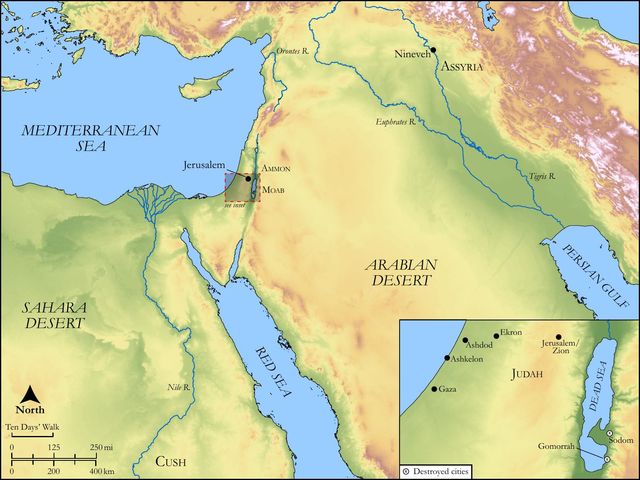
See on the biblical-era map
Study this verse
Public-domain commentary
Matthew Henry
From his Commentary on the Whole Bible. Henry comments on passages, not single verses — this entry covers Zephaniah 3:1–7. His three-level outline is real structure in the source text, so it is rendered as structure.
One would wonder that Jerusalem, the holy city, where God was known, and his name was great, should be the city of which this black character is here given, that a place which enjoyed such abundance of the means of grace should become so very corrupt and vicious, and that God should permit it to be so; yet so it is, to show that the law made nothing perfect; but if this be the true character of Jerusalem, as no doubt it is (for God's judgments will make none worse than they are), it is no wonder that the prophet begins with woe to her. For the holy God hates sin in those that are nearest to him, nay, in them he hates it most. A sinful state is, and will be, a woeful state.
I.Here is a very bad character given of the city in general. How has the faithful city become a harlot!
1.She shames herself; she is filthy and polluted (Zep 3:1), has made herself infamous (so some read it), the gluttonous city (so the margin), always cramming, and making provision for the flesh, to fulfil the lusts of it. Sin is the filthiness and pollution of persons and places, and makes them odious in the sight of the holy God.
2.She wrongs her neighbours and inhabitants; she is the oppressing city. Never any place had statutes and judgments so righteous as this city had, and yet, in the administration of the government, never was more unrighteousness.
3.She is very provoking to her God, and in every respect walks contrary to him, Zep 3:2. He had given his law, and spoken to her by his servants the prophets, telling her what was the good she should do and what the evil she should avoid; but she obeyed not his voice, nor made conscience of doing as he commanded her, in any thing. He had taken her under an excellent discipline, both of the word and of the rod; but she did not receive the instruction of the one nor the correction of the other, did not submit to God's will nor answer his end in either. He encouraged her to depend upon him, and his power and promise, for deliverance from evil and supply with good; but she trusted not in the Lord; her confidence was placed in her alliances with the nations more than in her covenant with God. He gave her tokens of his presence, and instituted ordinances of communion for her with himself; but she drew not near to her God, did not meet him where he appointed and where he promised to meet her. She stood at a distance, and said to the Almighty, Depart.
II.Here is a very bad character of the leading men in it; those that should by their influence suppress vice and profaneness there are the great patterns and patrons of wickedness, and those that should be her physicians are really her worst disease.
1.Her princes are ravenous and barbarous as roaring lions that make a prey of all about them, and they are universally feared and hated; they use their power for destruction, and not for edification.
2.Her judges, who should be the protectors of injured innocence, are evening wolves, rapacious and greedy, and their cruelty and covetousness both insatiable: They gnaw not the bones till the morrow; they take so much delight and pleasure in cruelty and oppression that when they have devoured a good man they reserve the bones, as it were, for a sweet morsel, to be gnawed the next morning, Job 31:31.
3.Her prophets, who pretend to be special messengers from heaven to them, are light and treacherous persons, fanciful, and of a vain imagination, frothy and airy, and of a loose conversation, men of no consistency with themselves, in whom one can put no confidence. They were so given to bantering that it was hard to say when they were serious. Their pretended prophecies were all a sham, and they secretly laughed at those that were deluded by them.
4.Her priests, who are teachers by office and have the charge of the holy things, are false to their trust and betray it. They were to preserve the purity of the sanctuary, but they did themselves pollute it, and the sacred offices of it, which they were to attend upon - such priests as Hophni and Phinehas, who by their wicked lives made the sacrifices of the Lord to be abhorred. They were to expound and apply the law, and to judge according to it; but, in their explications and applications of it, they did violence to the law; they corrupted the sense of it, and perverted it to the patronising of that which was directly contrary to it. By forced constructions, they made the law to speak what they pleased, to serve a turn, and so, in effect, made void the law.
III.We have here the aggravations of this general corruption of all orders and degrees of men in Jerusalem.
1.They had the tokens of God's presence among them, and all the advantages that could be of knowing his will, with the strongest inducements possible to do it, and yet they persisted in their disobedience, Zep 3:5. (1.) They had the honour and privilege of the Shechinah, God's dwelling in their land, so as he dwelt not with any other people: "The just Lord is in the midst of thee, to take cognizance of all thou doest amiss and give countenance to all thou doest well; he is in the midst of thee as a holy God, and therefore thy pollutions are the more offensive, Deu 23:14. He is in the midst of you as a just God, and therefore will punish the affronts you put upon him, and the wrongs and injuries you do to one another." (2.) They had God's own example set before them, in the discovery he made of himself to them, that they might conform to it: "He will not do iniquity, and therefore you should not;" for this was the great rule of their institution, "Be you holy, for I am holy. God will be true to you; be not you then false to him." (3.) He sent to them his prophets, rising up early and sending them: Every morning he brings his judgment to light, as duly as the morning comes; he fails not. He shows them plainly what the good is which he requires of them, and puts them in mind of it; he wakens morning by morning (Isa 50:4), wakens his prophets with the rising sun, to bring to light the things which belong to their peace. So that, upon the whole matter, what more could have been done to his vineyard, to make it fruitful? Isa 5:4. And yet, after all, the unjust know no shame; those that have been unjust are unjust still, and are not ashamed of their unrighteousness, neither can they blush. If they had any sense of honour, any shame left in them, they would not go so directly contrary to their profession and to the instructions given them. But those that are past shame are past cure.
2.God had set before their eyes some remarkable monuments of his justice, which were designed for warning to them (Zep 3:6): I have cut off the nations, the seven nations of Canaan, which the land spewed out for their wickedness, upon which they had this caution given them, to take heed lest it spew them out also, Lev 18:28. Or it may refer to some of the neighbouring nations that were made desolate for their wickedness, especially to the nations of Israel, the ten tribes. Their towers were desolate, their high towers, their strong towers, their pride and power broken; their streets were wasted, so that none passed along through them; their cities were destroyed and laid in ruins; no man was to be found in them, no inhabitant, all were slain or carried into captivity. The enemies did it, but God avows it: I cut them off, says he. And God designed this for an admonition to Jerusalem (Eze 23:9, Eze 23:11): "I said, Surely thou wilt fear me; surely these judgments upon others will deter thee from the like wicked practices; surely thou wilt receive instruction by these providences; it ought to be expected that thou wouldst not continue to sin like the nations when thou seest the ruin which their sin brought upon them." They could not but see their own house in danger when their neighbour's was on fire; and, when we are frightened, God should be feared.
3.He had set before them life and death, good and evil, both in his word and in his providence.
(1.)He had assured them of the continuance of their prosperity if they would fear him and receive instruction, for so their dwelling would not be cut off as their neighbour's was; if they took the warning given them, and reformed, what was past should be pardoned, and their tranquility lengthened out.
(2.)He had made them feel the smart of the rod, though he reprieved them from the sword: Howsoever I punished them, that, being chastened, they might not be condemned. Such various methods did God take with them, to reclaim them, but all in vain; they were not won upon by gentle methods, nor had severe ones any effect, for they rose early, and corrupted all their doings; they were more resolute and eager in their wicked courses than ever, more studious and solicitous in making provision for their lusts, and let slip no opportunity for the gratification of them. God rose up early, to send them his prophets, to reduce and reclaim them, but they were up before him, to shut and bolt the door against them. Their wickedness was universal: All their doings were corrupted; and it was all owing to themselves; they could not lay the blame upon the tempter, but they alone must bear it; they themselves wilfully and designedly corrupted all their doings; for every man is tempted when he is drawn aside of his own lust and enticed.
Historical interpretation
Historical reception
1 surviving comment on this verse from the historical church.
(Chapter 3, verses 1 onwards) Woe to the provoking and redeemed city: the dove did not hear the voice and did not receive discipline. It did not trust in the Lord and did not approach its God. Its princes are in its midst, like roaring lions. Its judges are wolves of the evening, they do not leave anything for the morning. Its prophets are insane, unfaithful men. Its priests have defiled the holy, they have acted unjustly against the law. The Lord is righteous; he will not do injustice. Every morning he brings his justice to light; it does not fail. But the wicked know no shame. I have cut off nations; their battlements are in ruins. I laid waste their streets, so that no one walks in them; their cities have been made desolate, without a man, without an inhabitant. I said, 'Surely you will fear me; you will accept correction. Then your dwelling would not be cut off according to all that I have appointed against you.' But all the more they were eager to make all their deeds corrupt. However, rising at dawn, they corrupted all their thoughts. LXX: O illustrious and redeemed city, the dove did not hear a voice, nor receive discipline: it did not trust in the Lord, nor did it approach its Lord. Its princes in it are like roaring lions; its judges are like Arabian wolves, not leaving anything until morning; its prophets are men who carry the spirit, contemptible men; its priests defile the holy things and act impiously against the law: but the Lord is righteous in its midst, and will not do iniquity. In the morning, it will give its judgment in the light, and it is not hidden, and it does not know iniquity in its demands, nor eternal injustice: I have removed the proud, their corners are scattered: I have destroyed their paths so that they may not pass: their cities have failed, because no one remains, nor does anybody dwell. I have said, nevertheless you will fear me, and you will receive discipline, and you will not perish from my sight in all the ways in which I have taken vengeance upon her. Prepare, rise early in the morning: all their buds have been destroyed. Many people think that because of the context of the discourse, it is said against Nineveh, about which it was said above: And he will destroy Assyria, and make Nineveh a wasteland. But the Scripture never called Nineveh a dove: although in Jeremiah, some think that what was said about the doves fleeing from the face of the sword of Nebuchadnezzar (Jer. 15) can refer to Nineveh. But it should be known that others assert the opposite, that instead of dove, it could be understood as Greece, so that the meaning is, from the face of the sword of Jonah, that is, from the face of the sword of Greece: for Jonah signifies both a dove and Greece. And to this day the Greeks still call it the Ionian sea, and the Hebrews retain their ancient word. And even the Roman emperors, when dealing with foreign nations, retain the ancient title of Caesar. So all talk about Jerusalem is: Alas for that city which was once a dove, always sinning and handed over to captivity, but redeemed again by the Lord. Alas for that provocative city, which in Hebrew is more significantly called Mara, meaning 'bitterness', which we can interpret as making God bitter, that is, turning a sweet and merciful Lord into bitterness because of your fault, so that he who desires to show mercy is compelled to punish. She did not hear the command of the Lord, and she refused to accept discipline; she also trusted in the Lord her God in times of distress; she did not walk after His back; and when He said, 'I am the approaching Lord, not from afar' (Jer. XXIII, 23), she wanted to approach Him. Her princes, judges, prophets, and priests are also described, so that in the city we may consider them as the people, and in the names of these dignities that I have mentioned, we may take them as princes. Therefore, his princes were like lions always prowling in the prey and shedding the blood of their subjects. His judges were rapacious, not leaving anything for others to plunder. His prophets raved or were stunned, which in Hebrew is called 'Phoezim', and Aquila translated it as 'astonishing'. They spoke as if from the mouth of the Lord, and they proclaimed everything against the Lord. The priests in the holy place committed sacrilege, and while acting against the law, they offered sacrifices according to the law. Therefore, because they acted unjustly, the Lord, who is just, will not do iniquity; but he will restore to the wicked city what it deserves. Morning, morning, that is, clearly and without any ambiguity, he will pass judgment on it, and there will be nothing that can be hidden from him. And the Lord will do this so that the reformed city may turn to better ways. But the wicked people of Israel did not recognize their own confusion, nor did they understand the punishments inflicted upon them, in order to repent. I have avenged you, he said afterwards, on the nations, and I have destroyed their empires, so that those who did not feel me through blows might at least recognize me through favors. Or certainly it should be understood thus: I have scattered all your cities, O Judah, and all the towns and tribes subject to you, and the diverse borders, and there was such a vast number of people that there was no one to dwell in your cities; and after I did this, I sent my prophets, rising early and calling for repentance, and I said: I have indeed done these things to you, O Jerusalem, but I have done it so that you might fear me and accept discipline, and so that your dwelling place, that is, the temple, might not perish because of all the crimes you have committed. On the contrary, the inhabitants of Jerusalem, provoked by me to repentance, intentionally and competitively rose early in the morning, so that they could fulfill all their thoughts and demonstrate in action what they had conceived in their minds. This is according to the Hebrew. Furthermore, the illustrious and redeemed city of Christ by blood is clearly understood as the Church, which is also called a dove, because of the simplicity of the multitude of believers in it. She did not hear the voice of the Lord, nor was she willing to receive discipline, nor did she trust in the Lord, because she did not want to draw near to her Lord God, in order to deserve forgiveness of sins. For in vain does anyone say that they hear the voice of their Lord God, and trust in the Lord, when they destroy faith with their actions, and are more joined to money than to their Lord God, and approach Him with a double heart, believing they can serve two masters, the world and God. The leaders of this [country] are like roaring lions. We have no doubt about the roar of the lions and the actions: when we see its leaders thundering against the subjected people, and crushing the commoners with tyrannical voices and raging insults, you would think they are barking like lions among little sheep. Its judges too, like Arabian wolves, prey in the evening and leave nothing in the morning: not looking towards the rising sun, but always lingering in darkness, and turning the possessions of the Church and the things that are contributed to God's gifts into their own profit, so that the poor have nothing to eat in the morning, who, like in the night and with no one watching, plunder everything; and like wolves, they snatched away everything, not even leaving small meals for the needy. Even the prophets, that is, the teachers who think they can teach the people and speak about the Scriptures, are carriers of the spirit, or spiritual (and this should be read ironically): they are men of contempt. For it is fitting for them to act in the Church, not to destroy words with deeds. However, when you teach someone else and you yourself do not do it, you are to be called not a teacher, but a despiser, as is written in Habakkuk: See, you scoffers, be astounded and perish (Habakkuk 1:5). Moreover, the priests who serve the Eucharist and distribute the blood of the Lord to his people act impiously against the law of Christ. They think that the words of the one who offers the Eucharist are more important than a virtuous life, and they believe that only a solemn prayer is necessary, not the merits of the priests. As it is said: 'And the priest who has a blemish shall not come near to offer the oblations to the Lord' (Leviticus 21, according to the Septuagint). Despite the fact that the princes, judges, prophets, and priests of Jerusalem do these things, the Lord remains merciful and just. Clement, in that he does not depart from his Church: just, in that he renders to everyone what they deserve. For when the morning comes, and the night of this age passes away, he will give his judgement in the light, and he will not hide himself or his judgement. And when he begins to demand the money that he entrusted to each person, he will not be unjust, nor will he allow injustice to prevail forever; but he will remove the proud rulers, whom God opposes, from their thrones, and from the heights they held, and their angles, that is, their wicked desires, will be dispersed, and they will deviate from the right path, on which the Pharisees always used to pray, with the cornerstone rejected. But I think that it is advantageous for the proud to be detracted from their arrogance, and for their narrow and winding paths to be scattered, so that afterwards they may walk on a straight path. Finally, it follows: And I will make their ways deserted, because there is no one who will pass through them; according to what is written in the first psalm: And the way of the wicked will perish (Psalm 1:6). Likewise, in Hosea, where it is said about Jerusalem fornicating: Behold, I will close her paths with thorns, and obstruct her ways, and she will not find her path, and she will pursue her lovers, and will not apprehend them, and she will seek them, and will not find them; and she will say: I will go and return to my former husband, for it was better for me then than now (Hosea 2:6-7). Note that unless the roads had been closed, and the paths blocked, and unless the Lord had destroyed their ways, the adulterous soul would never have been able to say: I will go and return to my former husband. Therefore, let the paths of the proud be scattered and their corners, so that they do not walk in pride and wickedness, and their cities, which were built poorly in arrogance and pride, are destroyed, so that they do not remain and have the most wretched inhabitants. So that no one thinks that we are using force on the Scripture, let them learn from the following: But I have done these things, he says, so that I may say to them: Behold, the paths of evil have been destroyed, from now on fear me and learn ((or receive)) my teaching, lest my teaching perish and I find no fruit of conversion in you; and let everything be in vain through which I wanted to correct you, and that the word written in Jeremiah may be applied to you: I have struck your sons without cause, you have not received discipline (Jer. II, 30). Indeed, fear me and accept discipline, so that all things may not perish from the sight of Jerusalem, and so that they may not be completely led into desolation because of these evils in which I have threatened her. Let it not trouble anyone (as I have often said) that these things are interpreted as being against the Church, since it is known that Jerusalem always has a typological meaning for the Church in the holy Scriptures: from which whoever sins is either led into Babylon or, if they willingly desire to descend, is wounded by thieves in Jericho. For what Church is so illustrious, which is founded throughout the whole world, so redeemed by the blood of Christ and called together from the nations by the dove for the grace of the Holy Spirit? In it, there are many who claim to believe in Christ but have not heard His voice, have not received His teaching, and do not wish to be close to Him. But what is said: 'Its leaders in it are like roaring lions,' I know that this will offend many because they interpret it as referring to bishops and priests, when in fact there are wicked priests who desired to violate Susanna, but they do not condemn the other priests who have lived uprightly. And the evil princes, whom the prophetic discourse describes, are not an insult to good princes: For when a fool is flogged, he becomes wiser, as it is written: 'When the ignorant is punished, the fool becomes wiser' (Prov. XIX, 15); if the fool becomes wiser, how much more so the wise? But his judges and princes, accepting bribes and selling justice, are they not rightly called 'Arabian wolves' or 'evening wolves', as Symmachus translated? For they do not deserve to be called 'Benjamin's wolves' who snatch in the morning and give food in the evening (Gen. XLIX); but 'evening wolves' who feed at night and leave nothing in the morning. But moving on to what follows: His prophets are spirit-bearers, that is, bearers of the spirit, men of contempt. Let it not bother us that, while interpreting the doctors, we also refer to them as prophets and men of contempt, since the Apostle also instructs us: Do not grieve the Holy Spirit of God, in whom you were sealed for the day of redemption (Ephesians 4:30). And let David speak in the fiftieth psalm: Do not take away your Holy Spirit from me (Psalm 51:13). For if the Holy Spirit had not been grieved and accustomed to flee from a place first, and to leave his dwelling, never would Paul have commanded what I have said above; and David, after committing adultery, would not have been afraid of losing what he had received, about which it is also written to the Hebrews: How much do you think he deserves worse punishments, who has trampled on the Son of God, and has esteemed the blood of the testament as unclean, in which he was sanctified, and has insulted the Spirit of grace (Heb. X, 29)? But it is also written in the third book of Kings: 'The man of God, undoubtedly a prophet, who spoke at the altar in Samaria, saying: Altar, altar, thus says the Lord: Behold, a son shall be born to David' (3 Kings 13:2) and so on; because he despised the words of the Lord and ate with the false prophet (for this is how Josephus explained this passage), he was killed by a lion. And so that it would not be thought of as a chance occurrence and not the judgment of the Lord, the false prophet who deceived him predicted that this would happen, and the lion itself, punishing the despiser, spared the donkey. Therefore it is not surprising that the doctors who were filled with the Holy Spirit could become contemptuous, since among the negligent ones who do not keep their hearts with all diligence, this very cause often gives rise to pride in the Lord and contempt, because they have knowledge of God and know His great goodness, which He hides from those who fear Him, and they despise the riches of His goodness, treasuring up for themselves wrath on the day of wrath and revelation. The priests also (who give baptism and pray for the advent of the Lord at the Eucharist: make the oil of chrism: impose hands; instruct catechumens: appoint Levites and other priests) do not despise us as we explain and prophesy, but rather they pray to the Lord and diligently strive that those priests who violate the holy things of the Lord do not deserve to be. For it is not the dignity and the names of dignities, but the work of dignity, that is accustomed to save princes, judges, prophets, and priests: 'He who desires the episcopate,' it says, 'desires a good work' (1 Timothy 3). See what he said: a good work desires, but not dignity. However, if, despising the work, he only looks at dignity, the tower in Siloam quickly falls, and the tall cedars are struck by lightning, and the raised neck is broken, and the swan, with its neck stretched out and reaching high, is counted among unclean birds. Furthermore, what we have set forth according to the Hebrew: Nevertheless, rising at dawn, they corrupted all their thoughts, for which it is written in the Septuagint: prepare, rise at dawn, their foliage is scattered, because it deviates greatly from the Hebrew, and it seems to agree more with the subsequent versions, which we will explain in what follows.
Continue studying Zephaniah 3:6 across the web’s major study libraries — every link below opens this exact verse, chapter, or book on the destination site.
Read & Compare
 BibleGatewayThis verse in more than 200 translations and 70 languages.
 Bible.comThe YouVersion reader — hundreds of translations, reading plans, and highlights.
 ESV.orgCrossway's official English Standard Version reader.
 NET BibleThe NET translation with 60,000+ translators' notes on every rendering decision.
 STEP BibleTyndale House's free study tool — original text, vocabulary, and scholarly resources.
 BibliaLogos Bible Software's free web reader.
 USCCBThe New American Bible (Revised Edition) with the U.S. bishops' study notes.
Commentaries
 BibleHub CommentariesDozens of classic commentaries on this verse, gathered on one page.
 StudyLightMore than 100 commentary sets — the largest collection on the web.
 BibleRefPlain-English commentary on what this verse means, verse by verse.
 Enduring WordDavid Guzik's free commentary on this chapter, widely used by Bible teachers.
 Bible Study ToolsVerse commentary alongside Greek and Hebrew study aids.
Original Language & Research
- BibleHub InterlinearThe verse word by word — original language, transliteration, and English.
- BibleHub LexiconEvery word's original-language definition and Strong's entry.
 Blue Letter BibleDeep-study tools — Strong's numbers, concordance, and word studies.
 SefariaThe Hebrew text with Rashi and centuries of Jewish commentary.
Sermons, Hymns & Audio


TrulyRandomVerse is not affiliated with these sites and doesn’t control their content. They’re linked because they’re genuinely useful.
Summary
Zephaniah 3:6 vividly portrays God's decisive and comprehensive judgment against the nations surrounding Judah. It describes a scene of utter desolation, where once-proud cities are reduced to ruins, their defensive structures are abandoned, and their public spaces are emptied of all human presence. This divine action serves as a stark demonstration of God's absolute sovereignty over all earthly powers and a severe warning of the consequences of rebellion against His holy will, emphasizing that no nation, regardless of its strength or prominence, is immune to His righteous wrath.
Context
ShowHideLiterary Context
Zephaniah 3:6 is situated within a broader prophetic oracle concerning God's judgment, specifically against the nations (Zephaniah 2:4-15) and then turning to Judah and Jerusalem (Zephaniah 3:1-7). Chapter 2 details specific judgments against Philistia, Moab, Ammon, Ethiopia, and Assyria, highlighting their pride and idolatry. Chapter 3 begins with a lament over Jerusalem's unfaithfulness, describing its corrupt leaders and persistent rebellion. Verse 6, therefore, serves as a powerful reminder to Judah, even amidst its own condemnation, that God's judgment is not arbitrary or limited to His covenant people. It underscores that the desolation witnessed in the surrounding nations, which Judah might have observed or heard about, is a direct consequence of divine intervention, a pattern of judgment that Judah itself is now facing due to its similar sins. This verse acts as a bridge, reinforcing the universality of God's justice before the prophet delivers a final, severe indictment against Jerusalem's spiritual leaders and inhabitants.
Historical & Cultural Context
Zephaniah prophesied during the reign of King Josiah (640-609 BC), a period marked by significant religious reforms in Judah following decades of idolatry under Manasseh and Amon. However, despite Josiah's efforts, deep-seated corruption, syncretism, and oppression persisted among the people and leaders. The nations mentioned in Zephaniah's prophecies (e.g., Assyria, Philistia, Moab, Ammon, Ethiopia) were powerful regional players, often in conflict with Judah or serving as examples of paganism and oppression. Assyria, in particular, had been the dominant superpower for centuries, but by Zephaniah's time, its power was waning, foreshadowing its eventual fall (Nineveh, 612 BC). The "towers" and "cities" mentioned reflect the common defensive structures and urban centers of that day, designed to protect populations and facilitate commerce. Their desolation signifies a complete societal collapse, a common outcome of military conquest and divine judgment in that day, often leading to depopulation and ruin.
Key Themes
ShowHideThis verse powerfully contributes to several overarching themes in Zephaniah and prophetic literature. Firstly, it emphasizes Divine Sovereignty and Justice, affirming that God is the supreme ruler over all nations, not just Israel, and that He executes righteous judgment against all forms of wickedness and rebellion. The repeated "I have cut off," "I made," and "their cities are destroyed" highlight His active agency. Secondly, it underscores the theme of Universal Judgment, demonstrating that God's wrath extends beyond Judah to encompass all who defy Him, regardless of their ethnic or political identity. This serves as a stark warning to Judah, reinforcing that their privileged status as God's chosen people does not grant immunity from the consequences of sin, a theme also seen in Amos's prophecies against Israel and the nations (e.g., Amos 1-2). Thirdly, the imagery of complete desolation—"no man," "none inhabitant"—reinforces the theme of Consequences of Rebellion, illustrating the absolute ruin that awaits those who persist in unrepentant sin. This serves as a call to repentance, echoing the prophet's plea in Zephaniah 2:3).
Exposition and Analysis
ShowHideKey Word Analysis
ShowHideThis term (H1471) typically refers to foreign, non-Israelite peoples or Gentiles. In this context, it emphasizes the universal scope of God's judgment, extending beyond Judah to include all peoples who have defied His moral order. It can also figuratively denote a mass or troop, highlighting the collective nature of the judgment against these organized societies.
The verb (H2717) means "to parch (through drought)," and by extension, "to desolate, destroy, kill." It conveys a sense of utter ruin, emptiness, and drying up, implying a loss of life, vitality, and productivity. When applied to "streets," it suggests a complete cessation of normal activity and commerce, leading to a barren, uninhabited landscape.
Derived from the root (H3427) meaning "to sit down, to dwell, to remain," this word, when negated as "none inhabitant," powerfully conveys the absolute depopulation of the cities. It signifies that no one is left to dwell, abide, or settle there, emphasizing the thoroughness of the destruction and the complete absence of human life.
Verse Breakdown
ShowHide"I have cut off the nations:"
This opening clause immediately establishes God's active role ("I have cut off") as the sovereign agent of judgment. The verb "cut off" (H3772, kârath) implies a decisive, permanent severance, often associated with destruction or the breaking of a covenant. Here, it signifies the termination of the nations' power, existence, or their ability to continue in their rebellious ways.
"their towers are desolate;"
The "towers" (H6438, pinnâh), likely referring to defensive strongholds, corner towers of cities, or even leading figures/chieftains, are described as "desolate" (H8074, shâmêm). This indicates that their primary means of defense and symbols of strength are abandoned, ruined, and empty, signifying the collapse of their security and authority.
"I made their streets waste, that none passeth by:"
God continues to assert His agency ("I made"). The "streets" (H2351, chûwts), public thoroughfares and centers of activity, are made "waste" (H2717, chârab), indicating barrenness and ruin. The phrase "that none passeth by" (H5674, ʻâbar) emphasizes the complete cessation of movement, commerce, and daily life, illustrating a profound emptiness and abandonment.
"their cities are destroyed, so that there is no man, that there is none inhabitant."
This final clause provides a comprehensive summary of the judgment's severity. The "cities" (H5892, ʻîyr), the heart of their civilization, are "destroyed" (H6658, tsâdâh), meaning chased away or desolated. The repetition of "no man" (H376, ʼîysh) and "none inhabitant" (H3427, yâshab) serves as a powerful rhetorical device, underscoring the absolute depopulation and complete eradication of human presence, leaving these once-thriving centers utterly devoid of life.
Literary Devices
ShowHideZephaniah 3:6 employs several powerful literary devices to convey its message of absolute judgment. Personification is subtly present as God speaks in the first person, "I have cut off... I made," emphasizing His direct, active, and personal involvement in the destruction of these nations, rather than attributing it to natural disaster or human conflict alone. Hyperbole is evident in the extreme descriptions of desolation: "none passeth by," "no man," and "none inhabitant." While some remnant might theoretically survive, the language is designed to convey a sense of total and irreversible ruin, emphasizing the severity and comprehensiveness of God's wrath. The use of Repetition ("no man, that there is none inhabitant") powerfully reinforces the theme of complete depopulation and utter emptiness, driving home the finality of the judgment. Finally, the verse is rich in Imagery, painting a vivid picture of abandoned towers, desolate streets, and destroyed cities, allowing the audience to visualize the catastrophic consequences of divine judgment. This stark imagery serves to instill both fear and a call to repentance.
Theological and Thematic Connections
ShowHideZephaniah 3:6 stands as a profound testament to God's unwavering holiness and His ultimate sovereignty over all earthly kingdoms. It reveals that divine judgment is not limited to His covenant people but extends to all nations that persist in rebellion, idolatry, and injustice. This verse underscores the biblical truth that God is the righteous judge of all the earth, who will not tolerate sin indefinitely. The desolation described serves as a stark reminder that human power, military might, and urban development are fragile before the omnipotent God. It foreshadows a day when all human systems that defy God will be brought to ruin, establishing the ultimate triumph of His kingdom and justice.
Reflection and Application
ShowHideZephaniah 3:6, though a passage of severe judgment, offers timeless principles for reflection and application in the life of a believer and the church today. It compels us to confront the reality of God's holiness and His unyielding opposition to sin. While we live under the New Covenant, the underlying truth that God is just and that sin carries grave consequences remains immutable. This verse serves as a powerful call to humility, reminding us that no nation, no institution, and no individual is beyond God's scrutiny or judgment. It urges us to examine our own lives and societies for any areas of rebellion, idolatry, or injustice, prompting genuine repentance and a pursuit of righteousness. Furthermore, it offers a sobering perspective on the transience of earthly power and achievements, encouraging us to place our ultimate trust not in human strength or material security, but in the enduring sovereignty of God.
Questions for Reflection
ShowHideFAQ
ShowHideWhat does "cut off the nations" mean in this context?
ShowHide"Cut off the nations" signifies God's decisive act of bringing about the destruction and desolation of the foreign nations mentioned or implied in Zephaniah's prophecy. The Hebrew word kārath (H3772) implies a complete severance, a permanent removal, or a total destruction. In this context, it refers to God's sovereign judgment leading to the military defeat, depopulation, and ruin of these nations, serving as a powerful demonstration of His justice and authority over all earthly kingdoms. It's a statement of divine intervention, where God Himself is the agent of their downfall, as seen throughout the prophetic books (e.g., Isaiah 13).
Why would God cause such complete desolation, leaving "no man" and "none inhabitant"?
ShowHideThe imagery of complete desolation, where cities are emptied of all human presence, emphasizes the absolute and comprehensive nature of God's judgment against profound and persistent sin. It's a hyperbolic expression designed to convey the severity of His wrath against idolatry, injustice, and rebellion. This level of destruction serves multiple purposes: it demonstrates God's unyielding holiness, warns other nations (including Judah) of the consequences of defying Him, and ultimately clears the way for His righteous purposes to be fulfilled. It illustrates that God's judgment is not superficial but penetrates to the very core of a society, eradicating its life and legacy when it stands in opposition to Him. This kind of judgment is also seen in the destruction of Sodom and Gomorrah (e.g., Genesis 19:24-25).
Christ-Centered Fulfillment
ShowHideWhile Zephaniah 3:6 speaks of God's judgment on ancient nations, its ultimate fulfillment and theological resonance are profoundly seen in Christ. The desolation of the nations, a consequence of their rebellion against God, foreshadows the judgment of all the earth that will be fully realized in the person and work of Jesus Christ. He is the one who, as the righteous judge, will ultimately "cut off" all unrighteousness and rebellion, not merely from specific nations but from the entire earth. The "streets waste" and "cities destroyed" find their spiritual parallel in the spiritual death and emptiness of those who reject God's rule, a condition that only Christ can redeem. Through His atoning sacrifice, Jesus takes upon Himself the judgment that humanity deserves, offering a pathway to escape the ultimate desolation of eternal separation from God. Furthermore, Christ's coming establishes a new kingdom, one that will never be "cut off" or "desolate," where "every knee will bow" and "every tongue confess" His sovereignty, transforming the desolate places of human hearts into dwelling places for His Spirit (e.g., Philippians 2:10-11). The final judgment described in Zephaniah anticipates the day when Christ will return, not to make cities waste, but to establish His eternal reign, bringing ultimate justice and a new heavens and new earth where righteousness dwells, and there is no longer any "man" or "inhabitant" of sin (e.g., Revelation 21:1-4).