


2 Chronicles 32:24
- בַּיָּמִיםbai·ya·Mimin the daysH3117Prep-b ¦ N-mpNoun Plural Masculine Absoluteבַּin theיָּמִיםdays
- הָהֵםha·Hem<the> thoseH1992Art ¦ Pro-3mpPronoun Personal 3rd Plural Masculineהָ<the>הֵםthose
- חָלָהcha·Lahhe was sickH2470V-Qal-Perf-3msVerb Qal Perfect 3rd Singular Masculine
- יְחִזְקִיָּהוּye·chiz·ki·Ya·huHezekiahH2396N-proper-mNoun Proper Masculine
- עַד'aduntilH5704PrepPreposition
- לָמוּתla·Mut<to> dieH4191Prep-l ¦ V-Qal-InfVerb Qal Infinitive Constructלָ<to>מוּתdie
- וַיִּתְפַּלֵּלvai·yit·pa·Leland he prayedH6419Conj-w ¦ V-Hithpael-ConsecImperf-3msVerb Hithpael Consecutive Imperfect 3rd Singular Masculineוַandיִּתְפַּלֵּלhe prayed
- אֶל'eltoH413PrepPreposition
- יְהוָהYah·wehYahwehH3068N-properNoun Proper Title
- וַיֹּאמֶרvai·Yo·merand he spokeH559Conj-w ¦ V-Qal-ConsecImperf-3msVerb Qal Consecutive Imperfect 3rd Singular Masculineוַandיֹּאמֶרhe spoke
- לוֹloto himPrep-l ¦ 3msSuffix Personal 3rd Singular Masculineלtoוֹhim
- וּמוֹפֵתu·mo·Fetand a signH4159Conj-w ¦ N-msNoun Singular Masculine Absoluteוּandמוֹפֵתa sign
- נָתַןNa·tanhe gaveH5414V-Qal-Perf-3msVerb Qal Perfect 3rd Singular Masculine
- לוֹloto himPrep-l ¦ 3msSuffix Personal 3rd Singular Masculineלtoוֹhim
English is a literal word-by-word gloss of the Hebrew, not the KJV's wording. Why?
This is the original text the KJV's translators worked from — each Hebrew word with its own literal English meaning in this verse, prepared by scholars at Tyndale House, Cambridge. The KJV translates whole sentences, not word by word, so its wording differs: one Hebrew word can become several English words, and the KJV may choose “the LORD” where the gloss reads “Yahweh”. Both are faithful — they answer different questions. For the KJV's own rendering, switch to the KJV text.
Details
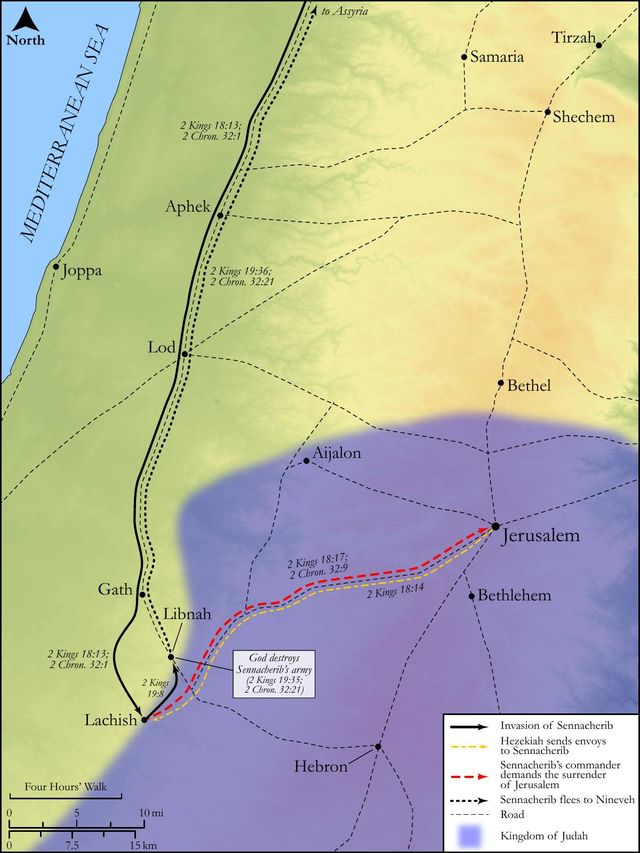
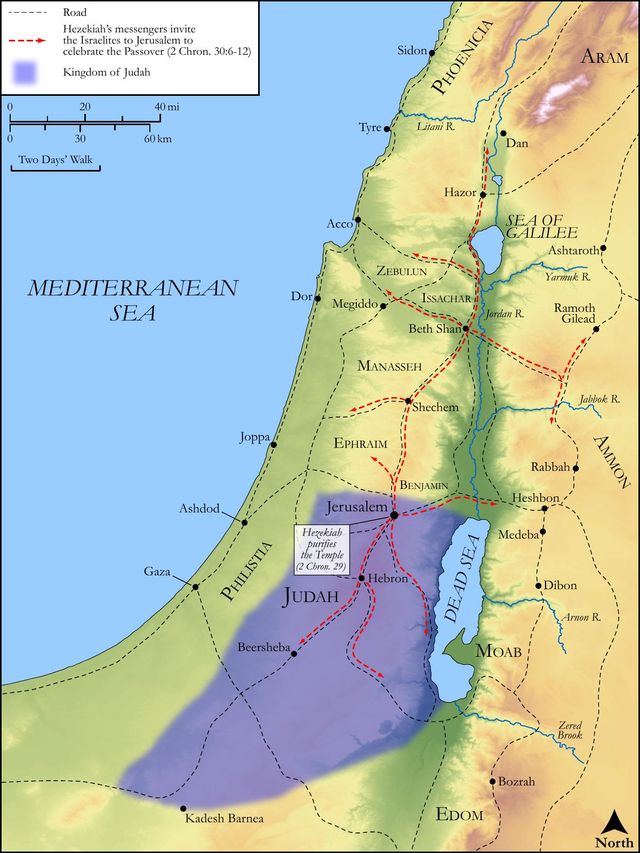
See on the biblical-era map
Study this verse
Public-domain commentary
Matthew Henry
From his Commentary on the Whole Bible. Henry comments on passages, not single verses — this entry covers 2 Chronicles 32:24–33. His three-level outline is real structure in the source text, so it is rendered as structure.
Here we conclude the story of Hezekiah with an account of three things concerning him: -
I.His sickness and his recovery from it, Ch2 32:24.
The account of his sickness is but briefly mentioned here; we had a large narrative of it, 2 Kings 20. His disease seemed likely to be mortal. In the extremity of it he prayed. God answered him, and gave him a sign that he should recover, the going back of the sun ten degrees.
II.His sin and his repentance for it, which were also more largely related, Kg2 20:12, etc. Yet several things are here observed concerning his sin which we had not there.
1.The occasion of it was the king of Babylon's sending an honourable embassy to him to congratulate him on his recovery. But here it is added that they came to enquire of the wonder that was done in the land (Ch2 32:31), either the destruction of the Assyrian army or the going back of the sun. The Assyrians were their enemies; they came to enquire concerning their fall, that they might triumph in it. The sun was their god; they came to enquire concerning the favour he had shown to Hezekiah, that they might honour him whom their god honoured, Ch2 32:31. These miracles were wrought to alarm and awaken a stupid careless world, and turn them from dumb and lame idols to the living God; and men were startled by them, but not converted till a greater wonder was done in that land, in the appearing of Jesus Christ, Mat 2:1, Mat 2:2.
2.God left him to himself in it, to try him, Ch2 32:31. God, by the power of his almighty grace, could have prevented the sin; but he permitted it for wise and holy ends, that, by this trial and his weakness in it, he might know, that is, it might be known (a usual Hebraism), what was in his heart, that he was not so perfect in grace as he thought he was, but had his follies and infirmities as other men. God left him to himself to be proud of his wealth, to keep him from being proud of his holiness. It is good for us to know ourselves, and our own weakness and sinfulness, that we may not be conceited or self-confident, but may always think meanly of ourselves and live in a dependence upon divine grace. We know not the corruption of our own hearts, nor what we shall do if God leave us to ourselves. Lord, lead us not into temptation.
3.His sin was the his heart was lifted up, Ch2 32:25. He was proud of the honour God had put upon him in so many instances, the honour his neighbours did him in bringing him presents, and now that the king of Babylon should send an embassy to him to caress and court him: this exalted him above measure. When Hezekiah had destroyed other idolatries he began to idolize himself. O what need have great men, and good men, and useful men, to study their own infirmities and follies, and their obligations to free grace, that they may never think highly of themselves, and to beg earnestly of God that he will hide pride from them and always keep them humble!
4.The aggravation of his sin was the he made so bad a return to God for his favours to him, making even those favours the food and fuel of his pride (Ch2 32:25): He rendered not again according to the benefit done unto him. Note, It is justly expected that those who have received mercy from God should study to make some suitable returns for the mercies they have received; and, if they do not, their ingratitude will certainly be charged upon them. Though we cannot render an equivalent, or the payment of a debt, we must render the acknowledgment of a favour. What shall I render that may be so accepted? Psa 116:12.
5.The divine displeasure he was under for this sin; though it was but a heart-sin, and the overt-act seemed not only innocent but civil (the showing of his treasures to a friend), yet wrath came upon him and his kingdom for it, Ch2 32:25. Note, Pride is a sin that God hates as much as any, and particularly in his own people. Those that exalt themselves must expect to be abased, and put under humbling providences. Wrath came on David for his pride in numbering the people.
6.His repentance for this sin: He humbled himself for the pride of his heart. Note,
(1.)Though God may, for wise and holy ends, suffer his people to fall into sin, yet he will not suffer them to lie still in it; they shall not be utterly cast down.
(2.)Heart-sins are to be repented of, though they go no further.
(3.)Self-humiliation is a necessary branch of repentance.
(4.)Pride of heart, by which we have lifted up ourselves, is a sin for which we ought in a special manner to humble ourselves.
(5.)People ought to mourn for the sins of their rulers. The inhabitants of Jerusalem humbled themselves with Hezekiah, because they either knew that they also had been guilty of the same sin, or at least feared that they might share in the punishment. When David, in his pride, numbered the people, they all smarted for his sin.
7.The reprieve granted thereupon. The wrath came not in his days. While he lived the country had peace and truth prevailed; so much does repentance avail to put by, or at least to put off, the tokens of God's anger.
III.Here is the honour done to Hezekiah,
1.By the providence of God while he lived. He had exceeding much riches and honour (Ch2 32:27), replenished his stores, victualled his campus, fortified his city, and did all he wished to do; for God had given him very much substance, Ch2 32:29. Among his great performances, his turning the water-course of Gihon is mentioned (Ch2 32:30), which was done upon occasion of Sennacherib's invasion, Ch2 32:3, Ch2 32:4. The water had come into that which is called the old pool (Isa 22:11) and the upper pool (Isa 7:3); but he gathered the waters into a new place, for the greater convenience of the city, called the lower pool, Isa 22:9. And, in general, he prospered in all his works, for they were good works.
2.By the respect paid to his memory when he was dead.
(1.)The prophet Isaiah wrote his life and reign (Ch2 32:32), his acts and his goodness or piety, or which it is part of the honour to be recorded and remembered, for examples to others.
(2.)The people did him honour at his death (Ch2 32:33), buried him in the chief of the sepulchres, made as great a burning for him as for Asa, or, which is a much greater honour, made great lamentation for him, as for Josiah. See how the honour of serious godliness is manifested in the consciences of men. Though it is to be feared that the generality of the people did not heartily comply with the reforming kings, yet they could not but praise their endeavours for reformation, and the memory of those kings was blessed among them. It is a debt we owe to those who have been eminently useful in their day to do them honour at their death, when they are out of the reach of flattery and we have seen the end of their conversation. The due payment of this debt will be an encouragement to others to do likewise.
Historical interpretation
Historical reception
1 surviving comment on this verse from the historical church.
“In those days,” we are told, “Hezekiah was sick unto death, and he prayed to the Lord, and the Lord heard him and gave him a sign,” that, namely of which we read in the fourth book of the kingdoms, which was given by Isaiah the prophet through the going back of the sun. “But,” it says, “he did not respond to the benefits which he had received, for his heart was proud. And wrath was kindled against him and against Judah and Jerusalem. He humbled himself afterwards because his heart had been proud, both he and the inhabitants of Jerusalem, and therefore the wrath of the Lord did not come upon them in the days of Hezekiah.” How dangerous, how terrible is the malady of vanity! So much goodness, so many virtues, faith and devotion, great enough to prevail to change nature itself and the laws of the whole world—all destroyed by a single act of pride! The result would have been that all his good deeds would have been forgotten as if they had never existed, and he would at once have been subject to the wrath of the Lord unless he had appeased him by recovering his humility. Thus, he who, at the suggestion of pride, had fallen from so great a height of excellence, could only mount again to the height he had lost by the same steps of humility.
Continue studying 2 Chronicles 32:24 across the web’s major study libraries — every link below opens this exact verse, chapter, or book on the destination site.
Read & Compare
 BibleGatewayThis verse in more than 200 translations and 70 languages.
 Bible.comThe YouVersion reader — hundreds of translations, reading plans, and highlights.
 ESV.orgCrossway's official English Standard Version reader.
 NET BibleThe NET translation with 60,000+ translators' notes on every rendering decision.
 STEP BibleTyndale House's free study tool — original text, vocabulary, and scholarly resources.
 BibliaLogos Bible Software's free web reader.
 USCCBThe New American Bible (Revised Edition) with the U.S. bishops' study notes.
Commentaries
 BibleHub CommentariesDozens of classic commentaries on this verse, gathered on one page.
 StudyLightMore than 100 commentary sets — the largest collection on the web.
 BibleRefPlain-English commentary on what this verse means, verse by verse.
 Enduring WordDavid Guzik's free commentary on this chapter, widely used by Bible teachers.
 Bible Study ToolsVerse commentary alongside Greek and Hebrew study aids.
Original Language & Research
- BibleHub InterlinearThe verse word by word — original language, transliteration, and English.
- BibleHub LexiconEvery word's original-language definition and Strong's entry.
 Blue Letter BibleDeep-study tools — Strong's numbers, concordance, and word studies.
 SefariaThe Hebrew text with Rashi and centuries of Jewish commentary.
Sermons, Hymns & Audio


TrulyRandomVerse is not affiliated with these sites and doesn’t control their content. They’re linked because they’re genuinely useful.
Summary
Second Chronicles 32:24 encapsulates a pivotal moment in King Hezekiah's reign, detailing his grave, life-threatening illness, his earnest and desperate prayer to the Lord, and God's immediate, personal, and miraculous response, which included the provision of a tangible sign. This concise account profoundly underscores divine sovereignty over human life and death, the transformative power of fervent prayer, and God's unwavering faithfulness to His devoted servants, even amidst personal crisis following national triumph.
Context
ShowHideLiterary Context
This verse serves as a crucial personal interlude within a chapter primarily dedicated to King Hezekiah's remarkable success in defending Jerusalem against the formidable Assyrian King Sennacherib. The preceding verses 2 Chronicles 32:1-23 recount God's miraculous deliverance of Judah from an overwhelming external threat, highlighting His power and faithfulness on a national scale. Verse 24 then pivots sharply to a severe, internal, and deeply personal crisis for the king himself, demonstrating that even a righteous king, divinely protected in public, is subject to human frailty and mortality. The Chronicler's account here is notably concise, focusing on the core interaction between Hezekiah and God, while parallel narratives in 2 Kings 20:1-11 and Isaiah 38:1-8 provide richer details, including the prophet Isaiah's role, the specific nature of the sign (the sundial), and the promise of fifteen additional years of life. Chronologically, this illness and recovery likely occurred after the Assyrian siege but before Hezekiah's subsequent display of pride to the Babylonian envoys, an event briefly alluded to in 2 Chronicles 32:25.
Historical & Cultural Context
King Hezekiah reigned over Judah during a tumultuous period in the late 8th century BCE, marked by the rising power of the Neo-Assyrian Empire. His reign (c. 715-686 BCE) was characterized by significant religious reforms aimed at centralizing worship in Jerusalem and eradicating idolatry, aligning with the Deuteronomic covenant. Illness in ancient Israel was often viewed through a theological lens, sometimes as divine judgment for sin, other times as a test of faith, or simply a part of the human condition. The response to severe illness invariably involved prayer and seeking divine intervention, often through prophets. Kings, though powerful, were not exempt from these realities. The concept of a "sign" (Hebrew: 'ôṯ) was a well-established biblical motif, serving as a miraculous confirmation of a divine promise or message, designed to bolster faith and demonstrate God's active involvement in human affairs. The specific sign of the sundial moving backward, as detailed in the parallel accounts, would have been an extraordinary and undeniable supernatural event, deeply impacting the king and his court.
Key Themes
ShowHideThis pivotal verse contributes significantly to several overarching themes within 2 Chronicles and the broader biblical narrative. Firstly, it powerfully illustrates the sovereignty of God over all aspects of life, including health and death. He alone has the power to determine the span of human life and to intervene miraculously. Secondly, it highlights the efficacy and power of fervent prayer, demonstrating that a desperate, sincere plea to God can indeed elicit a direct and transformative response, even in seemingly terminal situations. Hezekiah's prayer is a testament to God's accessibility and responsiveness to His people. Thirdly, the provision of a "sign" underscores God's faithfulness and willingness to confirm His word. It serves not only as an assurance to Hezekiah but also as a public demonstration of divine truth, reinforcing the theme of God's active involvement in the lives of His covenant people, as seen throughout 2 Chronicles. Finally, the narrative subtly explores the fragility of human life and the importance of humility, as Hezekiah's subsequent pride (mentioned in 2 Chronicles 32:25) serves as a cautionary counterpoint to his initial humble prayer and God's gracious response.
Exposition and Analysis
ShowHideKey Word Analysis
ShowHideThis verb describes Hezekiah's physical state, indicating a condition of being "weak, sick, diseased." When combined with "to the death," it conveys the terminal nature of his illness. The root implies a wearing down or affliction, emphasizing the dire circumstances that prompted his desperate prayer and the miraculous nature of his recovery, which was humanly impossible.
This verb signifies the act of "interceding" or "praying." In its Hithpael stem, as used here, it suggests an intense, self-directed, and earnest act of supplication. Hezekiah's prayer was not a casual request but a profound outpouring of his heart to the Lord, born of desperation and deep faith, highlighting the personal and intimate nature of his communion with God.
This noun refers to a "miracle," "token," or "omen." In this context, it functions as a miraculous confirmation of a divine promise or message. The "sign" was a tangible, supernatural event designed to bolster Hezekiah's faith and provide undeniable proof of God's active involvement and absolute control over creation, confirming His word to the king.
Verse Breakdown
ShowHide"In those days Hezekiah was sick to the death"
This opening clause establishes the critical state of affairs. "In those days" broadly refers to the period following the Assyrian siege, situating this personal crisis within the larger narrative of Hezekiah's reign. The phrase "sick to the death" conveys the terminal nature of his illness, emphasizing the human impossibility of recovery and setting the stage for divine intervention.
"and prayed unto the LORD"
Faced with a life-threatening illness, Hezekiah's immediate and sole recourse was to turn to the Lord in earnest prayer. This highlights his deep piety and his understanding of God's ultimate authority over life and death. His prayer was not a last resort but a primary act of faith and dependence, demonstrating his trust in God's power and compassion.
"and he spake unto him"
This clause signifies God's direct and personal response to Hezekiah's prayer. The Lord did not remain silent but actively communicated His will and promise to the king. This direct divine address underscores God's attentiveness to the prayers of His people and His willingness to engage personally with them, affirming His covenant relationship.
"and he gave him a sign"
Beyond speaking, God provided a tangible, miraculous sign to confirm His word. This sign, later revealed to be the sundial's shadow moving backward, served as an irrefutable physical manifestation of God's power and faithfulness, designed to remove all doubt from Hezekiah's mind regarding the promise of healing and extended life.
Literary Devices
ShowHideThe Chronicler's concise account in 2 Chronicles 32:24 employs several effective literary devices. There is a powerful juxtaposition between the preceding verses, which detail God's national deliverance of Judah from the Assyrians, and this verse, which shifts to a deeply personal crisis for the king. This contrast highlights that even divinely protected leaders are subject to human vulnerability, yet God's care extends to both national and individual needs. The narrative also employs narrative economy, presenting the core elements of the event (illness, prayer, divine response, sign) with remarkable brevity, leaving the more elaborate details of the miracle to the parallel accounts in Kings and Isaiah. This brevity serves to emphasize the direct and immediate cause-and-effect relationship between Hezekiah's prayer and God's response. Furthermore, the account features divine dialogue, as God "spake unto him," underscoring the intimate and responsive nature of God's relationship with His faithful servants. Finally, the mention of a "sign" functions as a form of foreshadowing, hinting at the extraordinary supernatural event that confirms God's promise, building anticipation for the reader familiar with the fuller accounts.
Theological and Thematic Connections
ShowHideThe account of Hezekiah's illness and miraculous recovery in 2 Chronicles 32:24 is a profound testament to God's absolute sovereignty over life and death, His responsiveness to the earnest prayers of His people, and His unwavering faithfulness to His covenant promises. It demonstrates that divine intervention is not limited to national crises but extends to the deepest personal needs of individuals, even kings. The provision of a supernatural sign underscores God's desire to confirm His word and strengthen the faith of those who trust in Him. This narrative reinforces the biblical principle that genuine humility and desperate prayer can unlock God's miraculous power, reminding believers that no situation is beyond the reach of His divine will and compassion.
Reflection and Application
ShowHideKing Hezekiah's experience offers timeless and powerful lessons for believers navigating the challenges of life, particularly in moments of despair or terminal diagnosis. His immediate and fervent turning to the Lord, even when facing what seemed to be certain death, provides a profound example of faith and spiritual resilience. It reminds us that our first and most effective recourse in any crisis should be earnest prayer to God, who holds all life in His hands. While we may not always receive a dramatic "sign" or a miraculous physical healing in the way Hezekiah did, this account assures us of God's attentiveness to our cries, His profound compassion, and His ultimate sovereignty. Our responsibility is to pray with sincerity, trust in His perfect will, and remain open to His diverse ways of answering, whether through supernatural intervention, the wisdom of medical professionals, or the peace that transcends understanding in the face of suffering. Hezekiah's story encourages us to cultivate a deep, personal relationship with God, knowing that He is intimately involved in our lives and capable of working beyond human limitations.
Questions for Reflection
ShowHideFAQ
ShowHideWhat was the specific illness Hezekiah suffered from, and how was he healed?
ShowHideWhile 2 Chronicles 32:24 states Hezekiah was "sick to the death," the parallel account in 2 Kings 20:7 specifies that the prophet Isaiah instructed Hezekiah's servants to "take a lump of figs, and lay it for a plaister upon the boil, and he shall recover." This suggests Hezekiah suffered from a severe boil or tumor, possibly gangrenous, which was considered fatal. The healing, however, was not merely a result of the poultice, but a direct miraculous act of God in response to Hezekiah's prayer, with the figs serving as a divinely appointed means or a test of obedience.
What was the "sign" God gave Hezekiah, and why was it significant?
ShowHideThe "sign" mentioned in 2 Chronicles 32:24 is elaborated in 2 Kings 20:9-11 and Isaiah 38:7-8. It was the shadow on the sundial of Ahaz moving backward ten degrees. This was an extraordinary, supernatural event that defied the natural order, serving as an irrefutable confirmation of God's promise to heal Hezekiah and add fifteen years to his life. Its significance lay in providing tangible, undeniable proof of God's power and faithfulness, bolstering Hezekiah's faith and demonstrating God's absolute control over creation.
Christ-Centered Fulfillment
ShowHideThe narrative of King Hezekiah's miraculous healing and the extension of his life, confirmed by a divine sign, finds its ultimate and most profound fulfillment in the person and work of Jesus Christ. Hezekiah's "sick to the death" condition and God's intervention foreshadow the greater reality that humanity is spiritually "sick to the death" due to sin, facing eternal separation from God. Just as Hezekiah's fervent prayer brought physical healing, Christ's intercessory work for us, as our great High Priest, brings spiritual healing and eternal life. The temporary extension of Hezekiah's life points to the eternal life that is freely offered to all who believe in Jesus, who conquered death through His resurrection John 11:25-26. Furthermore, the "sign" given to Hezekiah, a reversal of natural order, prefigures the ultimate sign given by God: the resurrection of Jesus from the dead Matthew 12:39-40. Christ is the ultimate Healer, not just of physical ailments but of the soul, offering complete restoration and reconciliation with God 1 Peter 2:24. Hezekiah's experience, therefore, serves as a powerful Old Testament echo of God's redemptive plan, culminating in the Lamb of God who takes away the sin of the world and grants abundant, everlasting life John 1:29 and John 10:10.