


2 Kings 19:36
Bible text: King James Version (1769 Blayney text) · Public domain
Bible text: Berean Standard Bible · Public domain
Bible text: American Standard Version (1901) · Public domain
Bible text: World English Bible, Messianic edition · Public domain
Bible text: Geneva Bible (1599) · Public domain
Bible text: Young's Literal Translation · Public domain
- וַיִּסַּעvai·yi·Sa'and he departedH5265Conj-w ¦ V-Qal-ConsecImperf-3msVerb Qal Consecutive Imperfect 3rd Singular Masculineוַandיִּסַּעhe departed
- וַיֵּלֶךְvai·Ye·lekhand he wentH1980Conj-w ¦ V-Qal-ConsecImperf-3msVerb Qal Consecutive Imperfect 3rd Singular Masculineוַandיֵּלֶךְhe went
- וַיָּשָׁבvai·Ya·shovand he returnedH7725Conj-w ¦ V-Qal-ConsecImperf-3msVerb Qal Consecutive Imperfect 3rd Singular Masculineוַandיָּשָׁבhe returned
- סַנְחֵרִיבsan·che·RivSennacheribH5576N-proper-mNoun Proper Masculine
- מֶלֶךְMe·lekh[the] king ofH4428N-mscNoun Singular Masculine Construct
- אַשּׁוּר'a·ShurAssyriaH804N-properNoun Proper Location
- וַיֵּשֶׁבvai·Ye·shevand he remainedH3427Conj-w ¦ V-Qal-ConsecImperf-3msVerb Qal Consecutive Imperfect 3rd Singular Masculineוַandיֵּשֶׁבhe remained
- בְּנִינְוֵהbe·Ni·ne·Vehin NinevehH5210Prep-b ¦ N-properNoun Proper LocationבְּinנִינְוֵהNineveh
English is a literal word-by-word gloss of the Hebrew, not the KJV's wording. Why?
This is the original text the KJV's translators worked from — each Hebrew word with its own literal English meaning in this verse, prepared by scholars at Tyndale House, Cambridge. The KJV translates whole sentences, not word by word, so its wording differs: one Hebrew word can become several English words, and the KJV may choose “the LORD” where the gloss reads “Yahweh”. Both are faithful — they answer different questions. For the KJV's own rendering, switch to the KJV text.
Details
See on the biblical-era map
Study this verse
Public-domain commentary
Matthew Henry
From his Commentary on the Whole Bible. Henry comments on passages, not single verses — this entry covers 2 Kings 19:35–37. His two-level outline is real structure in the source text, so it is rendered as structure.
Sometimes it was long ere prophecies were accomplished and promises performed; but here the word was no sooner spoken than the work was done.
I.The army of Assyria was entirely routed.
That night which immediately followed the sending of this message to Hezekiah, when the enemy had just set down before the city and were preparing (as we now say) to open the trenches, that night was the main body of their army slain upon the spot by an angel, Kg2 19:35. Hezekiah had not force sufficient to sally out upon them and attack their camp, nor would God do it by sword or bow; but he sent his angel, a destroying angel, in the dead of the night, to make an assault upon them, which their sentinels, though ever so wakeful, could neither discover nor resist. It was not by the sword of a mighty man or of a mean man, that is, not of any man at all, but of an angel, that the Assyrians army was to fall (Isa 31:8), such an angel as slew the first-born of Egypt. Josephus says it was done by a pestilential disease, which was instant death to them. The number slain was very great, 185,000 men, and Rabshakeh, it is likely, among the rest. When the besieged arose, early in the morning, behold they were all dead corpses, scarcely a living man among them. Some think the 76th Psalm was penned on this occasion, where we read that the stout-hearted were spoiled and slept their sleep, their last, their long sleep, Kg2 19:5. See how great, in power and might, the holy angels are, when one angel, in one night, could make so great a slaughter. See how weak the mightiest of men are before almighty God: who ever hardened himself against him and prospered? The pride and blasphemy of the king are punished by the destruction of his army. All these lives are sacrificed to God's glory and Zion's safety. The prophet shows that therefore God suffered this vast rendezvous to be made, that they might be gathered as sheaves into the floor, Mic 4:12, Mic 4:13.
II.The king of Assyria was hereby put into the utmost confusion.
Ashamed to see himself, after all his proud boasts, thus defeated and disabled to pursue his conquests and secure what he had (for this, we may suppose, was the flower of his army), and continually afraid of falling under the like stroke himself, He departed, and went, and returned; the manner of the expression intimates the great disorder and distraction of mind he was in, Kg2 19:36. And it was not long before God cut him off too, by the hands of two of his own sons, Kg2 19:37.
1.Those that did it were very wicked, to kill their own father (whom they were bound to protect) and in the act of his devotion; monstrous villany! But,
2.God was righteous in it. Justly are the sons suffered to rebel against their father that begat them, when he was in rebellion against the God that made him. Those whose children are undutiful to them ought to consider whether they have not been so to their Father in heaven. The God of Israel had done enough to convince him that he was the only true God, whom therefore he ought to worship; yet he persists in his idolatry, and seeks to his false god for protection against a God of irresistible power. Justly is his blood mingled with his sacrifices, since he will not be convinced by such a plain and dear-bought demonstration of his folly in worshipping idols. His sons that murdered him were suffered to escape, and no pursuit was made after them, his subjects perhaps being weary of the government of so proud a man and thinking themselves well rid of him. And his sons would be looked upon as the more excusable in what they had done if it be true (as bishop Patrick suggested) that he was now vowing to sacrifice them to his god, so that it was for their own preservation that they sacrificed him. His successor was another son, Esarhaddon, who (as it should seem) did not aim, like his father, to enlarge his conquests, but rather to improve them; for he it was that first sent colonies of Assyrians to inhabit the country of Samaria, though it is mentioned before (Kg2 17:24), as appears, Ezr 4:2, where the Samaritans say it was Esarhaddon that brought them thither.
Historical interpretation
Historical reception
2 surviving comments on this verse. Each one is dated, so this reads as a timeline rather than a list.
Select a marker to jump to its quote. Markers stagger vertically where authors wrote within a few decades of each other.
Since the evil spirits have no power, they play as on a stage, changing their shapes and frightening children by the apparition of crowds and by their changed forms. This is why they are to be despised the more for their powerlessness. The true angel sent by the Lord against the Assyrians had no need of crowds or apparitions from without, or loud noises or clappings, but he used his power quietly and destroyed 185, at one time. Powerless demons such as these, however, try to frighten, if only by empty phantoms.
But the Jews will say, “Where is the evidence that God has turned away from us?” Does this still need proof in words? Tell me this. Do not the facts themselves shout it out? Do they not send forth a sound clearer than the trumpet’s call? Do you still ask for proof in words when you see the destruction of your city, the desolation of your temple and all the other misfortunes that have come on you? “But people brought these things on us, not God.” Rather it was God above all others who did these things. If you attribute them to people, then you must consider that even if people were to have the boldness, they would not have had the power to bring these things to accomplishment, unless it were by God’s decree. The barbarian came down on you and brought all Persia with him. He expected that he would catch you all by the suddenness of his attack, and he kept you all locked in the city as if you were caught in the net of a hunter or fisherman. Because God was gracious to you at the time—I repeat, at that time—without a battle, without a war, without a hostile encounter, the barbarian king left 185, of his slain soldiers among you and fled, contented that he alone was saved. And God often decided countless other battles in this way. So also now, if God had not deserted you once and for all, your enemies would not have had the power to destroy your city and leave your temple desolate. If God had not abandoned you, the ruin of desolation would not have lasted so long a time, nor would your frequent efforts to rebuild the temple have been in vain.
Continue studying 2 Kings 19:36 across the web’s major study libraries — every link below opens this exact verse, chapter, or book on the destination site.
Read & Compare
 BibleGatewayThis verse in more than 200 translations and 70 languages.
 Bible.comThe YouVersion reader — hundreds of translations, reading plans, and highlights.
 ESV.orgCrossway's official English Standard Version reader.
 NET BibleThe NET translation with 60,000+ translators' notes on every rendering decision.
 STEP BibleTyndale House's free study tool — original text, vocabulary, and scholarly resources.
 BibliaLogos Bible Software's free web reader.
 USCCBThe New American Bible (Revised Edition) with the U.S. bishops' study notes.
Commentaries
 BibleHub CommentariesDozens of classic commentaries on this verse, gathered on one page.
 StudyLightMore than 100 commentary sets — the largest collection on the web.
 BibleRefPlain-English commentary on what this verse means, verse by verse.
 Enduring WordDavid Guzik's free commentary on this chapter, widely used by Bible teachers.
 Bible Study ToolsVerse commentary alongside Greek and Hebrew study aids.
Original Language & Research
- BibleHub InterlinearThe verse word by word — original language, transliteration, and English.
- BibleHub LexiconEvery word's original-language definition and Strong's entry.
 Blue Letter BibleDeep-study tools — Strong's numbers, concordance, and word studies.
 SefariaThe Hebrew text with Rashi and centuries of Jewish commentary.
Sermons, Hymns & Audio


TrulyRandomVerse is not affiliated with these sites and doesn’t control their content. They’re linked because they’re genuinely useful.
Summary
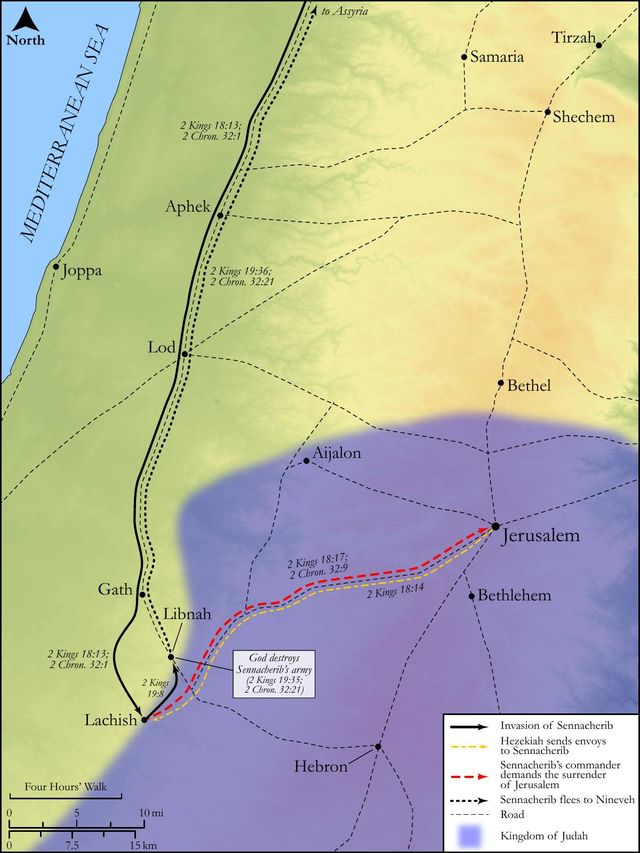
Second Kings 19:36 records the ignominious retreat of Sennacherib, king of Assyria, from his campaign against Judah and Jerusalem. Following the miraculous intervention of the Lord, who decimated his vast army, this verse marks the definitive and forced end of his imperial ambitions in the region, compelling him to return to his capital, Nineveh, where his reign would eventually conclude in a violent demise. It stands as a powerful testament to God's sovereignty over earthly powers and His unwavering commitment to His covenant people.
Context
ShowHideLiterary Context
This verse serves as the climactic resolution to the narrative arc of Sennacherib's invasion of Judah, which began in 2 Kings 18. The preceding verses, specifically 2 Kings 19:32-35, detail God's explicit promise through the prophet Isaiah to defend Jerusalem, followed by the dramatic fulfillment of that promise. The Lord's angel struck down 185,000 Assyrian soldiers in a single night, rendering Sennacherib's formidable army utterly incapacitated. Verse 36, therefore, describes the immediate and inevitable consequence of this divine intervention: the complete and humiliating withdrawal of the once-boastful king. It sets the stage for Sennacherib's ultimate fate, which is recorded in the very next verse, 2 Kings 19:37.
Historical & Cultural Context
Sennacherib was one of the most powerful and ruthless monarchs of the Neo-Assyrian Empire (705-681 BC), a dominant force among the nations of that day, known for its brutal military tactics, including mass deportations and psychological warfare. His campaign against Judah in 701 BC was part of a broader effort to consolidate Assyrian control over Syria, Philistia and Judah. Jerusalem, as the capital of Judah and a strategic stronghold, was a prime target. Assyrian siege warfare was highly effective, and their boasts, like those recorded in 2 Kings 18:19-35, were designed to demoralize their enemies into surrender. The Assyrian army was considered virtually unstoppable, making their sudden and complete withdrawal, as described in this verse, an unprecedented and shocking event that profoundly underscored the unique power of Judah's God.
Key Themes
ShowHideThe retreat of Sennacherib, as encapsulated in 2 Kings 19:36, powerfully illustrates several core biblical themes. Foremost is Divine Deliverance, showcasing God's absolute power to protect His people from overwhelming adversaries, even when human strength fails. This event is a profound testament to God's Sovereignty over all nations and their rulers, demonstrating that even the most formidable earthly empires are subject to His will, as seen in His humbling of Sennacherib. It also highlights the efficacy of Answered Prayer, as Hezekiah's fervent supplication in 2 Kings 19:15-19 directly precedes God's miraculous intervention. Finally, the event perfectly fulfills Prophecy, specifically Isaiah's declarations regarding Sennacherib's fate found in Isaiah 37:33-38, reinforcing the reliability and truthfulness of God's Word.
Exposition and Analysis
ShowHideKey Word Analysis
ShowHideThis primitive root (H5265) means "to pull up, especially the tent-pins, i.e. start on a journey." In the context of Sennacherib, it signifies an abrupt and forced departure, not a strategic withdrawal. It marks the immediate cessation of his campaign against Jerusalem, driven by the catastrophic loss of his army due to divine intervention.
This primitive root (H7725) means "to turn back (hence, away) transitively or intransitively, literally or figuratively." The use of "returned" here emphasizes the complete reversal of Sennacherib's advance. He had come to conquer, but now he was compelled to turn back towards his own land, underscoring the finality and totality of his defeat and the failure of his military objectives against Judah.
This primitive root (H3427) means "properly, to sit down... by implication, to dwell, to remain." This word indicates that Sennacherib took up permanent residence in Nineveh. It signifies the end of his active campaigning against Judah and his confinement to his capital, where he would remain until his assassination. This marks the definitive conclusion of his threat to Jerusalem.
Verse Breakdown
ShowHide"So Sennacherib king of Assyria departed"
This phrase immediately follows the divine intervention, presenting the direct and inevitable consequence of the angelic strike. It signifies the abrupt end of his siege and his entire campaign against Judah, forced by an invisible, superior power. The mighty king, who had boasted against God, is now seen in retreat.
"and went and returned"
This repetition emphasizes the completeness and finality of his withdrawal. It's not a temporary lull or a strategic repositioning, but a full, irreversible retreat back to his homeland. The language conveys a sense of ignominy and defeat, stripping away any pretense of a glorious return.
"and dwelt at Nineveh"
This concluding clause indicates that Sennacherib was confined to his capital city. His imperial ambitions concerning Judah were definitively thwarted, and he would not again pose a threat to Jerusalem. This marks the end of his active military career in the West and sets the stage for his eventual demise within the confines of his own kingdom, as prophesied.
Literary Devices
ShowHideThe simplicity of 2 Kings 19:36 belies its profound significance, employing several literary devices to achieve its impact. The most prominent is Contrast, setting Sennacherib's earlier grand boasts and overwhelming military might against his sudden, ignominious, and forced retreat. This creates a powerful sense of Irony, as the king who challenged the God of Israel is humbled by that very God, not by human strength. The phrase "went and returned" uses Repetition to emphasize the finality and completeness of his withdrawal, underscoring that his campaign was definitively over. Furthermore, the succinctness of the verse, describing such a monumental event with stark simplicity, can be seen as a form of Understatement, allowing the preceding miraculous events to speak for themselves and highlighting the absolute power of God without needing elaborate description of the king's shame.
Theological and Thematic Connections
ShowHideThe forced retreat of Sennacherib is a cornerstone event in the Old Testament, serving as a powerful demonstration of God's absolute sovereignty and His unwavering commitment to His covenant. It illustrates that no human power, no matter how formidable or arrogant, can ultimately thwart the divine will or overcome the Lord's protection of His people. This narrative reinforces the truth that God is the ultimate defender, capable of delivering His faithful from seemingly insurmountable odds, and that He hears and responds to the prayers of those who trust in Him. It's a vivid reminder that the battle belongs to the Lord, and His kingdom will ultimately prevail over all earthly empires.
Reflection and Application
ShowHideThe account of Sennacherib's defeat and retreat, culminating in 2 Kings 19:36, offers timeless lessons for believers facing overwhelming challenges. It reminds us that our hope and security are not found in human strength, military might, or political power, but solely in the omnipotent God who defends His own. When we feel surrounded by seemingly insurmountable problems, whether personal crises, societal pressures, or spiritual attacks, this narrative calls us to emulate King Hezekiah's humble and fervent prayer, trusting that God hears and is able to intervene miraculously. It instills confidence that even the most formidable "Sennacheribs" in our lives are ultimately subject to the Lord's sovereign control, and He can turn the tide in an instant. This story encourages us to stand firm in faith, knowing that God's faithfulness to His promises extends to us, His covenant people, today.
Questions for Reflection
ShowHideFAQ
ShowHideWhat was the fate of Sennacherib after he returned to Nineveh?
ShowHideFollowing his humiliating retreat from Judah, Sennacherib returned to his capital city, Nineveh, where he "dwelt." However, his reign did not end peacefully. As recorded in the very next verse, 2 Kings 19:37, he was assassinated by two of his own sons, Adrammelech and Sharezer, while he was worshipping in the temple of his god Nisroch. This violent end was also prophesied by Isaiah in Isaiah 37:38, further confirming the absolute accuracy and power of God's word. His son Esarhaddon then succeeded him as king.
Why is Sennacherib's retreat so significant in biblical history?
ShowHideSennacherib's retreat is profoundly significant because it represents a pivotal moment of divine intervention that preserved the Davidic line and the city of Jerusalem, which was crucial for the future coming of the Messiah. At a time when the northern kingdom of Israel had already fallen to Assyria (2 Kings 17:6), Judah stood as the last bastion of God's covenant people. Had Jerusalem fallen, the trajectory of redemptive history would have been dramatically altered. This event powerfully demonstrated God's unique power over the mightiest empires of the world and His unwavering faithfulness to His promises to David (2 Samuel 7:12-16) and to His people. It served as an enduring testimony to future generations of God's protective hand over His chosen city and lineage.
Christ-Centered Fulfillment
ShowHideThe dramatic deliverance of Jerusalem from Sennacherib, culminating in his forced retreat, serves as a powerful Old Testament type and shadow of the ultimate deliverance wrought by Jesus Christ. Just as God miraculously intervened to save His people from an overwhelming earthly foe, so too did He send His Son, the Lamb of God, to deliver humanity from the far more formidable spiritual enemies of sin, death, and the devil. Christ's triumph on the cross was the decisive blow against the powers of darkness, an act of divine intervention that disarmed and "made a public spectacle of them, triumphing over them by the cross" (Colossians 2:15). Where Sennacherib was forced to return to his earthly capital in defeat, Christ, through His resurrection, ascended to His heavenly throne, establishing an eternal kingdom that will never be defeated (Revelation 11:15). The retreat of Sennacherib foreshadows the ultimate vanquishing of all God's enemies by the King of kings, Jesus Christ, who delivers His people not just from physical armies, but from eternal condemnation, bringing them into everlasting peace and security in His divine presence (Hebrews 2:14-15).