


2 Kings 19:7
Bible text: King James Version (1769 Blayney text) · Public domain
Bible text: Berean Standard Bible · Public domain
Bible text: American Standard Version (1901) · Public domain
Bible text: World English Bible, Messianic edition · Public domain
Bible text: Geneva Bible (1599) · Public domain
Bible text: Young's Literal Translation · Public domain
- הִנְנִיhi·Nihere IH2005Prt ¦ 1csParticle InterjectionהִנְhereנִיI
- נֹתֵןno·Ten[am] about to putH5414V-Qal-Prtcpl-msVerb Qal Participle Singular Masculine Absolute
- בּוֹboin himPrep-b ¦ 3msSuffix Personal 3rd Singular Masculineבּinוֹhim
- רוּחַRu·acha spiritH7307N-fsNoun Singular Feminine Absolute
- וְשָׁמַעve·sha·Ma'and he will hearH8085Conj-w ¦ V-Qal-ConsecPerf-3msVerb Qal Consecutive Perfect 3rd Singular Masculineוְandשָׁמַעhe will hear
- שְׁמוּעָהshe·mu·'Aha reportH8052N-fsNoun Singular Feminine Absolute
- וְשָׁבve·Shavand he will returnH7725Conj-w ¦ V-Qal-ConsecPerf-3msVerb Qal Consecutive Perfect 3rd Singular Masculineוְandשָׁבhe will return
- לְאַרְצוֹle·'ar·Tzoto his own landH776Prep-l ¦ N-fsc ¦ 3msNoun Singular Feminine Constructלְtoאַרְצown landוֹhis
- וְהִפַּלְתִּיוve·hi·pal·Tivand I will make fall himH5307Conj-w ¦ V-Hiphil-ConsecPerf-1cs ¦ 3msVerb Hiphil Consecutive Perfect 1st Singular common genderוְandהִפַּלְתִּיI will make fallוhim
- בַּחֶרֶבba·Che·revby the swordH2719Prep-b ¦ N-fsNoun Singular Feminine Absoluteבַּby theחֶרֶבsword
- בְּאַרְצוֹbe·'ar·Tzoin his own landH776Prep-b ¦ N-fsc ¦ 3msNoun Singular Feminine Constructבְּinאַרְצown landוֹhis
English is a literal word-by-word gloss of the Hebrew, not the KJV's wording. Why?
This is the original text the KJV's translators worked from — each Hebrew word with its own literal English meaning in this verse, prepared by scholars at Tyndale House, Cambridge. The KJV translates whole sentences, not word by word, so its wording differs: one Hebrew word can become several English words, and the KJV may choose “the LORD” where the gloss reads “Yahweh”. Both are faithful — they answer different questions. For the KJV's own rendering, switch to the KJV text.
Details
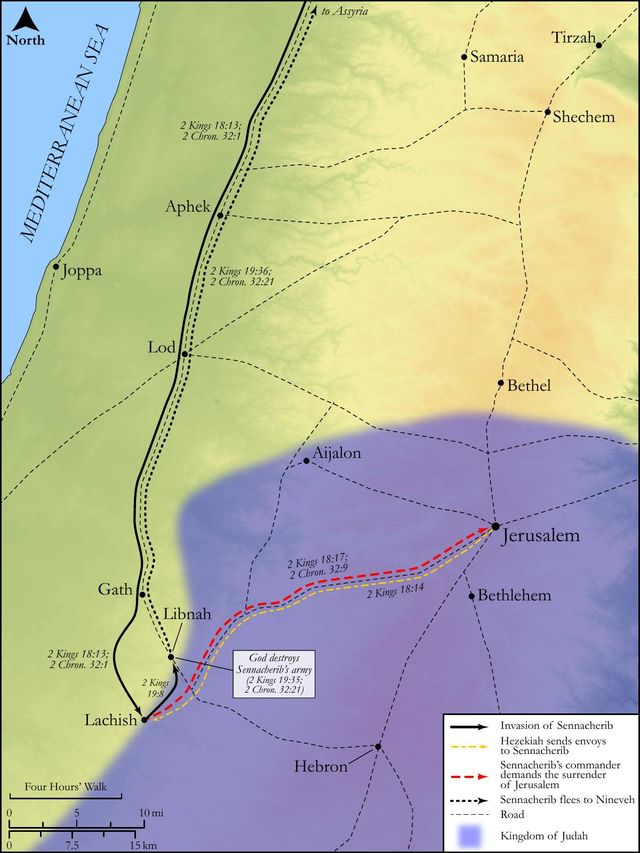
See on the biblical-era map
Study this verse
Public-domain commentary
Matthew Henry
From his Commentary on the Whole Bible. Henry comments on passages, not single verses — this entry covers 2 Kings 19:1–7. His three-level outline is real structure in the source text, so it is rendered as structure.
The contents of Rabshakeh's speech being brought to Hezekiah, one would have expected (and it is likely Rabshakeh did expect) that he would call a council of war and it would be debated whether it was best to capitulate or no. Before the siege, he had taken counsel with his princes and his mighty men, Ch2 32:3. But that would not do now; his greatest relief is that he has a God to go to, and what passed between him and his God on this occasion we have here an account of.
I.Hezekiah discovered a deep concern at the dishonour done to God by Rabshakeh's blasphemy.
When he heard it, though at second hand, he rent his clothes and covered himself with sackcloth, Kg2 19:1. Good men were wont to do so when they heard of any reproach cast on God's name; and great men must not think it any disparagement to them to sympathize with the injured honour of the great God. Royal robes are not too good to be rent, nor royal flesh too good to be clothed with sackcloth, in humiliation for indignities done to God and for the perils and terrors of his Jerusalem. To this God now called, and was displeased with those who were not thus affected. Isa 22:12-14, Behold joy and gladness, slaying oxen and killing sheep, though it was a day of trouble and perplexity in the valley of vision (Kg2 19:5), which refers to this very event. The king was in sackcloth, but many of his subjects were in soft clothing.
II.He went up to the house of the Lord, according to the example of the psalmist, who, when he was grieved at the pride and prosperity of the wicked, went into the sanctuary of God and there understood their end, Psa 73:17. He went to the house of God, to meditate and pray, and get his spirit into a sedate composed frame, after this agitation. He was not considering what answer to return to Rabshakeh, but refers the matter to God. "Thou shalt answer, Lord, for me." - Herbert. In the house of the Lord he found a place both of rest and refuge, a treasury, a magazine, a council-chamber, and all he needed, all in God. Note, When the church's enemies are very daring and threatening it is the wisdom and duty of the church's friends to apply to God, appeal to him, and leave their cause with him.
III.He sent to the prophet Isaiah, by honourable messengers, in token of the great respect he had for him, to desire his prayers, Kg2 19:2-4.
Eliakim and Shebna were two of those that had heard the words of Rabshakeh and were the better able both to acquaint and to affect Isaiah with the case. The elders of the priests were themselves to pray for the people in time of trouble (Joe 2:17); but they must go to engage Isaiah's prayers, because he could pray better and had a better interest in heaven. The messengers were to go in sackcloth, because they were to represent the king, who was so clothed.
1.Their errand to Isaiah was, "Lift up thy prayer for the remnant that is left, that is, for Judah, which is but a remnant now that the ten tribes are gone - for Jerusalem, which is but a remnant now that the defenced cities of Judah are taken." Note,
(1.)It is very desirable, and what we should be desirous of when we are in trouble, to have the prayers of our friends for us. In begging to have them we honour God, we honour prayer, and we honour our brethren.
(2.)When we desire the prayers of others for us we must not think we are excused from praying for ourselves. When Hezekiah sent to Isaiah to pray for him he himself went into the house of the Lord to offer up his own prayers.
(3.)Those who speak from God to us we should in a particular manner desire to speak to God for us. He is a prophet, and he shall pray for thee, Gen 20:7. The great prophet is the great intercessor.
(4.)Those are likely to prevail with God that lift up their prayers, that is, that lift up their hearts in prayer.
(5.)When the interests of God's church are brought very low, so that there is but a remnant left, few friends, and those weak and at a loss, then it is time to lift up our prayer for that remnant.
2.Two things are urged to Isaiah, to engage his prayers for them: - (1.) Their fears of the enemy (Kg2 19:3): "He is insolent and haughty; it is a day of rebuke and blasphemy. We are despised. God is dishonoured. Upon this account it is a day of trouble. Never were such a king and kingdom so trampled on and abused as we are: our soul is exceedingly filled with the contempt of the proud, and it is a sword in our bones to hear them reproach our confidence in God, and say, Where is now your God? and, which is worst of all, we see not which way we can help ourselves and get clear of the reproach. Our cause is good, our people are faithful; but we are quite overpowered with numbers. The children are brought to the birth; now is the time, the critical moment, when, if ever, we must be relieved. One successful blow given to the enemy would accomplish our wishes. But, alas! we are not able to give it: There is not strength to bring forth. Our case is as deplorable, and calls for as speedy help, as that of a woman in travail, that is quite spent with her throes, so that she has not strength to bear the child. Compare with this Hos 13:13. We are ready to perish; if thou canst do any thing, have compassion upon us and help us." (2.) Their hopes in God. To him they look, on him they depend, to appear for them. One word from him will turn the scale, and save the sinking remnant. If he but reprove the words of Rabshakeh (that is, disprove them, Kg2 19:4) - if he undertake to convince and confound the blasphemer - all will be well. And this they trust he will do, not for their merit's sake, but for his own honour's sake, because he has reproached the living God, by levelling him with deaf and dumb idols. They have reason to think the issue will be good, for they can interest God in the quarrel. Psa 74:22, Arise O God! plead thy own cause. "He is the Lord thy God," say they to Isaiah - "thine, whose glory thou art concerned for, and whose favour thou art interested in. He has heard and known the blasphemous words of Rabshakeh, and therefore, it may be, he will hear and rebuke them. We hope he will. Help us with thy prayers to bring the cause before him, and then we are content to leave it with him."
IV.God, by Isaiah, sent to Hezekiah, to assure him that he would glorify himself in the ruin of the Assyrians.
Hezekiah sent to Isaiah, not to enquire concerning the event, as many did that sent to the prophets (Shall I recover? or the like), but to desire his assistance in his duty. It was this that he was solicitous about; and therefore God let him know what the event should be, in recompence of his care to do his duty, Kg2 19:6, Kg2 19:7.
1.God interested himself in the cause: They have blasphemed me.
2.He encouraged Hezekiah, who was much dismayed: Be not afraid of the words which thou hast heard; they are but words (though swelling and fiery words), and words are but wind.
3.He promised to frighten the king of Assyria worse than Rabshakeh had frightened him: "I will send a blast upon him (that pestilential breath which killed his army), upon which terrors shall seize him and drive him into his own country, where death shall meet him." This short threatening from the mouth of God would do execution, when all the impotent menaces that came from Rabshakeh's mouth would vanish into air.
Historical interpretation
Historical reception
1 surviving comment on this verse from the historical church.
Faith unguarded is armed by God. Hezekiah, through the power of faith, proved stronger with his puny force than Sennacherib, king of Babylon and rich Nineveh, with his thousands. Sennacherib had enlisted the forces of Assyria and the realm of the Medes. Laying waste with his huge legions all the neighbouring kingdoms, he proceeded towards the city sacred to the Lord and against it alone concentrated his whole massive war machine. But as he made preparations for this, God hindered him, for warfare delayed his unholy designs. He sent to Jerusalem a letter brusque in its arrogant threats. Hezekiah received it with grief and bore it to the Lord before the altar. There in prostrate prayer accompanied by his people in mourning black, he read out those harsh words and bedewed the letter with abundant tears, and so he prevailed on God. By prayer alone, though absent from the scene, he won a shattering victory over the Assyrians, who suffered a grievous death when God warred on them. This favour he won was so considerable that he did not even clap eyes on the enemy he conquered. Once his tears of complaint had passed above the constellations, once his lament from a humble heart had risen beyond the stars and his devoted words had assailed the ears of highest Father, the lofty doors of heaven swung open and a winged angel glided down, breathing the fragrant air on his smooth descent. Armed with the sword of the Word, he smote that wicked army, and glorying in the silent slaughter of the sleeping foe, he brought simultaneous death to one hundred and eighty thousand men. A single night was the accomplice engagement on that scale. Next morning the king arose still threatening but then took flight with his depleted column, wretched because his army was thus stripped of its slaughtered soldiers. He fled from Hezekiah, though the prophet was far removed in another district, and though he had only recently in his presence threatened to clap his fetters on him. At that time Isaias was mediator for Hezekiah.
Continue studying 2 Kings 19:7 across the web’s major study libraries — every link below opens this exact verse, chapter, or book on the destination site.
Read & Compare
 BibleGatewayThis verse in more than 200 translations and 70 languages.
 Bible.comThe YouVersion reader — hundreds of translations, reading plans, and highlights.
 ESV.orgCrossway's official English Standard Version reader.
 NET BibleThe NET translation with 60,000+ translators' notes on every rendering decision.
 STEP BibleTyndale House's free study tool — original text, vocabulary, and scholarly resources.
 BibliaLogos Bible Software's free web reader.
 USCCBThe New American Bible (Revised Edition) with the U.S. bishops' study notes.
Commentaries
 BibleHub CommentariesDozens of classic commentaries on this verse, gathered on one page.
 StudyLightMore than 100 commentary sets — the largest collection on the web.
 BibleRefPlain-English commentary on what this verse means, verse by verse.
 Enduring WordDavid Guzik's free commentary on this chapter, widely used by Bible teachers.
 Bible Study ToolsVerse commentary alongside Greek and Hebrew study aids.
Original Language & Research
- BibleHub InterlinearThe verse word by word — original language, transliteration, and English.
- BibleHub LexiconEvery word's original-language definition and Strong's entry.
 Blue Letter BibleDeep-study tools — Strong's numbers, concordance, and word studies.
 SefariaThe Hebrew text with Rashi and centuries of Jewish commentary.
Sermons, Hymns & Audio


TrulyRandomVerse is not affiliated with these sites and doesn’t control their content. They’re linked because they’re genuinely useful.
Summary
Second Kings 19:7 delivers a profound divine declaration through the prophet Isaiah, addressed directly to the arrogant King Sennacherib of Assyria. In response to King Hezekiah's desperate prayer concerning Sennacherib's blasphemous threats against Judah and Jerusalem, God promises a supernatural intervention: He will cause Sennacherib to hear a compelling rumor that forces his ignominious retreat to his own land, where he will ultimately meet a violent, divinely orchestrated death by the sword. This verse stands as a powerful testament to God's absolute sovereignty over human affairs, His unwavering protection of His people, and His certain judgment against pride and defiance.
CONTEXT
ShowHideExposition and Analysis
ShowHideKey Word Analysis
ShowHideThis primitive root is remarkably versatile, meaning "to give," but used with the greatest latitude to imply putting, making, appointing, or causing. In this context, "I will send" (or "I will give") signifies God's direct, intentional, and active instigation of the events that follow. It emphasizes His sovereign agency in initiating the "blast" that will affect Sennacherib, demonstrating that this is not a random occurrence but a divinely ordained action.
From the root רוּחַ, this multifaceted Hebrew word can mean "wind," "breath," or "spirit." Here, it signifies a supernatural force or a terrifying divine influence sent by God. It is not merely a natural phenomenon but a direct, powerful, and unseen intervention from God that will impact Sennacherib's morale, decision-making, and ultimately compel his retreat. It denotes a divine, irresistible power at work, a spiritual or psychological assault orchestrated by the Almighty.
This phrase combines the primitive root נָפַל (nâphal), meaning "to fall" in a wide variety of applications (including to die, slay, be overthrown), with חֶרֶב (chereb), meaning "sword" or "cutting instrument." The combination specifically denotes a violent death by assassination or battle. The precision of God's prophecy—that Sennacherib would die by the sword and in his own land—underscores the detailed nature of God's foreknowledge and His sovereign execution of justice. It emphasizes the ignominious and divinely orchestrated end of a king who boasted of his invincibility.
Verse Breakdown
ShowHide"Behold, I will send a blast upon him,"
This opening clause is a powerful declaration of divine initiative and absolute sovereignty. The interjection "Behold" (הִנֵּה, hinneh) draws immediate attention to a momentous, certain event. God Himself, the "I," is the active agent, promising a supernatural, unseen force or influence (the "blast" or ruach) that will directly impact Sennacherib. This signifies God's direct, personal intervention in human affairs, demonstrating His absolute power over all earthly rulers and armies, even the mightiest.
"and he shall hear a rumour, and shall return to his own land;"
This clause details the immediate, divinely orchestrated consequence of God's "blast." The divine influence will lead Sennacherib to hear a specific "rumour" or report (שְׁמוּעָה, sh'mu'ah). This news, though seemingly ordinary, will be so compelling and threatening that it will force the mighty Assyrian king to abandon his aggressive campaign against Jerusalem and retreat to his homeland. This highlights God's ability to use intelligence, reports, or internal political unrest to guide events and fulfill His purposes, even against the will of a powerful adversary.
"and I will cause him to fall by the sword in his own land."
This final clause pronounces the ultimate, specific, and ignominious fate of Sennacherib. Not only will he retreat, but God explicitly states, "I will cause him to fall" (from נָפַל, nâphal). This is a direct divine judgment, ensuring that Sennacherib will meet a violent death, not in battle against Judah, but by assassination within his own territory. This precise prophecy, later fulfilled in 2 Kings 19:36-37, underscores God's perfect foreknowledge, His commitment to executing justice against those who defy Him, and the certainty of His word.
Literary Devices
ShowHideThe verse employs several potent literary devices that amplify its theological impact and underscore the message of divine sovereignty. Foremost is Prophecy, as it is a direct, declarative statement from God through Isaiah, foretelling future events with absolute certainty and precise detail, which is later literally fulfilled. The pervasive use of Divine Fiat is evident in the repeated "I will" statements ("I will send," "I will cause"), emphasizing God's active, sovereign will as the sole mover of these events, not human effort, chance, or the strength of armies. There is a strong element of Irony in the narrative: the mighty, boastful king who threatened to conquer all nations and mocked the God of Israel is not defeated in a grand battle by Judah's army, but is instead compelled to retreat by a mere "rumour" and ultimately assassinated by his own sons in his own land, a humiliating and ignominious end. This serves as a powerful Contrast between human arrogance and divine power, highlighting the utter futility of defying the Almighty. The narrative also functions as Foreshadowing, hinting at God's ultimate judgment on all who exalt themselves against Him and His people throughout history, a theme consistently present in biblical eschatology.
Theological and Thematic Connections
ShowHideSecond Kings 19:7 is a profound theological statement on God's active involvement in human history and His unwavering commitment to His covenant people. It powerfully asserts divine sovereignty, demonstrating that no earthly power, however formidable, can withstand the will of the Almighty. God's immediate and decisive response to Hezekiah's prayer underscores the efficacy of faithful intercession and His readiness to defend His name and His people. The verse also serves as a stark warning against hubris and blasphemy, illustrating that divine judgment inevitably awaits those who defy the living God. Ultimately, it reinforces the absolute reliability of God's prophetic word, proving that what He declares will come to pass, strengthening faith in His promises across generations and affirming His role as the sovereign Lord of all creation and history.
Reflection and Application
ShowHideThis powerful declaration from God in 2 Kings 19:7 offers profound encouragement and timeless lessons for believers today. In a world often dominated by seemingly insurmountable challenges, overwhelming threats, and the arrogance of human power, this verse reminds us that God remains sovereign over all. Just as He heard King Hezekiah's desperate prayer and intervened decisively against the formidable Sennacherib, so too does He hear the cries of His people today. We are called to trust in His unfailing power and protection, knowing that no adversary, no crisis, and no human boast can ultimately thwart His divine purposes. This narrative encourages us to bring our fears and challenges before the Lord in prayer, confident that He is actively involved in our lives and in the course of history, always working for the good of those who love Him and for the glory of His name. It also serves as a sobering reminder that while human pride may rise and seemingly triumph for a season, it will inevitably fall before the majesty and justice of God. Our ultimate security is found not in human strength or political alliances, but in the unwavering faithfulness of the Almighty.
Questions for Reflection
ShowHideFAQ
ShowHideWhat was the "blast" mentioned in 2 Kings 19:7, and how did it affect Sennacherib?
ShowHideThe Hebrew word translated "blast" is ruach (רוּחַ, H7307), which is a rich term meaning "spirit," "wind," or "breath." In this context, it signifies a supernatural, divine force or influence that God would send upon Sennacherib. It wasn't necessarily a literal gust of wind, but rather a spiritual or psychological impact orchestrated by God that would cause a profound shift in Sennacherib's plans and morale. This divine "blast" led to Sennacherib hearing a "rumour" (שְׁמוּעָה, sh'mu'ah, H8052), a report or news, which compelled him to abandon his siege of Jerusalem and retreat to his own land. While the text doesn't specify the exact nature of the rumor, its effect was divinely guaranteed, illustrating God's ability to use unseen or seemingly mundane means to achieve His sovereign will and protect His people, as seen in the broader narrative of 2 Kings 19.
How was the prophecy in 2 Kings 19:7 concerning Sennacherib's death fulfilled?
ShowHideThe prophecy in 2 Kings 19:7 was fulfilled precisely as God declared. After his forced retreat from Judah, Sennacherib returned to Nineveh, his capital. Years later, while he was worshipping in the temple of his god Nisroch, his own sons, Adrammelech and Sharezer, assassinated him with the sword. This event is recorded in 2 Kings 19:36-37 and is corroborated by extra-biblical historical records, including Sennacherib's own annals (which record his death, though not by assassination, but later Babylonian chronicles confirm it). The fulfillment of this precise prophecy underscores the absolute reliability of God's word and His sovereign control over the destinies of nations and individuals, even the most powerful kings, demonstrating that no one can defy the living God with impunity.
Christ-Centered Fulfillment
ShowHideThe divine intervention against Sennacherib in 2 Kings 19:7, where God promises to send a "blast" and cause the mighty king's ignominious demise, profoundly foreshadows the ultimate triumph of God's Anointed One, Jesus Christ. Just as God protected Jerusalem from an overwhelming earthly foe, Christ, the true Lamb of God, came not merely to deliver a city but to conquer the ultimate spiritual enemies: sin, death, and the devil. The "blast" God sent upon Sennacherib finds its ultimate echo in the spiritual authority and power of Christ, who, through His death and resurrection, disarmed the principalities and powers, triumphing over them (as seen in Colossians 2:15). The "rumour" that caused Sennacherib's retreat pales in comparison to the "good news" of the Gospel, which compels a spiritual return to God and repentance from sin, drawing all people to Himself (John 12:32). Furthermore, Sennacherib's death by the sword in his own land, orchestrated by God, points to Christ's decisive victory over the one who holds "the power of death, that is, the devil" (Hebrews 2:14-15). Ultimately, 2 Kings 19:7 is a testament to God's unwavering commitment to His people and His eventual judgment on all who oppose Him, a judgment fully realized in the righteous reign of the King of Kings, who will one day return to execute final justice and establish His eternal kingdom (Revelation 19:11-16). In Christ, we find not just protection from earthly foes, but eternal victory and peace, for He has indeed overcome the world (John 16:33).