


Obadiah 1:1
Bible text: King James Version (1769 Blayney text) · Public domain
Bible text: King James Version with Strong's numbers · Public domain
Bible text: Berean Standard Bible · Public domain
Bible text: American Standard Version (1901) · Public domain
Bible text: World English Bible, Messianic edition · Public domain
Bible text: Geneva Bible (1599) · Public domain
Bible text: Young's Literal Translation · Public domain
- חֲזוֹןcha·Zon[the] vision ofH2377N-mscNoun Singular Masculine Construct
- עֹבַדְיָה'oad·YahObadiahH5662N-proper-mNoun Proper Masculine
- כֹּהkohthusH3541AdvAdverb
- אָמַר'a·Marhe saysH559V-Qal-Perf-3msVerb Qal Perfect 3rd Singular Masculine
- אֲדֹנָי'a·do·Nai[the] LordH136N-properNoun Proper Title
- יְהוִהYah·wehYahwehH3069N-properNoun Proper Title
- לֶאֱדוֹםle·'e·Domof EdomH123Prep-l ¦ N-proper-mNoun Proper MasculineלֶofאֱדוֹםEdom
- שְׁמוּעָהshe·mu·'Aha reportH8052N-fsNoun Singular Feminine Absolute
- שָׁמַעְנוּsha·Ma'·nuwe have heardH8085V-Qal-Perf-1cpVerb Qal Perfect 1st Plural common gender
- מֵאֵתme·'Etfrom withH854Prep-m ¦ PrepPrepositionמֵfromאֵתwith
- יְהוָהYah·wehYahwehH3068N-properNoun Proper Title
- וְצִירve·Tzirand an envoyH6735Conj-w ¦ N-msNoun Singular Masculine Absoluteוְandצִירan envoy
- בַּגּוֹיִםba·go·Yimamong the nationsH1471Prep-b ¦ N-mpNoun Plural Masculine Absoluteבַּamong theגּוֹיִםnations
- שֻׁלָּחshu·Lachhe has been sentH7971V-Pual-Perf-3msVerb Pual Perfect 3rd Singular Masculine
- קוּמוּKu·muariseH6965V-Qal-Imp-2mpVerb Qal Imperative 2nd Plural Masculine
- וְנָקוּמָהve·na·Ku·mahso let us ariseH6965Conj-w ¦ V-Qal-Imperf-1cpVerb Qal Imperfect 1st Plural common genderוְsoנָקוּמָהlet us arise
- עָלֶיהָ'a·Lei·haon itH5921Prep ¦ 3fsPrepositionעָלֶיonהָit
- לַמִּלְחָמָהla·mil·cha·Mahfor <the> battleH4421Prep-l ¦ N-fsNoun Singular Feminine Absoluteלַfor <the>מִּלְחָמָהbattle
English is a literal word-by-word gloss of the Hebrew, not the KJV's wording. Why?
This is the original text the KJV's translators worked from — each Hebrew word with its own literal English meaning in this verse, prepared by scholars at Tyndale House, Cambridge. The KJV translates whole sentences, not word by word, so its wording differs: one Hebrew word can become several English words, and the KJV may choose “the LORD” where the gloss reads “Yahweh”. Both are faithful — they answer different questions. For the KJV's own rendering, switch to the KJV text.
Details
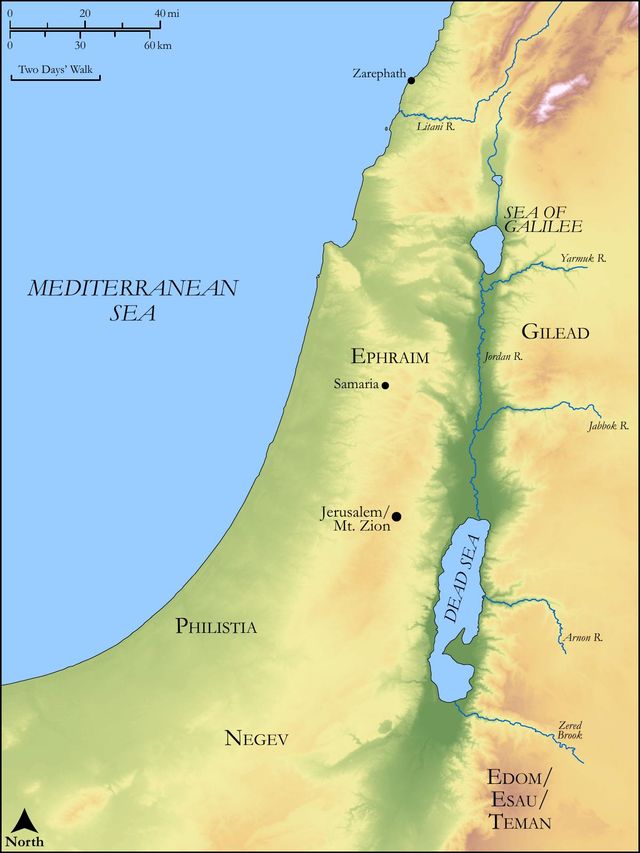
See on the biblical-era map
Study this verse
Historical interpretation
Nine Centuries of Reception
4 surviving comments on this verse. Each one is dated, so this reads as a timeline rather than a list.
Select a marker to jump to its quote. Markers stagger vertically where authors wrote within a few decades of each other.
“We have heard a report from the Lord,” that is, the Lord of the world powers will do nothing if he has not first revealed his mystery to his servants, the prophets. “And a messenger has been sent among the nations.” A mystical meaning is probable here, and these words may be referred to Emmanuel, the angel of the testament, sent from heaven, who announced peace to the nations, and therefore was said to be the “expectation of the nations.”
Obadiah of Sichem was born in the tribe of Ephraim and prophesied against the Edomites. He seems to be a contemporary of Hosea, Joel, Amos and Isaiah.
This differs not at all in its import from the phrase “Word of the Lord.” Scripture calls God’s activity “Word of the Lord” in reference to the spiritual grace by which the prophets received the revelations of the future. In the same way by “vision” he refers to the divine revelation by which in fact they received the knowledge of the unknown. They also received some insights in ineffable fashion through spiritual activity in their own soul. In response to the activity occurring within them from the Holy Spirit, they obeyed the word of instruction as though from someone speaking. Consequently Scripture calls it both “vision” and “Word of the Lord,” and probably also “report” in that they receive knowledge as though by a report of some kind.
He joins himself with the other prophets, those who spiritually heard a divine sentence against the Edomites.
Continue studying Obadiah 1:1 across the web’s major study libraries — every link below opens this exact verse, chapter, or book on the destination site.
Read & Compare
 BibleGatewayThis verse in more than 200 translations and 70 languages.
 Bible.comThe YouVersion reader — hundreds of translations, reading plans, and highlights.
 ESV.orgCrossway's official English Standard Version reader.
 NET BibleThe NET translation with 60,000+ translators' notes on every rendering decision.
 STEP BibleTyndale House's free study tool — original text, vocabulary, and scholarly resources.
 BibliaLogos Bible Software's free web reader.
 USCCBThe New American Bible (Revised Edition) with the U.S. bishops' study notes.
Commentaries
 BibleHub CommentariesDozens of classic commentaries on this verse, gathered on one page.
 StudyLightMore than 100 commentary sets — the largest collection on the web.
 BibleRefPlain-English commentary on what this verse means, verse by verse.
 Enduring WordDavid Guzik's free commentary on this chapter, widely used by Bible teachers.
 Bible Study ToolsVerse commentary alongside Greek and Hebrew study aids.
Original Language & Research
- BibleHub InterlinearThe verse word by word — original language, transliteration, and English.
- BibleHub LexiconEvery word's original-language definition and Strong's entry.
 Blue Letter BibleDeep-study tools — Strong's numbers, concordance, and word studies.
 SefariaThe Hebrew text with Rashi and centuries of Jewish commentary.
Sermons, Hymns & Audio


TrulyRandomVerse is not affiliated with these sites and doesn’t control their content. They’re linked because they’re genuinely useful.
Summary
Obadiah 1:1 serves as the prophetic introduction to the shortest book in the Old Testament, declaring a divine vision received by the prophet Obadiah. It immediately establishes the central theme: a pronouncement of judgment from the Lord GOD specifically "concerning Edom." The verse reveals that this impending judgment is not a mere human conjecture but originates from a divine decree, a "rumour" or authoritative report heard from the LORD Himself, which is then being communicated to other nations through an ambassador, stirring them to prepare for battle against Edom.
Context
ShowHideLiterary Context
Obadiah 1:1 functions as the superscription and immediate opening of the book of Obadiah, setting the stage for the entire prophecy. As the shortest book in the Old Testament, its singular focus on the judgment of Edom is immediately apparent from this verse. The "vision" introduced here is the entirety of the subsequent oracle, which details Edom's pride, their betrayal of Judah during a time of crisis, and the complete destruction that awaits them. This verse, therefore, acts as a divine warrant for the severe pronouncements that follow, emphasizing that the message is not Obadiah's own but a direct revelation from God.
Historical & Cultural Context
Edom was the nation descended from Esau, the twin brother of Jacob (Israel), as recounted in Genesis 25:23-30. Their relationship with Israel was marked by a long history of animosity and conflict, despite their familial ties. Geographically, Edom occupied the mountainous region south and east of the Dead Sea, a strategic location that fostered a sense of invincibility due to their seemingly impregnable fortresses (Obadiah 1:3-4). The most probable historical backdrop for this prophecy is Edom's complicity and active participation in the Babylonian conquest and destruction of Jerusalem in 586 BC, as detailed in Obadiah 1:10-14. Their actions during this critical time, rather than offering aid to their "brother" Judah, solidified their fate in divine judgment.
Key Themes
ShowHideThis opening verse introduces several key themes that permeate the book of Obadiah and resonate throughout biblical prophecy. Foremost is the theme of divine sovereignty, highlighted by the phrase "Thus saith the Lord GOD" and the concept of a "rumour from the LORD." God is not a passive observer but actively orchestrates the affairs of nations, even using "the heathen" as instruments of His will. Another crucial theme is justice for oppression, specifically against God's people. Edom's pride and violence against Judah will not go unpunished, underscoring God's commitment to vindicating His covenant people and holding all nations accountable for their actions, as seen in broader prophetic literature like Isaiah 34 and Ezekiel 35. The theme of retribution is also nascent here, where Edom's actions will ultimately rebound upon them.
Exposition and Analysis
ShowHideKey Word Analysis
ShowHideFrom the root meaning "to see," this term denotes a prophetic revelation, an oracle, or a divine communication received by a prophet, often in a dream-like state or through direct spiritual perception. It emphasizes that the ensuing message is not human wisdom or opinion, but a direct, authoritative disclosure from God, making the prophecy binding and certain in its fulfillment.
This double divine title, rendered "Lord GOD" in KJV, combines Adonai (meaning "my Lord" or "sovereign master," emphasizing God's absolute authority and ownership) with Yehovih (a vocalization of YHWH, the covenant name of God, Jehovah or Yahweh, emphasizing His self-existence, faithfulness, and covenant relationship). The combination powerfully asserts God's supreme, sovereign authority over all creation and His unwavering commitment to His covenant purposes, especially in executing justice.
This word signifies something heard, an announcement, report, or tidings. In this context, "a rumour from the LORD" suggests a message originating in the divine council, a heavenly decree or plan that has been decided and is now being put into action. It implies an authoritative, pre-determined divine purpose, rather than a mere whisper or speculation, underscoring the certainty and divine origin of the impending judgment against Edom.
Verse Breakdown
ShowHide"¶ The vision of Obadiah."
This opening phrase identifies the prophet as Obadiah and the nature of the message as a "vision," a direct divine revelation. The paragraph marker (¶) indicates a new section or thought in the KJV.
"Thus saith the Lord GOD concerning Edom;"
This is a classic prophetic formula, asserting the divine origin and authority of the message. The combined divine titles "Lord GOD" emphasize God's absolute sovereignty and covenant faithfulness. The target of the prophecy is explicitly named: "Edom," setting the stage for the book's singular focus.
"We have heard a rumour from the LORD,"
This clause indicates the source of the divine intelligence. The "we" likely refers to the prophetic community or perhaps even the divine council, implying a shared, certain knowledge of God's decree. The "rumour" is not idle gossip but an authoritative report or decision originating directly from YHWH, the covenant God of Israel.
"and an ambassador is sent among the heathen,"
This reveals the mechanism by which God's decree is being enacted. An "ambassador" (a messenger or envoy) is dispatched not to Israel, but "among the heathen" (foreign nations). This signifies God's sovereign control over all nations, using them, even those who do not acknowledge Him, as instruments to fulfill His purposes.
"Arise ye, and let us rise up against her in battle."
This is the content of the ambassador's message to the heathen nations. It is a divine summons to war against Edom. The imperative "Arise ye" and the collective "let us rise up" indicate a call to action, mobilizing a confederation of nations to execute God's judgment, highlighting the certainty and imminence of Edom's downfall.
Literary Devices
ShowHideObadiah 1:1 employs several powerful literary devices. Divine Oracle is the overarching device, signaled by "The vision of Obadiah" and "Thus saith the Lord GOD," immediately establishing the text as a direct, authoritative message from God. The phrase "We have heard a rumour from the LORD" uses Anthropomorphism, attributing the human action of "hearing" to God or His heavenly court, making the divine decree relatable and emphasizing its certainty. The sending of an "ambassador... among the heathen" and the subsequent call to "Arise ye, and let us rise up against her in battle" employs Personification and Imperative Mood, giving agency to an abstract divine plan and directly commanding nations into action. There is also an element of Irony, as God uses "heathen" nations, often considered enemies of Israel, as instruments of His justice against Edom, who were kinsmen but acted as adversaries.
Theological and Thematic Connections
ShowHideObadiah 1:1 profoundly establishes God's absolute sovereignty over all nations, not just Israel. It reveals that divine judgment is not arbitrary but flows from a pre-determined, righteous decree originating in God's own council. The "rumour from the LORD" signifies a settled divine plan, demonstrating that God is actively involved in the affairs of humanity, orchestrating events and raising up nations to fulfill His purposes, particularly in executing justice against those who oppress His people or act with pride and violence. This foundational truth underscores that no nation, regardless of its perceived strength or security, is beyond the reach of God's ultimate authority and righteous judgment.
Reflection and Application
ShowHideObadiah 1:1 serves as a powerful reminder that God is actively engaged in the world, overseeing the rise and fall of nations and holding all accountable for their actions. For believers, this verse instills confidence in God's ultimate justice; no act of oppression or betrayal, particularly against His people, goes unnoticed or unaddressed in the divine economy. It calls us to trust in God's perfect timing and methods, even when His justice seems delayed or when He uses unexpected instruments to achieve His purposes. Furthermore, it serves as a sobering warning against pride, complicity in injustice, and the mistreatment of others, especially those who are vulnerable or belong to God's family. Our actions have eternal consequences, and God's sovereign plan will ultimately prevail, bringing about righteousness and vindication.
Questions for Reflection
ShowHideFAQ
ShowHideWho was Obadiah, and why is his book so short?
ShowHideVery little is known about the prophet Obadiah beyond his name, which means "servant of Yahweh" or "worshiper of Yahweh." He is not mentioned elsewhere in the biblical record. The brevity of his book (only 21 verses) is due to its singular focus: a highly concentrated oracle of judgment against the nation of Edom. Unlike longer prophetic books that often contain multiple messages, historical narratives, or extensive calls to repentance for Israel, Obadiah's prophecy is a concise, laser-focused pronouncement of divine retribution for Edom's specific acts of treachery against Judah, particularly during the destruction of Jerusalem (see Obadiah 1:10-14).
What does "We have heard a rumour from the LORD" imply about God's plan?
ShowHideThis phrase signifies much more than mere hearsay. In a prophetic context, a "rumour from the LORD" (Hebrew: shᵉmûwʻâh) refers to an authoritative report or decree originating directly from God's heavenly council. It implies that the judgment against Edom is not a spontaneous reaction but a pre-determined, settled divine plan. It suggests that God has already made His decision concerning Edom's fate and is now actively putting that plan into motion, even dispatching an "ambassador" to rally other nations as instruments of His will. This highlights God's meticulous planning and sovereign control over human history, ensuring that His purposes will be fulfilled (Isaiah 46:10).
Christ-Centered Fulfillment
ShowHideWhile Obadiah's prophecy focuses on the historical judgment of Edom, its ultimate fulfillment points to the broader biblical narrative of God's righteous judgment against all who oppose His people and His kingdom, culminating in the redemptive work and final triumph of Jesus Christ. The "vision of Obadiah" and the "rumour from the LORD" foreshadow the ultimate divine revelation found in Christ, who is the full and final Word of God (Hebrews 1:1-3). The ambassador sent among the heathen to stir them to battle against Edom prefigures Christ's role as the ultimate divine Ambassador and King, who will one day execute perfect justice upon all nations. Just as Edom faced divine retribution for their pride and violence, so too will all unrighteousness be judged at Christ's return. He is the one who will gather the nations for final judgment, separating the sheep from the goats (Matthew 25:31-46), and He is the "Lamb of God" who takes away the sin of the world for those who believe, while also being the Lion of Judah who will conquer all His enemies (Revelation 5:5-6). Thus, Obadiah's message of divine justice finds its ultimate and comprehensive fulfillment in the person and work of Jesus Christ, who is both the righteous Judge and the merciful Savior.