


Obadiah 1:2
Bible text: King James Version (1769 Blayney text) · Public domain
Bible text: Berean Standard Bible · Public domain
Bible text: American Standard Version (1901) · Public domain
Bible text: World English Bible, Messianic edition · Public domain
Bible text: Geneva Bible (1599) · Public domain
Bible text: Young's Literal Translation · Public domain
- הִנֵּהhi·Nehhere!H2009PrtParticle Interjection
- קָטֹןka·TonsmallH6996Adj-msAdjective Singular Masculine Absolute
- נְתַתִּיךָne·ta·Ti·khaI will make youH5414V-Qal-Perf-1cs ¦ 2msVerb Qal Perfect 1st Singular common genderנְתַתִּיI will makeךָyou
- בַּגּוֹיִםba·go·Yimamong the nationsH1471Prep-b ¦ N-mpNoun Plural Masculine Absoluteבַּamong theגּוֹיִםnations
- בָּזוּיba·Zui[will be] despisedH959V-Qal-PassPrtcpl-msVerb Qal Participle Passive Singular Masculine Absolute
- אַתָּה'a·TahyouH859Pro-2msPronoun Personal 2nd Singular Masculine
- מְאֹדme·'OdexceedinglyH3966Adj-msAdjective Numerical Singular Masculine Absolute
English is a literal word-by-word gloss of the Hebrew, not the KJV's wording. Why?
This is the original text the KJV's translators worked from — each Hebrew word with its own literal English meaning in this verse, prepared by scholars at Tyndale House, Cambridge. The KJV translates whole sentences, not word by word, so its wording differs: one Hebrew word can become several English words, and the KJV may choose “the LORD” where the gloss reads “Yahweh”. Both are faithful — they answer different questions. For the KJV's own rendering, switch to the KJV text.
Details
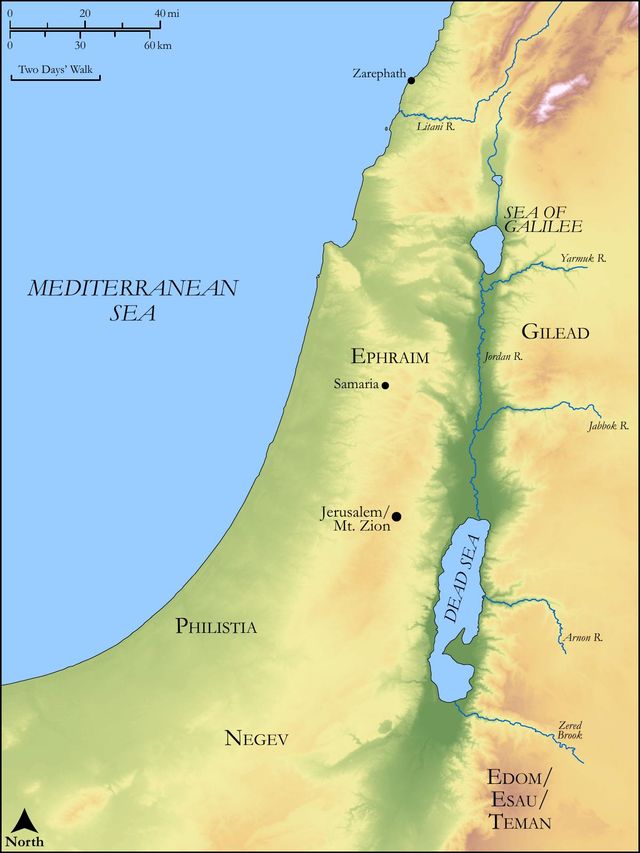
See on the biblical-era map
Study this verse
Historical interpretation
Historical reception
2 surviving comments on this verse. Each one is dated, so this reads as a timeline rather than a list.
Select a marker to jump to its quote. Markers stagger vertically where authors wrote within a few decades of each other.
Obadiah shows here that the Edomites must be subjected to captivity because of their pride and the enmity they held against their brothers. In a different sense he says that the devil is made least, as the words that follow are extremely suitable to him as well.
(Version 2, verse 2) Behold, I have made you a little one among the nations: you are very contemptible. The pride of your heart has lifted you up, dwelling in the clefts of the rock, exalting your throne, saying in your heart: Who will bring me down to the ground? If you elevate yourself like an eagle, and if you place your nest among the stars: from there I will bring you down, says the Lord. LXX: Behold, I have made you a little one among the nations: you are very dishonored. The pride of your heart has lifted you up, you who dwell in the clefts of the rock, exalting your dwelling and saying in your heart: Who will bring me down to the ground? Though you soar aloft like the eagle, though your nest is set among the stars, from there I will bring you down, declares the Lord. Jeremiah, of whom we have mentioned above, agrees in almost the same words, saying: Behold, I have made you small among the nations; you are utterly despised among mankind. Your arrogance has deceived you, and the pride of your heart, you who live in the clefts of the rock, who strive to grasp the height of the hill: though you soar aloft like the eagle, from there I will bring you down, declares the Lord. In prophetic interpretation, we must follow our custom, that first we lay the foundations of history, and then, if possible, we raise lofty towers and the peaks of roofs. 'O Edom,' He says, 'though you are the least among all the nations around, and small in comparison to the other peoples, you rise up in arrogance beyond your strength. And though you dwell in caves, or rather in the rocky caverns, humble and poor, and not possessing the lofty roofs of buildings, you are lifted up as an eagle to the heights, and you swell with such pride in your thoughts, that you believe yourself to dwell among the stars. Even if you could penetrate the heights of the heavens beyond nature, I would bring you down from there and bring you to the earth,' says the Lord God. But what is added in Jeremiah, and which you strive to understand, reveals the height of the hill, representing Mount Zion, and through this either the city of Jerusalem itself or the temple built within it. As for the eagle, it is known by those who discuss the nature of birds that it flies higher than all other birds. It is said to have such a keen sight that while it soars above the motionless sea with its steady wings, it can see fish swimming from such a great height and, when they are near the shore, descend like a weapon and drag its captured prey with its wings to the shore. If we learn history, let us follow spiritual intelligence. Although you, o heretic, may seem great and despise the smallness of the Church, you are nonetheless small among the nations, and contemptible, and not only contemptible, but also very contemptible with arrogance. The pride of your heart has lifted you up. For who among heretics is not lifted up in pride, despising the simplicity of the Church and considering faith as ignorance? Dwelling in the clefts of the rock, and exalting his throne. Although the rock is often seen as representing the Lord Himself or His steadfastness (hence the prophet says, He set my feet upon a rock (Ps. XXXIX, 5)) and is also said to Peter, You are Peter, and upon this rock I will build my Church (Mat. I, 8), yet it is often interpreted in the opposite sense: I will take away the stony heart, and will give you a heart of flesh (Ezek. XXXVI, 26). And do not presume to say to yourselves, ‘We have Abraham as our father,’ for I tell you, God is able from these stones to raise up children for Abraham (Matt. 3:9). Especially here, where it does not say dwelling upon the rock, upon which the wise builder builds his house, but in the clefts of the rock, in order to signify the heresies that arise from Christ the rock and from the Church. Moreover, what follows, ‘Exalting your throne,’ and, ‘Who has measured the waters in the hollow of his hand?’ reveals the arrogance of a heretical mind, confident in its mysteries and its secrets, and insofar as it is able (but we should take this hyperbolically) promising itself the kingdoms of heaven. Where the Apostle writes to such people: 'Now you reign without us, and I wish you would reign, so that we may also reign with you' (I Cor. IV, 8). So also David speaks: 'They have set their mouth in heaven, and their tongue has passed through the earth' (Psalm LXXII, 9). If therefore they are exalted, like the eagle (for they also promise themselves a likeness to eagles, which are accustomed to gather around the Lord's body), and if they have set their nest among the stars, from there I will bring them down, says the Lord. For just as a father of a family, while sleeping, an enemy man oversows darnel among good seed (Matthew 13): so does that great eagle, (Ezekiel 17, 3), with its large wings, long body members, full of feathers and variety, which has the way of entering into Lebanon, and takes from the top of the cedar, and plants on many waters, so that shoot out into a vineyard, as plantings among the stars of the Church, concerning which it is also said in another place: But the just shall shine as the brightness of the firmament (Matthew 13, 43), they shall set their nest. I said above that this very thing, contrary to the flesh, can be understood as its strength being diminished in the coming of Christ, and it is contemptible, subject to the soul's rule, and is in vain exalted when it dwells in the caves of the rock, either in our senses or in our thoughts, and it desires to dominate the soul, exalting its own throne, and not believing that its works can be overcome. It is said to this, that although it exalts itself and imitates the lofty eagle, and deceives many of the saints, nevertheless it is overcome and cast down by the Lord. What we understand in heretics and in the flesh can also be understood against the Jews.
Continue studying Obadiah 1:2 across the web’s major study libraries — every link below opens this exact verse, chapter, or book on the destination site.
Read & Compare
 BibleGatewayThis verse in more than 200 translations and 70 languages.
 Bible.comThe YouVersion reader — hundreds of translations, reading plans, and highlights.
 ESV.orgCrossway's official English Standard Version reader.
 NET BibleThe NET translation with 60,000+ translators' notes on every rendering decision.
 STEP BibleTyndale House's free study tool — original text, vocabulary, and scholarly resources.
 BibliaLogos Bible Software's free web reader.
 USCCBThe New American Bible (Revised Edition) with the U.S. bishops' study notes.
Commentaries
 BibleHub CommentariesDozens of classic commentaries on this verse, gathered on one page.
 StudyLightMore than 100 commentary sets — the largest collection on the web.
 BibleRefPlain-English commentary on what this verse means, verse by verse.
 Enduring WordDavid Guzik's free commentary on this chapter, widely used by Bible teachers.
 Bible Study ToolsVerse commentary alongside Greek and Hebrew study aids.
Original Language & Research
- BibleHub InterlinearThe verse word by word — original language, transliteration, and English.
- BibleHub LexiconEvery word's original-language definition and Strong's entry.
 Blue Letter BibleDeep-study tools — Strong's numbers, concordance, and word studies.
 SefariaThe Hebrew text with Rashi and centuries of Jewish commentary.
Sermons, Hymns & Audio


TrulyRandomVerse is not affiliated with these sites and doesn’t control their content. They’re linked because they’re genuinely useful.
Summary
Obadiah 1:2 delivers a stark and authoritative divine pronouncement against Edom, declaring that God Himself has reduced this seemingly formidable nation to a state of insignificance and profound contempt among the surrounding peoples. This verse immediately establishes the central theme of the book: God's sovereign judgment upon Edom for its pride and hostility towards His chosen people, Israel, setting the stage for the detailed indictment and prophecy of their ultimate downfall.
Context
ShowHideLiterary Context
Obadiah is the shortest book in the Old Testament, a singular prophetic oracle entirely dedicated to the judgment of Edom. Verse 1 introduces the prophet Obadiah and his "vision concerning Edom," immediately establishing the subject of the prophecy. Verse 2, "Behold, I have made thee small among the heathen: thou art greatly despised," serves as the initial, direct declaration of God's verdict. It is a foundational statement that sets the tone for the subsequent verses, which elaborate on Edom's specific sins (e.g., their pride in their seemingly impregnable dwelling in Obadiah 1:3 and their violent actions against Jerusalem in Obadiah 1:10-14). Thus, verse 2 functions as a summary judgment, the divine sentence preceding the detailed charges.
Historical & Cultural Context
Edom, located southeast of Judah, was a nation descended from Esau, Jacob's (Israel's) twin brother, making their relationship one of deep-seated familial rivalry and animosity. Historically, Edom often opposed Israel, refusing passage during the Exodus (Numbers 20:14-21), and engaging in various conflicts throughout Israelite history. Their capital, Sela (later Petra), was renowned for its natural fortifications, carved into red sandstone cliffs, which fostered a sense of invincibility and pride among the Edomites. The specific historical backdrop for Obadiah's prophecy is widely believed to be the Babylonian conquest of Jerusalem in 586 BC, during which Edom not only failed to aid their "brother" Judah but actively participated in the plundering and betrayal of the fleeing Judeans (Obadiah 1:11-14). This act of treachery against a distressed kin nation sealed Edom's fate in God's eyes.
Key Themes
ShowHideObadiah 1:2 contributes significantly to several overarching themes within the book and broader biblical narrative. Firstly, it powerfully asserts Divine Sovereignty and Judgment over nations, demonstrating that God actively intervenes in human affairs, raising up and bringing down kingdoms according to His righteous will. Edom's diminished status is not a random occurrence but a direct decree from the Almighty, underscoring that "the Most High is sovereign over all kingdoms on earth and gives them to anyone he wishes" (Daniel 4:17). Secondly, it highlights the theme of the Humiliation of Pride. Edom's self-reliant arrogance, stemming from their impregnable dwelling, is directly challenged by God's declaration that He will make them "small" and "despised," illustrating the biblical principle that "pride goes before destruction, a haughty spirit before a fall" (Proverbs 16:18). Finally, the verse foreshadows the Consequences of Hostility and Indifference towards God's people, laying the groundwork for the detailed indictment of Edom's cruelty and betrayal, and affirming God's unwavering commitment to His covenant people.
Exposition and Analysis
ShowHideKey Word Analysis
ShowHideThis word (H6996) signifies something abbreviated, diminutive, or insignificant, whether literally in quantity, size, or number, or figuratively in age or importance. In the context of Obadiah 1:2, it denotes Edom's reduction to a state of political and national insignificance, a stark contrast to their self-perceived strength and stature. God's action makes them "least" or "lesser" among the nations, stripping them of their former influence and standing.
Refers to a foreign nation or, by implication, a Gentile. This term emphasizes that Edom's humiliation is not merely internal but is observed and acknowledged by other non-Israelite nations. To be made "small among the heathen" means they would lose respect and standing even among other pagan nations, underscoring the depth of their contemptibility and isolation.
Is a primitive root meaning to disesteem, disdain, or contemn. When intensified by the word "greatly" (H3966, mᵉʼôd'), which means "vehemence" or "exceedingly," it conveys a profound and widespread scorn. This is not mere dislike but a deep, pervasive contempt, indicating that Edom would be utterly scorned and held in the lowest regard by all who observed their downfall, reflecting God's own judgment on their character and actions.
Verse Breakdown
ShowHide"Behold,"
This opening interjection (Hebrew: הִנֵּה, hinnēh) serves as an emphatic call to attention, signaling the immediate and undeniable truth of the divine declaration that follows. It commands the reader or listener to pay close heed to the profound and certain reality of God's pronouncement against Edom.
"I have made thee small among the heathen:"
This is a direct, first-person divine statement, asserting God's active and sovereign role in Edom's destiny. The perfect tense "I have made" indicates a completed action, a settled decree that will inevitably come to pass. Edom's reduction in size, power, and influence among the surrounding nations is not a natural decline but a direct result of God's intentional intervention. This phrase highlights their loss of standing and significance on the international stage.
"thou art greatly despised."
This clause further elaborates on the consequence of God's action, describing Edom's resulting state. The use of the intensive "greatly" underscores the depth and universality of the contempt Edom would experience. This despising is not just human scorn but reflects the divine judgment and the moral revulsion that their actions, particularly their treachery against Judah, would evoke. It signifies a complete loss of honor and respect.
Literary Devices
ShowHideThe verse employs several potent literary devices. Direct Address is immediately evident as God speaks directly to Edom ("thee," "thou"), creating an intimate yet confrontational tone that emphasizes the personal nature of divine judgment. This is coupled with Divine Pronouncement, as the "I have made" clearly asserts God's absolute sovereignty and active role in shaping the destiny of nations. The phrase "greatly despised" utilizes Hyperbole or Intensification, conveying an extreme degree of contempt that goes beyond mere dislike, suggesting utter scorn and universal disdain. This strong language serves to underscore the severity of Edom's punishment and the depth of their moral culpability. Furthermore, there is an implicit Contrast between Edom's self-perception of strength and security (as will be detailed in Obadiah 1:3) and the reality of their divinely ordained humiliation and insignificance.
Theological and Thematic Connections
ShowHideObadiah 1:2 powerfully articulates the biblical truth of divine sovereignty over all nations and the inevitable consequences of pride and hostility towards God's people. It underscores that no nation, however fortified or self-assured, can escape the righteous judgment of the Almighty. Edom's downfall serves as a stark reminder that God observes the actions of all peoples, and those who exalt themselves or act cruelly against the vulnerable, particularly those whom God has chosen, will ultimately face humiliation and destruction. This verse is a testament to God's justice and His unwavering commitment to upholding His covenant and defending His people.
Reflection and Application
ShowHideObadiah 1:2 serves as a timeless mirror for both individuals and nations, inviting profound reflection on the nature of pride, the consequences of cruelty, and the immutable justice of God. For us today, this verse challenges any inclination towards self-exaltation or a false sense of security based on human strength, wealth, or position. It reminds us that true significance and lasting security come not from worldly power or the approval of others, but from humility before God and faithful adherence to His ways. When we witness injustice or feel overlooked, Obadiah 1:2 offers comfort, assuring us that God sees, God judges, and God will ultimately bring all things to account. It calls us to examine our own hearts for any seeds of pride, indifference, or animosity towards others, especially those who may be vulnerable or different from us, recognizing that God's standards of justice and compassion apply universally.
Questions for Reflection
ShowHideFAQ
ShowHideWhy was Edom "greatly despised" by God?
ShowHideEdom was "greatly despised" by God primarily due to their deep-seated pride and, more specifically, their egregious actions against their "brother" nation, Judah. Despite their shared ancestry through Jacob and Esau, Edom consistently harbored animosity towards Israel. Their sin culminated during the Babylonian conquest of Jerusalem in 586 BC, when they not only failed to assist the beleaguered Judeans but actively participated in the plundering of the city, cut off escape routes for refugees, and handed over survivors to the Babylonians (Obadiah 1:11-14). This betrayal and cruelty, born out of a spirit of gloating and opportunistic malice, provoked God's righteous indignation, leading to the pronouncement that they would be made "small among the heathen" and "greatly despised."
Christ-Centered Fulfillment
ShowHideWhile Obadiah 1:2 pronounces judgment on Edom, its ultimate fulfillment and theological resonance point to the broader biblical narrative of God's justice and His redemptive plan centered in Christ. The "despised" status of Edom foreshadows the ultimate humiliation of all who reject God's authority and act in opposition to His people. Yet, in Christ, we see a profound reversal: the One who was truly "despised and rejected by mankind" (Isaiah 53:3), the "Lamb of God who takes away the sin of the world" (John 1:29), became small and humble, taking on human flesh (Philippians 2:7). He willingly endured contempt and crucifixion, not for His own sin, but to bear the judgment due to humanity. His ultimate exaltation (Philippians 2:9-11) demonstrates that true power and glory belong to the humble, and that God's final judgment will be executed by Him who was once despised. Thus, Obadiah's prophecy of nations being made small and despised finds its ultimate spiritual significance in the triumph of the humble Christ over all forms of pride and rebellion, offering redemption to those who acknowledge their own smallness and trust in His great sacrifice.