


Acts 18:9
Bible text: King James Version (1769 Blayney text) · Public domain
Bible text: Berean Standard Bible · Public domain
Bible text: American Standard Version (1901) · Public domain
Bible text: World English Bible, Messianic edition · Public domain
Bible text: Geneva Bible (1599) · Public domain
Bible text: Young's Literal Translation · Public domain
- ΕἶπενEipenSaidG2036V-2AAI-3SVerb 2nd Aorist Active Indicative 3rd Singular
- δὲdenowG1161CONJConjunction
- ὁhotheG3588T-NSMDefinite article Nominative Singular Masculine
- κύριοςkuriosLordG2962N-NSM-TNoun Nominative Singular Masculine Title
- ἐνenin [the]G1722PREPPreposition
- νυκτὶnuktinightG3571N-DSFNoun Dative Singular Feminine
- δι᾽di᾽throughG1223PREPPreposition
- ὁράματοςhoramatosa visionG3705N-GSNNoun Genitive Singular Neuter
- τῷtō<the>G3588T-DSMDefinite article Dative Singular Masculine
- Παύλῳ·Paulōto PaulG3972N-DSM-PNoun Dative Singular Masculine Individual
- μὴmēNotG3361PRT-NNegative Particle Negative
- φοβοῦphoboudo fearG5399V-PNM-2SVerb Present Middle Or Passive Deponent Imperative 2nd Singular
- ἀλλὰallabutG235CONJConjunction
- λάλειlaleido continue speakingG2980V-PAM-2SVerb Present Active Imperative 2nd Singular
- καὶkaiandG2532CONJConjunction
- μὴmēnotG3361PRT-NNegative Particle Negative
- σιωπήσῃςsiōpēsēsmay be silentG4623V-AAS-2SVerb Aorist Active Subjunctive 2nd Singular
English is a literal word-by-word gloss of the Greek, not the KJV's wording. Why?
This is the original text the KJV's translators worked from — each Greek word with its own literal English meaning in this verse, prepared by scholars at Tyndale House, Cambridge. The KJV translates whole sentences, not word by word, so its wording differs: one Greek word can become several English words, and the KJV may choose “charity” where the gloss reads “love”. Both are faithful — they answer different questions. For the KJV's own rendering, switch to the KJV text.
Details
See on the biblical-era maps
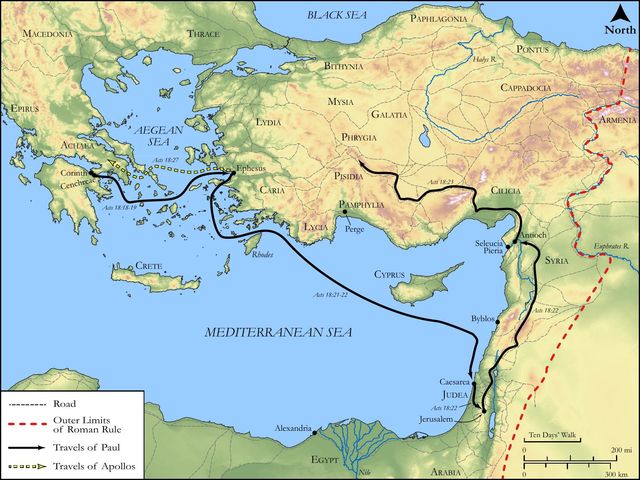
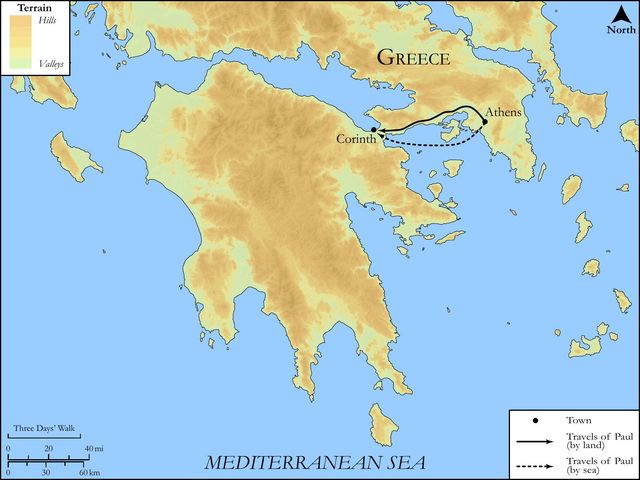
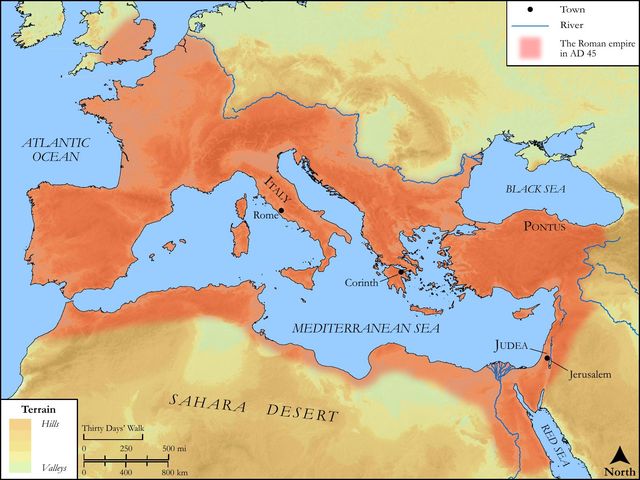
Study this verse
Public-domain commentary
Matthew Henry
From his Commentary on the Whole Bible. Henry comments on passages, not single verses — this entry covers Acts 18:7–11. His two-level outline is real structure in the source text, so it is rendered as structure.
Here we are told,
I.That Paul changed his quarters.
Christ directed his disciples, when he sent them forth, not to go from house to house (Luk 10:7), but there might be occasion to do it, as Paul did here. He departed out of the synagogue, being driven out by the perverseness of the unbelieving Jews, and he entered into a certain man's house, named Justus, Act 18:7. It should seem, he went to this man's house, not to lodge, for he continued with Aquila and Priscilla, but to preach. When the Jews would not let him go on peaceably with his work in their meeting, this honest man opened his doors to him, and told him he should be welcome to preach there; and Paul accepted the proposal. It was not the first time that God's ark had taken up its lodging in a private house. When Paul could not have liberty to preach in the synagogue, he preached in a house, without any disparagement to his doctrine. But observe the account of this man and his house.
1.The man was next door to a Jew; he was one that worshipped God; he was not an idolater, though he was a Gentile, but was a worshipper of the God of Israel, and him only, as Cornelius. That Paul might give the less offence to the Jews, though he had abandoned them, he set up his meeting in this man's house. Even when he was under a necessity of breaking off from them to turn to the Gentiles, yet he would study to oblige them.
2.The house was next door to the synagogue, it joined close to it, which some perhaps might interpret as done with design to draw people from the synagogue to the meeting; but I rather think it was done in charity, to show that he would come as near to them as he could, and was ready to return to them if they were but willing to receive his message, and would not contradict and blaspheme as they had done.
II.That Paul presently saw the good fruit of his labours, both among Jews and Gentiles.
1.Crispus a Jew, an eminent one, the chief ruler of the synagogue, believed on the Lord Jesus, with all his house, Act 18:8. It was for the honour of the gospel that there were some rulers, and persons of the first rank both in church and state, that embraced it. This would leave the Jews inexcusable, that the ruler of their synagogue, who may be supposed to have excelled the rest in knowledge of the scriptures and zeal for their religion, believed the gospel, and yet they opposed and blasphemed it. Not only he, but his house, believed, and, probably, were baptized with him by Paul, Co1 1:14.
2.Many of the Corinthians, who were Gentiles (and some of them persons of bad character, as appears, Co1 6:11, such were some of you), hearing, believed, and were baptized. First, they heard, for faith comes by hearing. Some perhaps came to hear Paul under some convictions of conscience that the way they were in was not right; but it is probable that the most came only for curiosity, because it was a new doctrine that was preached; but, hearing, they believed, by the power of God working upon them; and, believing, they were baptized, and so fixed for Christ, took upon them the profession of Christianity, and became entitled to the privileges of Christians.
III.That Paul was encouraged by a vision to go on with his work at Corinth (Act 18:9):
The Lord Jesus spoke to Paul in the night by a vision; when he was musing on his work, communing with his own heart upon his bed, and considering whether he should continue here or no, what method he should take here, and what probability there was of doing good, then Christ appeared very seasonably to him, and in the multitude of his thoughts within him delighted his soul with divine consolations. 1. He renewed his commission and charge to preach the gospel: "Be not afraid of the Jews; though they are very outrageous, and perhaps the more enraged by the conversion of the chief ruler of their synagogue. Be not afraid of the magistrates of the city, for they have no power against thee but what is given them from above. It is the cause of heaven thou art pleading, do it boldly. Be not afraid of their words, nor dismayed at their looks; but speak, and hold not thy peace; let slip no opportunity of speaking to them; cry aloud, spare not. Do not hold thy peace from speaking for fear of them, nor hold thy peace in speaking" (if I may so say); "do not speak shyly and with caution, but plainly and fully and with courage. Speak out; use all the liberty of spirit that becomes an ambassador for Christ." 2. He assured him of his presence with him, which was sufficient to animate him, and put life and spirit into him: "Be not afraid, for I am with thee, to protect thee, and bear thee out, and to deliver thee from all thy fears; speak, and hold not thy peace, for I am with thee, to own what thou sayest, to work with thee, and to confirm the word by signs following." The same promise that ratified the general commission (Mat 28:19, Mat 28:20), Lo I am with you always, is here repeated. Those that have Christ with them need not to fear, and ought not to shrink. 3. He gave him a warrant of protection to save him harmless: "No man shall set on thee to hurt thee; thou shalt be delivered out of the hands of wicked and unreasonable men and shalt not be driven hence, as thou wast from other places, by persecution." He does not promise that no man should set on him (for the next news we hear is that he is set upon, and brought to the judgment-seat, Act 18:12), but, "No man shall set on thee to hurt thee; the remainder of their wrath shall be restrained; thou shalt not be beaten and imprisoned here, as thou wast at Philippi." Paul met with coarser treatment at first than he did afterwards, and was now comforted according to the time wherein he had been afflicted. Trials shall not last always, Psa 66:10-12. Or we may take it more generally: "No man shall set on thee, tou kakōsai se - to do evil to thee; whatever trouble they may give thee, there is no real evil in it. They may kill thee, but they cannot hurt thee; for I am with thee," Psa 23:4; Isa 41:10. 4. He gave him a prospect of success: "For I have much people in this city. Therefore no man shall prevail to obstruct thy work, therefore I will be with thee to own thy work, and therefore do thou go on vigorously and cheerfully in it; for there are many in this city that are to be effectually called by thy ministry, in whom thou shalt see of the travail of thy soul." Laos esti moi polus - There is to me a great people here. The Lord knows those that are his, yea, and those that shall be his; for it is by his work upon them that they become his, and known unto him are all his works. "I have them, though they yet know me not, though yet they are let captive by Satan at his will; for the Father has given them to me, to be a seed to serve me; I have them written in the book of life; I have their names down, and of all that were given me I will lose none; I have them, for I am sure to have them;" whom he did predestinate, those he called. In this city, though it be a very profane wicked city, full of impurity, and the more so for a temple of Venus there, to which there was a great resort, yet in this heap, that seems to be all chaff, there is wheat; in this ore, that seems to be all dross, there is gold. Let us not despair concerning any place, when even in Corinth Christ had much people.
IV.That upon this encouragement he made a long stay there (Act 18:11):
He continued at Corinth a year and six months, not to take his ease, but to follow his work, teaching the word of God among them; and, it being a city flocked to from all parts, he had opportunity there of preaching the gospel to strangers, and sending notice of it thence to other countries. He staid so long,
1.For the bringing in of those that were without. Christ had many people there, and by the power of his grace he could have had them all converted in one month or week, as at the first preaching of the gospel, when thousands were enclosed at one cast of the net; but God works variously. The people Christ has at Corinth must be called in by degrees, some by one sermon, others by another; we see not yet all things put under Christ. Let Christ's ministers go on in their duty, though their work be not done all at once; nay, though it be done but a little at a time.
2.For the building up of those that were within. Those that are converted have still need to be taught the word of God, and particular need at Corinth to be taught it by Paul himself; for no sooner was the good seed sown in that field than the enemy came and sowed tares, the false apostles, those deceitful workers, of whom Paul in his epistles to the Corinthians complains so much. When the hands of Jewish persecutors were tied, who were professed enemies to the gospel, Paul had a more vexatious trouble created him, and the church more mischievous damage done it, by the tongue of judaizing preachers, who, under colour of the Christian name, undermined the very foundations of Christianity. Soon after Paul came to Corinth, it is supposed, he wrote the first epistle to the Thessalonians, which in order of time was the first of all the epistles he wrote by divine inspiration; and the second epistle to the same church was written not long after. Ministers may be serving Christ, and promoting the great ends of their ministry, by writing good letters, as well as by preaching good sermons.
Historical interpretation
Historical reception
2 surviving comments on this verse. Each one is dated, so this reads as a timeline rather than a list.
Select a marker to jump to its quote. Markers stagger vertically where authors wrote within a few decades of each other.
In Corinth, God appeared in a vision to the apostle and urged him not to be afraid to teach, and he made clear to him the reason why he should speak and not be silent, namely that, in that town, there were many that God knew would receive the proclamation of the gospel. For since it was natural that Paul, being human, was afraid of some attack against himself, seeing that then nearly everyone there was still pagan, God encourages and rouses the teacher to be brave by saying, “I am with you and will prevent anybody from attempting to harm you, so that nobody lays a hand on you.”
"Then spake the Lord to Paul in the night by a vision, Be not afraid, but speak, and hold not thy peace: for I am with thee, and no man shall set on thee to hurt thee: for I have much people in this city." See by how many reasons He persuades him, and how He puts last the reason which of all others most prevailed with him, "I have much people in this city." Now even the number of the "much people" persuaded him, but Christ's claiming them for His own moved him more. Yet He says also, "Fear not": for the danger was become greater now, both because more believed, and also the ruler of the synagogue. This was enough to rouse him. Not that he was reproved as fearing; but that he should not suffer aught; "I am with thee, and none shall set upon thee to hurt thee." For He did not always permit them to suffer evil, that they might not become too weak. For nothing so grieved Paul, as men's unbelief and setting themselves against the Truth: this was worse than the dangers. Therefore it is that Christ appears to him now.
Continue studying Acts 18:9 across the web’s major study libraries — every link below opens this exact verse, chapter, or book on the destination site.
Read & Compare
 BibleGatewayThis verse in more than 200 translations and 70 languages.
 Bible.comThe YouVersion reader — hundreds of translations, reading plans, and highlights.
 ESV.orgCrossway's official English Standard Version reader.
 NET BibleThe NET translation with 60,000+ translators' notes on every rendering decision.
 STEP BibleTyndale House's free study tool — original text, vocabulary, and scholarly resources.
 BibliaLogos Bible Software's free web reader.
 USCCBThe New American Bible (Revised Edition) with the U.S. bishops' study notes.
Commentaries
 BibleHub CommentariesDozens of classic commentaries on this verse, gathered on one page.
 StudyLightMore than 100 commentary sets — the largest collection on the web.
 BibleRefPlain-English commentary on what this verse means, verse by verse.
 Enduring WordDavid Guzik's free commentary on this chapter, widely used by Bible teachers.
 Bible Study ToolsVerse commentary alongside Greek and Hebrew study aids.
Original Language & Research
- BibleHub InterlinearThe verse word by word — original language, transliteration, and English.
- BibleHub LexiconEvery word's original-language definition and Strong's entry.
 Blue Letter BibleDeep-study tools — Strong's numbers, concordance, and word studies.
 CNTR CollationThe earliest Greek manuscripts of this verse, collated letter by letter.
Sermons, Hymns & Audio


TrulyRandomVerse is not affiliated with these sites and doesn’t control their content. They’re linked because they’re genuinely useful.
Summary
In Acts 18:9, the Apostle Paul, ministering in the bustling and often hostile city of Corinth, receives a direct and powerful divine intervention. Through a night vision, the Lord Jesus Christ personally reassures Paul, commanding him to overcome any fear, to speak boldly, and to persist in proclaiming the Gospel without ceasing, promising His unwavering presence and protection amidst the challenges of his ministry.
Context
ShowHideLiterary Context
This verse is strategically placed within the narrative of Paul's second missionary journey, specifically during his extended stay in Corinth. Prior to this vision, Paul had arrived in Corinth from Athens, where his philosophical discourse had met with limited success. In Corinth, he initially worked as a tentmaker with Aquila and Priscilla, while engaging in synagogue ministry on the Sabbath. The narrative highlights a shift when Silas and Timothy arrive, prompting Paul to dedicate himself fully to proclaiming Jesus as the Christ. This intensified preaching led to significant opposition and blasphemy from the Jewish community, causing Paul to declare his intention to turn to the Gentiles (as seen in Acts 18:1-6). It is precisely at this juncture of heightened spiritual conflict and potential discouragement that the Lord's vision provides crucial divine affirmation and direction, reinforcing Paul's mission and alleviating his fears.
Historical & Cultural Context
Corinth was a major Roman provincial capital, a thriving commercial hub, and a notoriously immoral city known for its wealth, diverse population, and pagan worship, particularly the temple of Aphrodite. Its strategic location on an isthmus connecting two seas made it a crossroads of trade and culture, but also a hotbed of various philosophical schools and religious practices, including a significant Jewish diaspora. The atmosphere for Christian evangelism was challenging, marked by both intellectual skepticism and religious hostility. Paul's experience in Corinth, including facing opposition from Jewish leaders (as described in Acts 18:12-17), reflects the typical reception of the Gospel in a Gentile city. The Lord's vision, therefore, serves not only as personal encouragement but also as a divine endorsement of Paul's ministry in such a formidable cultural landscape.
Key Themes
ShowHideActs 18:9 powerfully contributes to several overarching themes in the book of Acts and Paul's ministry. Firstly, it underscores the theme of Divine Sovereignty and Guidance, demonstrating that God actively directs the steps of His servants, intervening directly when needed, as He did for Peter in Acts 12:6-11. Secondly, it highlights the Necessity of Courage in Proclamation, showing that despite human fear or opposition, the Gospel must be proclaimed boldly and without reservation. This echoes the early apostles' prayer for boldness in Acts 4:29-31. Thirdly, the Lord's promise of protection reinforces the theme of God's Protection of His Messengers, assuring Paul that no harm would come to him as long as he remained faithful to his calling, a promise consistent with God's care for His people throughout Scripture, as seen in Psalm 91:1-4. Finally, it emphasizes the Unwavering Mandate to Witness, reinforcing that the mission to spread the Good News is paramount, even in the face of adversity, aligning with the Great Commission in Matthew 28:18-20.
Exposition and Analysis
ShowHideKey Word Analysis
ShowHideThis word refers to a definitive utterance, a direct communication. While the KJV translates it as "spake," the underlying Greek verb (G2036) implies a clear, authoritative declaration, often used for divine pronouncements. It signifies that the Lord's message to Paul was not a mere thought or impression, but a distinct and intentional verbal communication, conveying specific commands and assurances.
Derived from a verb meaning "to gaze at," this term (G3705) denotes something seen, particularly a supernatural sight or revelation. In the biblical context, a "vision" is a divinely granted experience that conveys a message or insight, often in a vivid, pictorial, or auditory manner. Here, it indicates that Paul's encounter with the Lord was a genuine, divinely orchestrated revelation, not a dream or mere imagination, lending absolute authority to the words spoken.
This verb (G5399) means "to frighten" or, in the passive, "to be alarmed" or "to fear." When used with a negative particle, as here ("Be not afraid"), it functions as a divine imperative to overcome apprehension, fear, or timidity. It acknowledges Paul's human vulnerability to fear in the face of opposition but simultaneously provides a divine antidote, calling him to trust in God's power rather than succumb to human weakness.
Verse Breakdown
ShowHide"Then spake the Lord to Paul in the night by a vision"
This clause establishes the divine origin and supernatural nature of the communication. The timing, "in the night," often signifies a time of quiet and receptivity, but also potentially a time of vulnerability or anxiety. The "vision" confirms that this was a direct, unmistakable revelation from the Lord Jesus Christ to Paul, underscoring its authority and significance for Paul's ministry.
"Be not afraid, but speak, and hold not thy peace:"
This is the core divine command and assurance. "Be not afraid" directly addresses any apprehension Paul might have been experiencing due to the intense opposition. It is a powerful divine reassurance of protection and presence. The subsequent commands, "speak, and hold not thy peace," are twin imperatives emphasizing continuous, bold, and unceasing proclamation of the Gospel. "Hold not thy peace" is a strong negation, meaning "do not be silent," highlighting the urgency and non-negotiable nature of Paul's witness, despite any external pressure or internal fear.
Literary Devices
ShowHideThe verse employs several significant literary devices. Direct Discourse is central, as the Lord's exact words to Paul are quoted, lending immediacy and authority to the divine message. This makes the command personal and undeniable. The use of Imperative Mood in "Be not afraid," "speak," and "hold not thy peace" conveys the authoritative and urgent nature of the Lord's instructions. These are not suggestions but direct commands. Furthermore, the phrase "Be not afraid" followed by "but speak, and hold not thy peace" demonstrates a form of Contrast or Antithesis, setting up the desired courageous action against the natural human inclination towards fear or silence. The negative commands ("not afraid," "hold not thy peace") are a form of Litotes, emphasizing the positive action (courage and speaking) by negating the opposite. Finally, the entire encounter functions as a moment of Divine Intervention, a common motif in biblical narratives where God directly steps into human affairs to guide, protect, or empower His chosen servants.
Theological and Thematic Connections
ShowHideActs 18:9 is a profound testament to God's active involvement in the lives of His servants, particularly when they face daunting challenges. It underscores the truth that divine calling is often accompanied by divine enabling and protection. The Lord's command to "Be not afraid" is a recurring motif throughout Scripture, signaling God's presence and sovereignty over circumstances, and empowering His people to fulfill their mission despite opposition. This divine assurance is not a guarantee of an easy path, but a promise of unwavering support and ultimate victory for those who remain faithful in their proclamation of the Gospel. It reminds us that the effectiveness of ministry rests not on human strength or eloquence, but on God's power and faithfulness.
Reflection and Application
ShowHideActs 18:9 offers timeless encouragement for believers navigating the complexities of faith and ministry in a world often hostile to the Gospel. Just as Paul faced intense opposition in Corinth, we too may encounter resistance, ridicule, or apathy when sharing our faith or living out our convictions. This verse reminds us that fear is a natural human emotion, but it is not meant to paralyze us. The Lord's direct intervention to Paul is a powerful reminder that He sees our struggles, knows our fears, and is intimately involved in our lives. His command to "Be not afraid, but speak, and hold not thy peace" is a call to courageous faithfulness. It challenges us to overcome our anxieties, whether they stem from fear of rejection, inadequacy, or persecution, and to faithfully articulate the truth of the Gospel. Our mission is not to achieve results through our own might, but to be obedient in proclamation, trusting that the Lord Himself will protect us and ensure His word accomplishes its purpose. This verse empowers us to step out in boldness, knowing that the God who called us is also the God who goes with us, ensuring that our voice for Christ is not silenced.
Questions for Reflection
ShowHideFAQ
ShowHideWhy did Paul need this vision? Was he afraid?
ShowHideWhile the text doesn't explicitly state Paul was "afraid" in the moments leading up to the vision, the Lord's direct command, "Be not afraid," strongly implies that Paul was experiencing apprehension or was vulnerable to it. Paul had just faced intense opposition and blasphemy from the Jews in Corinth, leading him to shake out his garments in protest and declare his turning to the Gentiles (Acts 18:6). This dramatic shift, combined with the general hostility of Corinth, could easily induce fear or discouragement in any human, even an apostle. The vision served as a timely and crucial divine reassurance, strengthening Paul for the continued, challenging ministry ahead, reminding him that the Lord was with him and would protect him, as promised in Acts 18:10).
Christ-Centered Fulfillment
ShowHideActs 18:9, while a specific encouragement to Paul, finds its ultimate Christ-centered fulfillment in the ongoing mission of the church, empowered by the very Lord who spoke to Paul. The "Lord" who appeared to Paul in the night vision is Jesus Christ Himself, the resurrected and ascended Son of God, who continues to direct His church. His command to "Be not afraid, but speak, and hold not thy peace" is a direct echo of His own fearless proclamation of truth in the face of opposition and His commission to His disciples. Jesus Himself promised His disciples, "I am with you always, even to the end of the age" (Matthew 28:20), a promise that undergirds the Lord's assurance to Paul. Furthermore, the mandate to speak and not be silent reflects Christ's own unwavering witness, even to the point of death on the cross, as described in Philippians 2:8. The protection promised to Paul foreshadows the spiritual protection and ultimate triumph of the church, which Christ declared "the gates of hell shall not prevail against" (Matthew 16:18). Thus, Paul's experience in Acts 18:9 is not merely an isolated historical event, but a living demonstration of the ever-present, empowering, and protective presence of the risen Christ, enabling His followers throughout history to boldly proclaim His saving message.