


Genesis 35:17
Bible text: King James Version (1769 Blayney text) · Public domain
Bible text: Berean Standard Bible · Public domain
Bible text: American Standard Version (1901) · Public domain
Bible text: World English Bible, Messianic edition · Public domain
Bible text: Geneva Bible (1599) · Public domain
Bible text: Young's Literal Translation · Public domain
- וַיְהִיvay·Hiand it wasH1961Conj-w ¦ V-Qal-ConsecImperf-3msVerb Qal Consecutive Imperfect 3rd Singular Masculineוַandיְהִיit was
- בְהַקְשֹׁתָהּve·hak·sho·Tahwhen she had difficultiesH7185Prep-b ¦ V-Hiphil-Inf ¦ 3fsVerb Hiphil Infinitive Constructבְwhenהַקְשֹׁתָhad difficultiesהּshe
- בְּלִדְתָּהּbe·lid·Tahwhen she gave birthH3205Prep-b ¦ V-Qal-Inf ¦ 3fsVerb Qal Infinitive Constructבְּwhenלִדְתָּgave birthהּshe
- וַתֹּאמֶרva·To·merand she saidH559Conj-w ¦ V-Qal-ConsecImperf-3fsVerb Qal Consecutive Imperfect 3rd Singular Feminineוַandתֹּאמֶרshe said
- לָהּlahto <the> herPrep-l ¦ 3fsSuffix Personal 3rd Singular Feminineלָto <the>הּher
- הַמְיַלֶּדֶתham·ya·Le·detthe midwifeH3205Art ¦ V-Piel-Prtcpl-fsVerb Piel Participle Singular Feminine Absoluteהַtheמְיַלֶּדֶתmidwife
- אַל'almay notH408NegParticle Negative
- תִּירְאִיtir·'Iyou be afraidH3372V-Qal-Imperf-2fsVerb Qal Imperfect 2nd Singular Feminine
- כִּיkiforH3588PrtParticle Conditional
- גַםgamalsoH1571AdvAdverb
- זֶהzehthis [one]H2088PrtParticle Demonstrative
- לָךְlakhfor <the> youPrep-l ¦ 2fsSuffix Personal 2nd Singular Feminineלָfor <the>ךְyou
- בֵּןBen[is] a sonH1121N-msNoun Singular Masculine Absolute
English is a literal word-by-word gloss of the Hebrew, not the KJV's wording. Why?
This is the original text the KJV's translators worked from — each Hebrew word with its own literal English meaning in this verse, prepared by scholars at Tyndale House, Cambridge. The KJV translates whole sentences, not word by word, so its wording differs: one Hebrew word can become several English words, and the KJV may choose “the LORD” where the gloss reads “Yahweh”. Both are faithful — they answer different questions. For the KJV's own rendering, switch to the KJV text.
Details
See on the biblical-era maps


Study this verse
Public-domain commentary
Matthew Henry
From his Commentary on the Whole Bible. Henry comments on passages, not single verses — this entry covers Genesis 35:16–20.
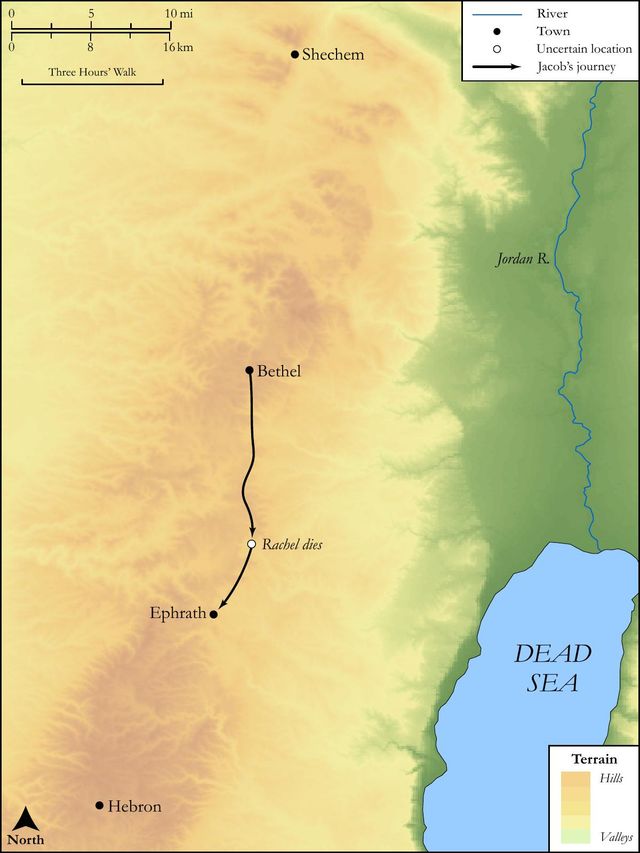
We have here the story of the death of Rachel, the beloved wife of Jacob. 1. She fell in travail by the way, not able to reach to Bethlehem, the next town, though they were near it; so suddenly does pain sometimes come upon a woman in travail, which she cannot escape, or put off. We may suppose Jacob had soon a tent up, convenient enough for her reception. 2. Her pains were violent. She had hard labour, harder than usual: this was the effect of sin, Gen 3:16. Note, Human life begins with sorrow, and the roses of its joy are surrounded with thorns. 3. The midwife encouraged her, Gen 35:17. No doubt she had her midwife with her, ready at hand, yet that would not secure her. Rachel had said, when she bore Joseph, God shall add another son, which now the midwife remembers, and tells her her words were made good. Yet this did not avail to keep up her spirits; unless God command away fear, no one else can. He only says as one having authority, Fear not. We are apt, in extreme perils, to comfort ourselves and our friends with the hopes of a temporal deliverance, in which we may be disappointed; we had better found our comforts on that which cannot fail us, the hope of eternal life. 4. Her travail was to the life of the child, but to her own death. Note, Though the pains and perils of childbearing were introduced by sin, yet they have sometimes been fatal to very holy women, who, though not saved in childbearing, are saved through it with an everlasting salvation. Rachel had passionately said, Give me children, or else I die; and now that she had children (for this was her second) she died. Her dying is here called the departing of her soul. Note, The death of the body is but the departure of the soul to the world of spirits. 5. Her dying lips called her new-born son Ben-oni, The son of my sorrow. And many a son, not born in such hard labour, yet proves the son of his parent's sorrow, and the heaviness of her that bore him. Children are enough the sorrow of their poor mothers in the breeding, bearing, and nursing of them; they should therefore, when they grow up, study to be their joy, and so, if possible, to make them some amends. But Jacob, because he would not renew the sorrowful remembrance of the mother's death every time he called his son by his name, changed his name, and called him Benjamin, The son of my right hand; that is, "very dear to me, set on my right hand for a blessing, the support of my age, like the staff in my right hand." 6. Jacob buried her near the place where she died. As she died in child-bed, it was convenient to bury her quickly; and therefore he did not bring her to the burying-place of his family. If the soul be at rest after death, it matters little where the body lies. In the place where the tree falls, there let it be. No mention is made of the mourning that was at her death, because that might easily be taken for granted. Jacob, no doubt, was a true mourner. Note, Great afflictions sometimes befal us immediately after great comforts. Lest Jacob should be lifted up with the visions of the Almighty with which he was honoured, this was sent as a thorn in the flesh to humble him. Those that enjoy the favours peculiar to the children of God must yet expect the troubles that are common to the children of men. Deborah, who, had she lived, would have been a comfort to Rachel in her extremity, died but a little before. Note, When death comes into a family, it often strikes double. God by it speaks once, yea, twice. The Jewish writers say, "The death of Deborah and Rachel was to expiate the murder of the Shechemites, occasioned by Dinah, a daughter of the family." 7. Jacob set up a pillar upon her grave, so that it was known, long after, to be Rachel's sepulchre (Sa1 10:2), and Providence so ordered it that this place afterwards fell in the lot of Benjamin. Jacob set up a pillar in remembrance of his joys (Gen 35:14), and here he sets up one in remembrance of his sorrows; for, as it may be of use to ourselves to keep both in mind, so it may be of use to others to transmit the memorials of both: the church, long afterwards, owned that what God said to Jacob at Bethel, both by his word and by his rod, he intended for their instruction (Hos 12:4), There he spoke with us.
Continue studying Genesis 35:17 across the web’s major study libraries — every link below opens this exact verse, chapter, or book on the destination site.
Read & Compare
 BibleGatewayThis verse in more than 200 translations and 70 languages.
 Bible.comThe YouVersion reader — hundreds of translations, reading plans, and highlights.
 ESV.orgCrossway's official English Standard Version reader.
 NET BibleThe NET translation with 60,000+ translators' notes on every rendering decision.
 STEP BibleTyndale House's free study tool — original text, vocabulary, and scholarly resources.
 BibliaLogos Bible Software's free web reader.
 USCCBThe New American Bible (Revised Edition) with the U.S. bishops' study notes.
Commentaries
 BibleHub CommentariesDozens of classic commentaries on this verse, gathered on one page.
 StudyLightMore than 100 commentary sets — the largest collection on the web.
 BibleRefPlain-English commentary on what this verse means, verse by verse.
 Enduring WordDavid Guzik's free commentary on this chapter, widely used by Bible teachers.
 Bible Study ToolsVerse commentary alongside Greek and Hebrew study aids.
Original Language & Research
- BibleHub InterlinearThe verse word by word — original language, transliteration, and English.
- BibleHub LexiconEvery word's original-language definition and Strong's entry.
 Blue Letter BibleDeep-study tools — Strong's numbers, concordance, and word studies.
 SefariaThe Hebrew text with Rashi and centuries of Jewish commentary.
Sermons, Hymns & Audio


TrulyRandomVerse is not affiliated with these sites and doesn’t control their content. They’re linked because they’re genuinely useful.
Summary
Genesis 35:17 profoundly captures the perilous and poignant moment of Rachel's final childbirth, depicting her "hard labour" and the midwife's crucial words of encouragement. This verse not only highlights the severe challenges and vulnerabilities of ancient life, particularly during childbirth, but also underscores the vital role of human compassion and the unwavering progression of God's covenant plan through the expansion of Jacob's family, even amidst profound personal suffering and impending tragedy.
Context
ShowHideLiterary Context
This verse is situated within a significant transitional phase in Jacob's life, as he journeys back to the Promised Land. Immediately preceding this event, God has powerfully reconfirmed His covenant promises to Jacob at Bethel, reiterating the blessing of numerous descendants and the inheritance of the land, effectively re-establishing Jacob's identity as "Israel" Genesis 35:9-12. The narrative then swiftly moves to Rachel's childbirth, a moment of intense personal struggle that tragically culminates in her death in the very next verse Genesis 35:18, followed by Benjamin's naming and Rachel's burial. This sequence underscores the interwoven themes of divine promise, human suffering, and the ongoing, often painful, unfolding of God's redemptive plan through the chosen lineage.
Historical & Cultural Context
Childbirth in that day was an extremely dangerous and often life-threatening event for both mother and child, with high mortality rates. Medical knowledge was rudimentary, and women relied heavily on experienced midwives, who provided not only physical assistance but also crucial emotional and spiritual support. The nomadic lifestyle of Jacob's family, constantly on the move, would have exacerbated the dangers of such an event, lacking the stability and resources of a settled community. The birth of a son was paramount for the continuation of the family line and the fulfillment of covenant promises, making Rachel's "hard labour" a moment of immense anxiety and significance for the entire household.
Key Themes
ShowHideGenesis 35:17 contributes to several overarching themes within the book of Genesis. Firstly, it highlights the theme of divine faithfulness amidst human struggle, demonstrating how God's promises of multiplication, first given to Abraham Genesis 12:2, continue to unfold even through personal pain and loss. Secondly, it emphasizes the importance of lineage and the continuity of the covenant, as the birth of this son, Benjamin, completes the twelve sons who will become the patriarchs of Israel's tribes Genesis 49:28. Finally, the verse subtly introduces the theme of life and death intertwined, as the joy of a new birth is immediately followed by the sorrow of Rachel's passing, a poignant reminder of the fragility of life and the mysterious ways in which God's purposes are accomplished.
Exposition and Analysis
ShowHideGenesis 35:17 details a critical moment in the patriarchal narrative, focusing on the immediate crisis of Rachel's childbirth, a scene fraught with danger and deep significance for Jacob's burgeoning family and the future of Israel.
Key Word Analysis
ShowHideMeaning "to be dense, i.e. tough or severe (in various applications); be cruel, be fiercer, make grievous, be ((ask a), be in, have, seem, would) hard(-en, (labour), -ly, thing), be sore, (be, make) stiff(-en, (-necked))." In this context, it describes the extreme difficulty and severity of Rachel's labor, implying a prolonged, agonizing, and life-threatening ordeal. This word choice underscores the dire physical state Rachel was in.
A primitive root meaning "to bear young; causatively, to beget; medically, to act as midwife; specifically, to show lineage." Here, it specifically refers to the act of giving birth, emphasizing the physical process of delivery. The combination with "hard" (qâshâh) paints a vivid picture of the intense struggle Rachel endured in bringing forth her child.
A primitive root meaning "to fear; morally, to revere; caus. to frighten." In the midwife's imperative "Fear not," this word addresses Rachel's natural apprehension and distress during such a perilous delivery. It is a common biblical expression of reassurance, aiming to calm and instill confidence in the face of danger or anxiety.
Verse Breakdown
ShowHide"And it came to pass, when she was in hard labour,"
This opening clause immediately establishes the setting and the critical nature of the situation. "Hard labour" (Hebrew: qashah leladet) signifies an extremely difficult, prolonged, and dangerous childbirth, indicating that Rachel's life was in peril. This phrase sets a tone of urgency and impending crisis, foreshadowing the tragic outcome.
"that the midwife said unto her,"
This introduces the intervention of the midwife, a crucial figure in ancient birthing practices. Her presence highlights the human support system available in such moments and underscores her professional role in guiding the delivery and providing comfort. Her words are presented as a direct, authoritative intervention in Rachel's suffering.
"Fear not;"
This is an imperative command, a common biblical phrase of reassurance (al tire'i in Hebrew). It directly addresses Rachel's emotional state, aiming to alleviate her anxiety and instill courage. Despite the physical agony, the midwife seeks to calm Rachel's spirit, focusing her attention away from the pain and towards the hope of a successful delivery.
"thou shalt have this son also."
This is the core of the midwife's encouragement and promise. The phrase "this son also" explicitly links the coming child to Rachel's first son, Joseph, and implicitly to God's ongoing faithfulness in expanding Jacob's lineage. It confirms the successful birth of a male heir, a matter of immense importance for the continuation of Jacob's family and the fulfillment of God's covenant promises.
Literary Devices
ShowHideGenesis 35:17 employs several literary devices to convey its profound message. The most prominent is Foreshadowing, as the description of "hard labour" subtly hints at the tragic outcome of Rachel's death, which is explicitly stated in the very next verse. This creates a sense of dramatic tension and pathos. The Dialogue of the midwife, "Fear not; thou shalt have this son also," serves as a direct and empathetic intervention, highlighting the human element of support and reassurance in a moment of extreme vulnerability. There is also a subtle Irony in the midwife's words of comfort; while the son is indeed born, the mother does not survive, creating a poignant contrast between the joy of new life and the sorrow of loss. Finally, the phrase "this son also" carries Symbolism, representing not just an individual birth but the continuation and expansion of the covenant lineage, a vital step in the unfolding of God's plan for Israel.
Theological and Thematic Connections
ShowHideGenesis 35:17 powerfully illustrates the intersection of divine sovereignty and human suffering. Even in moments of intense physical agony and vulnerability, God's overarching plan for the multiplication of Jacob's descendants continues to unfold. Rachel's "hard labour" is a stark reality of the fallen world, yet the birth of her son, Benjamin, fulfills a crucial step in the covenant lineage, demonstrating that God's purposes are accomplished even through pain and loss. The midwife's words of encouragement serve as a poignant reminder of the importance of human compassion and support in times of crisis, reflecting a divine principle of caring for the afflicted. This event, immediately preceding Rachel's death, underscores the intertwined themes of life and death, blessing and sorrow, that characterize the biblical narrative, ultimately pointing to a God who works through all circumstances, even the most tragic, to bring about His redemptive design.
Reflection and Application
ShowHideGenesis 35:17 offers a deeply moving and applicable lesson for contemporary life. It reminds us that even life's most anticipated and joyous moments can be accompanied by profound struggle, pain, and uncertainty. Like Rachel, we may encounter "hard labour" in various forms—be it physical illness, emotional distress, spiritual battles, or challenging life transitions. In such times, the passage highlights the invaluable role of encouragement and support from those around us. The midwife's simple yet profound words, "Fear not," serve as a timeless call to trust and courage, reminding us that even in our darkest hours, hope can be found, often through the compassionate words or actions of others. This narrative also compels us to reflect on God's sovereign plan; even when our personal experiences are marked by sorrow or loss, as Rachel's was, God's larger purposes continue to unfold, often in ways beyond our immediate comprehension. We are called to place our trust in His unfailing faithfulness, knowing that He works all things for the good of those who love Him, even amidst life's most trying circumstances.
Questions for Reflection
ShowHideFAQ
ShowHideWhy is the midwife's encouragement so significant given Rachel's eventual death?
ShowHideThe midwife's encouragement, "Fear not; thou shalt have this son also," is profoundly significant because it provides immediate hope and reassurance in a moment of extreme distress and physical peril. While it could not prevent Rachel's ultimate death, which is tragically recounted in Genesis 35:18, it focused on the positive outcome of the birth itself. The successful delivery of a son was crucial for the continuation of Jacob's lineage and the fulfillment of God's covenant promises. The midwife's words represent a vital human act of compassion and a hopeful perspective offered in a crisis, demonstrating the importance of present encouragement even when a larger, unforeseen tragedy looms. It highlights that even in the face of inevitable sorrow, there can be a focus on the immediate blessing and the continuation of life.
Christ-Centered Fulfillment
ShowHideThe birth of Benjamin, despite the profound sorrow surrounding it, is a critical step in the unfolding lineage through which the Messiah would eventually come. As the last of Jacob's twelve sons, Benjamin completes the patriarchal foundation for the nation of Israel, from whom Christ would ultimately descend. The struggles and triumphs of these early patriarchs, including the painful birth of Benjamin, underscore the human condition and the necessity of God's redemptive plan. Rachel's naming of her son "Ben-oni" ("son of my sorrow") poignantly reflects the suffering of childbirth and impending death, while Jacob's renaming him "Benjamin" ("son of the right hand") speaks to strength, favor, and destiny. This narrative foreshadows Christ, the ultimate "Son of Sorrow" who bore the weight of humanity's sin on the cross Isaiah 53:3-5, yet through His resurrection, He became the exalted "Son of the Right Hand" of God Acts 7:55-56, bringing forth spiritual life and eternal hope for all who believe. His journey from suffering to exaltation perfectly embodies the fulfillment of God's promises made to the patriarchs, transforming sorrow into ultimate triumph.