


2 Samuel 13:19
Bible text: King James Version (1769 Blayney text) · Public domain
Bible text: King James Version with Strong's numbers · Public domain
Bible text: Berean Standard Bible · Public domain
Bible text: American Standard Version (1901) · Public domain
Bible text: World English Bible, Messianic edition · Public domain
Bible text: Geneva Bible (1599) · Public domain
Bible text: Young's Literal Translation · Public domain
- וַתִּקַּחva·ti·Kachand she tookH3947Conj-w ¦ V-Qal-ConsecImperf-3fsVerb Qal Consecutive Imperfect 3rd Singular Feminineוַandתִּקַּחshe took
- תָּמָרta·MarTamarH8559N-proper-fNoun Proper Feminine
- אֵפֶר'e·ferash[es]H665N-msNoun Singular Masculine Absolute
- עַל'alonH5921PrepPreposition
- רֹאשָׁהּro·Shahher headH7218N-msc ¦ 3fsNoun Singular Masculine Constructרֹאשָׁheadהּher
- וּכְתֹנֶתu·khe·To·netand [the] long garment ofH3801Conj-w ¦ N-fscNoun Singular Feminine Constructוּandכְתֹנֶת[the] long garment of
- הַפַּסִּיםha·pa·Simthe palms and solesH6446Art ¦ N-mpNoun Plural Masculine Absoluteהַtheפַּסִּיםpalms and soles
- אֲשֶׁר'a·SherwhichH834RelParticle Relative
- עָלֶיהָ'a·Lei·ha[was] on herH5921Prep ¦ 3fsPreposition Definiteעָלֶי[was] onהָher
- קָרָעָהka·Ra·'ahshe toreH7167V-Qal-Perf-3fsVerb Qal Perfect 3rd Singular Feminine
- וַתָּשֶׂםva·Ta·semand she putH7760Conj-w ¦ V-Qal-ConsecImperf-3fsVerb Qal Consecutive Imperfect 3rd Singular Feminineוַandתָּשֶׂםshe put
- יָדָהּya·Dahher handH3027N-csc ¦ 3fsNoun Singular common gender Constructיָדָhandהּher
- עַל'alonH5921PrepPreposition
- רֹאשָׁהּro·Shahher headH7218N-msc ¦ 3fsNoun Singular Masculine Constructרֹאשָׁheadהּher
- וַתֵּלֶךְva·Te·lekhand she wentH1980Conj-w ¦ V-Qal-ConsecImperf-3fsVerb Qal Consecutive Imperfect 3rd Singular Feminineוַandתֵּלֶךְshe went
- הָלוֹךְha·Lokhcontinuously <to go>H1980V-Qal-InfAbsVerb Qal Infinitive Absolute
- וְזָעָקָהve·za·'A·kahand she cried outH2199Conj-w ¦ V-Qal-ConsecPerf-3fsVerb Qal Consecutive Perfect 3rd Singular Feminineוְandזָעָקָהshe cried out
English is a literal word-by-word gloss of the Hebrew, not the KJV's wording. Why?
This is the original text the KJV's translators worked from — each Hebrew word with its own literal English meaning in this verse, prepared by scholars at Tyndale House, Cambridge. The KJV translates whole sentences, not word by word, so its wording differs: one Hebrew word can become several English words, and the KJV may choose “the LORD” where the gloss reads “Yahweh”. Both are faithful — they answer different questions. For the KJV's own rendering, switch to the KJV text.
Details
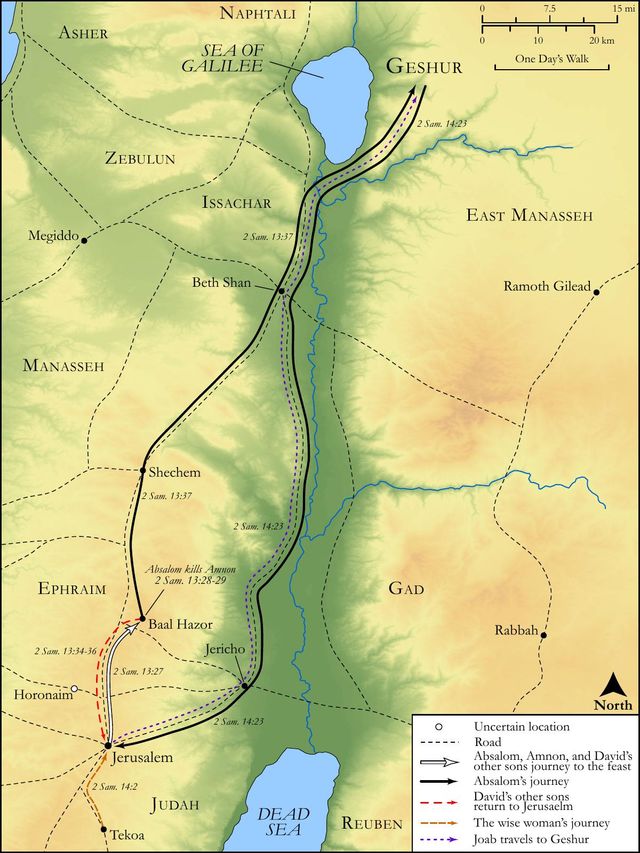
See on the biblical-era maps

Study this verse
Public-domain commentary
Matthew Henry
From his Commentary on the Whole Bible. Henry comments on passages, not single verses — this entry covers 2 Samuel 13:1–20. His four-level outline is real structure in the source text, so it is rendered as structure.
We have here a particular account of the abominable wickedness of Amnon in ravishing his sister, a subject not fit to be enlarged upon nor indeed to be mentioned without blushing, that ever any man should be so vile, especially that a son of David should be so. Amnon's character, we have reason to think, was bad in other things; if he had not forsaken God, he would never have been given up to these vile affections. Godly parents have often been afflicted with wicked children; grace does not run in the blood, but corruption does. We do not find that David's children imitated him in his devotion; but his false steps they trod in, and in those did much worse, and repented not. Parents know not how fatal the consequences may be if in any instance they give their children bad examples. Observe the steps of Amnon's sin.
I.The devil, as an unclean spirit, put it into his heart to lust after his sister Tamar.
Beauty is a snare to many; it was so to her. She was fair, and therefore Amnon coveted her, Sa2 13:1. Those that are peculiarly handsome have no reason, on that account, to be proud, but great reason to stand upon their watch. Amnon's lust was,
1.Unnatural in itself, to lust after his sister, which even natural conscience startles at and cannot think of without horror. Such a spirit of contradiction there is in man's corrupt nature that still it desires forbidden fruit, and the more strongly it is forbidden the more greedily it is desired. Can he entertain the thought of betraying that virtue and honour of which, as a brother, he ought to have been the protector? But what wickedness so vile as not to find admittance into an unsanctified unguarded heart, left to itself?
2.It was very uneasy to him. He was so vexed that he could not gain an opportunity to solicit her chastity (for innocent converse with her was not denied him) that he fell sick, Sa2 13:2. Fleshly lusts are their own punishment, and not only war against the soul, but against the body too, and are the rottenness of the bones. See what a hard master sinners serve, and how heavy his yoke is.
II.The devil, as a subtle serpent, put it into his head how to compass this wicked design.
Amnon had a friend (so he called him, but he was really an enemy to him), a kinsman, that had in him more of David's blood (for he was his nephew) than of David's spirit, for he was a subtle man, cunning to carry on any bad design, especially an intrigue of this nature, Sa2 13:3.
1.He took notice that Amnon looked ill, and, being a subtle man, concluded that he was love-sick (Sa2 13:4), and asks him, "Why art thou, being the king's son, lean from day to day? Why dost thou pine, being the king's eldest son, and heir to the crown. Being the king's son," (1.) "Thou hast the pleasures of the court to divert thee; take those pleasures then, and with them drive away the sorrow, whatever it is." Content and comfort are not always to be found in royal palaces. With much more reason may we ask dejected and disconsolate saints why they, who are the children of the King of kings and heirs of the crown of life, are thus lean from day to day. (2.) "Thou hast the power of a prince to command what thou wantest and wishest for; use that power therefore, and gratify thyself. Pine not away for that which, lawful or unlawful, thou, being the king's son, mayest have. Quicquid libet licet - Your will is law." Thus Jezebel to Ahab in a like case (Kg1 21:7), Dost not thou govern Israel? The abuse of power is the most dangerous temptation of the great.
2.Amnon having the impudence to own his wicked lust, miscalling it love (I love Tamar), Jonadab put him in a way to compass his design, Sa2 13:5. Had he been what he pretended (Amnon's friend), he would have startled at the mention of such horrid wickedness, would have laid before him the evil of it, what an offence it was to God and what a wrong to his own soul to entertain such a vile thought, of what fatal consequence it would be to him to cherish and prosecute it; he would have used his subtlety to divert Amnon from it, by recommending some other person to him, whom he might lawfully marry. But he seems not at all surprised at it, objects not either the unlawfulness or the difficulty, the reproach or so much as his father's displeasure, but puts him in the way to get Tamar to his bed-side, and then he might do as he pleased. Note, The case of those is very miserable whose friends, instead of admonishing and reproving them, flatter them and forward them in their sinful ways, and are their counsellors and contrivers to do wickedly. Amnon is already sick, but goes about; he must take upon him to be so ill (and his thin looks will give colour enough to the pretence) as not to be able to get up, and to have no appetite to any thing but just that which pleases his fancy. Dainty meat is abhorred, Job 33:20. The best dish from the king's table cannot please him; but, if he can eat any thing, it must be from his sister Tamar's fair hand. This is what he is advised to.
3.Amnon followed these directions, and thus got Tamar within his reach: He made himself sick, Sa2 13:6. Thus he lieth in wait secretly, as a lion in his den, to catch the poor, and to draw them into his net, Psa 10:8-10. David was always fond of his children, and concerned if any thing ailed them; he no sooner hears that Amnon is sick than he comes himself to visit him. Let parents learn hence to be tender of their children and compassionate towards them. The sick child commonly the mother comforteth (Isa 66:13), but let not the father be unconcerned. We may suppose that when David came to see his sick son he gave him good counsel to make a right use of his affliction, and prayed with him, which yet did not alter his wicked purpose. At parting, the indulgent father asks, "Is there any thing thou hast a mind to, that I can procure for thee?" "Yes, Sir," says the dissembling son, "my stomach is weak, and I know not of any thing I can eat, unless it be a cake of my sister Tamar's making, and I cannot be satisfied that it is so unless I see her make it, and it will do me the more good if I eat it at her hand." David saw no reason to suspect any mischief intended. God hid his heart from understanding in this matter. He therefore immediately orders Tamar to go and attend her sick brother, Sa2 13:7. He does it very innocently, but afterwards, no doubt, reflected upon it with great regret. Tamar as innocently goes to her brother's chamber, neither dreading any abuse (why should she from a brother, a sick brother?) nor disdaining, in obedience to her father and love to her brother (though but her half-brother), to be his nurse, Sa2 13:8, Sa2 13:9. Though she was a king's daughter, a great beauty (Sa2 13:1), and well dressed (Sa2 13:18), yet she did not think it below her to knead cakes and bake them, nor would she have done this now if she had not been used to it. Good house-wifery is not a thing below the greatest ladies, nor ought they to think it a disparagement to them. The virtuous woman, whose husband sits among the elders, yet works willingly with her hands, Pro 31:13. Modern ages have not been destitute of such instances, nor is it so unfashionable as some would make it. Preparing for the sick should be more the care and delight of the ladies than preparing for the nice, charity more than curiosity.
4.Having got her to him, he contrives to have her alone; for the adulterer (much more so vile an adulterer as this) is in care that no eye see him, Job 24:15. The meat is ready, but he cannot eat while he is looked at by those about him; they must all be turned out, Sa2 13:9. The sick must be humoured, and think they have a privilege to command. Tamar is willing to humour him; her chaste and virtuous soul has not the least thought of that which his polluted breast is full of; and therefore she makes no scruple of being alone with him in the inner chamber, Sa2 13:10. And now the mask is thrown off, the meat is thrown by, and the wicked wretch calls her sister, and yet impudently courts her to come and lie with him, Sa2 13:11. It was a base affront to her virtue to think it possible to persuade her to consent to such wickedness when he knew her behaviour to be always exemplarily modest and virtuous. But it is common for those that live in uncleanness to think others such as themselves, at least tinder to their sparks.
III.The devil, as a strong tempter, deafens his ear to all the reasonings with which she resisted his assaults and would have persuaded him to desist. We may well imagine what a surprise and terror it was to the young lady to be thus attacked, how she blushed and how she trembled; yet, in this great confusion, nothing could be said more pertinently, nor with greater strength of argument, than what she said to him.
1.She calls him brother, reminding him of the nearness of the relation, which made it unlawful for him to marry her, much more to debauch her. It was expressly forbidden (Lev 18:9) under a severe penalty, Lev 20:17. Great care must be taken lest the love that should be among relations degenerate into lust.
2.She entreats him not to force her, which intimates that she would never consent to it in any degree; and what satisfaction could he take in offering violence?
3.She lays before him the great wickedness of it. It is folly; all sin is so, especially uncleanness. It is wickedness of the worst kind. Such abominations ought not to be committed in Israel, among the professing people of God, that have better statutes than the heathen have. We are Israelites; if we do such things, we are more inexcusable than others, and our condemnation will be more intolerable, for we reproach the Lord, and that worthy name by which we are called.
4.She represents to him the shame of it, which perhaps might influence him more than the sin of it: "For my part, whither shall I cause my shame to go? If it should be concealed, yet I shall blush to think of it as long as I live; and, if ever it be known, how shall I be able to look any of my friends in the face? For thy part, thou shalt be as one of the fools in Israel," that is, "Thou wilt be looked upon as an atrocious debauchee, the worst of men; thou wilt lose thy interest in the esteem of all that are wise and good, and so wilt be set aside as unfit to rule, though the first-born; for Israel will never submit to the government of such a fool." Prospect of shame, especially everlasting shame, should deter us from sin.
5.To divert him from his wicked purpose at this time, and (if possible) to get clear of him, she intimates to him that probably the king, rather than he should die for love of her, would dispense with the divine law and let him marry her: not as if she thought he had such a dispensing power, or would pretend to it; but she was confident that, upon notice given to the king by himself of this wicked desire, which he would scarcely have believed from any one else, he would take an effectual course to protect her from him. But all her arts and all her arguments availed not. His proud spirit cannot bear a denial; but her comfort, and honour, and all that was dear to her, must be sacrificed to his brutish and outrageous lust, Sa2 13:14. It is to be feared that Amnon, though young, had long lived a lewd life, which his father either knew not or punished not; for a man could not, of a sudden, arrive at such a pitch of wickedness as this. But is this his love to Tamar? Is this the recompence he gives her for her readiness to attend him in his sickness? Will he deal with his sister as with a harlot? Base villain! God deliver all that are modest and virtuous from such wicked and unreasonable men.
IV.The devil, as a tormentor and betrayer, immediately turns his love of her into hatred (Sa2 13:15):
He hated her with great hatred, greatly, so it is in the margin, and grew as outrageous in his malice as he had been in his lust.
1.He basely turned her out of doors by force; nay, as if he now disdained to touch her with his own hands, he ordered his servant to pull her out and bolt the door after her, Sa2 13:17. Now,
(1.)The innocent injured lady had reason to resent this as a great affront, and in some respects (as she says, Sa2 13:16) worse than the former; for nothing could have been done more barbarous and ill-natured, or more disgraceful to her. Had he taken care to conceal what was done, her honour would have been lost to herself only. Had he gone down on his knees and begged her pardon, it might have been some little reparation. Had he given her time to compose herself after the horrid confusion she was put into, she might have kept her countenance when she went out, and so have kept her counsel. But to dismiss her thus hurried, thus rudely, as if she had done some wicked thing, obliged her, in her own defence, to proclaim the wrong that had been done her.
(2.)We may learn from it both the malignity of sin (unbridled passions are as bad as unbridled appetites) and the mischievous consequences of sin (at last, it bites like a serpent); for here we find,
[1.]That sins, sweet in the commission, afterwards become odious and painful, and the sinner's own conscience makes them so to himself. Amnon hated Tamar because she would not consent to his wickedness, and so take part of the blame upon herself, but to the last resisted it, and reasoned against it, and so threw all the blame upon him. Had he hated the sin, and loathed himself for it, we might have hoped he was penitent. Godly sorrow worketh indignation, Co2 7:11. But to hate the person he had abused showed that his conscience was terrified, but his heart not at all humbled. See what deceitful pleasures those of the flesh are, how soon they pass away, and turn into loathing; see Eze 23:17.
[2.]That sins, secret in the commission, afterwards become open and public, and the sinners themselves often make them so. Their own tongues fall upon them. The Jewish doctors say that, upon the occasion of this wickedness of Amnon, a law was made that a young man and a young woman should never be alone together; for, said they, if the king's daughter be so used, what will become of the children of private men?
2.We must now leave the criminal to the terrors of his own guilty conscience, and enquire what becomes of the poor victim.
(1.)She bitterly lamented the injury she had received, as it was a stain to her honour, though no real blemish to her virtue. She tore her fine clothes in token of her grief, and put ashes upon her head, to deform herself, loathing her own beauty and ornaments, because they had occasioned Amnon's unlawful love; and she went on crying for another's sin, Sa2 13:19.
(2.)She retired to her brother Absalom's house, because he was her own brother, and there she lived in solitude and sorrow, in token of her modesty and detestation of uncleanness. Absalom spoke kindly to her, bade her pass by the injury for the present, designing himself to revenge it, Sa2 13:20. It should seem by Absalom's question (Has Amnon been with thee?) that Amnon was notorious for such lewd practices, so that it was dangerous for a modest woman to be with him; this Absalom might know, and yet Tamar be wholly ignorant of it.
Continue studying 2 Samuel 13:19 across the web’s major study libraries — every link below opens this exact verse, chapter, or book on the destination site.
Read & Compare
 BibleGatewayThis verse in more than 200 translations and 70 languages.
 Bible.comThe YouVersion reader — hundreds of translations, reading plans, and highlights.
 ESV.orgCrossway's official English Standard Version reader.
 NET BibleThe NET translation with 60,000+ translators' notes on every rendering decision.
 STEP BibleTyndale House's free study tool — original text, vocabulary, and scholarly resources.
 BibliaLogos Bible Software's free web reader.
 USCCBThe New American Bible (Revised Edition) with the U.S. bishops' study notes.
Commentaries
 BibleHub CommentariesDozens of classic commentaries on this verse, gathered on one page.
 StudyLightMore than 100 commentary sets — the largest collection on the web.
 BibleRefPlain-English commentary on what this verse means, verse by verse.
 Enduring WordDavid Guzik's free commentary on this chapter, widely used by Bible teachers.
 Bible Study ToolsVerse commentary alongside Greek and Hebrew study aids.
Original Language & Research
- BibleHub InterlinearThe verse word by word — original language, transliteration, and English.
- BibleHub LexiconEvery word's original-language definition and Strong's entry.
 Blue Letter BibleDeep-study tools — Strong's numbers, concordance, and word studies.
 SefariaThe Hebrew text with Rashi and centuries of Jewish commentary.
Sermons, Hymns & Audio


TrulyRandomVerse is not affiliated with these sites and doesn’t control their content. They’re linked because they’re genuinely useful.
Summary
This verse vividly portrays the immediate, devastating reaction of Tamar following her horrific violation by Amnon. Her actions—donning ashes, tearing her distinctive royal garment, laying her hand on her head, and crying continuously—are a profound, public expression of her overwhelming grief, shame, and the irreparable loss of her honor and status within the royal family. It marks a pivotal moment where her private trauma becomes a public lament, exposing the deep brokenness and injustice within David's household and signaling a tragic turning point in the narrative.
Context
ShowHideLiterary Context
2 Samuel 13:19 immediately follows Amnon's brutal act of sexual violence against his half-sister, Tamar, meticulously detailed in 2 Samuel 13:1-14. The preceding verses meticulously recount Amnon's manipulative plot, aided by Jonadab, to lure Tamar into his private chambers under the guise of illness, culminating in the violent assault. This verse serves as a stark and abrupt transition from the hidden, private sin to Tamar's public, visceral display of her shattered state. It sets the agonizing stage for Amnon's subsequent cruel rejection of her (2 Samuel 13:15-17), Tamar's poignant encounter with her full brother Absalom (2 Samuel 13:20), and ultimately, Absalom's meticulously planned and executed vengeance against Amnon, culminating in his murder (2 Samuel 13:28-29). This verse is a crucial turning point, dramatically highlighting the devastating personal and familial consequences of Amnon's transgression, which ripple throughout the remainder of David's reign, marking a significant decline in his household's integrity and peace.
Historical & Cultural Context
In ancient Israel, a woman's virginity was of paramount importance, particularly for a princess, as it was inextricably linked to her honor, her family's honor, and her prospects for marriage and social standing. Sexual violation, especially of a virgin, was not merely a personal affront but a profound public disgrace that brought indelible shame upon the entire family. The actions described in this verse—putting ashes on the head, tearing one's garment, and crying aloud—were universally recognized and deeply symbolic expressions of extreme grief, mourning, lamentation, and public humiliation. These were not merely spontaneous emotional outbursts but established cultural rituals performed to signify profound distress, often in response to death, national disaster, or overwhelming personal tragedy. For a royal princess to engage in such public displays underscored the magnitude of the injustice and her utter desolation, signaling to all who witnessed it that an unspeakable tragedy had occurred.
Key Themes
ShowHideThis verse powerfully contributes to several overarching themes within the book of 2 Samuel and the broader Deuteronomistic History. Firstly, it underscores the devastating consequences of sin and unchecked lust, particularly within David's own family, foreshadowing the unraveling of his kingdom and the subsequent turmoil. Secondly, it highlights the pervasive theme of injustice and the suffering of the innocent, as Tamar, a blameless victim, bears the full, crushing weight of Amnon's transgression. Her actions embody profound grief and lament, showcasing the Bible's unflinching portrayal of human suffering and trauma in the face of evil. The specific mention of the "garment of divers colours" also introduces the theme of loss of status and identity, as the destruction of this symbolic garment mirrors the violent destruction of Tamar's purity, her royal standing, and her future prospects. This incident is a stark illustration of the moral decay within David's household, a direct result of his own past sins and a profound failure to administer justice, as tragically evident in his passive reaction to the news of Tamar's violation in 2 Samuel 13:21.
Exposition and Analysis
ShowHideKey Word Analysis
ShowHideThe act of putting ashes on one's head (H665) was a deeply symbolic and widely practiced ritual in Israel, signifying profound grief, mourning, humility, repentance, and self-abasement. It was a visible sign of utter desolation and distress, often associated with a sense of defilement or loss, as if one were identifying with the dust of death. For Tamar, it was a public declaration of her shattered state and the profound defilement she had endured, a visceral cry for recognition of her suffering.
To "rent" or tear one's garment (H7167) was another common and powerful expression of extreme sorrow, shock, or indignation. This primitive root signifies to literally or figuratively "tear" or "cut out." It was a spontaneous, visceral reaction to news of death, disaster, or profound personal tragedy. The tearing of Tamar's specific garment amplified the symbolic weight of this act, indicating not just grief but also the violent tearing apart of her life, her honor, and her very being.
This specific phrase (H3801, H6446) is highly significant. The Hebrew kethoneth (H3801) refers to a shirt, coat, or tunic, while passim (H6446) describes its distinctive feature, likely referring to a long, sleeved tunic, perhaps one with ornamental stripes or of many breadths, signifying a garment of special value or status. It is the same Hebrew term used to describe Joseph's "coat of many colours" in Genesis 37:3. For Tamar, it symbolized her purity, her royal standing as a virgin princess, and perhaps her protected status as an unmarried daughter. Its violent tearing was therefore a potent symbol of the tearing apart of her innocence, her honor, her future, and her very identity.
Verse Breakdown
ShowHide"And Tamar put ashes on her head"
This action immediately communicates Tamar's overwhelming grief and humiliation. It is a public, ritualistic act of mourning, signifying that she considers herself utterly defiled and broken, as if in a state of death or deep catastrophe. It is a visible cry for recognition of her suffering and a desperate appeal to the community for acknowledgment of her profound loss.
"and rent her garment of divers colours that [was] on her"
This is perhaps the most poignant action in the verse. The destruction of her distinctive royal garment, a potent symbol of her virginity, status, and honor, visually represents the violent destruction of her purity, her future, and her prospects. It is a powerful, non-verbal scream of protest against the injustice and the irreparable damage inflicted upon her identity and social standing.
"and laid her hand on her head"
This gesture, often seen in biblical lament (H3027 for "hand," H7218 for "head"), signifies deep despair, distress, and helplessness. It can be a posture of utter defeat, a sign of being overwhelmed by sorrow, or a gesture of self-affliction in profound mourning. It underscores her complete vulnerability, the crushing weight of her trauma, and her inability to alleviate her own suffering.
"and went on crying"
The continuous nature of her crying (H3212 for "went," H1980 for "on," H2199 for "crying") emphasizes the sustained agony and profound, unceasing nature of her grief. It is not a momentary outburst but an ongoing lament, a public wail that demands attention and acknowledges the depth of her trauma and despair, signifying that her pain is not fleeting but deeply ingrained and enduring.
Literary Devices
ShowHideThe verse is exceptionally rich in Symbolism, where each action carries profound meaning beyond its literal performance. The ashes symbolize profound mourning, humiliation, and defilement, marking Tamar as one in utter despair. The torn garment is a potent symbol of shattered honor, lost virginity, and the violent destruction of her identity and future prospects. The specific "garment of divers colours" is a powerful allusion to Joseph's coat in Genesis, subtly linking Tamar's betrayal and suffering to earlier patriarchal narratives of family dysfunction, injustice, and the devastating consequences of sibling rivalry. The vivid imagery evokes strong pathos, drawing the reader deeply into Tamar's profound suffering and eliciting immediate empathy. The phrase "went on crying" employs durative aspect and a form of hyperbole to emphasize the continuous and overwhelming nature of her grief, creating a sense of sustained agony and despair that permeates the scene. The entire scene is a powerful piece of visual imagery, painting a clear and heartbreaking picture of a soul in utter distress, a public spectacle of private agony.
Theological and Thematic Connections
ShowHideTamar's profound display of grief and shame in 2 Samuel 13:19 serves as a stark reminder of the devastating, far-reaching consequences of sin, particularly sexual violence, within a community and family. The Bible, in its unflinching realism, does not shy away from portraying the raw agony of victims, highlighting the deep spiritual, emotional, and social wounds inflicted by injustice. Her lament underscores a recurring biblical theme: the cries of the oppressed and the suffering of the innocent often go unheard by human authorities, yet they are always heard by God. This verse challenges believers to confront the reality of trauma and injustice, fostering profound empathy for those who suffer and recognizing the importance of lament as a legitimate and necessary form of spiritual expression. It also implicitly points to the pervasive brokenness of humanity and the insidious nature of sin, even within the most privileged households, necessitating a divine intervention for true justice and comprehensive healing.
Reflection and Application
ShowHideTamar's actions in this verse are a visceral, unfiltered portrayal of a soul in agony. Her public display of grief forces us to confront the horrific reality of sexual violence and its devastating impact on victims. It reminds us that the Bible is not a sanitized text but one that unflinchingly reveals the darkest aspects of human sin and suffering, refusing to gloss over the pain of the innocent. For us today, Tamar's story calls us to cultivate profound empathy for those who have experienced trauma and injustice, particularly those whose voices have been silenced or whose pain has been dismissed by societal or even religious structures. It challenges us to create communities—especially within the church—where victims feel safe to express their grief, where their pain is acknowledged without judgment, and where justice is actively pursued. Furthermore, it serves as a sobering reminder of the insidious nature of unchecked sin and the critical importance of accountability, even among those in positions of power. We are called not only to mourn with those who mourn but also to actively work towards preventing such atrocities and supporting survivors in their journey toward healing and restoration, embodying Christ's compassion and pursuit of righteousness.
Questions for Reflection
ShowHideFAQ
ShowHideWhy is the "garment of divers colours" so significant in this verse?
ShowHideThe "garment of divers colours" (Hebrew: kethoneth passim) is highly significant because it was a special, distinctive robe, likely indicating Tamar's royal status, her virginity, and her favored position as a princess. It is the same term used for Joseph's coat in Genesis 37:3, which symbolized his father's favor and his unique status among his brothers. For Tamar, its tearing was not just the destruction of a piece of clothing but a profound symbolic act representing the violent tearing apart of her purity, her honor, her social standing, and her future prospects. This public act made her defilement a visible, irreversible reality, stripping her of her identity and future.
What did the actions of putting ashes on her head and tearing her garment signify in Israel?
ShowHideIn Israel, putting ashes on one's head and tearing one's garment were deeply ingrained and universally understood rituals of extreme mourning, grief, and humiliation. These actions were performed in response to death, national disaster, or profound personal tragedy. Putting ashes on the head symbolized deep sorrow, repentance, self-abasement, and a sense of defilement or desolation, often indicating a state of utter brokenness. Tearing one's clothes, typically from the neck down, was a spontaneous and powerful expression of shock, indignation, or overwhelming grief. Together, these acts communicated a state of utter despair, public shame, and an urgent appeal for recognition of one's suffering, as seen in other biblical accounts of mourning like Job 2:12 and Genesis 37:34.
Christ-Centered Fulfillment
ShowHideTamar's agonizing display of grief and shame in 2 Samuel 13:19, marked by ashes, torn garments, and unceasing lament, finds profound resonance in the Christ-centered narrative of redemption. While Tamar was a victim of human depravity, left to bear her shame and brokenness publicly, Jesus Christ, the ultimate innocent victim, willingly bore the shame and suffering of all humanity. He is the true "man of sorrows, acquainted with grief" (Isaiah 53:3), who took upon Himself the defilement and disgrace that rightfully belonged to us, enduring the ultimate public humiliation on the cross, stripped bare and exposed. Where Tamar's lament was a cry of despair in a world of pervasive injustice, Christ's suffering was a redemptive act that conquered sin and its devastating effects, transforming the very meaning of shame and pain. He came not only to heal the brokenhearted (Luke 4:18) but to identify intimately with the lowly and the traumatized, knowing their pain profoundly because He Himself suffered in every way (Hebrews 4:15). Through His sacrifice, the shame that defiles is removed, and the tears of the oppressed will ultimately be wiped away by God Himself (Revelation 21:4). Tamar's story, therefore, points to the profound need for a Savior who can not only empathize with our deepest wounds but also bring true justice, healing, and restoration where human systems have failed, ultimately transforming ashes into beauty and mourning into everlasting joy (Isaiah 61:3).