


Judges 11:31
- וְהָיָהve·ha·Yahand it will beH1961Conj-w ¦ V-Qal-ConsecPerf-3msVerb Qal Consecutive Perfect 3rd Singular Masculineוְandהָיָהit will be
- הַיּוֹצֵאhai·yo·Tze'whatever comes outH3318Art ¦ V-Qal-Prtcpl-msVerb Qal Participle Singular Masculine Absoluteהַwhateverיּוֹצֵאcomes out
- אֲשֶׁר'a·SherwhichH834RelParticle Relative
- יֵצֵאye·Tze'it will come outH3318V-Qal-Imperf-3msVerb Qal Imperfect 3rd Singular Masculine
- מִדַּלְתֵיmi·dal·Teifrom [the] doors ofH1817Prep-m ¦ N-fdcNoun Dual Feminine Constructמִfromדַּלְתֵי[the] doors of
- בֵיתִיvei·Timy houseH1004N-msc ¦ 1csNoun Singular Masculine Constructבֵיתִhouseיmy
- לִקְרָאתִיlik·ra·Tito meet meH7122Prep-l ¦ V-Qal-Inf ¦ 1csVerb Qal Infinitive Constructלִtoקְרָאתִmeetיme
- בְּשׁוּבִיbe·shu·Viwhen I returnH7725Prep-b ¦ V-Qal-Inf ¦ 1csVerb Qal Infinitive ConstructבְּwhenשׁוּבִreturnיI
- בְשָׁלוֹםve·sha·Lomin peaceH7965Prep-b ¦ N-msNoun Singular Masculine Absoluteבְinשָׁלוֹםpeace
- מִבְּנֵיmi·be·Neifrom [the] people ofH1121Prep-m ¦ N-mpcNoun Plural Masculine Constructמִfromבְּנֵי[the] people of
- עַמּוֹןa·MonAmmonH5983N-proper-mNoun Proper Masculine
- וְהָיָהve·ha·Yahand it will belongH1961Conj-w ¦ V-Qal-ConsecPerf-3msVerb Qal Consecutive Perfect 3rd Singular Masculineוְandהָיָהit will belong
- לַיהוָהla·Yah·wehto YahwehH3068Prep-l ¦ N-properNoun Proper TitleלַtoיהוָהYahweh
- וְהַעֲלִיתִהוּve·ha·'a·li·Ti·huand I will offer up itH5927Conj-w ¦ V-Hiphil-ConsecPerf-1cs ¦ 3msVerb Hiphil Consecutive Perfect 1st Singular common genderוְandהַעֲלִיתִI will offer upהוּit
- עוֹלָהo·Laha burnt offeringH5930N-fsNoun Singular Feminine Absolute
English is a literal word-by-word gloss of the Hebrew, not the KJV's wording. Why?
This is the original text the KJV's translators worked from — each Hebrew word with its own literal English meaning in this verse, prepared by scholars at Tyndale House, Cambridge. The KJV translates whole sentences, not word by word, so its wording differs: one Hebrew word can become several English words, and the KJV may choose “the LORD” where the gloss reads “Yahweh”. Both are faithful — they answer different questions. For the KJV's own rendering, switch to the KJV text.
Details
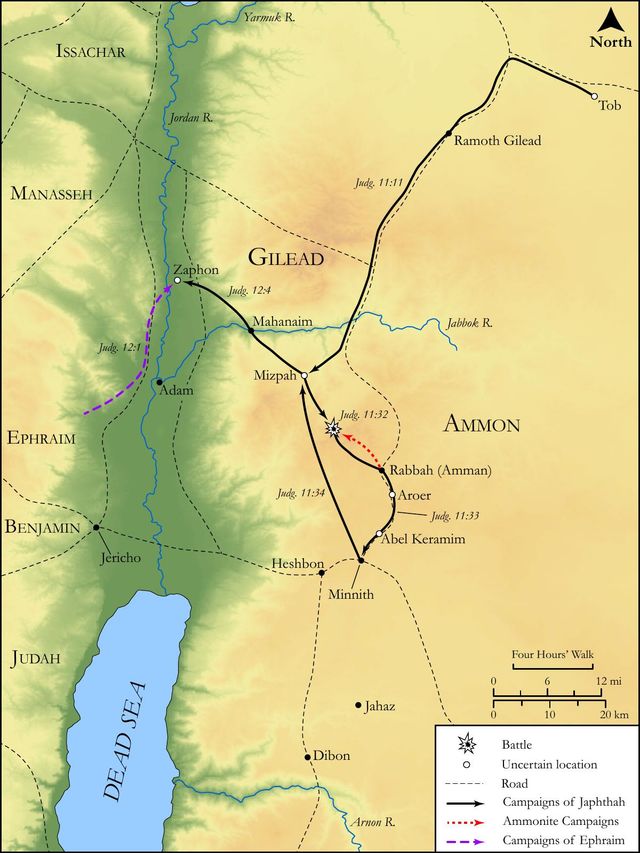
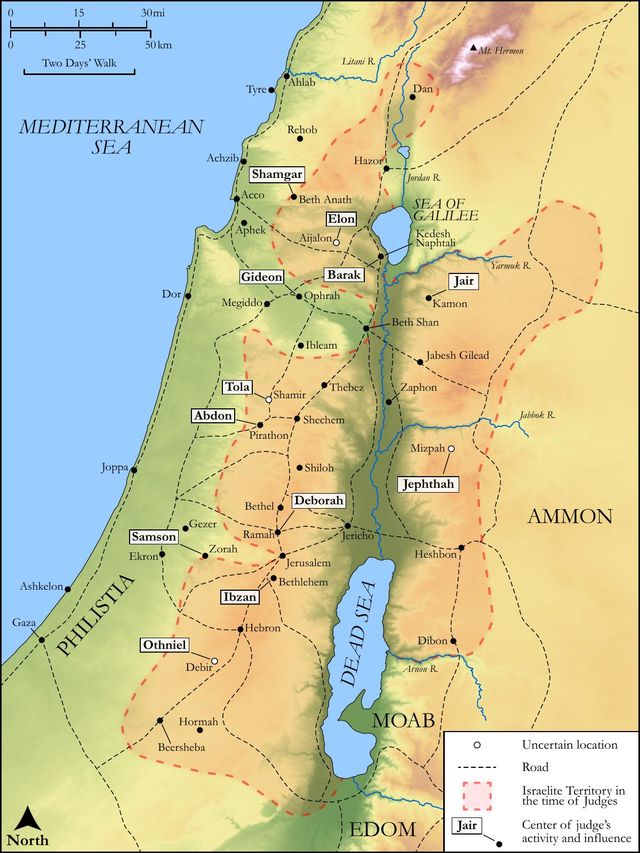
See on the biblical-era map
Study this verse
Public-domain commentary
Matthew Henry
From his Commentary on the Whole Bible. Henry comments on passages, not single verses — this entry covers Judges 11:29–40. His four-level outline is real structure in the source text, so it is rendered as structure.
We have here Jephthah triumphing in a glorious victory, but, as an alloy to his joy, troubled and distressed by an unadvised vow.
I.Jephthah's victory was clear, and shines very brightly, both to his honour and to the honour of God, his in pleading and God's in owning a righteous cause.
1.God gave him an excellent spirit, and he improved it bravely, Jdg 11:29. When it appeared by the people's unanimous choice of him for their leader that he had so clear a call to engage, and by the obstinate deafness of the king of Ammon to the proposals of accommodation that he had so just a cause to engage in, then the Spirit of the Lord came upon him, and very much advanced his natural faculties, enduing him with power from on high, and making him more bold and more wise than ever he had been, and more fired with a holy zeal against the enemies of his people. Hereby God confirmed him in his office, and assured him of success in his undertaking. Thus animated, he loses no time, but with an undaunted resolution takes the field. Particular notice is taken of the way by which he advanced towards the enemy's camp, probably because the choice of it was an instance of that extraordinary discretion with which the Spirit of the Lord had furnished him; for those who sincerely walk after the Spirit shall be led forth the right way.
2.God gave him eminent success, and he bravely improved that too (Jdg 11:32): The Lord delivered the Ammonites into his hand, and so gave judgment upon the appeal in favour of the righteous cause, and made those feel the force of war that would not yield to the force of reason; for he sits in the throne, judging right. Jephthah lost not the advantages given him, but pursued and completed his victory. Having routed their forces in the field, he pursued them to their cities, where he put to the sword all he found in arms, so as utterly to disable them from giving Israel any molestation, Jdg 11:33. But it does not appear that he utterly destroyed the people, as Joshua had destroyed the devoted nations, nor that he offered to make himself master of the country, though their pretensions to the land of Israel might have given him colour to do so: only he took care that they should be effectually subdued. Though others' attempting wrong to us will justify us in the defence of our own right, yet it will not authorize us to do them wrong.
II.Jephthah's vow is dark, and much in the clouds.
When he was going out from his own house upon this hazardous undertaking, in prayer to God for his presence with him he makes a secret but solemn vow or religious promise to God, that, if God would graciously bring him back a conqueror, whosoever or whatsoever should first come out of his house to meet him it should be devoted to God, and offered up for a burnt-offering. At his return, tidings of his victory coming home before him, his own and only daughter meets him with the seasonable expressions of joy. This puts him into a great confusion; but there was no remedy: after she had taken some time to lament her own infelicity, she cheerfully submitted to the performance of his vow. Now,
1.There are several good lessons to be learnt out of this story.
(1.)That there may be remainders of distrust and doubting even in the hearts of true and great believers. Jephthah had reason enough to be confident of success, especially when he found the Spirit of the Lord come upon him, and yet, now that it comes to the settling, he seems to hesitate (v. 30): If thou wilt without fail deliver them into my hand, then I will do so and so. And perhaps the snare into which his vow brought him was designed to correct the weakness of his faith, and a fond conceit he had that he could not promise himself a victory unless he proffered something considerable to be given to God in lieu of it.
(2.)That yet it is very good, when we are in the pursuit or expectation of any mercy, to make vows to God of some instance of acceptable service to him, not as a purchase of the favour we desire, but as an expression of our gratitude to him and the deep sense we have of our obligations to render according to the benefit done to us. The matter of such a singular vow (Lev 27:2) must be something that has a plain and direct tendency either to the advancement of God's glory, and the interests of his kingdom among men, or to the furtherance of ourselves in his service, and in that which is antecedently our duty.
(3.)That we have great need to be very cautious and well advised in the making of such vows, lest, by indulging a present emotion even of pious zeal, we entangle our own consciences, involve ourselves in perplexities, and are forced at last to say before the angel that it was an error, Ecc 5:2-6. It is a snare to a man hastily to devour that which is holy, without due consideration quid valeant humeri, quid ferre recusent - what we are able or unable to effect, and without inserting the needful provisos and limitations which might prevent the entanglement, and then after vows to make the enquiry which should have been made before, Pro 20:25. Let Jephthah's harm be our warning in this matter. See Deu 23:22.
(4.)That what we have solemnly vowed to God we must conscientiously perform, if it be possible and lawful, though it be ever so difficult and grievous to us. Jephthah's sense of the powerful obligation of his vow must always be ours (Jdg 11:35): "I have opened my mouth unto the Lord in a solemn vow, and I cannot go back," that is, "I cannot recall the vow myself, it is too late, nor can any power on earth dispense with it, or give me up my bond." The thing was my own, and in my own power (Act 5:4), but now it is not. Vow and pay, Psa 76:11. We deceive ourselves if we think to mock God. If we apply this to the consent we have solemnly given, in our sacramental vows, to the covenant of grace made with poor sinners in Christ, what a powerful argument will it be against the sins we have by those vows bound ourselves out from, what a strong inducement to the duties we have hereby bound ourselves up to, and what a ready answer to every temptation! "I have opened my mouth to the Lord, and I cannot go back; I must therefore go forward. I have sworn, and I must, I will, perform it. Let me not dare to play fast and loose with God." (5.) That it well becomes children obediently and cheerfully to submit to their parents in the Lord, and particularly to comply with their pious resolutions for the honour of God and the keeping up of religion in their families, though they be harsh and severe, as the Rechabites, who for many generations religiously observed the commands of Jonadab their father in forbearing wine, and Jephthah's daughter here, who, for the satisfying of her father's conscience, and for the honour of God and her country, yielded herself as one devoted (Jdg 11:36): "Do to me according to that which hath proceeded out of thy mouth; I know I am dear to thee, but am well content that God should be dearer." The father might disallow any vow made by the daughter (Num 30:5), but the daughter could not disallow or disannul, no, not such a vow as this, made by the father. This magnifies the law of the fifth commandment. (6.) That our friends' grievances should be our griefs. Where she went to bewail her hard fate the virgins, her companions, joined with her in her lamentations, Jdg 11:38. With those of her own sex and age she used to associate, who no doubt, now that her father had on a sudden grown so great, expected, shortly after his return, to dance at her wedding, but were heavily disappointed when they were called to retire to the mountains with her and share in her griefs. Those are unworthy the name of friends that will only rejoice with us, and not weep with us. (7.) That heroic zeal for the honour of God and Israel, though alloyed with infirmity and indiscretion, is worthy to be had in perpetual remembrance. It well became the daughters of Israel by an annual solemnity to preserve the honourable memory of Jephthah's daughter, who made light even of her own life like a noble heroine, when God had taken vengeance on Israel's enemies, Jdg 11:36. Such a rare instance of one that preferred the public interest before life itself was never to be forgotten. Her sex forbade her to follow to the war, and so to expose her life in battle, in lieu of which she hazards it much more (and perhaps apprehended that she did so, having some intimation of his vow, and did it designedly; for he tells her, Jdg 11:35, Thou hast brought me very low) to grace his triumphs. So transported was she with the victory as a common benefit that she was willing to be herself offered up as a thank-offering for it, and would think her life well bestowed when laid down on so great an occasion. She thinks it an honour to die, not as a sacrifice of atonement for the people's sins (that honour was reserved for Christ only), but as a sacrifice of acknowledgment for the people's mercies. (8.) From Jephthah's concern on this occasion, we must learn not to think it strange if the day of our triumphs in this world prove upon some account or other the day of our griefs, and therefore must always rejoice with trembling; we hope for a day of triumph hereafter which will have no alloy.
2.Yet there are some difficult questions that do arise upon this story which have very much employed the pens of learned men. I will say but little respecting them, because Mr. Poole has discussed them very fully in his English annotations.
(1.)It is hard to say what Jephthah did to his daughter in performance of his vow.
[1.]Some think he only shut her up for a nun, and that it being unlawful, according to one part of his vow (for they make it disjunctive), to offer her up for a burnt-offering, he thus, according to the other part, engaged her to be the Lord's, that is, totally to sequester herself from all the affairs of this life, and consequently from marriage, and to employ herself wholly in the acts of devotion all her days. That which countenances this opinion is that she is said to bewail her virginity (Jdg 11:37, Jdg 11:38) and that she knew no man, Jdg 11:39. But, if he sacrificed her, it was proper enough for her to bewail, not her death, because that was intended to be for the honour of God, and she would undergo it cheerfully, but that unhappy circumstance of it which made it more grievous to her than any other, because she was her father's only child, in whom he hoped his name and family would be built up, that she was unmarried, and so left no issue to inherit her father's honour and estate; therefore it is particularly taken notice of (Jdg 11:34) that besides her he had neither son nor daughter. But that which makes me think Jephthah did not go about thus to satisfy his vow, or evade it rather, is that we do not find any law, usage, or custom, in all the Old Testament, which does in the least intimate that a single life was any branch or article of religion, or that any person, man or woman, was looked upon as the more holy, more the Lord's, or devoted to him, for living unmarried: it was no part of the law either of the priests or of the Nazarites. Deborah and Huldah, both prophetesses, are both of them particularly recorded to have been married women. Besides, had she only been confined to a single life, she needed not to have desired these two months to bewail it in: she had her whole life before her to do that, if she saw cause. Nor needed she to take such a sad leave of her companions; for those that are of that opinion understand what is said in Jdg 11:40 of their coming to talk with her, as our margin reads it, four days in a year. Therefore,
[2.]It seems more probable that he offered her up for a sacrifice, according to the letter of his vow, misunderstanding that law which spoke of persons devoted by the curse of God as if it were to be applied to such as were devoted by men's vows (Lev 27:29, None devoted shall be redeemed, but shall surely be put to death), and wanting to be better informed of the power the law gave him in this case to redeem her. Abraham's attempt to offer up Isaac perhaps encouraged him, and made him think, if God would not accept this sacrifice which he had vowed, he would send an angel to stay his hand, as he did Abraham's. If she came out designedly to be made a sacrifice, as who knows but she might? perhaps he thought that would make the case the plainer. Volenti non sit injuria - No injury is done to a person by that to which he himself consents. He imagined, it may be, that where there was neither anger nor malice there was no murder, and that his good intention would sanctify this bad action; and, since he had made such a vow, he thought better to kill his daughter than break his vow, and let Providence bear the blame, that brought her forth to meet him.
(2.)But, supposing that Jephthah did sacrifice his daughter, the question is whether he did well.
[1.]Some justify him in it, and think he did well, and as became one that preferred the honour of God before that which was dearest to him in this world. He is mentioned among the eminent believers who by faith did great things, Heb 11:32. And this was one of the great things he did. It was done deliberately, and upon two months' consideration and consultation. He is never blamed for it by any inspired writer. Though it highly exalts the paternal authority, yet it cannot justify any in doing the like. He was an extraordinary person. The Spirit of the Lord came upon him. Many circumstances, now unknown to us, might make this altogether extraordinary, and justify it, yet not so as that it might justify the like. Some learned men have made this sacrifice a figure of Christ the great sacrifice: he was of unspotted purity and innocency, as she a chaste virgin; he was devoted to death by his Father, and so made a curse, or an anathema, for us; he submitted himself, as she did, to his Father's will: Not as I will, but as thou wilt. But,
[2.]Most condemn Jephthah; he did ill to make so rash a vow, and worse to perform it. He could not be bound by his vow to that which God had forbidden by the letter of the sixth commandment: Thou shalt not kill. God had forbidden human sacrifices, so that it was (says Dr. Lightfoot) in effect a sacrifice to Moloch. And, probably, the reason why it is left dubious by the inspired penman whether he sacrificed her or no was that those who did afterwards offer their children might not take any encouragement from this instance. Concerning this and some other such passages in the sacred story, which learned men are in the dark, divided, and in doubt about, we need not much perplex ourselves; what is necessary to our salvation, thanks be to God, is plain enough.
Historical interpretation
Fourteen Centuries of Reception
4 surviving comments on this verse. Each one is dated, so this reads as a timeline rather than a list.
Select a marker to jump to its quote. Markers stagger vertically where authors wrote within a few decades of each other.
People imitate those who do good deeds, therefore, not out of love for these good deeds but because of their utility.… The king of Moab took note of Jephthah. But, because it was his firstborn and a human being rather than an animal that he killed, God took pity on him, since he did it in affliction and not through love. In the case of Jephthah, if it had been one of his servants who had been first to encounter him, he would have killed him. But, in order that people would not engage in the sacrifice of their fellow human beings, he caused his own daughter to meet him, so that others would be afraid, lest they offer human beings by vow to God.
And whereas he [Jovinianus] prefers the fidelity of the father Jephthah to the tears of the virgin daughter, that corroborates our point. For we are not commending virgins of the world so much as those who are virgins for Christ’s sake. Most Hebrews blame the father for the rash vow he made, “If you will indeed deliver the children of Ammon into my hand, then it shall be that whatsoever comes out of the doors of my house to meet me, when I return in peace from the children of Ammon, it shall be for the Lord’s, and I will offer it up for a burnt offering.” Supposing (the Hebrews say) a dog or an ass had met him, what would he have done? Their meaning is that God so ordered events that he who had improvidently made a vow should learn his error by the death of his daughter.
With these words [of his vow] at any rate Jephthah did not vow some kind of animal that he could offer as a whole burnt offering according to the law; it is neither customary now nor was it in the past that cattle would run to meet generals returning victoriously from war. As far as mute animals are concerned, dogs often run to meet their masters and sport with them in fawning servitude. But Jephthah could not have been thinking about dogs in his vow, because it would seem that he would have vowed not only something unlawful but also something contemptible and unclean according to the law. It would have been an insult to God. Nor does he say, "I will offer as a whole burnt offering whatever will come out of the doors of my house to meet me." He says, "I will sacrifice whoever comes out of my house." Thus, there can be no doubt that he was thinking of nothing else than a human being—not his only daughter, however. Yet who would have been able to surpass her in her father's eyes except perhaps his wife?
Whosoever: Some are of opinion, that the meaning of this vow of Jephte, was to consecrate to God whatsoever should first meet him, according to the condition of the thing; so as to offer it up as a holocaust, if it were such a thing as might be offered by the law; or to devote it otherwise to God, if it were not such as the law allowed to be offered in sacrifice. And therefore they think the daughter of Jephte was not slain by her father, but only consecrated to perpetual virginity. But the common opinion followed by the generality of the holy fathers and divines is, that she was offered as a holocaust, in consequence of her father's vow: and that Jephte did not sin, at least not mortally, neither in making, nor in keeping, his vow: since he is no ways blamed for it in scripture; and was even inspired by God himself to make the vow (as appears from ver. 29, 30) in consequence of which he obtained the victory; and therefore he reasonably concluded that God, who is the master of life and death, was pleased on this occasion to dispense with his own law; and that it was the divine will he should fulfil his vow.
Continue studying Judges 11:31 across the web’s major study libraries — every link below opens this exact verse, chapter, or book on the destination site.
Read & Compare
 BibleGatewayThis verse in more than 200 translations and 70 languages.
 Bible.comThe YouVersion reader — hundreds of translations, reading plans, and highlights.
 ESV.orgCrossway's official English Standard Version reader.
 NET BibleThe NET translation with 60,000+ translators' notes on every rendering decision.
 STEP BibleTyndale House's free study tool — original text, vocabulary, and scholarly resources.
 BibliaLogos Bible Software's free web reader.
 USCCBThe New American Bible (Revised Edition) with the U.S. bishops' study notes.
Commentaries
 BibleHub CommentariesDozens of classic commentaries on this verse, gathered on one page.
 StudyLightMore than 100 commentary sets — the largest collection on the web.
 BibleRefPlain-English commentary on what this verse means, verse by verse.
 Enduring WordDavid Guzik's free commentary on this chapter, widely used by Bible teachers.
 Bible Study ToolsVerse commentary alongside Greek and Hebrew study aids.
Original Language & Research
- BibleHub InterlinearThe verse word by word — original language, transliteration, and English.
- BibleHub LexiconEvery word's original-language definition and Strong's entry.
 Blue Letter BibleDeep-study tools — Strong's numbers, concordance, and word studies.
 SefariaThe Hebrew text with Rashi and centuries of Jewish commentary.
Sermons, Hymns & Audio


TrulyRandomVerse is not affiliated with these sites and doesn’t control their content. They’re linked because they’re genuinely useful.
Summary
Judges 11:31 records the pivotal and ultimately tragic vow made by Jephthah, the Gileadite judge, as he prepared for battle against the Ammonites. In a desperate plea for divine favor and victory, Jephthah rashly pledges that if the Lord grants him success, whatever first emerges from the doors of his house upon his peaceful return will be consecrated to the Lord and offered as a burnt offering. This impulsive and ill-conceived promise, born from a misunderstanding of God's character and the Mosaic Law, sets the stage for a devastating personal tragedy that profoundly illustrates the moral and spiritual decline prevalent during the tumultuous period of the Judges.
Context
ShowHideLiterary Context
The narrative of Judges 11 introduces Jephthah as an overlooked figure, the son of a prostitute, ostracized by his half-brothers and driven from his family inheritance, as detailed in Judges 11:1-3. Despite his ignominious origins, his formidable reputation as a "mighty warrior" leads the elders of Gilead to seek him out as their deliverer against the oppressive Ammonites, as described in Judges 11:4-11. Following an unsuccessful diplomatic exchange with the Ammonite king, recounted in Judges 11:12-28, the Spirit of the Lord comes upon Jephthah, empowering him for the impending conflict (Judges 11:29). It is in this moment of heightened spiritual empowerment and the immediate anticipation of battle that Jephthah, perhaps out of a misguided zeal or an attempt to solidify divine assistance, utters this fateful vow. The verse directly precedes the account of God granting Jephthah a decisive victory over the Ammonites in Judges 11:32-33, thereby establishing the tragic inevitability of the vow's fulfillment in the subsequent narrative.
Historical & Cultural Context
The book of Judges vividly portrays a turbulent era in Israelite history, characterized by a cyclical pattern of apostasy, divine judgment through foreign oppression, repentance, and subsequent deliverance by divinely appointed judges. This period, which spanned the time between the conquest of Canaan and the establishment of the monarchy, was marked by a severe lack of centralized religious and political leadership, leading to widespread moral and spiritual anarchy, famously summarized by the recurring refrain, "every man did that which was right in his own eyes" (Judges 21:25). Vows were a common and significant religious practice throughout the ancient Near East, frequently made in times of distress or as a means of seeking divine intervention. While the Mosaic Law permitted and regulated vows, it also underscored their solemnity and the imperative of fulfilling them (Deuteronomy 23:21-23). Crucially, human sacrifice was an utterly abhorrent practice, explicitly and repeatedly forbidden in Israel as a detestable custom of the Canaanite nations (Leviticus 18:21; Deuteronomy 12:31). Jephthah's vow, therefore, tragically reveals either a profound ignorance of, or a desperate disregard for, the fundamental tenets of Israelite worship and the very character of Yahweh.
Key Themes
ShowHideJephthah's vow in Judges 11:31 contributes significantly to several overarching themes within the book of Judges and broader biblical theology. Firstly, it powerfully illustrates the danger of rash vows made without careful consideration, full understanding of God's will, or discernment of potential consequences. It demonstrates how desperate circumstances can lead to ill-conceived promises with devastating and irreversible outcomes. Secondly, the verse starkly highlights a profound misunderstanding of God's sacrificial system and His holy character. While burnt offerings were a central component of Israelite worship, they were strictly regulated and never, under any circumstances, involved human sacrifice, which was an abomination to the Lord (Leviticus 1). Jephthah's promise reveals a syncretistic tendency, possibly influenced by the surrounding pagan cultures that practiced child sacrifice, indicating a blurring of Israelite distinctiveness. Finally, this episode serves as a poignant example of the moral and spiritual decline in Israel during the Judges period, where even divinely appointed leaders acted according to their own flawed understanding and perceived necessity rather than God's revealed law, leading to tragic and lamentable outcomes.
Exposition and Analysis
ShowHideKey Word Analysis
ShowHideThe verb yāṣā' (H3318) is a primitive root meaning "to go (causatively, bring) out, in a great variety of applications, literally and figuratively, direct and proxim." In this context, it refers to the first living being that emerges from Jephthah's house to greet him. While some interpretations attempt to limit this to an animal, the natural reading of "to meet me" (לִקְרָאתִי, liqra'ti, from H7125, meaning "an encountering, accidental, friendly or hostile") strongly implies a person, as animals typically do not "meet" someone in this manner, especially from within a house. The tragic outcome, where his daughter fulfills the condition, confirms this interpretation.
The phrase "the LORD'S" (H3068, Yᵉhôvâh) signifies dedication or consecration to God, the self-Existent or Eternal One. In the context of vows, it implies setting something apart for sacred use or service. For an animal, this would mean offering it as a sacrifice. For a person, it could imply dedication to lifelong service (like a Nazirite vow, though Jephthah's vow is distinct) or, tragically, a sacrificial offering in Jephthah's misguided understanding. The ambiguity of this phrase, combined with the subsequent "burnt offering," creates the profound tension and horror of the vow.
The Hebrew term ʿōlāh (H5930) literally means "that which goes up" or "ascends," referring to a holocaust (as going up in smoke), an animal sacrifice entirely consumed by fire on the altar, with the smoke ascending to God as a pleasing aroma. It was a sacrifice of complete dedication. The application of this term to a human being, especially in the context of Jephthah's vow, is profoundly problematic and directly contradicts Mosaic Law, which strictly forbade human sacrifice as an abomination to the Lord. This reveals Jephthah's profound theological ignorance or a desperate, syncretistic attempt to appease God through pagan means.
Verse Breakdown
ShowHide"Then it shall be, that whatsoever cometh forth of the doors of my house to meet me,"
This clause establishes the critical condition of Jephthah's vow. It is an open-ended statement, not specifying a type of creature, but implying the first living being to emerge from his home. The phrase "to meet me" suggests an intentional greeting, which would typically be performed by a person. This lack of specificity, or perhaps Jephthah's unstated assumption of an animal, is crucial to the ensuing tragedy, as he is ultimately met by his only child.
"when I return in peace from the children of Ammon,"
This part sets the timing and the desired outcome of the battle. Jephthah's vow is explicitly contingent upon God granting him victory and a safe, unhindered return. It underscores his desperation and his attempt to bargain with God for military success against the Ammonites, who had been oppressing Israel for eighteen years. The "peace" signifies a successful, unhindered return, implying the fulfillment of God's favor and the cessation of conflict.
"shall surely be the LORD'S,"
This phrase indicates the dedication or consecration of the "whatsoever" to Yahweh. It implies that the object of the vow will be set apart for God's exclusive use or possession. In the context of vows, this could mean various forms of dedication, from temple service to a Nazirite vow, or, as Jephthah tragically interprets it, a sacrificial offering. The solemnity of this declaration underscores the binding nature of the vow in Jephthah's own mind, regardless of its content.
"and I will offer it up for a burnt offering."
This is the most shocking and problematic part of the vow. By specifying a "burnt offering," Jephthah explicitly states his intention to completely consume the dedicated entity by fire on an altar. This directly violates God's clear prohibition against human sacrifice, which was an abhorrent pagan practice. This clause reveals Jephthah's profound theological error and his willingness to make an extreme, unlawful promise in his zeal for victory, leading to a devastating and irreversible consequence.
Literary Devices
ShowHideThe narrative of Jephthah's vow in Judges 11:31 is rich with literary devices that amplify its tragic impact and theological implications. Foreshadowing is prominently employed, as the very wording of the vow immediately signals impending doom, especially given the strict biblical prohibitions against human sacrifice. The audience, well-aware of God's law, anticipates a dire and tragic outcome. There is a strong element of irony in Jephthah's attempt to secure divine favor through a vow that ultimately leads to the sacrifice of his innocent daughter, an act fundamentally opposed to God's character and law. This highlights the tragic irony of human attempts to manipulate divine will through misguided religiosity. The story also employs pathos, evoking deep pity and sorrow for Jephthah's daughter, who becomes the unwitting victim of her father's rash promise and the prevailing spiritual darkness. Furthermore, the narrative serves as a powerful cautionary tale, illustrating the severe consequences of impulsive vows and a superficial understanding of divine commands, a recurring theme in the period of the Judges, where individuals often acted "right in their own eyes" rather than according to God's revealed truth.
Theological and Thematic Connections
ShowHideJudges 11:31 stands as a stark reminder of the solemnity of vows and the profound dangers of making them rashly or based on a flawed understanding of God's character and law. It unequivocally underscores that God does not require or delight in human sacrifice; rather, He explicitly forbids it as an abomination. This episode powerfully illustrates the spiritual and moral decline of Israel during the Judges period, where even leaders like Jephthah, despite being empowered by the Spirit, could operate outside of God's revealed will, leading to tragic outcomes. It highlights the critical importance of knowing God's word and character, as true worship is rooted in obedience and a contrite heart, not in desperate, misguided attempts to manipulate divine favor or fulfill promises that violate His holy commands.
Reflection and Application
ShowHideJephthah's tragic vow in Judges 11:31 serves as a profound cautionary tale for believers today, compelling us to deeply consider the seriousness with which we make promises, particularly those directed towards God. In moments of desperation, fear, or ambition, it can be tempting to make rash commitments, believing that extreme measures or bargaining will secure divine favor. However, this passage teaches us that God desires genuine faith, wholehearted obedience, and a true, intimate understanding of His character far more than impulsive, ill-conceived bargains. We are called to live by faith, trusting in God's sovereign goodness and provision, rather than attempting to manipulate Him through vows that may violate His revealed will or lead to unforeseen and devastating consequences. Our walk with God should be characterized by careful discernment, humble submission to His word, and a deep appreciation for His boundless grace, which does not require us to earn His favor through self-imposed burdens or forbidden practices.
Questions for Reflection
ShowHideFAQ
ShowHideWas Jephthah's vow acceptable to God?
ShowHideAbsolutely not. While vows were a legitimate part of Israelite worship, Jephthah's vow was fundamentally unacceptable to God because it included the intention of a "burnt offering" for "whatsoever cometh forth of the doors of my house." God explicitly and repeatedly forbade human sacrifice as an abomination, a practice associated with pagan nations like the Canaanites (Deuteronomy 12:31). The Mosaic Law clearly outlines the types of sacrifices acceptable to God, none of which involve human beings (Leviticus 1). Jephthah's vow demonstrates a profound ignorance or disregard for these foundational laws and God's holy character, reflecting the spiritual decay of the Judges period.
Did God require Jephthah to fulfill this vow?
ShowHideNo, God did not require Jephthah to fulfill a vow that involved human sacrifice. While vows were generally considered binding in Israelite society (Deuteronomy 23:21-23), there were provisions for redemption or substitution in certain cases, particularly for persons dedicated to the Lord (Leviticus 27:1-8). More importantly, a vow that commanded an act contrary to God's explicit law (like human sacrifice) would have been null and void from a divine perspective. God desires obedience to His commands over ritualistic offerings or misguided zeal (1 Samuel 15:22). Jephthah's tragic fulfillment of the vow highlights his own misguided zeal and the spiritual darkness of the era, rather than God's endorsement or requirement of the act.
Christ-Centered Fulfillment
ShowHideThe tragic narrative of Jephthah's rash vow and its devastating outcome in Judges 11:31 finds its profound Christ-centered fulfillment in the perfect, willing sacrifice of Jesus Christ. Jephthah's vow, born of human desperation and a flawed understanding of God, led to the accidental and unlawful sacrifice of his innocent daughter, an act that brought only sorrow and violated divine law. In stark contrast, God the Father, in His perfect love and wisdom, willingly offered His only begotten Son, Jesus, as the ultimate and complete sacrifice for the sins of humanity (John 3:16). Unlike Jephthah's misguided burnt offering, Jesus' sacrifice on the cross was not an abomination but the fulfillment of all Old Testament sacrifices, perfectly atoning for sin once and for all (Hebrews 10:10-14). Where Jephthah's actions highlight humanity's inability to truly appease God through self-devised means, Christ's perfect obedience and self-offering demonstrate God's boundless grace and the true path to reconciliation. The innocent daughter's fate underscores the cost of sin and human folly, while Jesus, the Lamb of God who takes away the sin of the world, perfectly fulfills the righteous requirements of God, offering true peace, redemption, and eternal life that no human vow or sacrifice could ever achieve.