


Judges 11:39
Bible text: King James Version (1769 Blayney text) · Public domain
Bible text: King James Version with Strong's numbers · Public domain
Bible text: Berean Standard Bible · Public domain
Bible text: American Standard Version (1901) · Public domain
Bible text: World English Bible, Messianic edition · Public domain
Bible text: Geneva Bible (1599) · Public domain
Bible text: Young's Literal Translation · Public domain
- וַיְהִיvay·Hiand it wasH1961Conj-w ¦ V-Qal-ConsecImperf-3msVerb Qal Consecutive Imperfect 3rd Singular Masculineוַandיְהִיit was
- מִקֵּץmi·Ketzfrom [the] end ofH7093Prep-m ¦ N-mscNoun Singular Masculine Constructמִfromקֵּץ[the] end of
- שְׁנַיִםshe·Na·yimtwoH8147N-cdNoun Dual common gender Absolute
- חֳדָשִׁיםcho·da·ShimmonthsH2320N-mpNoun Plural Masculine Absolute
- וַתָּשָׁבva·Ta·shovand she returnedH7725Conj-w ¦ V-Qal-ConsecImperf-3fsVerb Qal Consecutive Imperfect 3rd Singular Feminineוַandתָּשָׁבshe returned
- אֶל'eltoH413PrepPreposition
- אָבִיהָ'a·Vi·haher fatherH1N-msc ¦ 3fsNoun Singular Masculine Constructאָבִיfatherהָher
- וַיַּעַשׂvai·Ya·'asand he didH6213Conj-w ¦ V-Qal-ConsecImperf-3msVerb Qal Consecutive Imperfect 3rd Singular Masculineוַandיַּעַשׂhe did
- לָהּLahto <the> herPrep-l ¦ 3fsSuffix Personal 3rd Singular Feminineלָto <the>הּher
- אֶת'et<obj.>H853DirObjMParticle Object Indicator
- נִדְרוֹnid·Rohis vowH5088N-msc ¦ 3msNoun Singular Masculine Constructנִדְרvowוֹhis
- אֲשֶׁר'a·SherwhichH834RelParticle Relative
- נָדָרna·Darhe had vowedH5087V-Qal-Perf-3msVerb Qal Perfect 3rd Singular Masculine
- וְהִיאve·Hi'and sheH1931Conj-w ¦ Pro-3fsPronoun Personal 3rd Singular Feminineוְandהִיאshe
- לֹאlo'notH3808NegParticle Negative
- יָדְעָהya·de·'Ahshe had knownH3045V-Qal-Perf-3fsVerb Qal Perfect 3rd Singular Feminine
- אִישׁ'Isha manH376N-msNoun Singular Masculine Absolute
- וַתְּהִיva·te·hiand it wasH1961Conj-w ¦ V-Qal-ConsecImperf-3fsVerb Qal Consecutive Imperfect 3rd Singular Feminineוַandתְּהִיit was
- חֹקchoka customH2706N-msNoun Singular Masculine Absolute
- בְּיִשְׂרָאֵלbe·Yis·ra·'Elin IsraelH3478Prep-b ¦ N-properNoun Proper LocationבְּinיִשְׂרָאֵלIsrael
English is a literal word-by-word gloss of the Hebrew, not the KJV's wording. Why?
This is the original text the KJV's translators worked from — each Hebrew word with its own literal English meaning in this verse, prepared by scholars at Tyndale House, Cambridge. The KJV translates whole sentences, not word by word, so its wording differs: one Hebrew word can become several English words, and the KJV may choose “the LORD” where the gloss reads “Yahweh”. Both are faithful — they answer different questions. For the KJV's own rendering, switch to the KJV text.
Details
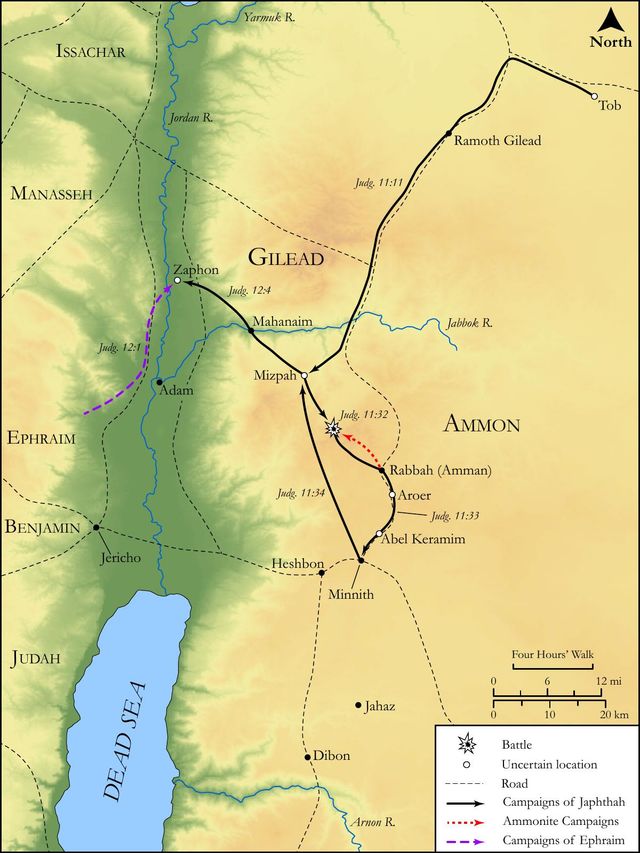
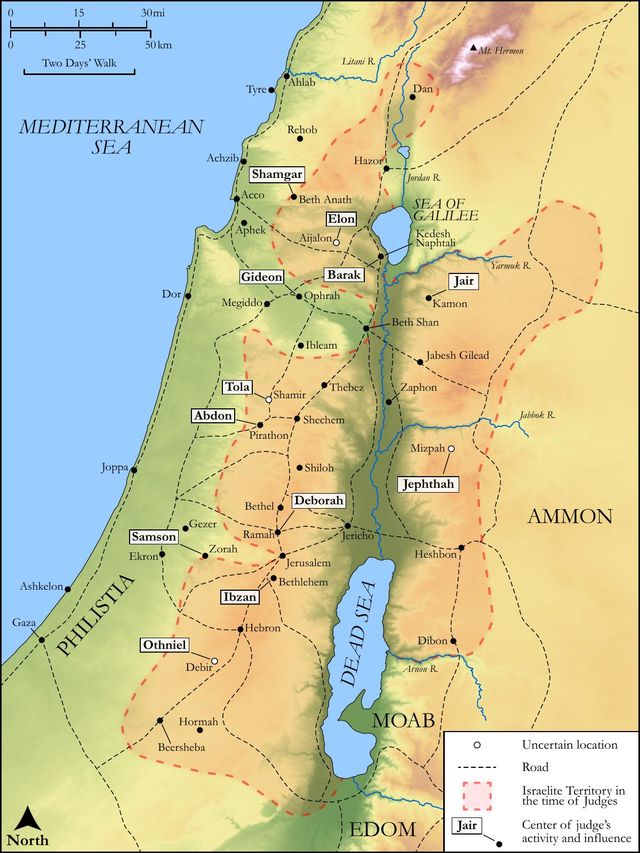
See on the biblical-era maps
Study this verse
Public-domain commentary
Matthew Henry
From his Commentary on the Whole Bible. Henry comments on passages, not single verses — this entry covers Judges 11:29–40. His four-level outline is real structure in the source text, so it is rendered as structure.
We have here Jephthah triumphing in a glorious victory, but, as an alloy to his joy, troubled and distressed by an unadvised vow.
I.Jephthah's victory was clear, and shines very brightly, both to his honour and to the honour of God, his in pleading and God's in owning a righteous cause.
1.God gave him an excellent spirit, and he improved it bravely, Jdg 11:29. When it appeared by the people's unanimous choice of him for their leader that he had so clear a call to engage, and by the obstinate deafness of the king of Ammon to the proposals of accommodation that he had so just a cause to engage in, then the Spirit of the Lord came upon him, and very much advanced his natural faculties, enduing him with power from on high, and making him more bold and more wise than ever he had been, and more fired with a holy zeal against the enemies of his people. Hereby God confirmed him in his office, and assured him of success in his undertaking. Thus animated, he loses no time, but with an undaunted resolution takes the field. Particular notice is taken of the way by which he advanced towards the enemy's camp, probably because the choice of it was an instance of that extraordinary discretion with which the Spirit of the Lord had furnished him; for those who sincerely walk after the Spirit shall be led forth the right way.
2.God gave him eminent success, and he bravely improved that too (Jdg 11:32): The Lord delivered the Ammonites into his hand, and so gave judgment upon the appeal in favour of the righteous cause, and made those feel the force of war that would not yield to the force of reason; for he sits in the throne, judging right. Jephthah lost not the advantages given him, but pursued and completed his victory. Having routed their forces in the field, he pursued them to their cities, where he put to the sword all he found in arms, so as utterly to disable them from giving Israel any molestation, Jdg 11:33. But it does not appear that he utterly destroyed the people, as Joshua had destroyed the devoted nations, nor that he offered to make himself master of the country, though their pretensions to the land of Israel might have given him colour to do so: only he took care that they should be effectually subdued. Though others' attempting wrong to us will justify us in the defence of our own right, yet it will not authorize us to do them wrong.
II.Jephthah's vow is dark, and much in the clouds.
When he was going out from his own house upon this hazardous undertaking, in prayer to God for his presence with him he makes a secret but solemn vow or religious promise to God, that, if God would graciously bring him back a conqueror, whosoever or whatsoever should first come out of his house to meet him it should be devoted to God, and offered up for a burnt-offering. At his return, tidings of his victory coming home before him, his own and only daughter meets him with the seasonable expressions of joy. This puts him into a great confusion; but there was no remedy: after she had taken some time to lament her own infelicity, she cheerfully submitted to the performance of his vow. Now,
1.There are several good lessons to be learnt out of this story.
(1.)That there may be remainders of distrust and doubting even in the hearts of true and great believers. Jephthah had reason enough to be confident of success, especially when he found the Spirit of the Lord come upon him, and yet, now that it comes to the settling, he seems to hesitate (v. 30): If thou wilt without fail deliver them into my hand, then I will do so and so. And perhaps the snare into which his vow brought him was designed to correct the weakness of his faith, and a fond conceit he had that he could not promise himself a victory unless he proffered something considerable to be given to God in lieu of it.
(2.)That yet it is very good, when we are in the pursuit or expectation of any mercy, to make vows to God of some instance of acceptable service to him, not as a purchase of the favour we desire, but as an expression of our gratitude to him and the deep sense we have of our obligations to render according to the benefit done to us. The matter of such a singular vow (Lev 27:2) must be something that has a plain and direct tendency either to the advancement of God's glory, and the interests of his kingdom among men, or to the furtherance of ourselves in his service, and in that which is antecedently our duty.
(3.)That we have great need to be very cautious and well advised in the making of such vows, lest, by indulging a present emotion even of pious zeal, we entangle our own consciences, involve ourselves in perplexities, and are forced at last to say before the angel that it was an error, Ecc 5:2-6. It is a snare to a man hastily to devour that which is holy, without due consideration quid valeant humeri, quid ferre recusent - what we are able or unable to effect, and without inserting the needful provisos and limitations which might prevent the entanglement, and then after vows to make the enquiry which should have been made before, Pro 20:25. Let Jephthah's harm be our warning in this matter. See Deu 23:22.
(4.)That what we have solemnly vowed to God we must conscientiously perform, if it be possible and lawful, though it be ever so difficult and grievous to us. Jephthah's sense of the powerful obligation of his vow must always be ours (Jdg 11:35): "I have opened my mouth unto the Lord in a solemn vow, and I cannot go back," that is, "I cannot recall the vow myself, it is too late, nor can any power on earth dispense with it, or give me up my bond." The thing was my own, and in my own power (Act 5:4), but now it is not. Vow and pay, Psa 76:11. We deceive ourselves if we think to mock God. If we apply this to the consent we have solemnly given, in our sacramental vows, to the covenant of grace made with poor sinners in Christ, what a powerful argument will it be against the sins we have by those vows bound ourselves out from, what a strong inducement to the duties we have hereby bound ourselves up to, and what a ready answer to every temptation! "I have opened my mouth to the Lord, and I cannot go back; I must therefore go forward. I have sworn, and I must, I will, perform it. Let me not dare to play fast and loose with God." (5.) That it well becomes children obediently and cheerfully to submit to their parents in the Lord, and particularly to comply with their pious resolutions for the honour of God and the keeping up of religion in their families, though they be harsh and severe, as the Rechabites, who for many generations religiously observed the commands of Jonadab their father in forbearing wine, and Jephthah's daughter here, who, for the satisfying of her father's conscience, and for the honour of God and her country, yielded herself as one devoted (Jdg 11:36): "Do to me according to that which hath proceeded out of thy mouth; I know I am dear to thee, but am well content that God should be dearer." The father might disallow any vow made by the daughter (Num 30:5), but the daughter could not disallow or disannul, no, not such a vow as this, made by the father. This magnifies the law of the fifth commandment. (6.) That our friends' grievances should be our griefs. Where she went to bewail her hard fate the virgins, her companions, joined with her in her lamentations, Jdg 11:38. With those of her own sex and age she used to associate, who no doubt, now that her father had on a sudden grown so great, expected, shortly after his return, to dance at her wedding, but were heavily disappointed when they were called to retire to the mountains with her and share in her griefs. Those are unworthy the name of friends that will only rejoice with us, and not weep with us. (7.) That heroic zeal for the honour of God and Israel, though alloyed with infirmity and indiscretion, is worthy to be had in perpetual remembrance. It well became the daughters of Israel by an annual solemnity to preserve the honourable memory of Jephthah's daughter, who made light even of her own life like a noble heroine, when God had taken vengeance on Israel's enemies, Jdg 11:36. Such a rare instance of one that preferred the public interest before life itself was never to be forgotten. Her sex forbade her to follow to the war, and so to expose her life in battle, in lieu of which she hazards it much more (and perhaps apprehended that she did so, having some intimation of his vow, and did it designedly; for he tells her, Jdg 11:35, Thou hast brought me very low) to grace his triumphs. So transported was she with the victory as a common benefit that she was willing to be herself offered up as a thank-offering for it, and would think her life well bestowed when laid down on so great an occasion. She thinks it an honour to die, not as a sacrifice of atonement for the people's sins (that honour was reserved for Christ only), but as a sacrifice of acknowledgment for the people's mercies. (8.) From Jephthah's concern on this occasion, we must learn not to think it strange if the day of our triumphs in this world prove upon some account or other the day of our griefs, and therefore must always rejoice with trembling; we hope for a day of triumph hereafter which will have no alloy.
2.Yet there are some difficult questions that do arise upon this story which have very much employed the pens of learned men. I will say but little respecting them, because Mr. Poole has discussed them very fully in his English annotations.
(1.)It is hard to say what Jephthah did to his daughter in performance of his vow.
[1.]Some think he only shut her up for a nun, and that it being unlawful, according to one part of his vow (for they make it disjunctive), to offer her up for a burnt-offering, he thus, according to the other part, engaged her to be the Lord's, that is, totally to sequester herself from all the affairs of this life, and consequently from marriage, and to employ herself wholly in the acts of devotion all her days. That which countenances this opinion is that she is said to bewail her virginity (Jdg 11:37, Jdg 11:38) and that she knew no man, Jdg 11:39. But, if he sacrificed her, it was proper enough for her to bewail, not her death, because that was intended to be for the honour of God, and she would undergo it cheerfully, but that unhappy circumstance of it which made it more grievous to her than any other, because she was her father's only child, in whom he hoped his name and family would be built up, that she was unmarried, and so left no issue to inherit her father's honour and estate; therefore it is particularly taken notice of (Jdg 11:34) that besides her he had neither son nor daughter. But that which makes me think Jephthah did not go about thus to satisfy his vow, or evade it rather, is that we do not find any law, usage, or custom, in all the Old Testament, which does in the least intimate that a single life was any branch or article of religion, or that any person, man or woman, was looked upon as the more holy, more the Lord's, or devoted to him, for living unmarried: it was no part of the law either of the priests or of the Nazarites. Deborah and Huldah, both prophetesses, are both of them particularly recorded to have been married women. Besides, had she only been confined to a single life, she needed not to have desired these two months to bewail it in: she had her whole life before her to do that, if she saw cause. Nor needed she to take such a sad leave of her companions; for those that are of that opinion understand what is said in Jdg 11:40 of their coming to talk with her, as our margin reads it, four days in a year. Therefore,
[2.]It seems more probable that he offered her up for a sacrifice, according to the letter of his vow, misunderstanding that law which spoke of persons devoted by the curse of God as if it were to be applied to such as were devoted by men's vows (Lev 27:29, None devoted shall be redeemed, but shall surely be put to death), and wanting to be better informed of the power the law gave him in this case to redeem her. Abraham's attempt to offer up Isaac perhaps encouraged him, and made him think, if God would not accept this sacrifice which he had vowed, he would send an angel to stay his hand, as he did Abraham's. If she came out designedly to be made a sacrifice, as who knows but she might? perhaps he thought that would make the case the plainer. Volenti non sit injuria - No injury is done to a person by that to which he himself consents. He imagined, it may be, that where there was neither anger nor malice there was no murder, and that his good intention would sanctify this bad action; and, since he had made such a vow, he thought better to kill his daughter than break his vow, and let Providence bear the blame, that brought her forth to meet him.
(2.)But, supposing that Jephthah did sacrifice his daughter, the question is whether he did well.
[1.]Some justify him in it, and think he did well, and as became one that preferred the honour of God before that which was dearest to him in this world. He is mentioned among the eminent believers who by faith did great things, Heb 11:32. And this was one of the great things he did. It was done deliberately, and upon two months' consideration and consultation. He is never blamed for it by any inspired writer. Though it highly exalts the paternal authority, yet it cannot justify any in doing the like. He was an extraordinary person. The Spirit of the Lord came upon him. Many circumstances, now unknown to us, might make this altogether extraordinary, and justify it, yet not so as that it might justify the like. Some learned men have made this sacrifice a figure of Christ the great sacrifice: he was of unspotted purity and innocency, as she a chaste virgin; he was devoted to death by his Father, and so made a curse, or an anathema, for us; he submitted himself, as she did, to his Father's will: Not as I will, but as thou wilt. But,
[2.]Most condemn Jephthah; he did ill to make so rash a vow, and worse to perform it. He could not be bound by his vow to that which God had forbidden by the letter of the sixth commandment: Thou shalt not kill. God had forbidden human sacrifices, so that it was (says Dr. Lightfoot) in effect a sacrifice to Moloch. And, probably, the reason why it is left dubious by the inspired penman whether he sacrificed her or no was that those who did afterwards offer their children might not take any encouragement from this instance. Concerning this and some other such passages in the sacred story, which learned men are in the dark, divided, and in doubt about, we need not much perplex ourselves; what is necessary to our salvation, thanks be to God, is plain enough.
Historical interpretation
Historical reception
5 surviving comments on this verse. Each one is dated, so this reads as a timeline rather than a list.
Select a marker to jump to its quote. Markers stagger vertically where authors wrote within a few decades of each other.
Never shall I be led to believe that the leader Jephthah made his vow otherwise than without thought, when he promised to offer to God whatever should meet him at the threshold of his house on his return. For he repented of his vow, as afterwards his daughter came to meet him. He tore his clothes and said, “Alas, my daughter, you have entangled me, you have become a source of trouble for me.” And though with pious fear and reverence he took upon himself the bitter fulfillment of his cruel task, yet he ordered and left to be observed an annual period of grief and mourning for future times. It was a hard vow, but far more bitter was its fulfillment, while he who carried it out had the greatest cause to mourn. Thus it became a rule and a law in Israel from year to year, as it says: “that the daughters of Israel went to lament the daughter of Jephthah the Gileadite four days in a year.” I cannot blame the man for holding it necessary to fulfill his vow, but yet it was a wretched necessity which could only be solved by the death of his child.…What, then, in the case of esteemed and learned people is full of marvel, that in the case of a virgin is found to be far more splendid, far more glorious, as she says to her sorrowing father, “Do to me according to that which has proceeded out of your mouth.” But she asked for a delay of two months in order that she might go about with her companions upon the mountains to bewail fitly and dutifully her virginity now given up to death. The weeping of her companions did not move her, their grief did not prevail upon her, nor did their lamentations hold her back. She did not allow the day to pass, nor did the hour escape her notice. She returned to her father as though returning according to her own desire, and of her own will [she] urged him on when he was hesitating, and acted thus of her own free choice, so that what was at first an awful chance became a pious sacrifice.
It is also sometimes contrary to duty to fulfill a promise or to keep an oath. As was the case with Herod, who swore that whatever was asked he would give to the daughter of Herodias, and so allowed the death of John, that he might not break his word. And what shall I say of Jephthah, who offered up his daughter in sacrifice, she having been the first to meet him as he returned home victorious; whereby he fulfilled the vow which he had made that he would offer to God whatever should meet him first. It would have been better to make no promise at all than to fulfill it in the death of his daughter.
For Jephthah likewise, when he had promised that the first thing that met him, after a victorious battle, he would sacrifice, fell into the snare of child murder; for his daughter first meeting him, he sacrificed her, and God did not forbid it. And I know, indeed, that many of the unbelievers impugn us of cruelty and inhumanity on account of this sacrifice; but I should say that the concession in the case of this sacrifice was a striking example of providence and clemency; and that it was in care for our race that he did not prevent that sacrifice. For if after that vow and promise he had forbidden the sacrifice, many also who were subsequent to Jephthah, in the expectation that God would not receive their vows, would have increased the number of such vows, and proceeding on their way would have fallen into child murder. But now, by suffering this vow to be actually fulfilled, he put a stop to all such cases in the future. And to show that this is true, after Jephthah’s daughter had been slain, in order that the calamity might be always remembered and that her fate might not be consigned to oblivion, it became a law among the Jews that the virgins assembling at the same season should bewail during forty days the sacrifice which had taken place; in order that renewing the memory of it by lamentation, they should make all people wiser for the future; and that they might learn that it was not after the mind of God that this should be done, for in that case he would not have permitted the virgins to bewail and lament her. And that what I have said is not conjectural, the event demonstrated; for after this sacrifice, no one vowed such a vow to God. Therefore also he did not indeed forbid this; but what he had expressly commanded in the case of Isaac, that he directly prohibited, plainly showing through both cases that he does not delight in such sacrifices.
But we rightly ask whether human sacrifices must have foreshadowed future events.… But if this were true, this type of sacrifice would not displease God. But in fact the Scriptures themselves clearly testify that human sacrifices displease him. For when God wanted and commanded all the firstborn to belong to him and to be his, he nonetheless wanted the firstborn of humankind to be redeemed by their parents, so that they would not entrust their firstborn children to God through immolation.…Now clearly God loves and rewards those sacrifices when a just man endures injustice and struggles for the truth even to the point of death or when he is killed by enemies whom he has offended for righteousness' sake, as he has returned them good for evil, that is, love instead of hatred.… In imitation of Abel, thousands of martyrs have struggled for the truth to the point of death and have been sacrificed by savage enemies. The Scripture says of them, "God has tested them like gold in a furnace and he has accepted them as a whole burnt offering." So too the apostle says, "I am being sacrificed."13
But that is not how Jephthah made a whole burnt offering to the Lord out of his daughter. Rather he offered her as a literal sacrifice in the way that it was commanded for animals to be offered and forbidden for humans to be sacrificed. What he did seems rather similar to what Abraham did. In that instance the Lord gave him a special command that this ought to be done. He did not order him by way of a general commandment that such sacrifices should take place at some time. Indeed, the general rule prohibited it.
As regards to the fact that Jephthah sacrificed his daughter to God as a whole burnt offering, these are the facts: he had vowed that if he were to obtain the victory, he would offer as a whole burnt offering whoever would come out of his house and meet him; because he had vowed this and won the battle and his daughter had been the one to meet him first, he fulfilled his vow. This event has become a great and rather difficult question to settle both for some who investigate the matter with piety and genuinely seek to know what this passage means and for some who out of ignorant impiety oppose the Holy Scriptures and call this a horrible misdeed that the God of the law and prophets would have delighted in sacrifices, yes, even human sacrifices. First let us reply to their calumnies by noting that the whole burnt offerings of cattle did not delight the God of the law and the prophets—or as I prefer to say, the God of Abraham, Isaac and Jacob. What pleased God about those sacrifices was that they were full of meaning and a foreshadowing of future things. We, however, have the very substance which was foreshadowed by these sacrifices that he wished to commend to us. Moreover, there was also a very pertinent reason why those sacrifices have been changed so that they no longer are commanded but even forbidden: it is so that we may not think that God is pleased by such sacrifices according to some carnal passion.
Continue studying Judges 11:39 across the web’s major study libraries — every link below opens this exact verse, chapter, or book on the destination site.
Read & Compare
 BibleGatewayThis verse in more than 200 translations and 70 languages.
 Bible.comThe YouVersion reader — hundreds of translations, reading plans, and highlights.
 ESV.orgCrossway's official English Standard Version reader.
 NET BibleThe NET translation with 60,000+ translators' notes on every rendering decision.
 STEP BibleTyndale House's free study tool — original text, vocabulary, and scholarly resources.
 BibliaLogos Bible Software's free web reader.
 USCCBThe New American Bible (Revised Edition) with the U.S. bishops' study notes.
Commentaries
 BibleHub CommentariesDozens of classic commentaries on this verse, gathered on one page.
 StudyLightMore than 100 commentary sets — the largest collection on the web.
 BibleRefPlain-English commentary on what this verse means, verse by verse.
 Enduring WordDavid Guzik's free commentary on this chapter, widely used by Bible teachers.
 Bible Study ToolsVerse commentary alongside Greek and Hebrew study aids.
Original Language & Research
- BibleHub InterlinearThe verse word by word — original language, transliteration, and English.
- BibleHub LexiconEvery word's original-language definition and Strong's entry.
 Blue Letter BibleDeep-study tools — Strong's numbers, concordance, and word studies.
 SefariaThe Hebrew text with Rashi and centuries of Jewish commentary.
Sermons, Hymns & Audio


TrulyRandomVerse is not affiliated with these sites and doesn’t control their content. They’re linked because they’re genuinely useful.
Summary
Judges 11:39 records the sorrowful and irreversible fulfillment of Jephthah's rash vow concerning his only daughter. After a two-month period of lamentation, she returned to her father, who then carried out his solemn promise. The critical detail that "she knew no man" strongly indicates that the nature of Jephthah's vow resulted in her lifelong dedication to the Lord in perpetual virginity, rather than a literal human sacrifice, which was explicitly forbidden and an abomination to God under Mosaic Law. This verse concludes the personal tragedy, setting the stage for the commemorative custom that arose from this profound event in Israel.
Context
ShowHideLiterary Context
Judges 11:39 brings to a poignant close the narrative of Jephthah's vow and its devastating consequences, a story that unfolds across Judges 11. The preceding verses establish the context: Jephthah, a Gileadite judge, made a desperate and ill-conceived vow to the Lord before a battle with the Ammonites, promising to sacrifice whatever came out of his house first upon his victorious return (Judges 11:30-31). Tragically, it was his only daughter who emerged to greet him (Judges 11:34). After a period of two months, during which she and her companions mourned her impending fate—specifically the loss of marriage and childbearing (Judges 11:37-38)—she returned to her father, accepting her destiny. This verse, therefore, marks the irreversible execution of the vow, immediately preceding the explanation of the annual custom that arose from this event in Judges 11:40. The entire episode serves as a powerful illustration of the moral and spiritual decline characteristic of the period of the Judges, where "everyone did what was right in his own eyes" (Judges 21:25).
Historical & Cultural Context
Vows in ancient Israel were considered extremely serious and binding commitments, often made in times of distress or in exchange for divine favor. Breaking a vow was a grave offense, as highlighted in Deuteronomy 23:21-23. However, the Mosaic Law explicitly and repeatedly condemned human sacrifice as an abhorrent practice, associating it with the detestable customs of the Canaanites and other pagan nations (Deuteronomy 18:10; Leviticus 18:21). The idea that the God of Israel would require or accept such a sacrifice is antithetical to His character and commands. Culturally, bearing children, especially for women, was of immense importance, ensuring the continuation of the family line and inheritance. For an only daughter, the inability to marry and have offspring was a profound personal and familial tragedy, tantamount to the termination of the family's future through her. This context strongly supports the interpretation that her "sacrifice" was her perpetual virginity and lifelong dedication to the Lord, a form of spiritual consecration, rather than a literal immolation.
Key Themes
ShowHideThe narrative of Jephthah's daughter contributes to several key themes within the book of Judges and broader biblical theology. Firstly, it highlights the gravity and consequences of rash vows, emphasizing the need for wisdom and discernment before making commitments to God (Ecclesiastes 5:4-5). Secondly, it underscores God's unwavering abhorrence of human sacrifice, reinforcing His moral character and the sanctity of human life, in direct contrast to pagan practices. This story serves as a stark reminder that God's character dictates His desires, not human desperation. Thirdly, the story tragically illustrates the moral and spiritual decline of Israel during the period of the Judges, where a lack of proper theological understanding and reliance on personal judgment led to devastating outcomes, as epitomized by the recurring phrase, "there was no king in Israel; everyone did what was right in his own eyes" (Judges 17:6). Finally, it portrays the profound personal cost of misguided zeal, showing how even a desire to honor God, when untempered by wisdom and knowledge of His revealed will, can lead to immense suffering and loss.
Exposition and Analysis
ShowHideKey Word Analysis
ShowHideThis term (H5088) refers to a solemn promise or pledge made to God, often conditional upon divine favor or as an expression of devotion. From the primitive root nâdar (H5087), to promise (pos., to do or give something to God); (make a) vow. In ancient Israel, vows were considered binding and had to be fulfilled, as seen in Numbers 30:2. Jephthah's vow was made under duress and without full consideration of its potential consequences, highlighting the danger of impulsive promises.
The verb yâdaʻ (H3045), meaning "to know," is frequently used in the Old Testament as a euphemism for sexual intercourse, particularly in the context of marriage and procreation (e.g., Genesis 4:1). Its inclusion in Judges 11:39, "she knew no man," is pivotal. It strongly suggests that the fulfillment of Jephthah's vow involved her perpetual virginity and lifelong dedication to God, likely in a form of consecrated life, rather than her physical death. This interpretation aligns with the biblical condemnation of human sacrifice and transforms the "sacrifice" from a physical immolation to a profound, lifelong spiritual consecration and the relinquishment of her ability to bear children and continue her father's lineage.
This term (H2706) refers to an enactment, an appointment (of time, space, quantity, labor or usage); appointed, bound, commandment, convenient, custom, decree(-d), due, law, measure, [idiom] necessary, ordinance(-nary), portion, set time, statute, task. Its use here indicates that the annual commemoration of Jephthah's daughter became an established practice among the daughters of Israel, signifying the lasting impact and memory of her unique sacrifice and the tragic circumstances surrounding it.
Verse Breakdown
ShowHide"And it came to pass at the end of two months, that she returned unto her father"
This clause marks the conclusion of the period of lamentation granted to Jephthah's daughter. The two months allowed her to come to terms with her fate and to mourn with her companions the loss of her future as a wife and mother, a significant aspect of womanhood in ancient Israelite society. Her return signifies her acceptance of the vow's terms and her readiness for its fulfillment, demonstrating remarkable courage and submission to her father's solemn promise.
"who did with her [according] to his vow which he had vowed"
This phrase confirms that Jephthah indeed carried out his promise. The precise nature of "did with her" is clarified by the subsequent clause. It emphasizes the binding nature of the vow in Jephthah's mind and the cultural expectation that oaths to God must be honored, even if made foolishly. This highlights Jephthah's misguided piety and his inability to discern a more appropriate fulfillment of his vow that would align with God's character and law.
"and she knew no man"
This is the crucial interpretative phrase. As discussed in the Key Word Analysis, "knew" is a euphemism for sexual intimacy. Therefore, this clause unequivocally states that Jephthah's daughter remained a virgin and never married. This detail strongly supports the interpretation that her "sacrifice" was a lifelong consecration to God in perpetual virginity, a profound and irreversible offering of her life and potential for progeny, rather than a literal human sacrifice. This interpretation is consistent with the biblical prohibition against human sacrifice and the value placed on life.
"And it was a custom in Israel"
This concluding phrase introduces the subsequent verse, Judges 11:40, which explains that the daughters of Israel commemorated Jephthah's daughter annually. This indicates that her story became a significant and enduring part of Israelite collective memory, serving as a reminder of the tragic consequences of Jephthah's vow and perhaps the profound sacrifice of her life and future. It also suggests that the community recognized the unique and sorrowful nature of her plight.
Literary Devices
ShowHideThe narrative of Jephthah's daughter is profoundly shaped by Tragedy, as her innocent life is irrevocably altered by her father's rash promise, leading to a sorrowful, unchangeable fate. The story employs Irony, as Jephthah's zealous attempt to secure victory through a vow leads not to the strengthening of his line, but to the devastation of his own household and the loss of his only heir, undermining the very concept of a lasting legacy he might have hoped for. The phrase "she knew no man" serves as a powerful Euphemism, subtly but clearly conveying the nature of her lifelong consecration and the profound personal sacrifice without explicitly detailing a literal immolation. The annual custom mentioned at the end of the verse functions as a Commemoration, ensuring that the profound sorrow and the unique nature of her sacrifice would not be forgotten by future generations of Israelite women. The entire episode also functions as a Foreshadowing of the deeper spiritual and moral decay that would plague Israel throughout the period of the Judges, where personal interpretation often superseded divine law.
Theological and Thematic Connections
ShowHideJudges 11:39 serves as a profound theological lesson on the nature of vows, the character of God, and the consequences of human folly. It powerfully affirms that God is not a deity who demands or delights in human sacrifice; such practices were an abomination to Him and explicitly forbidden under the Mosaic Law. Jephthah's vow, while binding in his own mind due to cultural pressure and a misguided understanding of divine requirements, was ultimately rash and outside the scope of God's will. The true tragedy lies not in a divine demand for human life, but in Jephthah's lack of discernment and his daughter's innocent suffering. Her lifelong consecration, marked by perpetual virginity, represented a profound and irreversible "sacrifice" of her future and lineage, highlighting the immense cost of an ill-conceived promise. This narrative calls believers to exercise wisdom and to understand God's character deeply before making commitments, ensuring that our promises align with His revealed will and righteous nature.
Reflection and Application
ShowHideThe story of Jephthah and his daughter is a somber yet profoundly instructive narrative for believers today. It compels us to consider the gravity of our words and commitments, especially those made to God. While God desires us to be people of integrity who keep our promises, this narrative underscores that our vows must always be made with wisdom, discernment, and a clear understanding of God's character and His revealed will. We are reminded that God never requires actions that contradict His moral law or His nature of love and life, which values human life above all. This account challenges us to seek God's wisdom diligently in all our decisions, to avoid impulsive pledges born of desperation or self-reliance, and to understand that true devotion is expressed not through desperate or misguided attempts to appease Him, but through obedient love that aligns with His righteous and holy commands. It also encourages us to reflect on the profound personal costs that can arise from human folly, even when cloaked in religious zeal, and to trust in God's sovereignty and goodness rather than our own flawed strategies.
Questions for Reflection
ShowHideFAQ
ShowHideWas Jephthah's daughter literally sacrificed as a burnt offering?
ShowHideNo, the most widely accepted and biblically sound interpretation, strongly supported by the text itself, is that Jephthah's daughter was consecrated to lifelong virginity and service to the Lord, not literally killed. The crucial phrase in Judges 11:39, "and she knew no man," is a clear biblical euphemism for sexual intimacy. This detail indicates that her "sacrifice" was her perpetual virginity and the profound loss of her ability to marry, bear children, and continue her father's lineage, which was a significant personal and familial tragedy in ancient Israelite society. This interpretation aligns with God's explicit prohibition of human sacrifice in the Mosaic Law (Deuteronomy 18:10; Leviticus 18:21), making it highly unlikely that God would have accepted or required such an abhorrent act.
Christ-Centered Fulfillment
ShowHideThe tragic narrative of Jephthah's daughter, bound by a flawed human vow, finds its profound and perfect fulfillment in the person and work of Jesus Christ. Jephthah's vow, born of human desperation and a misguided understanding of God's character, led to an irreversible and sorrowful "sacrifice" that brought no true redemption, only personal devastation and a commemorative custom of lament. In stark contrast, God the Father, in His infinite love and perfect wisdom, made the ultimate vow to redeem humanity, fulfilling it through the willing, perfect, and once-for-all sacrifice of His only Son, Jesus Christ. Unlike Jephthah's daughter, who was an innocent victim of a rash promise, Jesus willingly laid down His life, the true Lamb of God who takes away the sin of the world. His sacrifice on the cross was not a human-initiated, tragic consequence of a foolish vow, but a divine, pre-ordained act of pure love and obedience, perfectly fulfilling the will of God (Hebrews 10:4-10). Through Christ's perfect offering, we receive not lamentation, but eternal life, forgiveness, and reconciliation with God (Romans 5:8). The story of Jephthah's daughter, with its emphasis on a life consecrated and a future relinquished, ultimately points to the infinitely greater consecration and self-giving of Christ, whose sacrifice truly redeems, transforms, and brings hope to all who believe, offering a new covenant that transcends all human vows (Hebrews 8:6).