


Judges 11:38
Bible text: King James Version (1769 Blayney text) · Public domain
Bible text: Berean Standard Bible · Public domain
Bible text: American Standard Version (1901) · Public domain
Bible text: World English Bible, Messianic edition · Public domain
Bible text: Geneva Bible (1599) · Public domain
Bible text: Young's Literal Translation · Public domain
- וַיֹּאמֶרvai·Yo·merand he saidH559Conj-w ¦ V-Qal-ConsecImperf-3msVerb Qal Consecutive Imperfect 3rd Singular Masculineוַandיֹּאמֶרhe said
- לֵכִיLe·khigoH1980V-Qal-Imp-2fsVerb Qal Imperative 2nd Singular Feminine
- וַיִּשְׁלַחvai·yish·Lachand he sent awayH7971Conj-w ¦ V-Qal-ConsecImperf-3msVerb Qal Consecutive Imperfect 3rd Singular Masculineוַandיִּשְׁלַחhe sent away
- אוֹתָהּ'o·Tah<obj.> herH853DirObjM ¦ 3fsParticle Object Indicatorאוֹתָ<obj.>הּher
- שְׁנֵיshe·NeitwoH8147N-cdcNoun Dual common gender Construct
- חֳדָשִׁיםcho·da·ShimmonthsH2320N-mpNoun Plural Masculine Absolute
- וַתֵּלֶךְva·Te·lekhand she wentH1980Conj-w ¦ V-Qal-ConsecImperf-3fsVerb Qal Consecutive Imperfect 3rd Singular Feminineוַandתֵּלֶךְshe went
- הִיאhi'sheH1931Pro-3fsPronoun Personal 3rd Singular Feminine
- וְרֵעוֹתֶיהָve·Re·'o·Tei·haand her companionsH7464Conj-w ¦ N-fpc ¦ 3fsNoun Plural Feminine Constructוְandרֵעוֹתֶיcompanionsהָher
- וַתֵּבְךְּva·Te·vekand she weptH1058Conj-w ¦ V-Qal-ConsecImperf-3fsVerb Qal Consecutive Imperfect 3rd Singular Feminineוַandתֵּבְךְּshe wept
- עַל'alonH5921PrepPreposition
- בְּתוּלֶיהָbe·tu·Lei·haher virginiti<es>H1331N-mpc ¦ 3fsNoun Plural Masculine Constructבְּתוּלֶיvirginiti<es>הָher
- עַל'alonH5921PrepPreposition
- הֶהָרִיםhe·ha·Rimthe mountainsH2022Art ¦ N-mpNoun Plural Masculine Absoluteהֶtheהָרִיםmountains
English is a literal word-by-word gloss of the Hebrew, not the KJV's wording. Why?
This is the original text the KJV's translators worked from — each Hebrew word with its own literal English meaning in this verse, prepared by scholars at Tyndale House, Cambridge. The KJV translates whole sentences, not word by word, so its wording differs: one Hebrew word can become several English words, and the KJV may choose “the LORD” where the gloss reads “Yahweh”. Both are faithful — they answer different questions. For the KJV's own rendering, switch to the KJV text.
Details
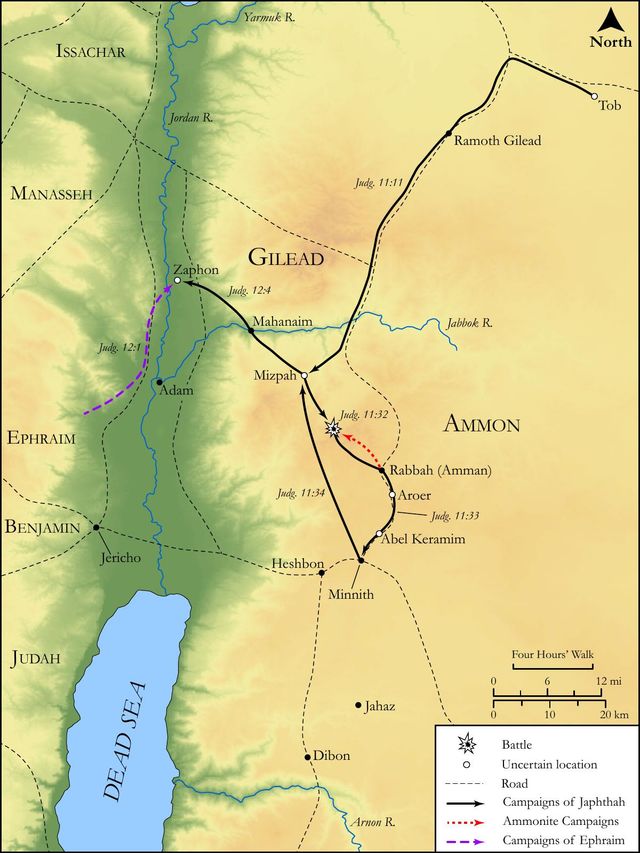
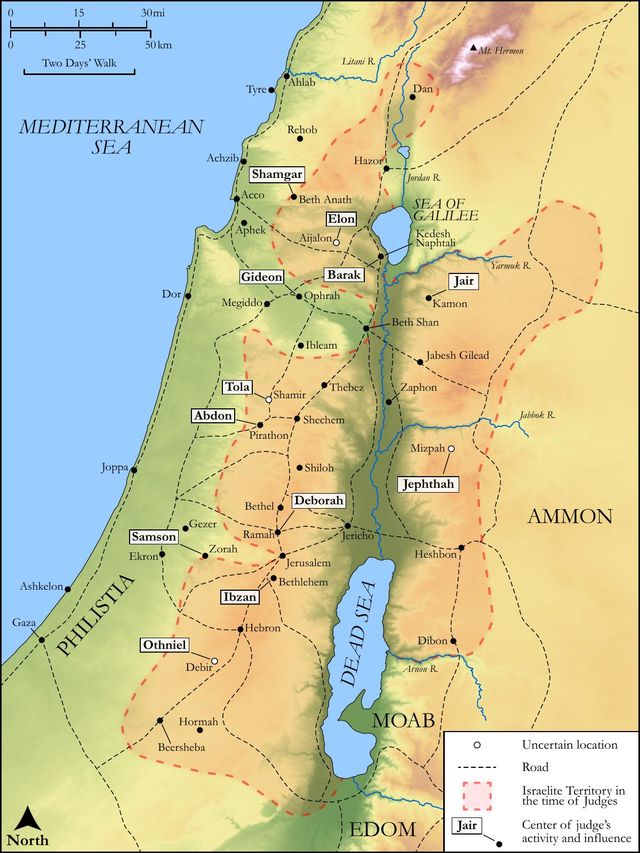
See on the biblical-era maps
Study this verse
Public-domain commentary
Matthew Henry
From his Commentary on the Whole Bible. Henry comments on passages, not single verses — this entry covers Judges 11:29–40. His four-level outline is real structure in the source text, so it is rendered as structure.
We have here Jephthah triumphing in a glorious victory, but, as an alloy to his joy, troubled and distressed by an unadvised vow.
I.Jephthah's victory was clear, and shines very brightly, both to his honour and to the honour of God, his in pleading and God's in owning a righteous cause.
1.God gave him an excellent spirit, and he improved it bravely, Jdg 11:29. When it appeared by the people's unanimous choice of him for their leader that he had so clear a call to engage, and by the obstinate deafness of the king of Ammon to the proposals of accommodation that he had so just a cause to engage in, then the Spirit of the Lord came upon him, and very much advanced his natural faculties, enduing him with power from on high, and making him more bold and more wise than ever he had been, and more fired with a holy zeal against the enemies of his people. Hereby God confirmed him in his office, and assured him of success in his undertaking. Thus animated, he loses no time, but with an undaunted resolution takes the field. Particular notice is taken of the way by which he advanced towards the enemy's camp, probably because the choice of it was an instance of that extraordinary discretion with which the Spirit of the Lord had furnished him; for those who sincerely walk after the Spirit shall be led forth the right way.
2.God gave him eminent success, and he bravely improved that too (Jdg 11:32): The Lord delivered the Ammonites into his hand, and so gave judgment upon the appeal in favour of the righteous cause, and made those feel the force of war that would not yield to the force of reason; for he sits in the throne, judging right. Jephthah lost not the advantages given him, but pursued and completed his victory. Having routed their forces in the field, he pursued them to their cities, where he put to the sword all he found in arms, so as utterly to disable them from giving Israel any molestation, Jdg 11:33. But it does not appear that he utterly destroyed the people, as Joshua had destroyed the devoted nations, nor that he offered to make himself master of the country, though their pretensions to the land of Israel might have given him colour to do so: only he took care that they should be effectually subdued. Though others' attempting wrong to us will justify us in the defence of our own right, yet it will not authorize us to do them wrong.
II.Jephthah's vow is dark, and much in the clouds.
When he was going out from his own house upon this hazardous undertaking, in prayer to God for his presence with him he makes a secret but solemn vow or religious promise to God, that, if God would graciously bring him back a conqueror, whosoever or whatsoever should first come out of his house to meet him it should be devoted to God, and offered up for a burnt-offering. At his return, tidings of his victory coming home before him, his own and only daughter meets him with the seasonable expressions of joy. This puts him into a great confusion; but there was no remedy: after she had taken some time to lament her own infelicity, she cheerfully submitted to the performance of his vow. Now,
1.There are several good lessons to be learnt out of this story.
(1.)That there may be remainders of distrust and doubting even in the hearts of true and great believers. Jephthah had reason enough to be confident of success, especially when he found the Spirit of the Lord come upon him, and yet, now that it comes to the settling, he seems to hesitate (v. 30): If thou wilt without fail deliver them into my hand, then I will do so and so. And perhaps the snare into which his vow brought him was designed to correct the weakness of his faith, and a fond conceit he had that he could not promise himself a victory unless he proffered something considerable to be given to God in lieu of it.
(2.)That yet it is very good, when we are in the pursuit or expectation of any mercy, to make vows to God of some instance of acceptable service to him, not as a purchase of the favour we desire, but as an expression of our gratitude to him and the deep sense we have of our obligations to render according to the benefit done to us. The matter of such a singular vow (Lev 27:2) must be something that has a plain and direct tendency either to the advancement of God's glory, and the interests of his kingdom among men, or to the furtherance of ourselves in his service, and in that which is antecedently our duty.
(3.)That we have great need to be very cautious and well advised in the making of such vows, lest, by indulging a present emotion even of pious zeal, we entangle our own consciences, involve ourselves in perplexities, and are forced at last to say before the angel that it was an error, Ecc 5:2-6. It is a snare to a man hastily to devour that which is holy, without due consideration quid valeant humeri, quid ferre recusent - what we are able or unable to effect, and without inserting the needful provisos and limitations which might prevent the entanglement, and then after vows to make the enquiry which should have been made before, Pro 20:25. Let Jephthah's harm be our warning in this matter. See Deu 23:22.
(4.)That what we have solemnly vowed to God we must conscientiously perform, if it be possible and lawful, though it be ever so difficult and grievous to us. Jephthah's sense of the powerful obligation of his vow must always be ours (Jdg 11:35): "I have opened my mouth unto the Lord in a solemn vow, and I cannot go back," that is, "I cannot recall the vow myself, it is too late, nor can any power on earth dispense with it, or give me up my bond." The thing was my own, and in my own power (Act 5:4), but now it is not. Vow and pay, Psa 76:11. We deceive ourselves if we think to mock God. If we apply this to the consent we have solemnly given, in our sacramental vows, to the covenant of grace made with poor sinners in Christ, what a powerful argument will it be against the sins we have by those vows bound ourselves out from, what a strong inducement to the duties we have hereby bound ourselves up to, and what a ready answer to every temptation! "I have opened my mouth to the Lord, and I cannot go back; I must therefore go forward. I have sworn, and I must, I will, perform it. Let me not dare to play fast and loose with God." (5.) That it well becomes children obediently and cheerfully to submit to their parents in the Lord, and particularly to comply with their pious resolutions for the honour of God and the keeping up of religion in their families, though they be harsh and severe, as the Rechabites, who for many generations religiously observed the commands of Jonadab their father in forbearing wine, and Jephthah's daughter here, who, for the satisfying of her father's conscience, and for the honour of God and her country, yielded herself as one devoted (Jdg 11:36): "Do to me according to that which hath proceeded out of thy mouth; I know I am dear to thee, but am well content that God should be dearer." The father might disallow any vow made by the daughter (Num 30:5), but the daughter could not disallow or disannul, no, not such a vow as this, made by the father. This magnifies the law of the fifth commandment. (6.) That our friends' grievances should be our griefs. Where she went to bewail her hard fate the virgins, her companions, joined with her in her lamentations, Jdg 11:38. With those of her own sex and age she used to associate, who no doubt, now that her father had on a sudden grown so great, expected, shortly after his return, to dance at her wedding, but were heavily disappointed when they were called to retire to the mountains with her and share in her griefs. Those are unworthy the name of friends that will only rejoice with us, and not weep with us. (7.) That heroic zeal for the honour of God and Israel, though alloyed with infirmity and indiscretion, is worthy to be had in perpetual remembrance. It well became the daughters of Israel by an annual solemnity to preserve the honourable memory of Jephthah's daughter, who made light even of her own life like a noble heroine, when God had taken vengeance on Israel's enemies, Jdg 11:36. Such a rare instance of one that preferred the public interest before life itself was never to be forgotten. Her sex forbade her to follow to the war, and so to expose her life in battle, in lieu of which she hazards it much more (and perhaps apprehended that she did so, having some intimation of his vow, and did it designedly; for he tells her, Jdg 11:35, Thou hast brought me very low) to grace his triumphs. So transported was she with the victory as a common benefit that she was willing to be herself offered up as a thank-offering for it, and would think her life well bestowed when laid down on so great an occasion. She thinks it an honour to die, not as a sacrifice of atonement for the people's sins (that honour was reserved for Christ only), but as a sacrifice of acknowledgment for the people's mercies. (8.) From Jephthah's concern on this occasion, we must learn not to think it strange if the day of our triumphs in this world prove upon some account or other the day of our griefs, and therefore must always rejoice with trembling; we hope for a day of triumph hereafter which will have no alloy.
2.Yet there are some difficult questions that do arise upon this story which have very much employed the pens of learned men. I will say but little respecting them, because Mr. Poole has discussed them very fully in his English annotations.
(1.)It is hard to say what Jephthah did to his daughter in performance of his vow.
[1.]Some think he only shut her up for a nun, and that it being unlawful, according to one part of his vow (for they make it disjunctive), to offer her up for a burnt-offering, he thus, according to the other part, engaged her to be the Lord's, that is, totally to sequester herself from all the affairs of this life, and consequently from marriage, and to employ herself wholly in the acts of devotion all her days. That which countenances this opinion is that she is said to bewail her virginity (Jdg 11:37, Jdg 11:38) and that she knew no man, Jdg 11:39. But, if he sacrificed her, it was proper enough for her to bewail, not her death, because that was intended to be for the honour of God, and she would undergo it cheerfully, but that unhappy circumstance of it which made it more grievous to her than any other, because she was her father's only child, in whom he hoped his name and family would be built up, that she was unmarried, and so left no issue to inherit her father's honour and estate; therefore it is particularly taken notice of (Jdg 11:34) that besides her he had neither son nor daughter. But that which makes me think Jephthah did not go about thus to satisfy his vow, or evade it rather, is that we do not find any law, usage, or custom, in all the Old Testament, which does in the least intimate that a single life was any branch or article of religion, or that any person, man or woman, was looked upon as the more holy, more the Lord's, or devoted to him, for living unmarried: it was no part of the law either of the priests or of the Nazarites. Deborah and Huldah, both prophetesses, are both of them particularly recorded to have been married women. Besides, had she only been confined to a single life, she needed not to have desired these two months to bewail it in: she had her whole life before her to do that, if she saw cause. Nor needed she to take such a sad leave of her companions; for those that are of that opinion understand what is said in Jdg 11:40 of their coming to talk with her, as our margin reads it, four days in a year. Therefore,
[2.]It seems more probable that he offered her up for a sacrifice, according to the letter of his vow, misunderstanding that law which spoke of persons devoted by the curse of God as if it were to be applied to such as were devoted by men's vows (Lev 27:29, None devoted shall be redeemed, but shall surely be put to death), and wanting to be better informed of the power the law gave him in this case to redeem her. Abraham's attempt to offer up Isaac perhaps encouraged him, and made him think, if God would not accept this sacrifice which he had vowed, he would send an angel to stay his hand, as he did Abraham's. If she came out designedly to be made a sacrifice, as who knows but she might? perhaps he thought that would make the case the plainer. Volenti non sit injuria - No injury is done to a person by that to which he himself consents. He imagined, it may be, that where there was neither anger nor malice there was no murder, and that his good intention would sanctify this bad action; and, since he had made such a vow, he thought better to kill his daughter than break his vow, and let Providence bear the blame, that brought her forth to meet him.
(2.)But, supposing that Jephthah did sacrifice his daughter, the question is whether he did well.
[1.]Some justify him in it, and think he did well, and as became one that preferred the honour of God before that which was dearest to him in this world. He is mentioned among the eminent believers who by faith did great things, Heb 11:32. And this was one of the great things he did. It was done deliberately, and upon two months' consideration and consultation. He is never blamed for it by any inspired writer. Though it highly exalts the paternal authority, yet it cannot justify any in doing the like. He was an extraordinary person. The Spirit of the Lord came upon him. Many circumstances, now unknown to us, might make this altogether extraordinary, and justify it, yet not so as that it might justify the like. Some learned men have made this sacrifice a figure of Christ the great sacrifice: he was of unspotted purity and innocency, as she a chaste virgin; he was devoted to death by his Father, and so made a curse, or an anathema, for us; he submitted himself, as she did, to his Father's will: Not as I will, but as thou wilt. But,
[2.]Most condemn Jephthah; he did ill to make so rash a vow, and worse to perform it. He could not be bound by his vow to that which God had forbidden by the letter of the sixth commandment: Thou shalt not kill. God had forbidden human sacrifices, so that it was (says Dr. Lightfoot) in effect a sacrifice to Moloch. And, probably, the reason why it is left dubious by the inspired penman whether he sacrificed her or no was that those who did afterwards offer their children might not take any encouragement from this instance. Concerning this and some other such passages in the sacred story, which learned men are in the dark, divided, and in doubt about, we need not much perplex ourselves; what is necessary to our salvation, thanks be to God, is plain enough.
Continue studying Judges 11:38 across the web’s major study libraries — every link below opens this exact verse, chapter, or book on the destination site.
Read & Compare
 BibleGatewayThis verse in more than 200 translations and 70 languages.
 Bible.comThe YouVersion reader — hundreds of translations, reading plans, and highlights.
 ESV.orgCrossway's official English Standard Version reader.
 NET BibleThe NET translation with 60,000+ translators' notes on every rendering decision.
 STEP BibleTyndale House's free study tool — original text, vocabulary, and scholarly resources.
 BibliaLogos Bible Software's free web reader.
 USCCBThe New American Bible (Revised Edition) with the U.S. bishops' study notes.
Commentaries
 BibleHub CommentariesDozens of classic commentaries on this verse, gathered on one page.
 StudyLightMore than 100 commentary sets — the largest collection on the web.
 BibleRefPlain-English commentary on what this verse means, verse by verse.
 Enduring WordDavid Guzik's free commentary on this chapter, widely used by Bible teachers.
 Bible Study ToolsVerse commentary alongside Greek and Hebrew study aids.
Original Language & Research
- BibleHub InterlinearThe verse word by word — original language, transliteration, and English.
- BibleHub LexiconEvery word's original-language definition and Strong's entry.
 Blue Letter BibleDeep-study tools — Strong's numbers, concordance, and word studies.
 SefariaThe Hebrew text with Rashi and centuries of Jewish commentary.
Sermons, Hymns & Audio


TrulyRandomVerse is not affiliated with these sites and doesn’t control their content. They’re linked because they’re genuinely useful.
Summary
Judges 11:38 presents a profoundly poignant moment in the tragic narrative of Jephthah's daughter, an innocent victim of her father's rash and ill-conceived vow. This verse details the two-month reprieve granted to her before the vow's fulfillment, during which she withdraws to the isolated mountains with her female companions. Her lament is not merely for her impending death, but specifically for the profound and permanent loss of her virginity, which in ancient Israelite society signified the forfeiture of her potential for marriage, motherhood, and the continuation of her family line, rendering her sacrifice uniquely devastating.
Context
ShowHideLiterary Context
This verse serves as a crucial interlude within the unfolding tragedy initiated by Jephthah's impulsive vow in Judges 11:30. Having promised to sacrifice whatever emerged first from his house upon his victorious return from battle against the Ammonites, Jephthah is met by his only daughter (Judges 11:34). Overwhelmed by grief but feeling irrevocably bound by his oath, he informs her of his devastating promise. Her response, a remarkable blend of courage and resignation, is not to resist, but to request a two-month period to prepare for her fate, specifically to "bewail her virginity" with her companions. This verse immediately precedes the somber fulfillment of the vow in Judges 11:39, powerfully underscoring the daughter's profound personal sacrifice and the grim consequences of Jephthah's misguided piety.
Historical & Cultural Context
In ancient Israelite society, a woman's honor, identity, and primary contribution to her family and community were inextricably linked to marriage and the bearing of children. Virginity was highly prized as a prerequisite for marriage, and the ability to bear offspring, particularly sons, was essential for the continuation of the family lineage and the inheritance of property. To die a virgin meant the cessation of her father's direct line, a profound tragedy in a culture that valued fruitfulness and multiplication as central to the covenant promises made to Abraham (Genesis 24:60). Furthermore, the period of the Judges was marked by significant moral and spiritual decline, where "everyone did what was right in his own eyes" (Judges 21:25). Jephthah's vow, though rooted in a desire for divine favor, reflects a syncretistic understanding of God, possibly influenced by pagan practices of human sacrifice, which were an abomination to Yahweh (Deuteronomy 12:31). Therefore, her lament for her virginity was not merely a personal sorrow but a deep mourning for the loss of her societal role, her potential legacy, and the very continuity of her family within a society struggling with spiritual discernment.
Key Themes
ShowHideThe narrative surrounding Jephthah's vow and its tragic outcome underscores several significant themes pertinent to the book of Judges and broader biblical theology. Firstly, it serves as a stark warning about the perilous consequences of rash vows, illustrating how impulsivity, even when cloaked in religious fervor, can lead to immense suffering and a profound misinterpretation of divine will. Secondly, the story powerfully highlights the immense cultural value placed on virginity, marriage, and lineage in ancient Israel, where the continuation of a family line was paramount for inheritance and identity. The daughter's specific lament emphasizes that her sacrifice encompassed not just her life, but her entire future as a woman within her society, making her fate uniquely poignant. Finally, her remarkable submission and resignation in the face of such a devastating fate, while deeply tragic, also speaks to a profound sense of duty and perhaps a misguided understanding of the absolute nature of vows to God in a period characterized by spiritual decline and a lack of clear moral leadership (Judges 17:6).
Exposition and Analysis
ShowHideKey Word Analysis
ShowHideA primitive root meaning "to weep; generally to bemoan." This word conveys a deep, often audible and public, expression of grief, lamentation, or mourning. In this context, it emphasizes the profound sorrow of Jephthah's daughter and her companions, signaling not just internal sadness but an outward, culturally recognized act of mourning for a devastating, irreversible loss. It suggests a profound and visceral expression of anguish.
Referring to the state of being a virgin, an unmarried woman. In this verse, the term carries immense cultural and theological weight. It signifies not merely a physical state but the entire future that was denied her: marriage, the bearing of children, and the continuation of her family line. Her lament is not just for her life, but for the permanent forfeiture of her potential to fulfill the most significant societal role for a woman in ancient Israel, making her sacrifice uniquely poignant and culturally devastating.
Meaning "a mountain or range of hills." The choice of "mountains" as the location for her lament is significant. Mountains often symbolize isolation, separation from society, and a place of withdrawal for deep sorrow or spiritual reckoning. Here, they provide a secluded, perhaps even sacred, space for this profound act of mourning, removed from the ordinary world and the gaze of the community, emphasizing the deeply personal and yet universally tragic nature of her situation.
Verse Breakdown
ShowHide"And he said, Go."
This terse command from Jephthah grants his daughter the requested reprieve. The brevity of his response likely reflects his profound grief, inner turmoil, and perhaps an inability to articulate more in the face of such a devastating outcome to his vow. It signifies his reluctant agreement to her plea, acknowledging her need for a period of mourning before the inevitable fulfillment of his oath.
"And he sent her away [for] two months:"
This clause specifies the duration of the reprieve, a significant period of sixty days. This extended time allowed for a thorough period of preparation, both emotionally and spiritually, for her impending fate. It also highlights the daughter's remarkable composure and agency in requesting this time, demonstrating a degree of control and dignity in an otherwise uncontrollable and tragic situation. The act of "sending her away" emphasizes her temporary separation from her father and the community.
"and she went with her companions,"
Her companions, likely other young women or close friends, join her in this period of mourning. Their presence underscores the communal aspect of grief in Israel and provides emotional and psychological support. It also highlights the collective sorrow felt for her tragic fate, as her loss was not just personal but a loss for her social circle and, by extension, for the community that valued lineage and continuity.
"and bewailed her virginity upon the mountains."
This is the core of the verse, detailing the specific nature and location of her lament. The "mountains" serve as a desolate, isolated setting, emphasizing her separation and the gravity of her sorrow. Her specific focus on "bewailing her virginity" powerfully conveys that her grief extended far beyond the mere loss of life. It was a profound and irreversible mourning for the forfeiture of her potential for marriage, motherhood, and the continuation of her family lineage, which was culturally and spiritually devastating in ancient Israel. This highlights the depth of her sacrifice, encompassing her entire future and identity as a woman.
Literary Devices
ShowHideThe narrative of Judges 11:38 is rich with pathos, evoking deep pity and sorrow from the reader. The image of a young woman, condemned by her father's rash vow, retreating to the mountains with her companions to mourn her lost future, is profoundly moving and elicits a strong emotional response. There is also a powerful element of irony present; Jephthah's vow, intended to secure victory and honor from God, ultimately leads to the tragic sacrifice of his only child and the termination of his lineage, highlighting the unintended and devastating consequences of human impulsivity and a misguided understanding of divine will. The "mountains" serve as a potent symbolic setting, representing isolation, a place of lament removed from the ordinary world, and perhaps even a place of spiritual reckoning or despair. The specific focus on "bewailing her virginity" is a form of synecdoche, where a part (her virginity, representing her potential for marriage, motherhood, and the continuation of her family line) stands in for the whole of her lost future and identity, amplifying the tragedy and the cultural significance of her sacrifice.
Theological and Thematic Connections
ShowHideThe story of Jephthah's daughter, particularly her lament in Judges 11:38, powerfully underscores the sanctity of human life and the profound value of covenantal fruitfulness within the biblical narrative. While Jephthah's vow was made in earnest, it fundamentally misunderstood the character of God, who explicitly forbade human sacrifice (Deuteronomy 12:31). This tragic episode stands in stark contrast to God's provision of a substitute for Isaac (Genesis 22:13), highlighting that God desires obedience and faithfulness, not human sacrifice. The daughter's mourning for her virginity also connects to the broader biblical theme of lineage and the importance of offspring in fulfilling God's promises, making her death not just a personal tragedy but a spiritual and communal one, as it cut off Jephthah's line. The story serves as a somber illustration of the spiritual decline during the period of the Judges, where even sincere intentions could lead to actions contrary to God's revealed will.
Reflection and Application
ShowHideJudges 11:38 invites us to reflect deeply on the weight of our words and the nature of our commitments, especially those made to God. Jephthah's tragic story serves as a sober warning against making hasty or ill-considered vows, reminding us that true devotion is expressed not through impulsive promises but through a life of consistent obedience and a deep understanding of God's character and His desires. We are called to exercise wisdom and discernment, ensuring that our zeal is tempered by knowledge, lest our actions, however well-intentioned, lead to unintended and devastating consequences. Furthermore, the daughter's lament for her lost future cultivates profound empathy within us for those who experience multifaceted loss—whether of dreams, opportunities, relationships, or life itself. It calls us to grieve with those who grieve, recognizing that sorrow can be complex and encompass not only what is physically taken but also what is forever denied. Her quiet, yet profound, act of mourning reminds us that even in the face of insurmountable tragedy, there is a fundamental human need to process grief and acknowledge the full scope of what has been lost, finding solace and support in community.
Questions for Reflection
ShowHideFAQ
ShowHideDid God require Jephthah to sacrifice his daughter?
ShowHideNo, the Bible is unequivocally clear that God absolutely did not require or desire human sacrifice. In fact, He explicitly condemned such practices as an abomination, particularly those of the surrounding pagan nations who sacrificed their children to idols (Deuteronomy 12:31). The narrative of Jephthah's vow and its tragic fulfillment is presented as a direct consequence of Jephthah's own misguided and rash promise, made out of a desperate desire for military victory, rather than a divine command. God had already provided a clear and foundational precedent for substitutionary sacrifice in the story of Abraham and Isaac (Genesis 22:13-14), demonstrating His nature as a God who provides a way, not one who demands human life in sacrifice. The story serves as a powerful cautionary tale about the dangers of impulsive vows made without discernment and a profound misunderstanding of God's holy, loving, and just character.
Christ-Centered Fulfillment
ShowHideThe tragic narrative of Jephthah's daughter, particularly her profound lament over her lost virginity and future, finds a striking and redemptive fulfillment in the person and work of Jesus Christ. While Jephthah's daughter was an innocent victim of a misguided human vow, submitting to a sacrifice that God never desired, Jesus willingly offered Himself as the perfect, unblemished sacrifice, not for a human oath, but for the sins of the world (John 1:29). Her purity and unfulfilled potential tragically ended in death, yet Christ, the spotless Lamb, offered His perfect life, not for a temporary victory, but for eternal redemption and reconciliation. Unlike Jephthah's daughter, whose sacrifice was a human error and a profound tragedy, Christ's sacrifice was the divinely ordained plan to reconcile humanity to God, fulfilling the Father's will (John 6:38). Her sorrow over a lost lineage is powerfully contrasted with Christ, who through His death and resurrection, establishes an eternal spiritual lineage of believers, fulfilling God's promises of fruitfulness and multiplication in a spiritual and eternal sense, far beyond any earthly family line. Her submission, though tragic and coerced by circumstance, foreshadows the ultimate, willing submission of Christ to His Father's will, even to the point of death on a cross (Philippians 2:8). In Christ, the brokenness, tragedy, and misguided devotion so evident in the book of Judges are ultimately overcome by perfect love, divine wisdom, and redemptive grace, offering hope where there was only despair.