


Judges 11:32
Bible text: King James Version (1769 Blayney text) · Public domain
Bible text: Berean Standard Bible · Public domain
Bible text: American Standard Version (1901) · Public domain
Bible text: World English Bible, Messianic edition · Public domain
Bible text: Geneva Bible (1599) · Public domain
Bible text: Young's Literal Translation · Public domain
- וַיַּעֲבֹרvai·ya·'a·Vorand he passed onH5674Conj-w ¦ V-Qal-ConsecImperf-3msVerb Qal Consecutive Imperfect 3rd Singular Masculineוַandיַּעֲבֹרhe passed on
- יִפְתָּחyif·TachJephthahH3316N-proper-mNoun Proper Masculine
- אֶל'eltoH413PrepPreposition
- בְּנֵיbe·Nei[the] people ofH1121N-mpcNoun Plural Masculine Construct
- עַמּוֹןa·MonAmmonH5983N-proper-mNoun Proper Masculine
- לְהִלָּחֶםle·hi·La·chemto fightH3898Prep-l ¦ V-Niphal-InfVerb Niphal Infinitive Constructלְtoהִלָּחֶםfight
- בָּםBamagainst <the> themPrep-b ¦ 3mpSuffix Personal 3rd Plural Masculineבָּagainst <the>םthem
- וַיִתְּנֵםvai·yi·te·Nemand he gave themH5414Conj-w ¦ V-Qal-ConsecImperf-3ms ¦ 3mpVerb Qal Consecutive Imperfect 3rd Singular Masculineוַandיִתְּנֵhe gaveםthem
- יְהוָהYah·wehYahwehH3068N-properNoun Proper Title
- בְּיָדוֹbe·ya·Doin his handH3027Prep-b ¦ N-csc ¦ 3msNoun Singular common gender Constructבְּinיָדhandוֹhis
English is a literal word-by-word gloss of the Hebrew, not the KJV's wording. Why?
This is the original text the KJV's translators worked from — each Hebrew word with its own literal English meaning in this verse, prepared by scholars at Tyndale House, Cambridge. The KJV translates whole sentences, not word by word, so its wording differs: one Hebrew word can become several English words, and the KJV may choose “the LORD” where the gloss reads “Yahweh”. Both are faithful — they answer different questions. For the KJV's own rendering, switch to the KJV text.
Details
See on the biblical-era maps
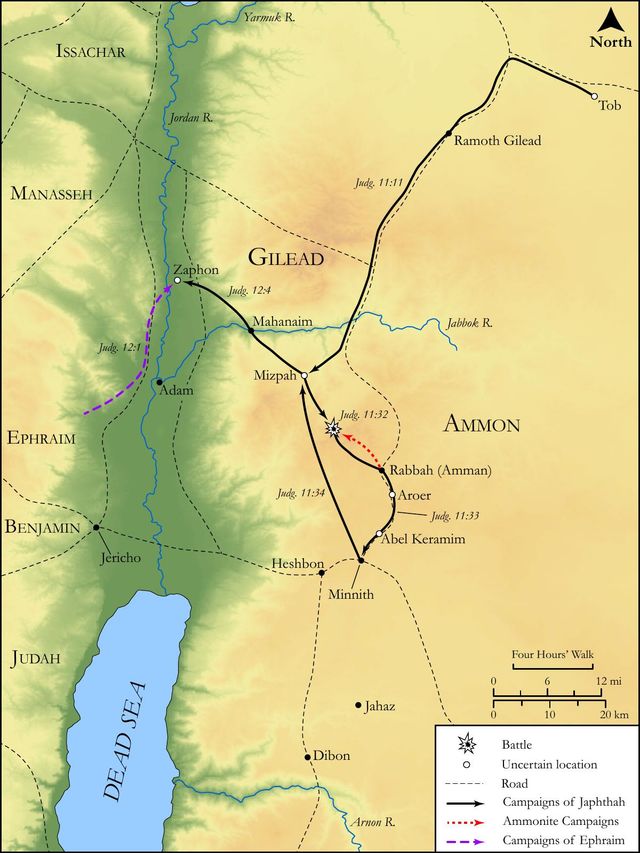
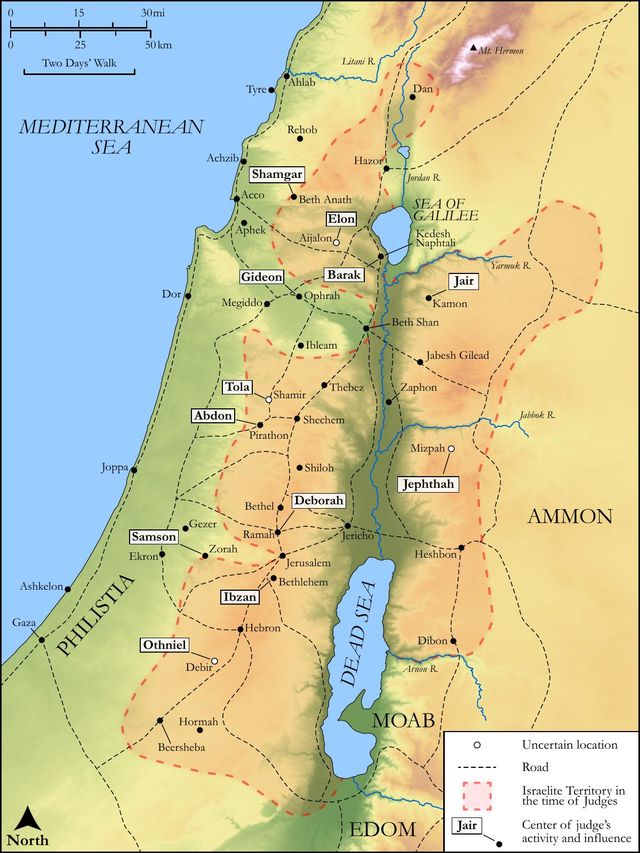
Study this verse
Public-domain commentary
Matthew Henry
From his Commentary on the Whole Bible. Henry comments on passages, not single verses — this entry covers Judges 11:29–40. His four-level outline is real structure in the source text, so it is rendered as structure.
We have here Jephthah triumphing in a glorious victory, but, as an alloy to his joy, troubled and distressed by an unadvised vow.
I.Jephthah's victory was clear, and shines very brightly, both to his honour and to the honour of God, his in pleading and God's in owning a righteous cause.
1.God gave him an excellent spirit, and he improved it bravely, Jdg 11:29. When it appeared by the people's unanimous choice of him for their leader that he had so clear a call to engage, and by the obstinate deafness of the king of Ammon to the proposals of accommodation that he had so just a cause to engage in, then the Spirit of the Lord came upon him, and very much advanced his natural faculties, enduing him with power from on high, and making him more bold and more wise than ever he had been, and more fired with a holy zeal against the enemies of his people. Hereby God confirmed him in his office, and assured him of success in his undertaking. Thus animated, he loses no time, but with an undaunted resolution takes the field. Particular notice is taken of the way by which he advanced towards the enemy's camp, probably because the choice of it was an instance of that extraordinary discretion with which the Spirit of the Lord had furnished him; for those who sincerely walk after the Spirit shall be led forth the right way.
2.God gave him eminent success, and he bravely improved that too (Jdg 11:32): The Lord delivered the Ammonites into his hand, and so gave judgment upon the appeal in favour of the righteous cause, and made those feel the force of war that would not yield to the force of reason; for he sits in the throne, judging right. Jephthah lost not the advantages given him, but pursued and completed his victory. Having routed their forces in the field, he pursued them to their cities, where he put to the sword all he found in arms, so as utterly to disable them from giving Israel any molestation, Jdg 11:33. But it does not appear that he utterly destroyed the people, as Joshua had destroyed the devoted nations, nor that he offered to make himself master of the country, though their pretensions to the land of Israel might have given him colour to do so: only he took care that they should be effectually subdued. Though others' attempting wrong to us will justify us in the defence of our own right, yet it will not authorize us to do them wrong.
II.Jephthah's vow is dark, and much in the clouds.
When he was going out from his own house upon this hazardous undertaking, in prayer to God for his presence with him he makes a secret but solemn vow or religious promise to God, that, if God would graciously bring him back a conqueror, whosoever or whatsoever should first come out of his house to meet him it should be devoted to God, and offered up for a burnt-offering. At his return, tidings of his victory coming home before him, his own and only daughter meets him with the seasonable expressions of joy. This puts him into a great confusion; but there was no remedy: after she had taken some time to lament her own infelicity, she cheerfully submitted to the performance of his vow. Now,
1.There are several good lessons to be learnt out of this story.
(1.)That there may be remainders of distrust and doubting even in the hearts of true and great believers. Jephthah had reason enough to be confident of success, especially when he found the Spirit of the Lord come upon him, and yet, now that it comes to the settling, he seems to hesitate (v. 30): If thou wilt without fail deliver them into my hand, then I will do so and so. And perhaps the snare into which his vow brought him was designed to correct the weakness of his faith, and a fond conceit he had that he could not promise himself a victory unless he proffered something considerable to be given to God in lieu of it.
(2.)That yet it is very good, when we are in the pursuit or expectation of any mercy, to make vows to God of some instance of acceptable service to him, not as a purchase of the favour we desire, but as an expression of our gratitude to him and the deep sense we have of our obligations to render according to the benefit done to us. The matter of such a singular vow (Lev 27:2) must be something that has a plain and direct tendency either to the advancement of God's glory, and the interests of his kingdom among men, or to the furtherance of ourselves in his service, and in that which is antecedently our duty.
(3.)That we have great need to be very cautious and well advised in the making of such vows, lest, by indulging a present emotion even of pious zeal, we entangle our own consciences, involve ourselves in perplexities, and are forced at last to say before the angel that it was an error, Ecc 5:2-6. It is a snare to a man hastily to devour that which is holy, without due consideration quid valeant humeri, quid ferre recusent - what we are able or unable to effect, and without inserting the needful provisos and limitations which might prevent the entanglement, and then after vows to make the enquiry which should have been made before, Pro 20:25. Let Jephthah's harm be our warning in this matter. See Deu 23:22.
(4.)That what we have solemnly vowed to God we must conscientiously perform, if it be possible and lawful, though it be ever so difficult and grievous to us. Jephthah's sense of the powerful obligation of his vow must always be ours (Jdg 11:35): "I have opened my mouth unto the Lord in a solemn vow, and I cannot go back," that is, "I cannot recall the vow myself, it is too late, nor can any power on earth dispense with it, or give me up my bond." The thing was my own, and in my own power (Act 5:4), but now it is not. Vow and pay, Psa 76:11. We deceive ourselves if we think to mock God. If we apply this to the consent we have solemnly given, in our sacramental vows, to the covenant of grace made with poor sinners in Christ, what a powerful argument will it be against the sins we have by those vows bound ourselves out from, what a strong inducement to the duties we have hereby bound ourselves up to, and what a ready answer to every temptation! "I have opened my mouth to the Lord, and I cannot go back; I must therefore go forward. I have sworn, and I must, I will, perform it. Let me not dare to play fast and loose with God." (5.) That it well becomes children obediently and cheerfully to submit to their parents in the Lord, and particularly to comply with their pious resolutions for the honour of God and the keeping up of religion in their families, though they be harsh and severe, as the Rechabites, who for many generations religiously observed the commands of Jonadab their father in forbearing wine, and Jephthah's daughter here, who, for the satisfying of her father's conscience, and for the honour of God and her country, yielded herself as one devoted (Jdg 11:36): "Do to me according to that which hath proceeded out of thy mouth; I know I am dear to thee, but am well content that God should be dearer." The father might disallow any vow made by the daughter (Num 30:5), but the daughter could not disallow or disannul, no, not such a vow as this, made by the father. This magnifies the law of the fifth commandment. (6.) That our friends' grievances should be our griefs. Where she went to bewail her hard fate the virgins, her companions, joined with her in her lamentations, Jdg 11:38. With those of her own sex and age she used to associate, who no doubt, now that her father had on a sudden grown so great, expected, shortly after his return, to dance at her wedding, but were heavily disappointed when they were called to retire to the mountains with her and share in her griefs. Those are unworthy the name of friends that will only rejoice with us, and not weep with us. (7.) That heroic zeal for the honour of God and Israel, though alloyed with infirmity and indiscretion, is worthy to be had in perpetual remembrance. It well became the daughters of Israel by an annual solemnity to preserve the honourable memory of Jephthah's daughter, who made light even of her own life like a noble heroine, when God had taken vengeance on Israel's enemies, Jdg 11:36. Such a rare instance of one that preferred the public interest before life itself was never to be forgotten. Her sex forbade her to follow to the war, and so to expose her life in battle, in lieu of which she hazards it much more (and perhaps apprehended that she did so, having some intimation of his vow, and did it designedly; for he tells her, Jdg 11:35, Thou hast brought me very low) to grace his triumphs. So transported was she with the victory as a common benefit that she was willing to be herself offered up as a thank-offering for it, and would think her life well bestowed when laid down on so great an occasion. She thinks it an honour to die, not as a sacrifice of atonement for the people's sins (that honour was reserved for Christ only), but as a sacrifice of acknowledgment for the people's mercies. (8.) From Jephthah's concern on this occasion, we must learn not to think it strange if the day of our triumphs in this world prove upon some account or other the day of our griefs, and therefore must always rejoice with trembling; we hope for a day of triumph hereafter which will have no alloy.
2.Yet there are some difficult questions that do arise upon this story which have very much employed the pens of learned men. I will say but little respecting them, because Mr. Poole has discussed them very fully in his English annotations.
(1.)It is hard to say what Jephthah did to his daughter in performance of his vow.
[1.]Some think he only shut her up for a nun, and that it being unlawful, according to one part of his vow (for they make it disjunctive), to offer her up for a burnt-offering, he thus, according to the other part, engaged her to be the Lord's, that is, totally to sequester herself from all the affairs of this life, and consequently from marriage, and to employ herself wholly in the acts of devotion all her days. That which countenances this opinion is that she is said to bewail her virginity (Jdg 11:37, Jdg 11:38) and that she knew no man, Jdg 11:39. But, if he sacrificed her, it was proper enough for her to bewail, not her death, because that was intended to be for the honour of God, and she would undergo it cheerfully, but that unhappy circumstance of it which made it more grievous to her than any other, because she was her father's only child, in whom he hoped his name and family would be built up, that she was unmarried, and so left no issue to inherit her father's honour and estate; therefore it is particularly taken notice of (Jdg 11:34) that besides her he had neither son nor daughter. But that which makes me think Jephthah did not go about thus to satisfy his vow, or evade it rather, is that we do not find any law, usage, or custom, in all the Old Testament, which does in the least intimate that a single life was any branch or article of religion, or that any person, man or woman, was looked upon as the more holy, more the Lord's, or devoted to him, for living unmarried: it was no part of the law either of the priests or of the Nazarites. Deborah and Huldah, both prophetesses, are both of them particularly recorded to have been married women. Besides, had she only been confined to a single life, she needed not to have desired these two months to bewail it in: she had her whole life before her to do that, if she saw cause. Nor needed she to take such a sad leave of her companions; for those that are of that opinion understand what is said in Jdg 11:40 of their coming to talk with her, as our margin reads it, four days in a year. Therefore,
[2.]It seems more probable that he offered her up for a sacrifice, according to the letter of his vow, misunderstanding that law which spoke of persons devoted by the curse of God as if it were to be applied to such as were devoted by men's vows (Lev 27:29, None devoted shall be redeemed, but shall surely be put to death), and wanting to be better informed of the power the law gave him in this case to redeem her. Abraham's attempt to offer up Isaac perhaps encouraged him, and made him think, if God would not accept this sacrifice which he had vowed, he would send an angel to stay his hand, as he did Abraham's. If she came out designedly to be made a sacrifice, as who knows but she might? perhaps he thought that would make the case the plainer. Volenti non sit injuria - No injury is done to a person by that to which he himself consents. He imagined, it may be, that where there was neither anger nor malice there was no murder, and that his good intention would sanctify this bad action; and, since he had made such a vow, he thought better to kill his daughter than break his vow, and let Providence bear the blame, that brought her forth to meet him.
(2.)But, supposing that Jephthah did sacrifice his daughter, the question is whether he did well.
[1.]Some justify him in it, and think he did well, and as became one that preferred the honour of God before that which was dearest to him in this world. He is mentioned among the eminent believers who by faith did great things, Heb 11:32. And this was one of the great things he did. It was done deliberately, and upon two months' consideration and consultation. He is never blamed for it by any inspired writer. Though it highly exalts the paternal authority, yet it cannot justify any in doing the like. He was an extraordinary person. The Spirit of the Lord came upon him. Many circumstances, now unknown to us, might make this altogether extraordinary, and justify it, yet not so as that it might justify the like. Some learned men have made this sacrifice a figure of Christ the great sacrifice: he was of unspotted purity and innocency, as she a chaste virgin; he was devoted to death by his Father, and so made a curse, or an anathema, for us; he submitted himself, as she did, to his Father's will: Not as I will, but as thou wilt. But,
[2.]Most condemn Jephthah; he did ill to make so rash a vow, and worse to perform it. He could not be bound by his vow to that which God had forbidden by the letter of the sixth commandment: Thou shalt not kill. God had forbidden human sacrifices, so that it was (says Dr. Lightfoot) in effect a sacrifice to Moloch. And, probably, the reason why it is left dubious by the inspired penman whether he sacrificed her or no was that those who did afterwards offer their children might not take any encouragement from this instance. Concerning this and some other such passages in the sacred story, which learned men are in the dark, divided, and in doubt about, we need not much perplex ourselves; what is necessary to our salvation, thanks be to God, is plain enough.
Continue studying Judges 11:32 across the web’s major study libraries — every link below opens this exact verse, chapter, or book on the destination site.
Read & Compare
 BibleGatewayThis verse in more than 200 translations and 70 languages.
 Bible.comThe YouVersion reader — hundreds of translations, reading plans, and highlights.
 ESV.orgCrossway's official English Standard Version reader.
 NET BibleThe NET translation with 60,000+ translators' notes on every rendering decision.
 STEP BibleTyndale House's free study tool — original text, vocabulary, and scholarly resources.
 BibliaLogos Bible Software's free web reader.
 USCCBThe New American Bible (Revised Edition) with the U.S. bishops' study notes.
Commentaries
 BibleHub CommentariesDozens of classic commentaries on this verse, gathered on one page.
 StudyLightMore than 100 commentary sets — the largest collection on the web.
 BibleRefPlain-English commentary on what this verse means, verse by verse.
 Enduring WordDavid Guzik's free commentary on this chapter, widely used by Bible teachers.
 Bible Study ToolsVerse commentary alongside Greek and Hebrew study aids.
Original Language & Research
- BibleHub InterlinearThe verse word by word — original language, transliteration, and English.
- BibleHub LexiconEvery word's original-language definition and Strong's entry.
 Blue Letter BibleDeep-study tools — Strong's numbers, concordance, and word studies.
 SefariaThe Hebrew text with Rashi and centuries of Jewish commentary.
Sermons, Hymns & Audio


TrulyRandomVerse is not affiliated with these sites and doesn’t control their content. They’re linked because they’re genuinely useful.
Summary
Judges 11:32 marks the decisive turn in Jephthah's conflict with the Ammonites, detailing his military advance and, crucially, God's direct intervention to grant him victory. Following failed diplomatic negotiations and the controversial vow, this verse shifts the narrative to the battlefield, highlighting Jephthah's leadership in action and underscoring the divine sovereignty that ultimately secures Israel's deliverance from oppression.
Context
ShowHideLiterary Context
Judges 11:32 immediately follows a pivotal sequence in Jephthah's story. The preceding verses detail his extensive, yet ultimately unsuccessful, diplomatic efforts to resolve the territorial dispute with the Ammonites by appealing to historical precedent and divine justice, as recorded in Judges 11:12-28. This diplomatic failure sets the stage for military confrontation. Crucially, the verse also comes right after Jephthah's controversial and tragic vow to the Lord, made in anticipation of the battle, where he pledges to sacrifice whatever comes out of his house first upon his victorious return, a solemn promise found in Judges 11:30-31. Thus, Judges 11:32 transitions the narrative from negotiation and vow to direct military engagement, demonstrating Jephthah's commitment to the fight and the immediate divine response to his plea.
Historical & Cultural Context
The period of the Judges (roughly 1200-1000 BC) was characterized by a cyclical pattern of Israelite apostasy, foreign oppression, cries for help, and God raising up a "judge" (a military deliverer) to rescue them, as described in Judges 2:11-19. The Ammonites had been oppressing the Israelites east of the Jordan for eighteen years, a desperate situation detailed in Judges 10:7-9. This prolonged oppression created a desperate situation that led the elders of Gilead to seek out Jephthah, an outcast and son of a prostitute, to lead them, as recounted in Judges 11:1-11. This verse reflects the reality of tribal warfare in ancient Israel, where conflicts were often localized, and leaders emerged in response to specific threats. The cultural understanding of divine intervention in battle was paramount; victory was not merely a matter of military strategy or strength, but a direct act of God's favor and power, a common theme throughout the Old Testament's accounts of Israel's wars.
Key Themes
ShowHideThe most prominent theme in Judges 11:32 is Divine Sovereignty and Deliverance. Despite Jephthah's problematic background and the questionable nature of his vow, the explicit statement "the LORD delivered them into his hands" unequivocally asserts God's active role as the ultimate source of Israel's victory. This highlights God's faithfulness to His covenant people, even when their leaders are flawed or their actions are morally ambiguous. Another key theme is Human Agency and Divine Empowerment. Jephthah "passed over... to fight," demonstrating his leadership and the necessary human effort in warfare, yet this effort is ultimately empowered and made effective by God. This verse also contributes to the broader theme of God Using Imperfect Instruments, a recurring motif throughout the book of Judges and biblical narrative, showing that God's plans prevail through human weakness, not just strength. It foreshadows the ongoing tension between human responsibility and divine action seen throughout the biblical narrative, particularly in the context of Israel's deliverance from oppression, a tension often explored in passages like Joshua 10.
Exposition and Analysis
ShowHideKey Word Analysis
ShowHideThis verb signifies a decisive movement, often involving crossing a boundary or territory. In this context, it emphasizes Jephthah's deliberate and active advance into Ammonite territory, transitioning from diplomatic efforts to direct military confrontation. It conveys a sense of purpose and commitment to engage the enemy, marking a physical and strategic shift.
This is the covenant name of God, emphasizing His self-existent, eternal nature and His relationship with Israel. The use of "LORD" here is highly significant, attributing the victory directly to the sovereign God of Israel, not to human might or strategy. It underscores His active involvement in the affairs of His people and His faithfulness to His promises.
This crucial verb means "to give," "to place," or "to grant." Its use here is profoundly theological, emphasizing that the victory was not merely a result of Jephthah's strategic prowess or the strength of the Israelite army, but a direct, sovereign act of divine giving or granting. God actively "handed over" the Ammonites to Jephthah, underscoring His role as the ultimate source of Israel's triumph and deliverance.
Verse Breakdown
ShowHide"So Jephthah passed over unto the children of Ammon to fight against them"
This initial clause describes Jephthah's immediate and determined action following the failed negotiations and his solemn vow. He leads the Israelite forces across the border into Ammonite territory, signifying the commencement of the military campaign. This highlights Jephthah's role as a military leader, fulfilling the purpose for which he was called by the elders of Gilead, demonstrating human initiative and obedience to the call.
"and the LORD delivered them into his hands"
This is the theological crux of the verse, immediately shifting the focus from human action to divine intervention. The conjunction "and" links Jephthah's action directly to God's response, implying that Jephthah's initiative was met with divine enablement and ultimate success. The phrase "the LORD delivered them into his hands" unequivocally attributes the success of the impending battle not to Jephthah's strength or strategy, but to God's sovereign power and faithfulness. It is a clear declaration that God Himself orchestrated the victory, granting Jephthah the power and authority to overcome the Ammonites.
Literary Devices
ShowHideThe verse effectively employs Narrative Progression, swiftly moving the story from the preceding dialogue and vow to the commencement of battle, indicating a decisive shift in the plot. The most significant device is Divine Intervention, explicitly stated with "the LORD delivered them into his hands," which highlights God's direct and active role in human affairs, particularly in the deliverance of His people. This intervention is presented as the ultimate cause of success, overshadowing human effort and underscoring the theological message of God's sovereignty. Finally, there is a clear Juxtaposition between Jephthah's human agency ("passed over... to fight") and the divine agency ("the LORD delivered"), illustrating the theological principle that while humans act, God ultimately orchestrates and empowers the outcome. This contrast emphasizes that human effort is a necessary component, but divine power is the decisive factor.
Theological and Thematic Connections
ShowHideJudges 11:32 powerfully illustrates the unwavering faithfulness of God to His covenant people, even amidst their moral failings and the questionable actions of their leaders. Despite Jephthah's problematic vow and his background as an outcast, God honors His commitment to Israel's deliverance. This verse underscores the biblical truth that God's purposes are not contingent upon human perfection but are accomplished through His sovereign power and grace. It reveals a God who actively engages in the battles of His people, providing victory not based on their merit, but on His own character and promises. This divine enablement in warfare is a recurring theme throughout the Old Testament, emphasizing that true victory comes from the Lord and that His hand is always at work for His people's salvation.
Reflection and Application
ShowHideJudges 11:32 offers profound lessons for believers navigating the complexities of life. It serves as a powerful reminder that God's faithfulness transcends human imperfection. Just as the Lord granted victory to Jephthah despite his flawed character and controversial vow, so too does God work through us, imperfect as we are, to accomplish His purposes. This verse encourages us to step out in faith and obedience, even when facing daunting challenges or "battles," recognizing that our ultimate success and deliverance come not from our own strength or wisdom, but from the sovereign hand of God. It calls us to cultivate a deep reliance on divine aid, acknowledging that He is the one who "delivers" and grants favor. In our struggles, whether personal, spiritual, or communal, we are invited to act with courage, knowing that the Lord is with us, empowering us to overcome obstacles and fulfill the callings He has placed upon our lives. This perspective fosters humility, prompts gratitude, and strengthens our trust in God's overarching plan, even when the path is unclear or our own efforts seem insufficient, reminding us that His power is made perfect in weakness.
Questions for Reflection
ShowHideFAQ
ShowHideDoes God's deliverance of Jephthah condone his vow or his past actions?
ShowHideNo, God's deliverance of Jephthah in Judges 11:32 does not imply divine approval of his vow or his problematic past. The text explicitly states that "the LORD delivered them into his hands," highlighting God's faithfulness to His covenant with Israel and His commitment to delivering His people from oppression, regardless of the moral complexities of the human instruments He uses. The book of Judges frequently portrays flawed leaders, emphasizing that God's power and purposes are not limited by human sin or error. The tragic outcome of Jephthah's vow, detailed later in Judges 11:34-40, serves as a stark warning against rash promises and a demonstration of the devastating consequences of human folly, even when God's greater plan of deliverance is simultaneously at work. God's character is consistent; He is holy and just, but also merciful and sovereign, able to bring about His will even through imperfect vessels.
How does this verse relate to the concept of human responsibility in warfare?
ShowHideJudges 11:32 beautifully illustrates the interplay between human responsibility and divine sovereignty in the context of warfare. Jephthah "passed over unto the children of Ammon to fight against them," demonstrating clear human initiative, strategic action, and the exercise of leadership. This shows that God expects His people to act, to engage, and to take responsibility in their circumstances. However, the subsequent phrase, "and the LORD delivered them into his hands," immediately clarifies that the ultimate source of victory is divine. Human effort is necessary, but it is God who empowers, enables, and ultimately grants the triumph. This balance means that while we are called to be diligent and courageous in our endeavors, our trust must ultimately rest in God's power and provision. It is a reminder that "the battle belongs to the Lord" (1 Samuel 17:47), even when we are actively engaged in the fight.
Christ-Centered Fulfillment
ShowHideJephthah's temporary and imperfect deliverance of Israel from the Ammonites, empowered by the Lord's hand, powerfully foreshadows the ultimate and perfect deliverance accomplished by Jesus Christ. Jephthah, though used by God, was a flawed judge, marked by a tragic vow and a questionable past. Yet, the Lord still "delivered them into his hands," demonstrating God's unwavering commitment to His people's salvation. This points to Christ, the perfect Deliverer, who was not merely empowered by God but is God incarnate, fully capable and without blemish, as affirmed in Hebrews 4:15. Where Jephthah's victory was over a physical enemy, Jesus' victory is over the ultimate adversaries: sin, death, and the spiritual powers of darkness. Through His crucifixion and resurrection, Christ disarmed the rulers and authorities, triumphing over them, as triumphantly declared in Colossians 2:15. Just as the Lord "delivered" the Ammonites to Jephthah, God the Father "delivered" humanity from the bondage of sin through the sacrifice of the Lamb of God, who takes away the sin of the world!. In Christ, believers are not just delivered from external oppression but are made "more than conquerors" through Him who loved us, a glorious truth found in Romans 8:37, experiencing a spiritual victory that far surpasses any earthly triumph.