


Judges 17:5
Bible text: King James Version (1769 Blayney text) · Public domain
Bible text: Berean Standard Bible · Public domain
Bible text: American Standard Version (1901) · Public domain
Bible text: World English Bible, Messianic edition · Public domain
Bible text: Geneva Bible (1599) · Public domain
Bible text: Young's Literal Translation · Public domain
- וְהָאִישׁve·ha·'Ishand the manH376Conj-w ¦ Art ¦ N-msNoun Singular Masculine Absoluteוְandהָtheאִישׁman
- מִיכָהmi·KhahMicahH4318N-proper-mNoun Proper Masculine
- לוֹlo[belonged] to <the> himPrep-l ¦ 3msSuffix Personal 3rd Singular Masculineל[belonged] to <the>וֹhim
- בֵּיתbeita house ofH1004N-mscNoun Singular Masculine Construct
- אֱלֹהִים'E·lo·HimGodH430N-mpNoun Plural Masculine Absolute
- וַיַּעַשׂvai·Ya·'asand he madeH6213Conj-w ¦ V-Qal-ConsecImperf-3msVerb Qal Consecutive Imperfect 3rd Singular Masculineוַandיַּעַשׂhe made
- אֵפוֹד'e·fOdan ephodH646N-msNoun Singular Masculine Absolute
- וּתְרָפִיםu·te·ra·Fimand teraphimH8655Conj-w ¦ N-mpNoun Plural Masculine Absoluteוּandתְרָפִיםteraphim
- וַיְמַלֵּאvay·ma·Le'and he filledH4390Conj-w ¦ V-Piel-ConsecImperf-3msVerb Piel Consecutive Imperfect 3rd Singular Masculineוַandיְמַלֵּאhe filled
- אֶת'et<obj.>H853DirObjMParticle Object Indicator
- יַדyad[the] hand ofH3027N-cscNoun Singular common gender Construct
- אַחַד'a·ChadoneH259N-fsNoun Singular Feminine Absolute
- מִבָּנָיוmi·ba·Navfrom his sonsH1121Prep-m ¦ N-mpc ¦ 3msNoun Plural Masculine Constructמִfromבָּנָיsonsוhis
- וַיְהִיvay·hiand he becameH1961Conj-w ¦ V-Qal-ConsecImperf-3msVerb Qal Consecutive Imperfect 3rd Singular Masculineוַandיְהִיhe became
- לוֹloof himPrep-l ¦ 3msSuffix Personal 3rd Singular Masculineלofוֹhim
- לְכֹהֵןle·kho·Hen<into> a priestH3548Prep-l ¦ N-msNoun Singular Masculine Absoluteלְ<into>כֹהֵןa priest
English is a literal word-by-word gloss of the Hebrew, not the KJV's wording. Why?
This is the original text the KJV's translators worked from — each Hebrew word with its own literal English meaning in this verse, prepared by scholars at Tyndale House, Cambridge. The KJV translates whole sentences, not word by word, so its wording differs: one Hebrew word can become several English words, and the KJV may choose “the LORD” where the gloss reads “Yahweh”. Both are faithful — they answer different questions. For the KJV's own rendering, switch to the KJV text.
Details
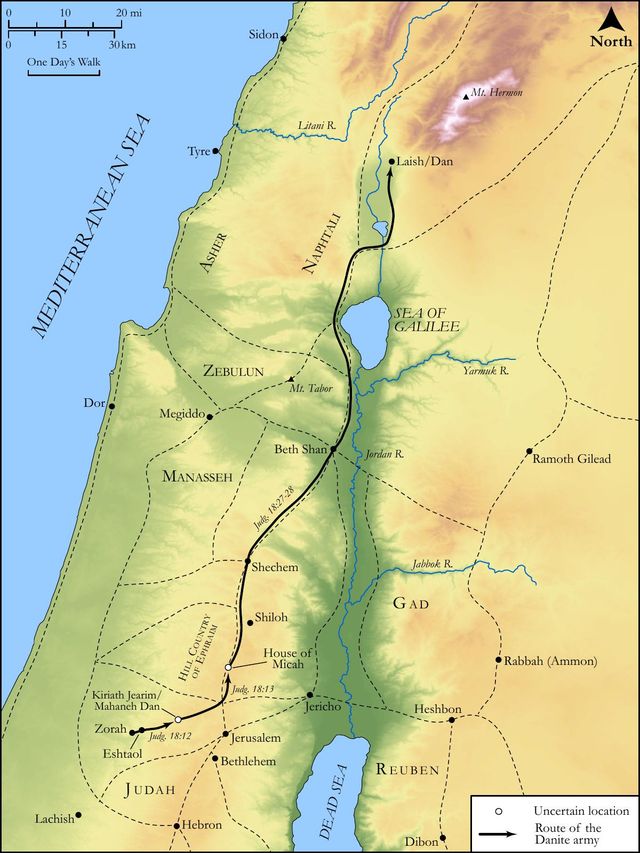
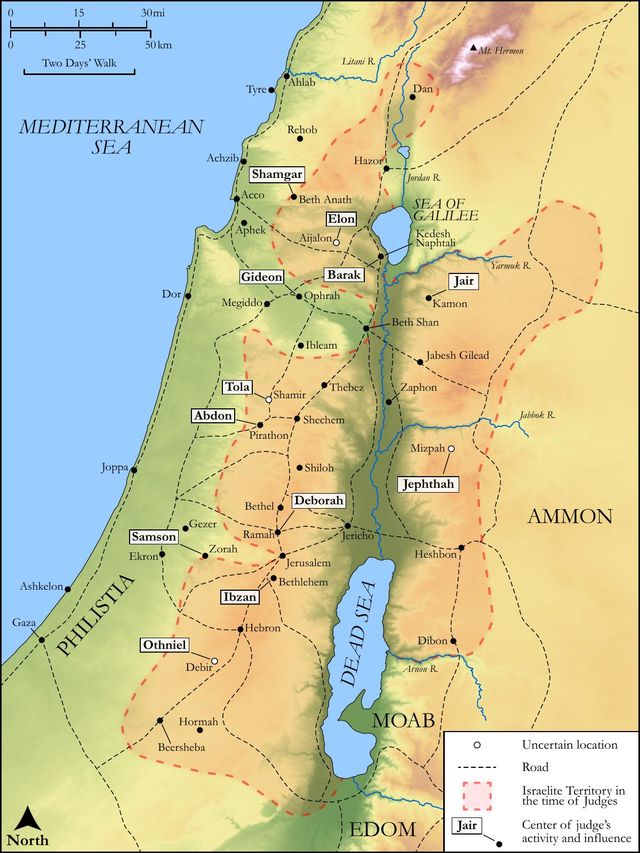
See on the biblical-era maps
Study this verse
Public-domain commentary
Matthew Henry
From his Commentary on the Whole Bible. Henry comments on passages, not single verses — this entry covers Judges 17:1–6. His four-level outline is real structure in the source text, so it is rendered as structure.
Here we have, I. Micah and his mother quarrelling. 1. The son robs the mother. The old woman had hoarded, with long scraping and saving, a great sum of money, 1100 pieces of silver. It is likely she intended, when she died, to leave it to her son: in the mean time it did her good to look upon it, and to count it over. The young man had a family of children grown up, for he had one of age to be a priest, Jdg 17:5. He knows where to find his mother's cash, thinks he has more need of it than she has, cannot stay till she dies, and so takes it away privately for his own use. Though it is a fault in parents to withhold from their children that which is meet, and lead them into temptation to wish them in their graves, yet even this will by no means excuse the wickedness of those children that steal from their parents, and think all their own that they can get from them, though by the most indirect methods. 2. The mother curses the son, or whoever had taken her money. It should seem she suspected her son; for, when she cursed, she spoke in his cars so loud, and with so much passion and vehemence, as made both his ears to tingle. See what mischief the love of money makes, how it destroys the duty and comfort of every relation. It was the love of money that made Micah so undutiful to his mother as to rob her, and made her so unkind and void of natural affection to her son as to curse him if he had it and concealed it. Outward losses drive good people to their prayers, but bad people to their curses. This woman's silver was her god before it was made thither into a graven or a molten image, else the loss of it would not have put her into such a passion as caused her quite to forget and break through all the laws of decency and piety. It is a very foolish thing for those that are provoked to throw their curses about as a madman that casteth fire-brands, arrows, and death, since they know not but they may light upon those that are most dear to them.
II.Micah and his mother reconciled.
1.The son was so terrified with his mother's curses that he restored the money. Though he had so little grace as to take it, he had so much left as not to dare to keep it when his mother had sent a curse after it. He cannot believe his mother's money will do him any good without his mother's blessing, nor dares he deny the theft when he is charged with it, nor retain the money when it is demanded by the right owner. It is best not to do evil, but it is next best, when it is done, to undo it again by repentance, confession, and restitution. Let children be afraid of having the prayers of their parents against them; for, though the curse causeless shall not come, yet that which is justly deserved may be justly feared, even though it was passionately and indecently uttered.
2.The mother was so pleased with her son's repentance that she recalled her curses, and turned them into prayers for her son's welfare: Blessed be thou of the Lord, my son. When those that have been guilty of a fault appear to be free and ingenuous in owning it they ought to be commended for their repentance, rather than still be condemned and upbraided for their fault.
III.Micah and his mother agreeing to turn their money into a god, and set up idolatry in their family; and this seems to have been the first instance of the revolt of any Israelite from God and his instituted worship after the death of Joshua and the elders that out-lived him, and is therefore thus particularly related. And though this was only the worship of the true God by an image, against the second commandment, yet this opened the door to the worship of other gods, Baalim and the groves, against the first and great commandment. Observe,
1.The mother's contrivance of this matter. When the silver was restored she pretended she had dedicated it to the Lord (Jdg 17:3), either before it was stolen, and then she would have this thought to be the reason why she was so much grieved at the loss of it and imprecated evil on him that had taken it, because it was a dedicated and therefore an accursed thing, or after it was stolen she had made a vow that, if she could retrieve it, she would dedicate it to God, and then she would have the providence that had so far favoured her as to bring it back to her hands to be an owning of her vow. "Come," said she to her son, "the money is mine, but thou hast a mind to it; let it be neither mine nor thine, but let us both agree to make it into an image for a religious use." Had she put it to a use that was indeed for the service and honour of God, this would have been a good way of accommodating the matter between them; but, as it was, the project was wicked. Probably this old woman was one of those that came out of Egypt, and would have such images made as she had seen there; now that she began to dote she called to remembrance the follies of her youth, and perhaps told her son that this way of worshipping God by images was, to her knowledge, the old religion.
2.The son's compliance with her. It should seem, when she first proposed the thing he stumbled at it, knowing what the second commandment was; for, when she said (Jdg 17:3) she designed it for her son to make an image of, yet he restored it to his mother (being loth to have a hand in making the image), and she gave it to the founder and had the thing done, blaming him perhaps for scrupling at it, Jdg 17:4. But, when the images were made, Micah, by his mother's persuasion, was not only well reconciled to them, but greatly pleased and in love with them; so strangely bewitching was idolatry, and so much supported by traditions received from their parents, Pe1 1:18; Jer 44:17. But observe how the old woman's covetousness prevailed, in part, above her superstition. She had wholly dedicated the silver to make the graven and molten images (Jdg 17:3), all the 1100 pieces; but, when it came to be done, she made less than a fifth part serve, even 200 shekels, Jdg 17:4. She thought that enough, and indeed it was too much to give for an image that is a teacher of lies. Had it been devoted truly to the honour of God, he would not thus have been put off with part of the price, but would have signified his resentment of the affront, as he did in the case of Ananias and Sapphira. Now observe,
(1.)What was the corruption here introduced, Jdg 17:5. The man Micah had a house of gods, a house of God, so the Septuagint, for so he thought it, as good as that at Shiloh, and better, because his own, of his own inventing and at his own disposal; for people love to have their religion under their girdle, to manage it as they please. A house of error, so the Chaldee, for really it was so, a deviation from the way of truth and an inlet to all deceit. Idolatry is a great cheat, and one of the worst of errors. That which he aimed at in the progress of his idolatry, whether he designed it at first or no, was to mimic and rival both God's oracles and his ordinances.
[1.]His oracles; for he made teraphim, little images which he might advise with as there was occasion, and receive informations, directions, and predictions from. What the urim and thummim were to the prince and people these teraphim should be to his family; yet he could not think that the true God would own them, or give answers by them, and therefore depended upon such demons as the heathen worshipped to inspire them and make them serviceable to him. Thus, while the honour of Jehovah was pretended (Jdg 17:3), yet, his institution being relinquished, these Israelites unavoidably lapsed into downright idolatry and demon-worship.
[2.]His ordinances. Some room or apartment in the house of Micah was appointed for the temple or house of God; an ephod, or holy garment, was provided for his priest to officiate in, in imitation of those used at the tabernacle of God, and one of his sons he consecrated, probably the eldest, to be his priest. And, when he had set up a graven or molten image to represent the object of his worship, no marvel if a priest of his own getting and his own making served to be the manager of it. Here is no mention of any altar, sacrifice, or incense, in honour of these silver gods, but, having a priest, it is probable he had all these, unless we suppose that, at first, his gods were intended only to be advised with, not to be adored, like Laban's teraphim; but the beginning of idolatry, as of other sins, is like the letting forth of water: break the dam, and you bring a deluge. Here idolatry began, and it spread like a fretting leprosy. Dr. Lightfoot would have us observe that as 1100 pieces of silver were here devoted to the making of an idol, which ruined religion, especially in the tribe of Dan (as we shall presently find), which was Samson's tribe, so 1100 pieces of silver were given by each Philistine lord for the ruin of Samson.
(2.)What was the cause of this corruption (Jdg 17:6): There was no king in Israel, no judge or sovereign prince to take cognizance of the setting up of these images (which, doubtless, the country about soon resorted to), and to give orders for the destroying of them, none to convince Micah of his error and to restrain and punish him, to take this disease in time, by which the spreading of the infection might have been happily prevented. Every man did that which was right in his own eyes, and then they soon did that which was evil in the sight of the Lord. When they were without a king to keep good order among them, God's house was forsaken, his priests were neglected, and all went to ruin among them. See what a mercy government is, and what reason there is that not only prayers and intercessions, but giving of thanks, should be made for kings and all in authority, Ti1 2:1, Ti1 2:2. Nothing contributes more, under God, to the support of religion in the world, than the due administration of those two great ordinances, magistracy and ministry.
Historical interpretation
Historical reception
1 surviving comment on this verse from the historical church.
Filled the hand: That is, appointed and consecrated him to the priestly office.
Continue studying Judges 17:5 across the web’s major study libraries — every link below opens this exact verse, chapter, or book on the destination site.
Read & Compare
 BibleGatewayThis verse in more than 200 translations and 70 languages.
 Bible.comThe YouVersion reader — hundreds of translations, reading plans, and highlights.
 ESV.orgCrossway's official English Standard Version reader.
 NET BibleThe NET translation with 60,000+ translators' notes on every rendering decision.
 STEP BibleTyndale House's free study tool — original text, vocabulary, and scholarly resources.
 BibliaLogos Bible Software's free web reader.
 USCCBThe New American Bible (Revised Edition) with the U.S. bishops' study notes.
Commentaries
 BibleHub CommentariesDozens of classic commentaries on this verse, gathered on one page.
 StudyLightMore than 100 commentary sets — the largest collection on the web.
 BibleRefPlain-English commentary on what this verse means, verse by verse.
 Enduring WordDavid Guzik's free commentary on this chapter, widely used by Bible teachers.
 Bible Study ToolsVerse commentary alongside Greek and Hebrew study aids.
Original Language & Research
- BibleHub InterlinearThe verse word by word — original language, transliteration, and English.
- BibleHub LexiconEvery word's original-language definition and Strong's entry.
 Blue Letter BibleDeep-study tools — Strong's numbers, concordance, and word studies.
 SefariaThe Hebrew text with Rashi and centuries of Jewish commentary.
Sermons, Hymns & Audio


TrulyRandomVerse is not affiliated with these sites and doesn’t control their content. They’re linked because they’re genuinely useful.
Summary
Judges 17:5 presents a stark and unsettling portrait of the spiritual anarchy and widespread syncretism that characterized Israel during the period of the Judges. It introduces Micah, a man from the hill country of Ephraim, who establishes a private shrine, complete with forbidden cultic objects like an ephod and teraphim, and takes the audacious step of consecrating his own son as a priest. This verse succinctly encapsulates the era's pervasive disregard for God's established laws concerning worship and priesthood, setting the stage for the chaotic events that unfold in the subsequent chapters and illustrating the profound spiritual decline when "every man did that which was right in his own eyes."
Context
ShowHideLiterary Context
Judges 17 and 18 form an appendix to the main narrative of the book of Judges, serving as a powerful illustration of the spiritual and moral decay described throughout the preceding chapters. These chapters, along with Judges 19-21, are often considered a "double epilogue" that demonstrates the consequences of the recurring refrain, "in those days there was no king in Israel." Micah's story immediately follows the accounts of Samson and the general decline of Israel's leadership and faithfulness. The narrative of Micah's idolatry and the subsequent migration of the Danites (Judges 18) highlights how deeply entrenched religious syncretism and lawlessness had become, even among God's chosen people, leading to internal strife and a perversion of true worship.
Historical & Cultural Context
The period of the Judges (roughly 1400-1050 BC) was a transitional era in Israel's history, marked by a decentralized tribal confederacy rather than a unified monarchy. Without a strong central religious or political authority, adherence to the Mosaic Law waned significantly. Israelites often lived among Canaanite populations, leading to widespread cultural and religious assimilation. This context explains the prevalence of syncretism—the blending of Yahwistic worship with pagan practices—as seen in Micah's "house of gods" and his use of forbidden cultic objects. The concept of a "private shrine" was not uncommon, but the specific elements Micah incorporated were direct violations of the covenant, reflecting a society where divine commands were increasingly ignored in favor of personal preference and local customs.
Key Themes
ShowHideJudges 17:5 powerfully introduces several key themes prevalent in the book of Judges and broader Israelite history. First, idolatry and syncretism are central, as Micah's "house of gods" and his use of an ephod and teraphim demonstrate a dangerous blend of Yahwistic forms with pagan elements, directly violating the first two commandments found in Exodus 20:3-5. Second, the theme of self-made religion and lawlessness is starkly presented. Micah takes religious authority into his own hands, establishing his own system of worship, manufacturing cultic objects, and, most significantly, "consecrated one of his sons, who became his priest." This act directly contravened God's divine institution of the priesthood, which was reserved exclusively for the descendants of Aaron from the tribe of Levi, as detailed in Numbers 3:10 and Numbers 18:7. Micah's actions highlight a profound disregard for God's established order, embodying the spiritual anarchy of the time where "every man did that which was right in his own eyes."
Exposition and Analysis
ShowHideKey Word Analysis
ShowHideThis phrase literally means "house of God" or "house of gods," but in this context, it refers to a private shrine or sanctuary containing idols. Unlike the legitimate Tabernacle or later Temple, this was a personal, unauthorized place of worship, likely housing multiple images or objects of veneration, indicating a polytheistic or syncretistic approach to religion. It highlights Micah's attempt to establish his own religious center outside of divine command.
In legitimate Israelite worship, the ephod was a sacred garment worn by the High Priest, intricately designed and used in conjunction with the Urim and Thummim for discerning God's will (e.g., Exodus 28:6-14). However, in Micah's context, his ephod was likely an idolatrous imitation, possibly a cultic image itself, or a means of unauthorized divination. Its presence here signifies a perversion of a sacred item into an instrument of false worship, further demonstrating his departure from true Yahwism.
These were household idols, often small figurines, associated with family or ancestor worship, and sometimes used for divination or as legal tokens of inheritance. Examples in the Old Testament show them being used in various contexts, from Rachel stealing her father's teraphim (Genesis 31:19) to Michal using one to deceive Saul's messengers (1 Samuel 19:13). Their presence in Micah's "house of gods" unequivocally underscores the pagan influence and deep syncretism within his religious practices.
Verse Breakdown
ShowHide"And the man Micah had an house of gods"
This opening clause immediately establishes Micah's personal initiative in establishing a religious system. The "house of gods" signifies a private, unauthorized shrine, reflecting a departure from the communal, divinely ordained worship at the Tabernacle. It suggests a personal preference for a tangible, visible form of deity, characteristic of idolatry.
"and made an ephod, and teraphim"
This phrase details the specific cultic objects Micah manufactured for his shrine. The making of these items, particularly the ephod (which should have been a priestly garment, not an idol) and the teraphim (household idols associated with pagan practices), demonstrates a clear blending of legitimate Israelite religious forms with forbidden Canaanite elements, such as the teraphim Rachel stole from Laban. This is the essence of syncretism, a direct violation of the Mosaic Law's prohibitions against idolatry and the creation of images.
"and consecrated one of his sons, who became his priest"
This final clause highlights Micah's most audacious act of religious usurpation. The consecration (literally, "filling the hand" in Hebrew, an idiom for ordination) of his own son as a priest was a blatant disregard for God's meticulously established Levitical priesthood, which was exclusively for the descendants of Aaron. This act underscores the profound spiritual lawlessness of the era, where individuals felt free to invent their own religious structures and roles, entirely independent of divine command.
Literary Devices
ShowHideJudges 17:5 employs several potent literary devices to convey its message of spiritual decay. The immediate establishment of Micah's "house of gods" and his self-appointed religious authority sets a tone of irony, as his zealous pursuit of personal piety is, in fact, a profound act of disobedience and rebellion against the true God. The verse also functions as foreshadowing, hinting at the deeper spiritual and moral chaos that will unfold in the subsequent chapters, particularly with the Danite migration and their adoption of Micah's idolatry. The objects themselves—the symbolism of the ephod and teraphim—are crucial. The ephod, a legitimate priestly garment, is here perverted, symbolizing the corruption of true worship. The teraphim, household idols, symbolize the pervasive influence of paganism within Israelite homes. Together, these elements paint a vivid picture of a nation where divine order has collapsed, replaced by individual will and syncretistic practices.
Theological and Thematic Connections
ShowHideJudges 17:5 is a foundational text for understanding the theological crisis of the Judges period. It vividly illustrates the dangers of religious syncretism and self-will, where human preferences supplant divine commands. Micah's actions represent a fundamental rejection of God's sovereignty over worship and priesthood, demonstrating that true faith is not merely about having religious objects or rituals, but about obedient submission to God's revealed will. This verse underscores the critical importance of a central, authoritative standard for faith and practice, which for Israel was the Mosaic Law, and for believers today, is God's inspired Word. When individuals or communities deviate from this standard, the result is spiritual chaos, moral relativism, and a perversion of genuine worship.
Reflection and Application
ShowHideJudges 17:5 serves as a profound cautionary tale for believers in any age. It highlights the insidious danger of blending biblical truth with personal preferences, cultural norms, or worldly philosophies, a practice known as syncretism. Micah's desire for a "house of gods" and a personal priest, while perhaps stemming from a desire for spiritual connection, was fundamentally flawed because it was rooted in self-will rather than divine command. We are constantly tempted to create a "god" or a "worship style" that suits our own desires, rather than submitting to God's revealed will concerning how He is to be worshipped. True worship is not about what feels right or convenient to us, but about what is right and honoring before God, as revealed in His Word. This passage challenges us to examine our own hearts: Are we truly seeking to worship God "in spirit and in truth," according to His commands, or are we, like Micah, crafting a religion that caters to our own preferences, desires for control, or perceived spiritual needs, rather than humbly submitting to His established authority and truth?
Questions for Reflection
ShowHideFAQ
ShowHideWhat is the significance of Micah making an ephod and teraphim?
ShowHideThe significance lies in the blatant syncretism and usurpation of divine authority. The ephod, in its legitimate form, was a sacred garment for the High Priest, used for discerning God's will. Micah's making of one suggests either an idolatrous imitation or an attempt to mimic legitimate priestly functions for his own unauthorized divination. Teraphim were household idols, often associated with pagan worship and divination. By creating both, Micah was blending elements of legitimate Israelite worship (or its corrupted form) with outright pagan practices. This act was a direct violation of God's commands against idolatry and the making of images (Exodus 20:4-5). It illustrates the spiritual confusion and lawlessness of the era, where individuals felt free to define their own religious practices outside of God's established covenant.
Why was it wrong for Micah to consecrate his own son as a priest?
ShowHideIt was fundamentally wrong because God had established a specific, exclusive priesthood through the tribe of Levi, specifically the descendants of Aaron (Numbers 3:10). The role of a priest was not something anyone could assume or be appointed to by personal decree; it was a divine institution with strict lineage requirements and specific duties. Micah's act of consecrating his son was a direct usurpation of God's authority and a profound disregard for the divinely appointed order. This highlights the theme of "every man doing what was right in his own eyes" (Judges 17:6), leading to spiritual chaos and a breakdown of the covenant relationship.
Christ-Centered Fulfillment
ShowHideJudges 17:5, with its depiction of a self-made religion and an unauthorized priesthood, powerfully foreshadows the ultimate need for a divine solution to humanity's spiritual anarchy. Micah's attempt to create his own "house of gods" and appoint his own priest underscores the deep human yearning for connection with the divine, yet also the inherent inability of humanity to rightly approach God on its own terms. This longing finds its perfect fulfillment in Jesus Christ. He is not merely a self-appointed priest, but the divinely appointed, eternal High Priest, "after the order of Melchizedek," who offered a "single sacrifice for sins forever" (Hebrews 10:12). Unlike Micah's son, whose priesthood was illegitimate and ineffective, Jesus' priesthood is perfect and provides true access to God. Furthermore, the "no king in Israel" refrain that permeates Judges points to the desperate need for a true and righteous ruler. Jesus is the true King, "the King of kings and Lord of lords," who establishes a kingdom not of human design, but of divine righteousness and peace. In Christ, the chaos of self-made religion gives way to worship "in spirit and truth," and the need for a human mediator is fulfilled by the one perfect Mediator "between God and mankind, the man Christ Jesus."