


1 Timothy 1:12
- ΚαὶKaiandG2532CONJConjunction
- χάρινcharinThankfulnessG5485N-ASFNoun Accusative Singular Feminine
- ἔχωechōI haveG2192V-PAI-1SVerb Present Active Indicative 1st Singular
- τῷtōfor the [One]G3588T-DSMDefinite article Dative Singular Masculine
- ἐνδυναμώσαντίendunamōsantihaving strengthenedG1743V-AAP-DSMVerb Aorist Active Participle Dative Singular Masculine
- μεmemeG3165P-1ASPersonal pronoun Accusative 1st Singular
- ΧριστῷChristōfor ChristG5547N-DSM-TNoun Dative Singular Masculine Title
- ἸησοῦIēsouJesusG2424N-DSM-PNoun Dative Singular Masculine Individual
- τῷtōtheG3588T-DSMDefinite article Dative Singular Masculine
- κυρίῳkuriōLordG2962N-DSM-TNoun Dative Singular Masculine Title
- ἡμῶνhēmōnof usG3165P-1GPPersonal pronoun Genitive 1st Plural
- ὅτιhotithatG3754CONJConjunction
- πιστόνpistonfaithfulG4103A-ASMAdjective Accusative Singular Masculine
- μεmemeG3165P-1ASPersonal pronoun Accusative 1st Singular
- ἡγήσατοhēgēsatoHe esteemedG2233V-ADI-3SVerb Aorist Middle Deponent Indicative 3rd Singular
- θέμενοςthemenoshaving appointed [me]G5087V-2AMP-NSMVerb 2nd Aorist Middle Participle Nominative Singular Masculine
- εἰςeistoG1519PREPPreposition
- διακονίανdiakonianserviceG1248N-ASFNoun Accusative Singular Feminine
English is a literal word-by-word gloss of the Greek, not the KJV's wording. Why?
This is the original text the KJV's translators worked from — each Greek word with its own literal English meaning in this verse, prepared by scholars at Tyndale House, Cambridge. The KJV translates whole sentences, not word by word, so its wording differs: one Greek word can become several English words, and the KJV may choose “charity” where the gloss reads “love”. Both are faithful — they answer different questions. For the KJV's own rendering, switch to the KJV text.
Details
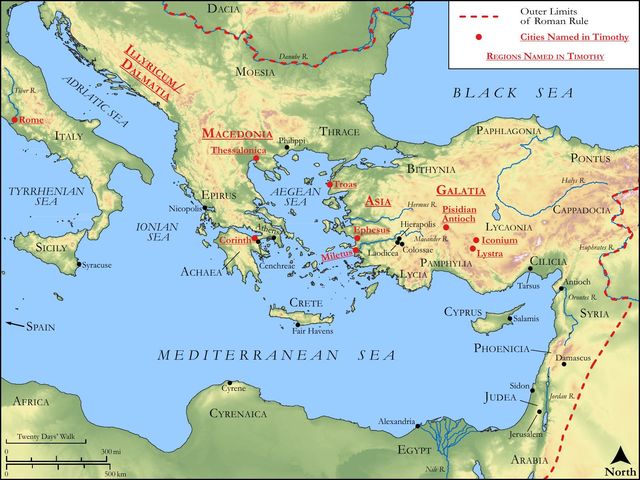
See on the biblical-era map

Study this verse
Public-domain commentary
Matthew Henry
From his Commentary on the Whole Bible. Henry comments on passages, not single verses — this entry covers 1 Timothy 1:12–17. His four-level outline is real structure in the source text, so it is rendered as structure.
Here the apostle, I. Returns thanks to Jesus Christ for putting him into the ministry. Observe, 1. It is Christ's work to put men into the ministry, Act 26:16, Act 26:17. God condemned the false prophets among the Jews in these words, I have not sent these prophets, yet they ran: I have not spoken to them, yet they prophesied, Jer 23:21. Ministers, properly speaking, cannot make themselves ministers; for it is Christ's work, as king and head, prophet and teacher, of his church. 2. Those whom he puts into the ministry he fits for it; whom he calls he qualifies. Those ministers who are no way fit for their work, nor have ability for it, are not of Christ's putting into the ministry, though there are different qualifications as to gifts and graces. 3. Christ gives not only ability, but fidelity, to those whom he puts into the ministry: He counted me faithful; and none are counted faithful but those whom he makes so. Christ's ministers are trusty servants, and they ought to be so, having so great a trust committed to them. 4. A call to the ministry is a great favour, for which those who are so called ought to give thanks to Jesus Christ: I thank Christ Jesus our Lord, who hath put me into the ministry.
II.The more to magnify the grace of Christ in putting him into the ministry, he gives an account of his conversion.
1.What he was before his conversion: A blasphemer, a persecutor, and injurious. Saul breathed out threatenings and slaughter against the disciples of the Lord, Act 9:1. He made havoc of the church, Act 8:3. He was a blasphemer of God, a persecutor of the saints, and injurious to both. Frequently those who are designed for great and eminent services are left to themselves before their conversion, to fall into great wickedness, that the mercy of God may be the more glorified in their remission, and the grace of God in their regeneration. The greatness of sin is no bar to our acceptance with God, no, nor to our being employed for him, if it be truly repented of. Observe here,
(1.)Blasphemy, persecution, and injuriousness, are very great and heinous sins, and those who are guilty of them are sinners before God exceedingly. To blaspheme God is immediately and directly to strike at God; to persecute his people is to endeavour to wound him through their sides; and to be injurious is to be like Ishmael, whose hand was against every one, and every one was against him; for such invade God's prerogative, and encroach upon the liberties of their fellow-creatures.
(2.)True penitents, to serve a good purpose, will not be backward to own their former condition before they were brought home to God: this good apostle often confessed what his former life had been, as Act 22:4; Act 26:10, Act 26:11.
2.The great favour of God to him: But I obtained mercy. This was a blessed but indeed, a great favour, that so notorious a rebel should find mercy with his prince.
(1.)If Paul had persecuted the Christians wilfully, knowing them to be the people of God, for aught I know he had been guilty of the unpardonable sin; but, because he did it ignorantly and in unbelief, he obtained mercy. Note,
[1.]What we do ignorantly is a less crime than what we do knowingly; yet a sin of ignorance is a sin, for he that knew not his Master's will, but did commit things worthy of stripes, shall be beaten with few stripes, Luk 12:48. Ignorance in some cases will extenuate a crime, though it do not take it away.
[2.]Unbelief is at the bottom of what sinners do ignorantly; they do not believe God's threatenings, otherwise they could not do as they do.
[3.]For these reasons Paul obtained mercy: But I obtained mercy, because I did it ignorantly, in unbelief.
[4.]Here was mercy for a blasphemer, a persecutor, and an injurious person: "But I obtained mercy, I a blasphemer," etc.
(2.)Here he takes notice of the abundant grace of Jesus Christ, Ti1 1:14. The conversion and salvation of great sinners are owing to the grace of Christ, his exceedingly abundant grace, even that grace of Christ which appears in his glorious gospel (Ti1 1:15): This is a faithful saying, etc. Here we have the sum of the whole gospel, that Jesus Christ came into the world. The Son of God took upon him our nature, was made flesh, and dwelt among us, Joh 1:14. He came into the world, not to call the righteous but sinners to repentance, Mat 9:13. His errand into the world was to seek and find, and so save, those that were lost, Luk 19:10. The ratification of this is that it is a faithful saying, and worthy of all acceptation. It is good news, worthy of all acceptation; and yet not too good to be true, for it is a faithful saying. It is a faithful saying, and therefore worthy to be embraced in the arms of faith: it is worthy of all acceptation, and therefore to be received with holy love, which refers to the foregoing verse, where the grace of Christ is said to abound in faith and love. In the close of the verse Paul applies it to himself: Of whom I am chief. Paul was a sinner of the first rank; so he acknowledges himself to have been, for he breathed out threatenings and slaughter against the disciples of the Lord, etc., Act 9:1, Act 9:2. Persecutors are some of the worst of sinners: such a one Paul had been. Or, of whom I am chief, that is, of pardoned sinners I am chief. It is an expression of his great humility; he that elsewhere calls himself the least of all saints (Eph 3:8) here calls himself the chief of sinners. Observe,
[1.]Christ Jesus has come into the world; the prophecies concerning his coming are now fulfilled.
[2.]He came to save sinners; he came to save those who could not save and help themselves.
[3.]Blasphemers and persecutors are the chief of sinners, so Paul reckoned them.
[4.]The chief of sinners may become the chief of saints; so this apostle was, for he was not a whit behind the very chief apostles (Co2 11:5), for Christ came to save the chief of sinners.
[5.]This is a very great truth, it is a faithful saying; these are true and faithful words, which may be depended on.
[6.]It deserves to be received, to be believed by us all, for our comfort and encouragement.
(3.)The mercy which Paul found with God, notwithstanding his great wickedness before his conversion, he speaks of,
[1.]For the encouragement of others to repent and believe (Ti1 1:16): For this cause I obtained mercy, that in me first Jesus Christ might show forth all long-suffering, for a pattern to those who should hereafter believe. It was an instance of the long-suffering of Christ that he would bear so much with one who had been so very provoking; and it was designed for a pattern to all others, that the greatest sinners might not despair of mercy with God. Note here, First, Our apostle was one of the first great sinners converted to Christianity. Secondly, He was converted, and obtained mercy, for the sake of others as well as of himself; he was a pattern to others. Thirdly, The Lord Jesus Christ shows great long-suffering in the conversion of great sinners. Fourthly, Those who obtain mercy believe on the Lord Jesus Christ; for without faith it is impossible to please God, Heb 11:6. Fifthly, Those who believe on Christ believe on him to life everlasting; they believe to the saving of the soul, Heb 10:39.
[2.]He mentions it to the glory of God having spoken of the mercy he had found with God, he could not go on with his letter without inserting a thankful acknowledgment of God's goodness to him: Now unto the King eternal, immortal, invisible, the only wise God, be honour and glory for ever and ever. Amen. Observe, First, That grace which we have the comfort of God must have the glory of. Those who are sensible of their obligations to the mercy and grace of God will have their hearts enlarged in his praise. Here is praise ascribed to him, as the King eternal, immortal, invisible. Secondly, When we have found God good we must not forget to pronounce him great; and his kind thoughts of us must not at all abate our high thoughts of him, but rather increase them. God had taken particular cognizance of Paul, and shown him mercy, and taken him into communion with himself, and yet he calls him the King eternal, etc. God's gracious dealings with us should fill us with admiration of his glorious attributes. He is eternal, without beginning of days, or end of life, or change of time. He is the Ancient of days, Dan 7:9. He is immortal, and the original of immortality; he only has immortality (Ti1 6:16), for he cannot die. He is invisible, for he cannot be seen with mortal eyes, dwelling in the light to which no man can approach, whom no man hath seen nor can see, Ti1 6:16. He is the only wise God (Jde 1:25); he only is infinitely wise, and the fountain of all wisdom. "To him be glory for ever and ever," or, "Let me be for ever employed in giving honour and glory to him, as the thousands of thousands do," Rev 5:12, Rev 5:13.
Historical interpretation
Six Centuries of Reception
6 surviving comments on this verse. Each one is dated, so this reads as a timeline rather than a list.
Select a marker to jump to its quote. Markers stagger vertically where authors wrote within a few decades of each other.
If you have sinned and God has pardoned your sin, receive your pardon and give thanks. But do not be forgetful of your sin. It is not that you should fret over the thought of it, but that you may school your soul not to grow lax or relapse again into the same snares. This is what Paul did, not hiding his actions as a blasphemer, persecutor and injurer. It is as if he were saying: “Let the life of your servant be openly exposed, so that the loving kindness of the Lord might be all the more apparent. For although I have received the remission of sins, I do not reject the memory of those sins.” And this not only made transparent the loving kindness of the Lord but made the man himself the more remarkable. For when you have learned who he was before, then you will be the more astonished at him. When you see what he came to be out of what he was, then you will commend him the more. So if you have greatly sinned, you yourself upon being changed will hope all the more by seeing him. Such an example comforts those who are in despair and causes them again to stand tall.
And what is this, "Who enabled me"? I will tell you. He had so heavy a burden to sustain, that he needed much aid from above. For think what it was to be exposed to daily insults, and mockeries, and snares, and dangers, scoffs, and reproaches, and deaths; and not to faint, or slip, or turn backward, but though assaulted every day with darts innumerable, to bear up manfully, and remain firm and imperturbable. This was the effect of no human power, and yet not of Divine influence alone, but of his own resolution also. For that Christ chose him with a foreknowledge of what he would be, is plain from the testimony He bore to him before the commencement of his preaching. "He is a chosen vessel unto me, to bear my name before the Gentiles and kings." (Acts ix. 15.) For as those who bear the royal standard in war require both strength and address, that they may not let it fall into the hands of the enemy; so those who sustain the name of Christ, not only in war but in peace, need a mighty strength, to preserve it uninjured from the attacks of accusers. Great indeed is the strength required to bear the name of Christ, and to sustain it well, and bear the Cross. For he who in action, or word, or thought, does anything unworthy of Christ, does not sustain His name, and has not Christ dwelling in him. For he that sustains that name bears it in triumph, not in the concourse of men, but through the very heavens, while all angels stand in awe, and attend upon him, and admire him.
Consider how he abounds in the expressions of humility. For so “to me last of all he appeared,” he says. He views himself alone “as one born out of due time.” He himself is “the least of all the apostles,” and not even worthy of this appellation. And he was not content even with these, but that he might not seem in mere words to be humble-minded, he states both reasons and proofs: of his being “one born out of due time,” his seeing Jesus last; and of his being unworthy even of the name of an apostle, “his persecuting the church.” For one who is simply humble-minded sets down the reasons for his contrition. To Timothy he makes mention of these same things, saying, “I thank him who has given me strength for this, Christ Jesus our Lord, because he judged me faithful by appointing me to his service, though I formerly blasphemed and persecuted and insulted him.”
"I thank the Lord, who hath enabled me." Observe how he thanks God even for that which was his own part. For he acknowledges it as a favor from Him that he was "a chosen vessel." For this, O blessed Paul, was thy own part. "For God is no respecter of persons." But I thank Him that he "thought me worthy of this ministry." For this is a proof that He esteemed me faithful. The steward in a house is not only thankful to his master that he is trusted, but considers it as a sign that he holds him more faithful than others: so it is here.
The advantages arising from humility are generally acknowledged, and yet it is a thing not easily to be met with. There is affectation of humble talking enough and to spare, but humbleness of mind is nowhere to be found. This quality was so cultivated by the blessed Paul, that he is ever looking out for inducements to be humble. They who are conscious to themselves of great merits must struggle much with themselves if they would be humble. And he too was one likely to be under violent temptations, his own good conscience swelling him up like a gathering humor. Observe therefore his method in this place. "I was intrusted," he had said, "with the glorious Gospel of God, of which they who still adhere to the law have no right to partake; for it is now opposed to the Gospel, and their difference is such, that those who are actuated by the one, are as yet unworthy to partake of the other; as we should say, that those who require punishments, and chains, have no right to be admitted into the train of philosophers." Being filled therefore with high thoughts, and having used magnificent expressions, he at once depresses himself, and engages others also to do the like. Having said therefore that "the Gospel was committed to his trust"; lest this should seem to be said from pride, he checks himself at once, adding by way of correction, "I thank Christ Jesus our Lord, who hath enabled me, for that He counted me faithful, putting me into the ministry." Thus everywhere, we see, he conceals his own merit, and ascribes everything to God, yet so far only, as not to take away free will. For the unbeliever might perhaps say, If everything is of God, and we contribute nothing of ourselves, while He turns us, as if we were mere wood and stone, from wickedness to the love of wisdom, why then did He make Paul such as he was, and not Judas? To remove this objection, mark the prudence of his expression, "Which was committed," he says, "to my trust." This was his own excellence and merit, but not wholly his own; for he says, "I thank Christ Jesus, who enabled me." This is God's part: then his own again, "Because He counted me faithful." Surely because he would be serviceable of his own part.
And I am grateful to Christ Jesus our Lord, who has strengthened me, because He considered me faithful, appointing me to minister.
Since Paul said, "which was committed to me," (1 Tim. 1:11) so that he might not seem to boast, he attributes everything to God, and he says, "I have grace because He has given me this power," for the Gospel to be entirely believed.
who has strengthened me." For Paul says, I have been given a great burden, and I am in need of much strength from God.
because He considered me faithful. Then Paul shows that something has also been brought in from us. For God is not indiscriminately selective of some. For the matter would have been disapproved. And he says; "because He considered me faithful." But how could God consider one who is not worthy of faith to be faithful? He is faithful, who does not take any of God's things to himself, but also commits his own things to God.
to minister. That is, of the Gospel. He says "minster" because it means to preach. The proof that I considered myself trustworthy is that the ministry of the Gospel was entrusted to me.
Continue studying 1 Timothy 1:12 across the web’s major study libraries — every link below opens this exact verse, chapter, or book on the destination site.
Read & Compare
 BibleGatewayThis verse in more than 200 translations and 70 languages.
 Bible.comThe YouVersion reader — hundreds of translations, reading plans, and highlights.
 ESV.orgCrossway's official English Standard Version reader.
 NET BibleThe NET translation with 60,000+ translators' notes on every rendering decision.
 STEP BibleTyndale House's free study tool — original text, vocabulary, and scholarly resources.
 BibliaLogos Bible Software's free web reader.
 USCCBThe New American Bible (Revised Edition) with the U.S. bishops' study notes.
Commentaries
 BibleHub CommentariesDozens of classic commentaries on this verse, gathered on one page.
 StudyLightMore than 100 commentary sets — the largest collection on the web.
 BibleRefPlain-English commentary on what this verse means, verse by verse.
 Enduring WordDavid Guzik's free commentary on this chapter, widely used by Bible teachers.
 Bible Study ToolsVerse commentary alongside Greek and Hebrew study aids.
Original Language & Research
- BibleHub InterlinearThe verse word by word — original language, transliteration, and English.
- BibleHub LexiconEvery word's original-language definition and Strong's entry.
 Blue Letter BibleDeep-study tools — Strong's numbers, concordance, and word studies.
 CNTR CollationThe earliest Greek manuscripts of this verse, collated letter by letter.
Sermons, Hymns & Audio


TrulyRandomVerse is not affiliated with these sites and doesn’t control their content. They’re linked because they’re genuinely useful.
Summary
In 1 Timothy 1:12, the Apostle Paul expresses profound gratitude to Christ Jesus, his Lord, for empowering him and deeming him trustworthy enough to be appointed to the ministry. This verse serves as a deeply personal declaration of Paul's divine calling and the enabling grace that transformed him from a persecutor of the church into a faithful servant of the Gospel, setting a humble and thankful tone for his pastoral instructions to Timothy.
Context
ShowHideLiterary Context
This verse immediately follows Paul's strong assertion of his apostolic authority, which he grounds not in human appointment but in the command of God and Christ Jesus (1 Timothy 1:1). Having just condemned false teachers and their misuse of the Law (1 Timothy 1:3-11), Paul pivots to his own testimony, using his personal experience as a prime example of God's extraordinary grace and patience. Verse 12 acts as a bridge, transitioning from the theological discussion of the Law's true purpose to a personal account of his transformation, which then leads into his confession of God's abundant mercy in 1 Timothy 1:13-17. This personal testimony reinforces the legitimacy of his apostolic instruction and underscores the power of the Gospel he preaches.
Historical & Cultural Context
Paul is writing this letter to Timothy, his spiritual son and a young leader, who is serving in the challenging city of Ephesus. Ephesus was a major center for pagan worship, particularly the cult of Artemis, and was also a hotbed of philosophical and religious syncretism, which gave rise to the false teachings Paul addresses. Timothy, likely facing opposition due to his youth and the prevalence of these erroneous doctrines, needed Paul's authoritative guidance and encouragement. Paul's own background as a zealous Pharisee and a persecutor of Christians (as detailed in Acts 9 and Galatians 1:13-14) would have been well-known. His testimony of being "counted faithful" by Christ, despite his notorious past, would have served as a powerful reminder to Timothy and the Ephesian church that God's calling and enablement transcend human qualifications or past failures, providing a model of divine grace for all believers.
Key Themes
ShowHide1 Timothy 1:12 introduces several foundational themes that resonate throughout Paul's letters and the New Testament. Firstly, it highlights the theme of Divine Calling and Empowerment, emphasizing that true Christian ministry is not a human endeavor but a supernatural appointment, empowered directly by Christ Jesus. This aligns with Paul's consistent emphasis that his apostleship was "not from men nor through man, but through Jesus Christ and God the Father" (Galatians 1:1). Secondly, the verse underscores God's Sovereign Grace and Faithfulness, demonstrating that God chooses and trusts individuals not based on their inherent merit, but on His own discerning judgment and transformative power, as seen in Paul's radical conversion from persecutor to apostle. Finally, it exemplifies the theme of Gratitude in Ministry, presenting a model of humble thanksgiving for the privilege of serving Christ, a posture Paul consistently adopted, recognizing that his sufficiency came from God (2 Corinthians 3:5).
Exposition and Analysis
ShowHideKey Word Analysis
ShowHideWhile the KJV translates "I thank" (G2192 échō and G5485 cháris), the underlying Greek word cháris (G5485) is profoundly significant. It means "graciousness (as gratifying), of manner or act... especially the divine influence upon the heart, and its reflection in the life; including gratitude." Paul's thanksgiving is not merely polite acknowledgment but a deep, Spirit-wrought response to the undeserved favor (grace) he received. It implies that his gratitude is a direct outflow of God's grace working within him, transforming his heart and life.
From en (in) and dynamóō (to empower), endynamóō (G1743) means "to empower; to increase in strength, to be (make) strong." This word emphasizes that Paul's capacity for ministry did not originate from his own abilities, intellect, or past training, but was supernaturally imparted by Christ Jesus. It speaks to a divine infusion of strength and capability, making him fit for a task that was humanly impossible, especially given his prior hostility towards the church.
From peíthō (to persuade), pistós (G4103) can mean "trustworthy" (objective) or "trustful" (subjective). In this context, "he counted me faithful" (G2233 hēgéomai and G4103 pistós) means Christ considered Paul trustworthy, reliable, and worthy of confidence for the task of ministry. This is a remarkable declaration, as Paul was previously an enemy of Christ. It highlights God's unique foresight, His ability to see potential and faithfulness where none was apparent, and His sovereign choice to entrust His Gospel to an unlikely vessel.
Verse Breakdown
ShowHide"And I thank Christ Jesus our Lord,"
Paul begins with an immediate and direct expression of profound gratitude. His thanksgiving is not directed generally but specifically to "Christ Jesus our Lord." This highlights the personal relationship Paul has with Christ and acknowledges Christ's supreme authority and redemptive work as the foundation for all that follows. The use of "our Lord" universalizes this acknowledgment, inviting Timothy and all believers to share in this recognition of Christ's sovereignty.
"who hath enabled me,"
This clause identifies the specific action for which Paul is thankful: Christ's divine empowerment. The verb "enabled" (G1743 endynamóō) signifies that Christ provided the necessary strength, ability, and spiritual capacity for Paul to undertake the arduous and demanding work of ministry. This enablement is not a one-time event but an ongoing divine provision, essential for effective service.
"for that he counted me faithful,"
This phrase reveals the basis for Christ's enablement and appointment. Christ did not merely empower Paul arbitrarily, but He "counted" or "deemed" (G2233 hēgéomai) him "faithful" (G4103 pistós). This is a testament to Christ's discerning judgment and His grace. Despite Paul's past as a persecutor, Christ saw in him the potential for trustworthiness and loyalty, a quality that qualified him for the sacred trust of the Gospel. It underscores that God's choices are not based on human merit but on His sovereign assessment and transformative power.
"putting me into the ministry;"
The culmination of Christ's enablement and assessment of faithfulness is Paul's divine appointment to "the ministry" (G1248 diakonía). This term refers to service, administration, or official service, particularly in the context of the Christian teacher or the diaconate. Paul's appointment was not self-initiated or humanly conferred; it was Christ's direct act of "putting" (G5087 títhēmi, to place or appoint) him into this sacred office. This emphasizes the divine origin and authority of Paul's apostolic calling.
Literary Devices
ShowHidePaul's declaration in 1 Timothy 1:12 employs several potent literary devices. Personal Testimony is central, as Paul grounds his instruction in his own experience of divine grace, lending authenticity and weight to his words. The verse also features Gratitude/Thanksgiving, expressed through the opening phrase, which sets a tone of humility and dependence on Christ, contrasting sharply with the arrogance of the false teachers. There is an implicit Contrast between Paul's past (as a persecutor, unworthy of ministry) and his present reality (enabled and counted faithful for ministry), highlighting the transformative power of Christ. Finally, the verse is rich in Divine Agency, with Christ Jesus explicitly identified as the active subject who "enabled," "counted," and "put" Paul into ministry, underscoring that all true spiritual service originates from and is sustained by God.
Theological and Thematic Connections
ShowHide1 Timothy 1:12 profoundly shapes our understanding of Christian calling and service. It asserts that genuine ministry is fundamentally a divine initiative, not a human aspiration. Paul's experience demonstrates that God's choice is rooted in His sovereign grace and foresight, rather than human merit or prior qualification. This means that God not only calls individuals but also supernaturally equips them, providing the necessary strength and trustworthiness. The verse thus establishes a theological foundation for all Christian service, emphasizing that our ability and appointment for any spiritual task come solely from Christ, fostering a spirit of profound gratitude and humble dependence.
Reflection and Application
ShowHidePaul's testimony in 1 Timothy 1:12 offers timeless insights for every believer, regardless of their specific role or calling. It calls us to cultivate a heart of deep gratitude for the privilege of serving Christ in any capacity, recognizing that every opportunity to contribute to His kingdom is a gift of His grace. This verse challenges us to release the burden of self-reliance and instead lean fully on Christ's enabling power, understanding that our weaknesses can become conduits for His strength. Just as Paul, the former persecutor, was deemed faithful, we are reminded that God sees beyond our past failures or perceived inadequacies, choosing and equipping us for His purposes. Our primary responsibility, then, is not to prove our worthiness but to respond with humble obedience and steadfast faithfulness to the tasks He entrusts to us, whether in formal ministry or in the everyday spheres of life.
Questions for Reflection
ShowHideFAQ
ShowHideDoes this verse mean only certain people are called to "ministry" in a formal sense?
ShowHideWhile Paul is speaking specifically of his apostolic ministry, the principles articulated in 1 Timothy 1:12 apply broadly to all believers. The Greek word diakonía (G1248), translated "ministry," fundamentally means "service." In the New Testament, it refers to various forms of service, from apostleship to practical acts of charity. Every believer is called to some form of service within the body of Christ, empowered by the Holy Spirit for the common good (1 Corinthians 12:4-7). Therefore, while not everyone is called to a formal, vocational ministry like Paul's, every Christian is "put into the ministry" of serving Christ and others in their unique God-given capacities, whether in the church, home, workplace, or community.
How can I know if God has "enabled" me for a particular task or ministry?
ShowHideGod's enablement is often evidenced by a combination of factors: a clear sense of divine leading (a burden or passion for a particular area of service), the provision of necessary gifts and talents (Romans 12:6-8), and the opening of opportunities. Furthermore, true enablement is often accompanied by a sense of peace and a supernatural strength that transcends one's natural abilities, allowing you to accomplish tasks that would otherwise be overwhelming. It's important to seek confirmation through prayer, wise counsel from mature believers, and observation of fruit in your efforts, remembering that Christ promises to strengthen us for every good work (Philippians 2:13).
What does it mean for God to "count someone faithful" when they feel unworthy or have a flawed past?
ShowHideFor God to "count someone faithful" (G2233 hēgéomai and G4103 pistós) means that He, in His divine wisdom and grace, assesses an individual as trustworthy and reliable for a specific purpose, regardless of their past. This is not based on human merit or perfection, but on God's sovereign choice and His ability to transform and empower. Paul, who once persecuted Christians (Acts 8:3), is the prime example. It demonstrates God's incredible mercy and His capacity to see potential and future faithfulness in those whom humanity might dismiss. This truth offers immense encouragement, reminding us that God's callings are rooted in His grace, not our deserving, and He equips those He calls, making them faithful for the task.
Christ-Centered Fulfillment
ShowHidePaul's profound gratitude in 1 Timothy 1:12 finds its ultimate fulfillment and meaning in the person and work of Christ Jesus. It is Christ, the very embodiment of God's grace, who not only called Paul but also provided the supernatural enablement necessary for his ministry. This echoes Christ's own example as the Son of Man who "came not to be served but to serve, and to give his life as a ransom for many" (Mark 10:45). The power that enabled Paul flowed directly from Christ's victory over sin and death, and His ongoing headship over the Church, by which He continues to equip His people for service (Ephesians 4:11-12). Moreover, Christ's act of "counting Paul faithful" is a reflection of His own perfect faithfulness to the Father's will, even unto death on the cross (Hebrews 3:2). Thus, Paul's experience is a microcosm of the broader truth that all Christian life and ministry are empowered by the resurrected Christ through His indwelling Spirit (Acts 1:8), enabling believers to live out their calling as a testament to His transformative grace and sovereign purpose.