


Colossians 1:25
- ἧςhēsof whichG3739R-GSFRelative pronoun Genitive Singular Feminine
- ἐγενόμηνegenomēnbecameG1096V-2ADI-1SVerb 2nd Aorist Middle Deponent Indicative 1st Singular
- ἐγὼegōI myselfG1473P-1NSPersonal pronoun Nominative 1st Singular
- διάκονοςdiakonosa ministerG1249N-NSMNoun Nominative Singular Masculine
- κατὰkataaccording toG2596PREPPreposition
- τὴνtēntheG3588T-ASFDefinite article Accusative Singular Feminine
- οἰκονομίανoikonomianadministrationG3622N-ASFNoun Accusative Singular Feminine
- τοῦtou<the>G3588T-GSMDefinite article Genitive Singular Masculine
- θεοῦtheouof GodG2316N-GSM-TNoun Genitive Singular Masculine Title
- τὴνtēnwhichG3588T-ASFDefinite article Accusative Singular Feminine
- δοθεῖσάνdotheisanhaving been givenG1325V-APP-ASFVerb Aorist Passive Participle Accusative Singular Feminine
- μοιmoimeG3165P-1DSPersonal pronoun Dative 1st Singular
- εἰςeistowardG1519PREPPreposition
- ὑμᾶςhumasyouG4771P-2APPersonal pronoun Accusative 2nd Plural
- πληρῶσαιplērōsaito completeG4137V-AANVerb Aorist Active Infinitive
- τὸνtontheG3588T-ASMDefinite article Accusative Singular Masculine
- λόγονlogonwordG3056N-ASMNoun Accusative Singular Masculine
- τοῦtou<the>G3588T-GSMDefinite article Genitive Singular Masculine
- θεοῦtheouof GodG2316N-GSM-TNoun Genitive Singular Masculine Title
English is a literal word-by-word gloss of the Greek, not the KJV's wording. Why?
This is the original text the KJV's translators worked from — each Greek word with its own literal English meaning in this verse, prepared by scholars at Tyndale House, Cambridge. The KJV translates whole sentences, not word by word, so its wording differs: one Greek word can become several English words, and the KJV may choose “charity” where the gloss reads “love”. Both are faithful — they answer different questions. For the KJV's own rendering, switch to the KJV text.
Details
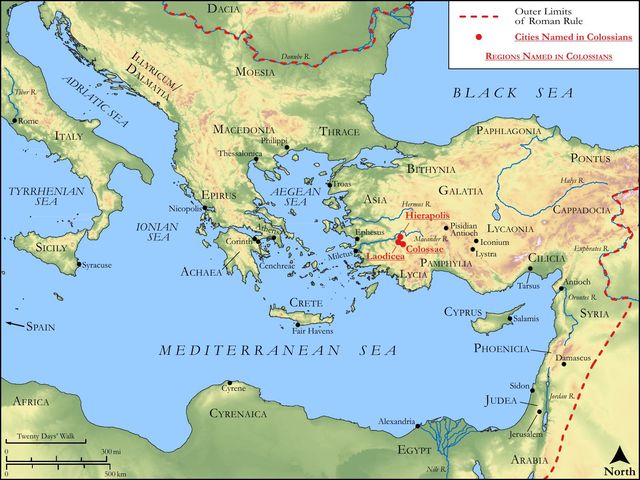
See on the biblical-era map

Study this verse
Public-domain commentary
Matthew Henry
From his Commentary on the Whole Bible. Henry comments on passages, not single verses — this entry covers Colossians 1:12–29. His four-level outline is real structure in the source text, so it is rendered as structure.
Here is a summary of the doctrine of the gospel concerning the great work of our redemption by Christ. It comes in here not as the matter of a sermon, but as the matter of a thanksgiving; for our salvation by Christ furnishes us with abundant matter of thanksgiving in every view of it: Giving thanks unto the Father, Col 1:12. He does not discourse of the work of redemption in the natural order of it; for then he would speak of the purchase of it first, and afterwards of the application of it. But here he inverts the order, because, in our sense and feeling of it, the application goes before the purchase. We first find the benefits of redemption in our hearts, and then are led by those streams to the original and fountain-head. The order and connection of the apostle's discourse may be considered in the following manner: -
I.He speaks concerning the operations of the Spirit of grace upon us.
We must give thanks for them, because by these we are qualified for an interest in the mediation of the Son: Giving thanks to the Father, etc., Col 1:12, Col 1:13. It is spoken of as the work of the Father, because the Spirit of grace is the Spirit of the Father, and the Father works in us by his Spirit. Those in whom the work of grace is wrought must give thanks unto the Father. If we have the comfort of it, he must have the glory of it. Now what is it which is wrought for us in the application of redemption? 1. "He hath delivered us from the power of darkness, Col 1:13. He has rescued us from the state of heathenish darkness and wickedness. He hath saved us from the dominion of sin, which is darkness (Jo1 1:6), from the dominion of Satan, who is the prince of darkness (Eph 6:12), and from the damnation of hell, which is utter darkness," Mat 25:30. They are called out of darkness, Pe1 2:9. 2. "He hath translated us into the kingdom of his dear Son, brought us into the gospel-state, and made us members of the church of Christ, which is a state of light and purity." You were once darkness, but now are you light in the Lord, Eph 5:8. Who hath called you out of darkness into his marvellous light, Pe1 2:9. Those were made willing subjects of Christ who were the slaves of Satan. The conversion of a sinner is the translation of a soul into the kingdom of Christ out of the kingdom of the devil. The power of sin is shaken off, and the power of Christ submitted to. The law of the Spirit of life in Christ Jesus makes them free from the law of sin and death; and it is the kingdom of his dear Son, or the Son of his peculiar love, his beloved Son (Mat 3:17), and eminently the beloved, Eph 1:6. 3. "He hath not only done this, but hath made us meet to partake of the inheritance of the saints in light, Col 1:12. He hath prepared us for the eternal happiness of heaven, as the Israelites divided the promised land by lot; and has given us the earnest and assurance of it." This he mentions first because it is the first indication of the future blessedness, that by the grace of God we find ourselves in some measure prepared for it. God gives grace and glory, and we are here told what they both are. (1.) What that glory is. It is the inheritance of the saints in light. It is an inheritance, and belongs to them as children, which is the best security and the sweetest tenure: If children, then heirs, Rom 8:17. And it is an inheritance of the saints-proper to sanctified souls. Those who are not saints on earth will never be saints in heaven. And it is an inheritance in light; the perfection of knowledge, holiness, and joy, by communion with God, who is light, and the Father of lights, Jam 1:17; Joh 1:5. (2.) What this grace is. It is a meetness for the inheritance: "He hath made us meet to be partakers, that is, suited and fitted us for the heavenly state by a proper temper and habit of soul; and he makes us meet by the powerful influence of his Spirit." It is the effect of the divine power to change the heart, and make it heavenly. Observe, All who are designed for heaven hereafter are prepared for heaven now. As those who live and die unsanctified go out of the world with their hell about them, so those who are sanctified and renewed go out of the world with their heaven about them. Those who have the inheritance of sons have the education of sons and the disposition of sons: they have the Spirit of adoption, whereby they cry, Abba, Father. Rom 8:15. And, because you are sons, God hath sent forth the Spirit of his Son into your hearts, crying, Abba, Father, Gal 4:6. This meetness for heaven is the earnest of the Spirit in our heart, which is part of payment, and assures the full payment. Those who are sanctified shall be glorified (Rom 8:30), and will be for ever indebted to the grace of God, which hath sanctified them.
II.Concerning the person of the Redeemer.
Glorious things are here said of him; for blessed Paul was full of Christ, and took all occasions to speak honourably of him. He speaks of him distinctly as God, and as Mediator. 1. As God he speaks of him, Col 1:15-17. (1.) He is the image of the invisible God. Not as man was made in the image of God (Gen 1:27), in his natural faculties and dominion over the creatures: no, he is the express image of his person, Heb 1:3. He is so the image of God as the son is the image of his father, who has a natural likeness to him; so that he who has seen him has seen the Father, and his glory was the glory of the only-begotten of the Father, Joh 1:14; Joh 14:9. (2.) He is the first-born of every creature. Not that he is himself a creature; for it is prōtotokos pasēs ktiseōs - born or begotten before all the creation, or before any creature was made, which is the scripture-way of representing eternity, and by which the eternity of God is represented to us: I was set up from everlasting, from the beginning, or ever the earth was; when there was no depth, before the mountains were settled, while as yet he had not made the earth, Pro 8:23-26. It signifies his dominion over all things, as the first-born in a family is heir and lord of all, so he is the heir of all things, Heb 1:2. The word, with only the change of the accent, prōtotokos, signifies actively the first begetter or producer of all things, and so it well agrees with the following clause. Vid. Isidor. Peleus. epist. 30 lib. 3. (3.) He is so far from beginning himself a creature that he is the Creator: For by him were all things created, which are in heaven and earth, visible and invisible, Col 1:16. He made all things out of nothing, the highest angel in heaven, as well as men upon earth. He made the world, the upper and lower world, with all the inhabitants of both. All things were made by him, and without him was not any thing made which was made, Joh 1:3. He speaks here as if there were several orders of angels: Whether thrones, or dominions, or principalities, or powers, which must signify either different degrees of excellence or different offices and employments. Angels, authorities, and powers, Pe1 3:22. Christ is the eternal wisdom of the Father, and the world was made in wisdom. He is the eternal Word, and the world was made by the word of God. He is the arm of the Lord, and the world was made by that arm. All things are created by him and for him; di' autou kai eis auton. Being created by him, they were created for him; being made by his power, they were made according to his pleasure and for his praise. He is the end, as well as the cause of all things. To him are all things, Rom 11:36; eis auton ta panta. (4.) He was before all things. He had a being before the world was made, before the beginning of time, and therefore from all eternity. Wisdom was with the Father, and possessed by him in the beginning of his ways, before his works of old, Pro 8:22. And in the beginning the Word was with God and was God, Joh 1:1. He not only had a being before he was born of the virgin, but he had a being before all time. (5.) By him all things consist. They not only subsist in their beings, but consist in their order and dependences. He not only created them all at first, but it is by the word of his power that they are still upheld, Heb 1:3. The whole creation is kept together by the power of the Son of God, and made to consist in its proper frame. It is preserved from disbanding and running into confusion.
2.The apostle next shows what he is as Mediator, Col 1:18, Col 1:19.
(1.)He is the head of the body the church: not only a head of government and direction, as the king is the head of the state and has right to prescribe laws, but a head of vital influence, as the head in the natural body: for all grace and strength are derived from him: and the church is his body, the fulness of him who filleth all in all, Eph 1:22, Eph 1:23.
(2.)He is the beginning, the first-born from the dead, archē, prōtotokos - the principle, the first-born from the dead; the principle of our resurrection, as well as the first-born himself. All our hopes and joys take their rise from him who is the author of our salvation. Not that he was the first who ever rose from the dead, but the first and only one who rose by his own power, and was declared to be the Son of God, and Lord of all things. And he is the head of the resurrection, and has given us an example and evidence of our resurrection from the dead. He rose as the first-fruits, Co1 15:20.
(3.)He hath in all things the pre-eminence. It was the will of the Father that he should have all power in heaven and earth, that he might be preferred above angels and all the powers in heaven (he has obtained a more excellent name than they, Heb 1:4), and that in all the affairs of the kingdom of God among men he should have the pre-eminence. He has the pre-eminence in the hearts of his people above the world and the flesh; and by giving him the pre-eminence we comply with the Father's will, That all men should honour the Son even as they honour the Father, Joh 5:23.
(4.)All fulness dwells in him, and it pleased the Father it should do so (Col 1:19), not only a fulness of abundance for himself, but redundance for us, a fulness of merit and righteousness, of strength and grace. As the head is the seat and source of the animal spirits, so is Christ of all graces to his people. It pleased the Father that all fulness should dwell in him; and we may have free resort to him for all that grace for which we have occasion. He not only intercedes for it, but is the trustee in whose hands it is lodged to dispense to us: Of his fulness we receive, and grace for grace, grace in us answering to that grace which is in him (Joh 1:16), and he fills all in all, Eph 1:23.
III.Concerning the work of redemption.
He speaks of the nature of it, or wherein it consists; and of the means of it, by which it was procured.
1.Wherein it consists. It is made to lie in two things: - (1.) In the remission of sin: In whom we have redemption, even the forgiveness of sins, Col 1:14. It was sin which sold us, sin which enslaved us: if we are redeemed, we must be redeemed from sin; and this is by forgiveness, or remitting the obligation to punishment. So Eph 1:7, In whom we have redemption, the forgiveness of sins, according to the riches of his grace. (2.) In reconciliation to God. God by him reconciled all things to himself, Col 1:20. He is the Mediator of reconciliation, who procures peace as well as pardon for sinners, who brings them into a state of friendship and favour at present, and will bring all holy creatures, angels as well as men, into one glorious and blessed society at last: things in earth, or things in heaven. So Eph 1:10, He will gather together in one all things in Christ, both which are in heaven and which are on earth. The word is anakephalaiōsasthai - he will bring them all under one head. The Gentiles, who were alienated, and enemies in their minds by wicked works, yet now hath he reconciled, Col 1:21. Here see what was their condition by nature, and in their Gentile state-estranged from God, and at enmity with God: and yet this enmity is slain, and, notwithstanding this distance, we are now reconciled. Christ has laid the foundation for our reconciliation; for he has paid the price of it, has purchased the proffer and promise of it, proclaims it as a prophet, applies it as a king. Observe, The greatest enemies to God, who have stood at the greatest distance and bidden him defiance, may be reconciled, if it by not their own fault.
2.How the redemption is procured: it is through his blood (Col 1:14); he has made peace through the blood of his cross (Col 1:20), and it is in the body of his flesh through death, Col 1:22. It was the blood which made an atonement, for the blood is the life; and without the shedding of blood there is no remission, Heb 9:22. There was such a value in the blood of Christ that, on account of Christ's shedding it, God was willing to deal with men upon new terms to bring them under a covenant of grace, and for his sake, and in consideration of his death upon the cross, to pardon and accept to favour all who comply with them.
IV.Concerning the preaching of this redemption. Here observe,
1.To whom it was preached: To every creature under heaven (Col 1:23), that is, it was ordered to be preached to every creature, Mar 16:15. It may be preached to every creature; for the gospel excludes none who do not exclude themselves. More or less it has been or will be preached to every nation, though many have sinned away the light of it and perhaps some have never yet enjoyed it.
2.By whom it was preached: Whereof I Paul am made a minister. Paul was a great apostle; but he looks upon it as the highest of his titles of honour to be a minister of the gospel of Jesus Christ. Paul takes all occasions to speak of his office; for he magnified his office, Rom 11:13. And again in Col 1:25, Whereof I am made a minister. Observe here,
(1.)Whence Paul had his ministry: it was according to the dispensation of God which was given to him (Col 1:25), the economy or wise disposition of things in the house of God. He was steward and master-builder, and this was given to him: he did not usurp it, nor take it to himself; and he could not challenge it as a debt. He received it from God as a gift, and took it as a favour.
(2.)For whose sake he had his ministry: "It is for you, for your benefit: ourselves your servants for Jesus' sake, Co2 4:5. We are Christ's ministers for the good of his people, to fulfil the word of God (that is, fully to preach it), of which you will have the greater advantage. The more we fulfil our ministry, or fill up all the parts of it, the greater will be the benefit of the people; they will be the more filled with knowledge, and furnished for service."
(3.)What kind of preacher Paul was. This is particularly represented.
[1.]He was a suffering preacher: Who now rejoice in my sufferings for you, Col 1:24. He suffered in the cause of Christ, and for the good of the church. He suffered for preaching the gospel to them. And, while he suffered in so good a cause, he could rejoice in his sufferings, rejoice that he was counted worthy to suffer, and esteem it an honour to him. And fill up that which is behind of the afflictions of Christ in my flesh. Not that the afflictions of Paul, or any other, were expiations for sin, as the sufferings of Christ were. There was nothing wanting in them, nothing which needed to be filled up. They were perfectly sufficient to answer the intention of them, the satisfaction of God's justice, in order to the salvation of his people. But the sufferings of Paul and other good ministers made them conformable to Christ; and they followed him in his suffering state: so they are said to fill up what was behind of the sufferings of Christ, as the wax fills up the vacuities of the seal, when it receives the impression of it. Or it may be meant not of Christ's sufferings, but of his suffering for Christ. He filled that which was behind. He had a certain rate and measure of suffering for Christ assigned him; and, as his sufferings were agreeable to that appointment, so he was still filling up more and more what was behind, or remained of them to his share.
[2.]He was a close preacher: he preached not only in public, but from house to house, from person to person. Whom we preach, warning every man, and teaching every man in all wisdom, Col 1:28. Every man has need to be warned and taught, and therefore let every man have his share. Observe, First, When we warn people of what they do amiss, we must teach them to do better: warning and teaching must go together. Secondly, Men must be warned and taught in all wisdom. We must choose the fittest seasons, and use the likeliest means, and accommodate ourselves to the different circumstances and capacities of those we have to do with, and teach them as they are able to bear. That which he aimed at was to present every man perfect in Christ Jesus, teleios, either perfect in the knowledge of the Christian doctrine (Let us therefore, as many as are perfect, be thus minded, Phi 3:15; Ti2 3:17), or else crowned with a glorious reward hereafter, when he will present to himself a glorious church (Eph 5:27), and bring them to the spirits of just men made perfect, Heb 12:23. Observe, Ministers ought to aim at the improvement and salvation of every particular person who hears them. Thirdly, He was a laborious preacher, and one who took pains: he was no loiter, and did not do his work negligently (Col 1:29): Whereunto I also labour, striving according to his working, which worketh in me mightily. He laboured and strove, used great diligence and contended with many difficulties, according to the measure of grace afforded to him and the extraordinary presence of Christ which was with him. Observe, As Paul laid out himself to do much good, so he had this favour, that the power of God wrought in him the more effectually. The more we labour in the work of the Lord the greater measures of help we may expect from him in it (Eph 3:7): According to the gift of the grace of God given unto me, by the effectual working of his power.
3.The gospel which was preached. We have an account of this: Even the mystery which hath been hid from ages, and from generations, but is now made manifest to his saints, Col 1:26, Col 1:27. Observe,
(1.)The mystery of the gospel was long hidden: it was concealed from ages and generations, the several ages of the church under the Old Testament dispensation. They were in a state of minority, and training up for a more perfect state of things, and could not look to the end of those things which were ordained, Co2 3:13.
(2.)This mystery now, in the fulness of time, is made manifest to the saints, or clearly revealed and made apparent. The veil which was over Moses's face is done away in Christ, Co2 3:14. The meanest saint under the gospel understands more than the greatest prophets under the law. He who is least in the kingdom of heaven is greater than they. The mystery of Christ, which in other ages was not made known unto the sons of men, is now revealed unto his holy apostles and prophets by the Spirit, Eph 3:4, Eph 3:5. And what is this mystery? It is the riches of God's glory among the Gentiles. The peculiar doctrine of the gospel was a mystery which was before hidden, and is now made manifest and made known. But the great mystery here referred to is the breaking down of the partition-wall between the Jew and Gentile, and preaching the gospel to the Gentile world, and making those partakers of the privileges of the gospel state who before lay in ignorance and idolatry: That the Gentiles should be fellow-heirs, and of the same body, and partakers together of his promise in Christ by the gospel, Eph 3:6. This mystery, thus made known, is Christ in you (or among you) the hope of glory. Observe, Christ is the hope of glory. The ground of our hope is Christ in the word, or the gospel revelation, declaring the nature and methods of obtaining it. The evidence of our hope is Christ in the heart, or the sanctification of the soul, and its preparation for the heavenly glory.
4.The duty of those who are interested in this redemption: If you continue in the faith, grounded and settled, and be not moved away from the hope of the gospel which you have heard, Col 1:23. We must continue in the faith grounded and settled, and not be moved away from the hope of the gospel; that is, we must be so well fixed in our minds as not to be moved from it by any temptations. We must be stedfast and immovable (Co1 15:58) and hold fast the profession of our faith without wavering, Heb 10:23. Observe, We can expect the happy end of our faith only when we continue in the faith, and are so far grounded and settled in it as not to be moved from it. We must not draw back unto perdition, but believe unto the saving of the soul, Heb 10:39. We must be faithful to death, through all trials, that we may receive the crown of life, and receive the end of our faith, the salvation of our souls, Pe1 1:9.
Historical interpretation
Three Centuries of Reception
3 surviving comments on this verse. Each one is dated, so this reads as a timeline rather than a list.
Select a marker to jump to its quote. Markers stagger vertically where authors wrote within a few decades of each other.
Let my spirit be counted as nothing for the sake of the cross, which is a stumbling-block to those that do not believe, but to us salvation and life eternal. "Where is the wise man? where the disputer? " Where is the boasting of those who are styled prudent? For our God, Jesus Christ, was, according to the appointment of God, conceived in the womb by Mary, of the seed of David, but by the Holy Ghost. He was born and baptized, that by His passion He might purify the water.
And again he says, "According to the disposition of the grace of God which is given me, that ye may fulfil the word of God; the mystery which has been hid from ages and generations, which now is manifested to His saints: to whom God wished to make known what is the riches of the glory of this mystery among the nations."
"Of which I was made," saith he, "a minister, according to the dispensation of God which is given me to youward, to fulfill the word of God." "The dispensation." Either he means, He so willed that after His own departure we should succeed to the dispensation, in order that ye might not feel as deserted, (for it is Himself that suffers, Himself that is ambassador;) or he means this, namely, me who was more than all a persecutor, for this end He permitted to persecute, that in my preaching I might gain belief; or by "dispensation" he means, that He required not deeds, nor actions, nor good works, but faith and baptism. For ye would not otherwise have received the word. "For you," he saith, "to fulfill the word of God." He speaks of the Gentiles, showing that they were yet wavering, by the expression, "fulfill." For that the cast-away Gentiles should have been able to receive such lofty doctrines was not of Paul, but of the dispensation of God; "for I never could have had the power," he saith. Having shown that which is greater, that his sufferings are Christ's, he next subjoins what is more evident, that this also is of God, "to fulfill His word in you." And he shows here covertly, that this too is of dispensation, that it is spoken to you now, when ye are able to hear it, and cometh not of neglect, but to the end ye may receive it. For God doeth not all things on a sudden, but useth condescension because of His plenteous love toward man. And this is the reason why Christ came at this time, and not of old.
Continue studying Colossians 1:25 across the web’s major study libraries — every link below opens this exact verse, chapter, or book on the destination site.
Read & Compare
 BibleGatewayThis verse in more than 200 translations and 70 languages.
 Bible.comThe YouVersion reader — hundreds of translations, reading plans, and highlights.
 ESV.orgCrossway's official English Standard Version reader.
 NET BibleThe NET translation with 60,000+ translators' notes on every rendering decision.
 STEP BibleTyndale House's free study tool — original text, vocabulary, and scholarly resources.
 BibliaLogos Bible Software's free web reader.
 USCCBThe New American Bible (Revised Edition) with the U.S. bishops' study notes.
Commentaries
 BibleHub CommentariesDozens of classic commentaries on this verse, gathered on one page.
 StudyLightMore than 100 commentary sets — the largest collection on the web.
 BibleRefPlain-English commentary on what this verse means, verse by verse.
 Enduring WordDavid Guzik's free commentary on this chapter, widely used by Bible teachers.
 Bible Study ToolsVerse commentary alongside Greek and Hebrew study aids.
Original Language & Research
- BibleHub InterlinearThe verse word by word — original language, transliteration, and English.
- BibleHub LexiconEvery word's original-language definition and Strong's entry.
 Blue Letter BibleDeep-study tools — Strong's numbers, concordance, and word studies.
 CNTR CollationThe earliest Greek manuscripts of this verse, collated letter by letter.
Sermons, Hymns & Audio


TrulyRandomVerse is not affiliated with these sites and doesn’t control their content. They’re linked because they’re genuinely useful.
Summary
In Colossians 1:25, the Apostle Paul articulates the divine mandate behind his apostolic ministry, emphasizing that his role as a servant is not of human origin but a direct commission from God. He describes this commission as a "dispensation of God," a sacred stewardship entrusted to him specifically for the benefit of the Colossian believers and, by extension, all Gentiles. The ultimate purpose of this divine arrangement, Paul declares, is "to fulfil the word of God," signifying the complete and full proclamation of the Gospel, particularly the previously hidden mystery of Christ's indwelling presence among all believers.
Context
ShowHideLiterary Context
Colossians 1:25 is strategically positioned within Paul's profound theological exposition, following his declaration of suffering for the church's sake in Colossians 1:24. This verse serves as a crucial bridge, clarifying the divine authority and purpose behind his suffering and ministry, which culminates in the magnificent revelation of "the mystery" in Colossians 1:26-27. Paul is not merely an itinerant preacher; he is a divinely appointed steward of God's unfolding plan, and this verse underscores the legitimacy and necessity of his mission in bringing the full scope of the Gospel to light, especially to the Gentile world. It reinforces that his suffering is not in vain but integral to his God-given role.
Historical & Cultural Context
The city of Colossae, located in the Lycus Valley of Asia Minor, was a melting pot of various religious and philosophical influences, including syncretistic forms of Judaism, nascent Gnostic ideas, and local pagan cults. The church there faced challenges from false teachings that diminished the supremacy and sufficiency of Christ. In this environment, Paul's assertion of a "dispensation of God" (οἰκονομία, oikonomía) would have resonated with the cultural understanding of a household manager or steward entrusted with a specific, vital responsibility. Such a steward was given authority and resources to manage affairs on behalf of the master. Paul leverages this familiar concept to convey the weight and divine origin of his commission, distinguishing his ministry from any human-initiated endeavor and asserting its unique authority in a context where competing spiritual claims were prevalent. His imprisonment, though physically limiting, did not negate the divine nature of his calling.
Key Themes
ShowHideThis verse contributes significantly to several overarching themes in Colossians and Paul's broader theology. Firstly, it highlights the theme of Divine Commission and Authority, asserting that Paul's apostleship is not self-appointed but a direct gift from God, legitimizing his message against any detractors. Secondly, the phrase "dispensation of God" introduces the theme of Divine Stewardship and God's Unfolding Plan (οἰκονομία), emphasizing that God has a specific, ordered plan for the ages, and Paul is a key administrator of its current phase, particularly concerning the inclusion of Gentiles. This connects to broader Pauline themes found in Ephesians 3:2-9 where he speaks of the "dispensation of the grace of God" given to him for the Gentiles. Thirdly, the purpose "to fulfil the word of God" underscores the theme of The Fullness and Sufficiency of the Gospel, implying that Paul's ministry is bringing to completion the revelation of God's redemptive truth, making known the "mystery" that was previously hidden, as further elaborated in Colossians 1:26-27. This theme counters any notion that additional knowledge or practices are needed beyond Christ.
Exposition and Analysis
ShowHideKey Word Analysis
ShowHideThis primary pronoun of the first person, "I," is used here emphatically. While pronouns are often omitted in Greek when the subject is clear from the verb, its inclusion here underscores Paul's personal and direct involvement in this divinely appointed ministry. It highlights his unique, individual calling and responsibility within God's plan, emphasizing that it was specifically he who was made a minister and given this stewardship.
Derived from a root meaning "to run on errands," this term denotes an attendant, a waiter, or more broadly, a servant. In a Christian context, it refers to one who serves, often in a teaching or pastoral capacity. Paul consistently uses this term to describe his humble yet crucial role in serving Christ and His church, emphasizing service rather than status. It conveys a sense of active, dedicated service in the spread of the Gospel.
This word, meaning "administration (of a household or estate)" or "stewardship," refers to a specific arrangement or management. Theologically, it describes a particular divine administration or economy, a phase or aspect of God's overarching plan for humanity. Paul sees himself as a faithful steward entrusted with the management and revelation of a particular phase of God's truth, specifically the mystery of Christ for both Jews and Gentiles. It is not merely a task but a divine trust.
This verb means "to make replete," "to cram," "to fill up," or "to complete." In the context of "the word of God," it signifies not adding to but fully proclaiming, making known, or bringing to completion the revelation of God's redemptive plan. Paul's mission was to ensure that the Gospel, in its entirety, was fully preached and understood, especially concerning the inclusion of Gentiles and the indwelling of Christ.
Verse Breakdown
ShowHide"Whereof I am made a minister"
Paul begins by stating his divine appointment as a "minister" or servant. The passive voice ("I am made") emphasizes that this role is not self-chosen or humanly conferred, but rather a result of God's sovereign action. It underscores the divine origin and authority of his apostleship and ministry.
"according to the dispensation of God"
This phrase clarifies the nature of Paul's ministry. It is not arbitrary but operates "according to" (κατά, katá) a specific divine arrangement or stewardship. God has a plan, an "economy," and Paul has been entrusted with a particular aspect of its administration. This highlights God's purposeful and ordered activity in salvation history, with Paul playing a key role in its unfolding.
"which is given to me for you"
The "dispensation" is explicitly stated as a gift from God ("given to me"). This gift is not for Paul's personal gain or glory but is "for you" – specifically for the Colossian believers, and by extension, for all Gentile Christians. This emphasizes the pastoral and evangelistic purpose of Paul's commission: to serve and benefit the church, bringing them the full revelation of God's truth.
"to fulfil the word of God;"
This clause states the ultimate purpose and goal of Paul's stewardship. "To fulfil" (πληρόω, plēróō) means to bring to completion, to fully preach, or to make known the "word of God." This implies that Paul's ministry was essential for the complete revelation of the Gospel, especially the "mystery" (mentioned in the subsequent verses) concerning Christ's indwelling in believers and the inclusion of Gentiles, ensuring that no part of God's redemptive message remained unproclaimed or obscure.
Literary Devices
ShowHidePaul employs several literary devices to convey the profound significance of his ministry in Colossians 1:25. The primary device is Metaphor, specifically the Stewardship Metaphor, where Paul likens his ministry to an "οἰκονομία" (dispensation or administration). This evokes the image of a trusted household manager or administrator, responsible for overseeing the master's affairs. This metaphor emphasizes the divine origin of his authority, the weighty responsibility entrusted to him, and the ordered nature of God's plan. Furthermore, there is an element of Purposeful Language, as every phrase is carefully chosen to articulate the "why" and "how" of his calling. The phrase "to fulfil the word of God" is a concise and powerful statement of his mission's Telos (ultimate purpose or end goal), indicating a completion or full proclamation rather than a mere introduction. The passive voice "I am made a minister" functions as a form of Divine Passive, subtly attributing the action to God without explicitly naming Him, thereby underscoring the divine agency behind Paul's appointment and reinforcing the legitimacy of his message.
Theological and Thematic Connections
ShowHideColossians 1:25 profoundly shapes our understanding of divine calling, stewardship, and the progressive revelation of God's redemptive plan. Paul's assertion that he was "made a minister, according to the dispensation of God" reveals that God orchestrates history and salvation through specific individuals entrusted with particular responsibilities. This "dispensation" (οἰκονομία) is not merely a task but a divine arrangement, a purposeful management of God's truth, designed to bring His eternal plan to fruition. For Paul, this meant making known the "word of God" in its fullness, especially the mystery of Christ's indwelling presence among all believers, regardless of their ethnic background. This verse underscores that God's word is not static but dynamically revealed through chosen vessels, ensuring that the complete Gospel message reaches its intended recipients, bringing clarity to what was once hidden.
Reflection and Application
ShowHideColossians 1:25 invites believers to reflect deeply on the nature of their own calling and participation in God's grand design. Just as Paul was entrusted with a specific "dispensation of God" to "fulfil the word of God," so too are all believers given a unique stewardship within the body of Christ. This verse challenges us to move beyond a passive understanding of faith to an active engagement with God's purposes. It encourages us to discern our individual roles, whether in formal ministry or daily life, as divine trusts to be faithfully managed. Our mission, like Paul's, is to embody and articulate the "word of God" in its fullness, making Christ known in our spheres of influence. This requires a commitment to understanding the complete Gospel, living out its truths, and sharing its transformative power with intentionality and humility, recognizing that every act of service is a contribution to the unfolding of God's kingdom.
Questions for Reflection
ShowHideFAQ
ShowHideWhat does Paul mean by "dispensation of God"?
ShowHideThe phrase "dispensation of God" (Greek: oikonomía tou theou) refers to a divine administration, stewardship, or arrangement. It signifies a specific plan or management that God has entrusted to Paul. In this context, it highlights that Paul's ministry is not a human invention but a divinely ordained responsibility to manage and reveal God's truth, particularly the "mystery" of Christ's inclusion of both Jews and Gentiles into one body, as elaborated in Ephesians 3:2-9. It's about God's purposeful ordering of salvation history, with Paul as a key administrator of this phase.
How did Paul "fulfil the word of God"?
ShowHideTo "fulfil the word of God" (Greek: plēróō ton logon tou theou) means to fully preach, make known, or bring to completion the revelation of God's redemptive plan. It doesn't imply that God's word was incomplete before Paul, but rather that Paul's ministry was instrumental in bringing to light aspects of God's eternal purpose that were previously hidden or not fully understood. This primarily refers to the "mystery" of Christ, which is Christ dwelling in Gentiles, making them fellow heirs and members of the body (as seen in Colossians 1:26-27 and Ephesians 3:6). Paul's mission was to ensure that this comprehensive truth of the Gospel was fully proclaimed and established among all nations.
Christ-Centered Fulfillment
ShowHideColossians 1:25, though focused on Paul's ministry, finds its ultimate Christ-centered fulfillment in the person and work of Jesus Himself. Paul's "dispensation" was "to fulfil the word of God," and Christ is the very embodiment and culmination of that Word. Jesus is the Logos, the Word of God made flesh, through whom all things were created and in whom all things hold together. His life, death, and resurrection are the ultimate "fulfillment" of God's redemptive plan, bringing to light the mystery of salvation previously veiled. Paul's ministry, therefore, was not about himself, but about making known the Christ who is the image of the invisible God and the head of the body, the church. The "word of God" that Paul was called to fulfill is ultimately the Gospel of Christ, which reveals God's reconciliation of all things to Himself through the cross, as described in Colossians 1:20. Thus, Paul's stewardship served to magnify Christ, the living Word, who perfectly fulfills all of God's promises and purposes, making salvation accessible to all who believe, Jew and Gentile alike, establishing Christ in them, the hope of glory.