


Isaiah 31:6
- שׁוּבוּShu·vureturnH7725V-Qal-Imp-2mpVerb Qal Imperative 2nd Plural Masculine
- לַאֲשֶׁרla·'a·Sherto [the one] whomH834Prep-l ¦ RelParticle Relativeלַtoאֲשֶׁר[the one] whom
- הֶעְמִיקוּhe'·Mi·kuthey have made deepH6009V-Hiphil-Perf-3cpVerb Hiphil Perfect 3rd Plural common gender
- סָרָהsa·RahrebellionH5627N-fsNoun Singular Feminine Absolute
- בְּנֵיbe·Nei[the] people ofH1121N-mpcNoun Plural Masculine Construct
- יִשְׂרָאֵלYis·ra·'ElIsraelH3478N-properNoun Proper Location
English is a literal word-by-word gloss of the Hebrew, not the KJV's wording. Why?
This is the original text the KJV's translators worked from — each Hebrew word with its own literal English meaning in this verse, prepared by scholars at Tyndale House, Cambridge. The KJV translates whole sentences, not word by word, so its wording differs: one Hebrew word can become several English words, and the KJV may choose “the LORD” where the gloss reads “Yahweh”. Both are faithful — they answer different questions. For the KJV's own rendering, switch to the KJV text.
Details
See on the biblical-era map
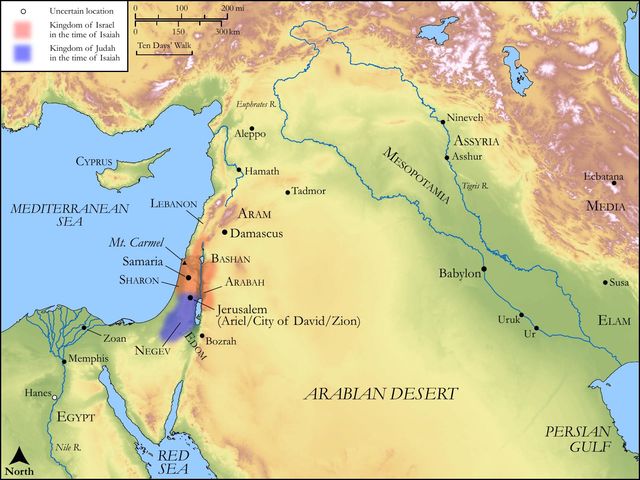
Study this verse
Public-domain commentary
Matthew Henry
From his Commentary on the Whole Bible. Henry comments on passages, not single verses — this entry covers Isaiah 31:6–9. His three-level outline is real structure in the source text, so it is rendered as structure.
This explains the foregoing promise of the deliverance of Jerusalem; she shall be fitted for deliverance, and then it shall be wrought for her; for in that method God delivers.
I.Jerusalem shall be reformed, and so she shall be delivered from her enemies within her walls, Isa 31:6, Isa 31:7.
Here is, 1. A gracious call to repentance. This was the Lord's voice crying in the city, the voice of the rod, the voice of the sword, and the voice of the prophets interpreting the judgment: "Turn you, O turn you now, from your evil ways, unto God, return to your allegiance to him from whom the children of Israel have deeply revolted, from whom you, O children of Israel! have revolted." He reminds them of their birth and parentage, that they were children of Israel, and therefore under the highest obligations imaginable to the God of Israel, as an aggravation of their revolt from him and as an encouragement to them to return to him. "They have been backsliding children, yet children; therefore let them return, and their backslidings shall be healed. They have deeply revolted, with great address as they supposed (the revolters are profound, Hos 5:2); but the issue will prove that they have revolted dangerously. The stain of their sins has gone deeply into their nature, not to be easily got out, like the blackness of the Ethiopian. They have deeply corrupted themselves (Hos 9:9); they have sunk deep into misery, and cannot easily recover themselves; therefore you have need to hasten your return to God." 2. A gracious promise of the good success of this call (Isa 31:7): In that day every man shall cast away his idols, in obedience to Hezekiah's orders, which, till they were alarmed by the Assyrian invasion, many refused to do. That is a happy fright which frightens us from our sins. (1.) It shall be a general reformation: every man shall cast away his own idols, shall begin with them before he undertakes to demolish other people's idols, which there will be no need of when every man reforms himself. (2.) It shall be a thorough reformation; for they shall part with their idolatry, their beloved sin, with their idols of silver and gold, their idols that they are most fond of. Many make an idol of their silver and gold, and by the love of that idol are drawn to revolt from God; but those that turn to God cast that away out of their hearts and will be ready to part with it when God calls. (3.) It shall be a reformation upon a right principle, a principle of piety, not of politics. They shall cast away their idols, because they have been unto them for a sin, an occasion of sin; therefore they will have nothing to do with them, though they had been the work of their own hands, and upon that account they had a particular fondness for them. Sin is the work of our own hands, but in working it we have been working our own ruin, and therefore we must cast it away; and those are strangely wedded to it who will not be prevailed upon to cast it away when they see that otherwise they themselves will be castaways. Some make this to be only a prediction that those who trust in idols, when they find they stand them in no stead, will cast them away in indignation. But it agrees so exactly with Isa 30:22 that I rather take it as a promise of a sincere reformation.
II.Jerusalem's besiegers shall be routed, and so she shall be delivered from the enemies about her walls.
The former makes way for this. If a people return to God, they may leave it to him to plead their cause against their enemies. When they have cast away their idols, then shall the Assyrian fall, Isa 31:8, Isa 31:9.
1.The army of the Assyrians shall be laid dead upon the spot by the sword, not of a mighty man, nor of a mean man, not of any man at all, either Israelite or Egyptian, not forcibly by the sword of a mighty man nor surreptitiously by the sword of a mean man, but by the sword of an angel, who strikes more strongly than a mighty man and yet more secretly than a mean man, by the sword of the Lord, and his power and wrath in the hand of the angel. Thus the young men of the army shall melt, and be discomfited, and become tributaries to death. When God has work to do against the enemies of his church we expect it must be done by mighty men and mean men, officers and common soldiers; whereas God can, if he please, do it without either. He needs not armies of men who has legions of angels at command, Mat 26:53.
2.The king of Assyria shall flee for the same, shall flee from that invisible sword, hoping to get out of the reach of it; and he shall make the best of his way to his own dominions, shall pass over to some strong-hold of his own, for fear lest the Jews should pursue him now that his army was routed. Sennacherib had been very confident that he should make himself master of Jerusalem, and in the most insolent manner had set both God and Hezekiah at defiance; yet now he is made to tremble for fear of both. God can strike a terror into the proudest of men, and make the stoutest heart to tremble. See Job 18:11; Job 20:24. His princes that accompany him shall be afraid of the ensign, shall be in a continual fright at the remembrance of the ensign in the air, which perhaps the destroying angel displayed before he gave the fatal bow. Or they shall be afraid of every ensign they see, suspecting it is a party of the Jews pursuing them. The banner that God displays for the encouragement of his people (Psa 60:4) will be a terror to his and their enemies. Thus he cuts off the spirit of princes and is terrible to the kings of the earth. But who will do this? It is the Lord, whose fire is in Zion and his furnace in Jerusalem.
(1.)Whose residence is there, and who there keeps house, as a man does where his fire and his oven are. It is the city of the great King, and let not the Assyrians think to turn him out of the possession of his own house.
(2.)Who is there a consuming fire to all his enemies and will make them as a fiery oven in the day of his wrath, Psa 21:9. He is himself a wall of fire round about Jerusalem, so that whoever assaults her does so at his peril, Zac 2:5; Rev 11:5.
(3.)Who has his altar there, on which the holy fire is continually kept burning and sacrifices are daily offered to his honour, and with which he is well pleased; and therefore he will defend this city, especially having an eye to the great sacrifice which was there also to be offered, of which all the sacrifices were types. If we keep up the fire of holy love and devotion in our hearts and houses, we may depend upon God to be a protection to us and them.
Historical interpretation
Historical reception
2 surviving comments on this verse. Each one is dated, so this reads as a timeline rather than a list.
(Verse 6 onwards) Return, as you have deeply strayed, O children of Israel. For on that day a man will cast away the idols of his silver and the idols of his gold, which your own hands have made for yourselves to sin. And Assur will fall by the sword, not of a man; and a sword, not of a human, will devour him. He will flee not from the face of the sword, and his young men will become forced labor. His strength will pass away in terror, and his fleeing princes will be filled with fear, says the Lord, whose fire is in Zion and whose furnace is in Jerusalem. LXX: Return, O children of Israel, as you have gone deep into sin. For on that day every man will throw away the idols of his silver and the idols of his gold that your own hands have made for your own sins. And Assyria will fall by the sword, not of a man, and a sword, not of a human, will devour him; he will flee, but not from the face of the sword; his young men will be defeated; they will be surrounded like a wall, and they will be conquered; but whoever flees will be captured. Thus says the Lord: Blessed is he who has offspring in Zion and who has a household in Jerusalem. While the Lord fights against his adversaries on Mount Zion and protects it like a rampart, O children of Israel, turn back! As Symmachus translated it: Repent, you who have strayed from the Lord due to deep counsel and sin. For if you do this, casting aside the golden and silver idols that have been a cause of sin for you, because of which your city was captured, Assyria will fall, from whose fear you now flee, not by the sword of men or the strength of an army, but by the power of God. But it signifies that an angel, by whom 185,000 Assyrians were destroyed in one night. Also, the Assyrian king himself will not flee from the sword of men, but from the wrath of God, so that his young and strong men will become tributaries to the Medes, of whom it is said above, in opposition to Babylon: Behold, I will raise up the Medes against you. And the might of Assyria will pass by with the terror of the Lord, and all its princes will tremble. For the Lord has spoken and promised, and what He has said, He has done: and He who has fire in Zion and a furnace in Jerusalem, so that He may consume His adversaries like straw and wood coming out of Jerusalem. Another thing that is said: On that day, a man will throw away his idols of silver and the rest, it is interpreted in such a way that it testifies that after the return from the Babylonian captivity until the coming of Christ, the children of Israel never worshiped idols. Assyria is also signified in the present place, not by an angel, but by the Medes, because it was the most ancient and once powerful kingdom, which was destroyed after offending the Lord, and served the conquerors. The Nazarenes understand this place thus: O children of Israel, who denied the Son of God with wicked counsel, return to Him and His Apostles. For if you do this, you will cast away all the idols that were previously a sin for you, and the devil will fall to you, not by your strength, but by the mercy of God; and its young men who once fought for it will be subjects of the Church, and all its strength and rock will be passed to it; even the philosophers and every perverse doctrine will turn their backs to the sign of the cross. For the opinion of the Lord is that this should be done: whose fire or light is in Zion and his furnace in Jerusalem. Fire and light are written in Hebrew with the same letters Aleph, Vau, Res; if it is read as Ur, it means fire: if Or, it means light. This is said because for the fire, which Symmachus alone interprets, Aquila and Theodotion translate it as light. But I do not know what is meant by what is read in the Septuagint: They will be surrounded like a wall by rock, and they will be conquered: but whoever flees will be captured. Unless perhaps we can say this, that the young men of the Assyrian king who are to be conquered and captured, are surrounded like a rock, that is, by the strength of the Lord, just as a city is surrounded by a wall. Furthermore, what follows: Blessed is the one who has offspring in Zion, and domestic servants in Jerusalem, we can interpret it in such a way as to say that it agrees with the meaning of this place, that the divine word exhorts those who are fleeing to Egypt to return to Jerusalem and to bear children. To whom such great blessedness is promised, that it may be defended and protected by the help of the Lord. And in another place it is written about it: The glory of this last house shall be greater than the glory of the former (Haggai 2:10). Which can also be referred to the Church, the vision of peace and the watchtower, of which it is written: Glorious things are spoken of you, O city of God (Psalm 87:2). And elsewhere: The streams of the river make glad the city of God (Psalm 46:3). For in it there is fire and a furnace that shall devour the sinners, and shall consume the wood, hay, and stubble; or it is a light and an oven, that the brightness of the righteous, and the punishment of the wicked, may be shown.
In place of the last clause [“But you have played the harlot with many lovers; yet return again to me, says the Lord.”] the true Hebrew text (which is not preserved in the Greek and Latin versions) gives the following: “you have forsaken me, yet return, and I will receive you, says the Lord.” Isaiah also speaking in the same sense uses almost the same words: “Return,” he cries, “O children of Israel, you who devise a deep and sinful counsel. Return to me, and I will redeem you. I am God, and there is no God else beside me; a just God and a Savior; there is nothing beside me. Look to me, and be saved, all the ends of the earth.” Remember this and show yourselves men: bring it again to mind, O you transgressors. Return in heart and remember the former things of old: for I am God and there is none else.”
Continue studying Isaiah 31:6 across the web’s major study libraries — every link below opens this exact verse, chapter, or book on the destination site.
Read & Compare
 BibleGatewayThis verse in more than 200 translations and 70 languages.
 Bible.comThe YouVersion reader — hundreds of translations, reading plans, and highlights.
 ESV.orgCrossway's official English Standard Version reader.
 NET BibleThe NET translation with 60,000+ translators' notes on every rendering decision.
 STEP BibleTyndale House's free study tool — original text, vocabulary, and scholarly resources.
 BibliaLogos Bible Software's free web reader.
 USCCBThe New American Bible (Revised Edition) with the U.S. bishops' study notes.
Commentaries
 BibleHub CommentariesDozens of classic commentaries on this verse, gathered on one page.
 StudyLightMore than 100 commentary sets — the largest collection on the web.
 BibleRefPlain-English commentary on what this verse means, verse by verse.
 Enduring WordDavid Guzik's free commentary on this chapter, widely used by Bible teachers.
 Bible Study ToolsVerse commentary alongside Greek and Hebrew study aids.
Original Language & Research
- BibleHub InterlinearThe verse word by word — original language, transliteration, and English.
- BibleHub LexiconEvery word's original-language definition and Strong's entry.
 Blue Letter BibleDeep-study tools — Strong's numbers, concordance, and word studies.
 SefariaThe Hebrew text with Rashi and centuries of Jewish commentary.
Sermons, Hymns & Audio


TrulyRandomVerse is not affiliated with these sites and doesn’t control their content. They’re linked because they’re genuinely useful.
Summary
Isaiah 31:6 delivers a profound prophetic summons to the nation of Israel, urging them to abandon their deep-seated rebellion and return to the Lord, their covenant God. This imperative call to repentance is issued against the backdrop of Judah's misguided reliance on foreign alliances, particularly with Egypt, rather than placing their trust in divine protection. The verse powerfully underscores the pervasive nature of their spiritual defection while simultaneously extending God's persistent invitation for reconciliation and restoration to His chosen people.
Context
ShowHideLiterary Context
Isaiah 31:6 is strategically positioned within a series of oracles (chapters 28-31) where the prophet Isaiah vehemently condemns Judah's policy of seeking an alliance with Egypt as a defense against the formidable Assyrian Empire. Chapters 30 and 31, in particular, form a powerful indictment of human self-reliance and misplaced trust. Isaiah 31:1-3 explicitly contrasts the futility of human strength—represented by Egypt's horses and chariots—with the omnipotence of God, who "will stretch out his hand against the house of the evildoers, and against the help of them that work iniquity." Verses 4-5 vividly portray God's protective presence over Jerusalem, likening Him to a lion guarding its prey or birds hovering over their young, emphasizing His unwavering commitment to defend His city. Therefore, verse 6, with its direct command to "Turn ye," serves as the logical and compassionate culmination of this denunciation, offering a clear path out of condemned behavior and back into covenant faithfulness and divine security.
Historical & Cultural Context
The late 8th century BCE was a period of immense geopolitical instability for the Southern Kingdom of Judah. The Assyrian Empire, under the aggressive expansion of Sennacherib, was the dominant superpower, threatening to engulf the entire Near East. Judah, a small buffer state, found itself precariously situated between Assyria and Egypt, a declining but still influential power. Despite God's repeated warnings through prophets like Isaiah to trust Him alone for deliverance, Judah's kings and officials, driven by fear and political expediency, sought security in treaties and alliances with Egypt. This reliance on foreign powers was a direct violation of the covenant, which mandated exclusive loyalty and trust in Yahweh, as articulated in passages such as Isaiah 30:1-7. Culturally, such alliances often entailed adopting foreign deities and practices, further entrenching the "revolt" mentioned in the verse. The prophetic call to "turn" was thus not merely about a shift in political alignment but a profound spiritual reorientation away from idolatry, syncretism, and humanistic reliance, back towards the one true God.
Key Themes
ShowHideThe overarching themes in Isaiah 31:6 resonate profoundly throughout the book of Isaiah and the broader prophetic corpus. A central theme is Repentance and Return (Hebrew: shûwb), a foundational concept in Israelite theology that emphasizes the possibility of restoring a broken covenant relationship through a genuine change of heart and action. This call to return is seen repeatedly when Israel strays, as highlighted in passages like Jeremiah 3:12. Closely intertwined is the theme of Rebellion and Unfaithfulness, which consistently highlights Israel's chronic tendency to stray from God's ways, often preferring human wisdom and strength over divine counsel, as powerfully depicted in Isaiah 1:2-4. Despite this persistent unfaithfulness, the verse implicitly conveys God's Enduring Invitation and Patience, demonstrating His steadfast love and desire for His people's restoration, even in the face of profound apostasy. Finally, it reinforces the crucial theme of Trust in God Alone, contrasting the deceptive security offered by worldly alliances with the true and ultimate deliverance found only in Yahweh, a truth echoed in Psalm 20:7.
Exposition and Analysis
ShowHideKey Word Analysis
ShowHideThis is a primitive root signifying "to turn back (hence, away) transitively or intransitively, literally or figuratively." In Isaiah 31:6, it functions as an imperative, a direct and urgent command for a spiritual reorientation. This verb is fundamental to the biblical concept of repentance, denoting a complete reversal of direction—a turning away from sin, apostasy, or misplaced trust, and a decisive turning back towards God and His covenant. It implies a conscious and deliberate choice to change allegiance and behavior.
The word "bên" (H1121) means "son" or "child," referring broadly to a descendant or a member of a collective group. "Yisrâʼêl" (H3478) is the symbolic name given to Jacob, meaning "he will rule as God," which subsequently refers to his posterity and the covenant nation. Together, "children of Israel" specifically identifies the audience of this prophetic call: God's chosen people, who, despite their unique covenant relationship and divine election, have deeply deviated from His prescribed path, embodying the very nation that was meant to bear God's name and witness to His sovereignty.
The verb "ʻâmaq" (H6009) means "to be (causatively, make) deep (literally or figuratively)," implying profundity or intensity. "Çârâh" (H5627) denotes "apostasy, crime; figuratively, remission; rebellion, revolt." The combination of these two words, often rendered as an intensive verbal construction ("they have deeply revolted"), powerfully emphasizes the profound, ingrained, and persistent nature of Israel's turning away from God. It signifies not a superficial error or a temporary lapse, but a fundamental, entrenched shift in loyalty and trust—a deep-seated, pervasive rebellion against their divine King and the terms of His covenant.
Verse Breakdown
ShowHide"Turn ye unto [him]"
This opening phrase is a direct, urgent imperative from the prophet, speaking with divine authority. The "him" unequivocally refers to Yahweh, the Lord God of Israel. The command "turn" (Hebrew: shûwb) is a foundational biblical concept of repentance, signifying a complete change of direction—away from sin, false gods, or misplaced trust, and back towards God. It demands a conscious and deliberate act of reorientation of one's heart, mind, and actions, implying a cessation of rebellious behavior and a return to covenant faithfulness.
"from whom the children of Israel have deeply revolted"
This clause provides the crucial context and justification for the preceding command. It clearly identifies the object of their rebellion—God Himself—and describes the severe, entrenched nature of their apostasy. The phrase "deeply revolted" (Hebrew: amaq he'emiqu çârâh) uses a powerful verbal construction to convey the intensity and ingrained character of their unfaithfulness. It suggests that their turning away was not a casual or momentary lapse but a profound, entrenched, and persistent act of rebellion against the covenant relationship, involving a fundamental shift in loyalty and trust from God to other sources of security or idolatrous practices. This deep-seated defection necessitated an equally profound "turning" back.
Literary Devices
ShowHideIsaiah 31:6 employs several potent literary devices to convey its urgent and poignant message. The most prominent is the Imperative Mood, evident in the opening command "Turn ye." This direct address creates a sense of immediate urgency and personal responsibility, demanding an active and decisive response from the audience. The phrase "deeply revolted" utilizes Intensification (a common feature of Hebrew verbal constructs) to emphasize the profound and entrenched nature of Israel's apostasy. It is not merely a revolt, but one that has gone "deep," suggesting a pervasive and ingrained spiritual condition that affects the very core of the nation's being. Furthermore, the verse employs a subtle form of Metonymy by referring to God as "him from whom" Israel has revolted, implying that the rebellion is not just against a person, but against His covenant, His laws, His divine authority, and His very being. This concise phrasing powerfully encapsulates the gravity of their sin. The overall tone is one of Pathos, appealing to the nation's spiritual well-being and God's enduring desire for their restoration, even in the face of profound and persistent unfaithfulness.
Theological and Thematic Connections
ShowHideIsaiah 31:6 stands as a timeless testament to God's unwavering call for repentance, even in the face of profound human rebellion. It underscores the biblical truth that true security, deliverance, and salvation are found exclusively in turning to the Lord, not in human alliances, military strength, or worldly wisdom. This verse highlights the covenantal nature of God's relationship with Israel, where faithfulness brings blessing and rebellion incurs judgment, yet always with an open door for return and reconciliation. It profoundly reveals God's character as both just in condemning sin and merciful in extending an invitation for reconciliation, demonstrating His patience, steadfast love, and enduring desire for His people's restoration, even when they have "deeply revolted" against Him.
Reflection and Application
ShowHideIsaiah 31:6 serves as a powerful mirror for individuals and communities in every age. Just as ancient Israel placed their trust in chariots and foreign alliances, we too often seek security and solutions in worldly resources—be it wealth, power, human wisdom, technological advancements, or even self-reliance—rather than in God alone. The phrase "deeply revolted" challenges us to honestly examine the depth of our own allegiances. Have we, perhaps subtly or unknowingly, allowed our trust to become deeply rooted in anything other than the Lord? This verse is an enduring invitation to a profound spiritual re-evaluation, urging us to "turn" from any form of misplaced trust, spiritual idolatry, or ingrained rebellion. It reminds us that God's arms are always open to receive those who sincerely turn back to Him, offering complete forgiveness, true security, and a path to restoration, regardless of how far we may perceive ourselves to have strayed. The call is not merely to superficial adjustment but to a deep, intentional re-orientation of our hearts and lives towards the One who is our true deliverer, protector, and ultimate source of all good.
Questions for Reflection
ShowHideFAQ
ShowHideWhat does "deeply revolted" mean in this context?
ShowHideThe phrase "deeply revolted" (Hebrew: amaq he'emiqu çârâh) signifies a profound, entrenched, and persistent turning away from God. It's not a casual or momentary lapse but a fundamental shift in loyalty and trust, indicating a deep-seated rebellion against the covenant relationship with Yahweh. It emphasizes that Israel's unfaithfulness was not superficial but had become deeply ingrained in their national character and actions, particularly in their reliance on foreign powers like Egypt instead of God, as explicitly condemned in Isaiah 31:1.
Is this call to "turn" only for the nation of Israel, or does it apply to believers today?
ShowHideWhile the immediate audience was the nation of Israel facing a specific historical crisis, the theological principle of "turning" (repentance) is universal and timeless. The call to abandon misplaced trust and return to God is a fundamental message throughout the entire biblical narrative, applicable to all people in all eras. For believers today, it serves as a vital and ongoing reminder to continually examine our hearts and ensure our ultimate trust and allegiance remain with God, turning away from any form of spiritual idolatry or self-reliance that might subtly creep into our lives, just as the early church was called to turn from idols to serve the living and true God, as seen in 1 Thessalonians 1:9.
Christ-Centered Fulfillment
ShowHideIsaiah 31:6, with its poignant call to "Turn ye unto him from whom the children of Israel have deeply revolted," finds its ultimate and most profound fulfillment in the person and work of Jesus Christ. The deep rebellion of Israel, rooted in their turning away from God's covenant and seeking security elsewhere, foreshadows humanity's universal sin problem—a profound and pervasive turning away from our Creator. Jesus, as the perfect Lamb of God and the embodiment of divine faithfulness, is the very "Him" to whom all humanity is now called to return. His life of perfect obedience, His atoning death on the cross, and His glorious resurrection provide the perfect sacrifice that makes true repentance and reconciliation with God possible. He is the one who "came to seek and to save the lost" (Luke 19:10), extending an open invitation to all who are weary and burdened to "come to me, all who labor and are heavy laden, and I will give you rest" (Matthew 11:28). Through faith in Him, the "deep revolt" of sin is overcome, and humanity can be truly reconciled to God, receiving forgiveness, new life, and the promise of eternal security. The prophetic call to "turn" is thus transformed into the New Testament imperative to "repent and believe in the gospel" (Mark 1:15), finding in Christ the ultimate and only source of true security, deliverance, and eternal life, thereby fulfilling the very trust that Israel so often failed to place in God.