


Isaiah 31:7
- כִּיkiforH3588PrtParticle Conditional
- בַּיּוֹםbai·Yomin the dayH3117Prep-b ¦ N-msNoun Singular Masculine Absoluteבַּin theיּוֹםday
- הַהוּאha·Hu'<the> thatH1931Art ¦ Pro-3msPronoun Personal 3rd Singular Masculineהַ<the>הוּאthat
- יִמְאָסוּןyim·'a·Sunthey will reject !H3988V-Qal-Imperf-3mp ¦ SfxVerb Qal Imperfect 3rd Plural Masculineיִמְאָסוּthey will rejectן!
- אִישׁ'isheveryoneH376N-msNoun Singular Masculine Absolute
- אֱלִילֵי'e·li·Lei[the] idols ofH457N-mpcNoun Plural Masculine Construct
- כַסְפּוֹkhas·Pohis silverH3701N-msc ¦ 3msNoun Singular Masculine Constructכַסְפּsilverוֹhis
- וֶאֱלִילֵיve·'e·li·Leiand [the] idols ofH457Conj-w ¦ N-mpcNoun Plural Masculine Constructוֶandאֱלִילֵי[the] idols of
- זְהָבוֹze·ha·Vohis goldH2091N-msc ¦ 3msNoun Singular Masculine Constructזְהָבgoldוֹhis
- אֲשֶׁר'a·SherwhichH834RelParticle Relative
- עָשׂוּ'a·Suthey have madeH6213V-Qal-Perf-3cpVerb Qal Perfect 3rd Plural common gender
- לָכֶםla·Khemfor youPrep-l ¦ 2mpSuffix Personal 2nd Plural Masculineלָforכֶםyou
- יְדֵיכֶםye·dei·Khemyour handsH3027N-cdc ¦ 2mpNoun Dual common gender Constructיְדֵיhandsכֶםyour
- חֵטְאChet'sinH2399N-msNoun Singular Masculine Absolute
English is a literal word-by-word gloss of the Hebrew, not the KJV's wording. Why?
This is the original text the KJV's translators worked from — each Hebrew word with its own literal English meaning in this verse, prepared by scholars at Tyndale House, Cambridge. The KJV translates whole sentences, not word by word, so its wording differs: one Hebrew word can become several English words, and the KJV may choose “the LORD” where the gloss reads “Yahweh”. Both are faithful — they answer different questions. For the KJV's own rendering, switch to the KJV text.
Details
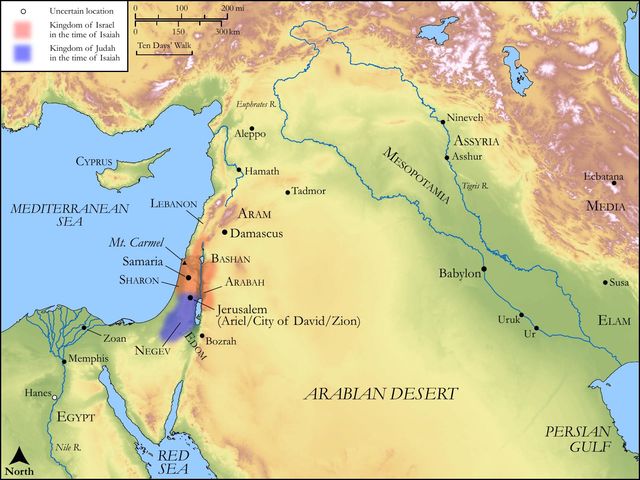
See on the biblical-era map
Study this verse
Public-domain commentary
Matthew Henry
From his Commentary on the Whole Bible. Henry comments on passages, not single verses — this entry covers Isaiah 31:6–9. His three-level outline is real structure in the source text, so it is rendered as structure.
This explains the foregoing promise of the deliverance of Jerusalem; she shall be fitted for deliverance, and then it shall be wrought for her; for in that method God delivers.
I.Jerusalem shall be reformed, and so she shall be delivered from her enemies within her walls, Isa 31:6, Isa 31:7.
Here is, 1. A gracious call to repentance. This was the Lord's voice crying in the city, the voice of the rod, the voice of the sword, and the voice of the prophets interpreting the judgment: "Turn you, O turn you now, from your evil ways, unto God, return to your allegiance to him from whom the children of Israel have deeply revolted, from whom you, O children of Israel! have revolted." He reminds them of their birth and parentage, that they were children of Israel, and therefore under the highest obligations imaginable to the God of Israel, as an aggravation of their revolt from him and as an encouragement to them to return to him. "They have been backsliding children, yet children; therefore let them return, and their backslidings shall be healed. They have deeply revolted, with great address as they supposed (the revolters are profound, Hos 5:2); but the issue will prove that they have revolted dangerously. The stain of their sins has gone deeply into their nature, not to be easily got out, like the blackness of the Ethiopian. They have deeply corrupted themselves (Hos 9:9); they have sunk deep into misery, and cannot easily recover themselves; therefore you have need to hasten your return to God." 2. A gracious promise of the good success of this call (Isa 31:7): In that day every man shall cast away his idols, in obedience to Hezekiah's orders, which, till they were alarmed by the Assyrian invasion, many refused to do. That is a happy fright which frightens us from our sins. (1.) It shall be a general reformation: every man shall cast away his own idols, shall begin with them before he undertakes to demolish other people's idols, which there will be no need of when every man reforms himself. (2.) It shall be a thorough reformation; for they shall part with their idolatry, their beloved sin, with their idols of silver and gold, their idols that they are most fond of. Many make an idol of their silver and gold, and by the love of that idol are drawn to revolt from God; but those that turn to God cast that away out of their hearts and will be ready to part with it when God calls. (3.) It shall be a reformation upon a right principle, a principle of piety, not of politics. They shall cast away their idols, because they have been unto them for a sin, an occasion of sin; therefore they will have nothing to do with them, though they had been the work of their own hands, and upon that account they had a particular fondness for them. Sin is the work of our own hands, but in working it we have been working our own ruin, and therefore we must cast it away; and those are strangely wedded to it who will not be prevailed upon to cast it away when they see that otherwise they themselves will be castaways. Some make this to be only a prediction that those who trust in idols, when they find they stand them in no stead, will cast them away in indignation. But it agrees so exactly with Isa 30:22 that I rather take it as a promise of a sincere reformation.
II.Jerusalem's besiegers shall be routed, and so she shall be delivered from the enemies about her walls.
The former makes way for this. If a people return to God, they may leave it to him to plead their cause against their enemies. When they have cast away their idols, then shall the Assyrian fall, Isa 31:8, Isa 31:9.
1.The army of the Assyrians shall be laid dead upon the spot by the sword, not of a mighty man, nor of a mean man, not of any man at all, either Israelite or Egyptian, not forcibly by the sword of a mighty man nor surreptitiously by the sword of a mean man, but by the sword of an angel, who strikes more strongly than a mighty man and yet more secretly than a mean man, by the sword of the Lord, and his power and wrath in the hand of the angel. Thus the young men of the army shall melt, and be discomfited, and become tributaries to death. When God has work to do against the enemies of his church we expect it must be done by mighty men and mean men, officers and common soldiers; whereas God can, if he please, do it without either. He needs not armies of men who has legions of angels at command, Mat 26:53.
2.The king of Assyria shall flee for the same, shall flee from that invisible sword, hoping to get out of the reach of it; and he shall make the best of his way to his own dominions, shall pass over to some strong-hold of his own, for fear lest the Jews should pursue him now that his army was routed. Sennacherib had been very confident that he should make himself master of Jerusalem, and in the most insolent manner had set both God and Hezekiah at defiance; yet now he is made to tremble for fear of both. God can strike a terror into the proudest of men, and make the stoutest heart to tremble. See Job 18:11; Job 20:24. His princes that accompany him shall be afraid of the ensign, shall be in a continual fright at the remembrance of the ensign in the air, which perhaps the destroying angel displayed before he gave the fatal bow. Or they shall be afraid of every ensign they see, suspecting it is a party of the Jews pursuing them. The banner that God displays for the encouragement of his people (Psa 60:4) will be a terror to his and their enemies. Thus he cuts off the spirit of princes and is terrible to the kings of the earth. But who will do this? It is the Lord, whose fire is in Zion and his furnace in Jerusalem.
(1.)Whose residence is there, and who there keeps house, as a man does where his fire and his oven are. It is the city of the great King, and let not the Assyrians think to turn him out of the possession of his own house.
(2.)Who is there a consuming fire to all his enemies and will make them as a fiery oven in the day of his wrath, Psa 21:9. He is himself a wall of fire round about Jerusalem, so that whoever assaults her does so at his peril, Zac 2:5; Rev 11:5.
(3.)Who has his altar there, on which the holy fire is continually kept burning and sacrifices are daily offered to his honour, and with which he is well pleased; and therefore he will defend this city, especially having an eye to the great sacrifice which was there also to be offered, of which all the sacrifices were types. If we keep up the fire of holy love and devotion in our hearts and houses, we may depend upon God to be a protection to us and them.
Historical interpretation
Historical reception
1 surviving comment on this verse from the historical church.
(Verse 6 onwards) Return, as you have deeply strayed, O children of Israel. For on that day a man will cast away the idols of his silver and the idols of his gold, which your own hands have made for yourselves to sin. And Assur will fall by the sword, not of a man; and a sword, not of a human, will devour him. He will flee not from the face of the sword, and his young men will become forced labor. His strength will pass away in terror, and his fleeing princes will be filled with fear, says the Lord, whose fire is in Zion and whose furnace is in Jerusalem. LXX: Return, O children of Israel, as you have gone deep into sin. For on that day every man will throw away the idols of his silver and the idols of his gold that your own hands have made for your own sins. And Assyria will fall by the sword, not of a man, and a sword, not of a human, will devour him; he will flee, but not from the face of the sword; his young men will be defeated; they will be surrounded like a wall, and they will be conquered; but whoever flees will be captured. Thus says the Lord: Blessed is he who has offspring in Zion and who has a household in Jerusalem. While the Lord fights against his adversaries on Mount Zion and protects it like a rampart, O children of Israel, turn back! As Symmachus translated it: Repent, you who have strayed from the Lord due to deep counsel and sin. For if you do this, casting aside the golden and silver idols that have been a cause of sin for you, because of which your city was captured, Assyria will fall, from whose fear you now flee, not by the sword of men or the strength of an army, but by the power of God. But it signifies that an angel, by whom 185,000 Assyrians were destroyed in one night. Also, the Assyrian king himself will not flee from the sword of men, but from the wrath of God, so that his young and strong men will become tributaries to the Medes, of whom it is said above, in opposition to Babylon: Behold, I will raise up the Medes against you. And the might of Assyria will pass by with the terror of the Lord, and all its princes will tremble. For the Lord has spoken and promised, and what He has said, He has done: and He who has fire in Zion and a furnace in Jerusalem, so that He may consume His adversaries like straw and wood coming out of Jerusalem. Another thing that is said: On that day, a man will throw away his idols of silver and the rest, it is interpreted in such a way that it testifies that after the return from the Babylonian captivity until the coming of Christ, the children of Israel never worshiped idols. Assyria is also signified in the present place, not by an angel, but by the Medes, because it was the most ancient and once powerful kingdom, which was destroyed after offending the Lord, and served the conquerors. The Nazarenes understand this place thus: O children of Israel, who denied the Son of God with wicked counsel, return to Him and His Apostles. For if you do this, you will cast away all the idols that were previously a sin for you, and the devil will fall to you, not by your strength, but by the mercy of God; and its young men who once fought for it will be subjects of the Church, and all its strength and rock will be passed to it; even the philosophers and every perverse doctrine will turn their backs to the sign of the cross. For the opinion of the Lord is that this should be done: whose fire or light is in Zion and his furnace in Jerusalem. Fire and light are written in Hebrew with the same letters Aleph, Vau, Res; if it is read as Ur, it means fire: if Or, it means light. This is said because for the fire, which Symmachus alone interprets, Aquila and Theodotion translate it as light. But I do not know what is meant by what is read in the Septuagint: They will be surrounded like a wall by rock, and they will be conquered: but whoever flees will be captured. Unless perhaps we can say this, that the young men of the Assyrian king who are to be conquered and captured, are surrounded like a rock, that is, by the strength of the Lord, just as a city is surrounded by a wall. Furthermore, what follows: Blessed is the one who has offspring in Zion, and domestic servants in Jerusalem, we can interpret it in such a way as to say that it agrees with the meaning of this place, that the divine word exhorts those who are fleeing to Egypt to return to Jerusalem and to bear children. To whom such great blessedness is promised, that it may be defended and protected by the help of the Lord. And in another place it is written about it: The glory of this last house shall be greater than the glory of the former (Haggai 2:10). Which can also be referred to the Church, the vision of peace and the watchtower, of which it is written: Glorious things are spoken of you, O city of God (Psalm 87:2). And elsewhere: The streams of the river make glad the city of God (Psalm 46:3). For in it there is fire and a furnace that shall devour the sinners, and shall consume the wood, hay, and stubble; or it is a light and an oven, that the brightness of the righteous, and the punishment of the wicked, may be shown.
Continue studying Isaiah 31:7 across the web’s major study libraries — every link below opens this exact verse, chapter, or book on the destination site.
Read & Compare
 BibleGatewayThis verse in more than 200 translations and 70 languages.
 Bible.comThe YouVersion reader — hundreds of translations, reading plans, and highlights.
 ESV.orgCrossway's official English Standard Version reader.
 NET BibleThe NET translation with 60,000+ translators' notes on every rendering decision.
 STEP BibleTyndale House's free study tool — original text, vocabulary, and scholarly resources.
 BibliaLogos Bible Software's free web reader.
 USCCBThe New American Bible (Revised Edition) with the U.S. bishops' study notes.
Commentaries
 BibleHub CommentariesDozens of classic commentaries on this verse, gathered on one page.
 StudyLightMore than 100 commentary sets — the largest collection on the web.
 BibleRefPlain-English commentary on what this verse means, verse by verse.
 Enduring WordDavid Guzik's free commentary on this chapter, widely used by Bible teachers.
 Bible Study ToolsVerse commentary alongside Greek and Hebrew study aids.
Original Language & Research
- BibleHub InterlinearThe verse word by word — original language, transliteration, and English.
- BibleHub LexiconEvery word's original-language definition and Strong's entry.
 Blue Letter BibleDeep-study tools — Strong's numbers, concordance, and word studies.
 SefariaThe Hebrew text with Rashi and centuries of Jewish commentary.
Sermons, Hymns & Audio


TrulyRandomVerse is not affiliated with these sites and doesn’t control their content. They’re linked because they’re genuinely useful.
Summary
Isaiah 31:7 presents a powerful prophetic vision of a future day when the people of Judah will undergo a profound spiritual transformation, decisively renouncing the idolatry that has ensnared them for generations. This verse anticipates a moment of national repentance where the very objects of their misplaced trust—idols crafted from precious metals by their own hands—will be utterly discarded, recognized for the profound sin they represent and the inherent futility they embody in stark contrast to the living God. It is a declaration of divine deliverance leading to a genuine, heartfelt turning from false worship and a return to covenant faithfulness.
Context
ShowHideLiterary Context
Isaiah 31 is situated within a significant section of Isaiah (chapters 28-33) that delivers a series of "woes" against Judah for their spiritual rebellion and their misguided political alliances. Chapters 30 and 31 specifically condemn Judah's decision to seek military assistance from Egypt against the formidable Assyrian empire, rather than placing their trust solely in the Lord. Isaiah consistently emphasizes that reliance on human strength, foreign powers, or self-made gods constitutes a rejection of divine sovereignty and inevitably leads to destruction. Verse 7, therefore, serves as a pivotal and hopeful, albeit conditional, promise of future repentance and restoration. It suggests that after experiencing divine judgment and subsequent miraculous deliverance (as described in the latter part of chapter 31 and into chapter 32), the people will finally recognize the error of their ways. This profound spiritual turning, symbolized by the casting off of idols, is presented as a necessary precursor to experiencing God's full blessing, protection, and the establishment of a righteous kingdom, themes beautifully elaborated in Isaiah 32.
Historical & Cultural Context
During Isaiah's prophetic ministry (late 8th century BCE), the Kingdom of Judah found itself precariously positioned between the expansionist Assyrian Empire to the north and the ancient power of Egypt to the south. Assyria, under rulers like Sennacherib, was a dominant military force renowned for its brutal conquests and aggressive policies, posing an existential threat to smaller nations like Judah. Culturally, idolatry was rampant throughout the ancient Near East, and despite their covenant with Yahweh, Israel and Judah frequently succumbed to the temptation to worship the gods of surrounding nations. These idols, often fashioned from precious metals like silver and gold, were not merely decorative objects; they were believed to embody divine power, ensure fertility, or provide protection. Their creation was an act of human ingenuity and misplaced devotion, often symbolizing political alliances with pagan nations or attempts to manipulate divine favor through human means rather than through exclusive covenant faithfulness to the Lord, as explicitly commanded in foundational texts like Deuteronomy 6:4-5. Isaiah's condemnation of "idols of silver, and his idols of gold" directly targets these tangible manifestations of Judah's spiritual infidelity and their reliance on human constructs.
Key Themes
ShowHideIsaiah 31:7 profoundly contributes to several overarching themes woven throughout the book of Isaiah and the broader prophetic literature. Foremost is the theme of Rejection of Idolatry, which extends beyond merely discarding physical objects to signify a radical reorientation of the heart from self-reliance and false worship to exclusive devotion to the one true God. This act of "casting away" is a powerful symbol of Repentance and Transformation, indicating a voluntary and profound change of allegiance that stems from a newfound understanding of God's power and faithfulness, often catalyzed by divine judgment and subsequent deliverance. Implicitly, the verse also reinforces the theme of Divine Sovereignty and Deliverance, as this future repentance is presented as a direct response to God's intervention, demonstrating that true security and salvation come only from Him, not from the "hands" of humanity or the "idols" they create. The futility of human constructs versus God's omnipotence is a recurring motif, contrasting the lifelessness of idols with the living God who alone can deliver, a truth powerfully articulated in Isaiah 44:9-20.
Exposition and Analysis
ShowHideKey Word Analysis
ShowHideFrom a primitive root meaning "to spurn; also (intransitively) to disappear." This word conveys a strong sense of utter rejection, disdain, and complete abandonment. It is not a gentle setting aside but a forceful, contemptuous discarding, implying a complete renunciation of something once held dear or relied upon. In this context, it signifies a decisive turning from idolatry as something loathsome, worthless, and utterly detestable.
Apparently from the Hebrew word for "no" or "nothing," meaning "good for nothing, by analogy vain or vanity; specifically an idol." This term fundamentally describes something that is worthless, powerless, and utterly without substance or reality. It emphasizes the emptiness and futility of the objects of false worship, highlighting their inability to help, save, or provide any true benefit, contrasting sharply with the living and active God.
From a root meaning "to miss the mark"; a crime or its penalty. This word denotes a transgression against God's law, an offense, or the guilt and punishment associated with it. By stating that the idols were made "for a sin," the prophet underscores that the very act of creating and worshipping these objects was not merely a mistake or a misstep, but a direct violation of God's covenant, incurring guilt and deserving judgment. It frames idolatry as a fundamental betrayal of the divine-human relationship.
Verse Breakdown
ShowHide"For in that day every man shall cast away his idols of silver, and his idols of gold"
This opening clause points to a specific future time ("in that day"), which is a common prophetic idiom referring not to a literal 24-hour period but to a significant, decisive era of divine intervention, whether in judgment or salvation. It declares a universal and decisive act ("every man shall cast away") of renunciation. The explicit mention of "idols of silver, and his idols of gold" highlights the immense perceived value, investment, and misplaced devotion that people had poured into these objects. This emphasis underscores the radical nature of their future repentance, as they will discard what they once held most precious and relied upon. The act of "casting away" implies a complete and utter rejection, a profound spiritual turning from their former ways.
"which your own hands have made unto you [for] a sin."
This concluding phrase powerfully exposes both the origin and the inherent nature of the idolatry. The idols are not divine creations but human constructs ("which your own hands have made"). This underscores their inherent powerlessness, their lack of true being, and the profound folly of worshipping something created by oneself. Furthermore, the phrase "[for] a sin" (or "unto you for a sin") clarifies the inherent transgression. These idols were not merely mistaken objects of worship; their very existence, the act of their creation, and their veneration constituted a direct and grievous offense against God. They represented a violation of the first and second commandments, serving as a constant source of spiritual corruption and a catalyst for divine judgment upon the people.
Literary Devices
ShowHideIsaiah 31:7 employs several powerful literary devices to convey its profound message. Prophecy is the overarching device, as the verse unequivocally foretells a future event ("in that day") of national repentance and spiritual cleansing. Symbolism is central, with "idols of silver, and his idols of gold" serving as potent symbols not only of physical objects of worship but also, more broadly, of any human-made reliance, false security, or self-devised system that displaces genuine trust in God. The specific mention of precious metals highlights the perceived value and significant investment in these false gods, making their eventual "casting away" an even more dramatic and significant act of renunciation. Furthermore, there is a strong element of Contrast implied throughout the verse: the active, sovereign, and delivering God is implicitly contrasted with the inert, lifeless, and man-made idols. The phrase "your own hands have made" emphasizes the utter futility of human effort in creating deity or finding salvation apart from the divine, setting it against the omnipotent power of God who alone can truly deliver and save.
Theological and Thematic Connections
ShowHideIsaiah 31:7 speaks to the core theological truth that true worship belongs exclusively to God alone, and anything that usurps His rightful place in our hearts or lives becomes an idol, inevitably leading to spiritual bondage, corruption, and judgment. The prophetic vision of casting away idols is a powerful testament to the transformative power of genuine repentance, where a people, having experienced the consequences of their unfaithfulness, willingly turn from their self-made gods to embrace the Lord. This turning is not merely an external act of discarding objects but a profound internal reorientation, recognizing the vanity of human constructs and the absolute sufficiency of God. It underscores that God's ultimate desire is for a people wholly devoted to Him, free from the entanglements of anything that diminishes His glory or their trust in Him. This act of renunciation is a prerequisite for experiencing His full covenant blessings and protection.
Reflection and Application
ShowHideWhile the physical idols of silver and gold may be less prevalent in contemporary society, the spiritual principle of idolatry remains profoundly relevant and pervasive. This verse challenges us to critically examine what truly occupies the throne of our hearts—what we ultimately rely on, derive our security from, or give our supreme allegiance to, apart from God Himself. Modern idols can manifest in myriad forms: career success, financial security, social media validation, personal comfort, relationships, intellectual achievements, political ideologies, or even self-image. Isaiah 31:7 calls for a radical act of spiritual discernment and decisive repentance, urging us to identify and "cast away" anything that competes with God for our supreme affection and trust. True freedom, lasting peace, and genuine fulfillment are found not in clinging to self-made securities or fleeting pleasures, but in wholeheartedly surrendering to and relying solely on the living God, who alone is worthy of all worship and able to provide lasting deliverance and abundant life. This process of continually casting away idols is an ongoing journey of sanctification, inviting us to deeper intimacy and dependence on Christ.
Questions for Reflection
ShowHideFAQ
ShowHideWhat does "in that day" refer to in this prophetic context?
ShowHide"In that day" (Hebrew, yôwm) is a common prophetic idiom in the Old Testament. It doesn't necessarily refer to a single 24-hour period but rather to a significant, decisive period of time when God intervenes in human history to accomplish His purposes. In Isaiah, it often points to a future time of divine judgment upon unfaithfulness, followed by purification and restoration for the remnant. For Judah, it would encompass the Assyrian invasion, the subsequent miraculous deliverance by God (as described later in Isaiah 31 and 37), and the spiritual awakening that would lead them to abandon their idolatrous practices. It is a time when God's character, power, and faithfulness are unmistakably revealed, leading to a profound shift in human response and allegiance, as also seen in prophecies concerning the "Day of the Lord" in Joel 2:31.
Christ-Centered Fulfillment
ShowHideIsaiah 31:7, with its poignant call to cast away idols made by human hands, finds its ultimate and most profound fulfillment in the person and redemptive work of Jesus Christ. The Old Testament's struggle against physical idolatry serves as a powerful foreshadowing of humanity's deeper, more pervasive spiritual idolatry—the inherent tendency to rely on self, human systems, created things, or anything other than God for salvation, meaning, and security. Jesus, as the Lamb of God who takes away the sin of the world, confronts the very root of all idolatry: the sin that separates humanity from a holy God and compels us to create false gods in His place. Through His perfect life, atoning sacrifice on the cross, and glorious resurrection, He provides the sole means for true repentance and the divine power to break free from the bondage of anything that enslaves us, whether literal idols, the pursuit of wealth, the worship of self, or the allure of worldly systems. The New Covenant, inaugurated by Christ's blood, empowers believers through the indwelling Holy Spirit to turn from the "futile ways inherited from your forefathers" (1 Peter 1:18) and to serve the living and true God, eagerly awaiting His Son from heaven. In Christ, the "casting away" of idols becomes a daily spiritual reality for believers, as we are called to put off the old self with its sinful practices and idolatrous tendencies and to put on the new self, created in righteousness and holiness, reflecting the image of our Creator (Ephesians 4:22-24). He is not merely a deliverer from external threats but the very one who delivers us from the idolatry of our own hearts, leading us into true worship, genuine freedom, and eternal life in Him.