


Hosea 9:9
- הֶעְמִיקוּhe'·mi·kuthey have made deepH6009V-Hiphil-Perf-3cpVerb Hiphil Perfect 3rd Plural common gender
- שִׁחֵתוּshi·Che·tuthey have dealt corruptlyH7843V-Piel-Perf-3cpVerb Piel Perfect 3rd Plural common gender
- כִּימֵיki·Meilike [the] days ofH3117Prep-k ¦ N-mpcNoun Plural Masculine Constructכִּlikeימֵי[the] days of
- הַגִּבְעָהha·giv·'Ah<the> GibeahH1390Art ¦ N-properNoun Proper Locationהַ<the>גִּבְעָהGibeah
- יִזְכּוֹרyiz·Korhe will rememberH2142V-Qal-Imperf-3msVerb Qal Imperfect 3rd Singular Masculine
- עֲוֹנָם'a·vo·Namtheir iniquityH5771N-msc ¦ 3mpNoun Singular Masculine Constructעֲוֹנָiniquityםtheir
- יִפְקוֹדyif·Kodhe will punishH6485V-Qal-Imperf-3msVerb Qal Imperfect 3rd Singular Masculine
- חַטֹּאותָםcha·to·Tamtheir sinsH2403N-fpc ¦ 3mpNoun Plural Feminine Constructחַטֹּאותָsinsםtheir
English is a literal word-by-word gloss of the Hebrew, not the KJV's wording. Why?
This is the original text the KJV's translators worked from — each Hebrew word with its own literal English meaning in this verse, prepared by scholars at Tyndale House, Cambridge. The KJV translates whole sentences, not word by word, so its wording differs: one Hebrew word can become several English words, and the KJV may choose “the LORD” where the gloss reads “Yahweh”. Both are faithful — they answer different questions. For the KJV's own rendering, switch to the KJV text.
Details
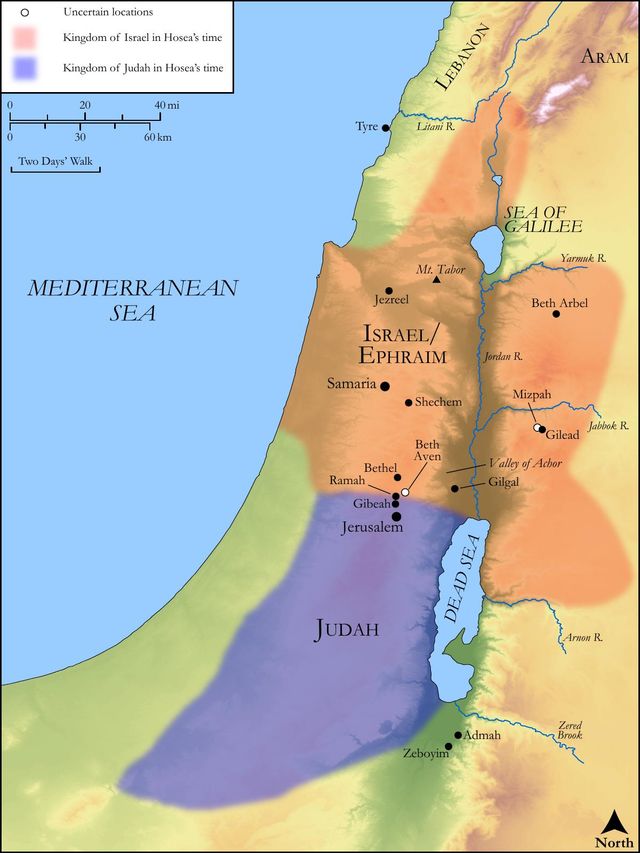
See on the biblical-era map
Study this verse
Public-domain commentary
Matthew Henry
From his Commentary on the Whole Bible. Henry comments on passages, not single verses — this entry covers Hosea 9:7–10. His three-level outline is real structure in the source text, so it is rendered as structure.
For their further awakening, it is here threatened,
I.That the destruction spoken of shall come speedily.
They shall have no reason to hope for a long reprieve, for the judgment slumbers not; it is at the door (Hos 9:7): The days of visitation have come, and there shall be no more delay; the days of recompence have come, which they have been so often warned to expect; their prophets have told them that destruction would come, and now it has come, and the time of the divine patience has expired. Note,
1.The day of God's judgments is both a day of visitation, in which men's sins are enquired into and brought to light, and a day of recompence, in which men's doom will be passed, and a reward given to every man according to his work; the strict visitation is in order to a just retribution.
2.This day of visitation and recompence is hastening on apace. It is sure; it is near; as if it had already come.
II.That hereby they shall be made ashamed of their sentiments concerning their prophets.
When the day of visitation comes Israel shall know it, shall be made to know that by sad experience which they would not know by instruction. Israel shall know then what an evil and bitter thing it is to depart from God, and what a fearful thing it is to fall into his hands. When thy hand is lifted up they will not see, but they shall see. Israel shall know the difference between true prophets and false.
1.They shall know then that the pretenders to prophecy, who flattered them in their sins, and rocked them asleep in their security, and told them that they should have peace though they went on, however they pretended to be spiritual men (as Ahab's prophets did, Kg1 22:24) were fools and madmen, and not true prophets; they deceived themselves and those to whom they prophesied. But why would God suffer his people Israel to be imposed upon by those false prophets? He answers, "It is for the multitude of thy iniquity which, in contempt of the divine law, thou hast persisted in, and, for the great hatred of the true prophets, that reproved thee, in God's name, for it." Note, Because men receive not the love of the truth, but conceive a hatred of it, and by the multitude of their iniquities bid defiance to it, therefore God shall send them strong delusions, to believe a lie, so strong that they shall not be undeceived till the day of visitation and recompence comes, which will convince them of the folly and madness of those that seduced them and of their own folly and madness in suffering themselves to be seduced by them.
2.They shall know then whether the true prophets, that were really spiritual men, guided by the Spirit of God, were such as they called and counted them, fools and madmen; and they shall be convinced that they were so far from being so that they were the wise men of their times, and God's faithful ambassadors to them. When Israel saw that none of Samuel's words fell to the ground they knew he was established to be a prophet (Sa1 3:20); and so here, when God fulfils the word of his messengers, by bringing the days of recompence they foretold, then those that despised and ridiculed them, and thought Bedlam the fittest place for them, will be ashamed of the multitude of their iniquities of that kind, and of their great hatred, for which God brings upon them this swift destruction. Mocking the messengers of the Lord was the sin they were punished for, and so made ashamed of.
III.That hereby the wickedness of the false prophets themselves shall be manifested to their shame (Hos 9:8):
"The watchman of Ephraim was with my God; he had been formerly. They had a set of worthy good ministers, that kept close to God and maintained communion with him; but now they have a race of corrupt, malignant, persecuting prophets, that are the ring-leaders of all mischief." Or, "The watchman of Ephraim now pretends to have been with my God, and prefaces his lies with, Thus saith the Lord; but he is a snare of a fowler in all his ways, and is cunning to draw the simple into sin and the upright into trouble; and he is so full of hatred and enmity to goodness and good men that he has become hatred itself in the house of his God, or against the house of his God." Note, Wicked prophets are the worst of men; their sins against God are most heinous, and their plots against religion most dangerous. They may boast that they are watchmen, speculators, and, as far as speculation goes, they may be right, and with my God, may have their heads full of good notions; but look into their lives, and they are the snare of a fowler in all their ways, catching for themselves and making a prey of others; look into their hearts, and they are hatred in the house of my God, very malicious and spiteful against good ministers and good people. Woe unto thee, O land! unto thee, O church! that hast such watchmen, such prophets, that are seers, but not doers! Corruptio optimi est pessima - The best things, when corrupted, become the worst.
IV.That God will now reckon with them for the sins of their fathers, which they have trod in the steps of, Hos 9:9, Hos 9:10.
1.They were as bad as their fathers: They have deeply corrupted themselves; they are rooted and riveted in sin; they are far gone in the depths of Satan (Isa 31:6), so that it is next to impossible that they should be recovered; the stain of their corruption is deep, not to be got out; it is as scarlet and crimson, or as the spots of the leopard: and it is their own fault; they have corrupted themselves, have polluted and hardened their own hearts, as in the days of Gibeah, when the Levite's concubine was abused to death by the men of Gibeah and the whole tribe of Benjamin patronised the villany; that was a time of deep corruption indeed, and such were the present days. Lewdness and wickedness were as impudent and daring now as in the days of Gibeah; and therefore what can be expected but such a vengeance as was then taken on Gibeah? Every tribe is now as bad as the tribe of Benjamin then was, and therefore may expect to be brought as low as that tribe then was.
2.They shall therefore be reckoned with for their fathers' sins: He will remember their iniquity and visit their sins, the iniquity they have by kind and by entail, the sin that runs in the blood; the sin of the father shall now be visited upon the children. Hence God takes occasion to upbraid them with the degeneracy and apostasy of their ancestors, their perfidiousness and base ingratitude, Hos 9:10. Here observe,
(1.)The great honour God put upon Israel when he first formed them into a people: I found Israel like grapes in the wilderness. He took as much delight and pleasure in them as a poor traveller would do if he found grapes in a wilderness, where he most needed them and least expected them. Or when they were in the wilderness he found them as grapes, not precious in themselves, but precious to him, and pleasant as the first-ripe grapes to the lord of the vineyard. They were precious in his sight, and honourable (Isa 43:4); he planted them a choice vine, a right seed (Jer 2:21), and found them no better than he himself made them, good grapes at first. I saw them with pleasure, as the first-ripe in the fig-tree at the first time. Good people are compared to the good things that are first ripe, Jer 24:2. One then is worth more than many afterwards. This intimates the delight God took in them and in doing them good, not for their sakes, but because he loved their fathers. He preserved them carefully, as a man does the first and choicest fruits of his vineyard. Now when he put all this honour upon them, and they stood so fair for preferment, one would think they should have maintained their excellency; but,
(2.)See the great disgrace they put upon themselves. God set them apart for himself as a peculiar people, but they went to Baal-peor, joined with the Moabites in sacrificing to that dirty dunghill deity (Num 25:2, Num 25:3), and they separated themselves unto that shame, that shameful idol, so Baal-peor was in a particular manner, if (as should seem) the whoredom which the people committed with the daughters of Moab was a part of the service done to Baal-peor. Note, Whatever those separate themselves to that forsake God it will certainly be a shame to them, first or last. Their abominations are here said to be as they loved; their practices which were an abomination to God were as the best-beloved of their souls. Or when they had once forsaken God they multiplied their abominations, their idols and abominable idolatries, at their pleasure. This was the way of their fathers; God had done well for them, but they had acted ungratefully towards him, and in the same manner had the present generation deeply corrupted themselves.
Historical interpretation
Historical reception
1 surviving comment on this verse from the historical church.
"Ephraim the spy with my God: the prophet is a snare of ruin" "above all his ways: insanity in the house of his God, deeply they have sinned: as in the days of Gabaa, their iniquities will be remembered, and their sins will be visited." LXX: "Ephraim the spy with God the prophet: a twisted snare over all his ways, insanity" "they have fabricated in the house of God: they have been corrupted according to the days of the hill: " "their iniquities will be remembered, and they will be avenged for their sins." Therefore, God gave the leaders to rebuke the delinquent people and to guide them back to the right path: hence, he speaks to Ezekiel: "I have made you a spy for the house of Israel" (Ezek. V, 17). Therefore Jeroboam was given as a spy among people, and as a prophet with my God, that is, with God who speaks these things by Hosea. But he is called the trap, according to that which is written above: "You have become a spectacle of snare, and a net spread out over Tabor, and you have turned victims into the abyss", and even now the people of Israel are referred to as the trap, because all fall into its snare, especially since he has put insanity in the house of God, or schemed it, that is, he made a golden calf in "Bethel", for this is interpreted as the house of God: and he has also deeply sinned in wickedness, and so he is submerged in the abyss of impiety, so that he surpasses the sin that was once committed in Gibeah, when they killed the wife of the Levite returning from Bethlehem in an illicit way (Judges 19). We can accept the days of Gibeah and that time, when for God they chose for themselves a king from the city of Gibeah, that is, Saul. And now they are said to have sinned much more, by choosing Jeroboam and worshipping idols, than at that time when they chose Saul: for here schism even was coupled with idolatry: but there the worship of God remained in the people. Therefore their injustices, which now by patience are considered forgotten, will be remembered, and their sins and the wounds that have been festering for a long time will be visited. Scrutinizing the ancient histories, I am unable to find that the Church was split, and that the people seduced the house of the Lord, except for those who were the priests appointed by God and the prophets, that is, the watchers. Therefore, these people are turned into a twisted snare, placing scandal in all places, so that whoever enters by their path may fall and not be able to stand in Christ, and be led astray by various errors and taken down paths to ruin. These are the Ephraim's spies, who have brought madness into the house of the Lord, that is, in the Church, or in the holy scriptures, interpreting them perversely, or certainly in the case of each of the believers who is most rightly called the house of God. Therefore they are corrupt and have perished according to the days of the hill, when they spoke iniquity against the highest ones and ascended into empty roofs. God will remember their iniquity by which they acted unjustly towards their neighbor, bringing him out of the Church, and will visit their sins with which they sinned against their souls. This is what we read in the psalm: 'They have laid a stumbling block for me beside the way' (Ps. 140:6). For unless someone has seen the way of God, that is, heard the name of Christ, they will not enter through it. Therefore, even heretics set traps beside the way in the name of Christ, so that anyone who believes they are walking in Christ—of whom we read that he is the way—may instead tread upon their snares, which they have woven in the house of God.
Continue studying Hosea 9:9 across the web’s major study libraries — every link below opens this exact verse, chapter, or book on the destination site.
Read & Compare
 BibleGatewayThis verse in more than 200 translations and 70 languages.
 Bible.comThe YouVersion reader — hundreds of translations, reading plans, and highlights.
 ESV.orgCrossway's official English Standard Version reader.
 NET BibleThe NET translation with 60,000+ translators' notes on every rendering decision.
 STEP BibleTyndale House's free study tool — original text, vocabulary, and scholarly resources.
 BibliaLogos Bible Software's free web reader.
 USCCBThe New American Bible (Revised Edition) with the U.S. bishops' study notes.
Commentaries
 BibleHub CommentariesDozens of classic commentaries on this verse, gathered on one page.
 StudyLightMore than 100 commentary sets — the largest collection on the web.
 BibleRefPlain-English commentary on what this verse means, verse by verse.
 Enduring WordDavid Guzik's free commentary on this chapter, widely used by Bible teachers.
 Bible Study ToolsVerse commentary alongside Greek and Hebrew study aids.
Original Language & Research
- BibleHub InterlinearThe verse word by word — original language, transliteration, and English.
- BibleHub LexiconEvery word's original-language definition and Strong's entry.
 Blue Letter BibleDeep-study tools — Strong's numbers, concordance, and word studies.
 SefariaThe Hebrew text with Rashi and centuries of Jewish commentary.
Sermons, Hymns & Audio


TrulyRandomVerse is not affiliated with these sites and doesn’t control their content. They’re linked because they’re genuinely useful.
Summary
Hosea 9:9 serves as a severe indictment against the Northern Kingdom of Israel, declaring that their moral and spiritual degradation has reached a depth comparable to the infamous wickedness of Gibeah, thereby ensuring God's righteous and decisive judgment for their pervasive iniquity and accumulated sins.
Context
ShowHideLiterary Context
Hosea 9 is a chapter steeped in divine judgment, following earlier chapters where God laments Israel's spiritual adultery and pronounces impending doom. The immediate context of Hosea 9 details the consequences of Israel's idolatry and rebellion, particularly their reliance on foreign alliances and their corrupt religious practices. Verses preceding Hosea 9:9 speak of their inability to rejoice in the Lord, their defilement, and their impending exile, setting the stage for this verse's direct accusation of profound corruption and the certainty of divine retribution. The reference to Gibeah intensifies the gravity of their sin by drawing a historical parallel to a time of extreme moral breakdown.
Historical & Cultural Context
The prophet Hosea ministered during the tumultuous final decades of the Northern Kingdom (Israel), roughly 750-715 BC, leading up to its fall to Assyria in 722 BC. This period was marked by political instability, with frequent assassinations of kings, and widespread religious syncretism, where the worship of Yahweh was mixed with Baal worship and other pagan practices. Oppression, bribery, and moral decay were rampant, reflecting a society that had abandoned the covenant principles of God. The reference to "the days of Gibeah" immediately evokes the horrific events recorded in Judges 19 and Judges 20, which describe an unspeakable act of sexual violence, tribal civil war, and a complete breakdown of law and order in Israel, a time when "there was no king in Israel: every man did that which was right in his own eyes" (Judges 21:25). By comparing contemporary Israel to Gibeah, Hosea highlights the nation's return to a state of profound moral anarchy and depravity, deserving of similar, if not greater, divine judgment.
Key Themes
ShowHideHosea 9:9 powerfully articulates several core themes prevalent throughout the book of Hosea. Firstly, it underscores the theme of profound corruption and moral decay, illustrating that Israel's sin was not superficial but deeply ingrained, permeating every aspect of their society. The phrase "deeply corrupted themselves" emphasizes the pervasive nature of their wickedness, a stark contrast to the covenant relationship they were meant to uphold. Secondly, the verse highlights divine remembrance and inevitable judgment. In biblical terms, God "remembering" their iniquity (Hosea 9:9) is not a mere recollection but an active turning of His attention toward their deeds, signaling an impending, decisive act of justice. This is further emphasized by the declaration that He "will visit their sins," a phrase that consistently denotes God's intervention to bring about accountability and punishment for unrepentant transgression, as seen in other prophetic warnings like Amos 8:7. The comparison to Gibeah also introduces the theme of historical precedent and the cyclical nature of sin and judgment, reminding Israel that past wickedness led to severe consequences, and their current state would be no different.
Exposition and Analysis
ShowHideKey Word Analysis
ShowHideThis word signifies to be or make deep, profound, or hidden. When combined with "corrupted," it emphasizes the pervasive and ingrained nature of Israel's depravity. Their corruption was not superficial but had penetrated to the very core of their being and society, making their wickedness profound and difficult to reverse.
A primitive root meaning to decay, ruin, or destroy, either literally or figuratively. In this context, it describes Israel's moral and spiritual deterioration. They had actively ruined themselves and their covenant relationship with God through their actions, leading to a state of utter depravity and moral decay.
While literally meaning to recall or mention, in a divine context, especially concerning sin, "remember" signifies an active turning of God's attention to past deeds with the intent to act decisively. It implies that God's patience has reached its limit, and He is now poised to bring about the consequences of their actions, not merely to recollect them.
This versatile root can mean to visit with friendly or hostile intent, to oversee, muster, or charge. In the context of divine judgment, as here, it means to inspect, hold accountable, and bring punishment. God's "visitation" of their sins signifies His active engagement with their transgressions, leading to the execution of justice and retribution.
Verse Breakdown
ShowHide"They have deeply corrupted [themselves], as in the days of Gibeah"
This clause delivers a scathing indictment of Israel's pervasive moral and spiritual decay. The combination of "deeply" and "corrupted" highlights that their wickedness was not superficial but had penetrated to the core of their national and individual character. It implies a deliberate and profound turning away from God's standards. The chilling comparison to "the days of Gibeah" immediately brings to mind one of the darkest and most morally depraved episodes in Israel's history, recorded in Judges 19, where extreme sexual violence and a subsequent civil war demonstrated a complete breakdown of justice and order. By drawing this parallel, Hosea underscores the severity and depth of Israel's current sin, implying they have regressed to a state of utter lawlessness and depravity that demands divine intervention.
"[therefore] he will remember their iniquity"
This phrase introduces the inevitable consequence of their profound corruption. The word "therefore" (implied by the causal relationship) signals that God's forthcoming action is a direct response to their sin. When God "remembers" iniquity in the biblical sense, it is not merely a mental recollection but an active turning of His attention towards the transgression with the intent to act decisively in judgment. It signifies that the time for patience has passed, and the period of accountability has arrived. "Iniquity" (Hebrew: avôn) refers to perversity, moral evil, and the guilt or punishment associated with it, encompassing the crookedness and distortion of their actions against God's law.
"he will visit their sins"
This final clause reinforces the certainty and nature of God's impending judgment. To "visit" sins, in this context, means God will actively intervene to inspect, hold accountable, and administer punishment for their transgressions. It is a declaration that God's justice will not be delayed or overlooked. "Sins" (Hebrew: chaṭṭâʼâh) refers to an offense, a missing of the mark, and its penalty. Together with "iniquity," it emphasizes the comprehensive nature of their offense and the certainty of divine retribution for their accumulated rebellion against the covenant.
Literary Devices
ShowHideHosea 9:9 employs several powerful literary devices to convey its message of judgment. The most prominent is Simile, explicitly stated in "as in the days of Gibeah." This comparison is not merely descriptive but deeply condemnatory, equating contemporary Israel's moral decay with a historical nadir of depravity and violence, thereby intensifying the gravity of their current state. The verse also utilizes Parallelism, specifically synonymous parallelism, in the latter half: "he will remember their iniquity, he will visit their sins." Here, "remember their iniquity" and "visit their sins" convey a similar message of divine judgment, reinforcing the certainty and comprehensive nature of God's response to their rebellion through slightly different but complementary phrasing. Furthermore, the phrase "deeply corrupted" can be seen as a form of Hyperbole or Intensification, emphasizing the extreme and pervasive nature of Israel's wickedness, suggesting that their moral decay was not superficial but had penetrated to the very core of their being. This vivid language serves to underscore the profound spiritual sickness that necessitated such severe divine intervention.
Theological and Thematic Connections
ShowHideHosea 9:9 powerfully articulates the theological truth of God's unwavering justice and His covenant faithfulness, even when met with human infidelity. It reveals that God is not indifferent to sin, especially when it becomes deeply ingrained and widespread within His covenant people. The comparison to Gibeah underscores that repeated patterns of rebellion and moral depravity will inevitably lead to divine remembrance and visitation, meaning God will actively intervene to bring about consequences. This passage serves as a stark reminder that spiritual privilege does not exempt a nation or an individual from accountability for persistent sin; rather, it often heightens the judgment due to greater light and revelation received. The "remembering" and "visiting" of sin highlight God's active role as the righteous judge who upholds His moral order and ensures that justice prevails, even if delayed.
Reflection and Application
ShowHideHosea 9:9 offers a profound and sobering reflection for believers and societies today. It warns against the insidious nature of moral and spiritual decay, especially when it becomes deeply ingrained and normalized. Just as ancient Israel's corruption paralleled the depravity of Gibeah, so too can contemporary societies or even individual lives drift into patterns of sin that are profoundly offensive to God. This verse challenges us to examine the depth of our own hearts and the collective conscience of our communities: Are we "deeply corrupted," or are we striving for purity and righteousness? The divine promise to "remember their iniquity" and "visit their sins" serves as a timeless reminder that God is a God of justice who will not indefinitely overlook unrepentant sin. This should provoke a healthy fear of the Lord and a renewed commitment to repentance, holiness, and obedience. It calls us to actively resist the pervasive moral relativism and spiritual apathy of our age, choosing instead to live according to God's unchanging standards, lest we, too, face the consequences of His righteous visitation.
Questions for Reflection
ShowHideFAQ
ShowHideWhat was "the days of Gibeah" and why is it significant here?
ShowHide"The days of Gibeah" refers to a horrific event recounted in Judges 19 and Judges 20. It details an unspeakable act of sexual violence against a Levite's concubine by the men of Gibeah (a city in the tribe of Benjamin), followed by the Levite's gruesome act of dismembering her body to send a message to all Israel. This led to a devastating civil war where the other tribes nearly annihilated Benjamin. The significance in Hosea 9:9 is that Gibeah represents a nadir of moral depravity, lawlessness, and social breakdown in Israel's history, a time when "there was no king in Israel: every man did that which was right in his own eyes" (Judges 21:25). By comparing contemporary Israel's corruption to Gibeah, Hosea underscores that their current wickedness is equally profound and deserving of severe divine judgment.
Does God "forget" sins if He "remembers" them for judgment?
ShowHideIn biblical language, when God "remembers" sin, as in Hosea 9:9, it does not imply that He had literally forgotten them. Instead, "remembering" in this context signifies an active turning of His attention to past transgressions with the intent to act decisively and bring about the consequences. It indicates that the period of divine patience has reached its limit, and the time for accountability and judgment has arrived. Conversely, when the Bible speaks of God "not remembering" sins (e.g., Jeremiah 31:34), it refers to His gracious act of forgiveness and the removal of guilt, where He chooses not to hold them against the repentant sinner for judgment.
Christ-Centered Fulfillment
ShowHideHosea 9:9, with its stark declaration of God's "remembering" and "visiting" Israel's deep corruption and sins, finds its ultimate Christ-centered fulfillment in the person and work of Jesus Christ. Israel's pervasive iniquity, comparable to the abject depravity of Gibeah, highlighted humanity's utter inability to escape the just judgment of a holy God. The Old Testament's repeated pattern of sin and divine visitation underscored the need for a perfect sacrifice and a new covenant. Jesus, the sinless Lamb of God, became the one upon whom God's "visitation" of sin justly fell. He bore the full weight of humanity's "iniquity" and "sins" on the cross, becoming sin for us (2 Corinthians 5:21). Through His atoning death, Christ satisfied the righteous demands of God's justice, ensuring that God could "remember" our sins no more, not by overlooking them, but by fully dealing with them in Christ (Hebrews 8:12). Thus, for those who believe, the terrifying "visitation" of judgment is transformed into a gracious "visitation" of salvation, as God's righteous wrath against sin was poured out on His Son, securing forgiveness and eternal life for all who trust in Him (Romans 3:25-26).