


2 Kings 9:34
Bible text: King James Version (1769 Blayney text) · Public domain
Bible text: Berean Standard Bible · Public domain
Bible text: American Standard Version (1901) · Public domain
Bible text: World English Bible, Messianic edition · Public domain
Bible text: Geneva Bible (1599) · Public domain
Bible text: Young's Literal Translation · Public domain
- וַיָּבֹאvai·ya·Vo'and he wentH935Conj-w ¦ V-Qal-ConsecImperf-3msVerb Qal Consecutive Imperfect 3rd Singular Masculineוַandיָּבֹאhe went
- וַיֹּאכַלvai·Yo·khaland he ateH398Conj-w ¦ V-Qal-ConsecImperf-3msVerb Qal Consecutive Imperfect 3rd Singular Masculineוַandיֹּאכַלhe ate
- וַיֵּשְׁתְּvai·Ye·shetand he drankH8354Conj-w ¦ V-Qal-ConsecImperf-3msVerb Qal Consecutive Imperfect 3rd Singular Masculineוַandיֵּשְׁתְּhe drank
- וַיֹּאמֶרvai·Yo·merand he saidH559Conj-w ¦ V-Qal-ConsecImperf-3msVerb Qal Consecutive Imperfect 3rd Singular Masculineוַandיֹּאמֶרhe said
- פִּקְדוּpik·duattend toH6485V-Qal-Imp-2mpVerb Qal Imperative 2nd Plural Masculine
- נָאna'pleaseH4994PrtParticle Interjection
- אֶת'et<obj.>H853DirObjMParticle Object Indicator
- הָאֲרוּרָהha·'a·ru·Rahthe accursed [woman]H779Art ¦ V-Qal-PassPrtcpl-fsVerb Qal Participle Passive Singular Feminine Absoluteהָtheאֲרוּרָהaccursed [woman]
- הַזֹּאתha·zoT<the> thisH2063Art ¦ PrtParticle Demonstrativeהַ<the>זֹּאתthis
- וְקִבְרוּהָve·kiv·Ru·haand bury herH6912Conj-w ¦ V-Qal-Imp-2mp ¦ 3fsVerb Qal Imperative 2nd Plural Masculineוְandקִבְרוּburyהָher
- כִּיkiforH3588PrtParticle Conditional
- בַתvat[was] a daughter ofH1323N-fscNoun Singular Feminine Construct
- מֶלֶךְMe·lekha kingH4428N-msNoun Singular Masculine Absolute
- הִיאHi'sheH1931Pro-3fsPronoun Personal 3rd Singular Feminine
English is a literal word-by-word gloss of the Hebrew, not the KJV's wording. Why?
This is the original text the KJV's translators worked from — each Hebrew word with its own literal English meaning in this verse, prepared by scholars at Tyndale House, Cambridge. The KJV translates whole sentences, not word by word, so its wording differs: one Hebrew word can become several English words, and the KJV may choose “the LORD” where the gloss reads “Yahweh”. Both are faithful — they answer different questions. For the KJV's own rendering, switch to the KJV text.
Details
See on the biblical-era maps

Study this verse
Public-domain commentary
Matthew Henry
From his Commentary on the Whole Bible. Henry comments on passages, not single verses — this entry covers 2 Kings 9:30–37. His three-level outline is real structure in the source text, so it is rendered as structure.
The greatest delinquent in the house of Ahab was Jezebel: it was she that introduced Baal, slew the Lord's prophets, contrived the murder of Naboth, stirred up her husband first, and then her sons, to do wickedly; a cursed woman she is here called (Kg2 9:34), a curse to the country, and whom all that wished well to their country had a curse for. Three reigns her reign had lasted, but now, at length, her day had come to fall. We read of a false prophetess in the church of Thyatira that is compared to Jezebel, and called by her name (Rev 2:20), her wickedness the same, seducing God's servants to idolatry, a long space given her to repent (Kg2 9:21) as to Jezebel, and a fearful ruin brought upon her at last (Kg2 9:22, Kg2 9:23), as here upon Jezebel. So that Jezebel's destruction may be looked upon as typical of the destruction of idolaters and persecutors, especially that great whore, that mother of harlots, that hath made herself drunk with the blood of saints and the nations drunk with the wine of her fornications, when God shall put it into the heart of the kings of the earth to hate her, Rev 17:5, Rev 17:6. 16. Now here we have,
I.Jezebel daring the judgment.
She heard that Jehu had slain her son, and slain him for her whoredoms and witchcrafts, and thrown his dead body into the portion of Naboth, according to the word of the Lord, and that he was now coming to Jezreel, where she could not but expect herself to fall next a sacrifice to his revenging sword. Now see how she meets her fate; she posted herself in a window at the entering of the gate, to affront Jehu and set him at defiance.
1.Instead of hiding herself, as one afraid of divine vengeance, she exposed herself to it and scorned to flee, mocked at fear and was not affrighted. See how a heart hardened against God will brave it out to the last, run upon him, even upon his neck, Job 15:26. But never did any thus harden their hearts against him and prosper.
2.Instead of humbling herself, and putting herself into close mourning for her son, she painted her face, and tired her head, that she might appear like herself, that is (as she thought), great and majestic, hoping thereby to daunt Jehu, to put him out of countenance, and to stop his career. The Lord God called to baldness and girding with sackcloth, but behold painting and dressing, walking contrary to God, Isa 22:12, Isa 22:13. There is not a surer presage of ruin than an unhumbled heart under humbling providences. Let painted faces look in Jezebel's glass, and see how they like themselves.
3.Instead of trembling before Jehu, the instrument of God's vengeance, she thought to make him tremble with that threatening question, Had Zimri peace, who slew his master? Observe,
(1.)She took no notice of the hand of God gone out against her family, but flew in the face of him that was only the sword in his hand. We are very apt, when we are in trouble, to break out into a passion against the instruments of our trouble, when we ought to be submissive to God and angry at ourselves only.
(2.)She pleased herself with the thought that what Jehu was now doing would certainly end in his own ruin, and that he would not have peace in it. He had cut her off from all pretensions to peace (Kg2 9:22), and now she thought to cut him off likewise. Note, It is no new thing for those that are doing God's work to be looked upon as out of the way of peace. Active reformers, faithful reprovers, are threatened with trouble; but let them be in nothing terrified, Phi 1:28.
(3.)She quoted a precedent, to deter him from the prosecution of this enterprise: "Had Zimri peace? No, he had not; he came to the throne by blood and treachery, and within seven days was constrained to burn the palace over his head and himself in it: and canst thou expect to fare any better?" Had the case been parallel, it would have been proper enough to give him this memorandum; for the judgments of God upon those that have gone before us in any sinful way should be warnings to us to take heed of treading in their steps. But the instance of Zimri was misapplied to Jehu. Zimri had no warrant for what he did, but was incited to it merely by his own ambition and cruelty; whereas Jehu was anointed by one of the sons of the prophets, and did this by order from heaven, which would bear him out. In comparing persons and things we must carefully distinguish between the precious and the vile, and take heed lest from the fate of sinful men we read the doom of useful men.
II.Jehu demanding aid against her.
He looked up to the window, not daunted at the menaces of her impudent but impotent rage, and cried, Who is on my side? Who? Kg2 9:32. He was called out to do God's work, in reforming the land and punishing those that had debauched it; and here he calls out for assistance in the doing of it, looked as if there were any to help, any to uphold, Isa 63:5. He lifts up a standard, and makes proclamation, as Moses (Exo 32:26), Who is on the Lord's side? And the Psalmist (Psa 94:16), Who will rise up for me against the evil-doers? Note, When reformation-work is set on foot, it is time to ask, "Who sides with it?"
III.Her own attendants delivering her up to his just revenge.
Two or three chamberlains looked out to Jehu with such a countenance as encouraged him to believe they were on his side, and to them he called not to seize or secure her till further orders, but immediately to throw her down, which was one way of stoning malefactors, casting them headlong from some steep place. Thus was vengeance taken on her for the stoning of Naboth. They threw her down, Kg2 9:33. If God's command would justify Jehu, his command would justify them. Perhaps they had a secret dislike of Jezebel's wickedness, and hated her, though they served her; or, it may be, she was barbarous and injurious to those about her, and they were pleased with this opportunity of being avenged on her; or, observing Jehu's success, they hoped thus to ingratiate themselves with him, and keep their places in his court. However it was, thus she was most shamefully put to death, dashed against the wall and the pavement, and then trodden on by the horses, which were all besmeared with her blood and brains. See the end of pride and cruelty, and say, The Lord is righteous.
IV.The very dogs completing her shame and ruin, according to the prophecy.
When Jehu had taken some refreshment in the palace, he bethought himself of showing so much respect to Jezebel's sex and quality as to bury her. As bad as she was, she was a daughter, a king's daughter, a king's wife, a king's mother: Go and bury her, Kg2 9:34. But, though he had forgotten what the prophet said (Kg2 9:10, Dogs shall eat Jezebel), God had not forgotten it. While he was eating and drinking, the dogs had devoured her dead body, the dogs that went about the city (Psa 59:6) and fed upon the carrion, so that there was nothing left but her bare skull (the painted face gone) and her feet and hands. The hungry dogs had no respect to the dignity of her extraction; a king's daughter was no more to them than a common person. When we pamper our bodies, and use them deliciously, let us think how vile they are, and that shortly they will be either a feast for worms under ground or beasts above ground. When notice was brought of this to Jehu, he remembered the threatening (Kg1 21:23), The dogs shall eat Jezebel by the wall of Jezreel. Nothing should remain of her but the monuments of her infamy. She had been used to appear on public days in great state, and the cry was, "This is Jezebel. What a majestic port and figure! How great she looks!" But now it shall be said no more. We have often seen the wicked buried (Ecc 8:10), yet sometimes, as here, they have no burial, Ecc 6:3. Jezebel's name nowhere remained, but as stigmatized in sacred writ: they could not so much as say, "This is Jezebel's dust, This is Jezebel's grave," or "This is Jezebel's seed." Thus the name of the wicked shall rot - rot above ground.
Historical interpretation
Historical reception
1 surviving comment on this verse from the historical church.
Jehu, who had seen the woman who had spoken to him and had recognized her to be Jezebel, ordered the eunuchs who were beside her to throw her out of the window, and they immediately threw her with force and spattered the wall with her blood. Horses passed there and trampled her corpse, and, a little later, dogs lacerated her flesh, so that nobody could say, This was Jezebel.[Let us see] the symbolic meaning [of this passage]. Ahab was struck in battle and fell, and after his fall, his servants came to mourn and weep over him, and they placed him into the tomb of the kings with honor. But the same thing did not happen to Jezebel. After the eunuchs had thrown her to the ground and her bones were broken in the fall, horses trampled her and dogs lacerated her. The reason for this difference is that Ahab, even though he committed many crimes, showed repentance now and then. Jezebel, by contrast, did not only violate justice and cause rage with her abominable behavior but also drove her husband to crime and exhorted him to commit iniquities. And later, she never repented in the times of her prosperity or in those of calamity, nor [did she turn] away from her path of perversity. Even in the very time of her condemnation to death, she became furious like a madwoman. Therefore there were many reasons why justice should be particularly harsh against her.
In addition, observe and understand how Jezebel, who had terrified prophets and enslaved kings, was thrown by slaves into shame and dishonor and was lacerated by the teeth of dogs. That happened so that the mouth of liars might be stopped, and they might not say, “Why does the way of the guilty prosper? Why do all who are treacherous thrive?”
Continue studying 2 Kings 9:34 across the web’s major study libraries — every link below opens this exact verse, chapter, or book on the destination site.
Read & Compare
 BibleGatewayThis verse in more than 200 translations and 70 languages.
 Bible.comThe YouVersion reader — hundreds of translations, reading plans, and highlights.
 ESV.orgCrossway's official English Standard Version reader.
 NET BibleThe NET translation with 60,000+ translators' notes on every rendering decision.
 STEP BibleTyndale House's free study tool — original text, vocabulary, and scholarly resources.
 BibliaLogos Bible Software's free web reader.
 USCCBThe New American Bible (Revised Edition) with the U.S. bishops' study notes.
Commentaries
 BibleHub CommentariesDozens of classic commentaries on this verse, gathered on one page.
 StudyLightMore than 100 commentary sets — the largest collection on the web.
 BibleRefPlain-English commentary on what this verse means, verse by verse.
 Enduring WordDavid Guzik's free commentary on this chapter, widely used by Bible teachers.
 Bible Study ToolsVerse commentary alongside Greek and Hebrew study aids.
Original Language & Research
- BibleHub InterlinearThe verse word by word — original language, transliteration, and English.
- BibleHub LexiconEvery word's original-language definition and Strong's entry.
 Blue Letter BibleDeep-study tools — Strong's numbers, concordance, and word studies.
 SefariaThe Hebrew text with Rashi and centuries of Jewish commentary.
Sermons, Hymns & Audio


TrulyRandomVerse is not affiliated with these sites and doesn’t control their content. They’re linked because they’re genuinely useful.
Summary
Following the dramatic and brutal execution of Queen Jezebel, King Jehu, having fulfilled a significant phase of his divinely mandated mission to eradicate the house of Ahab, enters the royal precinct. His immediate action is to partake in a meal, signifying a moment of respite or satisfaction, before issuing a seemingly pragmatic command regarding the disposition of Jezebel's remains. Despite her recent ignominious demise and his own role in her judgment, Jehu instructs his servants to attend to her burial, acknowledging her former royal status even as he labels her a "cursed woman," thereby highlighting the complex interplay of divine judgment, human custom, and the stark reality of her utter downfall.
Context
ShowHideLiterary Context
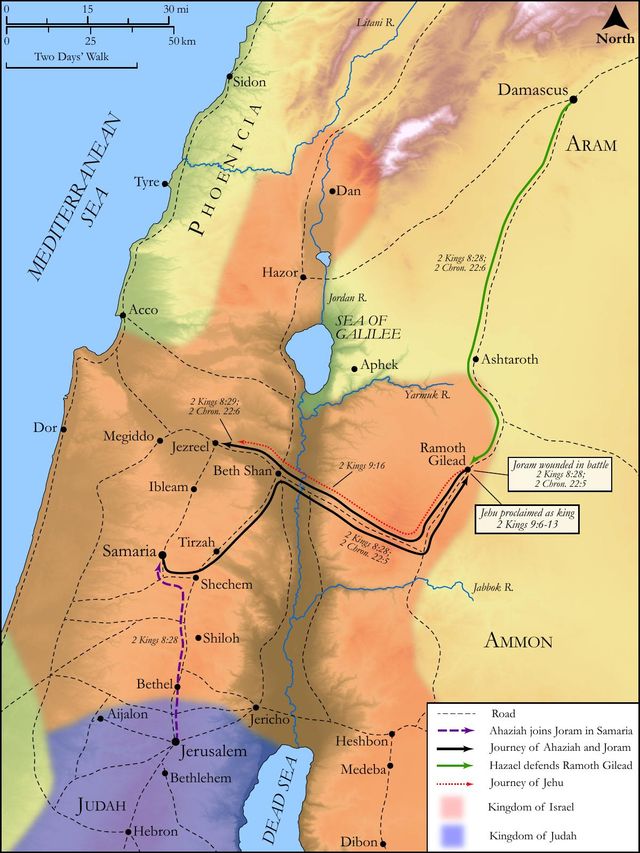
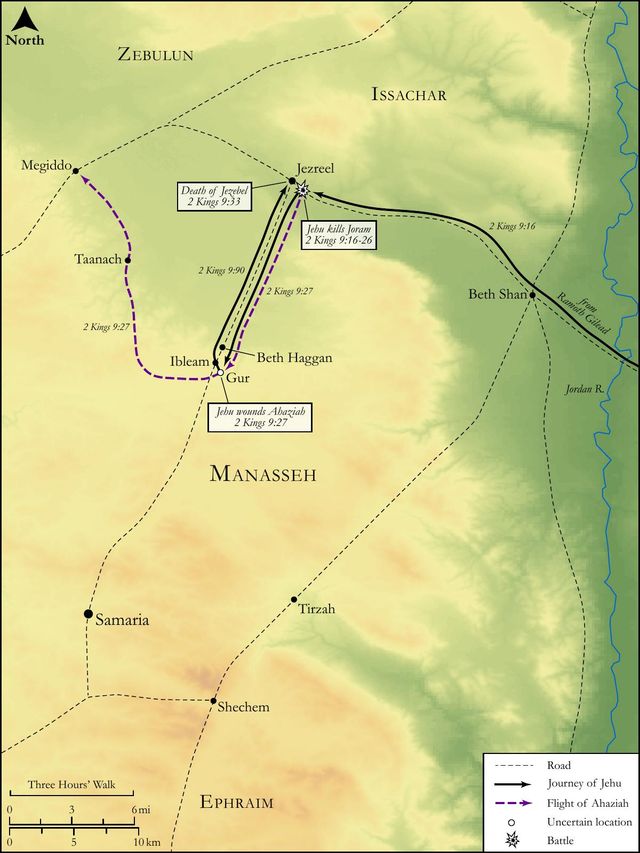
This verse is strategically placed at a climactic point in the narrative of Jehu's divinely appointed coup, which unfolds with shocking speed and violence in 2 Kings 9. Jehu has just been anointed by a prophet sent by Elisha with the explicit and urgent mission to utterly destroy the house of Ahab and avenge the blood of the prophets and servants of the Lord (2 Kings 9:6-7). Having already executed King Joram of Israel and King Ahaziah of Judah, Jehu arrives in Jezreel. Jezebel, with characteristic defiance, attempts to mock him from her window, but is summarily thrown down by her own eunuchs at Jehu's command, trampled by his horses, and her blood splattered on the wall and horses (2 Kings 9:30-33). Verse 2 Kings 9:34 immediately follows this gruesome event, depicting Jehu's actions and command after the initial, violent phase of judgment. This seemingly mundane instruction for burial sets the stage for the shocking discovery in the subsequent verses (2 Kings 9:35-37) that confirms the precise and horrifying fulfillment of Elijah's earlier prophecy against Jezebel.
Historical & Cultural Context
The period of the Omride dynasty, particularly under Ahab and Jezebel, was arguably the darkest era of religious apostasy in the northern kingdom of Israel. Jezebel, a Phoenician princess from Sidon, aggressively promoted the state-sponsored worship of Baal and Asherah, directly challenging the worship of Yahweh and persecuting His prophets (1 Kings 16:31-33; 1 Kings 18:4). Her orchestrating of Naboth's murder to seize his vineyard (1 Kings 21:7-16) further cemented her reputation for ruthless wickedness. In Israel, proper burial was a profoundly significant act, deeply intertwined with honor and memory, as the patriarchs' care for the cave of Machpelah shows. To be left unburied was considered the ultimate disgrace and a severe curse, often reserved for the most despised enemies or as a direct divine judgment (Deuteronomy 28:26; Jeremiah 8:2). Jehu's command, therefore, despite his utter contempt for Jezebel, touches upon a deeply ingrained cultural practice, even if his motive was merely to dispose of a defiling corpse rather than to bestow honor.
Key Themes
ShowHide2 Kings 9 is profoundly marked by the overarching themes of divine judgment and the unwavering fulfillment of prophecy. Jezebel's horrific and ignominious end is presented not merely as a political assassination but as the direct, precise consequence of her persistent wickedness and a literal execution of Elijah's prophetic word against her and the house of Ahab (1 Kings 21:23). The verse also powerfully illustrates the transience and futility of human power and glory when it stands in opposition to God. Jezebel, once an immensely powerful and terrifying queen who wielded absolute influence, is now reduced to a discarded, trampled corpse, referred to by her executioner with utter disdain. Jehu's casualness in eating and drinking before addressing her remains underscores the complete disregard for her former status and the finality of her downfall. Yet, the instruction to bury her, however perfunctory, introduces a subtle theme of acknowledgment of royal lineage, even for a cursed enemy, hinting at residual cultural norms surrounding the treatment of royalty, or perhaps a pragmatic desire to avoid defilement within the royal city.
Exposition and Analysis
ShowHideKey Word Analysis
ShowHideThis term (אֲרוּרָה, H779) is a feminine passive participle derived from the verb 'arar (אָרַר), meaning "to execrate," "to be cursed," or "to be under a curse." It signifies a state of being divinely condemned or devoted to destruction, often implying a severe, irrevocable judgment from God. In this context, Jehu's labeling of Jezebel as "cursed" is far more than a personal insult; it functions as a theological declaration that her fate is a direct consequence of divine judgment. She is not merely an object of human contempt, but one explicitly under the curse of God due to her pervasive idolatry, relentless persecution of Yahweh's prophets, and instigation of gross injustice. This word elevates her demise from a political assassination to a divinely sanctioned execution of justice, highlighting the spiritual significance of her end.
This word (בַּת, H1323) literally means "daughter" and, when combined with "king's" (H4428, melek), forms the phrase "king's daughter" (bat-melekh). It refers to Jezebel's lineage as a princess of Sidon, daughter of Ethbaal, king of the Sidonians (1 Kings 16:31). This designation highlights her high birth and former royal status, which typically afforded certain dignities, even in death. Jehu's acknowledgment of this lineage, despite labeling her "cursed," creates a striking tension. It suggests a lingering, albeit minimal, respect for the custom of burying royalty, or perhaps a pragmatic desire to avoid the defilement of an unburied corpse, regardless of the individual's wickedness. It underscores the profound irony of her fall from such a prestigious position to such an ignominious end, where her royal status is merely a footnote to her cursed state.
Verse Breakdown
ShowHide"And when he was come in, he did eat and drink"
This clause reveals Jehu's immediate action upon entering the royal palace or precinct. His decision to eat and drink before dealing with Jezzebl's body is highly significant. It suggests a sense of calm, completion, and perhaps even a celebratory satisfaction after the intense, bloody events of the coup and the executions of Joram, Ahaziah, and Jezebel herself. This casual act implies a moment of rest and the successful accomplishment of the primary, violent phase of his mission. This starkly contrasts with the gravity of the preceding events and the gruesome nature of Jezebel's death, highlighting Jehu's hardened demeanor, his unflinching resolve, and his complete lack of sentimentality or remorse.
"and said, Go, see now this cursed [woman], and bury her"
After his meal, Jehu issues a direct and seemingly casual command to his servants. The phrase "Go, see now" implies a perfunctory dispatching, not a solemn or respectful directive. His designation of Jezebel as "this cursed [woman]" (אֲרוּרָה) is a powerful and damning indictment, marking her as divinely condemned and an object of utter contempt. Despite this profound disdain, he commands her burial. This instruction is crucial, as it suggests a recognition of some basic human or royal custom, even for an enemy, or more likely, a pragmatic desire to remove the defilement of an unburied corpse from the royal premises. It is a command born of expediency, not compassion or honor.
"for she [is] a king's daughter"
This final clause provides Jehu's brief rationale for the burial command. Despite her being "cursed" and his vanquished enemy, her royal lineage is acknowledged. This highlights a tension between the divine curse pronounced upon her and the prevailing cultural expectation of burying royalty. It could be a nod to ancient customs that afforded a measure of respect or proper disposal to those of royal birth, regardless of their actions, or simply a practical consideration to avoid a lingering defilement or a public spectacle of an unburied royal body, even a despised one. It underscores the stark contrast between her former glory and her current state of utter disgrace, where her royal status is the only remaining, albeit weak, justification for a burial.
Literary Devices
ShowHideThe passage employs several potent literary devices to convey its powerful message. Irony is profoundly present, as Jezebel, a once-powerful queen of royal birth, meets an ignominious and public end, reduced to a "cursed woman" whose burial is an afterthought. Her former status, instead of affording protection or dignity, only serves as a stark contrast to her gruesome demise. Foreshadowing is implicitly woven into the narrative, as Jehu's command to bury her, immediately followed by the shocking discovery of her devoured remains (2 Kings 9:35-37), meticulously sets up the dramatic and precise fulfillment of Elijah's earlier prophecy from 1 Kings 21:23. The narrative skillfully builds anticipation for this ultimate divine judgment. Furthermore, Juxtaposition is strikingly evident in Jehu's casual "eat and drink" behavior immediately following the violent and bloody events of the coup. This starkly contrasts with the horror of Jezebel's death, emphasizing Jehu's cold, calculating nature and the complete disregard for Jezebel's former influence, thereby underscoring the finality and thoroughness of the divine judgment.
Theological and Thematic Connections
ShowHideThis verse, though brief, powerfully encapsulates the unwavering certainty of divine judgment and the precise, undeniable fulfillment of God's prophetic word. Jezebel's horrific end is not merely a political assassination but the culmination of God's righteous anger against persistent idolatry, deep-seated injustice, and the relentless persecution of His people. Her being labeled "cursed" underscores that her fate was a direct, inescapable consequence of her actions against the Lord. Even in the midst of human actions, political maneuvering, and the exercise of earthly power, God's sovereign plan unfolds with perfect precision, demonstrating that no one, regardless of their power, influence, or status, is beyond His ultimate accountability. The tension between her "cursed" state and her "king's daughter" status highlights that while human customs may attempt to offer a semblance of dignity or respect, divine judgment ultimately supersedes all earthly prestige and societal norms.
Reflection and Application
ShowHideThe chilling account of Jezebel's demise and Jehu's subsequent, almost indifferent, command serves as a stark and sobering reminder of the ultimate and inescapable consequences of rebellion against God and persistent, unrepentant wickedness. It compels us, as believers, to deeply consider that while justice may seem delayed or elusive in our human experience, God's divine judgment is absolutely certain and will be perfectly executed in His appointed time. No amount of worldly power, influence, or elevated status can ultimately shield an individual from accountability before the Almighty. This passage calls us to a profound and unwavering trust in God's sovereignty and the absolute reliability of His word, knowing that every prophecy, every promise, and every warning will be fulfilled with meticulous precision. It also challenges us to critically examine our own lives: are we aligning ourselves with God's truth, justice, and righteous ways, or are we, like Jezebel, pursuing paths of idolatry, injustice, spiritual rebellion, or moral compromise? The casualness of Jehu's command, juxtaposed with the gravity of the judgment, also prompts a crucial reflection on the hardened heart that can become desensitized to both the heinousness of sin and its inevitable, devastating consequences.
Questions for Reflection
ShowHideFAQ
ShowHideWhy did Jehu eat and drink before dealing with Jezebel's body?
ShowHideJehu's decision to eat and drink immediately after Jezebel's death, and before issuing the command for her burial, suggests several significant possibilities. It could signify a moment of personal satisfaction, relief, and perhaps even a form of celebration, marking the successful completion of a major and particularly gruesome phase of his divinely ordained mission to eradicate the house of Ahab (2 Kings 9:7-8). In Scripture, eating and drinking could also be a way to establish or solidify a new reign or covenant, as when Isaac made Abimelech a feast and they ate and drank and swore one to another, or simply to restore oneself after strenuous and violent activity. His casualness highlights his hardened demeanor and the thoroughness of his resolve, demonstrating a complete lack of sentimentality or remorse for the queen's brutal end. It underscores the cold, calculating nature of his actions as an unflinching instrument of divine judgment.
Why did Jehu command Jezebel to be buried if she was "cursed"?
ShowHideJehu's command to bury Jezebel, despite labeling her "this cursed woman," reveals a complex interplay of factors rather than any compassion. First, it might reflect a residual respect for prevailing royal custom; even a despised queen was still "a king's daughter," and proper burial was generally afforded to royalty, regardless of their actions, to avoid further defilement. Second, and more pragmatically, it could be a decision to avoid the ritual impurity and public disgrace associated with an unburied corpse within the royal city or palace grounds. Unburied bodies were considered a source of severe ritual impurity and a public spectacle of utter contempt (Deuteronomy 21:23). Jehu's primary concern was likely the swift and expedient removal of her body, not a compassionate act. The subsequent discovery that only parts of her remained (2 Kings 9:35-37) ultimately showed that even this minimal acknowledgment of royal custom was thwarted by the precise and overriding fulfillment of Elijah's prophecy.
Christ-Centered Fulfillment
ShowHideThe gruesome judgment of Jezebel in 2 Kings 9:34 and the precise fulfillment of Elijah's prophecy, while seemingly far removed from the person and work of Christ, powerfully anticipate the ultimate triumph of God's perfect justice and the comprehensive nature of His redemptive plan. Jezebel's demise is a vivid, historical demonstration that all wickedness, persistent idolatry, and rebellion against God will ultimately face inescapable divine judgment. This foreshadows Christ as the ultimate and righteous Judge, who will one day return in glory to execute perfect justice upon all unrighteousness (John 5:27; Revelation 19:11). Furthermore, the meticulous fulfillment of Elijah's prophecy underscores the absolute reliability and truthfulness of God's Word. This points directly to Jesus Christ as the supreme fulfillment of all prophecy, the one in whom all God's promises find their definitive "Yes" and "Amen" (2 Corinthians 1:20). Through His sacrificial death on the cross and His glorious resurrection, Christ has decisively conquered the spiritual forces of wickedness and the curse of sin that Jezebel so powerfully embodied, offering deliverance from the curse of the law and eternal death to all who believe in Him (Colossians 2:15; Galatians 3:13). Thus, Jezebel's judgment, while a historical event of Old Testament justice, serves as a stark reminder of the future judgment for those who reject God, and simultaneously magnifies the boundless grace and ultimate victory found in Christ, who has secured eternal life and freedom from the curse for His redeemed people.