


1 Kings 16:23
Bible text: King James Version (1769 Blayney text) · Public domain
Bible text: King James Version with Strong's numbers · Public domain
Bible text: Berean Standard Bible · Public domain
Bible text: American Standard Version (1901) · Public domain
Bible text: World English Bible, Messianic edition · Public domain
Bible text: Geneva Bible (1599) · Public domain
Bible text: Young's Literal Translation · Public domain
- בִּשְׁנַתbish·Natin yearH8141Prep-b ¦ N-fscNoun Singular Feminine Constructבִּinשְׁנַתyear
- שְׁלֹשִׁיםshe·lo·ShimthirtyH7970N-mpNoun Plural Masculine Absolute
- וְאַחַתve·'a·Chatand oneH259Conj-w ¦ N-fscNoun Singular Feminine Constructוְandאַחַתone
- שָׁנָהsha·NahyearH8141N-fsNoun Singular Feminine Absolute
- לְאָסָאle·'a·Sa'of AsaH609Prep-l ¦ N-proper-mNoun Proper MasculineלְofאָסָאAsa
- מֶלֶךְMe·lekh[the] king ofH4428N-mscNoun Singular Masculine Construct
- יְהוּדָהye·hu·DahJudahH3063N-properNoun Proper Location
- מָלַךְma·Lakhhe became kingH4427V-Qal-Perf-3msVerb Qal Perfect 3rd Singular Masculine
- עָמְרִי'a·me·RiOmriH6018N-proper-mNoun Proper Masculine
- עַל'aloverH5921PrepPreposition
- יִשְׂרָאֵלYis·ra·'ElIsraelH3478N-properNoun Proper Location
- שְׁתֵּיםshe·Teimtwo [plus]H8147N-fdNoun Dual Feminine Absolute
- עֶשְׂרֵה'es·RehtenH6240N-csNoun Singular common gender Absolute
- שָׁנָהsha·Nahyear[s]H8141N-fsNoun Singular Feminine Absolute
- בְּתִרְצָהbe·tir·Tzahin TirzahH8656Prep-b ¦ N-properNoun Proper LocationבְּinתִרְצָהTirzah
- מָלַךְma·Lakhhe reignedH4427V-Qal-Perf-3msVerb Qal Perfect 3rd Singular Masculine
- שֵׁשׁsheshsixH8337N-cscNoun Singular common gender Construct
- שָׁנִיםsha·NimyearsH8141N-mpNoun Plural Masculine Absolute
English is a literal word-by-word gloss of the Hebrew, not the KJV's wording. Why?
This is the original text the KJV's translators worked from — each Hebrew word with its own literal English meaning in this verse, prepared by scholars at Tyndale House, Cambridge. The KJV translates whole sentences, not word by word, so its wording differs: one Hebrew word can become several English words, and the KJV may choose “the LORD” where the gloss reads “Yahweh”. Both are faithful — they answer different questions. For the KJV's own rendering, switch to the KJV text.
Details
See on the biblical-era maps

Study this verse
Public-domain commentary
Matthew Henry
From his Commentary on the Whole Bible. Henry comments on passages, not single verses — this entry covers 1 Kings 16:15–28. His two-level outline is real structure in the source text, so it is rendered as structure.
Solomon observes (Pro 28:2) that for the transgression of a land many were the princes thereof (so it was here in Israel), but by a man of understanding the state thereof shall be prolonged - so it was with Judah at the same time under Asa. When men forsake God they are out of the way of rest and establishment. Zimri, and Tibni, and Omri, are here striving for the crown. Proud aspiring men ruin one another, and involve others in the ruin. These confusions end in the settlement of Omri; we must therefore take him along with us through this part of the story.
I.How he was chosen, as the Roman emperors often were, by the army in the field, now encamped before Gibbethon.
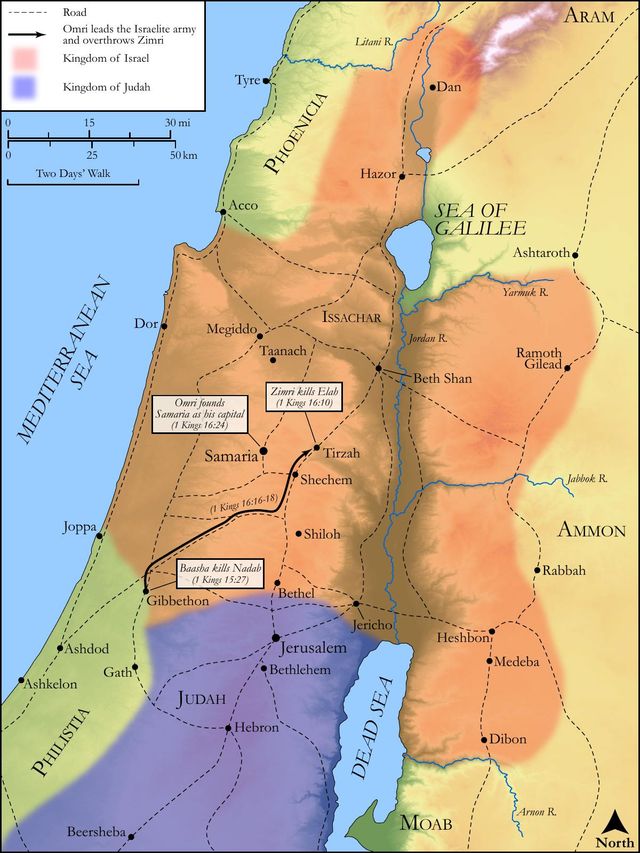
Notice was soon brought thither that Zimri had slain their king (Kg1 16:16) and set up himself in Tirzah, the royal city, whereupon they chose Omri king in the camp, that they might without delay avenge the death of Elah upon Zimri. Though he was idle and intemperate, yet he was their king, and they would not tamely submit to his murderer, nor let the treason go unpunished. They did not attempt to avenge the death of Nadab upon Baasha, perhaps because the house of Baasha had ruled with more gentleness than the house of Jeroboam; but Zimri shall feel the resentments of the provoked army. The siege of Gibbethon is quitted (Philistines are sure to gain when Israelites quarrel) and Zimri is prosecuted.
II.How he conquered Zimri, who is said to have reigned seven days (Kg1 16:15), so long before Omri was proclaimed king and himself proclaimed traitor; but we may suppose it was a longer time before he died, for he continued long enough to show his inclination to the way of Jeroboam, and to make himself obnoxious to the justice of God by supporting his idolatry, Kg1 16:19. Tirzah was a beautiful city, but not fortified, so that Omri soon made himself master of it (Kg1 16:17), forced Zimri into the palace, which being unable to defend, and yet unwilling to surrender, he burnt, and himself in it, Kg1 16:18. Unwilling that his rival should ever enjoy that sumptuous palace, he burnt it; and fearing that if he fell into the hands of the army, either alive or dead, he should be ignominiously treated, he burnt himself in it. See what desperate practices men's wickedness sometimes brings them to, and how it hurries them into their own ruin; see the disposition of incendiaries, who set palaces and kingdoms on fire, though they are themselves in danger of perishing in the flame.
III.How he struggled with Tibni, and at length got clear of him:
Half of the people followed this Tibni (Kg1 16:21), probably those who were in Zimri's interest, with whom others joined, who would not have a king chosen in the camp (lest he should rule by the sword and a standing army), but in a convention of the states. The contest between these two lasted some years, and, it is likely, cost a great deal of blood on both sides, for it was in the twenty-seventh year of Asa that Omri was first elected (Kg1 16:15) and thence the twelve years of his reign are to be dated; but it was not till the thirty-first year of Asa that he began to reign without a rival; then Tibni died, it is likely in battle, and Omri reigned, Kg1 16:22. Sir Walter Raleigh, in his History of the World (2.19.6), enquires here why it was that in all these confusions and revolutions of the kingdom of Israel they never thought of returning to the house of David, and uniting themselves again to Judah, for then it was better with them than now; and he thinks the reason was because the kings of Judah assumed a more absolute, arbitrary, and despotic power than the kings of Israel. It was the heaviness of the yoke that they complained of when they first revolted from the house of David, and the dread of that made them ever after averse to it, and attached to kings of their own, who ruled more by law and the rules of a limited monarchy.
IV.How he reigned when he was at length settled on the throne.
1.He made himself famous by building Samaria, which, ever after, was the royal city of the kings of Israel (the palace at Tirzah being burnt), and in process of time grew so considerable that it gave name to the middle part of Canaan (which lay between Galilee on the north and Judea on the south) and to the inhabitants of that country, who were called Samaritans. He bought the ground for two talents of silver, somewhat more than 700l. of our money, for a talent was 353l. 11s. 10 1/2d. Perhaps Shemer, who sold him the ground, let him have it considerably the cheaper upon condition that the city should be called after his name, for otherwise it would have borne the name of the purchaser; it was called Samaria, or Shemeren (as it is in the Hebrew), from Shemer, the former owner, Kg1 16:24. The kings of Israel changed their royal seats, Shechem first, then Tirzah, now Samaria; but the kings of Judah were constant to Jerusalem, the city of God. Those that cleave to the Lord fix, but those that leave him ever wander.
2.He made himself infamous by his wickedness; for he did worse than all that were before him, Kg1 16:25. Though he was brought to the throne with much difficulty, and Providence had remarkably favoured him in his advancement, yet he was more profane, or more superstitious, and a greater persecutor, than either of the houses of Jeroboam or Baasha. He went further than they had done in establishing iniquity by a law, and forcing his subjects to comply with him in it; for we read of the statutes of Omri, the keeping of which made Israel a desolation, Mic 6:16. Jeroboam caused Israel to sin by temptation, example, and allurement; but Omri did it by compulsion.
V.How he ended his reign, Kg1 16:27, Kg1 16:28.
He was in some repute for the might which he showed. Many a bad man has been a stout man. He died in his bed, as did Jeroboam and Baasha themselves; but, like them, left it to his posterity to fill up the measure, and then pay off the scores, of his iniquity.
Historical interpretation
Historical reception
1 surviving comment on this verse from the historical church.
In the one and thirtieth year: Amri began to reign in the seven and twentieth year of Asa; but had not quiet possession of the kingdom till the death of his competitor Thebni, which was in the one and thirtieth year of Asa's reign.
Continue studying 1 Kings 16:23 across the web’s major study libraries — every link below opens this exact verse, chapter, or book on the destination site.
Read & Compare
 BibleGatewayThis verse in more than 200 translations and 70 languages.
 Bible.comThe YouVersion reader — hundreds of translations, reading plans, and highlights.
 ESV.orgCrossway's official English Standard Version reader.
 NET BibleThe NET translation with 60,000+ translators' notes on every rendering decision.
 STEP BibleTyndale House's free study tool — original text, vocabulary, and scholarly resources.
 BibliaLogos Bible Software's free web reader.
 USCCBThe New American Bible (Revised Edition) with the U.S. bishops' study notes.
Commentaries
 BibleHub CommentariesDozens of classic commentaries on this verse, gathered on one page.
 StudyLightMore than 100 commentary sets — the largest collection on the web.
 BibleRefPlain-English commentary on what this verse means, verse by verse.
 Enduring WordDavid Guzik's free commentary on this chapter, widely used by Bible teachers.
 Bible Study ToolsVerse commentary alongside Greek and Hebrew study aids.
Original Language & Research
- BibleHub InterlinearThe verse word by word — original language, transliteration, and English.
- BibleHub LexiconEvery word's original-language definition and Strong's entry.
 Blue Letter BibleDeep-study tools — Strong's numbers, concordance, and word studies.
 SefariaThe Hebrew text with Rashi and centuries of Jewish commentary.
Sermons, Hymns & Audio


TrulyRandomVerse is not affiliated with these sites and doesn’t control their content. They’re linked because they’re genuinely useful.
Summary
First Kings 16:23 serves as a precise chronological anchor within the tumultuous history of the divided monarchy, marking the commencement of Omri's twelve-year reign over the Northern Kingdom of Israel. This verse synchronizes Omri's ascent to power with the thirty-first year of King Asa's rule in Judah, further specifying that Omri initially governed from Tirzah for six of those years. It sets the stage for a period of significant political consolidation and the establishment of a powerful, albeit idolatrous, dynasty that would profoundly impact Israel's future.
Context
ShowHideLiterary Context
This verse is strategically placed within a section of 1 Kings that meticulously chronicles the rapid and often violent succession of kings in the Northern Kingdom of Israel, contrasting sharply with the relative, though sometimes challenged, stability of the Davidic line in Judah. Immediately preceding 1 Kings 16:23, the narrative details the short, wicked reigns of Baasha, Elah, and Zimri, culminating in a civil war. Omri, a commander of the army, emerges from this chaos, overthrowing Zimri who reigned for only seven days, and then defeating Tibni, a rival claimant to the throne, as described in 1 Kings 16:15-22. Therefore, verse 23 signifies the formal and consolidated beginning of Omri's reign after a period of intense political instability, setting the stage for his significant administrative and geopolitical actions, particularly the founding of Samaria, detailed in the very next verse, 1 Kings 16:24.
Historical & Cultural Context
The era of the divided monarchy (c. 931-722 BCE) was characterized by distinct political and religious trajectories for the Northern Kingdom of Israel and the Southern Kingdom of Judah. Unlike Judah, which maintained the Davidic dynasty in Jerusalem, Israel experienced frequent dynastic changes, coups, and assassinations, often with kings rising from military ranks, as was the case with Omri. The precise chronological synchronism with "the thirty and first year of Asa king of Judah" is a crucial historical marker, a common practice in the Deuteronomistic History that allows for the alignment of the two kingdoms' chronologies and, by extension, the dating of events across both kingdoms. Tirzah, the initial capital mentioned, had served as a royal city for previous Israelite kings like Baasha and Elah. While known for its beauty, its strategic defensibility was limited, prompting Omri's visionary decision to establish a new, more secure capital at Samaria, a move that would have profound and lasting geopolitical implications for the Northern Kingdom.
Key Themes
ShowHideThis verse, though brief, contributes to several overarching themes in the books of Kings. Firstly, it highlights the persistent dynastic instability of the Northern Kingdom, a stark contrast to the relative, divinely ordained continuity of the Davidic line in Judah, even amidst its own challenges, as seen in Asa's reign. Omri's establishment of a new, powerful dynasty, despite its unrighteousness (as explicitly stated in 1 Kings 16:25), temporarily halts the rapid succession of kings. Secondly, the meticulous chronological detail underscores the biblical authors' emphasis on historical accuracy and the pervasive theme of divine sovereignty over human affairs. Even the rise of powerful, ungodly rulers like Omri is recorded as part of God's unfolding plan and judgment. Thirdly, the mention of Tirzah and the subsequent move to Samaria subtly introduces the theme of transition and transformation, illustrating Omri's strategic acumen and the shift in the Northern Kingdom's center of power, which would unfortunately become a major hub of idolatry for centuries.
Exposition and Analysis
ShowHideKey Word Analysis
ShowHideThis numeral, derived from a root meaning "united," signifies "one" or, as an ordinal, "first." In the context of "the thirty and first year," it precisely dates the beginning of Omri's reign. This seemingly simple word underscores the meticulous chronological efforts of the biblical authors, who sought to provide a clear and verifiable timeline for the events of Israelite history, emphasizing that these were real historical occurrences grounded in specific moments in time.
This primitive root verb means "to reign," "to ascend the throne," or "to induct into royalty." Its use here signifies the formal and established beginning of Omri's rule, following his military victory and consolidation of power. The verb encapsulates the act of assuming royal authority and exercising sovereign control, highlighting Omri's successful transition from military commander to king, a position he would hold for twelve years, a relatively long and influential reign for the Northern Kingdom.
Meaning "delightsomeness" or "pleasantness," Tirzah was an ancient Canaanite city that served as the capital of the Northern Kingdom for several earlier kings (e.g., Baasha, Elah, Zimri). Its name suggests its beauty, as even referenced in Song of Solomon 6:4. However, its strategic vulnerability, evidenced by Omri's own siege against Zimri there (1 Kings 16:17), ultimately led Omri to relocate the capital. The mention of his six-year reign in Tirzah marks a transitional phase before his monumental decision to build Samaria, a move of significant strategic and political foresight.
Verse Breakdown
ShowHide"In the thirty and first year of Asa king of Judah"
This opening clause provides a crucial synchronism, anchoring Omri's reign within the established timeline of the Southern Kingdom. King Asa was a relatively righteous king of Judah, whose long reign (41 years) is detailed in 1 Kings 15:9-24 and 2 Chronicles 14-16. This cross-referencing between the two kingdoms' chronologies is a hallmark of the Deuteronomistic History, emphasizing the interconnectedness of their fates under God's sovereignty, even as they remained politically divided and often antagonistic.
"began Omri to reign over Israel, twelve years"
This declares the official commencement and total duration of Omri's rule over the Northern Kingdom. His reign of twelve years was notably long for an Israelite king of this period, especially given the preceding instability and rapid succession of rulers. This extended duration allowed him to consolidate power, establish a dynasty, and implement significant administrative and strategic changes, most notably the founding of Samaria, which would become a lasting center of power for the Northern Kingdom.
"six years reigned he in Tirzah"
This specifies the initial phase of Omri's reign. After overthrowing Zimri and defeating Tibni's rival claim, Omri initially ruled from the existing capital of Tirzah. This six-year period served as a transitional phase, during which he solidified his control and assessed the strategic landscape before embarking on the ambitious and costly project of building a new, more defensible capital at Samaria. This move would define his legacy and the future geopolitical landscape of the Northern Kingdom.
Literary Devices
ShowHideThe primary literary devices at play in this verse are Chronology and Synchronism. The precise dating of Omri's reign by reference to Asa's reign in Judah is a classic example of Synchronism, a technique used throughout the books of Kings to interweave the histories of the two divided kingdoms. This not only provides historical precision but also underscores the biblical authors' view of history as a unified narrative under God's sovereign hand, even when dealing with disparate and often antagonistic kingdoms. The brevity of the description of Omri's reign, despite his significant historical impact (as known from extrabiblical sources), also serves as a subtle form of Juxtaposition. It implicitly contrasts the world's measure of success (political power, military might, administrative prowess) with the biblical author's primary concern: faithfulness to the covenant with Yahweh. Omri's success is noted, but his spiritual failings are highlighted in subsequent verses, demonstrating that earthly achievements are secondary to divine approval in the biblical narrative.
Theological and Thematic Connections
ShowHideFirst Kings 16:23, while seemingly a simple chronological note, is deeply embedded in the theological narrative of the Deuteronomistic History. It highlights God's sovereign control over the rise and fall of nations and rulers, even those who do not acknowledge Him or act righteously. Omri's ascent, though marked by political maneuvering and violence, is ultimately part of God's overarching plan, serving as an instrument in the unfolding judgment upon the Northern Kingdom for its persistent idolatry and rejection of the Davidic covenant. His reign, and the powerful dynasty he established, would later become a significant force against which God's prophets, like Elijah and Elisha, would contend, demonstrating that even the most formidable earthly powers are subject to divine scrutiny and judgment. The meticulous dating also underscores the reality of God's engagement with human history, demonstrating that these events are not mythical but grounded in specific times and places, affirming the historical reliability of the biblical account.
Reflection and Application
ShowHideThe brief account of Omri's rise, marked by political acumen and strategic foresight, yet overshadowed by his spiritual failings (as revealed in subsequent verses), offers profound lessons for contemporary reflection. It challenges us to consider what truly constitutes a "successful" life or leadership in the eyes of God. Omri built a powerful kingdom, established a new capital, and left a significant mark on the geopolitical map of his time, yet the biblical narrative quickly dismisses his achievements to highlight his unrighteousness. This prompts us to examine our own ambitions and priorities: Are we pursuing earthly recognition and power at the expense of spiritual integrity and faithfulness to God? Do we recognize God's hand in the seemingly chaotic ebb and flow of world events, trusting that He is sovereign over all rulers and nations? Ultimately, Omri's story reminds us that true lasting legacy is not built on political might or material success, but on a life lived in obedience and devotion to the Creator, whose standards transcend all human metrics.
Questions for Reflection
ShowHideFAQ
ShowHideWhy is Omri's reign so briefly described in the Bible despite his historical significance?
ShowHideThe biblical narrative, particularly in the Deuteronomistic History (Joshua through 2 Kings), is not primarily a secular historical record but a theological one. Its main concern is Israel's faithfulness to Yahweh and the consequences of obedience or disobedience to the covenant. While Omri was a powerful and historically significant king, even mentioned in Assyrian inscriptions as the founder of the "House of Omri" (which referred to the Northern Kingdom for over a century), the Bible focuses on his spiritual failings. 1 Kings 16:25 states, "But Omri wrought evil in the eyes of the Lord, and did worse than all that were before him." His political and military achievements, though real and impactful, were secondary to his spiritual rebellion from the perspective of the biblical author. The brevity underscores that worldly success, without righteousness, holds little ultimate value in God's eyes.
What was the significance of Tirzah, and why did Omri move the capital to Samaria?
ShowHideTirzah was an ancient Canaanite city that had served as the capital of the Northern Kingdom for several kings, including Baasha, Elah, and Zimri, before Omri. It was known for its beauty and pleasantness, as referenced in Song of Solomon 6:4. However, Tirzah had strategic vulnerabilities, as demonstrated by Omri's own successful siege against Zimri there (1 Kings 16:17). Omri's decision to move the capital to Samaria, detailed in 1 Kings 16:24, was a brilliant strategic move. Samaria was built on a defensible hill, offering superior protection and control over crucial trade routes. This move solidified Omri's power and provided a more secure and central administrative hub for his dynasty, demonstrating his political and military acumen and ensuring his legacy.
Christ-Centered Fulfillment
ShowHideThe instability and ultimate failure of the earthly kings of Israel, exemplified by figures like Omri who sought to establish their own power and legacy apart from God, powerfully foreshadow the necessity of a perfect and eternal King. Omri's reign, though marked by political strength and the founding of a new capital, was ultimately "evil in the eyes of the Lord" (1 Kings 16:25), leading to further spiritual decay in Israel and setting the stage for even greater idolatry under his son, Ahab. This constant cycle of flawed human leadership, marked by sin and idolatry, highlights the deep human need for a different kind of ruler—one who is not merely politically adept but perfectly righteous and eternally sovereign. This longing is ultimately fulfilled in Jesus Christ, the true King of Israel and the world. Unlike Omri, whose reign was limited by time and tainted by sin, Jesus' kingdom is an everlasting kingdom, and His dominion endures throughout all generations (Psalm 145:13). He does not merely establish a temporary earthly capital but builds an eternal spiritual kingdom, the Church, over which He reigns with perfect justice and grace, having been given all authority in heaven and on earth (Matthew 28:18). The rise and fall of human kings like Omri serve as a stark reminder that true security and lasting peace are found not in earthly power or strategic locations, but in the unwavering, righteous reign of the Lamb of God, who is King of kings and Lord of lords (Revelation 19:16) and whose kingdom will have no end (Luke 1:33).