


Genesis 41:8
Bible text: King James Version (1769 Blayney text) · Public domain
Bible text: King James Version with Strong's numbers · Public domain
Bible text: Berean Standard Bible · Public domain
Bible text: American Standard Version (1901) · Public domain
Bible text: World English Bible, Messianic edition · Public domain
Bible text: Geneva Bible (1599) · Public domain
Bible text: Young's Literal Translation · Public domain
- וַיְהִיvay·Hiand it wasH1961Conj-w ¦ V-Qal-ConsecImperf-3msVerb Qal Consecutive Imperfect 3rd Singular Masculineוַandיְהִיit was
- בַבֹּקֶרva·Bo·kerin the morningH1242Prep-b ¦ N-msNoun Singular Masculine Absoluteבַin theבֹּקֶרmorning
- וַתִּפָּעֶםva·ti·Pa·'emand it was troubledH6470Conj-w ¦ V-Niphal-ConsecImperf-3fsVerb Niphal Consecutive Imperfect 3rd Singular Feminineוַandתִּפָּעֶםit was troubled
- רוּחוֹru·Chohis spiritH7307N-fsc ¦ 3msNoun Singular Feminine Constructרוּחspiritוֹhis
- וַיִּשְׁלַחvai·yish·Lachand he sentH7971Conj-w ¦ V-Qal-ConsecImperf-3msVerb Qal Consecutive Imperfect 3rd Singular Masculineוַandיִּשְׁלַחhe sent
- וַיִּקְרָאvai·yik·Ra'and he summonedH7121Conj-w ¦ V-Qal-ConsecImperf-3msVerb Qal Consecutive Imperfect 3rd Singular Masculineוַandיִּקְרָאhe summoned
- אֶת'et<obj.>H853DirObjMParticle Object Indicator
- כָּלkolallH3605N-mscNoun Singular Masculine Construct
- חַרְטֻמֵּיchar·tu·Mei[the] diviner priests ofH2748N-mpcNoun Plural Masculine Construct
- מִצְרַיִםmitz·Ra·yimEgyptH4714N-properNoun Proper Location
- וְאֶתve·'Etand <obj.>H853Conj-w ¦ DirObjMParticle Object Indicatorוְandאֶת<obj.>
- כָּלkolallH3605N-mscNoun Singular Masculine Construct
- חֲכָמֶיהָcha·kha·Mei·haits wise [men]H2450Adj-mpc ¦ 3fsAdjective Plural Masculine Constructחֲכָמֶיwise [men]הָits
- וַיְסַפֵּרvay·sa·Perand he recountedH5608Conj-w ¦ V-Piel-ConsecImperf-3msVerb Piel Consecutive Imperfect 3rd Singular Masculineוַandיְסַפֵּרhe recounted
- פַּרְעֹהpar·'OhPharaohH6547N-msNoun Title Singular Masculine Absolute
- לָהֶםla·Hemto <the> themPrep-l ¦ 3mpSuffix Personal 3rd Plural Masculineלָto <the>הֶםthem
- אֶת'et<obj.>H853DirObjMParticle Object Indicator
- חֲלֹמוֹcha·lo·Mohis dreamH2472N-msc ¦ 3msNoun Singular Masculine Constructחֲלֹמdreamוֹhis
- וְאֵיןve·'einand there notH369Conj-w ¦ N-mscNoun Singular Masculine Constructוְandאֵיןthere not
- פּוֹתֵרpo·Ter[was one who] interpretedH6622V-Qal-Prtcpl-msVerb Qal Participle Singular Masculine Absolute
- אוֹתָם'o·Tam<obj.> themH853DirObjM ¦ 3mpParticle Object Indicatorאוֹתָ<obj.>םthem
- לְפַרְעֹהle·far·'Ohfor PharaohH6547Prep-l ¦ N-msNoun Title Singular Masculine AbsoluteלְforפַרְעֹהPharaoh
English is a literal word-by-word gloss of the Hebrew, not the KJV's wording. Why?
This is the original text the KJV's translators worked from — each Hebrew word with its own literal English meaning in this verse, prepared by scholars at Tyndale House, Cambridge. The KJV translates whole sentences, not word by word, so its wording differs: one Hebrew word can become several English words, and the KJV may choose “the LORD” where the gloss reads “Yahweh”. Both are faithful — they answer different questions. For the KJV's own rendering, switch to the KJV text.
Details
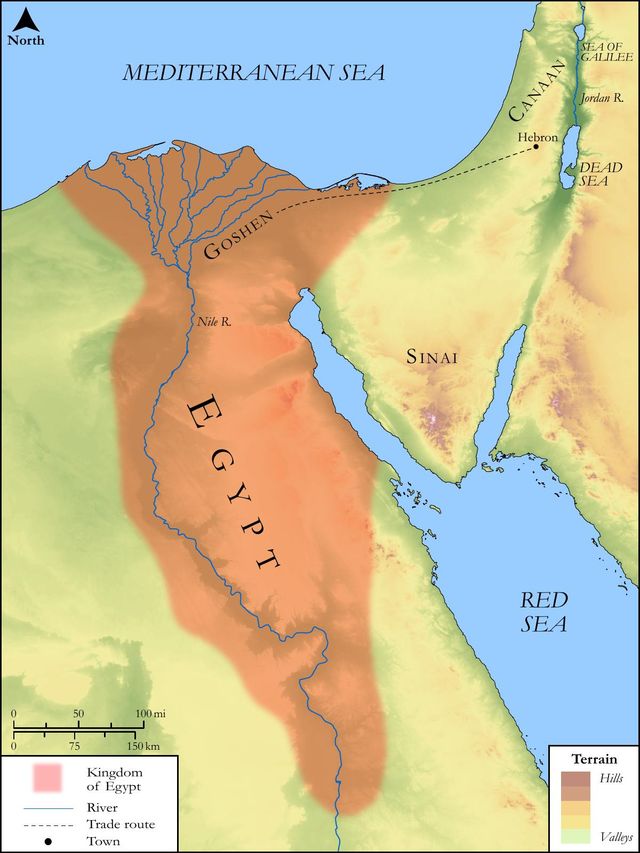
See on the biblical-era maps


Study this verse
Public-domain commentary
Matthew Henry
From his Commentary on the Whole Bible. Henry comments on passages, not single verses — this entry covers Genesis 41:1–8.
Observe, 1. The delay of Joseph's enlargement. It was not till the end of two full years (Gen 41:1); so long he waited after he had entrusted the chief butler with his case and began to have some prospect of relief. Note, We have need of patience, not only bearing, but waiting, patience. Joseph lay in prison until the time that his word came, Psa 105:19. There is a time set for the deliverance of God's people; that time will come, though it seem to tarry; and, when it comes, it will appear to have been the best time, and therefore we ought to wait for it (Hab 2:3), and not think two full years too long to continue waiting. 2. The means of Joseph's enlargement, which were Pharaoh's dreams, here related. If we were to look upon them as ordinary dreams, we might observe from them the follies and absurdities of a roving working fancy, how it represents to itself tame cows as beasts of prey (nay, more ravenous than any, eating up those of their own kind), and ears of corn as devouring one another. Surely in the multitude of dreams, nay, even in one dream, there are divers vanities, Ecc 5:7. Now that God no longer speaks to us in that way, I think it is no matter how little we either heed them or tell them. Foolish dreams related can make no better than foolish talk. But these dreams which Pharaoh dreamed carried their own evidence with them that they were sent of God; and therefore, when he awoke, his spirit was troubled, Gen 41:8. It cannot but put us into a concern to receive any extraordinary message from heaven, because we are conscious to ourselves that we have no reason to expect any good tidings thence. His magicians were puzzled, the rules of their art failed them: these dreams of Pharaoh, it seems, did not fall within the compass of them, so that they could not offer at the interpretation of them. This was to make Joseph's performance by the Spirit of God the more admirable. Human reason, prudence, and foresight, must be nonplussed, that divine revelation may appear the more glorious in the contrivance of our redemption, Co1 2:13, Co1 2:14. Compare with this story, Dan 2:27; Dan 4:7; Dan 5:8. Joseph's own dreams were the occasion of his troubles, and now Pharaoh's dreams were the occasion of his enlargement.
Continue studying Genesis 41:8 across the web’s major study libraries — every link below opens this exact verse, chapter, or book on the destination site.
Read & Compare
 BibleGatewayThis verse in more than 200 translations and 70 languages.
 Bible.comThe YouVersion reader — hundreds of translations, reading plans, and highlights.
 ESV.orgCrossway's official English Standard Version reader.
 NET BibleThe NET translation with 60,000+ translators' notes on every rendering decision.
 STEP BibleTyndale House's free study tool — original text, vocabulary, and scholarly resources.
 BibliaLogos Bible Software's free web reader.
 USCCBThe New American Bible (Revised Edition) with the U.S. bishops' study notes.
Commentaries
 BibleHub CommentariesDozens of classic commentaries on this verse, gathered on one page.
 StudyLightMore than 100 commentary sets — the largest collection on the web.
 BibleRefPlain-English commentary on what this verse means, verse by verse.
 Enduring WordDavid Guzik's free commentary on this chapter, widely used by Bible teachers.
 Bible Study ToolsVerse commentary alongside Greek and Hebrew study aids.
Original Language & Research
- BibleHub InterlinearThe verse word by word — original language, transliteration, and English.
- BibleHub LexiconEvery word's original-language definition and Strong's entry.
 Blue Letter BibleDeep-study tools — Strong's numbers, concordance, and word studies.
 SefariaThe Hebrew text with Rashi and centuries of Jewish commentary.
Sermons, Hymns & Audio


TrulyRandomVerse is not affiliated with these sites and doesn’t control their content. They’re linked because they’re genuinely useful.
Summary
Genesis 41:8 describes the profound distress of Pharaoh after his unsettling dreams and the complete failure of his most esteemed advisors—the magicians and wise men of Egypt—to provide any interpretation. This pivotal moment underscores the limitations of human wisdom and occult practices when confronted with divine revelation, setting the stage for God's sovereign intervention through Joseph, thereby orchestrating events crucial for the future of both Egypt and the nascent nation of Israel.
Context
ShowHideLiterary Context
This verse immediately follows Pharaoh's two vivid and disturbing dreams, detailed in Genesis 41:1-7. The narrative flow establishes Pharaoh's deep psychological and spiritual agitation upon waking, which prompts his immediate action to seek understanding. The inability of his court to interpret the dreams creates a narrative void, directly paving the way for the chief butler's recollection of Joseph (Genesis 41:9-13) and Joseph's subsequent summons to the palace. This sequence highlights a deliberate divine orchestration, moving the plot from human perplexity to divine revelation through an unexpected source.
Historical & Cultural Context
In ancient Egypt, dreams were considered significant conduits for divine messages or omens, particularly for a pharaoh, who was regarded as a god-king. Consequently, the royal court maintained specialists—scribes, diviners, and learned counselors—whose primary role included interpreting such omens and providing guidance. Pharaoh's immediate summoning of "all the magicians of Egypt, and all the wise men thereof" reflects the customary protocol for a ruler faced with an inexplicable and potentially ominous vision. Their collective failure, therefore, would have been highly unusual and deeply concerning within that cultural framework, signaling that the dreams were beyond ordinary human or even occult comprehension.
Key Themes
ShowHideGenesis 41:8 contributes significantly to several overarching themes within the book of Genesis and the broader biblical narrative. It powerfully illustrates the theme of Divine Sovereignty, demonstrating that God is actively at work, even in the courts of pagan kings, orchestrating events to fulfill His purposes. It also highlights the Limitations of Human Wisdom versus the Power of Divine Revelation, as the most learned men of Egypt are rendered helpless. This episode further advances the theme of God's Faithfulness to His Covenant Promises, as Joseph's eventual interpretation and exaltation are integral steps in preserving the lineage of Abraham and preparing for the nation of Israel's growth, echoing earlier divine interventions like God's promise to Abraham in Genesis 12:2-3.
Exposition and Analysis
ShowHideKey Word Analysis
ShowHideThis word signifies a primitive root meaning "to tap," "beat regularly," or "to impel or agitate." When applied to Pharaoh's spirit, it conveys a profound, persistent, and unsettling agitation or pounding within his innermost being. It suggests more than mere worry; it implies a deep, rhythmic disturbance that would not subside, indicating the supernatural and urgent nature of the dreams.
These individuals were a specific class of Egyptian diviners or sacred scribes, often associated with drawing magical lines or circles, and skilled in horoscopy and occult practices. They were considered experts in interpreting omens, hieroglyphs, and esoteric knowledge, making their failure particularly striking.
This primitive root means "to open up," and figuratively, "to interpret" a dream. The verse's emphasis that "none that could interpret them unto Pharaoh" highlights the absolute inability of human wisdom, even that steeped in occult arts, to "open up" or reveal the meaning of these divinely sent dreams.
Verse Breakdown
ShowHide"And it came to pass in the morning that his spirit was troubled"
This opening clause immediately establishes the profound impact of the dreams on Pharaoh. The "morning" suggests that the dreams were so disturbing that they continued to agitate him even after waking, preventing him from dismissing them. His "spirit" (Hebrew, rûwach', H7307) refers to his inner being, his mind, and his very essence, indicating a deep, pervasive disquiet, not merely a fleeting concern.
"and he sent and called for all the magicians of Egypt, and all the wise men thereof"
In response to his profound distress, Pharaoh immediately takes the customary action of a king of that day. He summons the highest intellectual and spiritual authorities in his realm—the "magicians" (charṭômîm, H2748) and "wise men" (châkâmîm, H2450). This demonstrates his urgent need for an explanation and his reliance on the established channels of wisdom and divination within his kingdom. The inclusion of "all" emphasizes the comprehensive nature of his consultation, leaving no stone unturned.
"and Pharaoh told them his dream; but there was none that could interpret them unto Pharaoh"
Pharaoh clearly articulates his dreams to these experts, expecting a solution. However, the concluding phrase delivers the dramatic climax: "none that could interpret them." This collective and utter failure is theologically significant. It underscores that the dreams were not merely complex or cryptic, but supernaturally sealed from human understanding, deliberately so by God, to pave the way for His chosen instrument, Joseph. The repetition of "unto Pharaoh" highlights his desperate need and the complete lack of satisfaction from his trusted advisors.
Literary Devices
ShowHideThe verse effectively employs several literary devices. Dramatic Irony is present, as the reader knows (from previous chapters) that Joseph, a prisoner, holds the key to interpreting dreams, while the most powerful and learned men of Egypt are utterly clueless. This creates tension and anticipation for Joseph's eventual appearance. Contrast is starkly drawn between the immense power and resources of Pharaoh and his court, and their complete helplessness in the face of divine revelation. The phrase "his spirit was troubled" uses Pathos, evoking sympathy for Pharaoh's genuine distress and highlighting the profound, internal impact of the dreams. The collective failure of "all the magicians" and "all the wise men" serves as Foreshadowing, signaling that a divine, rather than human, solution is required, thereby setting the stage for Joseph's miraculous elevation and God's overarching plan.
Theological and Thematic Connections
ShowHideThis verse profoundly illustrates the stark contrast between human wisdom and divine revelation. Despite the vast knowledge, occult practices, and political power concentrated in Pharaoh's court, the most learned individuals in Egypt were utterly incapable of discerning the meaning of God's message. This highlights the biblical principle that God's ways and thoughts are infinitely higher than human understanding (Isaiah 55:8-9). Their failure was not an oversight but a deliberate act of divine providence, designed to create a vacuum that only God, through His chosen vessel, Joseph, could fill. This magnifies God's unique power to reveal secrets and His sovereign control over history, demonstrating that true wisdom comes only from Him.
Reflection and Application
ShowHideGenesis 41:8 offers a timeless and crucial lesson about the limits of human intellect and self-reliance, and the absolute necessity of divine revelation. In a world that often exalts human achievement, scientific discovery, and intellectual prowess as the ultimate sources of truth and solutions, this verse serves as a powerful reminder that there are mysteries, challenges, and future events that lie utterly beyond the grasp of human wisdom, no matter how sophisticated. When we face profound uncertainties, personal crises, or societal dilemmas that defy human solutions, our ultimate reliance must be on God. He alone possesses true understanding, orchestrates history, and reveals hidden truths. This passage encourages us to cultivate a posture of humility, seeking God's guidance through His Word and prayer, recognizing that He often works through unexpected means and people (like Joseph, a forgotten prisoner) to accomplish His perfect and sovereign plans. It reminds us that God's wisdom is not found in the world's elite but is freely given to those who seek Him.
Questions for Reflection
ShowHideFAQ
ShowHideWhy couldn't the magicians and wise men interpret Pharaoh's dreams?
ShowHideThe magicians and wise men of Egypt could not interpret Pharaoh's dreams because the dreams were of divine origin, sent directly by God, and their meaning was supernaturally hidden from all human wisdom and occult knowledge. God deliberately withheld the interpretation from them to demonstrate His unique power and to create a situation where only His chosen servant, Joseph, empowered by the Holy Spirit, could provide the correct understanding. This orchestrated inability served to elevate Joseph and showcase God's sovereignty over all earthly powers, as seen when Joseph later attributes the interpretation solely to God in Genesis 41:16.
What does it mean that Pharaoh's "spirit was troubled"?
ShowHideThe phrase "his spirit was troubled" (Hebrew: pâʻam, H6470) signifies a deep, profound, and unsettling agitation of Pharaoh's inner being. It indicates more than just simple worry or annoyance; it suggests a persistent, disturbing rhythm or pounding in his thoughts and emotions, highlighting the intense psychological and spiritual distress caused by the vivid and inexplicable nature of the dreams. This deep trouble underscored the dreams' supernatural origin and their critical importance for the future of Egypt, compelling Pharaoh to seek an immediate and authoritative interpretation.
Were Egyptian magicians and wise men real figures in ancient Egypt?
ShowHideYes, historical and archaeological evidence confirms the existence of various classes of scribes, diviners, and learned counselors in ancient Egypt, similar to the "magicians" (charṭômîm) and "wise men" (châkâmîm) mentioned in the Bible. These individuals held significant and influential positions in the royal court and were regularly consulted on matters of state, religious affairs, omens, and the interpretation of signs. However, as Genesis 41:8 demonstrates, their human or even demonic insights were ultimately limited when confronted with the direct revelation of the one true God, who alone holds ultimate knowledge and power.
Christ-Centered Fulfillment
ShowHideThe narrative of Genesis 41:8 powerfully foreshadows the ultimate revelation of God's wisdom and plan in Jesus Christ. Just as the collective wisdom of Egypt's greatest minds proved utterly futile in discerning God's message through Pharaoh's dreams, so too does the wisdom of the world utterly fail to comprehend the profound mystery of God's salvation through Christ (1 Corinthians 1:20-25). The world's philosophers, scholars, and powerful leaders could not, and cannot, devise a plan for humanity's redemption. Christ alone is the ultimate revealer of God's hidden truths, the "wisdom of God" personified (Colossians 2:3). He perfectly interprets God's will and fulfills His sovereign plan, not through human intellect or esoteric knowledge, but through divine power, sacrificial love, and the cross, which appears as foolishness to the world but is the power and wisdom of God (1 Corinthians 1:18). The inability of the wise men to interpret the dream points to the necessity of a divine interpreter, ultimately fulfilled in Christ, who reveals the Father (John 1:18) and brings true understanding, peace, and salvation to a troubled world.