


Luke 12:54
Bible text: King James Version (1769 Blayney text) · Public domain
Bible text: King James Version with Strong's numbers · Public domain
Bible text: Berean Standard Bible · Public domain
Bible text: American Standard Version (1901) · Public domain
Bible text: World English Bible, Messianic edition · Public domain
Bible text: Geneva Bible (1599) · Public domain
Bible text: Young's Literal Translation · Public domain
- ἜλεγενElegenHe was sayingG3004V-IAI-3SVerb Imperfect Active Indicative 3rd Singular
- δὲdenowG1161CONJConjunction
- καὶkaialsoG2532CONJConjunction
- τοῖςtoisto theG3588T-DPMDefinite article Dative Plural Masculine
- ὄχλοις·ochloiscrowdsG3793N-DPMNoun Dative Plural Masculine
- ὅτανhotanWhenG3752CONJConjunction
- ἴδητεidēteyou may seeG1492V-2AAS-2PVerb 2nd Aorist Active Subjunctive 2nd Plural
- τὴνtēn<the>G3588T-ASFDefinite article Accusative Singular Feminine
- νεφέληνnephelēna cloudG3507N-ASFNoun Accusative Singular Feminine
- ἀνατέλλουσανanatellousanrising upG393V-PAP-ASFVerb Present Active Participle Accusative Singular Feminine
- ἐπὶepifromG1909PREPPreposition
- δυσμῶνdusmōn[the] westG1424N-GPFNoun Genitive Plural Feminine
- εὐθέωςeutheōsimmediatelyG2112ADVAdverb
- λέγετεlegeteyou sayG3004V-PAI-2PVerb Present Active Indicative 2nd Plural
- ὄμβροςombrosA showerG3655N-NSMNoun Nominative Singular Masculine
- ἔρχεταιerchetaiis comingG2064V-PNI-3SVerb Present Middle Or Passive Deponent Indicative 3rd Singular
- καὶkaiandG2532CONJConjunction
- γίνεταιginetaiit happensG1096V-PNI-3SVerb Present Middle Or Passive Deponent Indicative 3rd Singular
- οὕτωςhoutōssoG3779ADVAdverb
English is a literal word-by-word gloss of the Greek, not the KJV's wording. Why?
This is the original text the KJV's translators worked from — each Greek word with its own literal English meaning in this verse, prepared by scholars at Tyndale House, Cambridge. The KJV translates whole sentences, not word by word, so its wording differs: one Greek word can become several English words, and the KJV may choose “charity” where the gloss reads “love”. Both are faithful — they answer different questions. For the KJV's own rendering, switch to the KJV text.
Details
See on the biblical-era maps
Study this verse
Public-domain commentary
Matthew Henry
From his Commentary on the Whole Bible. Henry comments on passages, not single verses — this entry covers Luke 12:54–59. His two-level outline is real structure in the source text, so it is rendered as structure.
Having given his disciples their lesson in the foregoing verses, here Christ turns to the people, and gives them theirs, Luk 12:54. He said also to the people: he preached ad populum - to the people, as well as ad clerum - to the clergy. In general, he would have them be as wise in the affairs of their souls as they are in their outward affairs. Two things he specifies: -
I.Let them learn to discern the way of God towards them, that they may prepare accordingly.
They were weather-wise, and by observing the winds and clouds could foresee when there would be rain and when there would be hot weather (Luk 12:54, Luk 12:55); and, according as they foresaw the weather would be, they either housed their hay and corn, or threw it abroad, and equipped themselves for a journey? Even in regard to changes of the weather God gives warning to us what is coming, and art has improved the notices of nature in weather-glasses. The prognostications here referred to had their origin in repeated observations upon the chain of causes: from what has been we conjecture what will be. See the benefit of experience; by taking notice we may come to give notice. Whose is wise will observe and learn. See now.
1.The particulars of the presages: "When you see a cloud arising out of the west" (the Hebrew would say, out of the sea), "perhaps it is at first no bigger than a man's hand (Kg1 18:44), but you say, There is a shower in the womb of it, and it proves so. When you observe the south wind blow, you say, There will be heat" (for the hot countries of Africa lay not far south from Judea), "and it usually comes to pass;" yet nature has not ties itself to such a track but that sometimes we are mistaken in our prognostics.
2.The inferences from them (Luk 12:56): "Ye hypocrites, who pretend to be wise, but really are not so, who pretend to expect the Messiah and his kingdom" (for so the generality of the Jews did) "and yet are no way disposed to receive and entertain it, how is it that you do not discern this time, that you do not discern that now is the time, according to the indications given in the Old Testament prophecies, for the Messiah to appear, and that, according to the marks given of him, I am he? Why are you not aware that you have now an opportunity which you will not have long, and which you may never have again, of securing to yourselves an interest in the kingdom of God and the privileges of that kingdom?" Now is the accepted time, now or never. It is the folly and misery of man that he knows not his time, Ecc 9:12. This was the ruin of the men of that generation, that they knew not the day of their visitation, Luk 19:44. But a wise man's heart discerns time and judgment; such was the wisdom of the men of Issachar, who had understanding of the times, Ch1 12:32. He adds, "Yea, and why even of yourselves, though ye had not these loud alarms given you, judge ye not what is right? Luk 12:57. You are not only stupid and regardless in matters that are purely of divine revelation, and take not the hints which that gives you, but you are so even in the dictates of the very light and law of nature." Christianity has reason and natural conscience on its side; and, if men would allow themselves the liberty of judging what is right, they would soon find that all Christ's precepts concerning all things are right, and that there is nothing more equitable in itself, nor better becoming us, than to submit to them and be ruled by them.
II.Let them hasten to make their peace with God in time, before it be too late, Luk 12:58, Luk 12:59. This we had upon another occasion, Mat 5:25, Mat 5:26.
1.We reckon it our wisdom in our temporal affairs to compound with those with whom we cannot contend, to agree with our adversary upon the best terms we can, before the equity be foreclosed, and we be left to the rigour of the law: "When thou goest with thine adversary to the magistrate, to whom the appeal is made, and knowest that he has an advantage against thee, and thou art in danger of being cast, thou knowest it is the most prudent course to make the matter up between yourselves; as thou art in the way, give diligence to be delivered from him, to get a discharge, lest judgment be given, and execution awarded according to law." Wise men will not let their quarrels go to an extremity, but accommodate them in time.
2.Let us do thus in the affairs of our souls. We have by sin made God our adversary, have provoked his displeasure against us, and he has both right and might on his side; so that it is to no purpose to think of carrying on the controversy with him either at bar or in battle. Christ, to whom all judgment is committed, is the magistrate before whom we are hastening to appear: if we stand a trial before him, and insist upon our own justification, the cause will certainly go against us, the Judge will deliver us to the officer, the ministers of his justice, and we shall be cast into the prison of hell, and the debt will be exacted to the utmost; though we cannot make a full satisfaction for it, it will be continually demanded, till the last mite be paid, which will not be to all eternity. Christ's sufferings were short, yet the value of them made them fully satisfactory. In the sufferings of damned sinners what is wanting in value must be made up in an endless duration. Now, in consideration of this, let us give diligence to be delivered out of the hands of God as an adversary, into his hands as a Father, and this as we are in the way, which has the chief stress laid upon it here. While we are alive, we are in the way; and now is our time, by repentance and faith through Christ (who is the Mediator as well as the magistrate), to get the quarrel made up, while it may be done, before it be too late. Thus was God in Christ reconciling the world to himself, beseeching us to be reconciled. Let us take hold on the arm of the Lord stretched out in this gracious offer, that we may make peace, and we shall make peace (Isa 27:4, Isa 27:5), for we cannot walk together till we be agreed.
Historical interpretation
Seven Centuries of Reception
6 surviving comments on this verse. Each one is dated, so this reads as a timeline rather than a list.
Select a marker to jump to its quote. Markers stagger vertically where authors wrote within a few decades of each other.
(in Hexam. Hom. 6, 4.) Now we must observe, that conjectures concerning the stars are necessary to the life of man, as long as we do lot push our searches into their signs beyond due limits. For it is possible to discover some things with respect to coming rain, still more concerning heat and the force of the winds, whether partial or universal, stormy or gentle. But the great advantage that is rendered to life by these conjectures is known to every one. For it is of importance to the sailor to prognosticate the dangers of storms, to the traveller the changes of the weather, to the husbandman the abundant supply of his fruits.
For the prophets have in many ways foretold the mystery of Christ; it became them therefore, if they were wise, to stretch their prospect beyond to the future, nor will ignorance of the time to come avail them after the present life. For there will be wind and rain, and a future punishment by fire; and this is signified when it is said, A shower cometh. It became them also not to be ignorant of the time of salvation, that is, the coming of the Saviour, through whom perfect piety entered into the world. And this is meant when it is said, Ye say that there will be heat. Whence it follows in censure of them, Ye hypocrites, ye can discern the face of the sky and the earth, but how is it that ye do not discern this time?
People focus their attention on things of this kind. From long observation and practice they tell beforehand when rain will fall or violent winds will blow. One especially sees that sailors are very skillful in this matter. He says that it would be suitable for those who can calculate things of this sort and may foretell storms that are about to happen to focus the penetrating eyes of the mind also on important matters. What are these? The law showed beforehand the mystery of Christ, that he would shine out in the last ages of the world on the inhabitants of the earth and submit to be a sacrifice for the salvation of all. It even commanded a lamb to be sacrificed as a type of him who died towards evening and at lighting of lamps. We might now understand that when, like the day, this world was declining to its close, the great, precious and truly saving passion would be fulfilled. The door of salvation would be thrown wide open to those who believe in him, and abundant happiness be their share. In the Song of Songs, we also find Christ calling to the bride described there. The bride personally represents the church, in these words, “Arise, come, my neighbor, my beautiful dove. Look, the winter is past, and the rain is gone. It has passed away. The flowers appear on the ground. The time of the pruning has come.” As I said, a certain springlike calm was about to arise for those who believe in him.
Moreover, he said to the crowds: When you see a cloud rising in the west, immediately you say, A storm is coming, and so it happens. And when you see the south wind blowing, you say there will be heat, and it happens. The cloud rising from the west signifies his flesh rising from death. For from that, the rain of the Evangelical preaching has been poured upon all lands. The south wind blowing before the heat signifies lighter tribulations before the judgment.
Or, they who from the change of the elements can easily when they like predetermine the state of the weather, might if they wished also understand the time of our Lord's coming from the words of the Prophets.
But lest any of the people should allege their ignorance of the prophetical books as a reason why they could not discern the courses of the times, He carefully adds, And why even of yourselves judge ye not what is right, showing them that although unlearned they might still by their natural ability discern Him, who did works such as none other man did, to be above man, and to be God, and that therefore after the injustice of this world, the just judgment of the creation would come.
When He spoke about preaching, and called it a sword, His hearers may have been troubled, not knowing what He meant. And therefore our Lord adds, that as men determine the state of the weather by certain signs, so ought they to know His coming. And this is what he means by saying, When ye see a cloud rise out of the west, straightway ye say, There cometh a shower. And when ye see the south wind blowing, ye say, There will be heat, &c. As if He says, Your words and works show me to be opposed to you. Ye may therefore suppose that I came not to give peace, but the storm and whirlwind. For I am a cloud, and I come out of the west, that is, from human nature; which has been long since clothed with the thick darkness of sin. I came also to send fire, that is, to stir up heat. For I am the strong south wind, opposed to the northern coldness.
Continue studying Luke 12:54 across the web’s major study libraries — every link below opens this exact verse, chapter, or book on the destination site.
Read & Compare
 BibleGatewayThis verse in more than 200 translations and 70 languages.
 Bible.comThe YouVersion reader — hundreds of translations, reading plans, and highlights.
 ESV.orgCrossway's official English Standard Version reader.
 NET BibleThe NET translation with 60,000+ translators' notes on every rendering decision.
 STEP BibleTyndale House's free study tool — original text, vocabulary, and scholarly resources.
 BibliaLogos Bible Software's free web reader.
 USCCBThe New American Bible (Revised Edition) with the U.S. bishops' study notes.
Commentaries
 BibleHub CommentariesDozens of classic commentaries on this verse, gathered on one page.
 StudyLightMore than 100 commentary sets — the largest collection on the web.
 BibleRefPlain-English commentary on what this verse means, verse by verse.
 Enduring WordDavid Guzik's free commentary on this chapter, widely used by Bible teachers.
 Bible Study ToolsVerse commentary alongside Greek and Hebrew study aids.
Original Language & Research
- BibleHub InterlinearThe verse word by word — original language, transliteration, and English.
- BibleHub LexiconEvery word's original-language definition and Strong's entry.
 Blue Letter BibleDeep-study tools — Strong's numbers, concordance, and word studies.
 CNTR CollationThe earliest Greek manuscripts of this verse, collated letter by letter.
Sermons, Hymns & Audio


TrulyRandomVerse is not affiliated with these sites and doesn’t control their content. They’re linked because they’re genuinely useful.
Summary
In Luke 12:54, Jesus addresses the crowds, drawing a sharp contrast between their astute ability to interpret meteorological signs and their profound failure to discern the far more significant spiritual "signs of the times" embodied in His own ministry. He highlights their immediate and accurate prediction of rain based on a cloud rising from the west, setting the stage for a challenge to their spiritual blindness regarding the pivotal moment of God's redemptive work unfolding before them.
Context
ShowHideLiterary Context
This verse is part of a larger discourse by Jesus to His disciples and the surrounding crowds in Luke 12. Immediately preceding it, Jesus has been teaching about the urgency of being prepared for His return, warning against hypocrisy (Luke 12:1-3), encouraging fear of God rather than man (Luke 12:4-7), and emphasizing the importance of confessing Him before others (Luke 12:8-12). He then shifts to parables and teachings on greed, anxiety, and the need for spiritual readiness, culminating in the parable of the rich fool (Luke 12:13-21) and exhortations to seek God's kingdom first (Luke 12:22-34). The passage immediately preceding Luke 12:54-56 describes being ready for the master's return and settling disputes quickly (Luke 12:35-53). Thus, Luke 12:54-56 serves as a direct challenge to the crowd's spiritual perception, building on themes of discernment and urgency.
Historical & Cultural Context
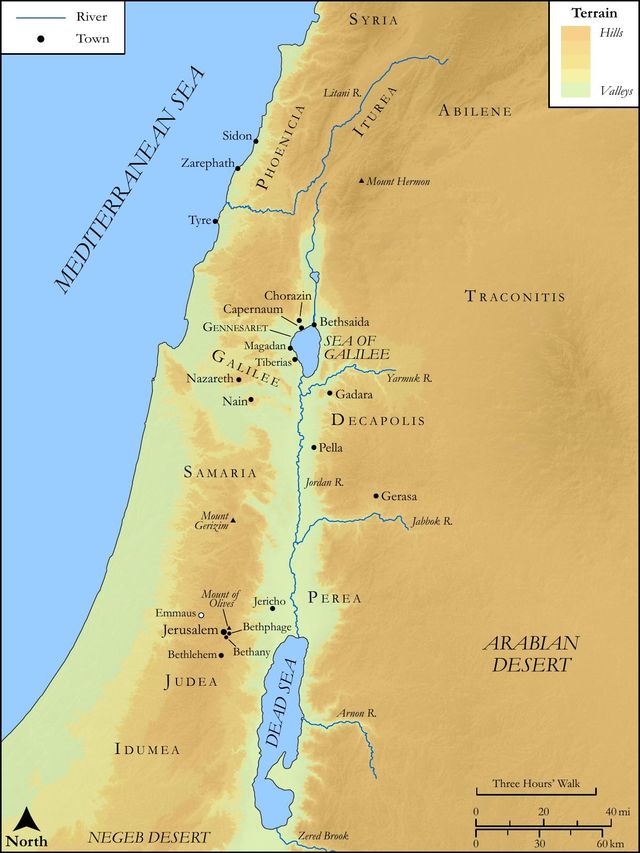
In ancient Galilee and Judea, an agrarian society heavily dependent on seasonal rains, the ability to predict weather patterns was crucial for survival and livelihood. The Mediterranean Sea lay to the west of Israel, and weather systems typically moved eastward from the sea. Therefore, a cloud rising from the west was a reliable indicator of approaching rain, often a "shower" or heavy downpour, essential for crops. This was common knowledge, deeply ingrained in the daily lives of the Jewish people. Jesus' audience, primarily rural and agricultural, would have instantly understood and affirmed the accuracy of this observation. This cultural familiarity with natural signs makes Jesus' subsequent challenge about spiritual blindness all the more poignant, as He uses their own practical wisdom as a benchmark for their spiritual deficiency.
Key Themes
ShowHideThis verse, and the broader passage of Luke 12:54-56, contributes significantly to several key themes within Luke's Gospel and Jesus' teaching. Firstly, it emphasizes Spiritual Discernment, contrasting the crowd's natural acumen with their spiritual dullness. While they can readily interpret physical signs, they fail to grasp the profound spiritual significance of Jesus' presence and ministry. Secondly, it highlights the theme of Understanding the Present Moment or "discerning the signs of the times." Jesus implies that His arrival, teachings, and miracles are clear indicators of a pivotal era in God's redemptive plan, a time of visitation that demands a response. This echoes similar rebukes found in Matthew 16:2-3. Thirdly, it subtly introduces the theme of Judgment for Unbelief, as their failure to discern the times will have dire consequences, implicitly leading to the rejection of the Messiah.
Exposition and Analysis
ShowHideKey Word Analysis
ShowHideFrom the root meaning "to set," this word specifically refers to the sun-set, and by implication, the western region. In the geographical context of Israel, the west is where the Mediterranean Sea lies, the source of most rain-bearing weather systems. Jesus' reference to a cloud rising "out of the west" thus points to a universally understood and reliable meteorological indicator for rain in that region.
Properly meaning "cloudiness," and concretely, "a cloud." This term denotes a visible mass of water droplets or ice crystals suspended in the atmosphere. In this context, it signifies a specific, observable natural phenomenon that serves as a precursor to precipitation, forming the primary visual cue for the crowd's weather prediction.
This word refers to a "thunder storm" or heavy rain/downpour. It indicates a significant amount of precipitation, not just a light drizzle. The expectation of an "ómbros" from a western cloud underscores the certainty and magnitude of the expected weather event, reinforcing the crowd's accurate and confident interpretation of the natural sign.
Verse Breakdown
ShowHide"And he said also to the people"
This opening phrase indicates a shift in Jesus' audience or a broadening of His address. While He had been speaking to His disciples, He now turns His attention specifically to the "people" or "multitude" (G3793, óchlos), setting the stage for a direct challenge to their collective understanding and perception.
"When ye see a cloud rise out of the west"
Jesus begins by acknowledging a common, observable phenomenon familiar to His audience. The "cloud rising out of the west" is a clear and unambiguous natural sign. The verb "see" (G1492, eídō) implies direct observation and perception, suggesting that this is not a hidden or obscure sign but one readily apparent to anyone.
"straightway ye say, There cometh a shower"
This clause highlights the immediate and confident conclusion drawn by the people. The word "straightway" (G2112, euthéōs) emphasizes the swiftness and certainty of their interpretation. They don't hesitate; they know what the sign means – a "shower" (G3655, ómbros), or heavy rain, is imminent.
"and so it is"
This short, emphatic phrase confirms the accuracy of their prediction. Jesus Himself validates their meteorological discernment, acknowledging that their interpretation of this natural sign is consistently correct. This affirmation sets up the stark contrast that follows in the subsequent verse, where He challenges their inability to apply the same discernment to spiritual signs.
Literary Devices
ShowHideJesus employs several potent literary devices in this verse. The primary device is Analogy, where He draws a direct comparison between the people's ability to interpret natural weather signs and their inability to interpret spiritual signs. This analogy is foundational to His argument in the broader passage. There is also a strong element of Contrast at play, as Jesus juxtaposes their keen practical discernment with their spiritual blindness. This contrast highlights the irony of their situation: they are wise in earthly matters but foolish in heavenly ones. Furthermore, one could argue for Irony, as the very people who claim to know God and His ways are shown to be oblivious to the most significant manifestation of His presence among them. The simplicity of the language used for the natural sign underscores the clarity of the spiritual signs they are missing, making their lack of discernment even more striking.
Theological and Thematic Connections
ShowHideLuke 12:54 serves as a powerful indictment of spiritual apathy and a call to discerning the times in which one lives. Theologically, it underscores the human tendency to be adept at earthly affairs while remaining blind to divine realities. Jesus implies that God provides clear "signs" of His work and presence, and a failure to interpret these signs correctly is not merely an intellectual oversight but a spiritual failing with profound consequences. This discernment is not just about predicting future events, but about understanding the significance of God's redemptive activity in the present moment and responding appropriately.
Reflection and Application
ShowHideThis passage challenges us to examine our own lives: where do we excel in discernment, and where do we fall short? We often dedicate considerable time and energy to understanding worldly trends, financial markets, social dynamics, or even trivial matters like sports statistics, yet we may neglect to cultivate spiritual sensitivity. Jesus' rebuke reminds us that true wisdom involves recognizing God's active presence and purpose in our contemporary world. Are we attuned to the "signs" of His work around us – the movements of His Spirit, the needs of our communities, the call to justice, the opportunities for sharing the Gospel? This verse calls us to develop a spiritual "weather eye," to be as diligent in discerning God's will and timing as we are in predicting a rain shower. It urges us to move beyond superficial observation to deep spiritual understanding, allowing God's truth to shape our priorities and actions.
Questions for Reflection
ShowHideFAQ
ShowHideWhy does Jesus use a weather analogy to make this point?
ShowHideJesus uses a weather analogy because it was a universally understood and highly practical aspect of daily life for His audience. In an agrarian society like ancient Israel, predicting rain was crucial for survival and livelihood. Everyone knew that a cloud rising from the west (from the Mediterranean Sea) meant rain was coming. By starting with something so obvious and undeniable, Jesus establishes common ground and affirms their natural intelligence. This then allows Him to highlight the stark contrast: if they are so astute in discerning natural signs that affect their physical well-being, why are they so blind to the spiritual signs that affect their eternal well-being, particularly the profound significance of His own ministry and the dawning of the Kingdom of God? It makes His rebuke in Luke 12:56 even more piercing.
Christ-Centered Fulfillment
ShowHideWhile Luke 12:54 directly addresses the crowd's failure to discern the signs of Jesus' first coming, it finds its ultimate Christ-centered fulfillment in Jesus Himself being the supreme "sign" that humanity failed to recognize. The "signs of the times" that the people were missing were not merely abstract theological concepts, but the very presence and work of the Son of God among them. His miracles, His authoritative teaching, His fulfillment of Old Testament prophecies—all these were undeniable indicators that the Messiah had arrived, yet many remained spiritually blind. This inability to discern the times ultimately led to His rejection and crucifixion, as prophesied in passages like Isaiah 53. However, Jesus' death and resurrection became the ultimate sign, confirming His identity as the Christ and inaugurating a new covenant. For believers today, discerning the signs of the times means recognizing Jesus as Lord, living in light of His completed work on the cross, and eagerly awaiting His promised return, as encouraged in Titus 2:13. He is the one through whom all of God's redemptive purposes are revealed and fulfilled, making Him the central figure of all true discernment.