


Matthew 16:2
Bible text: King James Version (1769 Blayney text) · Public domain
Bible text: Berean Standard Bible · Public domain
Bible text: American Standard Version (1901) · Public domain
Bible text: World English Bible, Messianic edition · Public domain
Bible text: Geneva Bible (1599) · Public domain
Bible text: Young's Literal Translation · Public domain
- ὉHo<the>G3588T-NSMDefinite article Nominative Singular Masculine
- δὲdeAndG1161CONJConjunction
- ἀποκριθεὶςapokritheisansweringG611V-AOP-NSMVerb Aorist Passive Deponent Participle Nominative Singular Masculine
- εἶπενeipenHe saidG2036V-2AAI-3SVerb 2nd Aorist Active Indicative 3rd Singular
- αὐτοῖς·autoisto themG846P-DPMPersonal pronoun Dative Plural Masculine
- ὀψίαςopsiasEveningG3798A-GSFAdjective Genitive Singular Feminine
- γενομένηςgenomenēshaving comeG1096V-2ADP-GSFVerb 2nd Aorist Middle Deponent Participle Genitive Singular Feminine
- λέγετε·legeteyou sayG3004V-PAI-2PVerb Present Active Indicative 2nd Plural
- εὐδίαeudiaFair weatherG2105N-NSFNoun Nominative Singular Feminine
- πυρράζειpurrazeiis redG4449V-PAI-3SVerb Present Active Indicative 3rd Singular
- γὰρgarforG1063CONJConjunction
- ὁhotheG3588T-NSMDefinite article Nominative Singular Masculine
- οὐρανόςouranosskyG3772N-NSMNoun Nominative Singular Masculine
English is a literal word-by-word gloss of the Greek, not the KJV's wording. Why?
This is the original text the KJV's translators worked from — each Greek word with its own literal English meaning in this verse, prepared by scholars at Tyndale House, Cambridge. The KJV translates whole sentences, not word by word, so its wording differs: one Greek word can become several English words, and the KJV may choose “charity” where the gloss reads “love”. Both are faithful — they answer different questions. For the KJV's own rendering, switch to the KJV text.
Details
See on the biblical-era maps
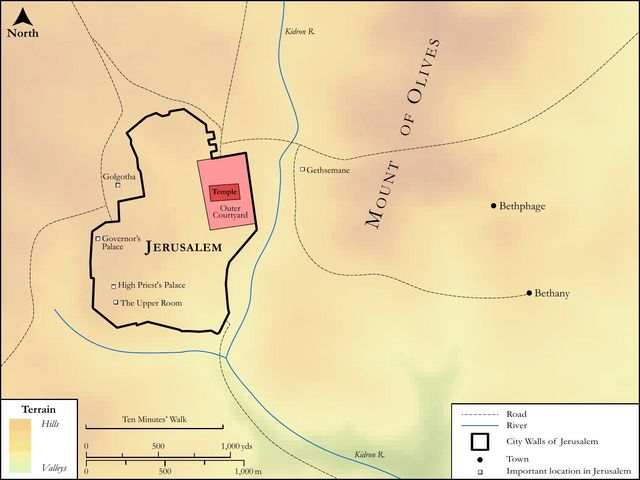
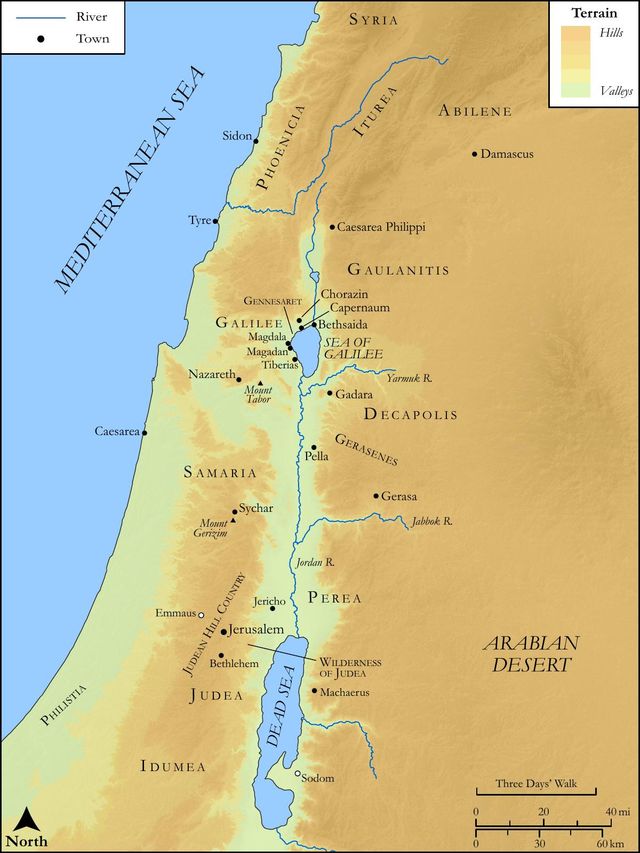
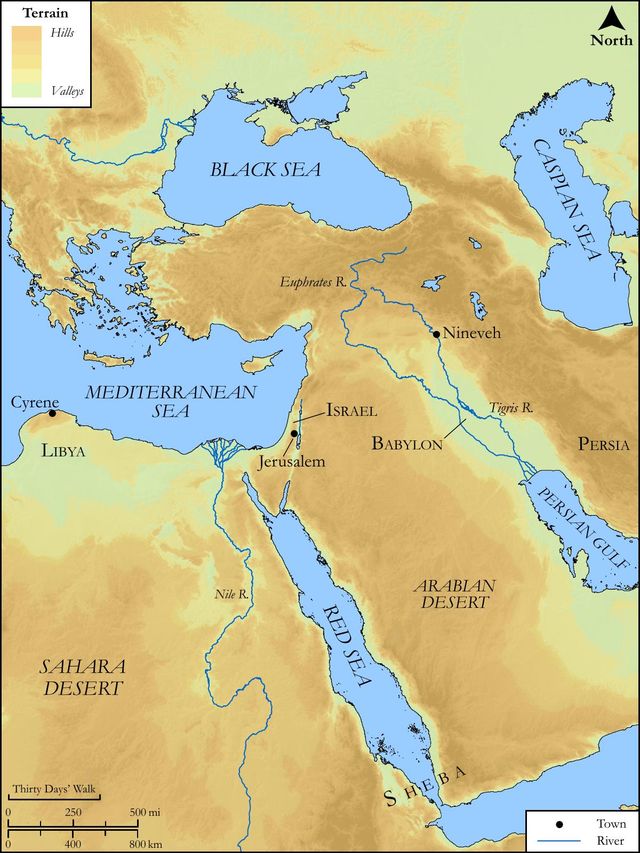
Study this verse
Public-domain commentary
Matthew Henry
From his Commentary on the Whole Bible. Henry comments on passages, not single verses — this entry covers Matthew 16:1–4. His four-level outline is real structure in the source text, so it is rendered as structure.
We have here Christ's discourse with the Pharisees and Sadducees, men at variance among themselves, as appears Act 23:7, Act 23:8, and yet unanimous in their opposition to Christ; because his doctrine did equally overthrow the errors and heresies of the Sadducees, who denied the existence of spirits and a future state; and the pride, tyranny, and hypocrisy of the Pharisees, who were the great imposters of the traditions of the elders. Christ and Christianity meet with opposition on all hands. Observe,
I.Their demand, and the design of it.
1.The demand was of a sign from heaven; this they desired him to show them; pretending they were very willing to be satisfied and convinced, when really they were far from being so, but sought excuses from an obstinate infidelity. That which they pretended to desire was,
(1.)Some other sign than what they had yet had. They had great plenty of signs; every miracle Christ wrought was a sign, for no man could do what he did unless God were with him. But this will not serve, they must have a sign of their own choosing; they despised those signs which relieved the necessity of the sick and sorrowful, and insisted upon some sign which gratify the curiosity of the proud. It is fit that the proofs of divine revelation should be chosen by the wisdom of God, not by the follies and fancies of men. The evidence that is given is sufficient to satisfy an unprejudiced understanding, but was not intended to please a vain humour. Ant it is an instance of the deceitfulness of the heart, to think that we should be wrought upon by the means and advantages which we have not, while we slight those which we have. If we hear not Moses and the prophets, neither would we be wrought upon though one rose from the dead.
(2.)It must be a sign from heaven. They would have such miracles to prove his commission, as were wrought at the giving of the law upon mount Sinai: thunder, and lightening, and the voice of words, were the sign from heaven they required. Whereas the sensible signs and terrible ones were not agreeable to the spiritual and comfortable dispensation of the gospel. Now the word comes more nigh us (Rom 10:8), and therefore the miracles do so, and do not oblige us to keep such a distance as these did, Heb 12:18.
2.The design was to tempt him; not to be taught by him, but to ensnare him. If he should show them a sign from heaven, they would attribute it to a confederacy with the prince of the power of the air; if he should not, as they supposed he would not, they would have that to say for themselves, why they did not believe on him. They now tempted Christ as Israel did, Co1 10:9. And observe their perverseness; then, when they had signs from heaven, they tempted Christ, saying, Can he furnish a table in the wilderness? Now that he had furnished a table in the wilderness, they tempted him, saying, Can he give us a sign from heaven?
II.Christ's reply to this demand; lest they should be wise in their own conceit, he answered these fools according to their folly, Pro 26:5. In his answer,
1.He condemns their overlooking of the signs they had, Mat 16:2, Mat 16:3. They were seeking for the signs of the kingdom of God, when it was already among them. The Lord was in this place, and they knew it not. Thus their unbelieving ancestors, when miracles were their daily bread, asked, Is the Lord among us, or is he not?
To expose this, he observes to them,
(1.)Their skilfulness and sagacity in other things, particularly in natural prognostications of the weather; "You know that a red sky over-night is a presage of fair weather, and a red sky in the morning of foul weather." There are common rules drawn from observation and experience, by which it is easy to foretel very probably what weather it will be. When second causes have begun to work, we may easily guess at their issue, so uniform is nature in its motions, and so consistent with itself. We know not the balancing of the clouds (Job 37:16), but we may spell something from the faces of them. This gives no countenance at all to the wild and ridiculous predictions of the astrologers, the star-gazers, and the monthly prognosticators (Isa 47:13) concerning the weather long before, with which weak and foolish people are imposed upon; we are sure, in general, that seed-time and harvest, cold and heat, summer and winter, shall not cease. But as to the particulars, till, by the weather-glasses, or otherwise, we perceive the immediate signs and harbingers of the change of weather, it is not for us to know, no, not that concerning the times and seasons. Let it suffice, that it shall be what weather pleases God; and that which pleases God, should not displease us.
(2.)Their sottishness and stupidity in the concerns of their souls; Can ye not discern the signs of the times?
[1.]"Do you not see that the Messiah is come?" The sceptre was departed from Judah, Daniel's weeks were just expiring, and yet they regarded not. The miracles Christ wrought, and the gathering of the people to him, were plain indications that the kingdom of heaven was at hand, that this was the day of their visitation. Note, First, There are signs of the times, by which wise and upright men are enabled to make moral prognostications, and so far to understand the motions and methods of Providence, as from thence to take their measures, and to know what Israel ought to do, as the men of Issachar, as the physician from some certain symptoms finds a crisis formed. Secondly, There are many who are skilful enough in other things, and yet cannot or will not discern the day of their opportunities, are not aware of the wind when it is fair for them, and so let slip the gale. See Jer 8:7; Isa 1:3. Thirdly, It is great hypocrisy, when we slight the signs of God's ordaining, to seek for signs of our own prescribing.
[2.]"Do not you foresee your own ruin coming for rejecting him? You will not entertain the gospel of peace, and can you not evidently discern that hereby you pull an inevitable destruction upon your own heads?" Note, It is the undoing of multitudes, that they are not aware what will be the end of their refusing Christ.
2.He refuses to give them any other sign (Mat 16:4), as he had done before in the same words, Mat 12:39. Those that persist in the same iniquities, must expect to meet with the same reproofs. Here, as there,
(1.)He calls them an adulterous generation; because, while they professed themselves of the true church and spouse of God, they treacherously departed from him, and brake their covenants with him. The Pharisees were a generation pure in their own eyes, having the way of the adulterous woman, that thinks she has done no wickedness, Pro 30:20.
(2.)He refuses to gratify their desire. Christ will not be prescribed to; we ask, and have not, because we ask amiss.
(3.)He refers them to the sign of the prophet Jonas, which should yet be given them; his resurrection from the dead, and his preaching by his apostles to the Gentiles; these were reserved for the last and highest evidences of his divine mission. Note, Though the fancies of proud men shall not be humoured, yet the faith of the humble shall be supported, and the unbelief of them that perish left for ever inexcusable, and every mouth shall be stopped.
This discourse broke off abruptly; he left them and departed. Christ will not tarry long with those that tempt him, but justly withdraws from those that are disposed to quarrel with him. He left them as irreclaimable; Let them alone. He left them to themselves, left them in the hand of their own counsels; so he gave them up to their own hearts' lust.
Historical interpretation
Nine Centuries of Reception
11 surviving comments on this verse. Each one is dated, so this reads as a timeline rather than a list.
Select a marker to jump to its quote. Markers stagger vertically where authors wrote within a few decades of each other.
Observe, we do not read here as in other places, that He sent the multitudes away and departed; but because the error of unbelief held the minds of the presumptuous, it is said that He left them.
As the Lord sent the multitudes away after the miracle of the five loaves, so also now, not on foot, but by boat, that the multitudes may not follow Him; And he sent away the multitude, and entered into a ship, and came into the coasts of Magedan.
As then in the sky there is one sign of fair weather, and another of rain, so ought ye to think concerning me; now, in this My first coming, there is need of these signs which are done in the earth; but those which are done in heaven are reserved for the time of the second coming. Now I come as a physician, then as a judge; now I come in secret, then with much pomp, when the powers of the heavens shall be shaken. But now is not the time of these signs, now have I come to die, and to suffer humiliations; as it follows, An evil and adulterous generation seeketh after a sign, and there shall no sign be given it, but the sign of Jonas the prophet.
And when the Pharisees heard this, they ought to have asked Him, What it was He meant? But they had not asked at first with any desire of learning, and therefore the Lord leaves them, as it follows, And he left them, and went his way.
"And the Pharisees and Sadducees came and desired Him to show them a sign from Heaven. But He saith, When it is evening, ye say, Fair weather, for the sky is red; and in the morning, Foul weather today, for the sky is red and lowering. Ye can discern the face of the sky, but can ye not the signs of the times? A wicked and adulterous generation seeketh after a sign, and there shall no sign be given unto it, but the sign of the prophet Jonas. And He left them, and departed."
But Mark saith, that when they were come unto Him, and were questioning with Him, "He sighed deeply in His spirit, and saith, Why doth this generation seek after a sign?"
And yet surely their inquiry was deserving of anger and great displeasure; yet nevertheless the benevolent and provident One is not angry, but pities and bewails them as incurably diseased, and after so full a demonstration of His power, tempting Him.
For not in order to believe did they seek, but to lay hold of Him. Since had they come unto Him as ready to believe, He would have given it. For He who said to the woman, "It is not meet," and afterwards gave, much more would He have shown His bounty to these.
But since they did not seek to believe, therefore He also calls them hypocrites, because in another place they said one thing, and meant another. Yea, had they believed, they would not even have asked. And from another thing too it is evident that they believed not; that when reproved and exposed, they abode not with Him, nor said, "We are ignorant and seek to learn."
But for what sign from Heaven were they asking? Either that He should stay the sun, or curb the moon, or bring down thunderbolts, or work a change in the air, or some other such thing.
What then saith He to all this? "Ye can discern the face of the sky, but can ye not discern the signs of the times?" See His meekness and moderation. For not even as before did He refuse merely, and say, "There shall none be given them," but He states also the cause why He gives it not, even though they were not asking for information.
What then was the cause? "Much as in the sky," saith He, "one thing is a sign of a storm, another of fair weather, and no one when he saw the sign of foul weather would seek for a calm, neither in calm and fair weather for a storm; so should you reckon with regard to me also. For this present time of my coming, is different from that which is to come. Now there is need of these signs which are on the earth, but those in Heaven are stored up against that time. Now as a physician am I come, then I shall be here as a judge; now to seek that which is gone astray, then to demand an account. Therefore in a hidden manner am I come, but then with much publicity, folding up the heaven, hiding the sun, not suffering the moon to give her light. Then 'the very powers of the heavens shall be shaken, and the manifestation of my coming shall imitate lightning that appears at once to all. But not now is the time for these signs; for I am come to die, and to suffer all extremities."
Heard ye not the prophet, saying, "He shall not strive nor cry, neither shall His voice be heard without?" and another again, "He shall come down as rain upon a fleece of wool?"
And if men speak of the signs in Pharaoh's time, there was an enemy then from whom deliverance was needed, and it all took place in due course. But to Him that came among friends there was no need of those signs.
"And besides, how shall I give the great signs, when the little are not believed?" Little, I mean, as regards display, since in power these latter were much greater than the former. For what could be equal to remitting sins, and raising the dead, and driving away devils, and creating a body, and ordering all other things aright?
But do thou see their hardened heart, how on being told, that "no sign should be given them but the sign of the prophet Jonas," they do not ask. And yet, knowing both the prophet, and all that befell him, and having been told this a second time, they ought to have inquired and learnt what the saying could mean; but, as I said, there is no desire of information in these their doings. For this cause "He also left them, and departed."
This is not found in many codices. The meaning is clear from the order and harmony of the elements. Both fair and rainy days can be forecast. But the scribes and Pharisees, who were viewed as doctors of the law, could not discern the coming of the Savior from what the prophets had predicted.
(Chapter XVI—Verse 1 and following) And the Pharisees and Sadducees came to him and tested him, asking him to show them a sign from heaven. But he answered and said to them: When it is evening, you say, 'It will be fair weather, for the sky is red'; and in the morning, 'It will be stormy today, for the sky is red and threatening.' You know how to discern the appearance of the sky, but you cannot discern the signs of the times. An evil and adulterous generation seeks for a sign, but no sign will be given to it except the sign of Jonah the prophet. This is not found in most codices: it is clear that from the arrangement and stability of the elements, both fair and rainy days can be predicted. However, the scribes and Pharisees, who seemed to be experts in the law, could not understand the advent of the Savior from the prophecy of the prophets.
This is not found in most copies of the Greek text. But the sense is clear, that fair and rainy days may be foretold by the condition and harmony of the elements. But the Scribes and Pharisees who seemed to be doctors of the Law could not discern the Saviour's coming by the predictions of the Prophets.
But what is meant by the sign of Jonas has been explained above.
That is, leaving the evil generation of the Jews, He passed over the strait, and the people of the Gentiles followed Him.
He exposes the rashness of their question, saying, “You regard the air as moving according to a certain order, so that by means of signs you are able to predict when the weather will be fair and when stormy. But in the case of miracles you recognize no order at all. You do not recognize any occasions on which doing or not doing wonders is appropriate. You assume that such a thing happens completely without order and without any reason.”
(de Cons. Ev. ii. 51.) Mark says Dal-manutha, no doubt the same place under a different name, for many copies of the Gospel according to Mark have Magedan.
(Quæst. Ev. i. 20.) We might also understand this saying, When it is evening, ye say, It mill be fair weather, for the sky is red, in this way, By the blood of Christ's passion at His first coming, indulgence of sin is given. And in the morning, It will be foul weather to-day, for the sky is red and lowring; that is, at His second coming He will come with fire before Him.
(ubi sup.) This Matthew has already given; whence we may store up for our information, that the Lord spoke the same things many times, that where there are contradictions which cannot be explained, it may be understood that the same sayings were uttered on two different occasions.
Wondrous blindness of the Pharisees and Sadducees! They asked a sign from heaven, as though the things they now saw were not signs. John shows what sign it was they desired; for he relates, that after the feeding with the five loaves, the multitudes came to the Lord and said, What sign doest thou, that we may see it and believe on thee? Our fathers did eat manna in the desert, as it is written, He gave them bread to eat from heaven. (John 6:30.) Therefore when they say here, show us a sign from heaven, they mean, Cause that it rain manna for one or two days, that the whole people may eat, as was done for a long time in the desert. He looking into their thoughts as God, and knowing that even if a sign from heaven should be showed them they would not believe, would not give them the sign for which they asked, as it follows, But he answered and said unto them, When the evening is come, ye say, It will be fair weather; for the sky is red, &c.
This Magedan is the country opposite Gerasa, and is interpreted 'fruits,' or 'a messenger.' It signifies a garden, of which it is said, A garden enclosed, a fountain sealed, (Song of Sol. 4:12.) wherein the fruits of virtues grow, and where the name of the Lord is announced. It teaches us that preachers having ministered the word to the multitude ought to be refreshed themselves with the fruits of the virtues within the chamber of their own heart. It follows; And there come unto him Pharisees and Sadducees tempting him, and desired him to show them a sign from heaven.
The signs of the times He means of His own coming, or passion, to which the evening redness of the heavens may be likened; and the tribulation which shall be before His coming, to which the morning redness with the lowring sky may be compared.
To this generation that thus tempted the Lord is not given a sign from heaven, such as they sought for, though many signs are given on the earth; but only to the generation of such as sought the Lord, in whose sight He ascended into heaven, and sent the Holy Spirit.
Otherwise; The sky is red and lowring; that is, the Apostles suffer after the resurrection, by which ye may know that I shall judge hereafter; for if I spare not the good who are mine from present suffering, I shall not spare others hereafter; Ye can therefore discern the face of the sky, but the signs of the times ye cannot.
(interlin.) He says, Evil and adulterous generation, that is, unbelieving, having carnal, and not spiritual understanding.
Continue studying Matthew 16:2 across the web’s major study libraries — every link below opens this exact verse, chapter, or book on the destination site.
Read & Compare
 BibleGatewayThis verse in more than 200 translations and 70 languages.
 Bible.comThe YouVersion reader — hundreds of translations, reading plans, and highlights.
 ESV.orgCrossway's official English Standard Version reader.
 NET BibleThe NET translation with 60,000+ translators' notes on every rendering decision.
 STEP BibleTyndale House's free study tool — original text, vocabulary, and scholarly resources.
 BibliaLogos Bible Software's free web reader.
 USCCBThe New American Bible (Revised Edition) with the U.S. bishops' study notes.
Commentaries
 BibleHub CommentariesDozens of classic commentaries on this verse, gathered on one page.
 StudyLightMore than 100 commentary sets — the largest collection on the web.
 BibleRefPlain-English commentary on what this verse means, verse by verse.
 Enduring WordDavid Guzik's free commentary on this chapter, widely used by Bible teachers.
 Bible Study ToolsVerse commentary alongside Greek and Hebrew study aids.
Original Language & Research
- BibleHub InterlinearThe verse word by word — original language, transliteration, and English.
- BibleHub LexiconEvery word's original-language definition and Strong's entry.
 Blue Letter BibleDeep-study tools — Strong's numbers, concordance, and word studies.
 CNTR CollationThe earliest Greek manuscripts of this verse, collated letter by letter.
Sermons, Hymns & Audio


TrulyRandomVerse is not affiliated with these sites and doesn’t control their content. They’re linked because they’re genuinely useful.
Summary
In Matthew 16:2, Jesus confronts the Pharisees and Sadducees who demand a miraculous sign from heaven. He challenges their spiritual inconsistency by pointing out their ability to interpret natural weather signs—predicting fair weather from a red evening sky—while simultaneously failing to discern the profound spiritual "signs of the times" evident in His own ministry and person. This exchange highlights their spiritual blindness and hypocrisy, underscoring the readily available evidence of God's kingdom already present among them.
Context
ShowHideLiterary Context
This verse immediately follows a direct confrontation where the Pharisees and Sadducees approach Jesus, "tempting him, desiring that he would shew them a sign from heaven" (Matthew 16:1). Jesus's response in verse 2, and the subsequent verses, is a sharp rebuke of their spiritual dullness. Rather than providing the spectacle they sought, He uses a common, everyday observation to expose their hypocrisy and inability to recognize the clear, ongoing manifestations of God's kingdom through His miracles, teachings, and very presence. This passage serves as a pivotal moment, highlighting the escalating tension between Jesus and the religious establishment, who consistently missed the spiritual reality unfolding before their eyes.
Historical & Cultural Context
The ability to predict weather patterns was crucial in ancient agrarian societies, where livelihoods depended on understanding natural phenomena. The proverb "When it is evening, ye say, It will be fair weather: for the sky is red" was a widely recognized and practical piece of folk wisdom, akin to the modern "Red sky at night, sailor's delight." This observation was based on the scattering of light by dust particles in the atmosphere; a red sunset often indicated clear air to the west (where the sun sets), suggesting good weather approaching from that direction. The Pharisees and Sadducees, as leaders in a society deeply connected to the land, would have been intimately familiar with such signs. Jesus leverages this common knowledge to draw a parallel to their spiritual discernment, or lack thereof, regarding the far more significant "signs of the times" related to the arrival of the Messiah and the kingdom of God.
Key Themes
ShowHideThis verse powerfully contributes to several overarching themes in Matthew's Gospel. Firstly, it underscores the theme of Spiritual Blindness vs. Natural Discernment. Jesus exposes the irony that those who claimed spiritual authority were adept at interpreting mundane natural signs but utterly incapable of discerning the profound spiritual realities of His ministry, which was replete with signs of the Messiah's advent (e.g., Matthew 11:4-5). Secondly, it highlights the Availability of Signs. The religious leaders' demand for a sign was not due to a lack of evidence, but a willful refusal to acknowledge the overwhelming proof already present in Jesus's words and deeds. His miracles, teachings, and the very fulfillment of Old Testament prophecies were the ultimate signs of God's kingdom breaking into the world (as seen throughout Matthew's Gospel). Finally, the passage exposes the Hypocrisy of the religious leaders, who sought external validation while their hearts remained hardened to the truth, preferring to test Jesus rather than humbly receive His message. This spiritual dullness is a recurring motif in Jesus's interactions with them, as further elaborated in Matthew 23.
Exposition and Analysis
ShowHideKey Word Analysis
ShowHideThis word signifies "to respond" or "to begin to speak where an address is expected." In this context, it implies Jesus's deliberate and authoritative reply to the challenge posed by the Pharisees and Sadducees. It's not a casual comment but a pointed counter-argument to their demand for a sign.
This noun literally means "a clear sky" or "fine weather." It encapsulates the common understanding of a favorable atmospheric condition, which the people could reliably predict based on the observation of the sky's color. Jesus uses this precise term to refer to the natural phenomenon they easily understood.
This verb means "to redden" or "to be red" (intransitively). It describes the specific visual cue—the reddish hue of the sky at sunset—that served as the basis for their weather prediction. The vividness of the color is key to the proverb's effectiveness and Jesus's analogy.
Verse Breakdown
ShowHide"He answered and said unto them"
This phrase establishes Jesus's direct engagement with the Pharisees and Sadducees, indicating that His subsequent words are a deliberate and pointed response to their demand for a sign. It sets the stage for a teaching moment that exposes their spiritual shortcomings.
"When it is evening, ye say, [It will be] fair weather:"
Jesus references a common, practical observation. People in His day, and even today, could look at the sky in the evening and make a reliable prediction about the next day's weather. This highlights their natural, worldly discernment, which is keen and accurate in practical matters.
"for the sky is red."
This clause provides the specific reason for their prediction. The red hue of the evening sky was the universally understood sign indicating clear weather for the following day. It underscores the simplicity and accessibility of this natural sign, contrasting it with the spiritual signs they failed to perceive.
Literary Devices
ShowHideJesus employs several literary devices in this verse. The primary device is Analogy, where He draws a direct comparison between the ability to discern natural weather patterns and the inability to discern spiritual "signs of the times." He uses a common, well-understood proverb ("red sky at night") to highlight their spiritual blindness. This creates a powerful Irony: those who are supposed to be spiritual guides are shown to be adept at predicting the weather but utterly inept at recognizing the presence of God's kingdom. The use of a Proverbial Wisdom (the weather saying) makes His point relatable and undeniable to His audience, setting up the subsequent rebuke in Matthew 16:3. The structure of His statement also functions as a Rhetorical Question (implied in the broader context of Matthew 16:3), challenging their inconsistency.
Theological and Thematic Connections
ShowHideThis passage profoundly addresses the human capacity for discernment, distinguishing between practical, worldly insight and spiritual understanding. Jesus highlights a critical theological truth: God provides ample evidence of His presence and activity, but human spiritual blindness, often rooted in unbelief or a hardened heart, prevents recognition. The religious leaders' demand for a sign was not a genuine search for truth but a test, revealing their unwillingness to accept Jesus on His own terms despite the overwhelming "signs" already manifest in His ministry. Their spiritual dullness serves as a cautionary tale against intellectual pride and the danger of missing God's ongoing revelation because one is looking for something other than what He has already provided.
Reflection and Application
ShowHideMatthew 16:2 serves as a timeless mirror for believers, prompting us to examine the depth and authenticity of our own spiritual discernment. Are we, like the Pharisees and Sadducees, quick to understand the patterns and demands of the secular world, yet slow to perceive the subtle, yet profound, workings of God in our lives and in the broader sweep of history? This verse challenges us to cultivate a spiritual sensitivity that goes beyond superficial observation, enabling us to recognize God's voice, His will, and the "signs of the times" as He continues to unfold His redemptive plan. It warns against spiritual apathy and the dangerous complacency that can lead us to dismiss or demand new, spectacular evidences of God, rather than humbly engaging with the revelation He has already provided in His Word, through His Spirit, and in the person of Jesus Christ. Our prayer should be for eyes to see and ears to hear, so that we might not miss the divine activity amidst the mundane.
Questions for Reflection
ShowHideFAQ
ShowHideWhy did Jesus refuse to give the Pharisees and Sadducees the "sign from heaven" they demanded?
ShowHideJesus refused to give them a specific "sign from heaven" because their request was not born out of genuine faith or a sincere desire for truth, but rather out of a desire to test Him and trap Him. As Matthew 16:1 states, they were "tempting him." Jesus had already performed countless miracles and taught with unparalleled authority, which were more than sufficient "signs" for anyone with an open heart. He knew that no external sign, however spectacular, would convince those whose hearts were hardened by unbelief and pride. Instead of a sign from heaven, He later referred to the "sign of the prophet Jonah" (Matthew 16:4), which pointed to His death, burial, and resurrection as the ultimate and most profound sign of His divine authority and the truth of His message. This sign, unlike a mere spectacle, required faith and repentance.
Christ-Centered Fulfillment
ShowHideWhile Matthew 16:2 directly addresses the spiritual blindness of Jesus's contemporaries, it implicitly points to Christ as the ultimate and sufficient "sign" of God's presence and kingdom. The Pharisees and Sadducees were looking for a spectacular, external display, yet the very Son of God stood before them, embodying the fullness of divine revelation. Jesus's life, teachings, miracles, and ultimately His death and resurrection, were the most profound "signs of the times" that God would ever give. He is the "light of the world" (John 8:12), the fulfillment of all prophecy, and the visible image of the invisible God (Colossians 1:15). For those with spiritual eyes to see, as granted by the Holy Spirit (1 Corinthians 2:14), Christ Himself is the undeniable evidence of God's redemptive work. He is the "way, the truth, and the life" (John 14:6), making any further external sign redundant for those who truly seek God. His coming marked the dawn of the new covenant, a spiritual reality far more significant than any atmospheric phenomenon.