


Luke 12:53
Bible text: King James Version (1769 Blayney text) · Public domain
Bible text: King James Version with Strong's numbers · Public domain
Bible text: Berean Standard Bible · Public domain
Bible text: American Standard Version (1901) · Public domain
Bible text: World English Bible, Messianic edition · Public domain
Bible text: Geneva Bible (1599) · Public domain
Bible text: Young's Literal Translation · Public domain
- διαμερισθήσονταιdiameristhēsontaiThey will be dividedG1266V-FPI-3PVerb Future Passive Indicative 3rd Plural
- πατὴρpatērfatherG3962N-NSMNoun Nominative Singular Masculine
- ἐπὶepiagainstG1909PREPPreposition
- υἱῷhuiōsonG5207N-DSMNoun Dative Singular Masculine
- καὶkaiandG2532CONJConjunction
- υἱὸςhuiossonG5207N-NSMNoun Nominative Singular Masculine
- ἐπὶepiagainstG1909PREPPreposition
- πατρίpatrifatherG3962N-DSMNoun Dative Singular Masculine
- μήτηρmētērmotherG3384N-NSFNoun Nominative Singular Feminine
- ἐπὶepiagainstG1909PREPPreposition
- θυγατέραthugateradaughterG2364N-ASFNoun Accusative Singular Feminine
- καὶkaiandG2532CONJConjunction
- θυγάτηρthugatērdaughterG2364N-NSFNoun Nominative Singular Feminine
- ἐπὶepiagainstG1909PREPPreposition
- μητέραmēteramotherG3384N-ASFNoun Accusative Singular Feminine
- πενθερὰpentheramother-in-lawG3994N-NSFNoun Nominative Singular Feminine
- ἐπὶepiagainstG1909PREPPreposition
- τὴνtēntheG3588T-ASFDefinite article Accusative Singular Feminine
- νύμφηνnumphēndaughter-in-lawG3565N-ASFNoun Accusative Singular Feminine
- αὐτῆςautēsof herG846P-GSFPersonal pronoun Genitive Singular Feminine
- καὶkaiandG2532CONJConjunction
- νύμφηnumphēdaughter-in-lawG3565N-NSFNoun Nominative Singular Feminine
- ἐπὶepiagainstG1909PREPPreposition
- τὴνtēn<the>G3588T-ASFDefinite article Accusative Singular Feminine
- πενθεράνpentheranmother-in-lawG3994N-ASFNoun Accusative Singular Feminine
- αὐτῆςautēsof herG846P-GSFPersonal pronoun Genitive Singular Feminine
English is a literal word-by-word gloss of the Greek, not the KJV's wording. Why?
This is the original text the KJV's translators worked from — each Greek word with its own literal English meaning in this verse, prepared by scholars at Tyndale House, Cambridge. The KJV translates whole sentences, not word by word, so its wording differs: one Greek word can become several English words, and the KJV may choose “charity” where the gloss reads “love”. Both are faithful — they answer different questions. For the KJV's own rendering, switch to the KJV text.
Details
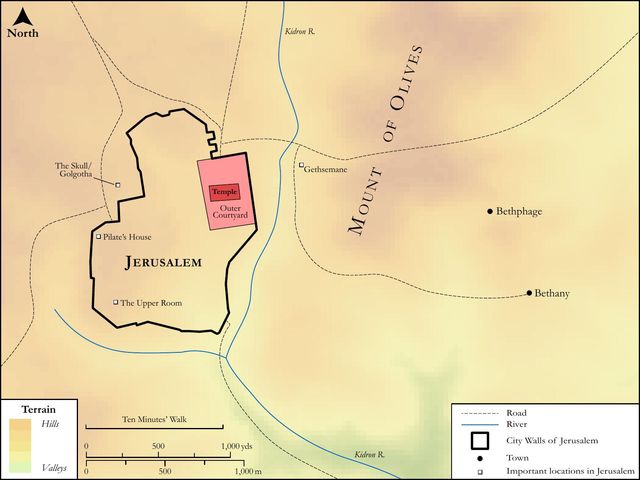
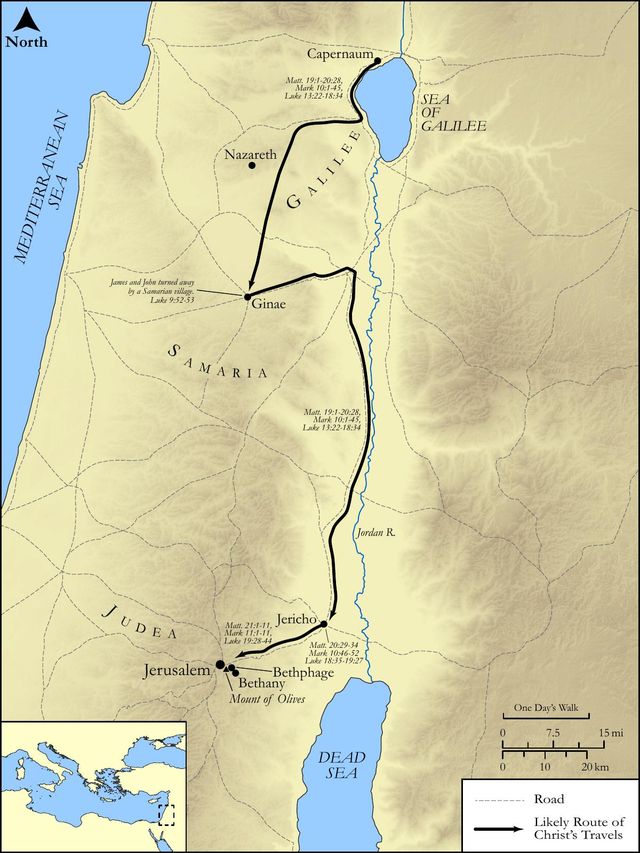
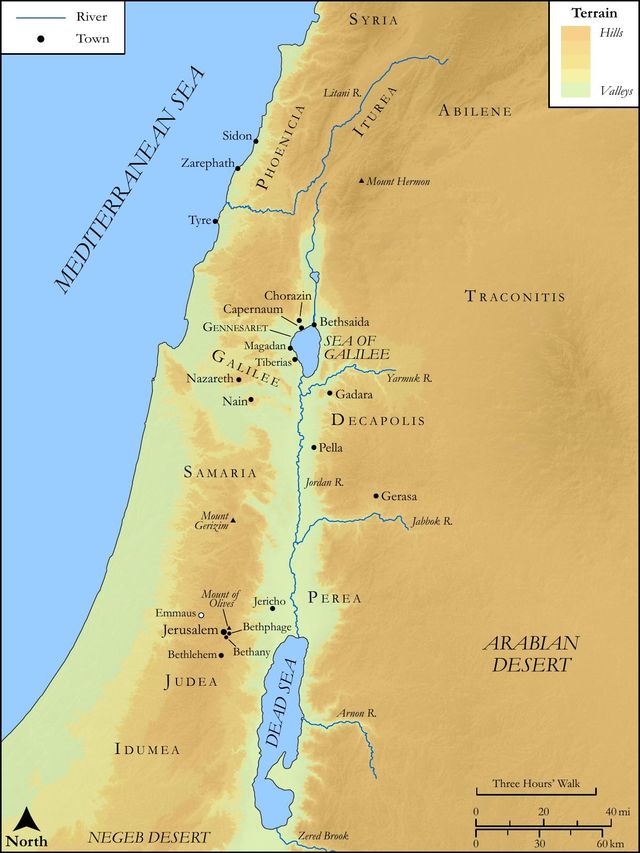
See on the biblical-era maps
Study this verse
Public-domain commentary
Matthew Henry
From his Commentary on the Whole Bible. Henry comments on passages, not single verses — this entry covers Luke 12:41–53. His three-level outline is real structure in the source text, so it is rendered as structure.
Here is, I. Peter's question, which he put to Christ upon occasion of the foregoing parable (Luk 12:41): "Lord, speakest thou this parable to us that are thy constant followers, to us that are ministers, or also to all that come to be taught by thee, to all the hearers, and in them to all Christians?" Peter was now, as often, spokesman for the disciples. We have reason to bless God that there are some such forward men, that have a gift of utterance; let those that are such take heed of being proud. Now Peter desires Christ to explain himself, and to direct the arrow of the foregoing parable to the mark he intended. He calls it a parable, because it was not only figurative, but weighty, solid, and instructive. Lord, said Peter, was it intended for us, or for all? To this Christ gives a direct answer (Mar 13:37): What I say unto you, I say unto all. Yet here he seems to show that the apostles were primarily concerned in it. Note, We are all concerned to take to ourselves what Christ in his word designs for us, and to enquire accordingly concerning it: Speakest thou this to us? To me? Speak, Lord, for thy servant hears. Doth this word belong to me? Speak it to my heart.
II.Christ's reply to this question, directed to Peter and the rest of the disciples.
If what Christ had said before did not so peculiarly concern them, but in common with other Christians, who must all watch and pray for Christ's coming, as his servants, yet this that follows is peculiarly adapted to ministers, who are the stewards in Christ's house. Now our Lord Jesus here tells them,
1.What was their duty as stewards, and what the trust committed to them.
(1.)They are made rulers of God's household, under Christ, whose own the house is; ministers derive an authority from Christ to preach the gospel, and to administer the ordinances of Christ, and apply the seals of the covenant of grace.
(2.)Their business is to give God's children and servants their portion of meat, that which is proper for them and allotted to them; convictions and comfort to those to whom they respectively belong. Suum cuique - to every one his own. This is rightly to divide the word of truth, Ti2 2:15.
(3.)To give it to them in due season, at that time and in that way which are most suitable to the temper and condition of those that are to be fed; a word in season to him that is weary.
(4.)Herein they must approve themselves faithful and wise; faithful to their Master, by whom this great trust is reposed in them, and faithful to their fellow-servants, for whose benefit they are put in trust; and wise to improve an opportunity of doing honour to their Master, and service in the family. Ministers must be both skilful and faithful.
2.What would be their happiness if they approved themselves faithful and wise (Luk 12:43): Blessed is that servant,
(1.)That is doing, and is not idle, nor indulgent of his ease; even the rulers of the household must be doing, and make themselves servants of all.
(2.)That is so doing, doing as he should be, giving them their portion of meat, by public preaching and personal application.
(3.)That is found so doing when his Lord comes; that perseveres to the end, notwithstanding the difficulties he may meet with in the way. Now his happiness is illustrated by the preferment of a steward that has approved himself within a lower and narrower degree of service; he shall be preferred to a larger and higher (Luk 12:44): He will make him ruler over all that he has, which was Joseph's preferment in Pharaoh's court. Note, Ministers that obtain mercy of the Lord to be faithful shall obtain further mercy to be abundantly rewarded for their faithfulness in the day of the Lord.
3.What a dreadful reckoning there would be if they were treacherous and unfaithful, Luk 12:45, Luk 12:46. If that servant begin to be quarrelsome and profane, he shall be called to an account, and severely punished. We had all this before in Matthew, and therefore shall here only observe,
(1.)Our looking upon Christ's second coming as a thing at a distance is the cause of all those irregularities which render the thought of it terrible to us: He saith in his heart, My Lord delays his coming. Christ's patience is very often misinterpreted his delay, to the discouragement of his people, and the encouragement of his enemies.
(2.)The persecutors of God's people are commonly abandoned to security and sensuality; they beat their fellow-servants, and then eat and drink with the drunken, altogether unconcerned either at their own sin or their brethren's sufferings, as the king and Haman, who sat down to drink when the city Shushan was perplexed. Thus they drink, to drown the clamours of their own consciences, and baffle them, which would otherwise fly in their faces.
(3.)Death and judgment will be very terrible to all wicked people, but especially to wicked ministers. It will be a surprise to them: At an hour when they are not aware. It will be the determining of them to endless misery; they shall be cut in sunder, and have their portion assigned them with the unbelievers.
4.What an aggravation it would be of their sin and punishment that they knew their duty, and did not do it (Luk 12:47, Luk 12:48): That servant that knew his lord's will, and did it not, shall be beaten with many stripes, shall fall under a sorer punishment; and he that knew not shall be beaten with few stripes, his punishment shall, in consideration of this, be mitigated. Here seems to be an allusion to the law, which made a distinction between sins committed through ignorance, and presumptuous sins (Lev 5:15, etc.; Num 15:29, Num 15:30), as also to another law concerning the number of stripes given to a malefactor, to be according to the nature of the crime, Deu 25:2, Deu 25:3. Now,
(1.)Ignorance of our duty is an extenuation of sin. He that knew not his lord's will, through carelessness and neglect, and his not having such opportunities as some others had of coming to the knowledge of it, and did things worthy of stripes, he shall be beaten, because he might have known his duty better, but with few stripes; his ignorance excuses in part, but not wholly. Thus through ignorance the Jews put Christ to death (Act 3:17; Co1 2:8), and Christ pleaded that ignorance in their excuse: They know not what they do.
(2.)The knowledge of our duty is an aggravation of our sin: That servant that knew his lord's will, and yet did his own will, shall be beaten with many stripes. God will justly inflict more upon him for abusing the means of knowledge he afforded him, which others would have made a better use of, because it argues a great degree of wilfulness and contempt to sin against knowledge; of how much sorer punishment then shall they be thought worthy, besides the many stripes that their own consciences will give them! Son, remember. Here is a good reason for this added: To whomsoever much is given, of him shall be much required, especially when it is committed as a trust he is to account for. Those have greater capacities of mind than others, more knowledge and learning, more acquaintance and converse with the scriptures, to them much is given, and their account will be accordingly.
III.A further discourse concerning his own sufferings, which he expected, and concerning the sufferings of his followers, which he would have them also to live in expectation of. In general (Luk 12:49): I am come to send fire on the earth. By this some understand the preaching of the gospel, and the pouring out of the Spirit, holy fire; this Christ came to send with a commission to refine the world, to purge away its dross, to burn up its chaff, and it was already kindled. The gospel was begun to be preached; some prefaces there were to the pouring out of the Spirit. Christ baptized with the Holy Ghost and with fire; this Spirit descended in fiery tongues. But, by what follows, it seems rather to be understood of the fire of persecution. Christ is not the Author of it, as it is the sin of the incendiaries, the persecutors; but he permits it, nay, he commissions it, as a refining fire for the trial of the persecuted. This fire was already kindled in the enmity of the carnal Jews to Christ and his followers. "What will I that it may presently be kindled? What thou doest, do quickly. If it be already kindled, what will I? Shall I wait the quenching of it? No, for it must fasten upon myself, and upon all, and glory will redound to God from it."
1.He must himself suffer many things; he must pass through this fire that was already kindled (Luk 12:50): I have a baptism to be baptized with. Afflictions are compared both to fire and water, Psa 66:12; Psa 69:1, Psa 69:2. Christ's sufferings were both. He calls them a baptism (Mat 20:22); for he was watered or sprinkled with them, as Israel was baptized in the cloud, and dipped into them, as Israel was baptized in the sea, Co1 10:2. He must be sprinkled with his own blood, and with the blood of his enemies, Isa 63:3. See here,
(1.)Christ's foresight of his sufferings; he knew what he was to undergo, and the necessity of undergoing it: I am to be baptized with a baptism. He calls his sufferings by a name that mitigates them; it is a baptism, not a deluge; I must be dipped in them, not drowned in them; and by a name that sanctifies them, for baptism is a name that sanctifies them, for baptism is a sacred rite. Christ in his sufferings devoted himself to his Father's honour, and consecrated himself a priest for evermore, Heb 7:27, Heb 7:28.
(2.)Christ's forwardness to his sufferings: How am I straitened till it be accomplished! He longed for the time when he should suffer and die, having an eye to the glorious issue of his sufferings. It is an allusion to a woman in travail, that is pained to be delivered, and welcomes her pains, because they hasten the birth of the child, and wishes them sharp and strong, that the work may be cut short. Christ's sufferings were the travail of his soul, which he cheerfully underwent, in hope that he should by them see his seed, Isa 53:10, Isa 53:11. So much was his heart set upon the redemption and salvation of man.
2.He tells those about him that they also must bear with hardships and difficulties (Luk 12:51): "Suppose ye that I came to give peace on earth, to give you a peaceable possession of the earth, and outward prosperity on the earth?" It is intimated that they were ready to entertain such a thought as this, nay, that they went upon this supposition, that the gospel would meet with a universal welcome, that people unanimously embrace it, and would therefore study to make the preachers of it easy and great, that Christ, if he did not give them pomp and power, would at least give them peace; and herein they were encouraged by divers passages of the Old Testament, which speak of the peace of the Messiah's kingdom, which they were willing to understand of external peace. "But," saith Christ, "you will be mistaken, the event will declare the contrary, and therefore do not flatter yourselves into a fool's paradise. You will find,"
(1.)"That the effect of the preaching of the gospel will be division." Not but that the design of the gospel and its proper tendency are to unite the children of men to one another, to knit them together in holy love, and, if all would receive it, this would be the effect of it; but there being multitudes that not only will not receive it, but oppose it, and have their corruptions exasperated by it, and are enraged at those that do receive it, it proves, though not the cause yet the occasion of division. While the strong man armed kept his palace, in the Gentile world, his goods were at peace; all was quiet, for all went one way, the sects of philosophers agreed well enough, so did the worshippers of different deities; but when the gospel was preached, and many were enlightened by it, and turned from the power of Satan to God, then there was a disturbance, a noise and a shaking, Eze 37:7. Some distinguished themselves by embracing the gospel, and others were angry that they did so. Yea, and among them that received the gospel there would be different sentiments in minor things, which would occasion division; and Christ permits it for holy ends (Co1 11:18), that Christians may learn and practise mutual forbearance, Rom 14:1, Rom 14:2.
(2.)"That this division will reach into private families, and the preaching of the gospel will give occasion for discord among the nearest relations" (Luk 12:53): The father shall be divided against the son, and the son against the father, when the one turns Christian and the other does not; for the one that does turn Christian will be zealous by arguments and endearments to turn the other too, Co1 7:16. As soon as ever Paul was converted, he disputed, Act 9:29. The one that continues in unbelief will be provoked, and will hate and persecute the one that by his faith and obedience witnesses against, and condemns, his unbelief and disobedience. A spirit of bigotry and persecution will break through the strongest bonds of relation and natural affection; see Mat 10:35; Mat 24:7. Even mothers and daughters fall out about religion; and those that believe not are so violent and outrageous that they are ready to deliver up into the hands of the bloody persecutors those that believe, though otherwise very near and dear to them. We find in the Acts that, wherever the gospel came, persecution was stirred up; it was every where spoken against, and there was no small stir about that way. Therefore let not the disciples of Christ promise themselves peace upon earth, for they are sent forth as sheep in the midst of wolves.
Historical interpretation
Five Centuries of Reception
15 surviving comments on this verse. Each one is dated, so this reads as a timeline rather than a list.
Select a marker to jump to its quote. Markers stagger vertically where authors wrote within a few decades of each other.
He says at last, "The father shall be divided against the son, and the son against the father; the mother against the daughter, and the daughter against the mother; the mother-in-law against the daughter-in-law, and the daughter-in-law against the mother-in-law." Since this battle among the relatives was sung by the prophet's trumpet in the very words, I fear that Micah must have predicted it to Marcion's Christ! On this account He pronounced them "hypocrites," because they could "discern the face of the sky and the earth, but could not distinguish this time," when of course He ought to have been recognised, fulfilling (as he was) all things which had been predicted concerning them, and teaching them so.
And we must here believe that Christ came down from heaven. For if He had come from earth to earth, He would not say, I came to send fire upon the earth.
Although in nearly all Evangelical places the spiritual intellect operates; nevertheless, for the present time, the series of senses must be moderated so as not to offend anyone with the harshness of naked exposition, especially since the sacred religion invites even the exiles of faith to reverence with moral disciplines and gentle examples of piety, kindly dissolving the hard superstitions with the meekness of its preceding discipline of faith, and compelling minds that are subject to errors to believe in faith, which it could soothe with piety.
Therefore, we will think now that the Lord, who embraced both reverence for divinity and the grace of piety, said: You shall love the Lord your God... and you shall love your neighbor; has it been changed so that we believe it commands the abolition of the names of relationships, the collision of feelings of piety, and the dissension of beloved family members? And how is He our peace who made both one? How can he say, My peace I give to you, my peace I leave with you, if he comes to separate parents from children, and children from parents, to destroy the bond of family? How cursed is the one who does not honor their father, the one who abandons their religious devotion?
But if we consider that the first cause of religion is piety, we must also evaluate this question in the same way; for it is necessary to prioritize divine matters over human matters. For if duty must be shown to parents, how much more to the author of parents, to whom you also owe gratitude for your parents! Or if they do not acknowledge a parent at all, how can you acknowledge one? Therefore, it does not say that debts must be renounced, but that God must be preferred above all. Finally, you have in another book: Whoever loves father or mother more than me is not worthy of me. You are not forbidden to love your parents, but you are instructed to prefer them to God; for they are the pledges of the Lord's blessings: and no one should love the gift he has received more than God from whom the gift was received.
Therefore, even according to the literal meaning, the religious explanation is not lacking for those who understand it piously; however, there is a deeper meaning which we should consider because He added: There will be five divided into one group in the house, three into two, and two into three.
For who are the five, when it appears that there is subjection of six persons, of father and son, mother and daughter, mother-in-law and daughter-in-law? Although the same mother that can be called mother-in-law, since she is the mother of the son, is the mother-in-law of his wife; so that according to the letter of the number, the reason may not be absurd, and it may clearly be shown that the bond of faith is not connected to nature, in which they are obligated by the duty of piety, yet they are free by faith.
It does not seem inappropriate either if we give the same meaning through a mystical interpretation. One house, one man. For each house is either of God or of the devil. Therefore, a spiritual house is a spiritual man, as we have in the Epistle of Peter: And you are being built up as living stones, a spiritual house, to be a holy priesthood. In this house, two are divided into three, and three into two.
Though the connection would seem to be of six persons, father and son, mother and daughter, mother in law and daughter in law, yet are they five, for the mother and the mother in law may be taken as the same, since she who is the mother of the son, is the mother in law of his wife.
Now in a mystical sense the one house is one man, but by two we often mean the soul and the body. But if two things meet together, each one has its part; there is one which obeys, another which rules. But there are three conditions of the soul, one concerned with reason, another with desire, the third with anger. Two then are divided against three, and three against two. For by the coming of Christ, man who was material became rational. We were carnal and earthly, God sent His Spirit into our hearts, and we became spiritual children. (Gal. 4:6.) We may also say, that in the house there are five others, that is, smell, touch, taste, sight, and hearing. If then with respect to those things which we hear or see, separating the sense of sight and hearing, we shut out the worthless pleasures of the body which we take in by our taste, touch, and smell, we divide two against three, because the mind is not carried away by the allurements of vice. Or if we understand the five bodily senses, already are the vices and sins of the body divided among themselves. The flesh and the soul may also seem separated from the smell, touch, and taste of pleasure, for while the stronger sex of reason is impelled, as it were, to manly affections, the flesh strives to keep the reason more effeminate. Out of these then there spring up the motions of different desires, but when the soul returns to itself it renounces the degenerate offspring. The flesh also bewails that it is fastened down by its desires (which it has borne to itself,) as by the thorns of the world. But pleasure is a kind of daughter in law of the body and soul, and is wedded to the motions of foul desire. As long then as there remained in one house the vices conspiring together with one consent, there seemed to be no division; but when Christ sent fire upon the earth which should burn out the offences of the heart, or the sword which should pierce the very secrets of the heart, then the flesh and the soul renewed by the mysteries of regeneration cast off the bond of connection with their offspring. So that parents are divided against their children, while the intemperate man gets rid of his intemperate desires, and the soul has no more fellowship with crime. Children also are divided against parents when men having become regenerate renounce their old vices, and younger pleasure flies from the rule of piety, as from the discipline of a strict house.
But to those who not only did not believe, but set themselves in opposition to His doctrine, He proclaims the war of the word and of confutation, and says that 'henceforth you shall see son separated from father, and husband from wife, and daughter from mother, and brother from brother, and daughter-in-law from mother-in-law, and a man's foes shall be they of his own house.' For in every house, when there begins to be a difference between believer and unbeliever, there is necessarily a contest: the unbelievers, on the one hand, fighting against the faith; and the believers on the other, confuting the old error and the vices of sins in them.
For by the earth He now means not that which we tread under our feet, but that which was fashioned by His hands, namely, man, upon whom the Lord pours out fire for the consuming of sins, and the renewing of souls.
(non occ.) Now hereby He declared a future event, for it so happened in the same house that there have been believers whose fathers wished to bring them to unbelief; but the power of Christ's doctrines has so prevailed, that fathers were left by sons, mothers by daughters, and children by parents. For the faithful in Christ were content not only to despise their own, but at the same time also to suffer all things as long as they were not without the worship of their faith. But if He were mere man, how would it have occurred to Him to conceive it possible that He should be more loved by fathers than their children were, by children than their fathers, by husbands than their wives, and they too not in one house or a hundred, but throughout the world? And not only did he predict this, but accomplish it in deed.
What sayest thou, O Lord? Didst thou not come to give peace, Who art made peace for us? (Eph. 2:14.) making peace by Thy cross with things in earth and things in heaven; (Col. 1:20.) Who saidst, My peace I give unto you. (John 14:27.) But it is plain that peace is indeed a good, but sometimes hurtful, and separating us from the love of God, that is, when by it we unite with those who keep away from God. And for this reason we teach the faithful to avoid earthly bonds. Hence it follows, For from henceforth there shall be five in one house divided, three against two, &c.
(in Ezech. lib. i. Hom. 2.) Or else, fire is sent upon the earth, when by the fiery breath of the Holy Spirit, the earthly mind has all its carnal desires burnt up, but inflamed with spiritual love, bewails the evil it has done; and so the earth is burnt, when the conscience accusing itself, the heart of the sinner is consumed in the sorrow of repentance.
The mother against her daughter, and the daughter against her mother. The mother is the synagogue, the daughter is the early Church, which both endured the persecution of faith from that synagogue from which she derived her lineage, and also contradicted the synagogue in the truth of faith.
Or else, much is often given also to certain individuals, upon whom is bestowed the knowledge of God's will, and the means of performing what they know; much also is given to him to whom, together with his own salvation, is committed the care also of feeding our Lord's flock. Upon those then who are gifted with more abundant grace a heavier penalty falls; but the mildest punishment of all will be theirs, who, beyond the guilt they originally contracted, have added none besides; and in all who have added, theirs will be the more tolerable who have committed fewest iniquities.
But He adds, I have a baptism to be baptized with, that is, I have first to be sprinkled with the drops of My own Blood, and then to inflame the hearts of believers by the fire of the Spirit.
Some manuscripts have, "And how am I anguished," (coangor) that is, grieved. For though He had in Himself nothing to grieve Him, yet was He afflicted by our woes, and at the time of death He betrayed the anguish which He underwent not from the fear of His death, but from the delay of our redemption. For he who is troubled until he reaches perfection, is secure of perfection, for the condition of bodily affections not the dread of death offends him. For ho who has put on the body must suffer all things which are of the body, hunger, thirst, vexation, sorrow; but the Divine nature knows no change from such feelings. At the same time He also shows, that in the conflict of suffering consists the death of the body, peace of mind has no struggle with grief.
But the manner in which after the baptism of His passion and the coming of the spiritual fire the earth will be burnt, He declares as follows, Suppose ye that I am to give peace, &c.
Or in another way. By three are signified those who have faith in the Trinity, by two the unbelievers who depart from the unity of the faith. But the father is the devil, whose children we were by following him, but when that heavenly fire came down, it separated us from one another, and showed us another Father who is in heaven. The mother is the Synagogue, the daughter is the Primitive Church, who had to bear the persecution of that same synagogue, from whom she derived her birth, and whom she did herself in the truth of the faith contradict. The mother in law is the Synagogue, the daughter in law the Gentile Church, for Christ the husband of the Church is the son of the Synagogue, according to the flesh. The Synagogue then was divided both against its daughter in law, and its daughter, persecuting believers of each people. But they also were divided against their mother in law and mother, because they wished to abolish the circumcision of the flesh.
The mother-in-law against her daughter-in-law, and the daughter-in-law against her mother-in-law. The mother-in-law is the synagogue, the daughter-in-law is the Church of the Gentiles, because the groom of the Church, Christ, is the son of the synagogue, as the Apostle says: "Of whom are the fathers, and from whom Christ is according to the flesh" (Rom. IX). Therefore, the mother-in-law, that is, the mother of the groom, is divided against her daughter-in-law and daughter, as we said before, because the carnal synagogue persecutes those who believe from the circumcision and from the uncircumcision without ceasing. But these are also divided against their mother-in-law and mother, unwilling to receive carnal circumcision, as the Acts of the Apostles teach.
The father against his son, and the son against his father. Here, the father is the devil, whose sons we once were, not by his creation, but by imitating him, as the Lord said: You are of your father the devil (John VIII). But after we heard the voice of admonition, Forget your people and the house of your father’s (Psalm 45:10), that fire came, that is, the spiritual grace that separated us from one another, showing us another father, to whom we would say, Our Father who art in heaven (Matthew VI).
It should be noted how he speaks of the five divided, when it seems he has mentioned six persons: father and son, mother and daughter, mother-in-law and daughter-in-law. And it should be understood that the same woman is designated as both mother and mother-in-law, because she who is the mother of the son is also the mother-in-law of his wife, and thus, she is said to be divided both against her own daughter and against her daughter-in-law. If anyone seeks to interpret these divisions allegorically, three are divided against two, and two against three, because the good oppose the evil, and the evil oppose the good. No one doubts that three pertains to those who maintain faith in the highest Trinity. It is also found fitting that two relates to those who dissent from the unity of faith, and in many places in Scripture, this is proven; notably, unclean animals in the ark are held under this number, and only in Genesis is it said that the works of the second day are not seen by God as good.
A first baptism was by the flood for the cutting away of sin. A second baptism was by the sea and the cloud, because the cloud is a symbol of the Spirit, while the sea is a symbol of the water. A third baptism is that of the law, because every unclean person washed himself with water and also washed his garments and then entered the camp. A fourth is that of John, which was an introductory baptism leading those thus baptized into repentance so that they might believe in Christ. “I indeed,” he says, “baptize you in water, but he that will come after me, he will baptize you in the Holy Spirit and fire.” John purified with water in advance to prepare for the Spirit. A fifth baptism is the Lord’s baptism with which he was baptized. He was not baptized because he needed purification. He was baptized so that by making my purification his own, he might “crush the heads of the dragons in the waters,” wash away the sin and bury all of the old Adam in the water, sanctify the baptizer, fulfill the law, reveal the mystery of the Trinity and become for us a model and example for the reception of baptism. We also are baptized with the perfect baptism of the Lord, which is by water and the Spirit. It is said that Christ baptizes in fire because he poured out the grace of the Spirit on the holy apostles in the form of tongues of fire. The Lord says, “John indeed baptized with water, but you will be baptized with the Holy Spirit and fire, not many days from now.” It may also be that he is said to baptize with fire because of the chastising baptism of the fire to come. A sixth baptism is that which is by repentance and tears, which is truly painful. A seventh baptism is that which is by blood and martyrdom. Christ was also baptized with this for our sake. This baptism is exceedingly sublime and blessed because second stains do not pollute it. An eighth baptism, which is the last, is not saving. While being destructive of evil, since evil and sin no longer hold power, it chastises endlessly.
Continue studying Luke 12:53 across the web’s major study libraries — every link below opens this exact verse, chapter, or book on the destination site.
Read & Compare
 BibleGatewayThis verse in more than 200 translations and 70 languages.
 Bible.comThe YouVersion reader — hundreds of translations, reading plans, and highlights.
 ESV.orgCrossway's official English Standard Version reader.
 NET BibleThe NET translation with 60,000+ translators' notes on every rendering decision.
 STEP BibleTyndale House's free study tool — original text, vocabulary, and scholarly resources.
 BibliaLogos Bible Software's free web reader.
 USCCBThe New American Bible (Revised Edition) with the U.S. bishops' study notes.
Commentaries
 BibleHub CommentariesDozens of classic commentaries on this verse, gathered on one page.
 StudyLightMore than 100 commentary sets — the largest collection on the web.
 BibleRefPlain-English commentary on what this verse means, verse by verse.
 Enduring WordDavid Guzik's free commentary on this chapter, widely used by Bible teachers.
 Bible Study ToolsVerse commentary alongside Greek and Hebrew study aids.
Original Language & Research
- BibleHub InterlinearThe verse word by word — original language, transliteration, and English.
- BibleHub LexiconEvery word's original-language definition and Strong's entry.
 Blue Letter BibleDeep-study tools — Strong's numbers, concordance, and word studies.
 CNTR CollationThe earliest Greek manuscripts of this verse, collated letter by letter.
Sermons, Hymns & Audio


TrulyRandomVerse is not affiliated with these sites and doesn’t control their content. They’re linked because they’re genuinely useful.
Summary
Luke 12:53 is a stark and challenging declaration from Jesus, revealing the profound and often disruptive impact His coming and the truth of the Gospel would have, even within the most sacred of human bonds: the family. Far from promising universal harmony, Jesus foretells an unavoidable spiritual and relational cleavage that would compel individuals to choose allegiance, thereby creating division between those who embrace His message and those who reject it, leading to strife between parents and children, and in-laws.
Context
ShowHideLiterary Context
This verse is part of a larger, sobering discourse by Jesus concerning the radical implications of His mission and the urgency of responding to His call. Immediately preceding Luke 12:53 are Jesus' declarations in Luke 12:49-52, where He states, "I am come to send fire on the earth... Suppose ye that I am come to give peace on earth? I tell you, Nay; but rather division." This sets the stage for the specific familial divisions described in verse 53, clarifying that the ensuing conflict is a direct, albeit unintended, consequence of the Gospel's uncompromising demands. The passage underscores that following Christ is not a path of easy comfort but one that requires ultimate loyalty, often challenging existing loyalties and societal norms.
Historical & Cultural Context
In ancient Jewish society, the family unit was the bedrock of social, economic, and religious life. Familial loyalty and unity were paramount, often superseding individual desires. Disruption within the family was considered a profound societal breakdown and a source of shame. Jesus' words directly confront this foundational social structure, indicating that allegiance to Him would transcend even these deeply ingrained and sacred familial bonds. This statement would have been profoundly shocking to His listeners, challenging their most fundamental understanding of social order and obligation.
Key Themes
ShowHideThis verse powerfully contributes to several key themes in Luke's Gospel and broader New Testament theology. Firstly, it highlights the disruptive nature of truth, demonstrating that the Gospel, in demanding ultimate allegiance to God, often confronts deeply held beliefs, traditions, and relationships, leading to inevitable division between those who accept and those who reject it. Secondly, it underscores the cost of discipleship, emphasizing that following Christ is not always comfortable or convenient, potentially leading to alienation or opposition from family members who do not share the same faith, as further elaborated in passages like Luke 14:26. Lastly, it points to prophetic fulfillment, echoing Old Testament prophecies such as Micah 7:6, which speaks of similar familial discord in the last days, giving Jesus' statement a deeper layer of eschatological significance.
Exposition and Analysis
ShowHideKey Word Analysis
ShowHide(diamerízō), meaning "to partition thoroughly" or "to separate." This word implies a complete and distinct separation, not merely a disagreement or minor dispute. It suggests a fundamental schism that cleaves relationships, aligning with Jesus' earlier declaration of bringing a "sword" (Matthew 10:34), a metaphor for the sharp division His teachings would introduce.
(epí), a preposition indicating superimposition or direction "towards" or "upon," but in this context, it signifies opposition or antagonism. The repeated use of "against" throughout the verse emphasizes the adversarial nature of the division, highlighting direct conflict and opposition between family members.
(patḗr), meaning "a father" (literally or figuratively, near or more remote). This term, along with "son," "mother," "daughter," "mother-in-law," and "daughter-in-law," represents the core, foundational relationships within the family unit. Their inclusion underscores that the division Jesus speaks of will penetrate to the very heart of familial bonds, affecting all generations and marital ties.
Verse Breakdown
ShowHide"The father shall be divided against the son, and the son against the father"
This phrase immediately establishes the reciprocal and comprehensive nature of the division. It is not a one-sided conflict but a mutual opposition, indicating a fundamental disagreement or spiritual misalignment that pits even the closest family members against each other.
"the mother against the daughter, and the daughter against the mother"
Extending the principle, this clause highlights that the division will also affect the female lines of the family, demonstrating the pervasive reach of the Gospel's demands across all direct parent-child relationships. The repetition reinforces the idea of reciprocal opposition.
"the mother in law against her daughter in law, and the daughter in law against her mother in law"
This final clause broadens the scope to include relationships formed through marriage, specifically the often sensitive mother-in-law/daughter-in-law dynamic. By including this, Jesus emphasizes that no familial bond, whether by blood or by marriage, is immune to the divisive impact of choosing allegiance to Him.
Literary Devices
ShowHideLuke 12:53 employs several potent literary devices to underscore the radical nature of Jesus' message. The most prominent is Parallelism, specifically a form of chiasmus or antimetabole, seen in the "A against B, and B against A" structure (e.g., "father against son, and son against father"). This repetitive, inverted structure emphasizes the mutual and pervasive nature of the conflict, creating a sense of inescapable opposition. The cumulative effect of listing three distinct familial pairs (father/son, mother/daughter, mother-in-law/daughter-in-law) creates a powerful sense of comprehensiveness, suggesting that no family relationship will be untouched by this division. While the statement describes literal potential outcomes, it also functions as Hyperbole, using extreme examples to convey the intense and radical demands of discipleship, shocking the audience into understanding that allegiance to Christ must supersede all other loyalties, even those most cherished.
Theological and Thematic Connections
ShowHideThis challenging verse reveals a profound theological paradox: the "Prince of Peace" Isaiah 9:6 brings not immediate social harmony, but division. This division is not an end in itself, nor is it advocated by Jesus as desirable, but rather an unavoidable consequence of the radical truth of the Gospel encountering a world resistant to God's kingdom. The peace Jesus offers is primarily a spiritual peace with God, which demands absolute allegiance and exposes the true loyalties of the human heart. When the ultimate loyalty to Christ clashes with existing loyalties to family, tradition, or worldly values, division becomes inevitable, forcing individuals to make a definitive choice for or against the Kingdom of God.
Reflection and Application
ShowHideLuke 12:53 serves as a sobering reminder that the path of discipleship is not always smooth or socially convenient. It challenges believers to examine their ultimate loyalties, making it clear that commitment to Christ must supersede even the strongest familial bonds. While honoring family is a biblical imperative, Jesus demands supreme allegiance, preparing us for the potential reality that our faith may lead to misunderstandings, friction, or even outright opposition from those closest to us who do not share our convictions. This is not a sign of failure on our part, but a fulfillment of Jesus' own prophecy, underscoring the transformative and often disruptive power of the Gospel. It calls us to steadfastness, grace, and an unwavering focus on Christ, even when it creates relational tension, trusting that God's ultimate purpose is reconciliation for those who believe.
Questions for Reflection
ShowHideFAQ
ShowHideDoes Jesus actually want families to be divided?
ShowHideNo, Jesus does not desire or advocate for family division as an end in itself. He is the "Prince of Peace" Isaiah 9:6 and consistently teaches love, reconciliation, and unity. However, the division He speaks of in Luke 12:53 is an unavoidable consequence of His radical message and the absolute demands of the Gospel. When individuals choose to follow Christ, they are called to a new allegiance that transcends all earthly ties. This commitment can expose fundamental differences in values, priorities, and spiritual allegiances within families, leading to a spiritual and sometimes relational divide between those who embrace the truth and those who reject it. It's a prophetic statement about the reality of the world's response to divine truth, not a command to break family bonds.
Christ-Centered Fulfillment
ShowHideLuke 12:53, though challenging, finds its Christ-centered fulfillment not in advocating for familial strife, but in revealing the profound and exclusive claim of Jesus as the Messiah and the Lord of all. Jesus Himself experienced rejection from His own family and community, demonstrating the very division He prophesied Mark 3:31-35. His coming inaugurated a new spiritual family, where allegiance to Him creates a bond stronger than blood ties. This new family, the Church, is comprised of those who "do the will of God" Matthew 12:46-50. Ultimately, Christ's work on the cross, while initially causing division by exposing sin and demanding a choice, also provides the only true means for reconciliation and unity—not based on earthly lineage, but on spiritual adoption into God's family through faith in Him. He is our peace, who "has broken down in his flesh the dividing wall of hostility" Ephesians 2:14, uniting Jew and Gentile, and ultimately, all who believe, into one new humanity in Him. The division described in Luke 12:53 is therefore a necessary, temporary consequence on the path to the ultimate, Christ-centered unity of His redeemed people.