


Zechariah 13:2
- וְהָיָהve·ha·Yahand it will beH1961Conj-w ¦ V-Qal-ConsecPerf-3msVerb Qal Consecutive Perfect 3rd Singular Masculineוְandהָיָהit will be
- בַיּוֹםvai·Yomon the dayH3117Prep-b ¦ N-msNoun Singular Masculine Absoluteבַon theיּוֹםday
- הַהוּאha·Hu'<the> thatH1931Art ¦ Pro-3msPronoun Personal 3rd Singular Masculineהַ<the>הוּאthat
- נְאֻםne·'Um[the] utterance ofH5002N-mscNoun Singular Masculine Construct
- יְהוָהYah·wehYahwehH3068N-properNoun Proper Title
- צְבָאוֹתtze·va·'otof hostsH6635N-fpNoun Plural Feminine Absolute
- אַכְרִית'akh·RitI will cut offH3772V-Hiphil-Imperf-1csVerb Hiphil Imperfect 1st Singular common gender
- אֶת'et<obj.>H853DirObjMParticle Object Indicator
- שְׁמוֹתshe·Mot[the] names ofH8034N-fpcNoun Plural Feminine Construct
- הָעֲצַבִּיםha·'a·tza·Bimthe idolsH6091Art ¦ N-mpNoun Plural Masculine Absoluteהָtheעֲצַבִּיםidols
- מִןminfromH4480PrepPreposition
- הָאָרֶץha·'A·retzthe landH776Art ¦ N-fsNoun Singular Feminine Absoluteהָtheאָרֶץland
- וְלֹאve·Lo'and notH3808Conj-w ¦ NegParticle Negativeוְandלֹאnot
- יִזָּכְרוּyi·za·khe·Ruthey will be rememberedH2142V-Niphal-Imperf-3mpVerb Niphal Imperfect 3rd Plural Masculine
- עוֹדodagainH5750Adj-msAdjective Numerical Singular Masculine Absolute
- וְגַםve·Gamand alsoH1571Conj-w ¦ AdvAdverbוְandגַםalso
- אֶת'et<obj.>H853DirObjMParticle Object Indicator
- הַנְּבִיאִיםha·ne·vi·'Imthe prophetsH5030Art ¦ N-mpNoun Plural Masculine Absoluteהַtheנְּבִיאִיםprophets
- וְאֶתve·'Etand <obj.>H853Conj-w ¦ DirObjMParticle Object Indicatorוְandאֶת<obj.>
- רוּחַRu·ach[the] spirit ofH7307N-fscNoun Singular Feminine Construct
- הַטֻּמְאָהha·tum·'Ah<the> uncleannessH2932Art ¦ N-fsNoun Singular Feminine Absoluteהַ<the>טֻּמְאָהuncleanness
- אַעֲבִיר'a·'a·VirI will cause to pass awayH5674V-Hiphil-Imperf-1csVerb Hiphil Imperfect 1st Singular common gender
- מִןminfromH4480PrepPreposition
- הָאָרֶץha·'A·retzthe landH776Art ¦ N-fsNoun Singular Feminine Absoluteהָtheאָרֶץland
English is a literal word-by-word gloss of the Hebrew, not the KJV's wording. Why?
This is the original text the KJV's translators worked from — each Hebrew word with its own literal English meaning in this verse, prepared by scholars at Tyndale House, Cambridge. The KJV translates whole sentences, not word by word, so its wording differs: one Hebrew word can become several English words, and the KJV may choose “the LORD” where the gloss reads “Yahweh”. Both are faithful — they answer different questions. For the KJV's own rendering, switch to the KJV text.
Details
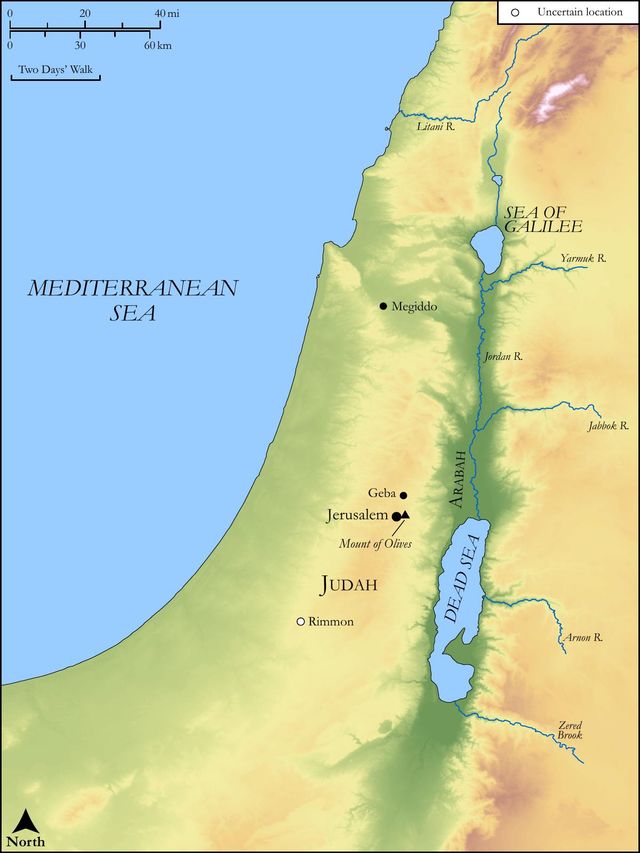
See on the biblical-era map
Study this verse
Public-domain commentary
Matthew Henry
From his Commentary on the Whole Bible. Henry comments on passages, not single verses — this entry covers Zechariah 13:1–6. His four-level outline is real structure in the source text, so it is rendered as structure.
Behold the Lamb of God taking away the sin of the world, the sin of the church; for therefore was the Son of God manifested, to take away our sin, Jo1 3:5.
I.He takes away the guilt of sin by the blood of his cross (Zac 13:1):
In that day, in the gospel-day, there shall be a fountain opened, that is, provision made for the cleansing of all those from the pollutions of sin who truly repent and are sorry for them. In that day, when the Spirit of grace is poured out to set them a mourning for their sins, they shall not mourn as those who have no hope, but they shall have their sins pardoned, and the comfort of their pardon in their bosoms. Their consciences shall be purified and pacified by the blood of Christ, which cleanses from all sin, Jo1 1:7. For Christ is exalted to give both repentance and remission of sins; and where he gives the one no doubt he gives the other. This fountain opened is the pierced side of Jesus Christ, spoken of just before (Zac 12:10), for thence came there out blood and water, and both for cleansing. And those who look upon Christ pierced, and mourn for their sins that pierced him, and are therefore in bitterness for him, may look again upon Christ pierced and rejoice in him, because it pleased the Lord thus to smite this rock, that it might be to us a fountain of living waters. See here,
1.How we are polluted; we are all so; we have sinned, and sin is uncleanness; it defiles the mind and conscience, renders us odious to God and uneasy in ourselves, unfit to be employed in the service of God and admitted into communion with him, as those who were ceremonially unclean were shut out of the sanctuary. The house of David and the inhabitants of Jerusalem are under sin, which is uncleanness. The truth is, we are all as an unclean thing, and deserve to have our portion with the unclean.
2.How we may be purged. Behold, there is fountain opened for us to wash in, and there are streams flowing to us from that fountain, so that, if we be not made clean, it is our own fault. The blood of Christ, and God's pardoning mercy in that blood, revealed in the new covenant, are,
(1.)A fountain; for there is in them an inexhaustible fulness. There is mercy enough in God, and merit enough in Christ, for the forgiving of the greatest sins and sinners, upon gospel-terms. Such were some of you, but you are washed, Co1 6:11. Under the law there were a brazen laver and a brazen sea to wash in; those were but vessels, but we have a fountain to ourselves, overflowing, ever-flowing.
(2.)A fountain opened; for, whoever will, may come and take the benefit of it; it is opened, not only to the house of David, but to the inhabitants of Jerusalem, to the poor and mean as well as to the rich and great; or it is opened for all believers, who, as the spiritual seed of Christ, are of the house of David, and, as living members of the church, are inhabitants of Jerusalem. Through Christ all that believe are justified, are washed from their sins in his blood, that they may be made to our God kings and priests, Rev 1:5, Rev 1:6.
II.He takes away the dominion of sin by the power of his grace, even of beloved sins.
This evermore accompanies the former; those that are washed in the fountain opened, as they are justified, so they are sanctified; the water came with the blood out of the pierced side of Christ. It is here promised that in that day,
1.Idolatry shall be quite abolished and the people of the Jews shall be effectually cured of their inclination to it (Zac 13:2): I will cut off the names of the idols out of the land. The worship of the idols of their fathers shall be so perfectly rooted out that in one generation or two it shall be forgotten that ever there were such idols among them; they shall either not be named at all or not with any respect; they shall no more be remembered, as was promised, Hos 2:17. This was fulfilled in the rooted aversion which the Jews had, after the captivity, to idols and idolatry, and still retain to this day; it was fulfilled also in the ready conversion of many to the faith of Christ, by which they were taken off from making an idol of the ceremonial law, as the unbelieving Jews did; and it is still in the fulfilling when souls are brought off from the world and the flesh, those two great idols, that they may cleave to God only.
2.False prophecy shall also be brought to an end: I will cause the prophets and the unclean spirit, the prophets that are under the influence of the unclean spirit, to pass out of the land. The devil is an unclean spirit; sin and uncleanness are from him; he has his prophets, that serve his interests and receive their instructions from him. Take away the unclean spirit, and the prophets would not deceive as they do; take away the false prophets that produce sham commissions, and the unclean spirit could not do the mischief he does. When God designs the silencing of the false prophets he banishes the unclean spirit out of the land, that wrought in them, and was a rival with him for the throne in the heart. The church of the Jews, when they were addicted to idols, did also dote much upon false prophets, who flattered them in their sins with promises of impunity and peace; but here it is promised, as a blessed effect of the promised reformation, that they should be very much set against false prophets, and zealous to clear the land of them; they were so after the captivity, till, through the blindness of their zeal against false prophets, they had put Christ to death under that character, and, after that, there arose many false Christs and false prophets, and deceived many, Mat 24:11. It is here foretold,
(1.)That false prophets, instead of being indulged and favoured, should be brought to condign punishment even by their nearest relations, which would be as great an instance as any of flagrant zeal against those deceivers (Zac 13:3): When any shall set up for a prophet, and shall speak lies in the name of the Lord, shall preach that which tends to draw people from God and to confirm them in sin, his own parents shall be the first and most forward to prosecute him for it, according to the law. Deu 13:6-11, "If thy son entice thee secretly from God, thou shalt surely kill him. Show thy indignation against him, and prevent any further temptation from him." His father and his mother shall thrust him through when he prophesies. Note, We ought to conceive, and always to retain, a very great detestation and dread of every thing that would draw us out of the way of our duty into by-paths, as those who cannot bear that which is evil, Rev 2:2. And holy zeal for God and godliness will make us hate sin, and dread temptation, most in those whom naturally we love best, and who are nearest to us; there our danger is greatest, as Adam's from Eve, Job's from his wife; and there it will be the most praiseworthy to show our zeal, as Levi, who, in the cause of God, did not acknowledge his brethren, nor know his own children, Deu 33:9. Thus we must hate and forsake our nearest relations when they come in competition with our duty to God, Luk 14:26. Natural affections, even the strongest, must be over-ruled by gracious affections.
(2.)That false prophets should be themselves convinced of their sin and folly, and let fall their pretensions (Zac 13:4): "The prophets shall be ashamed every one of his vision; they shall not repeat it, or insist upon it, but desire that it may be forgotten and no more said of it, being ready themselves to own it was a sham, because God has by his grace awakened their consciences and shown them their error, or because the event disproves their predictions, and gives them the lie, or because their prophecies do not meet with such a favourable reception as they used to meet with, but are generally despised and distasted; they perceive the people ashamed of them, which makes them begin to be ashamed of themselves. And therefore they shall no longer wear a rough garment, or garment of hair, as the true prophets used to do, in imitation of Elijah, and in token of their being mortified to the pleasures and delights of sense." The pretenders had appeared in the habit of true prophets; but, their folly being now made manifest, they shall lay it aside, no more to deceive and impose upon unthinking unwary people by it. A modest dress is a very good thing, if it be the genuine indication of a humble heart, and is to instruct; but it is a bad thing if it be the hypocritical disguise of a proud ambitious heart, and is to deceive. Let men be really as good as they seem to be, but not seem to be better than really they are. This pretender, as a true penitent,
[1.]Shall undeceive those whom he had imposed upon: He shall say, "I am no prophet, as I have pretended to be, was never designed nor set apart to the office, never educated nor brought up for it, never conversant among the sons of the prophets. I am a husbandman, and was bred to that business; I was never taught of God to prophesy, but taught of man to keep cattle" Amos was originally such a one too, and yet was afterwards called to be a prophet, Amo 7:14, Amo 7:15. But this deceiver never had any such call. Note, Those who sorrow after a godly sort for their having deceived others will be forward to confess their sin, and will be so just as to rectify the mistakes which they have been the cause of. Thus those who had used curious arts, when they were converted showed their deeds, and by what fallacies they had cheated the people, Act 19:18.
[2.]He shall return to his own proper employment, which is the fittest for him: I will be a husbandman (so it may be read); "I will apply myself to my calling again, and meddle no more with things that belong not to me; for man taught me to keep cattle from my youth, and cattle I will again keep, and never set up for a preacher any more." Note, When we are convinced that we have gone out of the way of our duty we must evince the truth of our repentance by returning to it again, though it be the severest mortification to us.
[3.]He shall acknowledge those to be his friends who by a severe discipline were instrumental to bring him to a sight of his error, Zac 13:6. When he who with the greatest assurance had asserted himself so lately to be a prophet suddenly drops his claims, and says, I am no prophet, every body will be surprised at it, and some will ask, "What are these wounds, or marks of stripes, in thy hands? how camest thou by them? Hast thou not been examined by scourging? And is not that it that has brought thee to thyself?" (Vexatio dat intellectum - Vexation sharpens the intellect.) "Hast thou not been beaten into this acknowledgment? Was it not the rod and reproof that gave thee this wisdom?" And he shall own, "Yes, it was; these are the wounds with which I was wounded in the house of my friends, who bound me, and used me hardly and severely, as a distracted man, and so brought me to my senses." By this it appears that those parents of the false prophet that thrust him through (Zac 13:3) did not do it till they had first tried to reclaim him by correction, and he would not be reclaimed; for so was the law concerning a disobedient son - his parents must first have chastened him in vain before they were allowed to bring him forth to be stoned, Deu 21:18, Deu 21:19. But here is another who was reduced by stripes, and so prevented the capital punishment; and he had the sense and honesty to own that they were his friends, his real friends, who thus wounded him, that they might reclaim him; for faithful are the wounds of a friend, Pro 27:6. Some good interpreters, observing how soon this comes after the mention of Christ's being pierced, think that these are the words of that great prophet, not of the false prophet spoken of before. Christ was wounded in his hands, when they were nailed to the cross, and, after his resurrection, he had the marks of these wounds; and here he tells how he came by them; he received them as a false prophet, for the chief priests called him a deceiver, and upon that account would have him crucified; but he received them in the house of his friends - the Jews, who should have been his friends; for he came to his own, and, though they were his bitter enemies, yet he was pleased to call them his friends, as he did Judas (Friend, wherefore hast thou come?) because they forwarded his sufferings for him; as he called Peter Satan - an adversary, because he dissuaded him from them.
Historical interpretation
Two Centuries of Reception
3 surviving comments on this verse. Each one is dated, so this reads as a timeline rather than a list.
Select a marker to jump to its quote. Markers stagger vertically where authors wrote within a few decades of each other.
Let us see, then, the necessity of literary erudition; let us reflect that partly it cannot be admitted, partly cannot be avoided. Learning literature is allowable for believers, rather than teaching; for the principle of learning and teaching is different. If a believer teaches literature, while he teaches doubtless he commends, while he delivers he affirms, while he recalls he bears testimony to, the praise of idols interspersed therein. He seals the gods themselves with this name [of gods], whereas the law, as we have said, prohibits “the names of gods to be pronounced” and this name [of God] to be conferred on vanity. Hence the devil gets people’s early faith built up from the beginnings of erudition. Inquire whether he who catechizes about idols commits idolatry. But when a believer learns these things, if he is already capable of understanding what idolatry is, he neither receives nor allows them; much more if he is not yet capable. Or, when he begins to understand, it behooves him first to understand what he has previously learned, that is, touching God and the faith. Therefore he will reject those things and will not receive them; and [the believer] will be as safe as one who knows it not, who knowingly accepts poison but does not drink it. To him necessity is attributed as an excuse, because he has no other way to learn. Moreover, the not teaching literature is as much easier than the not learning, as it is easier too for the pupil not to attend than for the master not to frequent the rest of the defilements incident to the schools from public and scholastic solemnities.
(V2.) And it shall be in that day, says the Lord of hosts, I will destroy the names of the idols from the land, and they shall be remembered no more; and I will also remove the false prophets and the unclean spirit from the land. LXX: And it shall be in that day, says the Lord of hosts, I will destroy the names of the idols from the land, and their memory shall no longer exist; and the false prophets and the unclean spirit I will remove from the land. On that day that is frequently mentioned, all idols will be removed from the land, including those idols of which the Psalmist says: The idols of the nations are silver and gold, the work of human hands (Ps. 115:4), so that there may be no other religion except the name of the Christians, and concerning which it is written in the prophet: Wail, you sculptures, in Jerusalem and in Samaria. For as I have done to Samaria and its idols, so I will do to Jerusalem and its idols (Jer. XXX). Whether these idols, of which the Apostle speaks: Now the Spirit manifestly saith: That in the last times some shall depart from the faith, giving heed to spirits of error and doctrines of devils, Speaking lies in hypocrisy and having their conscience seared (into idolatry) (I Tim. IV, 1, 2). For just as idols are made by the hand of the craftsman, so the perverse doctrine of heretics, whatever it may simulate, turns into an idol and causes Antichrist to be adored in place of Christ. For pseudo-prophets, in Hebrew the prophets are absolutely called prophets, that is, Nebim, which also means pseudo-prophets; but nevertheless even the priests of idols among the Gentiles are called prophets.
Hermes Trismegistus lamented these vain, deceptive, pernicious, sacrilegious things because he foresaw that the time was coming when they would be abolished. He was impudent in his grief as imprudent in his prophecy, since the Holy Spirit had made no revelation to him as to the holy prophets, who exultantly proclaimed their inspired visions: “Shall a man make gods to himself, and they are no gods?” and again, “And it shall come to pass in that day, says the Lord of hosts, that I will destroy the names of the idols out of the earth, and they shall be remembered no more.” It is relevant to recall that holy Isaiah uttered a particular prophecy concerning Egypt: “And the idols of Egypt shall be moved at his presence, and the heart of Egypt shall melt in the midst thereof,” and the rest.
Continue studying Zechariah 13:2 across the web’s major study libraries — every link below opens this exact verse, chapter, or book on the destination site.
Read & Compare
 BibleGatewayThis verse in more than 200 translations and 70 languages.
 Bible.comThe YouVersion reader — hundreds of translations, reading plans, and highlights.
 ESV.orgCrossway's official English Standard Version reader.
 NET BibleThe NET translation with 60,000+ translators' notes on every rendering decision.
 STEP BibleTyndale House's free study tool — original text, vocabulary, and scholarly resources.
 BibliaLogos Bible Software's free web reader.
 USCCBThe New American Bible (Revised Edition) with the U.S. bishops' study notes.
Commentaries
 BibleHub CommentariesDozens of classic commentaries on this verse, gathered on one page.
 StudyLightMore than 100 commentary sets — the largest collection on the web.
 BibleRefPlain-English commentary on what this verse means, verse by verse.
 Enduring WordDavid Guzik's free commentary on this chapter, widely used by Bible teachers.
 Bible Study ToolsVerse commentary alongside Greek and Hebrew study aids.
Original Language & Research
- BibleHub InterlinearThe verse word by word — original language, transliteration, and English.
- BibleHub LexiconEvery word's original-language definition and Strong's entry.
 Blue Letter BibleDeep-study tools — Strong's numbers, concordance, and word studies.
 SefariaThe Hebrew text with Rashi and centuries of Jewish commentary.
Sermons, Hymns & Audio


TrulyRandomVerse is not affiliated with these sites and doesn’t control their content. They’re linked because they’re genuinely useful.
Summary
Zechariah 13:2 delivers a potent divine declaration from the LORD of hosts, foretelling a future "day" of comprehensive spiritual purification for the land. In this eschatological period, God Himself pledges to utterly eradicate the memory and influence of idols, signifying a complete break from past idolatry. Furthermore, He promises to remove both the false prophets and the "unclean spirit" that inspires them, ensuring a thorough cleansing from spiritual deception and malevolent influences, thus paving the way for true worship and divine presence.
Context
ShowHideLiterary Context
Zechariah 13:2 is situated within a significant prophetic block (chapters 12-14) that focuses on the eschatological "day of the LORD" and the ultimate restoration of Israel. Chapter 12 details the future siege of Jerusalem and the nation's mourning over the pierced One. Chapter 13 then transitions to the theme of national purification, beginning with the opening of a fountain for sin and uncleanness in Zechariah 13:1. Verse 2 directly follows this promise of cleansing, specifying the removal of idols and false prophecy as key components of this purification. The subsequent verses in chapter 13 describe the rejection of false prophecy by the people themselves and the smiting of the Shepherd, leading to the purification of a remnant, as detailed in Zechariah 13:7-9. This immediate context highlights a divinely initiated, radical cleansing that prepares the nation for God's full redemptive purposes.
Historical & Cultural Context
The post-exilic period, in which Zechariah prophesied, was marked by the return of a remnant to Judah and the rebuilding of the temple. While the overt idolatry that plagued pre-exilic Israel had largely diminished, the people still grappled with spiritual lethargy, oppression, and the subtle influences of pagan practices and false religious leaders. The memory of past national sins, particularly the worship of foreign gods and the proliferation of false prophets who led the nation astray (e.g., during the time of Jeremiah and Ezekiel), loomed large. Culturally, idols were tangible representations of deities, often associated with fertility rites, political alliances, or personal protection. False prophets, on the other hand, claimed divine inspiration but spoke from their own imaginations or demonic influence, often prophesying peace when there was no peace, or encouraging practices contrary to God's law. Zechariah's prophecy speaks to a deep-seated need for a spiritual purge that would address both the external symbols of apostasy and the internal sources of deception, ensuring a pure covenant relationship with Yahweh.
Key Themes
ShowHideThis verse powerfully contributes to several overarching themes within Zechariah and broader biblical theology. Firstly, it underscores the theme of Divine Sovereignty and Initiative in purification; God Himself declares, "I will cut off" and "I will cause... to pass out," emphasizing that this profound cleansing is His work, not merely human effort. Secondly, it highlights the Eradication of Idolatry and False Worship, a recurring theme throughout the Old Testament, from the commands against other gods in Exodus 20:3 to the condemnation of idolaters in the prophets. The promise that idol names "shall no more be remembered" signifies a complete and lasting spiritual deliverance from the grip of false religion. Thirdly, the verse addresses the Suppression of False Prophecy and Demonic Influence, indicating God's commitment to protecting His people from spiritual deception. This aligns with the biblical emphasis on discerning spirits and testing prophets, as seen in Deuteronomy 13:1-5 and later in the New Testament's call to test the spirits. Ultimately, the verse points to a future of Holiness and True Worship, where the land and its people are fully consecrated to the LORD, free from the defilement of sin and error.
Exposition and Analysis
ShowHideKey Word Analysis
ShowHideThis primitive root means "to cut (off, down or asunder)." It implies destruction or consumption. Significantly, it is also used to mean "to covenant," referring to the ancient practice of cutting flesh and passing between pieces to ratify an agreement. In Zechariah 13:2, its use signifies a decisive, permanent, and often violent severance. God is not merely reducing the presence of idols; He is utterly severing their existence and influence, akin to a surgical removal or a complete destruction.
Derived from a root meaning "to mark (so as to be recognized)," this word denotes remembering, mentioning, or calling to mind. When the text states idols "shall no more be remembered," it goes beyond mere physical removal. It implies a complete erasure from the collective consciousness, memory, and cultural practice. It's a profound spiritual cleansing where the very notion or concept of these false gods ceases to hold any sway or recognition among the people.
This term refers to religious impurity or defilement, often associated with ritual uncleanness but extending to moral and spiritual filthiness. In the context of "unclean spirit," it denotes a spirit that is inherently defiling, corrupting, and contrary to God's holiness. It highlights the spiritual nature of false prophecy, indicating that it is not merely human error but often originates from a source of spiritual defilement.
Verse Breakdown
ShowHide"And it shall come to pass in that day, saith the LORD of hosts"
This opening phrase sets the stage for a momentous, divinely ordained event. "In that day" is a common prophetic idiom referring to a future, often eschatological, period of decisive divine intervention. "Saith the LORD of hosts" (YHWH Sabaoth) emphasizes God's supreme authority, power, and ability to fulfill this grand prophecy, underscoring His sovereign control over all creation and historical events.
"that I will cut off the names of the idols out of the land, and they shall no more be remembered"
This clause declares God's direct and active role in eradicating idolatry. "Cut off the names of the idols" signifies not just the physical removal of idols but the obliteration of their very identity, reputation, and the memory associated with them. The phrase "shall no more be remembered" powerfully conveys a complete and permanent cessation of their influence and worship, indicating a profound spiritual transformation where the nation is entirely purged of its past apostasy.
"and also I will cause the prophets and the unclean spirit to pass out of the land"
This second part of God's promise extends the purification to the realm of spiritual deception. "The prophets" here refers to false prophets who misled the people with their lies and false teachings. The "unclean spirit" is the malevolent, defiling spiritual force that inspires such false prophecy, indicating that the problem is not merely human deception but a demonic influence. God pledges to cause both the human agents of deception and their spiritual source to "pass out of the land," ensuring a comprehensive cleansing from all forms of spiritual corruption.
Literary Devices
ShowHideZechariah 13:2 employs several powerful literary devices to convey its message of divine purification. The phrase "in that day" functions as a Prophetic Marker, signaling a future, pivotal moment of divine action, often with eschatological implications. The declaration "saith the LORD of hosts" is a Divine Formula, emphasizing the absolute authority and certainty of the prophecy, grounding it in the character of the omnipotent God. The statement that idol names "shall no more be remembered" utilizes Hyperbole to underscore the completeness and permanence of their eradication; it's not just that they will be gone, but their very memory will be expunged from the national consciousness. Furthermore, the verse exhibits Parallelism by linking the removal of "idols" with the removal of "prophets and the unclean spirit." This highlights that both external objects of false worship and internal sources of spiritual deception are equally targeted by God's cleansing work, demonstrating His comprehensive approach to purification.
Theological and Thematic Connections
ShowHideZechariah 13:2 profoundly illustrates God's unyielding commitment to holiness and His active role in purifying His people. It reveals that true spiritual restoration involves a radical removal of anything that competes with His exclusive worship, whether tangible idols or intangible spiritual deception. This divine initiative underscores God's covenant faithfulness, as He acts to bring His people back into a state of purity and singular devotion, fulfilling His promise to be their God and they His people. The prophecy points to a future where the spiritual landscape is utterly transformed, free from the defilement that historically plagued Israel.
Reflection and Application
ShowHideZechariah 13:2 offers profound hope and a powerful challenge for believers today. It reminds us that God is actively at work, not only in the grand sweep of redemptive history but also in our personal lives, to purify and sanctify. Just as ancient Israel struggled with overt idolatry and the subtle influences of false prophets, so too do we face modern "idols"—anything that takes God's rightful place in our hearts, be it wealth, status, comfort, or even good causes pursued apart from Him. We also contend with various forms of "unclean spirits" and false teachings that seek to distort truth and lead us astray. This verse calls us to a radical commitment to spiritual purity, urging us to cooperate with God's cleansing work by identifying and repenting of our own idols and by diligently discerning truth from error. It assures us that God desires our complete freedom from spiritual bondage and deception, promising a future where His presence is unhindered by sin and falsehood. This hope should motivate us to pursue holiness and to stand firm against all forms of spiritual compromise, trusting in God's power to cleanse and restore.
Questions for Reflection
ShowHideFAQ
ShowHideWhat does "in that day" signify in this prophecy?
ShowHide"In that day" is a common prophetic idiom used throughout the Old Testament, particularly in the prophets, to refer to a future, decisive period of divine intervention. It often points to an eschatological time when God will act powerfully to judge evil, fulfill His promises, and establish His kingdom. In Zechariah, it frequently refers to the Messianic era or the end times, when God will bring about ultimate salvation and purification for His people, as seen in passages like Zechariah 14:9.
How does God "cut off the names of the idols" and ensure they "shall no more be remembered"?
ShowHideThis phrase signifies a complete and utter eradication of idolatry, going beyond mere physical destruction of statues. To "cut off the names" means to obliterate their identity, reputation, and the very memory associated with them. It implies a profound spiritual cleansing where the concept or influence of these false gods is entirely removed from the national consciousness and practice. This is a divine act, ensuring that the people will no longer be tempted or influenced by the worship of other deities, reflecting God's desire for exclusive devotion, as commanded in Exodus 20:3.
What is the "unclean spirit" mentioned in Zechariah 13:2?
ShowHideThe "unclean spirit" (Hebrew: ruach tum'ah) refers to a spirit of impurity or defilement, often associated with malevolent spiritual influences or demonic forces. In this context, it is the spiritual source that inspires false prophets and leads people into spiritual deception and moral corruption. It highlights that false prophecy is not merely human error but can originate from a supernatural, defiling power. God's promise to remove this spirit alongside the false prophets signifies a comprehensive cleansing from both the human agents and the spiritual forces of evil, ensuring a pure environment for true worship and divine revelation, echoing the New Testament's call to test the spirits.
Christ-Centered Fulfillment
ShowHideZechariah 13:2 finds its ultimate fulfillment in the person and work of Jesus Christ. While the Old Testament prophets looked forward to a "day" when God would cleanse His people, Christ's first advent inaugurated this era of radical purification. He, as the true Shepherd (foreshadowed in Zechariah 13:7), came to deal decisively with sin and its spiritual consequences. Through His sacrificial death on the cross, Jesus became the Lamb of God who takes away the sin of the world, providing the ultimate cleansing for all uncleanness, as symbolized by the fountain opened for sin and impurity in Zechariah 13:1. Furthermore, Christ's ministry was characterized by His authority over "unclean spirits," casting out demons and silencing their lies, demonstrating His power to cause such forces to "pass out of the land" (e.g., Mark 1:27). He is the embodiment of truth, exposing and overcoming all false prophecy and deception, establishing a new covenant where the Holy Spirit guides believers into all truth (John 16:13). The complete eradication of idols and false spirits, though partially realized in Christ's first coming, awaits its final consummation at His glorious return, when all forms of evil and deception will be utterly abolished, and God's kingdom will be established in perfect purity (Revelation 21:27).