


2 Kings 2:10
Bible text: King James Version (1769 Blayney text) · Public domain
Bible text: Berean Standard Bible · Public domain
Bible text: American Standard Version (1901) · Public domain
Bible text: World English Bible, Messianic edition · Public domain
Bible text: Geneva Bible (1599) · Public domain
Bible text: Young's Literal Translation · Public domain
- וַיֹּאמֶרvai·Yo·merand he saidH559Conj-w ¦ V-Qal-ConsecImperf-3msVerb Qal Consecutive Imperfect 3rd Singular Masculineוַandיֹּאמֶרhe said
- הִקְשִׁיתָhik·Shi·tayou have made difficultH7185V-Hiphil-Perf-2msVerb Hiphil Perfect 2nd Singular Masculine
- לִשְׁאוֹלlish·'olto askH7592Prep-l ¦ V-Qal-InfVerb Qal Infinitive Constructלִtoשְׁאוֹלask
- אִם'imifH518PrtParticle Conditional
- תִּרְאֶהtir·'Ehyou will seeH7200V-Qal-Imperf-2msVerb Qal Imperfect 2nd Singular Masculine
- אֹתִי'o·Ti<obj.> meH853DirObjM ¦ 1csParticle Object Indicatorאֹתִ<obj.>יme
- לֻקָּחlu·KachtakenH3947V-Pual-PassPrtcpl-msVerb Pual Participle Passive Singular Masculine Absolute
- מֵאִתָּךְme·'i·toKhfrom with <the> youH854Prep-m ¦ Prep ¦ 2msPreposition Definiteמֵfromאִתָּwith <the>ךְyou
- יְהִיye·himay it beH1961V-Qal-Imperf-3msVerb Qal Imperfect 3rd Singular Masculine
- לְךָle·Khato youPrep-l ¦ 2msSuffix Personal 2nd Singular Masculineלְtoךָyou
- כֵןKhenthusH3651AdvAdverb
- וְאִםve·'imand ifH518Conj-w ¦ PrtParticle Conditionalוְandאִםif
- אַיִן'A·yinnotH369N-msNoun Singular Masculine Absolute
- לֹאlo'notH3808NegParticle Negative
- יִהְיֶהyih·Yehit will beH1961V-Qal-Imperf-3msVerb Qal Imperfect 3rd Singular Masculine
English is a literal word-by-word gloss of the Hebrew, not the KJV's wording. Why?
This is the original text the KJV's translators worked from — each Hebrew word with its own literal English meaning in this verse, prepared by scholars at Tyndale House, Cambridge. The KJV translates whole sentences, not word by word, so its wording differs: one Hebrew word can become several English words, and the KJV may choose “the LORD” where the gloss reads “Yahweh”. Both are faithful — they answer different questions. For the KJV's own rendering, switch to the KJV text.
Details
See on the biblical-era map
Study this verse
Public-domain commentary
Matthew Henry
From his Commentary on the Whole Bible. Henry comments on passages, not single verses — this entry covers 2 Kings 2:9–12. His three-level outline is real structure in the source text, so it is rendered as structure.
Here, I. Elijah makes his will, and leaves Elisha his heir, now anointing him to be prophet in his room, more than when he cast his mantle upon him, Kg1 19:19.
1.Elijah, being greatly pleased with the constancy of Elisha's affection and attendance, bade him ask what he should do for him, what blessing he should leave him at parting; he does not say (as bishop Hall observes), "Ask of me when I am gone, in heaven I shall be better able to befriend thee," but, "Ask before I go." Our friends on earth may be spoken to, and can give us an answer, but we know not that we can have access to any friend in heaven but Christ, and God in him. Abraham is ignorant of us.
2.Elisha, having this fair opportunity to enrich himself with the best riches, prays for a double portion of his spirit. He asks not for wealth, nor honour, nor exemption from trouble, but to be qualified for the service of God and his generation, he asks,
(1.)For the Spirit, not that the gifts and graces of the Spirit were in Elijah's power to give, therefore he says not, "Give me the Spirit" (he knew very well it was God's gift), but "Let it be upon me, intercede with God for this for me." Christ bade his disciples ask what they would, not one, but all, and promised to send the Spirit, with much more authority and assurance than Elijah could.
(2.)For his spirit, because he was to be a prophet in his room, to carry on his work, to father the sons of the prophets and face their enemies, because he had the same perverse generation to deal with that he had, so that, if he have not his spirit, he has not strength according to the day.
(3.)For a double portion of his spirit; he does not mean double to what Elijah had, but double to what the rest of the prophets had, from whom so much would not be expected as from Elisha, who had been brought up under Elijah. It is a holy ambition to covet earnestly the best gifts, and those which will render us most serviceable to God and our brethren. Note, We all ought, both ministers and people, to set before us the example of our predecessors, to labour after their spirit, and to be earnest with God for that grace which carried them through their work and enabled them to finish well.
3.Elijah promised him that which he asked, but under two provisos, Kg2 2:10.
(1.)Provided he put a due value upon it and esteem it highly: this he teaches him to do by calling it a hard thing, not too hard for God to do, but too great for him to expect. Those are best prepared for spiritual blessings that are most sensible of their worth and their own unworthiness to receive them.
(2.)Provided he kept close to his master, even to the last, and was observant of him: If thou see me when I am taken from thee, it shall be so, otherwise not. A diligent attendance upon his master's instructions, and a careful observance of his example, particularly now in his last scene, were the condition and would be a proper means of obtaining much of his spirit. Taking strict notice of the manner of his ascension would likewise be of great use to him. The comforts of departing saints, and their experiences, will mightily help both to gild our comforts and to steel our resolutions. Or, perhaps, this was intended only as a sign: "If God favour thee so far as to give thee a sight of me when I ascend, take that for a token that he will do this for thee, and depend upon it." Christ's disciples saw him ascend, and were thereupon assured that they should, in a little time, be filled with his Spirit, Act 1:8. Elisha, we may suppose, hereupon prayed earnestly, Lord, show me this token for good.
II.Elijah is carried up to heaven in a fiery chariot, Kg2 2:11.
Like Enoch, he was translated, that he should not see death; and was (as Mr. Cowley expresses it) the second man that leaped the ditch where all the rest of mankind fell, and went not downward to the sky. Many curious questions might be asked about this matter, which could not be answered. Let it suffice that we are here told,
1.What his Lord, when he came, found him doing. He was talking with Elisha, instructing and encouraging him, directing him in his work, and quickening him to it, for the good of those whom he left behind. He was not meditating nor praying, as one wholly taken up with the world he was going to, but engaged in edifying discourse, as one concerned about the kingdom of God among men. We mistake if we think our preparation for heaven is carried on only by contemplation and the acts of devotion. Usefulness to others will pass as well in our account as any thing. Thinking of divine things is good, but talking of them (if it come from the heart) is better, because for edification, Co1 14:4. Christ ascended as he was blessing his disciples.
2.What convoy his Lord sent for him - a chariot of fire and horses of fire, which appeared either descending upon them from the clouds or (as bishop Patrick thinks) running towards them upon the ground: in this form the angels appeared. The souls of all the faithful are carried by an invisible guard of angels into the bosom of Abraham; but, Elijah being to carry his body with him, this heavenly guard was visible, not in a human shape, as usual, though they might so have borne him up in their arms, or carried him as on eagles' wings, but that would have been to carry him like a child, like a lamp (Isa 40:11, Isa 40:31); they appear in the form of a chariot and horses, that he may ride in state, may ride in triumph, like a prince, like a conqueror, yea, more than a conqueror. The angels are called in scripture cherubim and seraphim, and their appearance here, though it may seem below their dignity, answers to both those names; for (1.) Seraphim signifies fiery, and God is said to make them a flame of fire, Psa 104:4. (2.) Cherubim (as many think) signifies chariots, and they are called the chariots of God (Psa 68:17), and he is said to ride upon a cherub (Psa 18:10), to which perhaps there is an allusion in Ezekiel's vision of four living creatures, and wheels, like horses and chariots; in Zechariah's vision, they are so represented, Zac 1:8; Zac 6:1. Compare Rev 6:2, etc. See the readiness of the angels to do the will go God, even in the meanest services, for the good of those that shall be heirs of salvation. Elijah must remove to the world of angels, and therefore, to show how desirous they were of his company, some of them would come to fetch him. The chariot and horses appeared like fire, not for burning, but brightness, not to torture or consume him, but to render his ascension conspicuous and illustrious in the eyes of those that stood afar off to view it. Elijah had burned with holy zeal for God and his honour, and now with a heavenly fire he was refined and translated.
3.How he was separated from Elisha. This chariot parted them both asunder. Note, The dearest friends must part. Elisha had protested he would not leave him, yet now is left behind by him.
4.Whither he was carried. He went up by a whirlwind into heaven. The fire tends upward; the whirlwind helped to carry him through the atmosphere, out of the reach of the magnetic virtue of this earth, and then how swiftly he ascended through the pure ether to the world of holy and blessed spirits we cannot conceive.
"But where he stopped will ne'er be known,
'Till Phenix-nature, aged grown,
To a better being shall aspire,
Mounting herself, like him, to eternity in fire."
- Cowley
Elijah had once, in a passion, wished he might die; yet God was so gracious to him as not only not to take him at his word then, but to honour him with this singular privilege, that he should never see death; and by this instance, and that of Enoch, (1.) God showed how men should have left the world if they had not sinned, not by death, but by a translation. (2.) He gave a glimpse of that life and immortality which are brought to light by the gospel, of the glory reserved for the bodies of the saints, and the opening of the kingdom of heaven to all believers, as then to Elijah. It was also a figure of Christ's ascension.
III.Elisha pathetically laments the loss of that great prophet, but attends him with an ecomium, Kg2 2:12.
1.He saw it; thus he received the sign by which he was assured of the grant of his request for a double portion of Elijah's spirit. He looked stedfastly towards heaven, whence he was to expect that gift, as the disciples did, Act 1:10. he saw it awhile, but the vision was presently out of his sight; and he saw him no more.
2.He rent his own clothes, in token of the sense he had of his own and the public loss. Though Elijah had gone triumphantly to heaven, yet this world could ill spare him, and therefore his removal ought to be much regretted by the survivors. Surely their hearts are hard whose eyes are dry when God, by taking away faithful useful men, calls for weeping and mourning. Though Elijah's departure made way for Elisha's eminency, especially since he was now sure of a double portion of his spirit, yet he lamented the loss of him, for he loved him, and could have served him for ever.
3.He gave him a very honourable character, as the reason why he thus lamented the loss of him.
(1.)He himself had lost the guide of his youth: My father, my father. He saw his own condition like that of a fatherless child thrown upon the world, and lamented it accordingly. Christ, when he left his disciples, did not leave them orphans (Joh 14:15), but Elijah must.
(2.)The public had lost its best guard; he was the chariot of Israel, and the horsemen thereof. He would have brought them all to heaven, as in this chariot, if it had not been their own fault; they used not chariots and horses in their wars, but Elijah was to them, by his counsels, reproofs, and prayers, better than the strongest force of chariot and horse, and kept off the judgments of God. His departure was like the routing of an army, an irreparable loss. "Better have lost all our men of war than this man of God."
Historical interpretation
Historical reception
1 surviving comment on this verse from the historical church.
Angels carry Elijah to heaven while angels guard Elisha on earth. Why is it so amazing if the angels who carried the master were also guarding the disciple? And what is noteworthy if the allegiance which they displayed toward the father they also offer to the son? For Elisha is the spiritual son of Elijah and the heir of his holiness. Elisha is therefore rightly called the spiritual son of Elijah, for when Elijah was ascending to heaven he left behind for Elisha a double spirit of his grace. For when an opportunity was given to Elisha to ask for whatever he wanted before Elijah was taken from him, he asked that a double spirit of Elijah be in him. Then Elijah responded: “You have asked for something difficult, but it will be done for you.” O precious inheritance in which more is left to the heir than was actually possessed, and the ones who receives the inheritance receives more than the giver owned! This is certainly a precious inheritance, which is doubled by some interest derived from merits when it is transferred from the father to the son! So Elijah, although he had a single spirit of holiness, left a double portion to Elisha. In an amazing way, he left more grace on earth for Elisha than he took with himself to heaven.
Continue studying 2 Kings 2:10 across the web’s major study libraries — every link below opens this exact verse, chapter, or book on the destination site.
Read & Compare
 BibleGatewayThis verse in more than 200 translations and 70 languages.
 Bible.comThe YouVersion reader — hundreds of translations, reading plans, and highlights.
 ESV.orgCrossway's official English Standard Version reader.
 NET BibleThe NET translation with 60,000+ translators' notes on every rendering decision.
 STEP BibleTyndale House's free study tool — original text, vocabulary, and scholarly resources.
 BibliaLogos Bible Software's free web reader.
 USCCBThe New American Bible (Revised Edition) with the U.S. bishops' study notes.
Commentaries
 BibleHub CommentariesDozens of classic commentaries on this verse, gathered on one page.
 StudyLightMore than 100 commentary sets — the largest collection on the web.
 BibleRefPlain-English commentary on what this verse means, verse by verse.
 Enduring WordDavid Guzik's free commentary on this chapter, widely used by Bible teachers.
 Bible Study ToolsVerse commentary alongside Greek and Hebrew study aids.
Original Language & Research
- BibleHub InterlinearThe verse word by word — original language, transliteration, and English.
- BibleHub LexiconEvery word's original-language definition and Strong's entry.
 Blue Letter BibleDeep-study tools — Strong's numbers, concordance, and word studies.
 SefariaThe Hebrew text with Rashi and centuries of Jewish commentary.
Sermons, Hymns & Audio


TrulyRandomVerse is not affiliated with these sites and doesn’t control their content. They’re linked because they’re genuinely useful.
Summary
Second Kings 2:10 encapsulates Elijah's profound response to Elisha's audacious request for a "double portion" of his spirit. Elijah declares the request "a hard thing," not in terms of impossibility, but in its weighty significance and the divine conditions necessary for its fulfillment. He sets a pivotal test: if Elisha spiritually perceives and witnesses Elijah's miraculous ascension, then the desired spiritual inheritance will be granted; otherwise, it will not. This verse powerfully underscores the sovereign nature of divine anointing and the critical necessity of spiritual attentiveness and readiness for receiving extraordinary spiritual blessings.
Context
ShowHideLiterary Context
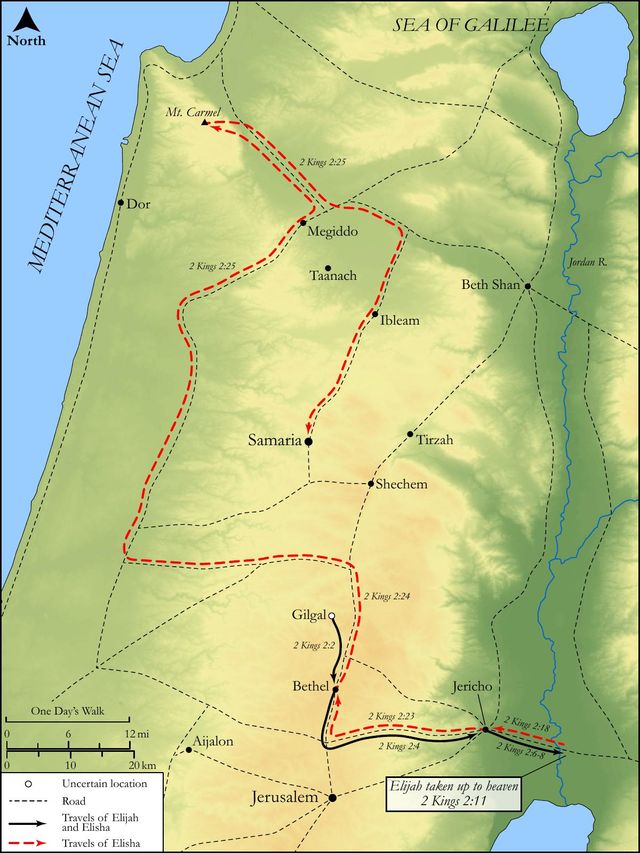
This verse serves as a pivotal moment within the dramatic narrative of Elijah's final days and the consequential transfer of his prophetic mantle to Elisha. The preceding verses meticulously detail Elijah and Elisha's final journey together from Gilgal to Bethel, Jericho, and finally to the Jordan River, visiting communities of prophets along the way. Throughout this journey, Elisha demonstrates unwavering loyalty and profound spiritual hunger, repeatedly refusing to leave Elijah's side, even as he is aware that the Lord is about to "take away" his master, a fact acknowledged by the sons of the prophets at Bethel in 2 Kings 2:3. In 2 Kings 2:9, Elisha makes his bold and singular request: "I pray thee, let a double portion of thy spirit be upon me." Elijah's response in 2 Kings 2:10 directly addresses this audacious plea, setting the divine condition that immediately precedes and prepares for Elijah's miraculous ascension in 2 Kings 2:11. The entire chapter meticulously builds to this climactic moment of transition, establishing Elisha as the legitimate and powerfully endowed successor to the prophetic office.
Historical & Cultural Context
The concept of a "double portion" (Hebrew: pi shenayim) was deeply rooted in ancient Israelite inheritance law, as explicitly outlined in Deuteronomy 21:17. This legal provision designated the eldest son's right to receive twice the inheritance of his siblings, thereby marking him as the primary heir and the one entrusted with the future leadership and responsibility of the family. Therefore, Elisha's request was not for twice Elijah's inherent power, but rather for the inheritance of the "firstborn son" among the prophetic community—to be recognized as Elijah's principal spiritual successor and the primary inheritor of his unique prophetic authority and anointing. This cultural context profoundly highlights the nature of Elisha's desire for a legitimate spiritual lineage and responsibility, rather than merely personal power or glory. The frequent mention of "sons of the prophets" or prophetic schools throughout 2 Kings 2 further underscores the existence of an established prophetic community and the vital importance of a recognized, divinely appointed leader within it.
Key Themes
ShowHideThis verse powerfully contributes to several overarching themes within the broader narrative of 2 Kings. Firstly, it profoundly emphasizes Divine Sovereignty in Spiritual Empowerment. While Elisha articulates a bold and specific request, the granting of the "double portion" is not an automatic outcome of human desire but is entirely contingent on God's sovereign will, as mediated through Elijah's specific condition. This highlights that spiritual gifts, anointing, and authority are ultimately God's to bestow, not merely human aspirations to achieve or earn. Secondly, the theme of Spiritual Succession and Inheritance is central, vividly illustrating the divinely orchestrated transfer of prophetic authority and responsibility from one generation to the next, a crucial aspect of God's ongoing work through His chosen servants. Elisha's unwavering persistence and Elijah's precise condition serve to establish the legitimacy and divine endorsement of this monumental transfer. Lastly, the verse underscores the profound theme of Spiritual Perception and Readiness. The condition "if thou see me" implies far more than mere physical observation; it demands profound spiritual discernment, attentiveness, and understanding. This suggests that receiving extraordinary spiritual blessings and empowerments requires a heightened state of spiritual awareness and a readiness to witness and apprehend God's supernatural acts. This theme resonates deeply with the broader biblical emphasis on having "eyes to see" and "ears to hear," as taught by Jesus in Matthew 13:16.
Exposition and Analysis
ShowHideKey Word Analysis
ShowHideThis word (H7185, קָשֶׁה) is a primitive root meaning, properly, "to be dense," which extends to "tough or severe" in various applications. It can mean "to be cruel," "to be fiercer," "to make grievous," or "to be hard" (in terms of labor, thing, or heart). When Elijah states, "Thou hast asked a hard thing," he is not implying impossibility, but rather the immense, profound, and weighty nature of Elisha's request. It signifies that the "double portion" is not a light matter or an automatic inheritance, but an extraordinary spiritual endowment requiring direct divine intervention and a significant spiritual capacity to receive and bear its responsibilities.
The verb "see" (H7200, רָאָה) is a primitive root meaning "to see, literally or figuratively (in numerous applications, direct and implied, transitive, intransitive and causative)." It encompasses concepts such as "to advise self," "appear," "approve," "behold," "consider," "discern," "take heed," "look," "mark," "perceive," "regard," and "have respect." In this context, "see" transcends mere physical observation. While Elisha physically witnessed Elijah's ascension, the emphasis is on spiritual perception, discernment, and understanding. It implies an attentiveness of spirit that would allow Elisha to grasp the divine significance of the event and to receive the spiritual impartation. This "seeing" is active and engaged, a spiritual readiness that aligns the recipient with God's supernatural working. It is about being spiritually attuned to the moment of divine transfer.
This word (H3947, לָקַח) is a primitive root meaning "to take (in the widest variety of applications)." Its broad semantic range includes "accept," "bring," "buy," "carry away," "draw," "fetch," "get," "receive," "seize," and "take up." In 2 Kings 2:10, "when I am taken from thee" refers to Elijah's miraculous ascension, his being "taken up" to heaven by God. This signifies a divine act of removal, not by death, but by supernatural transport, emphasizing God's direct involvement in the transition of prophetic authority. Elisha's ability to "see" this specific act of being "taken" is the condition for his spiritual inheritance.
Verse Breakdown
ShowHide"And he said, Thou hast asked a hard thing:"
Elijah's immediate response acknowledges the profound magnitude and weighty nature of Elisha's request for a "double portion" of his spirit. It is "hard" not because it is beyond God's power or willingness, but because it represents an extraordinary spiritual inheritance, demanding exceptional divine favor and a profound spiritual capacity in the recipient to both receive and steward such a gift. This initial statement sets the stage for the conditional nature of the subsequent promise.
"nevertheless, if thou see me when I am taken from thee, it shall be so unto thee;"
This clause presents the core, divinely appointed condition for Elisha's audacious request to be granted. The phrase "if thou see me when I am taken from thee" highlights the absolute requirement of spiritual attentiveness, profound discernment, and active perception. Elisha must not only be physically present but must be spiritually awake and perceptive enough to truly witness and comprehend the divine significance of the supernatural event of Elijah's ascension. If he successfully meets this condition, the "double portion" of Elijah's spirit and prophetic authority will be irrevocably granted to him, signifying God's sovereign approval of his succession.
"but if not, it shall not be so."
This concluding clause powerfully underscores the absolute and non-negotiable nature of the condition. If Elisha fails to "see" Elijah being taken—meaning he lacks the necessary spiritual readiness, focus, or perception required to grasp the divine moment—then the requested spiritual inheritance will not be bestowed upon him. This emphasizes both divine sovereignty in the distribution of spiritual gifts and the critical necessity of fulfilling God's specific conditions for receiving extraordinary blessings and empowerments.
Literary Devices
ShowHideThe verse employs several significant literary devices to convey its profound message. The most prominent is the Conditional Statement ("if... then... but if not..."), which creates a direct and unambiguous link between Elisha's spiritual perception and the fulfillment of his extraordinary request. This structure emphasizes that divine blessings and empowerments are often contingent upon human readiness, spiritual attentiveness, and faithfulness. There is also rich Symbolism present: the "double portion" profoundly symbolizes the inheritance of authority, the mantle of leadership, and the continuation of a powerful prophetic ministry, while "seeing" symbolizes not mere physical sight but deep spiritual discernment, active engagement with God's supernatural acts, and a receptive heart. Furthermore, Elijah's statement functions as a form of Prophetic Utterance, setting a divine test and foretelling the precise outcome based on Elisha's response, thereby powerfully foreshadowing the dramatic and miraculous ascension that immediately follows in the narrative.
Theological and Thematic Connections
ShowHideThe profound exchange in 2 Kings 2:10 profoundly illustrates the nature of divine anointing and spiritual inheritance within God's economy. It teaches that spiritual authority and power are not automatically transferred by proximity or simply inherited through human desire, but are sovereignly bestowed by God, often through specific, divinely appointed conditions. Elisha's persistent pursuit, his unwavering devotion, and his spiritual readiness to "see" were crucial for receiving the unique empowerment necessary for his subsequent prophetic ministry. This highlights a foundational biblical principle: while God is absolutely sovereign in giving spiritual gifts and callings, He often honors diligent pursuit, profound spiritual hunger, and a heart prepared to receive. The "hard thing" Elisha asked for was not impossible for God, but it required a level of spiritual attunement that few possess, making the granting of the "double portion" a testament to Elisha's deep devotion and God's specific and extraordinary call upon his life.
Reflection and Application
ShowHideElijah's conditional promise to Elisha serves as a powerful and enduring paradigm for believers today who seek deeper spiritual experience, greater anointing, and profound empowerment for ministry. It challenges us to move beyond passive expectation to active, spiritual engagement and pursuit. The "hard thing" Elisha asked for was not a casual or fleeting desire but a profound, unwavering longing for God's anointing to continue Elijah's vital work. This prompts us to deeply examine the depth of our own spiritual hunger and the earnestness of our prayers. Are we merely hoping for blessings, or are we actively pursuing God's presence, His power, and His specific callings with a focused, unwavering spirit? The requirement to "see" implies a critical need for spiritual discernment—to be acutely attuned to God's movements, to recognize His divine appointments, and to perceive His hand at work even in the midst of the miraculous or the mundane. Great spiritual blessings and significant empowerments often require great spiritual attentiveness, persistent pursuit, and a readiness to step courageously into the divine flow. Our diligence, persistence, and spiritual sensitivity position us to receive what God, in His sovereignty, desires to impart for the advancement of His kingdom purposes.
Questions for Reflection
ShowHideFAQ
ShowHideWhat does "Thou hast asked a hard thing" truly mean in this context?
ShowHideWhen Elijah says, "Thou hast asked a hard thing," he is not implying that Elisha's request for a "double portion" of his spirit is impossible for God to grant. Instead, the Hebrew word qâshâh (H7185, קָשֶׁה) conveys that the request is weighty, severe, or difficult in its nature and profound implications. It signifies that such an extraordinary spiritual impartation is not a trivial matter but requires direct divine intervention and a profound spiritual capacity in the recipient to both receive and steward it. It underscores the immense significance and responsibility of the anointing Elisha sought, rather than suggesting it's beyond God's power or willingness to bestow.
Why was "seeing" Elijah taken away so important for Elisha to receive the double portion?
ShowHideThe condition "if thou see me when I am taken from thee" points to far more than just physical observation. It implies a profound spiritual perception, discernment, and attentiveness. Elisha needed to be spiritually alert and discerning enough to recognize and grasp the divine significance of Elijah's miraculous ascension. This "seeing" was a crucial test of his spiritual readiness, unwavering focus, and deep connection with his master and, more importantly, with God's supernatural work. It demonstrated his spiritual capacity to receive and steward such a powerful anointing, confirming his divine appointment as Elijah's successor. Without this spiritual insight and receptivity, the transfer of authority would not occur, highlighting that extraordinary spiritual blessings are often contingent on a heightened state of spiritual receptivity. This concept of spiritual understanding is crucial for disciples, as Jesus taught in Matthew 13:16, where blessed are the eyes that see.
Was Elisha's request for a "double portion" selfish or arrogant?
ShowHideNo, Elisha's request for a "double portion" was not selfish or arrogant; rather, it was deeply rooted in ancient Israelite inheritance law. In this cultural context, the "double portion" (Hebrew: pi shenayim) was the legal right of the firstborn son (Deuteronomy 21:17). Elisha was not asking for twice Elijah's inherent power, but rather to be recognized as Elijah's primary spiritual heir and successor, inheriting the full scope of his prophetic authority and anointing. It was a request for the mantle of leadership and the profound responsibility that came with it, demonstrating his deep commitment to continuing Elijah's prophetic ministry and serving God's people. It was a desire for legitimate spiritual inheritance and divine empowerment for service, not personal glory or self-aggrandizement.
Christ-Centered Fulfillment
ShowHideThe dramatic ascension of Elijah and the subsequent impartation of his spirit to Elisha, as described in 2 Kings 2:10-11, find their ultimate, glorious, and infinitely greater fulfillment in the person and redemptive work of Jesus Christ. Just as Elijah was miraculously taken up to heaven, so too was Jesus, ascending to the right hand of the Father after triumphantly completing His earthly ministry of atonement and reconciliation (Acts 1:9). However, unlike Elijah, who passed on a portion of his spirit to a single successor, Christ's ascension was the absolute prerequisite for the universal outpouring of the Holy Spirit upon all believers. This fulfilled His profound promise to send "another Helper" (John 14:16) and His declaration that it was "to your advantage that I go away" (John 16:7). The "double portion" Elisha received, enabling him to perform miracles and continue Elijah's prophetic work, is magnificently surpassed by the indwelling and empowering presence of the Holy Spirit in every believer, equipping them to do "greater works" than even Jesus performed during His earthly ministry (John 14:12). Christ's ascension was not merely a transfer of authority to one individual, but the universal impartation of divine power, making every believer a spiritual heir, fully equipped to continue His mission on earth, as vividly demonstrated on the Day of Pentecost (Acts 2:1-4). Thus, the conditional promise to Elisha powerfully foreshadows the unconditional, abundant, and universally available spiritual inheritance granted to all who believe in Christ, made possible by His glorious departure and the subsequent gift of His Spirit.