


2 Kings 2:15
Bible text: King James Version (1769 Blayney text) · Public domain
Bible text: King James Version with Strong's numbers · Public domain
Bible text: Berean Standard Bible · Public domain
Bible text: American Standard Version (1901) · Public domain
Bible text: World English Bible, Messianic edition · Public domain
Bible text: Geneva Bible (1599) · Public domain
Bible text: Young's Literal Translation · Public domain
- וַיִּרְאֻהוּvai·yir·'U·huand they saw himH7200Conj-w ¦ V-Qal-ConsecImperf-3mp ¦ 3msVerb Qal Consecutive Imperfect 3rd Plural Masculineוַandיִּרְאֻthey sawהוּhim
- בְנֵיve·nei[the] sons ofH1121N-mpcNoun Plural Masculine Construct
- הַנְּבִיאִיםha·ne·vi·'Imthe prophetsH5030Art ¦ N-mpNoun Plural Masculine Absoluteהַtheנְּבִיאִיםprophets
- אֲשֶׁר'a·SherwhoH834RelParticle Relative
- בִּירִיחוֹbi·ri·Cho[were] at JerichoH3405Prep-b ¦ N-properNoun Proper Locationבִּ[were] atירִיחוֹJericho
- מִנֶּגֶדmi·Ne·gedfrom beforeH5048Prep-m ¦ Adj-msAdjective Numerical Singular Masculine Absoluteמִfromנֶּגֶדbefore
- וַיֹּאמְרוּvai·Yo·me·Ruand they saidH559Conj-w ¦ V-Qal-ConsecImperf-3mpVerb Qal Consecutive Imperfect 3rd Plural Masculineוַandיֹּאמְרוּthey said
- נָחָהNa·chahit has restedH5117V-Qal-Perf-3fsVerb Qal Perfect 3rd Singular Feminine
- רוּחַRu·ach[the] spirit ofH7307N-fscNoun Singular Feminine Construct
- אֵלִיָּהוּ'e·li·Ya·huElijahH452N-proper-mNoun Proper Masculine
- עַל'alonH5921PrepPreposition
- אֱלִישָׁע'e·li·Sha'ElishaH477N-proper-mNoun Proper Masculine
- וַיָּבֹאוּvai·ya·Vo·'uand they cameH935Conj-w ¦ V-Qal-ConsecImperf-3mpVerb Qal Consecutive Imperfect 3rd Plural Masculineוַandיָּבֹאוּthey came
- לִקְרָאתוֹlik·ra·Toto meet himH7122Prep-l ¦ V-Qal-Inf ¦ 3msVerb Qal Infinitive Constructלִtoקְרָאתmeetוֹhim
- וַיִּשְׁתַּחֲווּvai·yish·ta·cha·vuand they bowed downH7812Conj-w ¦ V-Hishtaphel-ConsecImperf-3mpVerb Hishtaphel Consecutive Imperfect 3rd Plural Masculineוַandיִּשְׁתַּחֲווּthey bowed down
- לוֹloto himPrep-l ¦ 3msSuffix Personal 3rd Singular Masculineלtoוֹhim
- אָרְצָה'A·re·tzah[the] ground towardsH776N-fs ¦ SfxNoun Singular Feminine Absoluteאָרְצָ[the] groundהtowards
English is a literal word-by-word gloss of the Hebrew, not the KJV's wording. Why?
This is the original text the KJV's translators worked from — each Hebrew word with its own literal English meaning in this verse, prepared by scholars at Tyndale House, Cambridge. The KJV translates whole sentences, not word by word, so its wording differs: one Hebrew word can become several English words, and the KJV may choose “the LORD” where the gloss reads “Yahweh”. Both are faithful — they answer different questions. For the KJV's own rendering, switch to the KJV text.
Details
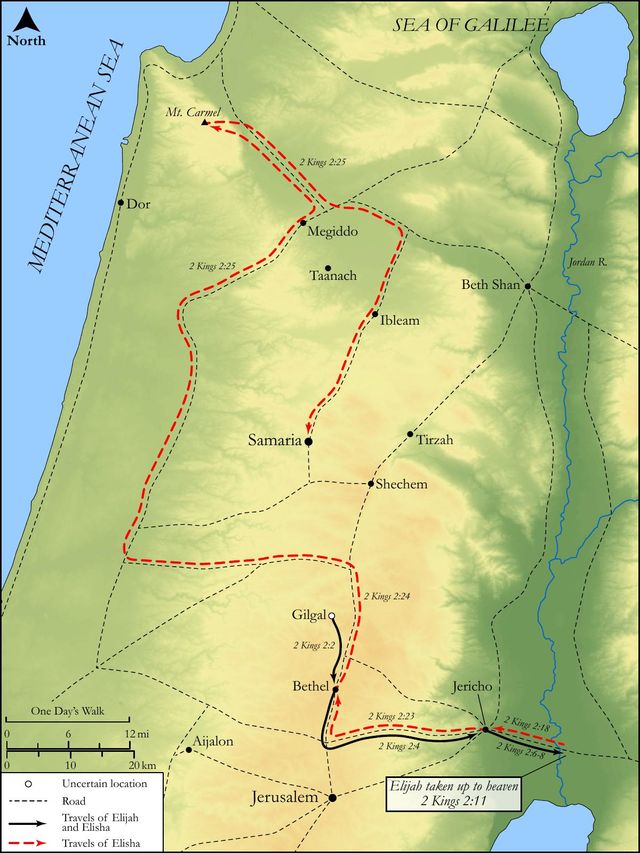
See on the biblical-era map
Study this verse
Public-domain commentary
Matthew Henry
From his Commentary on the Whole Bible. Henry comments on passages, not single verses — this entry covers 2 Kings 2:13–18. His four-level outline is real structure in the source text, so it is rendered as structure.
We have here an account of what followed immediately after the translation of Elijah.
I.The tokens of God's presence with Elisha, and the marks of his elevation into Elijah's room, to be, as he had been, a father to the sons of the prophets, and the chariots and horsemen of Israel.
1.He was possessed of Elijah's mantle, the badge of his office, which, we may suppose, he put on and wore for his master's sake, Kg2 2:13. When Elijah went to heaven, though he did not let fall his body as others do, he let fall his mantle instead of it; for he was unclothed, that he might be clothed upon with immortality: he was going to a world where he needed not the mantle to adorn him, nor to shelter him from the weather, nor to wrap his face in, as Kg1 19:13. He left his mantle as a legacy to Elisha, and, though in itself it was of small value, yet as it was a token of the descent of the Spirit upon him, it was more than if he had bequeathed to him thousands of gold and silver. Elisha took it up, not as a sacred relic to be worshipped, but as a significant garment to be worn, and a recompence to him for his own garments which he had rent. he loved this cloak ever since it was first cast over him, Kg1 19:19. He that then so cheerfully obeyed the summons of it, and became Elihah's servant, is now dignified with it, and becomes his successor. There are remains of great and good men, which, like this mantle, ought to be gathered up and preserved by the survivors, their sayings, their writings, their examples, that, as their works follow them in the reward of them, they may stay behind in the benefit of them.
2.He was possessed of Elijah's power to divide Jordan, Kg2 2:14. Having parted with his father, he returns to his sons in the schools of the prophets. Jordan was between him and them; it had been divided to make way for Elijah to his glory; he will try whether it will divide to make way for him to his business, and by that he will know that God is with him, and that he has the double portion of Elijah's spirit. Elijah's last miracle shall be Elisha's first; thus he begins where Elijah left off and there is no vacancy. In dividing the waters,
(1.)He made use of Elijah's mantle, as Elijah himself had done (Kg2 2:8), to signify that he designed to keep to his master's methods and would not introduce any thing new, as those affect to do that think themselves wiser than their predecessors.
(2.)He applied to Elijah's God: Where is the Lord God of Elijah? He does not ask, "Where is Elijah?" as poring upon the loss of him, as if he could not be easy now that he was gone, - or as doubting of his happy state, as if, like the sons of the prophets here, he knew not what had become of him, - or as curiously enquiring concerning him, and the particular of that state he was removed to (no, that is a hidden life, it does not yet appear what we shall be), - nor as expecting help from him; no, Elijah is happy, but is neither omniscient nor omnipotent; but he asks, Where is the Lord God of Elijah? Now that Elijah was taken to heaven God had abundantly proved himself the God of Elijah; if he had not prepared for him that city, and done better for him there than ever he did for him in this world, he would have been ashamed to be called his God, Heb 11:16; Mat 27:31, Mat 27:32. Now that Elijah was taken to heaven Elisha enquired,
[1.]After God. When our creature-comforts are removed, we have a God to go to, that lives for ever.
[2.]After The God of Elijah, the God that Elijah served, and honoured, and pleaded for, and adhered to when all Israel had deserted him. This honour is done to those who cleave to God in times of general apostasy, that God will be, in a peculiar manner, their God. "The God that owned, and protected, and provided for Elijah, and many ways honoured him, especially now at last, where is he? Lord, am not I promised Elijah's spirit? Make good that promise." The words which next follow in the original, Aph-his - even he, which we join to the following clause, when he also had smitten the waters, some make an answer to this question, Where is Elijah's God? Etiam ille adhuc superest - "He is in being still, and nigh at hand. We have lost Elijah, but we have not lost Elijah's God. He has not forsaken the earth; it is even he that is still with me." Note, First, It is the duty and interest of the saints on earth to enquire after God, and apply to him as the Lord God of the saints that have gone before to heaven, the God of our fathers. Secondly, It is very comfortable to those who enquire of him; it is even he that is in his holy temple (Psa 11:4) and nigh to all who call upon him, Psa 145:18. Thirdly, Those that walk in the spirit and steps of their godly faithful predecessors shall certainly experience the same grace that they experienced; Elijah's God will be Elisha's too. The Lord God of the holy prophets is the same yesterday, today, and for ever; and what will it avail us to have the mantles of those that are gone, their places, their books, if we have not their spirit, their God?
3.He was possessed of Elijah's interest in the sons of the prophets, Kg2 2:15. Some of the fellows of the college at Jericho, who had placed themselves conveniently near Jordan, to see what passed, were surprised to see Jordan divided before Elisha in his return, and took that as a convincing evidence that the spirit of Elijah did rest upon him, and that therefore they ought to pay the same respect and deference to him that they had paid to Elijah. Accordingly they went to meet him, to congratulate him on his safe passage through fire and water, and the honour God had put upon him; and they bowed themselves to the ground before him. They were trained up in the schools; Elisha was taken from the plough; yet when they perceived that God was with him, and that this was the man whom he delighted to honour, they readily submitted to him as their head and father, as the people to Joshua when Moses was dead, Jos 1:17. Those that appear to have God's Spirit and presence with them ought to have our esteem and best affections, notwithstanding the meanness of their extraction and education. This ready submission of the sons of the prophets, no doubt, was a great encouragement to Elisha, and helped to clear his call.
II.The needless search which the sons of the prophets made for Elijah.
1. They suggested that possibly he was dropped, either alive or dead, upon some mountain, or in some valley; and it would be a satisfaction to them if they sent some strong men, whom they had at command, in quest of him, Kg2 2:16. Some of them perhaps started this as a demurrer to the choice of Elisha: "Let us first be sure that Elijah has quite gone. Can we think Elijah thus neglected by heaven, that chosen vessel thus cast away as a vessel in which was no pleasure?" 2. Elisha consented not to their motion till they overcame him with importunity, Kg2 2:17. They urged him till he was ashamed to oppose it any further lest he should be thought wanting in his respect to his old master or loth to resign the mantle again. Wise men may yield to that, for the sake of peace and the good opinion of others, which yet their judgment is against as needless and fruitless. 3. The issue made them as much ashamed of their proposal as they, by their importunity, had made Elisha ashamed of his opposing it. Their messengers, after they had tired themselves with fruitless search, returned with a non est inventus - he is not to be found, and gave Elisha an opportunity of upbraiding his friends with their folly: Did I not say unto you, Go not? Kg2 2:18. This would make them the more willing to acquiesce in his judgment another time. Traversing hills and valleys will never bring us to Elijah, but the imitation of his holy faith and zeal will, in due time.
Historical interpretation
Fifteen Centuries of Reception
2 surviving comments on this verse. Each one is dated, so this reads as a timeline rather than a list.
Select a marker to jump to its quote. Markers stagger vertically where authors wrote within a few decades of each other.
I have thought it necessary to dwell some time on the examination of the doctrine of transmigration, because of the suspicion of some who suppose that the soul under consideration was the same in Elijah and in John, being called in the former case Elijah and in the second case John; and that, not apart from God, had he been called John, as is plain from the saying of the angel who appeared to Zacharias, "Fear not, Zacharias, for your supplication is heard, and your wife Elizabeth shall bear you a son, and you shall call his name John"; and from the fact that Zacharias regained his speech after he had written in the tablet, that he who had been born should be called John." But if it were the soul of Elijah, then, when he was begotten a second time, he should have been called Elijah; or for the change of name some reason should have been assigned, as in the case of Abram and Abraham, Sarah and Sarai, Jacob and Israel, Simon and Peter. And yet not even thus would their argument in the case be tenable; for … the changes of name took place in one and the same life. But someone might ask, if the soul of Elijah was not first in the Tishbite and second in John, what might that be in both which the Savior called Elijah? And I say that Gabriel in his words to Zacharias suggested what the substance was in Elijah and John that was the same; for he says, "Many of the children of Israel shall he turn to the Lord their God; and he shall go before his face in the spirit and power of Elijah." For, observe, he did not say in the soul of Elijah, in which case the doctrine might have some ground, but "in the spirit and power of Elijah." For the Scripture well knows the distinction spirit and soul, as, "May God sanctify you wholly, and may your spirit and soul and body be preserved entire, without blame at the coming of our Lord Jesus Christ"; and the passage, "Bless the Lord, you spirits and souls of the righteous" as it stands in the book of Daniel, according to the Septuagint, represents the difference between spirit and soul. Elijah, therefore, was not called John because of the soul but because of the spirit and the power, which in no way conflicts with the teaching of the church, though they were formerly in Elijah and afterwards in John; and "the spirits of the prophets are subject to the prophets," but the souls of the prophets are not subject to the prophets, and "the spirit of Elijah rested on Elisha."
They worshipped him: viz., with an inferior, yet religious veneration, not for any temporal, but spiritual excellency.
Continue studying 2 Kings 2:15 across the web’s major study libraries — every link below opens this exact verse, chapter, or book on the destination site.
Read & Compare
 BibleGatewayThis verse in more than 200 translations and 70 languages.
 Bible.comThe YouVersion reader — hundreds of translations, reading plans, and highlights.
 ESV.orgCrossway's official English Standard Version reader.
 NET BibleThe NET translation with 60,000+ translators' notes on every rendering decision.
 STEP BibleTyndale House's free study tool — original text, vocabulary, and scholarly resources.
 BibliaLogos Bible Software's free web reader.
 USCCBThe New American Bible (Revised Edition) with the U.S. bishops' study notes.
Commentaries
 BibleHub CommentariesDozens of classic commentaries on this verse, gathered on one page.
 StudyLightMore than 100 commentary sets — the largest collection on the web.
 BibleRefPlain-English commentary on what this verse means, verse by verse.
 Enduring WordDavid Guzik's free commentary on this chapter, widely used by Bible teachers.
 Bible Study ToolsVerse commentary alongside Greek and Hebrew study aids.
Original Language & Research
- BibleHub InterlinearThe verse word by word — original language, transliteration, and English.
- BibleHub LexiconEvery word's original-language definition and Strong's entry.
 Blue Letter BibleDeep-study tools — Strong's numbers, concordance, and word studies.
 SefariaThe Hebrew text with Rashi and centuries of Jewish commentary.
Sermons, Hymns & Audio


TrulyRandomVerse is not affiliated with these sites and doesn’t control their content. They’re linked because they’re genuinely useful.
Summary
2 Kings 2:15 marks the definitive public recognition of Elisha's prophetic succession to Elijah. Following Elijah's dramatic ascension and Elisha's immediate demonstration of divine power in parting the Jordan, the assembled "sons of the prophets" at Jericho discern and declare that the unique spiritual anointing and authority that characterized Elijah's ministry has now demonstrably settled upon Elisha. Their subsequent act of bowing before him signifies their profound acknowledgment and submission to his newly confirmed prophetic leadership, solidifying his divine appointment in the eyes of the prophetic community and setting the stage for his extensive ministry.
Context
ShowHideLiterary Context
This pivotal verse immediately follows one of the most extraordinary events in the Old Testament: the miraculous ascension of Elijah into heaven by a whirlwind and chariot of fire, as detailed in 2 Kings 2:11. Elisha, having steadfastly remained with Elijah and requested a "double portion" of his spirit, then picks up Elijah's fallen mantle (2 Kings 2:13) and uses it to miraculously part the Jordan River, mirroring Elijah's own earlier feat (2 Kings 2:8). The "sons of the prophets" at Jericho had been observing these events from a distance, having been aware of Elijah's impending departure (2 Kings 2:5), and their witness of Elisha's first miracle provides the irrefutable evidence they needed to confirm the transfer of divine authority. This verse thus marks the public and communal validation of Elisha's new role, transitioning the narrative focus squarely onto his burgeoning ministry.
Historical & Cultural Context
The "sons of the prophets" were not biological offspring but rather members of prophetic guilds or schools that emerged during the monarchical period in Israel, particularly prominent in the Northern Kingdom. These communities, often centered in places like Bethel, Jericho, and Gilgal, served as training grounds for prophets, places of spiritual fellowship, and centers for preserving prophetic traditions. They were typically led by a senior prophet, in this case, Elijah, and later Elisha. Their presence "to view at Jericho" suggests they were positioned to observe the events unfolding at the Jordan, perhaps out of curiosity, concern for Elijah, or anticipation of divine activity. Their collective acknowledgment of Elisha was crucial for his legitimacy within the broader prophetic movement and among the people, as it provided a human, communal endorsement of a divinely orchestrated succession. Their act of bowing was a common gesture of profound respect and submission to a superior, whether a king, a master, or, in this case, a divinely appointed leader.
Key Themes
ShowHideThis verse powerfully encapsulates several key themes central to the book of 2 Kings. Firstly, it underscores the theme of Divine Succession and Continuity of God's Work. Even with the departure of a figure as monumental as Elijah, God ensures the continuation of His prophetic voice and activity through a chosen successor, demonstrating His unwavering commitment to His covenant people. Secondly, the declaration "The spirit of Elijah doth rest on Elisha" highlights the theme of Spiritual Authority and Anointing. This was not merely a change of leadership but a tangible impartation of divine power and prophetic gifting, enabling Elisha to perform miracles and speak with the same authority as his predecessor. This anointing is the source of true prophetic power, as seen in the life of Elijah and now Elisha. Finally, the response of the sons of the prophets illustrates the theme of Prophetic Discernment and Recognition. Despite their initial skepticism or desire for tangible proof regarding Elijah's whereabouts (2 Kings 2:16), they possessed the spiritual insight to recognize the unmistakable sign of God's hand on Elisha, leading them to acknowledge his divinely ordained authority.
Exposition and Analysis
ShowHideKey Word Analysis
ShowHideThis phrase combines bên (H1121), meaning "son" in a broad sense, encompassing disciples, members, or associates, and nâbîyʼ (H5030), meaning "prophet" or "inspired man." Together, they refer to the members of prophetic guilds or schools who studied and served under a senior prophet. Their presence and collective witness were vital for the public authentication of Elisha's succession, representing the established prophetic community's endorsement of a divine act.
In this context, "spirit" denotes the divine anointing, power, zeal, and prophetic gifting that empowered Elijah's ministry. It signifies the same divine enablement and authority that characterized Elijah's unique prophetic office. The declaration "the spirit of Elijah doth rest on Elisha" means that Elisha is now endowed with the same supernatural capacity and divine mandate to carry out God's will as Elijah was.
This verb implies a settling, a coming to reside, or a permanent establishment. It suggests that the "spirit of Elijah"—the prophetic anointing—has not merely passed over Elisha momentarily but has settled upon him as a lasting endowment. This signifies a stable and enduring transfer of divine authority, indicating that Elisha is now fully equipped and empowered for his prophetic ministry, not just for a single act.
Verse Breakdown
ShowHide"And when the sons of the prophets which [were] to view at Jericho saw him,"
This clause establishes the setting and the critical witnesses. The "sons of the prophets" are the established prophetic community, and their location "at Jericho" indicates their proximity to the Jordan River where the miraculous events occurred. Their purpose "to view" implies they were observing, perhaps with anticipation or skepticism, waiting for a clear sign regarding Elijah's departure and Elisha's future. Their visual confirmation of Elisha's return from the Jordan, having successfully crossed it as Elijah had, is foundational to their subsequent declaration.
"they said, The spirit of Elijah doth rest on Elisha."
This is the central declaration of the verse. Having witnessed Elisha's miraculous parting of the Jordan with Elijah's mantle, and perhaps having seen Elijah's ascension itself, the sons of the prophets definitively conclude that the unique prophetic anointing and power that characterized Elijah's ministry has now been transferred to and resides upon Elisha. This is a profound theological statement, recognizing a divine act of succession and empowerment. It is the public, communal affirmation of Elisha's legitimacy as the new chief prophet.
"And they came to meet him, and bowed themselves to the ground before him."
This final clause describes the physical response to their spiritual discernment. Their action of coming to meet Elisha and bowing themselves to the ground is a gesture of deep reverence, submission, and acknowledgment of his newfound authority. It signifies their acceptance of Elisha as their new leader and God's chosen prophet, demonstrating their respect for the divine anointing they perceived upon him. This act seals the public recognition of Elisha's prophetic office.
Literary Devices
ShowHideThe passage employs several potent literary devices to convey its profound message. Recognition is a primary device, as the sons of the prophets, initially skeptical and later seeking confirmation, finally acknowledge Elisha's divine appointment. This external validation by an established spiritual community lends significant weight to Elisha's new role. Symbolism is also prominent; the "spirit of Elijah" is a powerful symbol of divine anointing and authority, not a literal transfer of a soul. The act of Elisha picking up Elijah's mantle (2 Kings 2:13) and using it to part the Jordan (2 Kings 2:14) serves as a symbolic re-enactment of Elijah's own miracle, visually confirming the transfer of power. Furthermore, the scene presents a form of Dramatic Irony or Contrast when compared to the sons of the prophets' initial insistence on searching for Elijah's body (2 Kings 2:16). Despite their initial human-centric approach, their spiritual discernment ultimately prevails, leading to immediate and profound reverence for Elisha. The passage also utilizes Narrative Confirmation, where the actions of Elisha (parting the Jordan) and the reactions of the witnesses (their declaration and bowing) confirm the fulfillment of Elisha's request for a double portion of Elijah's spirit, thus validating the divine promise.
Theological and Thematic Connections
ShowHide2 Kings 2:15 profoundly illustrates God's faithfulness in maintaining a prophetic witness among His people, even through transitions of leadership. It underscores the concept that divine authority and spiritual anointing are not merely human appointments but are sovereignly bestowed by God. The "spirit of Elijah" resting on Elisha signifies a continuation of God's powerful work through chosen vessels, demonstrating that God's purposes transcend the life of any single individual. This passage also highlights the importance of spiritual discernment within the community of faith, as the sons of the prophets are able to recognize and affirm God's hand on Elisha. Their submission to Elisha's authority models the proper response to divinely appointed leadership, acknowledging that true authority flows from God's anointing.
Reflection and Application
ShowHideThe scene at Jericho offers profound insights for believers today regarding divine calling, spiritual authority, and the continuity of God's work. It reminds us that God is perpetually at work, raising up and equipping leaders for His purposes, even when beloved figures depart. The recognition of Elisha by the sons of the prophets serves as a powerful reminder for us to cultivate spiritual discernment, seeking to recognize and honor those whom God has clearly gifted and anointed for leadership within the church and beyond. This passage encourages us to look beyond human credentials and instead perceive the authentic presence and power of the Holy Spirit. Furthermore, it challenges us to consider our own readiness to receive and operate in the Holy Spirit's power to fulfill God's will in our lives, understanding that while we may not inherit a prophetic mantle in the same way, the Holy Spirit empowers all believers for ministry and witness. God's work is continuous, and He invites us to be part of His ongoing story, equipped by His Spirit.
Questions for Reflection
ShowHideFAQ
ShowHideWhat does "the spirit of Elijah doth rest on Elisha" truly mean?
ShowHideThis phrase signifies a profound transfer of divine anointing, power, and prophetic authority from Elijah to Elisha. It does not imply a literal transfer of Elijah's soul or personality, but rather that Elisha was now endowed with the same unique spiritual enablement, zeal, and capacity for miraculous works that characterized Elijah's ministry. It means God had chosen Elisha to continue the prophetic office with comparable divine backing and effectiveness, as seen throughout his subsequent ministry in the book of 2 Kings. This divine endowment was publicly confirmed by Elisha's successful parting of the Jordan River with Elijah's mantle, mirroring Elijah's own miracle in 2 Kings 2:8.
Christ-Centered Fulfillment
ShowHideThe succession of Elisha by the "spirit of Elijah" powerfully foreshadows the ultimate prophetic anointing found in Jesus Christ and the subsequent impartation of the Holy Spirit to His followers. While Elisha received a portion of Elijah's spirit, Jesus received the Spirit without measure (John 3:34), being the Prophet par excellence, the one whom Moses foretold (Deuteronomy 18:15). His ministry was marked by unparalleled power and authority, confirming His divine identity as the Son of God (Matthew 7:29). Just as the sons of the prophets recognized the Spirit on Elisha, the disciples and many others recognized the divine authority and power in Jesus' words and deeds, proclaiming Him to be "the Prophet" (John 6:14). Furthermore, the transfer of Elijah's spirit to Elisha finds its ultimate fulfillment in Christ's ascension and His subsequent outpouring of the Holy Spirit on His disciples at Pentecost (Acts 2:1-4). Jesus, having completed His earthly ministry, did not leave His followers orphaned but promised and sent the Holy Spirit to empower them to continue His work (John 14:16-18), enabling them to perform "greater works" through His name (John 14:12). Thus, the pattern of divine succession and spiritual anointing in 2 Kings 2:15 points directly to the person and work of Christ and the ongoing empowering ministry of the Holy Spirit in the church today.