


Joshua 4:14
Bible text: King James Version (1769 Blayney text) · Public domain
Bible text: Berean Standard Bible · Public domain
Bible text: American Standard Version (1901) · Public domain
Bible text: World English Bible, Messianic edition · Public domain
Bible text: Geneva Bible (1599) · Public domain
Bible text: Young's Literal Translation · Public domain
- בַּיּוֹםbai·Yomon the dayH3117Prep-b ¦ N-msNoun Singular Masculine Absoluteבַּon theיּוֹםday
- הַהוּאha·Hu'<the> thatH1931Art ¦ Pro-3msPronoun Personal 3rd Singular Masculineהַ<the>הוּאthat
- גִּדַּלgi·Dalhe made greatH1431V-Piel-Perf-3msVerb Piel Perfect 3rd Singular Masculine
- יְהוָהYah·wehYahwehH3068N-properNoun Proper Title
- אֶת'et<obj.>H853DirObjMParticle Object Indicator
- יְהוֹשֻׁעַye·ho·Shu·a'JoshuaH3091N-proper-mNoun Proper Masculine
- בְּעֵינֵיbe·'ei·Neiin [the] eyes ofH5869Prep-b ¦ N-fdcNoun Dual Feminine Constructבְּinעֵינֵי[the] eyes of
- כָּלkolallH3605N-mscNoun Singular Masculine Construct
- יִשְׂרָאֵלYis·ra·'ElIsraelH3478N-properNoun Proper Location
- וַיִּרְאוּvai·yir·'Uand they fearedH3372Conj-w ¦ V-Qal-ConsecImperf-3mpVerb Qal Consecutive Imperfect 3rd Plural Masculineוַandיִּרְאוּthey feared
- אֹתוֹ'o·To<obj.> himH853DirObjM ¦ 3msParticle Object Indicatorאֹת<obj.>וֹhim
- כַּאֲשֶׁרka·'a·Sherjust asH834Prep-k ¦ RelParticle Relativeכַּjustאֲשֶׁרas
- יָרְאוּya·re·'Uthey had fearedH3372V-Qal-Perf-3cpVerb Qal Perfect 3rd Plural common gender
- אֶת'et<obj.>H853DirObjMParticle Object Indicator
- מֹשֶׁהmo·ShehMosesH4872N-proper-mNoun Proper Masculine
- כָּלkolallH3605N-mscNoun Singular Masculine Construct
- יְמֵיye·Mei[the] days ofH3117N-mpcNoun Plural Masculine Construct
- חַיָּיוchai·Yavhis lifeH2416N-mpc ¦ 3msNoun Plural Masculine Constructחַיָּיlifeוhis
English is a literal word-by-word gloss of the Hebrew, not the KJV's wording. Why?
This is the original text the KJV's translators worked from — each Hebrew word with its own literal English meaning in this verse, prepared by scholars at Tyndale House, Cambridge. The KJV translates whole sentences, not word by word, so its wording differs: one Hebrew word can become several English words, and the KJV may choose “the LORD” where the gloss reads “Yahweh”. Both are faithful — they answer different questions. For the KJV's own rendering, switch to the KJV text.
Details
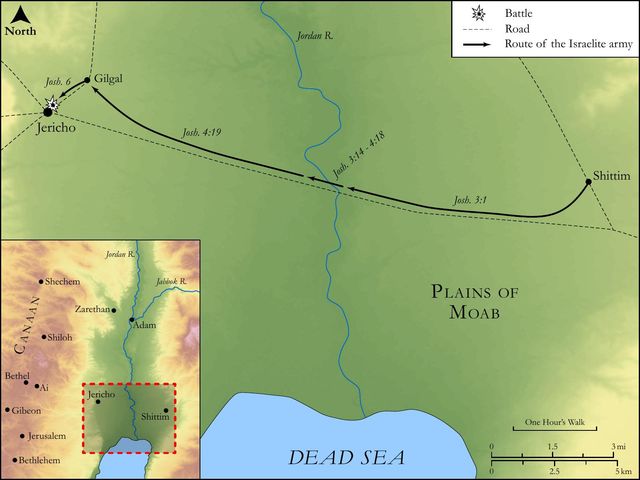
See on the biblical-era map
Study this verse
Public-domain commentary
Matthew Henry
From his Commentary on the Whole Bible. Henry comments on passages, not single verses — this entry covers Joshua 4:10–19.
The inspired historian seems to be so well pleased with his subject here that he is loth to quit it, and is therefore very particular in his narrative, especially in observing how closely Joshua pursued the orders God gave him, and that he did nothing without divine direction, finishing all that the Lord had commanded him (v. 10), which is also said to be what Moses commanded. We read not of any particular commands that Moses gave to Joshua about this matter: the thing was altogether new to him. It must therefore be understood of the general instructions Moses had given him to follow the divine direction, to deliver that to the people which he received of the Lord, and to take all occasions to remind them of their duty to God, as the best return for his favours to them. This which Moses, who was now dead and gone, had said to him, he had in mind at this time, and did accordingly. It is well for us to have the good instructions that have been given us ready to us when we have occasion for them.
I.The people hasted and passed over, v.
10. Some understand this of the twelve men that carried the stones, but it seems rather to be meant of the body of the people; for, though an account was given of their passing over (v. 1), yet here it is repeated for the sake of this circumstance, which was to be added, that they passed over in haste, either because Joshua by their officers ordered them to make haste, for it was to be but one day's work and they must not leave a hoof behind, or perhaps it was their own inclination that hastened them. 1. Some hasted because they were not able to trust God. They were afraid the waters should return upon them, being conscious of guilt, and diffident of the divine power and goodness. 2. Others because they were not willing to tempt God to continue the miracle longer than needs must, nor would they put the patience of the priests that bor the ark too much to the stretch by unnecessary delay. 3. Others because they were eager to be in Canaan, and would thus show how much they longed after that pleasant land. 4. Those that considered least, yet hasted because others did. He that believeth doth not make haste to anticipate God's counsels, but he makes haste to attend them, Isa 28:16.
II.The two tribes and a half led the van, Jos 4:12, Jos 4:13.
So they had promised when they had their lot given them on that side Jordan, Num 32:27. And Joshua had lately reminded them of their promise, Jos 1:12-15. It was fit that those who had the first settlement should be the first in the encounter of difficulties, the rather because they had not the incumbrance of families with them as the other tribes had, and they were all chose men, and fit for service, ready armed. It was a good providence that they had so strong a body to lead them on, and would be an encouragement to the rest. And the two tribes had no reason to complain: the post of danger is the post of honour.
III.When all the people had got clear to the other side, the priests with the ark came up out of Jordan.
This, one would think, should have been done of course; their own reason would tell them that now there was no more occasion for them, and yet they did not stir a step till Joshua ordered them to move, and Joshua did not order them out of Jordan till God directed him to do so, Jos 4:15-17. so observant were they of Joshua, and he of God, which was their praise, as it was their happiness to be under such good direction. How low a condition soever God may at any time bring his priests or people to, let them patiently wait, till by his providence he shall call them up out of it, as the priests here were called to come up out of Jordan, and let them not be weary of waiting, while they have the tokens of God's presence with them, even the ark of the covenant, in the depth of their adversity.
IV.As soon as ever the priests and the ark had come up out of Jordan, the waters of the river, which had stood on a heap, gradually flowed down according to their nature and usual course, and soon filled the channel again, v. 18. This makes it yet more evident that the stop which had now been given to the river was not from any secret natural cause, but purely from the power of God's presence, and for the sake of his Israel; for when Israel's turn was served, and the token of God's presence was removed, immediately the water went forward again; so that if it be asked, What ailed thee, O Jordan! that thou wast driven back? It must be answered, It was purely in obedience to the God of Israel, and in kindness to the Israel of God. There is therefore none like unto the God of Jeshurun; happy also art thou, O Israel! who is like unto thee, O people? Some observe here, by way of allusion, that when the ark, and the priests that bor it, are removed from any place, the flood-gates are drawn up, the defence has departed, and an inundation of judgments is to be expected shortly. Those that are unchurched will soon be undone. The glory has departed if the ark is taken.
V.Notice is taken of the honour put upon Joshua by all this (v.
14): On that day the Lord magnified Joshua, both by the fellowship he admitted him to with himself, speaking to him upon all occasions and being ready to be consulted by him, and by the authority he confirmed him in over both priests and people. Those that honour God he will honour, and when he will magnify a man, as he had said he would magnify Joshua (Jos 3:7), he will do it effectually. Yet it was not for Joshua's sake only that he was thus magnified, but to put him in a capacity of doing so much the more service to Israel, for hereupon they feared him as they feared Moses. Se here what is the best and surest way to command the respect of inferiors, and to gain their reverence and observance, not by blustering and threatening, and carrying it with a high hand, but by holiness and love, and all possible indications of a constant regard to their welfare, and to God's will and honour. Those are feared in the best manner, and to the best purpose, who make it to appear that God is with them, and that they set him before them. Those that are sanctified are truly magnified, and are worthy of double honour. Favourites of heaven should be looked on with awe.
VI.An account is kept of the time of this great event (v.
19): it was on the tenth day of the first month, just forty years since they came out of Egypt, wanting five days. God had said in his wrath that they should wander forty years in the wilderness, but, to make up that forty, we must take in the first year, which was then past, and had been a year of triumph in their deliverance out of Egypt, and this last, which had been a year of triumph likewise on the other side Jordan, so that all the forty were not years of sorrow; and at last he brought them into Canaan five days before the forty years were ended, to show how little pleasure God takes in punishing, how swift he is to show mercy, and that for the elects' sake the days of trouble are shortened, Mat 24:22. God ordered it so that they should enter Canaan four days before the annual solemnity of the passover, and on the very day when the preparation for it was to begin (Exo 12:3), because he would have their entrance into Canaan Graced and sanctified with that religious feast, and would have them then to be reminded of their deliverance out of Egypt, that, comparing them together, God might be glorified as the Alpha and Omega of their bliss.
Historical interpretation
Three Centuries of Reception
3 surviving comments on this verse. Each one is dated, so this reads as a timeline rather than a list.
Select a marker to jump to its quote. Markers stagger vertically where authors wrote within a few decades of each other.
Certainly, that exaltation of the son of Nun took place in order that the leader of those former people might be held eminent among those whom he ruled. But let us see how our Jesus my Lord, leader and ruler of this latter people, is “exalted” in the sight of all the descendants of the sons of Israel. I myself think that he was always exalted and elevated in the presence of the Father. But it is necessary that God exalt him in our sight. He is exalted in my sight when the sublimity and loftiness of his divinity is disclosed to me. When, therefore, is his lofty divinity revealed to me? At that time, assuredly, when I crossed over the Jordan and was equipped with the various defenses of the sacraments for the future battle.
Everyone who is under the law reveres Moses. But when one crosses over to the gospel from the law, by the changed observance the reverence is also changed. It is just as the apostle says, “For I through the law have died to the law so that I may live for God; I was crucified with Christ, but now I live; not I, but Christ lives in me.”
“In that day the Lord exalted Joshua.” The Lord exalted Joshua, for as he increased in age his strength became obvious [for all to see]. They rightly feared the son of Nun with a lawful fear as is fitting for service. And we rightly revere our Jesus with holy fear who stands by us for all eternity.
Continue studying Joshua 4:14 across the web’s major study libraries — every link below opens this exact verse, chapter, or book on the destination site.
Read & Compare
 BibleGatewayThis verse in more than 200 translations and 70 languages.
 Bible.comThe YouVersion reader — hundreds of translations, reading plans, and highlights.
 ESV.orgCrossway's official English Standard Version reader.
 NET BibleThe NET translation with 60,000+ translators' notes on every rendering decision.
 STEP BibleTyndale House's free study tool — original text, vocabulary, and scholarly resources.
 BibliaLogos Bible Software's free web reader.
 USCCBThe New American Bible (Revised Edition) with the U.S. bishops' study notes.
Commentaries
 BibleHub CommentariesDozens of classic commentaries on this verse, gathered on one page.
 StudyLightMore than 100 commentary sets — the largest collection on the web.
 BibleRefPlain-English commentary on what this verse means, verse by verse.
 Enduring WordDavid Guzik's free commentary on this chapter, widely used by Bible teachers.
 Bible Study ToolsVerse commentary alongside Greek and Hebrew study aids.
Original Language & Research
- BibleHub InterlinearThe verse word by word — original language, transliteration, and English.
- BibleHub LexiconEvery word's original-language definition and Strong's entry.
 Blue Letter BibleDeep-study tools — Strong's numbers, concordance, and word studies.
 SefariaThe Hebrew text with Rashi and centuries of Jewish commentary.
Sermons, Hymns & Audio


TrulyRandomVerse is not affiliated with these sites and doesn’t control their content. They’re linked because they’re genuinely useful.
Summary
Joshua 4:14 captures a pivotal moment in Israel's history, immediately following the miraculous crossing of the Jordan River, where the LORD unequivocally elevated Joshua's standing before the entire nation. This divine act served to publicly validate Joshua's leadership, firmly establishing him as Moses' divinely appointed successor. Consequently, the people's profound reverence and obedience towards Joshua mirrored the respect they had accorded Moses, underscoring God's continuous presence, unwavering guidance, and active validation of His chosen leader for the daunting task of entering and conquering the Promised Land.
Context
ShowHideLiterary Context
This verse is strategically positioned as the theological culmination of the miraculous Jordan River crossing, detailed in Joshua 3 and the beginning of Joshua 4. The preceding narrative meticulously recounts how the priests, bearing the Ark of the Covenant, stepped into the swollen Jordan, causing the waters to miraculously pile up, enabling the entire nation to cross on dry ground. This extraordinary event served as a profound sign, intentionally mirroring the earlier parting of the Red Sea under Moses' leadership. The subsequent command to erect twelve memorial stones, executed under Joshua's direction, further solidified the memory of this divine intervention for future generations. Thus, Joshua 4:14 functions as the immediate and direct consequence of this awe-inspiring display of God's power, transitioning the narrative from the miracle itself to the firm establishment of Joshua's divinely sanctioned authority for the impending conquest of Canaan.
Historical & Cultural Context
In Israel, the legitimacy of a leader was tied to visible demonstrations of divine favor, as the LORD promised Joshua, "This day will I begin to magnify thee in the sight of all Israel." Following the death of Moses, Israel found itself at a critical juncture, poised to invade a hostile land inhabited by formidable peoples. While Joshua had been appointed by Moses and had God's promise, he had not yet demonstrated the same public track record of miraculous leadership that had defined Moses' tenure. The Jordan crossing, therefore, was not merely a logistical maneuver but a crucial public spectacle designed to validate Joshua in the eyes of all Israel and to instill fear in the inhabitants of Canaan. This event, akin to the Red Sea deliverance for Moses, publicly affirmed God's active presence with Joshua. The "fear" mentioned in the verse is not terror but a profound reverence, awe, and respect for one chosen and empowered by God, a necessary foundation for unity, discipline, and obedience within the Israelite military and spiritual structure as they embarked on the challenging campaigns ahead.
Key Themes
ShowHideJoshua 4:14 powerfully encapsulates several core themes central to the book of Joshua and the broader biblical narrative. First, it highlights the Divine Validation of Leadership, emphasizing that Joshua's authority was not self-appointed or merely humanly conferred, but directly established and publicly affirmed by the LORD Himself. This echoes God's earlier promise to Joshua in Joshua 1:5 that He would be with him just as He had been with Moses. Second, the verse underscores Succession and Continuity in God's redemptive plan. The seamless transition from Moses to Joshua, marked by similar divine signs and the people's comparable reverence, assures Israel that God's covenant promises and His active guidance remain steadfast across generations. Finally, it speaks to the theme of Respect for Divinely Appointed Authority. The people's "fear" of Joshua, mirroring their fear of Moses, signifies a recognition of God's hand on their leader, understanding that obedience to Joshua was, in essence, obedience to God's will for their conquest and settlement of the Promised Land.
Exposition and Analysis
ShowHideKey Word Analysis
ShowHideThis primitive root means "to twist," but properly "to be (causatively make) large (in various senses, as in body, mind, estate or honor, also in pride)." In this context, it signifies that God actively and conspicuously elevated Joshua's status, influence, and reputation in the eyes of all Israel. It implies a divine act of public endorsement and promotion, demonstrating God's power working through Joshua and validating his leadership for the entire nation. It was not merely a passive recognition but an active divine act of making Joshua great.
This primitive root means "to fear; morally, to revere; caus. to frighten." In this verse, it conveys a profound sense of awe, reverence, respect, and submission, rather than paralyzing terror. It is the same term used to describe Israel's attitude towards God and Moses after the Red Sea deliverance in Exodus 14:31. Here, it indicates that the people understood Joshua's authority as divinely ordained and therefore worthy of deep respect and obedience, which was essential for their unity and success in the upcoming conquest of Canaan.
Verse Breakdown
ShowHide"On that day the LORD magnified Joshua in the sight of all Israel"
This clause emphasizes the immediate and public nature of God's decisive action. "On that day" refers specifically to the day of the Jordan crossing, making the divine validation directly consequent to the miracle. The "LORD" (Yahweh, H3068) is explicitly identified as the active agent, underscoring that Joshua's authority was not self-proclaimed or humanly contrived but divinely bestowed and demonstrated. The phrase "in the sight of all Israel" highlights the public spectacle and undeniable evidence of God's endorsement, ensuring that no one could reasonably question Joshua's legitimacy or divine appointment.
"and they feared him, as they feared Moses"
This segment describes the direct and intended result of God's magnification: the people's reverent respect and awe towards Joshua. The comparison to Moses (H4872) is profoundly significant, linking Joshua's leadership directly to the foundational figure of Israel's exodus and law-giving. It signifies that the new generation recognized the same divine presence, authority, and power operating through Joshua that the previous generation had recognized in Moses. This "fear" denotes a deep respect, awe, and willingness to obey, crucial for the cohesion of the nation.
"all the days of his life"
This final phrase, using "days" (H3117) and "life" (H2416), indicates the enduring and lasting nature of this established authority. It was not a fleeting moment of respect or a temporary surge of obedience but a sustained and consistent recognition of Joshua's God-given leadership that persisted throughout his entire tenure as Israel's leader. This longevity of respect was vital for the sustained unity and obedience required for the prolonged and challenging conquest and settlement of Canaan.
Literary Devices
ShowHideThe verse employs several powerful literary devices to convey its profound message. Parallelism is strikingly evident in the explicit comparison between Joshua and Moses, particularly in the phrase "as they feared Moses." This draws a direct link to the earlier account in Exodus 14:31 where Israel "feared the LORD and believed the LORD and his servant Moses." This parallelism serves to powerfully legitimize Joshua's leadership by associating him with the revered figure of Moses, thereby ensuring continuity of divine authority in the eyes of the people. Hyperbole might be perceived in the phrases "all Israel" and "all the days of his life," emphasizing the comprehensive and enduring nature of the people's reverence. While not literally every single individual or every single moment, it conveys the overwhelming and consistent recognition of Joshua's authority. Furthermore, the entire narrative context surrounding this verse functions as Symbolism, with the Jordan crossing acting as a symbolic second exodus, validating Joshua's role as the new Moses, leading the people into their promised inheritance.
Theological and Thematic Connections
ShowHideJoshua 4:14 stands as a profound theological statement on divine sovereignty in leadership and the unwavering continuity of God's covenant promises. It powerfully demonstrates that God actively intervenes to establish, empower, and publicly validate His chosen instruments, ensuring the fulfillment of His redemptive purposes. The divine validation of Joshua, mirroring that of Moses, reinforces the enduring truth that God remains faithful across generations, raising up leaders uniquely equipped for specific tasks within His overarching plan of redemption. This continuity of divine presence and authority provided essential stability and assurance to a nation embarking on a challenging and dangerous mission, reminding them that their success depended not on human strength or charisma, but on God's unwavering commitment to His covenant people and His ultimate control over history.
Reflection and Application
ShowHideJoshua 4:14 offers timeless and profound lessons on the nature of true leadership and the vital importance of recognizing God's hand in those He calls and sets apart. For those in leadership, it powerfully underscores that genuine authority and lasting influence stem not from human charisma, strategic brilliance, or personal ambition alone, but fundamentally from divine validation and empowerment. It serves as a compelling reminder to leaders to cultivate a deep reliance on God's presence and power for true effectiveness, understanding that their primary role is to faithfully steward what God has entrusted to them. For followers, this verse teaches the crucial importance of respecting and submitting to those whom God has placed in positions of authority, understanding that their leadership often reflects a divine purpose and serves God's broader plans. This "fear" is not a blind or uncritical obedience, but a discerning reverence for the office and, more importantly, for the God who appointed the individual. In our own lives, this passage encourages us to pray earnestly for our leaders, to support them in their God-given roles, and to recognize that God continues to raise up and equip individuals for His work in every generation, ensuring the ongoing progress and ultimate triumph of His kingdom in the world.
Questions for Reflection
ShowHideFAQ
ShowHideWhat does "the LORD magnified Joshua" truly mean in this context?
ShowHide"The LORD magnified Joshua" (H1431, gâdal') means that God Himself actively and publicly elevated Joshua's status, authority, and reputation in the eyes of all Israel. It was not merely that Joshua became great through his own efforts, but that God sovereignly made him great and visibly demonstrated His endorsement. This divine act of magnification was powerfully demonstrated through the miraculous Jordan River crossing, which served as undeniable proof of God's presence with Joshua, just as He had been with Moses during the Red Sea deliverance. This public and miraculous endorsement was absolutely crucial for Joshua's leadership, as it instilled confidence in the Israelites and firmly established his legitimacy as Moses' successor, ensuring their obedience, unity, and willingness to follow him as they prepared to conquer the Promised Land.
Christ-Centered Fulfillment
ShowHideJoshua 4:14, with its profound emphasis on divine validation and the establishment of a leader to guide God's people into their inheritance, powerfully foreshadows the ultimate leadership of Jesus Christ. Just as the LORD "magnified" Joshua, God the Father supremely magnified His Son, Jesus, demonstrating His divine authority through countless miraculous signs and wonders, culminating in His glorious resurrection and ascension. Jesus is the greater Joshua (Yeshua, meaning "the LORD saves"), not merely leading ancient Israel into an earthly promised land, but leading all believers into the spiritual realities of the new covenant and the eternal, heavenly inheritance of God's kingdom. The people's "fear" and reverence for Joshua, mirroring that for Moses, pales in comparison to the universal reverence and worship due to Christ, to whom "every knee should bow, of things in heaven, and things in earth, and things under the earth" (Philippians 2:10). Jesus' authority is not limited to a lifetime, but is eternal and absolute, for He Himself declared, "All authority has been given to Me in heaven and on earth" (Matthew 28:18). He is the true and ultimate leader who has overcome the ultimate Jordan—death itself—leading His people into the true rest and everlasting life that was only partially prefigured by the conquest of Canaan (Hebrews 4:8-10).