


Job 8:16
Bible text: King James Version (1769 Blayney text) · Public domain
Bible text: Berean Standard Bible · Public domain
Bible text: American Standard Version (1901) · Public domain
Bible text: World English Bible, Messianic edition · Public domain
Bible text: Geneva Bible (1599) · Public domain
Bible text: Young's Literal Translation · Public domain
- רָטֹבra·To[is] a fresh [plant]H7373Adj-msAdjective Singular Masculine Absolute
- הוּאhu'heH1931Pro-3msPronoun Personal 3rd Singular Masculine
- לִפְנֵיlif·nei<to> beforeH6440Prep-l ¦ N-mpcNoun Plural Masculine Constructלִ<to>פְנֵיbefore
- שָׁמֶשׁSha·mesh[the] sunH8121N-csNoun Singular common gender Absolute
- וְעַלve·'Aland overH5921Conj-w ¦ PrepPrepositionוְandעַלover
- גַּנָּתוֹga·na·Toits gardenH1593N-fsc ¦ 3msNoun Singular Feminine Constructגַּנָּתgardenוֹits
- יֹנַקְתּוֹyo·nak·Toits young shoot[s]H3127N-fsc ¦ 3msNoun Singular Feminine Constructיֹנַקְתּyoung shoot[s]וֹits
- תֵצֵאte·Tze'it goes outH3318V-Qal-Imperf-3fsVerb Qal Imperfect 3rd Singular Feminine
English is a literal word-by-word gloss of the Hebrew, not the KJV's wording. Why?
This is the original text the KJV's translators worked from — each Hebrew word with its own literal English meaning in this verse, prepared by scholars at Tyndale House, Cambridge. The KJV translates whole sentences, not word by word, so its wording differs: one Hebrew word can become several English words, and the KJV may choose “the LORD” where the gloss reads “Yahweh”. Both are faithful — they answer different questions. For the KJV's own rendering, switch to the KJV text.
Details
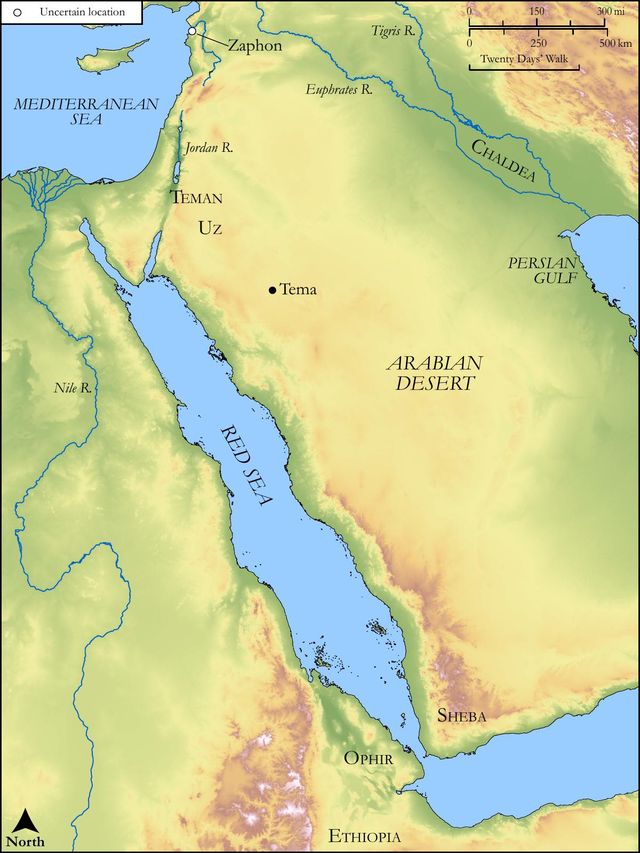
See on the biblical-era map
Study this verse
Public-domain commentary
Matthew Henry
From his Commentary on the Whole Bible. Henry comments on passages, not single verses — this entry covers Job 8:8–19. His four-level outline is real structure in the source text, so it is rendered as structure.
Bildad here discourses very well on the sad catastrophe of hypocrites and evil-doers and the fatal period of all their hopes and joys. He will not be so bold as to say with Eliphaz that none that were righteous were ever cut off thus (Job 4:7); yet he takes it for granted that God, in the course of his providence, does ordinarily bring wicked men, who seemed pious and were prosperous, to shame and ruin in this world, and that, by making their prosperity short, he discovers their piety to be counterfeit. Whether this will certainly prove that all who are thus ruined must be concluded to have been hypocrites he will not say, but rather suspect, and thinks the application is easy.
I.He proves this truth, of the certain destruction of all the hopes and joys of hypocrites, by an appeal to antiquity and the concurring sentiment and observation of all wise and good men; and an undoubted truth it is, if we take in the other world, that, if not in this life, yet in the life to come, hypocrites will be deprived of all their trusts and all their triumphs: whether Bildad so meant or no, we must so take it. Let us observe the method of his proof, Job 8:8-10.
1.He insists not on his own judgment and that of his companions: We are but of yesterday, and know nothing, Job 8:9. He perceived that Job had no opinion of their abilities, but thought they knew little. "We will own," says Bildad, "that we know nothing, are as ready to confess our ignorance as thou art to condemn it; for we are but of yesterday in comparison, and our days upon earth are short and transient, and hastening away as a shadow. And hence," (1.) "We are not so near the fountain-head of divine revelation" (which then for aught that appears, was conveyed by tradition) "as the former age was; and therefore we must enquire what they said and recount what we have been told of their sentiments." Blessed be God, now that we have the word of God in writing, and are directed to search that, we need not enquire of the former age, nor prepare ourselves to the search of their fathers; for, though we ourselves are but of yesterday, the word of God in the scripture is as nigh to us as it was to them (Rom 10:8), and it is the more sure word of prophecy, to which we must take heed. If we study and keep God's precepts, we may by them understand more than the ancients, Psa 119:99,Psa 119:100. (2.) "We do not live so long as those of the former age did, to make observations upon the methods of divine providence, and therefore cannot be such competent judges as they in a cause of this nature." Note, The shortness of our lives is a great hindrance to the improvement of our knowledge, and so are the frailty and weakness of our bodies. Vita brevis, ars longa - life is short, the progress of art boundless.
2.He refers to the testimony of the ancients and to the knowledge which Job himself had of their sentiments. "Do thou enquire of the former age, and let them tell thee, not only their own judgment in this matter, but the judgment also of their fathers, Job 8:8. They will teach thee, and inform thee (Job 8:10), that all along, in their time, the judgments of God followed wicked men. This they will utter out of their hearts, that is, as that which they firmly believe themselves, which they are greatly affected with and desirous to acquaint and affect others with." Note,
(1.)For the right understanding of divine Providence, and the unfolding of the difficulties of it, it will be of use to compare the observations and experiences of former ages with the events of our own day; and, in order thereto, to consult history, especially the sacred history, which is the most ancient, infallibly true, and written designedly for our learning.
(2.)Those that would fetch knowledge from the former ages must search diligently, prepare for the search, and take pains for the search.
(3.)Those words are most likely to reach to the hearts of the learners that come from the hearts of the teachers. Those shall teach thee best that utter words out of their heart, that speak by experience, and not by rote, of spiritual and divine things. The learned bishop Patrick suggests that Bildad being a Shuhite, descended from Shuah one of Abraham's sons by Keturah (Gen 25:2), in this appeal which he makes to history he has a particular respect to the rewards which the blessing of God secured to the posterity of faithful Abraham (who hitherto, and long after, continued in his religion) and to the extirpation of those eastern people, neighbours to Job (in whose country they were settled), for their wickedness, whence he infers that it is God's usual way to prosper the just and root out the wicked, though for a while they may flourish.
II.He illustrates this truth by some similitudes.
1.The hopes and joys of the hypocrite are here compared to a rush or flag, v. 11-13.
(1.)It grows up out of the mire and water. The hypocrite cannot gain his hope without some false rotten ground or other out of which to raise it, and with which to support it and keep it alive, any more than the rush can grow without mire. He grounds it on his worldly prosperity, the plausible profession he makes of religion, the good opinion of his neighbours, and his own good conceit of himself, which are no solid foundation on which to build his confidence. It is all but mire and water; and the hope that grows out of it is but rush and flag.
(2.)It may look green and gay for a while (the rush outgrows the grass), but it is light and hollow, and empty, and good for nothing. It is green for show, but of no use.
(3.)It withers presently, before any other herb, v. 12. Even while it is in its greenness it is dried away and gone in a little time. Note, The best state of hypocrites and evil-doers borders upon withering; even when it is green it is going. The grass is cut down and withers (Psa 90:6); but the rush is not cut down and yet withers, withers before it grows up (Psa 129:6): as it has no use, so it has no continuance. So are the paths of all that forget God (v. 13); they take the same way that the rush does, for the hypocrite's hope shall perish. Note,
[1.]Forgetfulness of God is at the bottom of men's hypocrisy, and of the vain hopes with which they flatter and deceive themselves in their hypocrisy. Men would not be hypocrites if they did not forget that the God with whom they have to do searches the heart and requires truth there, that he is a Spirit and has his eye on our spirits; and hypocrites would have no hope if they did not forget that God is righteous, and will not be mocked with the torn and the lame.
[2.]The hope of hypocrites is a great cheat upon themselves, and, though it may flourish for a while, it will certainly perish at last, and they with it.
2.They are here compared to a spider's web, or a spider's house (as it is in the margin), a cobweb, Job 8:14, Job 8:15. The hope of the hypocrite,
(1.)Is woven out of his own bowels; it is the creature of his own fancy, and arises merely from a conceit of his own merit and sufficiency. There is a great deal of difference between the work of the bee and that of the spider. A diligent Christian, like the laborious bee, fetches in all his comfort from the heavenly dews of God's word; but the hypocrite, like the subtle spider, weaves his out of a false hypothesis of his own concerning God, as if he were altogether such a one as himself.
(2.)He is very fond of it, as the spider of her web; pleases himself with it, wraps himself in it, calls it his house, leans upon it, and holds it fast. It is said of the spider that she takes hold with her hands, and is in kings' palaces, Pro 30:28. So does a carnal worldling hug himself in the fulness and firmness of his outward prosperity; he prides himself in that house as his palace, fortifies himself in it as his castle, and makes use of it as the spider of her web, to ensnare those he has a mind to prey upon. So does a formal professor; he flatters himself in his own eyes, doubts not of his salvation, is secure of heaven, and cheats the world with his vain confidences.
(3.)It will easily and certainly be swept away, as the cobweb with the besom, when God shall come to purge his house. The prosperity of worldly people will fail them when they expect to find safety and happiness in it. They seek to hold fast their estates, but God is plucking them out of their hands; and whose shall all those things be, which they have provided? or what the better they will be for them? The confidences of hypocrites will fail them. I tell you, I know you not. The house built on the sand will fall in the storm, when the builder most needs it and promised himself the benefit of it. When a wicked man dies his expectation perishes. The ground of his hopes will prove false; he will be disappointed of the thing he hoped for, and his foolish hope with which he buoyed himself up will be turned into endless despair; and thus his hope will be cut off, his web, that refuge of lies, swept away, and he crushed in it.
3.The hypocrite is here compared to a flourishing and well-rooted tree, which, though it do not wither of itself, yet will easily be cut down and its place no it no more. The secure and prosperous sinner may think himself wronged when he is compared to a rush and a flag; he thinks he has a better root. "We will allow him his conceit," says Bildad, "and give him all the advantage he can desire, and bring him in suddenly cut off." He is here represented as Nebuchadnezzar was in his own dream (Dan 4:10) by a great tree.
(1.)See this tree fair and flourishing (Job 8:16) like a green bay-tree (Psa 37:35), green before the sun, it keeps its greenness in defiance of the scorching sun-beams, and his branch shoots forth under the protection of his garden-wall and with the benefit of his garden-soil. See it fixed, and taking deep root, never likely to be overthrown by stormy winds, for his roots are interwoven with the stones (Job 8:17); it grows in firm ground, not, as the rush, of mire and water. Thus does a wicked man, when he prospers in the world, think himself secure; his wealth is a high wall in his own conceit.
(2.)See this tree felled and forgotten notwithstanding, destroyed from his place (Job 8:18), and so entirely extirpated that there shall remain no sign or token where it grew. The very place say, I have not seen thee; and the standers by shall say the same. I sought him, but he could not be found, Psa 37:36. He made a great show and a great noise for a time, but he is gone of a sudden, and neither root nor branch is left him, Mal 4:1. This is the joy (that is, this is the end and conclusion) of the wicked man's way (Job 8:19); this is that which all his joy comes to. The way of the ungodly shall perish, Psa 1:6. His hope, he thought, would in the issue be turned into joy; but this is the issue, this is the joy. The harvest shall be a heap in the day of grief and of desperate sorrow, Isa 17:11. This is the best of it; and what then is the worst of it? But shall he not leave a family behind him to enjoy what he has? No, out of the earth (not out of his roots) shall others grow, that are nothing akin to him, and shall fill up his place, and rule over that for which he labored. Others (that is, others of the same spirit and disposition) shall grow up in his place, and be as secure as ever he was, not warned by his fall. The way of worldlings is their folly, and yet there is a race of those that approve their sayings, Psa 49:13.
Historical interpretation
Historical reception
2 surviving comments on this verse. Each one is dated, so this reads as a timeline rather than a list.
Select a marker to jump to its quote. Markers stagger vertically where authors wrote within a few decades of each other.
The papyrus and the reed are dried by the scorching heat of the sun and their shoots rot, even though they are moistened by water. In fact, this is what “his branch shall sprout from his dung heap” means. The impious will suffer the same destiny, when the wrath of God falls upon them. Bildad appears to allude to the death of Job’s children through his use of “branch,” which can indicate shoots, branches or flowers.
76. Oftentimes in Holy Writ the Lord is represented by the title of the Sun, as it is said by the Prophet, But unto you that fear My Name shall the Sun of righteousness arise. [Mal. 4, 2] And as the ungodly that are cast away in the Judgment, are described in the book of Wisdom, as saying, We have erred from the way of truth, and the light of righteousness hath not shined unto us, and the Sun rose not upon us; [Wisd. 5, 6] therefore, ‘before the sun the rush is seen moist,’ in that before God's severity burns hot in the Judgment, every hypocrite shows himself bedewed with the grace of holiness. He is seen as it were flourishing, because he is accounted righteous, he wins the post of honour, he is strong in his high repute for sanctity, reverence is awarded to him by all men, his credit for praise is magnified. Thus this rush is full of moisture in the night, but on the coming of the sun it is dried up, in that the hypocrite is accounted holy by all men in the darkness of the present life, but when the searching Judge cometh, he will appear as wicked as he is. So then let him say, He appears moist before the sun, because now he shows himself flourishing to the eyes of men, but then he shall wither up in the scorching heat of the Divine Judgment. The account goes on;
And his produce I issueth forth in his springing up.
77. For every herb in general is first raised out of the ground by springing up, it is subject to the influences of the air and heat, it is fed by the sun and showers, and then at length it is made to open itself to put forth the produce of its seed. But the rush is produced along with its flower, and so soon as it springs out of the earth, it puts forth its produce of seed with itself. Therefore by the rest of the herbs the Saints in general are well denoted, but the hypocrite by ‘the rush,’ because the righteous, before they spring up [l] in the practice of holy conversation, undergo the winter season of this life, and the heats of bitter persecutions press them hard; and then, when they do what is right, they never look here for the reward of their, righteousness, but when they depart forth from the labours of the present world, on coming to their eternal Country, they enter upon the enjoyment of their looked-for reward. But contrariwise the hypocrite, in that he springs up in good practice at once, goes about to win the glory of the present world. As it were like a rush he springs up with his produce, who in return for this, that he is beginning to live well, aims at the outset to be held in honour by all men. So that the ‘produce in the springing up,’ is a reward at the outset. For often there are those that abandon the paths of overt wickedness, and put on the garb of holiness, and the moment they have touched the bare threshold of good living, forgetting what they were, they will not be henceforth chastened by penance for the iniquities they have committed, but they long to be commended for goodness begun; they are eager to get above the rest, even though better men than themselves. And for the most part whilst present prosperity follows them to their wish, they become infinitely worse than they were by the wearing of sanctity; but being busied with countless concerns, and distracted by that same busying, they not only never bewail the things that they have done, but still fill up more that should be bewailed.
78. For they that quit the world, ought not to be promoted to externa1[i.e. public] offices, unless in humility they be for some long time established in the contempt of that world. For the good soon comes to an end, which is made known to the world before the time. Thus with shrubs too that have been planted, if, before they are fastened with a firm root, the hand touch and shake them, it causes them to wither away, but, if the root be fixed deep, and, being sprinkled with the dews of the earth, be set fast, such as these the hand may even push, and not hurt: these even blasts of wind may buffet and wave, yet not overthrow. Thus, that the life of practice we have entered upon may not be uprooted, the root of the heart must be fixed long and vigorously in the deep of humility, that when from the mouths of men the breath of calumny or of applause blows strong, though it bend it a little either way, it may not root up the mind from its seat, but that after such bending it may return to its own upright standing, if it but hold strong in the root in its own self. What among things in course of growth is stronger than a rising wall? yet if, while it is in the act of erecting, it is pushed, it is at once destroyed without an effort; but if for a space of time it be allowed to dry from its wetness, often it is never a jot moved even by the strokes of the battering rams. In this way, in this self-same way, our goodness on the one hand being unseasonably displayed comes to nought, and on the other hand being longer kept hidden, is fairly secured; in that when the hand of human employment touches the recent life of our conversation, as it were it pushes the fresh brick wall, and easily destroys it, because it has not as yet got rid of the moisture of its own weakness. But when in its long lying at rest, the soul holds itself in, as it were like a dry wall, it grows hard against blows, and every thing that strikes it, now it is solid, bounds off it at once shattered. It is hence that Moses forbade the life of aught that made the beginning to be employed in services for men, saying, Thou shalt do no work with the firstling of thy bullock, nor shear the firstling of thy sheep. [Deut. 15, 19] For to ‘do work with the firstling of the bullock’ is to display the beginning of a good conversation in the employment of public business. Moreover ‘to shear the firstlings of sheep,’ is to lay bare of the covering of its concealment the good we have begun before the eyes of men. And so we are forbidden to ‘work with the firstling of the bullock,’ and we are hindered from ‘shearing the firstlings of our sheep,’ in that even if we begin any thing strong, we ought not to be too ready to execute it in public. And when our life commences something simple and harmless, it is meet that it quit not the coverings of its secresy, that it may not bare that thing naked to the eyes of the world, the fleece being as it were withdrawn.
79. So let the firstlings of the bullocks and the sheep avail for the Divine sacrifices alone, that whatsoever we begin strong and harmless, we may sacrifice in honour of the Judge of the interior upon the altar of our hearts. Which same we may be sure is accepted the more gladly by Him, in proportion as being kept concealed from men it is stained by no desire of applause. But it often happens that the beginnings of a new method of life have still a mixture of the carnal life, and therefore they ought not to be too ready to make themselves known, lest while the good that pleases is applauded, the soul being beguiled by the praises of itself have no power to discover in itself the evil that lies concealed. Hence it is rightly said by Moses again, And when ye shall have come into the land that I shall give you, and shall have planted all manner of trees bearing fruit, then ye shall take off their foreskins. The fruits that are put forth shall be unclean, unto you, ye shall not eat of them. [Lev. 19, 23] For ‘the trees bearing fruit’ are works fruitful in virtue, and so we ‘take off the foreskins of the trees,’ when suspecting ourselves of the mere weakness of a beginning in itself, we do not give our approval to the beginnings of our good practices, but the fruits that are put forth, we count unclean, and do not make them answer for good for us, in that when the beginnings of good practice are applauded, it is meet that the mind of the doer should not be fed thereby; lest whilst the praise bestowed is plucked with delight, the fruit of good works be eaten prematurely. He, then, that receives the praise of virtue in its beginning from the mouths of men, as it were eats the fruit of the tree that he has planted before the time,
80. Hence ‘Truth’ saith by the Psalmist, It is vain for you to rise up before the light: rise up after ye have sat. [Ps. 127, 2. Vulg.] For ‘to: rise up before the light’ is to take one's pleasure in the night-time of the present life, before the shining of Eternal Retribution is revealed. So we are to sit first, that we may rise afterwards in a right way. For whoever doth not now humble himself by his own act and deed, the glory to ensue does not exalt such an one. Therefore what it is there to rise before the light, it is here for the hypocrite to put forth the produce in his springing up, for in setting his heart on human applauses, in the self-same place, where he springs up to good works, there he desires directly to obtain the glorying of his recompense. Had not they ‘put forth their produce in their springing up,’ of whom ‘Truth’ said, They love the uppermost rooms at feasts, and the chief seats in the synagogues, and greetings in the markets, and to be called of men Rabbi? [Matt. 23, 6, 7] Therefore seeing that for this reason, viz. because they are beginning to do well, they endeavour to obtain honour of men, as it were, like a rush, ‘in their springing up they rise with their produce.’ These same, whilst they aim to practise right things, first anxiously look about for witnesses of those same works, and canvass with secret calculation, if there be persons to see the things they are about to do, or if those who see them can report them in a proper way. But if it chance to happen that no one witnesses their doings, then, surely, they reckon them to be lost to them, and they account the eyes of the interior Umpire as off them, because they have no mind to receive at His hands the reward of their works hereafter. And whereas when the hypocrite does any thing, he aims to be seen by many eyes, it is yet further added with truth concerning this same ‘rush,’
Continue studying Job 8:16 across the web’s major study libraries — every link below opens this exact verse, chapter, or book on the destination site.
Read & Compare
 BibleGatewayThis verse in more than 200 translations and 70 languages.
 Bible.comThe YouVersion reader — hundreds of translations, reading plans, and highlights.
 ESV.orgCrossway's official English Standard Version reader.
 NET BibleThe NET translation with 60,000+ translators' notes on every rendering decision.
 STEP BibleTyndale House's free study tool — original text, vocabulary, and scholarly resources.
 BibliaLogos Bible Software's free web reader.
 USCCBThe New American Bible (Revised Edition) with the U.S. bishops' study notes.
Commentaries
 BibleHub CommentariesDozens of classic commentaries on this verse, gathered on one page.
 StudyLightMore than 100 commentary sets — the largest collection on the web.
 BibleRefPlain-English commentary on what this verse means, verse by verse.
 Enduring WordDavid Guzik's free commentary on this chapter, widely used by Bible teachers.
 Bible Study ToolsVerse commentary alongside Greek and Hebrew study aids.
Original Language & Research
- BibleHub InterlinearThe verse word by word — original language, transliteration, and English.
- BibleHub LexiconEvery word's original-language definition and Strong's entry.
 Blue Letter BibleDeep-study tools — Strong's numbers, concordance, and word studies.
 SefariaThe Hebrew text with Rashi and centuries of Jewish commentary.
Sermons, Hymns & Audio


TrulyRandomVerse is not affiliated with these sites and doesn’t control their content. They’re linked because they’re genuinely useful.
Summary
Job 8:16, a statement by Bildad the Shuhite, employs a vivid botanical metaphor to illustrate the superficial and ultimately ephemeral nature of the wicked's apparent prosperity. Within Bildad's traditional retribution theology, this verse sets up a stark contrast, portraying an individual who seems to flourish abundantly and visibly, only to be swiftly and completely uprooted, thereby serving as a testament to what he perceives as God's immediate and unyielding justice against sin.
Context
ShowHideLiterary Context
Job 8:16 is situated within Bildad's first speech (Job 8:1-22), specifically in a section (Job 8:11-19) where he extensively uses botanical imagery to argue for the impermanence and inevitable downfall of the wicked. Bildad's primary objective is to persuade Job that his profound suffering is a direct consequence of his sin, aligning with the conventional wisdom theology of the men of the east that posited a direct, discernible correlation between righteousness and prosperity, and wickedness and affliction. This verse, "He [is] green before the sun, and his branch shooteth forth in his garden," presents the initial, seemingly robust image of a thriving plant. It is immediately followed by verses (Job 8:17-19) that describe its swift and complete demise: this vigorous plant is uprooted, its former place forgotten, and its very existence erased from memory. This metaphor serves as a powerful rhetorical device to underscore Bildad's unwavering conviction that God does not pervert justice and that the unrighteous will inevitably wither and perish.
Historical & Cultural Context
The Book of Job is set in the land of Uz, where agricultural life and natural cycles profoundly influenced daily existence, philosophical thought, and religious understanding. The pervasive use of plant imagery to convey spiritual or moral truths was a common literary and didactic device in ancient wisdom literature, evident throughout the Psalms and Proverbs. Central to the theological discussions of the time were concepts of divine justice, retribution, and the stark contrast between the prosperity of the righteous and the affliction of the wicked. Bildad's perspective reflects a conventional understanding of divine covenant, where blessings and curses were often perceived as immediate and tangible consequences of obedience or disobedience. The "garden" mentioned in the verse would have evoked an image of an ideal, cultivated, and protected environment, emphasizing that even under the most favorable conditions, a plant not truly rooted will fail. This cultural context helps an ancient audience readily grasp the power and implications of such a natural metaphor.
Key Themes
ShowHideJob 8:16, within the framework of Bildad's discourse, contributes significantly to several overarching themes. The most prominent is Fleeting Prosperity, which asserts that the success and vitality of the wicked are merely temporary and superficial. Like the plant that is "green before the sun," their apparent strength lacks true, enduring substance and is destined for swift decay. This concept is a recurring motif in wisdom literature, often serving as a warning against envy of the wicked, as articulated in Psalm 73:18-19, which speaks of the wicked being set in "slippery places" and brought to sudden ruin. Another key theme is Divine Justice, as understood by Bildad. For him, the plant's initial flourishing is merely a prelude to its deserved destruction, serving as irrefutable proof of God's just hand in bringing down the unrighteous. This view, however, contrasts sharply with Job's experience of righteous suffering, challenging the simplistic retribution theology that Bildad espouses. Finally, the verse highlights the Use of Nature as an Analogy, a pervasive literary technique throughout the Bible. Here, the plant's growth and eventual demise serve as a powerful metaphor for the life cycle of the wicked within Bildad's rigid theological framework. This stands in stark contrast to imagery of the righteous flourishing like a tree planted by streams of water, as beautifully described in Psalm 1:3.
Exposition and Analysis
ShowHideKey Word Analysis
ShowHideThis adjective (H7373) literally means "moist (with sap)" and is translated as "green." It vividly conveys a sense of lushness, freshness, and vigorous vitality. In this context, it emphasizes the outward appearance of health and prosperity, suggesting an abundance of sap and active growth, indicative of a plant in its prime. This verdant imagery makes the subsequent description of its decay all the more striking and poignant.
This feminine noun (H3127) refers to a "sprout," "tender branch," or "young twig." It signifies new, active growth and expansion, suggesting that the plant is not merely surviving but actively proliferating and extending its reach. The choice of "branch" here implies the offspring or the expanding influence of the wicked, reinforcing the image of a thriving entity.
This feminine noun (H1593) denotes a "garden" or cultivated enclosure. The presence of a garden implies an environment that is cared for, protected, and ideally conducive to growth. This setting suggests that the plant's flourishing is not accidental but seemingly well-established and nurtured under optimal conditions, making its eventual demise, as described in subsequent verses, even more indicative of an inherent flaw or divine judgment rather than environmental hardship.
Verse Breakdown
ShowHide"He [is] green before the sun"
This initial clause introduces the central metaphor of a flourishing plant, with "He" referring to the wicked individual in Bildad's argument. The term "green" (râṭôb) emphasizes the vibrant, fresh, and healthy outward appearance of this individual's life or prosperity. The phrase "before the sun" suggests that this flourishing is open, visible, and perhaps even dependent on the sun's life-giving properties. It implies a public display of success and vitality, seemingly unhindered and thriving in the full light of day.
"and his branch shooteth forth in his garden"
This second clause elaborates on the image of abundant prosperity. "His branch" signifies the offspring, descendants, or the expansion of the wicked person's influence and success. The verb "shooteth forth" (from yâtsâʼ, H3318) denotes vigorous, new growth, indicating an increase and proliferation. The setting "in his garden" suggests an ideal, cultivated, and protected environment, implying that this prosperity is not accidental but seemingly well-established and nurtured. Together, these clauses paint a vivid picture of abundant, unhindered, and seemingly secure flourishing.
Literary Devices
ShowHideJob 8:16 is rich in Imagery, painting a vivid picture of a plant that is "green before the sun" and has its "branch shooteth forth in his garden." This sensory detail allows the audience to visualize a scene of lush, vibrant growth. The primary device is Metaphor, where the flourishing plant serves as a direct comparison for the temporary prosperity of the wicked. Bildad uses this natural phenomenon to illustrate a theological point, asserting that just as a plant can appear healthy but lack deep roots, so too can the wicked appear successful without true, lasting foundation. There is also an element of Irony in Bildad's application of this metaphor. While the imagery itself accurately describes a type of growth, Bildad's rigid theology misapplies it to Job's situation, creating a dramatic irony where the audience knows Job is righteous, yet Bildad insists on his wickedness based on this flawed premise. Furthermore, the verse sets up a powerful Contrast that is fully realized in the subsequent verses (Job 8:17-19), where the initial image of flourishing is juxtaposed with the sudden and complete uprooting and forgetting of the plant, highlighting the transient nature of the wicked's success.
Theological and Thematic Connections
ShowHideBildad's use of the flourishing plant metaphor in Job 8:16, while ultimately misapplied to Job's specific circumstances, articulates a significant theological truth found elsewhere in Scripture: the transient nature of worldly success for those not truly rooted in God's truth. This verse highlights the danger of judging spiritual standing solely by outward prosperity, a common temptation in all ages. It underscores the biblical teaching that genuine flourishing is not merely an external display of wealth or power, but an internal vitality derived from a deep, abiding connection with the divine. While the wicked may appear to thrive, their foundation is ultimately unstable, leading to an inevitable and often swift downfall. This serves as a warning against envy of the unrighteous and a call to trust in God's ultimate justice, even when it is not immediately apparent.
Reflection and Application
ShowHideJob 8:16, despite its origin in Bildad's flawed counsel, offers profound insights for contemporary believers. It challenges us to look beyond superficial appearances and to critically evaluate what constitutes true, enduring prosperity. In a world often captivated by outward success, material wealth, and fleeting fame, this verse serves as a powerful reminder that not all that glitters is gold, and not all that flourishes is truly rooted. It encourages us to cultivate a spiritual discernment that recognizes the difference between temporary worldly gains and genuine, God-given flourishing that withstands the tests of time and adversity. Our focus should not be on accumulating transient successes, but on deepening our roots in Christ, ensuring that our growth is not merely "before the sun" but grounded in eternal truth. This perspective fosters patience, trust in God's perfect timing, and a steadfast commitment to righteousness, knowing that true vitality comes from Him alone, even if it doesn't always manifest in immediate, visible prosperity.
Questions for Reflection
ShowHideFAQ
ShowHideWas Bildad's theology completely wrong in this passage?
ShowHideWhile Bildad's application of his theology to Job was profoundly flawed and insensitive, the general principle he articulates in Job 8:16-19—that the prosperity of the wicked is temporary and ultimately leads to destruction—is a truth found elsewhere in Scripture. Many biblical texts, particularly in the wisdom literature (e.g., Psalm 73, Proverbs 24:19-20), affirm that the wicked will not ultimately escape divine judgment. Bildad's error lay not in the principle itself, but in his rigid, simplistic, and uncompassionate assumption that Job's suffering must be a direct result of his sin, thereby misapplying a general truth to a specific, complex situation without understanding God's broader purposes. He failed to grasp that God's ways are often beyond human comprehension, as later revealed in Job 38-41.
How does the imagery of a plant "green before the sun" relate to the "wicked"?
ShowHideThe imagery is a powerful metaphor for outward, visible prosperity that lacks true, lasting substance. A plant that is "green before the sun" appears vibrant, healthy, and thriving, much like a wicked person who might experience worldly success, wealth, or influence. The "sun" provides the ideal conditions for growth, symbolizing favorable circumstances. However, Bildad's point, fully developed in the subsequent verses (Job 8:17-19), is that this apparent flourishing is superficial. Unlike a deeply rooted tree, this plant is easily uprooted, its place forgotten, and its very existence erased. Thus, the "greenness" symbolizes a deceptive, temporary vitality that will inevitably wither because it lacks the deep, spiritual roots of righteousness and a true connection with God. It highlights the fleeting nature of success built on unrighteous foundations, contrasting it with the enduring stability of those who trust in the Lord (e.g., Jeremiah 17:7-8).
Christ-Centered Fulfillment
ShowHideBildad's flawed theology in Job 8:16, while attempting to explain suffering through a rigid cause-and-effect lens, inadvertently points to a deeper truth about true flourishing and divine justice, which finds its ultimate fulfillment in Christ. The temporary "greenness" of the wicked, destined to wither, stands in stark contrast to the eternal life and true vitality offered by Jesus. He is the true vine, and those who abide in Him bear lasting fruit, embodying a flourishing that is not superficial or fleeting but deeply rooted in divine life. Unlike the plant that is "green before the sun" but lacks true foundation, Christ's kingdom and the life He offers are eternal and unshakeable. His death and resurrection demonstrate God's perfect justice, not as a rigid retribution, but as a redemptive act that overcomes sin and death, offering genuine reconciliation and the promise of a glorious, unfading inheritance for all who believe (e.g., 1 Peter 1:3-4). In Christ, the suffering of the righteous is not evidence of sin, but often a path to deeper glory and identification with the suffering Servant. He is the one who truly flourishes in the "garden" of God's presence, offering a life that is eternally "green" and fruitful, a life that triumphs over the transient nature of all worldly prosperity and judgment (e.g., Revelation 22:1-2).