


Job 8:15
Bible text: King James Version (1769 Blayney text) · Public domain
Bible text: Berean Standard Bible · Public domain
Bible text: American Standard Version (1901) · Public domain
Bible text: World English Bible, Messianic edition · Public domain
Bible text: Geneva Bible (1599) · Public domain
Bible text: Young's Literal Translation · Public domain
- יִשָּׁעֵןyi·sha·'Enhe supports himselfH8172V-Niphal-Imperf-3msVerb Niphal Imperfect 3rd Singular Masculine
- עַל'alonH5921PrepPreposition
- בֵּיתוֹbei·tohis houseH1004N-msc ¦ 3msNoun Singular Masculine Constructבֵּיתhouseוֹhis
- וְלֹאve·Lo'and notH3808Conj-w ¦ NegParticle Negativeוְandלֹאnot
- יַעֲמֹדya·'a·Modit standsH5975V-Qal-Imperf-3msVerb Qal Imperfect 3rd Singular Masculine
- יַחֲזִיקya·cha·Zikhe takes holdH2388V-Hiphil-Imperf-3msVerb Hiphil Imperfect 3rd Singular Masculine
- בּוֹboon itPrep-b ¦ 3msSuffix Personal 3rd Singular Masculineבּonוֹit
- וְלֹאve·Lo'and notH3808Conj-w ¦ NegParticle Negativeוְandלֹאnot
- יָקוּםya·Kumit enduresH6965V-Qal-Imperf-3msVerb Qal Imperfect 3rd Singular Masculine
English is a literal word-by-word gloss of the Hebrew, not the KJV's wording. Why?
This is the original text the KJV's translators worked from — each Hebrew word with its own literal English meaning in this verse, prepared by scholars at Tyndale House, Cambridge. The KJV translates whole sentences, not word by word, so its wording differs: one Hebrew word can become several English words, and the KJV may choose “the LORD” where the gloss reads “Yahweh”. Both are faithful — they answer different questions. For the KJV's own rendering, switch to the KJV text.
Details
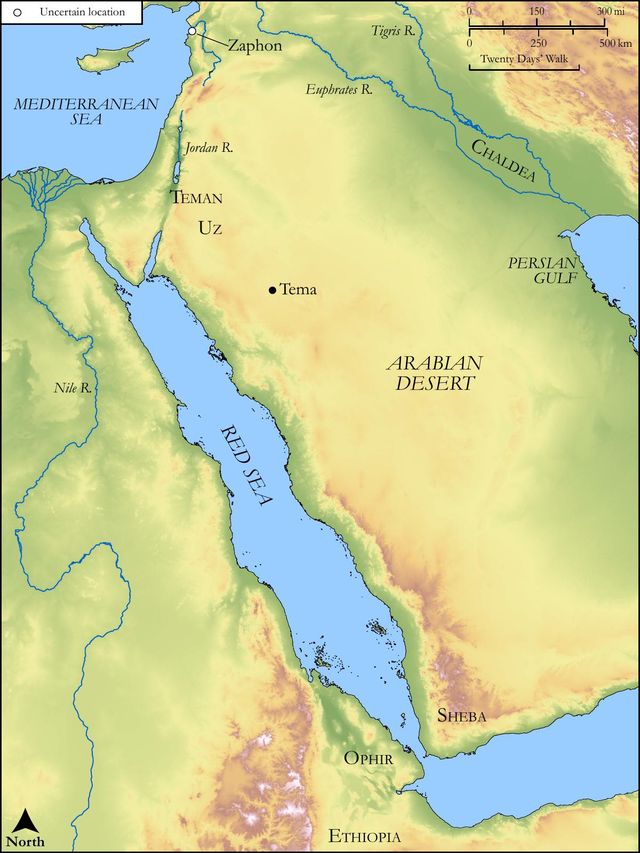
See on the biblical-era map
Study this verse
Public-domain commentary
Matthew Henry
From his Commentary on the Whole Bible. Henry comments on passages, not single verses — this entry covers Job 8:8–19. His four-level outline is real structure in the source text, so it is rendered as structure.
Bildad here discourses very well on the sad catastrophe of hypocrites and evil-doers and the fatal period of all their hopes and joys. He will not be so bold as to say with Eliphaz that none that were righteous were ever cut off thus (Job 4:7); yet he takes it for granted that God, in the course of his providence, does ordinarily bring wicked men, who seemed pious and were prosperous, to shame and ruin in this world, and that, by making their prosperity short, he discovers their piety to be counterfeit. Whether this will certainly prove that all who are thus ruined must be concluded to have been hypocrites he will not say, but rather suspect, and thinks the application is easy.
I.He proves this truth, of the certain destruction of all the hopes and joys of hypocrites, by an appeal to antiquity and the concurring sentiment and observation of all wise and good men; and an undoubted truth it is, if we take in the other world, that, if not in this life, yet in the life to come, hypocrites will be deprived of all their trusts and all their triumphs: whether Bildad so meant or no, we must so take it. Let us observe the method of his proof, Job 8:8-10.
1.He insists not on his own judgment and that of his companions: We are but of yesterday, and know nothing, Job 8:9. He perceived that Job had no opinion of their abilities, but thought they knew little. "We will own," says Bildad, "that we know nothing, are as ready to confess our ignorance as thou art to condemn it; for we are but of yesterday in comparison, and our days upon earth are short and transient, and hastening away as a shadow. And hence," (1.) "We are not so near the fountain-head of divine revelation" (which then for aught that appears, was conveyed by tradition) "as the former age was; and therefore we must enquire what they said and recount what we have been told of their sentiments." Blessed be God, now that we have the word of God in writing, and are directed to search that, we need not enquire of the former age, nor prepare ourselves to the search of their fathers; for, though we ourselves are but of yesterday, the word of God in the scripture is as nigh to us as it was to them (Rom 10:8), and it is the more sure word of prophecy, to which we must take heed. If we study and keep God's precepts, we may by them understand more than the ancients, Psa 119:99,Psa 119:100. (2.) "We do not live so long as those of the former age did, to make observations upon the methods of divine providence, and therefore cannot be such competent judges as they in a cause of this nature." Note, The shortness of our lives is a great hindrance to the improvement of our knowledge, and so are the frailty and weakness of our bodies. Vita brevis, ars longa - life is short, the progress of art boundless.
2.He refers to the testimony of the ancients and to the knowledge which Job himself had of their sentiments. "Do thou enquire of the former age, and let them tell thee, not only their own judgment in this matter, but the judgment also of their fathers, Job 8:8. They will teach thee, and inform thee (Job 8:10), that all along, in their time, the judgments of God followed wicked men. This they will utter out of their hearts, that is, as that which they firmly believe themselves, which they are greatly affected with and desirous to acquaint and affect others with." Note,
(1.)For the right understanding of divine Providence, and the unfolding of the difficulties of it, it will be of use to compare the observations and experiences of former ages with the events of our own day; and, in order thereto, to consult history, especially the sacred history, which is the most ancient, infallibly true, and written designedly for our learning.
(2.)Those that would fetch knowledge from the former ages must search diligently, prepare for the search, and take pains for the search.
(3.)Those words are most likely to reach to the hearts of the learners that come from the hearts of the teachers. Those shall teach thee best that utter words out of their heart, that speak by experience, and not by rote, of spiritual and divine things. The learned bishop Patrick suggests that Bildad being a Shuhite, descended from Shuah one of Abraham's sons by Keturah (Gen 25:2), in this appeal which he makes to history he has a particular respect to the rewards which the blessing of God secured to the posterity of faithful Abraham (who hitherto, and long after, continued in his religion) and to the extirpation of those eastern people, neighbours to Job (in whose country they were settled), for their wickedness, whence he infers that it is God's usual way to prosper the just and root out the wicked, though for a while they may flourish.
II.He illustrates this truth by some similitudes.
1.The hopes and joys of the hypocrite are here compared to a rush or flag, v. 11-13.
(1.)It grows up out of the mire and water. The hypocrite cannot gain his hope without some false rotten ground or other out of which to raise it, and with which to support it and keep it alive, any more than the rush can grow without mire. He grounds it on his worldly prosperity, the plausible profession he makes of religion, the good opinion of his neighbours, and his own good conceit of himself, which are no solid foundation on which to build his confidence. It is all but mire and water; and the hope that grows out of it is but rush and flag.
(2.)It may look green and gay for a while (the rush outgrows the grass), but it is light and hollow, and empty, and good for nothing. It is green for show, but of no use.
(3.)It withers presently, before any other herb, v. 12. Even while it is in its greenness it is dried away and gone in a little time. Note, The best state of hypocrites and evil-doers borders upon withering; even when it is green it is going. The grass is cut down and withers (Psa 90:6); but the rush is not cut down and yet withers, withers before it grows up (Psa 129:6): as it has no use, so it has no continuance. So are the paths of all that forget God (v. 13); they take the same way that the rush does, for the hypocrite's hope shall perish. Note,
[1.]Forgetfulness of God is at the bottom of men's hypocrisy, and of the vain hopes with which they flatter and deceive themselves in their hypocrisy. Men would not be hypocrites if they did not forget that the God with whom they have to do searches the heart and requires truth there, that he is a Spirit and has his eye on our spirits; and hypocrites would have no hope if they did not forget that God is righteous, and will not be mocked with the torn and the lame.
[2.]The hope of hypocrites is a great cheat upon themselves, and, though it may flourish for a while, it will certainly perish at last, and they with it.
2.They are here compared to a spider's web, or a spider's house (as it is in the margin), a cobweb, Job 8:14, Job 8:15. The hope of the hypocrite,
(1.)Is woven out of his own bowels; it is the creature of his own fancy, and arises merely from a conceit of his own merit and sufficiency. There is a great deal of difference between the work of the bee and that of the spider. A diligent Christian, like the laborious bee, fetches in all his comfort from the heavenly dews of God's word; but the hypocrite, like the subtle spider, weaves his out of a false hypothesis of his own concerning God, as if he were altogether such a one as himself.
(2.)He is very fond of it, as the spider of her web; pleases himself with it, wraps himself in it, calls it his house, leans upon it, and holds it fast. It is said of the spider that she takes hold with her hands, and is in kings' palaces, Pro 30:28. So does a carnal worldling hug himself in the fulness and firmness of his outward prosperity; he prides himself in that house as his palace, fortifies himself in it as his castle, and makes use of it as the spider of her web, to ensnare those he has a mind to prey upon. So does a formal professor; he flatters himself in his own eyes, doubts not of his salvation, is secure of heaven, and cheats the world with his vain confidences.
(3.)It will easily and certainly be swept away, as the cobweb with the besom, when God shall come to purge his house. The prosperity of worldly people will fail them when they expect to find safety and happiness in it. They seek to hold fast their estates, but God is plucking them out of their hands; and whose shall all those things be, which they have provided? or what the better they will be for them? The confidences of hypocrites will fail them. I tell you, I know you not. The house built on the sand will fall in the storm, when the builder most needs it and promised himself the benefit of it. When a wicked man dies his expectation perishes. The ground of his hopes will prove false; he will be disappointed of the thing he hoped for, and his foolish hope with which he buoyed himself up will be turned into endless despair; and thus his hope will be cut off, his web, that refuge of lies, swept away, and he crushed in it.
3.The hypocrite is here compared to a flourishing and well-rooted tree, which, though it do not wither of itself, yet will easily be cut down and its place no it no more. The secure and prosperous sinner may think himself wronged when he is compared to a rush and a flag; he thinks he has a better root. "We will allow him his conceit," says Bildad, "and give him all the advantage he can desire, and bring him in suddenly cut off." He is here represented as Nebuchadnezzar was in his own dream (Dan 4:10) by a great tree.
(1.)See this tree fair and flourishing (Job 8:16) like a green bay-tree (Psa 37:35), green before the sun, it keeps its greenness in defiance of the scorching sun-beams, and his branch shoots forth under the protection of his garden-wall and with the benefit of his garden-soil. See it fixed, and taking deep root, never likely to be overthrown by stormy winds, for his roots are interwoven with the stones (Job 8:17); it grows in firm ground, not, as the rush, of mire and water. Thus does a wicked man, when he prospers in the world, think himself secure; his wealth is a high wall in his own conceit.
(2.)See this tree felled and forgotten notwithstanding, destroyed from his place (Job 8:18), and so entirely extirpated that there shall remain no sign or token where it grew. The very place say, I have not seen thee; and the standers by shall say the same. I sought him, but he could not be found, Psa 37:36. He made a great show and a great noise for a time, but he is gone of a sudden, and neither root nor branch is left him, Mal 4:1. This is the joy (that is, this is the end and conclusion) of the wicked man's way (Job 8:19); this is that which all his joy comes to. The way of the ungodly shall perish, Psa 1:6. His hope, he thought, would in the issue be turned into joy; but this is the issue, this is the joy. The harvest shall be a heap in the day of grief and of desperate sorrow, Isa 17:11. This is the best of it; and what then is the worst of it? But shall he not leave a family behind him to enjoy what he has? No, out of the earth (not out of his roots) shall others grow, that are nothing akin to him, and shall fill up his place, and rule over that for which he labored. Others (that is, others of the same spirit and disposition) shall grow up in his place, and be as secure as ever he was, not warned by his fall. The way of worldlings is their folly, and yet there is a race of those that approve their sayings, Psa 49:13.
Historical interpretation
Historical reception
1 surviving comment on this verse from the historical church.
74. As the house of our exterior life is the building which the body lives in, so the house of our thought is any thing whatever that the mind is centered in by affection. For every thing that we love, we as it were make our dwelling-place by reposing in it. Whence Paul, because he had fixed his heart in things above, being still upon earth indeed, yet a stranger to earth, said, Our conversation is in heaven. [Phil. 3, 20] So the mind of the hypocrite in whatever it does minds nothing else but the fame of its own reputation, nor cares where it is carried [‘ducitur’] after by its deserts, but what it is called [‘dicatur’] in the mean season. Therefore his house is delight of popularity, which he as it were dwells in at rest, in that in all his works he throws himself back thereupon within his mind. But this house can never stand, because praise fleeth away with life, and the applause of man does not hold in the Judgment. Hence the foolish virgins too, who took no oil in their vessels, because their glory was in the voices of others and not in their own consciences, confounded by the presence of the Bridegroom, say, Give us of your oil, for our lamps are going out. [Matt. 25, 8] For to seek oil from our neighbours is to beseech the fame of good works from the testimony of another man's mouth. For the empty soul, when it finds that it has retained nothing within by all its labours, looks about for testimony from without. As if the foolish Virgins said plainly, ‘When ye behold us cast away without reward, say ye what ye have seen in our practice.’
75. But the hypocrite leans in vain then upon this house of applause, since no human testimony stands him in stead in the Judgment; for the same praise, which he afterwards claims in testimony, he before received in reward. Or surely the hypocrite leans upon his house, when beguiled by vain caresses, he is as it were lifted up in assurance of his holiness; for hypocrites do many things evil in secret, but a few things good in public. And when they receive praises from the good that appears, they turn away the eyes of observation from the concealed ill, and they esteem themselves such as they hear without, not such as they know themselves within. Whence it very often happens that they also come to the Judgment of the Most High with confidence, because they imagine themselves such in the sight of the Interior Judge, as they were held to be by men without. Yet ‘the house of the hypocrite cannot stand,’ for in the terror of a sifting search, all the foregoing assurance of holiness falls to the ground. And when he knows that the testimony of another man's lips is wanting to him, he betakes himself to reckoning up his own works. Hence it is still further added, He shall prop it, but it shall not rise up. For that which cannot stand by itself, is propped to make it stand; for when the hypocrite sees his life tottering in the Judgment, he sets himself to make it stand in propping it, by the enumeration of his deeds. Do not they prop the dwelling-place of their own praise on every hand, who in reckoning up their own deeds in the Judgment, as we said before, say, Lord, Lord, have we not prophesied in Thy Name? and in Thy Name have cast out devils? and in Thy Name done many marvellous works? [Matt. 7, 22. 23.] But the house of praise, stayed up by all these statements, cannot rise, because the Judge saith directly, I never knew you; depart from Me, ye that work iniquity. And it is to be had in mind that any thing, that rises, lifts itself from below to a higher elevation, and so ‘the house of the hypocrite cannot rise,’ in that in all that he may have done after the heavenly precepts, he never lifted his soul from off the earth, so that with justice he is not then lifted up to the meed of recompense, who in that which he sets forth now, lies prostrate in the desire of temporal glory. But whereas we have heard how the life of the hypocrite, represented by the name of ‘a rush,’ is rejected in the Judgment, let us hear what sort of person he is held by men before the strict Judge appeareth.
Continue studying Job 8:15 across the web’s major study libraries — every link below opens this exact verse, chapter, or book on the destination site.
Read & Compare
 BibleGatewayThis verse in more than 200 translations and 70 languages.
 Bible.comThe YouVersion reader — hundreds of translations, reading plans, and highlights.
 ESV.orgCrossway's official English Standard Version reader.
 NET BibleThe NET translation with 60,000+ translators' notes on every rendering decision.
 STEP BibleTyndale House's free study tool — original text, vocabulary, and scholarly resources.
 BibliaLogos Bible Software's free web reader.
 USCCBThe New American Bible (Revised Edition) with the U.S. bishops' study notes.
Commentaries
 BibleHub CommentariesDozens of classic commentaries on this verse, gathered on one page.
 StudyLightMore than 100 commentary sets — the largest collection on the web.
 BibleRefPlain-English commentary on what this verse means, verse by verse.
 Enduring WordDavid Guzik's free commentary on this chapter, widely used by Bible teachers.
 Bible Study ToolsVerse commentary alongside Greek and Hebrew study aids.
Original Language & Research
- BibleHub InterlinearThe verse word by word — original language, transliteration, and English.
- BibleHub LexiconEvery word's original-language definition and Strong's entry.
 Blue Letter BibleDeep-study tools — Strong's numbers, concordance, and word studies.
 SefariaThe Hebrew text with Rashi and centuries of Jewish commentary.
Sermons, Hymns & Audio


TrulyRandomVerse is not affiliated with these sites and doesn’t control their content. They’re linked because they’re genuinely useful.
Summary
Job 8:15, a pronouncement by Bildad the Shuhite, serves as a poignant warning against the futility of placing one's ultimate trust in any self-constructed foundation, particularly in the face of divine scrutiny. It vividly portrays the inevitable collapse of security and stability built apart from God's enduring truth, emphasizing that such reliance, no matter how diligently maintained, is inherently transient and destined to fail. The verse underscores the impermanence of worldly anchors when confronted by the unyielding consequences of a life misaligned with divine principles.
Context
ShowHideLiterary Context
This verse is an integral part of Bildad the Shuhite's initial discourse (Job 8:1-22) in response to Job's profound lament. Bildad, rooted in a conventional, rigid wisdom theology, posits a direct and simplistic correlation between suffering and sin, and conversely, between prosperity and righteousness. He interprets Job's immense suffering as irrefutable evidence of his wickedness, asserting that God, being just, invariably punishes the guilty while blessing the righteous. Within his speech, Bildad employs a series of natural metaphors to illustrate the ephemeral nature of the wicked. Verses 11-14, for instance, describe marsh plants that wither without water and a spider's fragile web, setting the metaphorical stage for the more direct and powerful image of the collapsing house in verse 15. The subsequent verses (Job 8:16-19) further extend this imagery, depicting the wicked as a plant uprooted and forgotten, thereby reinforcing the pervasive theme of inevitable downfall for those not firmly rooted in righteousness.
Historical & Cultural Context
In Hebrew thought, the concept of a "house" (Hebrew: bayith) transcended its literal meaning as a physical dwelling. It functioned as a profound symbol encompassing one's entire household, family lineage, reputation, accumulated wealth, social standing, and ultimately, one's legacy or dynasty. To "lean upon his house" or "hold it fast" would signify placing one's ultimate trust, security, and identity in these established aspects of one's life, relying on human efforts and achievements rather than divine provision. The dominant wisdom tradition of the era, as exemplified by Job's friends, strongly advocated a retributive justice system where divine favor followed obedience and divine judgment followed sin. While this worldview contained elements of truth regarding moral order, its simplistic application often failed to account for the complexities of suffering and divine sovereignty, a central tension that the book of Job meticulously explores.
Key Themes
ShowHideJob 8:15 significantly contributes to several profound themes woven throughout the book of Job and broader biblical wisdom literature. It powerfully illustrates the theme of False Security, highlighting the pervasive human tendency to place ultimate reliance on transient and unreliable foundations—be it material possessions, social status, personal accomplishments, or even human relationships—rather than on an eternal, divine bedrock. This stands in stark contrast to the theme of True Wisdom, which the book of Job ultimately defines not as rigid adherence to human-centric theological formulas, but as the reverent fear of the Lord and a deliberate turning away from evil (Job 28:28). Furthermore, the verse underscores the Transience of Worldly Foundations, emphasizing that anything not rooted in God's truth "shall not stand" and "shall not endure," a concept powerfully echoed in Jesus' parable of the wise and foolish builders. Implicit in Bildad's argument, though tragically misapplied to Job, is the theme of Divine Justice and Consequences, where actions, particularly those of the wicked, inevitably lead to ruin.
Exposition and Analysis
ShowHideKey Word Analysis
ShowHideThis verb (H8172) signifies more than mere physical support; it carries the profound connotation of trust, reliance, or confident dependence. When the text states "He shall lean upon his house," it implies a deep-seated confidence and security placed in one's own established life, wealth, or human systems. It is the act of resting one's entire weight, both physically and existentially, upon something, expecting it to provide unwavering support. The underlying sense is one of profound trust and dependence.
As explored in the context, "house" (H1004) here is a rich and expansive metaphor. It represents not just a physical dwelling but the entirety of one's security system: family, lineage, possessions, reputation, achievements, and all that constitutes one's perceived stability, identity, and legacy. It is the sum total of what a person builds and relies upon in life for their sense of safety and permanence. The term encompasses a broad spectrum of human endeavors and accumulations.
This verb (H5975) means "to stand, to remain, to endure, to be established." Its negation, "shall not stand," emphatically declares the absolute certainty of collapse and failure. Despite any reliance placed upon it, the "house" will not remain upright; it will inevitably fall. This signifies the inherent instability and impermanence of any foundation built apart from divine truth and righteousness. The word conveys the idea of maintaining one's position or integrity, which in this context, is utterly denied to the false foundation.
Verse Breakdown
ShowHide"He shall lean upon his house,"
This opening clause vividly portrays a person placing their full weight, trust, and confidence in their self-made security. This "house" can represent their accumulated wealth, social status, family connections, personal achievements, or any system of human devising that promises stability. It suggests a deep, existential reliance on something other than God for ultimate support and well-being.
"but it shall not stand:"
This is the immediate and inevitable consequence of such misplaced trust. Despite the heavy reliance, the "house"—the foundation of their life and security—will not remain upright; it will collapse. This signifies the inherent instability, fragility, and impermanence of any foundation built apart from divine truth and righteousness, highlighting its inability to withstand the tests of life or divine judgment.
"he shall hold it fast,"
This clause illustrates the desperate human effort to maintain control and preserve what is perceived as secure. It speaks to the futile attempts to prop up a failing system through sheer will, strength, or tenacity. It underscores the tenacity with which individuals often cling to their false securities, even when their inadequacy becomes apparent.
"but it shall not endure."
This final clause powerfully reiterates and reinforces the previous one, emphasizing the absolute certainty of ultimate and complete failure. Despite the most strenuous efforts to "hold fast," the foundation will not last; it will not be able to stand firm against the forces that inevitably bring it down. The repetition underscores the unyielding nature of consequences when trust is fundamentally misplaced, leading to inescapable ruin.
Literary Devices
ShowHideJob 8:15 masterfully employs several literary devices to convey its stark and profound message. The primary device is Metaphor, where "his house" stands as a comprehensive symbol for one's entire system of security, wealth, reputation, and life's foundation. The actions of "leaning upon" and "holding fast" are also metaphorical, representing deep trust and desperate clinging, respectively. The verse also utilizes strong Parallelism, specifically Synonymous Parallelism, where the second half of the verse ("he shall hold it fast, but it shall not endure") largely reiterates and amplifies the meaning of the first half ("He shall lean upon his house, but it shall not stand"). This repetition serves to intensify the certainty and finality of the message, creating a powerful rhetorical emphasis on inevitable collapse. Furthermore, there is a subtle yet profound Irony in Bildad's application of this truth. While the principle of a failing human foundation is universally true, Bildad's rigid and simplistic theology ironically misapplies it to Job, failing to grasp the deeper complexities of God's sovereign ways and Job's blamelessness, thereby highlighting the limits of human wisdom.
Theological and Thematic Connections
ShowHideJob 8:15 resonates deeply with the broader biblical narrative concerning the nature of true security and the inherent dangers of misplaced trust. It stands as a timeless warning against building one's life on anything other than God Himself, who is consistently portrayed throughout Scripture as the only unshakeable foundation, the Rock upon whom one can truly lean and find enduring stability. Any attempt to construct a lasting edifice of security—whether through accumulated wealth, social power, human wisdom, self-righteousness, or personal achievements—is ultimately futile and destined for collapse. This verse serves as a profound theological statement on the impermanence of all earthly things when compared to the eternal steadfastness and unwavering faithfulness of the Divine. It calls believers to a radical reorientation of trust from the temporal to the eternal.
Reflection and Application
ShowHideJob 8:15 offers a sober and challenging reflection for every individual, compelling us to critically examine the true foundation of our hope and security in a world that constantly encourages us to build our lives around material possessions, career achievements, social status, or even seemingly stable relationships. Are we, like the person described in the verse, leaning heavily upon our "house"—our self-made systems of comfort, control, and perceived invincibility—believing that our efforts can make them endure? The verse serves as a powerful reminder that no matter how tightly we try to "hold fast" to these transient things, they are ultimately incapable of providing lasting stability or protection when faced with life's inevitable storms, unforeseen adversities, or divine judgment. True and lasting security is found not in what we can build or grasp, but in placing our unwavering faith and reliance on the Lord, who alone is our unshakeable Rock and our eternal refuge. It calls us to a profound shift in trust: from the fleeting to the eternal, from the visible to the invisible, and to build our lives on the solid, unchanging ground of God's truth and character.
Questions for Reflection
ShowHideFAQ
ShowHideDoes "his house" only refer to a physical dwelling in Job 8:15?
ShowHideNo, the term "house" (Hebrew: bayit) in Job 8:15 extends far beyond a mere physical dwelling. In Hebrew thought, and throughout the Bible, "house" is a rich metaphor that can signify one's entire household, family lineage, possessions, reputation, wealth, security, and even one's entire system of support and identity. When Bildad says "He shall lean upon his house," he is referring to the sum total of what a person builds and relies upon in life for security and stability, apart from God. This could include a person's accumulated wealth, their social standing, their personal achievements, or any self-constructed system of perceived safety. The verse underscores that any such foundation, no matter how diligently constructed or desperately clung to, "shall not stand" and "shall not endure" if it is not rooted in divine truth, echoing the broader biblical teaching on the vanity of earthly pursuits.
Christ-Centered Fulfillment
ShowHideJob 8:15, though spoken by Bildad and tragically misapplied to Job, powerfully foreshadows the ultimate truth revealed in Christ: that all humanly constructed foundations are inherently unstable and destined to fail, while Christ alone provides the unshakeable ground for true life and eternal security. The "house" upon which one leans and which "shall not stand" represents any attempt to find salvation, righteousness, or lasting peace apart from God. In the New Testament, Jesus himself contrasts the foolish man who built his house on sand with the wise man who built on the rock, revealing that hearing and obeying His words is the only secure foundation that can withstand life's storms. The Apostle Paul explicitly declares that "no one can lay any foundation other than the one already laid, which is Jesus Christ" (1 Corinthians 3:11). The instability and inevitable collapse of the "house" in Job 8:15 point directly to the profound necessity of building our lives on Christ, who is the cornerstone of God's eternal temple, and through whom we receive an unshakeable kingdom. Our ultimate security and enduring hope are found not in what we can accumulate or achieve, but in the person and redemptive work of Jesus, the Lamb of God who takes away the sin of the world, who is Himself the solid Rock upon whom we can lean and truly endure for eternity.