


Ezekiel 47:4
Bible text: King James Version (1769 Blayney text) · Public domain
Bible text: King James Version with Strong's numbers · Public domain
Bible text: Berean Standard Bible · Public domain
Bible text: American Standard Version (1901) · Public domain
Bible text: World English Bible, Messianic edition · Public domain
Bible text: Geneva Bible (1599) · Public domain
Bible text: Young's Literal Translation · Public domain
- וַיָּמָדvai·Ya·modand he measured outH4058Conj-w ¦ V-Qal-ConsecImperf-3msVerb Qal Consecutive Imperfect 3rd Singular Masculineוַandיָּמָדhe measured out
- אֶלֶף'E·lefa thousand [cubits]H505Adj-csAdjective Numerical Singular common gender Absolute
- וַיַּעֲבִרֵנִיvai·ya·'a·vi·Re·niand he made pass meH5674Conj-w ¦ V-Hiphil-ConsecImperf-3ms ¦ 1csVerb Hiphil Consecutive Imperfect 3rd Singular Masculineוַandיַּעֲבִרֵhe made passנִיme
- בַמַּיִםva·Ma·yimin the watersH4325Prep-b ¦ N-mpNoun Plural Masculine Absoluteבַin theמַּיִםwaters
- מַיִםMa·yimwatersH4325N-mpNoun Plural Masculine Absolute
- בִּרְכָּיִםbir·Ka·yimkneesH1290N-fdNoun Dual Feminine Absolute
- וַיָּמָדvai·Ya·modand he measured outH4058Conj-w ¦ V-Qal-ConsecImperf-3msVerb Qal Consecutive Imperfect 3rd Singular Masculineוַandיָּמָדhe measured out
- אֶלֶף'E·lefa thousand [cubits]H505Adj-csAdjective Numerical Singular common gender Absolute
- וַיַּעֲבִרֵנִיvai·ya·'a·vi·Re·niand he made pass through meH5674Conj-w ¦ V-Hiphil-ConsecImperf-3ms ¦ 1csVerb Hiphil Consecutive Imperfect 3rd Singular Masculineוַandיַּעֲבִרֵhe made pass throughנִיme
- מֵיmeiwaters ofH4325N-mpcNoun Plural Masculine Construct
- מָתְנָיִםma·te·Na·yimloinsH4975N-mdNoun Dual Masculine Absolute
English is a literal word-by-word gloss of the Hebrew, not the KJV's wording. Why?
This is the original text the KJV's translators worked from — each Hebrew word with its own literal English meaning in this verse, prepared by scholars at Tyndale House, Cambridge. The KJV translates whole sentences, not word by word, so its wording differs: one Hebrew word can become several English words, and the KJV may choose “the LORD” where the gloss reads “Yahweh”. Both are faithful — they answer different questions. For the KJV's own rendering, switch to the KJV text.
Details
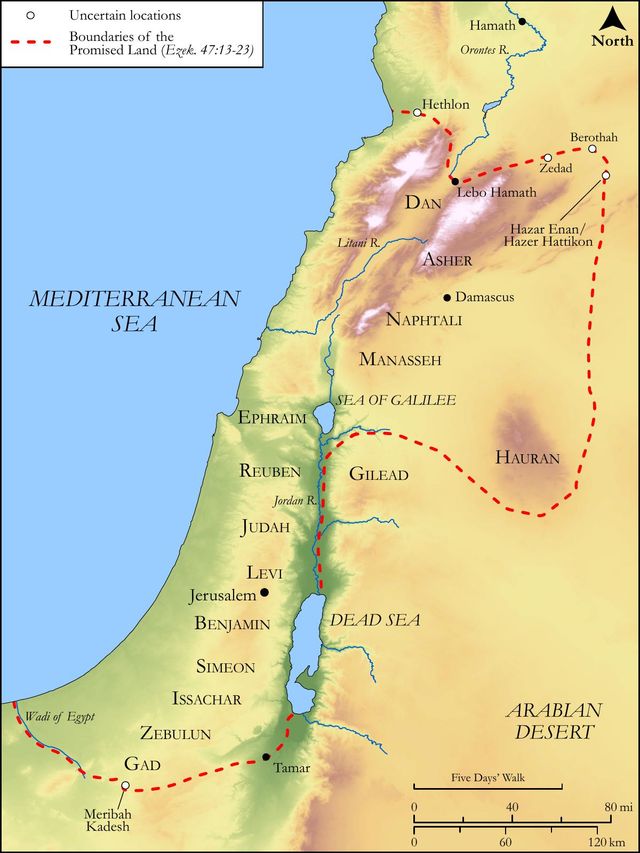
See on the biblical-era map
Study this verse
Public-domain commentary
Matthew Henry
From his Commentary on the Whole Bible. Henry comments on passages, not single verses — this entry covers Ezekiel 47:1–12. His two-level outline is real structure in the source text, so it is rendered as structure.
This part of Ezekiel's vision must so necessarily have a mystical and spiritual meaning that thence we conclude the other parts of his vision have a mystical and spiritual meaning also; for it cannot be applied to the waters brought by pipes into the temple for the washing of the sacrifices, the keeping of the temple clean, and the carrying off of those waters, for that would be to turn this pleasant river into a sink or common sewer. That prophecy, Zac 14:8, may explain it, of living waters that shall go out from Jerusalem, half of them towards the former sea and half of them towards the hinder sea. And there is plainly a reference to this in St. John's vision of a pure river of water of life, Rev 22:1. That seems to represent the glory and joy which are grace perfected. This seems to represent the grace and joy which are glory begun. Most interpreters agree that these waters signify the gospel of Christ, which went forth from Jerusalem, and spread itself into the countries about, and the gifts and powers of the Holy Ghost which accompanied it, and by virtue of which it spread far and produced strange and blessed effects. Ezekiel had walked round the house again and again, and yet did not till now take notice of those waters; for God makes known his mind and will to his people, not all at once, but by degrees. Now observe,
I.The rise of these waters.
He is not put to trace the streams to the fountain, but has the fountain-head first discovered to him (Eze 47:1): Waters issued out from the threshold of the house eastward, and from under the right side of the house, that is, the south side of the alter. And again (Eze 47:2), There ran out waters on the right side, signifying that from Zion should go forth the law and the word of the Lord from Jerusalem, Isa 2:3. There it was that the Spirit was poured out upon the apostles, and endued them with the gift of tongues, that they might carry these waters to all nations. In the temple first they were to stand and preach the words of this life, Act 5:20. They must preach the gospel to all nations, but must begin at Jerusalem, Luk 24:47. But that is not all: Christ is the temple; he is the door; from him those living waters flow, out of his pierced side. It is the water that he gives us that is the well of water which springs up, Joh 4:14. And it is by believing in him that we receive from him rivers of living water; and this spoke he of the Spirit, Joh 7:38, Joh 7:39. The original of these waters was not above-ground, but they sprang up from under the threshold; for the fountain of a believer's life is a mystery; it is hid with Christ in God, Col 3:3. Some observe that they came forth on the right side of the house to intimate that gospel-blessings are right-hand blessings. It is also an encouragement to those who attend at Wisdom's gates, at the posts of her doors, who are willing to lie at the threshold of God's house, as David was, that they lie at the fountainhead of comfort and grace; the very entrance into God's word gives light and life, Psa 119:130. David speaks it to the praise of Zion, All my springs are in thee, Psa 87:7. They came from the side of the altar, for it is in and by Jesus Christ, the great altar (who sanctifies our gifts to God), that God has blessed us with spiritual blessings in holy heavenly places. From God as the fountain, in him as the channel, flows the river which makes glad the city of our God, the holy place of the tabernacles of the Most High, Psa 46:4. But observe how much the blessedness and joy of glorified saints in heaven exceed those of the best and happiest saints on earth; here the streams of our comfort arise from under the threshold; there they proceed from the throne the throne of God and of the Lamb, Rev 22:1.
II.The progress and increase of these waters:
They went forth eastward (Eze 47:3), towards the east country (Eze 47:8), for so they were directed. The prophet and his guide followed the stream as it ran down from the holy mountains, and when they had followed it about a thousand cubits they went over across it, to try the depth of it, and it was to the ankles, Eze 47:3. Then they walked along on the bank of the river on the other side, a thousand cubits more, and then, to try the depth of it, they waded through it the second time, and it was up to their knees, Eze 47:4. They walked along by it a thousand cubits more, and then forded it the third time, and then it was up to their middle - the waters were to the loins. They then walked a thousand cubits further, and attempted to repass it the fourth time, but found it impracticable: The waters had risen, by the addition either of brooks that fell into it above ground or by springs under ground, so that they were waters to swim in, a river that could not be passed over, Eze 47:5. Note,
1.The waters of the sanctuary are running waters, as those of a river, not standing waters, as those of a pond. The gospel, when it was first preached, was still spreading further. Grace in the soul is still pressing forward; it is an active principle, plus ultra - onward still, till it comes to perfection.
2.They are increasing waters. This river, as it runs constantly, so the further it goes the fuller it grows. The gospel-church was very small in its beginnings, like a little purling brook; but by degrees it came to be to the ankles, to the knees: many were added to it daily, and the grain of mustard seed grew up to be a great tree. The gifts of the Spirit increase by being exercised, and grace, where it is true, is growing, like the light of the morning, which shines more and more to the perfect day.
3.It is good for us to follow these waters, and go along with them. Observe the progress of the gospel in the world; observe the process of the work of grace in the heart; attend the motions of the blessed Spirit, and walk after them, under a divine guidance, as Ezekiel here did.
4.It is good to be often searching into the things of God, and trying the depth of them, not only to look on the surface of those waters, but to go to the bottom of them as far as we can, to be often digging, often diving, into the mysteries of the kingdom of heaven, as those who covet to be intimately acquainted with those things.
5.If we search into the things of God, we shall find some things very plain and easy to be understood, as the waters that were but to the ankles, others more difficult, and which require a deeper search, as the water to the knees or the loins, and some quite beyond our reach, which we cannot penetrate into, or account for, but, despairing to find the bottom, must, as St. Paul, sit down at the brink, and adore the depth, Rom 11:33. It has been often said that in the scripture, like these waters of the sanctuary, there are some places so shallow that a lamb may wade through them, and others so deep that an elephant may swim in them. And it is our wisdom, as the prophet here, to begin with that which is most easy, and get our hearts washed with those things before we proceed to that which is dark and hard to be understood; it is good to take our work before us.
III.The extent of this river:
It issues towards the east country, but thence it either divide itself into several streams or fetches a compass, so that it goes down into the desert, and so goes into the sea, either into the dead sea, which lay south-east, or the sea of Tiberias, which lay north-east, or the great sea, which lay west, Eze 47:8. This was accomplished when the gospel was preached with success throughout all the regions of Judea and Samaria (Act 8:1), and afterwards the nations about, nay, and those that lay most emote, even in the isles of the sea, were enlightened and leavened by it. The sound of it went forth to the end of the world; and the enemies of it could no more prevail to stop the progress of it than that of a mighty river.
IV.The healing virtue of this river.
The waters of the sanctuary, wherever they come and have a free course, will be found a wonderful restorative. Being brought forth into the sea, the sulphureous lake of Sodom, that standing monument of divine vengeance, even those waters shall be healed (Eze 47:8), shall become sweet, and pleasant, and healthful. This intimates the wonderful and blessed change that the gospel would make, wheresoever it came in its power, a a great change, in respect both of character and condition, as the turning of the dead sea into a fountain of gardens. When children of wrath became children of love, and those that were dead in trespasses an sins were made alive, then this was fulfilled. The gospel was as that salt which Elisha cast into the spring of the waters of Jericho, with which he healed them, Kg2 2:20, Kg2 2:21. Christ, coming into the world to be its physician, sent his gospel as the great medicine, the panpharmacon; there is in it a remedy for every malady. Nay, wherever these rivers come, they make things to live (Eze 47:9), both plants and animals; they are the water of life, Rev 22:1, Rev 22:17. Christ came, that we might have life and for that end he sends his gospel. Every thing shall live whither the river comes. The grace of God makes dead sinners alive and living saints lively; everything is made fruitful and flourishing by it. But its effect is according as it is received, and as the mind is prepared and disposed to receive it; for (Eze 47:11) with respect to the marshes and miry places thereof, that are settled in the mire of their own sinfulness, and will not be healed, or settled in the moisture of their own righteousness, and think they need no healing, their doom is, They shall not be healed; the same gospel which to others is a savour of life unto life shall to them be a savour of death unto death; they shall be given to salt, to perpetual barrenness, Deu 29:23. Those that will not be watered with the grace of God, and made fruitful, shall be abandoned to their own hearts' lusts, and left for ever unfruitful. He that is filthy, let him be filthy still. Never fruit grow on thee more for ever. They shall be given to salt, that is, to be monuments of divine justice, as Lot's wife that was turned into a pillar of salt, to season others.
V.The great plenty of fish that should be in this river.
Everything living moving thing shall be found here, shall live here (Eze 47:9), shall come on and prosper, shall be the best of the kind, and shall increase greatly; so that there shall be a very great multitude of fish, according to their kinds, as the fish of the great sea, exceedingly many. There shall be as great plenty of the river fish, and as vast shoals of them, as there is of salt-water fish, Eze 47:10. There shall be no great numbers of Christians in the church, and those multiplying like fishes in the rising generations and the dew of their youth. In the creation the waters brought forth the fish abundantly (Gen 1:20, Gen 1:21), and they still live in and by the waters that produced them; so believers are begotten by the word of truth (Jam 1:18), and born by it (Pe1 1:23), that river of God; by it they live, from it they have their maintenance and subsistence; in the waters of the sanctuary they are as in their element, out of them they are as fish upon dry ground; so David was when he thirsted and panted for God, for the living God. Where the fish are known to be in abundance, thither will the fishers flock, and there they will cast their nets; and therefore, to intimate the replenishing of these waters and their being made every way useful, it is here foretold that the fishers shall stand upon the banks of this river, from En-gedi, which lies on the border of the dead sea, to En-eglaim, another city, which joins to that sea, and all along shall spread their nets. The dead sea, which before was shunned as noisome and noxious, shall be frequented. Gospel-grace makes those persons and places which were unprofitable and good for nothing to become serviceable to God and man.
VI.The trees that were on the banks of this river - many trees on the one side and on the other (Eze 47:7), which made the prospect very pleasant and agreeable to the eye; the shelter of these trees also would be a convenience to the fishery. But that is not all (Eze 47:12); they are trees for meat, and the fruit of them shall not be consumed, for it shall produce fresh fruit every month. The leaf shall be for medicine, and it shall not fade, This part of the vision is copied out into St. John's vision very exactly (Rev 22:2), where, on either side of the river, is said to grow the tree of life, which yielded her fruit every month, and the leaves were for the healing of the nations. Christians are supposed to be these trees, ministers especially, trees of righteousness, the planting of the Lord (Isa 61:3), set by the rivers of water, the waters of the sanctuary (Psa 1:3), grafted into Christ the tree of life, and by virtue of their union with him made trees of life too, rooted in him, Col 2:7. There is a great variety of these trees, through the diversity of gifts with which they are endued by that one Spirit who works all in all. They grow on the bank of the river, or they keep close to holy ordinances, and through them derive from Christ sap and virtue. They are fruit-trees, designed, as the fig tree and the olive, with their fruits to honour God and man, Jdg 9:9. The fruit thereof shall be for meat, for the lips of the righteous feed many. The fruits of their righteousness are one way or other beneficial. The very leaves of these trees are for medicine, for bruises and sores, margin. Good Christians with their good discourses, which are as their leaves, as well as with their charitable actions, which are as their fruits, do good to those about them; they strengthen the weak, and bind up the broken-hearted. Their cheerfulness does good like a medicine, not only to themselves, but to others also. They shall be enabled by the grace of God to persevere in their goodness and usefulness; their leaf shall not fade, or lose its medicinal virtue, having not only life in their root, but sap in all their branches; their profession shall not wither (Psa 1:3), neither shall the fruit thereof be consumed; that is, they shall not lose the principle of their fruitfulness, but shall still bring forth fruit in old age, to show that the Lord is upright (Psa 92:14, Psa 92:15), or the reward of their fruitfulness shall abide for ever; they bring forth fruit that shall abound to their account in the great day, fruit to life eternal; that is indeed fruit which shall not be consumed. They bring new fruit according to their months, some in one month and others in another: so that still there shall be one or other found to serve the glory of God for the purpose he designs. Or each one of them shall bring forth fruit monthly, which denotes an abundant disposition to fruit-bearing (they shall never be weary of well-doing), and a very happy climate, such that there shall be a perpetual spring and summer. And the reason of this extraordinary fruitfulness is because their waters issued out of the sanctuary; it is not to be ascribed to any thing in themselves, but to the continual supplies of divine grace, with which they are watered every moment (Isa 27:3); for, whoever planted them, it was that which gave the increase.
Historical interpretation
Historical reception
1 surviving comment on this verse from the historical church.
(Chapter 47, verses 1 and following) And he brought me back to the door of the house, and behold, water was coming out from under the threshold of the house eastward. For the face of the house was toward the east, and the water was flowing down from the right side of the temple, south of the altar. Then he led me out by way of the north gate and led me around on the outside to the outer gate that faces toward the east; and behold, water was trickling from the right side. When the man went out toward the east with a line in his hand, he measured a thousand cubits, and he led me through the water, water reaching the ankles (or passed through water of remission). And he measured again a thousand, and he led me through the water up to the knees (or he passed in the water unto the thighs). And he measured a thousand, and he led me through the water up to the loins (or he passed in the water unto the waist). And he measured a thousand of a deep, which I could not pass over, because the waters were risen, waters of a deep river, which could not be passed over. For which LXX have translated: And he measured a thousand, and could not pass over: because the water was bearing a stream like the rapid stream, which cannot be passed over. These waters which were flowing out from beneath the threshold of the house, that is, the temple, did not flow towards the North and the West, but also towards the East, and on the right side of the temple, that is, towards the South, and towards the very South not of any place, but of the altar. From this it becomes clear that the waters are sacred, and they signify the doctrine of our Savior, according to that which is written: 'For out of Zion shall go forth the law, and the word of the Lord from Jerusalem' (Isaiah 2:3). And in another place: The knowledge of the Lord fills everything, like water covering the sea (Isai. XI, 9). Concerning these waters, the Prophet Zacharias also predicted, saying: In that day, living water will flow out from Jerusalem, half of it toward the eastern sea and half of it toward the western sea (Zach. XIV, 8). Concerning these waters, the Lord spoke to the Samaritan woman: If you knew who it is that asks you for a drink, you would have asked Him, and He would have given you living water (John IV, 10). And again: Everyone who drinks from this water will be thirsty again; but whoever drinks from the water that I will give him will never be thirsty again (John 4:13). And in the temple he cried out and said: If anyone thirsts, let him come to me and drink. Whoever believes in me (as the scripture says), out of his belly will flow rivers of living water. But this he said of the Spirit, which those who believed in him were to receive (John 7:37-38). These are the waters that the prophet spoke of in the psalm: He led me beside still waters (Psalm 23:3). And Ezekiel: I will take you from the nations, and gather you from all the countries, and I will sprinkle clean water upon you, and you shall be clean from all your uncleannesses. (Ezek. XXXVI, 24, 25). For water fountains appeared. And in the ninety-second Psalm it is sung: The rivers have lifted up, O Lord, the rivers have lifted up their voices from the voices of many waters. Wonderful are the elevations of the sea. (Ps. XCII, 2, 3). These are the waters of Siloam, which flow with silence, of which Isaiah speaks: You shall draw waters with joy from the fountains of salvation. (Isaiah XII, 3). And the Psalmist says: Bless the Lord from the fountains of Israel (Ps. 67). Likewise, Isaiah speaks of the Lord as Savior: He, it is said, shall dwell in the high cave of the strongest rock. Bread shall be given to him, and his water shall be faithful (Isa. 33:16). For water burst forth in the desert, and a valley in a thirsty land. And it is said to the believers: Do not fear, for I have redeemed you; you are mine, and if you pass through water, I am with you (Isa. 43:1, 2). And again: 'All you who are thirsty, come to the water' (Isaiah 55:1). And through Jeremiah, God speaks: 'My people have committed two evils: they have forsaken me, the fountain of living waters, and hewed out cisterns for themselves, broken cisterns that can hold no water' (Jeremiah 2:13). Therefore, just as we read in a good sense the waters that flow from the threshold of the temple and are returned to the teaching of the Church, so are bitter waters and the worst waters to which the prophet Jeremiah forbids us to approach, saying: 'What have you to do with the way of Egypt, to drink from the waters of the Nile?' (ibid). The Hebrew term for 'turbid and muddy' is Sior. Regarding these, God speaks angrily about the heretics: Behold, I will feed them with bitterness and give them poisonous water to drink (Jeremiah 9:15), in which the Egyptian dragon reigns, saying: The rivers are mine, and I made them; he who sees all that is high, and he himself is the king of those who are in the waters. Therefore, the man from Sirach prays to the Lord and says: Save me, O Lord, for the waters have come up to my neck. I am stuck in the mud of the deep, and there is no substance, and the storm has engulfed me (Ps. 68:1-2). And again; Deliver me from those who hate me, and from the depths of the waters: let not the water storm overwhelm me, nor let the depths swallow me up, nor let the pit close its mouth over me (Ps. 15:16). And in another psalm: If it had not been the Lord who was on our side, let Israel now say: If it had not been the Lord who was on our side. When men rose up against us, then they might have swallowed us up alive. When their fury was raging against us, perhaps the water would have swallowed us up (Psalm 123:1-3). And the Bride in the Song of Songs: Many waters cannot quench love, nor can rivers drown it (Song of Songs 8:7). This is the water of which Hosea speaks: The city of Galaad has scorned me, a city that works in vanities, disturbing the water, and the strength of its men are pirates (Hosea 6:7-8). This water is called by another name, Mara, which means bitterness; into it the wood of the Cross is placed, and the bitter is turned into sweet. Consider the law of Moses, if understood according to the carnal sense of the Jews, how bitter it is, 'an eye for an eye, a tooth for a tooth' (Exodus XXI); see the fornication of Thamar (II Kings XIII), and the joining of the prostitute by Hosea (Hosea I, Jeremiah XIII), Moses' Ethiopian wife, and the killing of the Egyptian, and a thousand other things, which if understood according to the literal sense, and not according to the life-giving spirit, are bitter, and do not edify the reader as much as they destroy (Numbers XII, Exodus II). Therefore, those waters which flow out from the temple of the Lord, and proceed to the East, and descend to the right side of the Temple, to the South of the altar, where the bridegroom feeds his guests, and reclines. But what follows: And he led me by the way of the North gate, and turned to the way outside the outer gate, the way that looked towards the East, he covertly shows that we cannot immediately reach the Eastern gate, unless we go around it through the way of the North gate. For unless we conquer the most extreme cold by the heat of faith, and trample on its regions, that may be fulfilled in us what is in the Apostle: But the God of peace shall crush Satan under your feet speedily. (Rom. 16:20), we will not be able to enter the gate through which the waters flow out, which are on the right side. And note that those waters that enter through the gate of the East flee so much towards the left side, that they are described as going from the right side of the altar to the South. But the man, he said, who had a rope in his hand, when he had led me through the gate on the outer side to the road that looked towards the East, and he himself was also in the same place, measured the same water a thousand cubits; and he led me through the water up to the ankles, which Aquila and Symmachus, and Theodotio rendered as 'ankles', for which the LXX rendered: and he passed into the water, the water of forgiveness: which we can understand as signifying the first sins of men, which are forgiven for us when we enter the waters of the Lord, and they show the saving grace of baptism and are the beginnings of progress, yet they themselves are sublime. Finally, they reach the ankles, which are close to the heel and exposed to the bites of snakes, as the Lord says: You will watch out for its head, and it will watch out for your heel (Gen. III, 15, according to the Septuagint). And in the Psalms about Judas the betrayer, it is said: He who ate my bread has magnified treachery against me (Ps. XL, 10), or rather the heel, for the Greek word πτέρνη (or πτέρνα in some manuscripts) means heel. But after one thousand cubits, which bring us to the ankle, he measures another thousand cubits in water and leads me up to the knees. After the forgiveness of sins, and during the journey of progress, when we attempt to ascend even a little from earthly things to higher ones, we bend our knees to the Lord, with the Apostle saying: So that every knee shall bow, in heaven, on earth, and under the earth, and every tongue confess that the Lord Jesus Christ is in the glory of God the Father (Philippians 2:10). He measures another three thousand cubits, and leads me through the water up to my waist, he says. For we climb to lofty heights by degrees: but those very heights descend to the loins and kidneys, so that every base desire within us is cut off; and we possess the sanctification of the body, without which no one sees God. Hence in the same Prophet it is written: 'From His feet to His loins He is a fiery God' (Ezekiel 8:2). For the loins need fire and purgation, as the just man says, 'For my loins are filled with illusions' (Psalm 38:8), through which the enemy deludes us both in the day and in the night time. But from the loins to the head and neck, it shines with the glitter of precious electrum, so that it has nothing filthy in itself, nothing of cheapness. Hence it is now said in the fourth (book): And he measured a thousand, with the addition of cubits, of a torrent (which the Septuagint did not translate), which I could not go through: much better than the Seventy who said, and he could not go through. For the prophet and all human nature, after the loins of the torrent of thoughts, and the incentives of vices in the heart, cannot go through. But that man, who was clothed with Baddim and was the leader of the prophets, passed through easily; who did not commit sin, nor was guile found in his mouth (Isaiah 56). And he gives the reasons why the prophet could not pass through a thousand cubits: because, he says, the deep waters of the torrent had swelled, which could not be crossed. And as it is written, with the prophet boasting: Our soul has passed through the torrent (Psalm 124, 5). But it is easily resolved if we know that this is written in Hebrew: A torrent passed through my soul. Concerning this torrent, Isaiah says: Behold, I will extend peace over them like a river, and the glory like a overflowing torrent (Isa. LXVI, 12). And in the thirty-fifth psalm, it is said about the saints: They will hope in the protection of your wings. They will be intoxicated with the abundance of your house, and you will give them to drink from the river of your delights; for with you is the fountain of life (Psal. XXXV, 8, 9). And on the hundred and twenty-fifth: Convert, O Lord, our captivity, like a stream in the South (Psalm 125:5). And about the Savior: He shall drink from the brook by the wayside (Psalm 110:7). For who among men can boast of having a pure heart? (Proverbs 20). Or whose mind, through the windows of the eyes, shall not be entered by the death of desire (Jeremiah 9), and, dare I say, the tickling of the soul? For the world is placed in the evil one (1 John 5:19), and from childhood the heart of man is inclined to evil, so that from the very beginning of his birth, not even for one day, is human condition without sin (Job 15). And David confesses in the psalm: Behold, I was conceived in iniquities, and in sins my mother conceived me (Ps. 50:7). Not in the iniquities of my mother, or certainly mine, but in the iniquities of human condition. Hence the Apostle says: Death reigned from Adam to Moses, even over those who did not sin in the likeness of Adam's transgression (Rom. 5:14). We use the term cubits, in the masculine gender and not neutral, according to the rule of grammarians, as I have taught in previous passages. We do this not out of ignorance, but out of custom for the sake of the simple and uneducated, among whom the majority is in the congregation of the Church.
Continue studying Ezekiel 47:4 across the web’s major study libraries — every link below opens this exact verse, chapter, or book on the destination site.
Read & Compare
 BibleGatewayThis verse in more than 200 translations and 70 languages.
 Bible.comThe YouVersion reader — hundreds of translations, reading plans, and highlights.
 ESV.orgCrossway's official English Standard Version reader.
 NET BibleThe NET translation with 60,000+ translators' notes on every rendering decision.
 STEP BibleTyndale House's free study tool — original text, vocabulary, and scholarly resources.
 BibliaLogos Bible Software's free web reader.
 USCCBThe New American Bible (Revised Edition) with the U.S. bishops' study notes.
Commentaries
 BibleHub CommentariesDozens of classic commentaries on this verse, gathered on one page.
 StudyLightMore than 100 commentary sets — the largest collection on the web.
 BibleRefPlain-English commentary on what this verse means, verse by verse.
 Enduring WordDavid Guzik's free commentary on this chapter, widely used by Bible teachers.
 Bible Study ToolsVerse commentary alongside Greek and Hebrew study aids.
Original Language & Research
- BibleHub InterlinearThe verse word by word — original language, transliteration, and English.
- BibleHub LexiconEvery word's original-language definition and Strong's entry.
 Blue Letter BibleDeep-study tools — Strong's numbers, concordance, and word studies.
 SefariaThe Hebrew text with Rashi and centuries of Jewish commentary.
Sermons, Hymns & Audio


TrulyRandomVerse is not affiliated with these sites and doesn’t control their content. They’re linked because they’re genuinely useful.
Summary
Ezekiel 47:4 continues the prophet's awe-inspiring vision of a life-giving river flowing from the new temple, illustrating its miraculous and ever-increasing depth. Following the initial measurement where the water reached the ankles, the divine guide leads Ezekiel further into the stream, revealing its progressive growth to the knees and then to the loins. This systematic and divinely orchestrated expansion signifies a profound and escalating immersion in God's presence and blessing, emphasizing the call to deeper engagement with His transformative power and abundant provision.
Context
ShowHideLiterary Context
Ezekiel 47:4 is an integral part of a larger prophetic vision spanning Ezekiel chapters 40-48, which meticulously describes the blueprint of a new temple, the restoration of the land, and the reordering of Israel. Specifically, this verse is embedded within the vision of the river (Ezekiel 47:1-12), which serves as a powerful symbol of God's life-giving presence and the transformative power of His Spirit flowing out from the temple to bring healing and fertility to a barren world. The progression of the river's depth—from ankles in Ezekiel 47:3 to knees and loins in Ezekiel 47:4, and finally a river to swim in by Ezekiel 47:5—is central to the narrative's unfolding message of increasing divine blessing and immersion, culminating in a complete surrender to its current.
Historical & Cultural Context
The vision in Ezekiel was given to the prophet during the Babylonian exile (circa 593-571 BC), a period of profound despair and displacement for the Jewish people. They had lost their temple, their land, and their national identity. In this context, the vision of a new, glorious temple and a life-giving river offered immense hope and reassurance of God's faithfulness to His covenant promises. The imagery of a river bringing life to a desolate land would have resonated deeply with an agricultural society dependent on water for survival, particularly in a region where fresh water sources were vital and often scarce. The Dead Sea, mentioned as being healed by this river later in the chapter (Ezekiel 47:8-9), was a stark symbol of barrenness and death, making the river's transformative power even more striking and a powerful promise of restoration.
Key Themes
ShowHideThis verse powerfully contributes to several overarching themes within Ezekiel and the broader biblical narrative. The most prominent is Progressive Revelation and Immersion, as the increasing depth of the water symbolizes a deeper, more encompassing experience of God's presence and Spirit. It illustrates a journey from superficial engagement to profound dependence, mirroring the spiritual growth of a believer. Another key theme is Divine Provision and Abundance, where the ever-deepening river signifies the overflowing and inexhaustible nature of God's blessings, life, and healing, emphasizing that His grace is not static but continually expands. Furthermore, the theme of Divine Guidance is evident as the angel actively "brought" Ezekiel through the waters, emphasizing that this spiritual journey into deeper realms is not self-initiated but divinely led, echoing the concept of being led by the Spirit in the New Testament.
Exposition and Analysis
ShowHideKey Word Analysis
ShowHideA primitive root meaning "to stretch; by implication, to measure (as if by stretching a line); figuratively, to be extended." In Ezekiel 47:4, the repeated action of "measuring a thousand" (cubits) underscores a precise, deliberate, and systematic unfolding of God's plan. This is not a random occurrence but a divinely ordered expansion, highlighting the intentionality and control God exercises over the outpouring of His blessing and presence.
A primitive root meaning "to cross over; used very widely of any transition (literal or figurative; transitive, intransitive, intensive, causative)." This word emphasizes the active role of the angelic guide in leading Ezekiel deeper into the waters. It highlights that the experience of increasing spiritual depth and immersion is not a solitary or self-initiated endeavor, but one facilitated and guided by divine agency, ensuring the prophet's safe passage through the intensifying current and symbolizing God's active leading in our spiritual journey.
A dual of a primitive noun (but used in a singular sense) referring to "water." In this prophetic vision, "waters" are profoundly symbolic, representing the life-giving, cleansing, and healing power of God's Spirit and presence. The increasing volume and depth of these waters signify the overflowing abundance and pervasive influence of divine life that flows from the temple, transforming everything it touches and bringing vitality to barrenness.
Verse Breakdown
ShowHide"Again he measured a thousand, and brought me through the waters; the waters [were] to the knees."
This clause describes the second stage of Ezekiel's journey into the river. Following the initial 1,000 cubits where the water reached the ankles, another 1,000 cubits are measured, and the angel leads the prophet further in. The water now reaches his knees, signifying a deeper level of immersion that requires greater engagement and effort to move through. This depth symbolizes a more profound commitment and participation in God's Spirit, moving beyond a superficial encounter to a more active and intentional walk of faith.
"Again he measured a thousand, and brought me through; the waters [were] to the loins."
This marks the third stage of the progression. Another 1,000 cubits are measured, and Ezekiel is guided even further into the ever-deepening current. The water now reaches his loins, which is the waist or small of the back, a region associated with strength, procreation, and the center of the body's power. This depth indicates an even greater level of surrender and dependence, as movement becomes significantly more challenging, and one is increasingly enveloped by the current. It symbolizes a deeper, more encompassing experience of God's presence, where one's own efforts become less effective, and reliance on the divine current becomes paramount.
Literary Devices
ShowHideEzekiel 47:4 is rich with Symbolism, where the physical progression of the water's depth serves as a potent metaphor for spiritual growth and immersion. The water itself symbolizes God's life-giving Spirit, His healing power, and the abundance of His blessings. The increasing depth (from ankles to knees to loins) symbolizes a progressive, intensifying experience of God's presence, moving from a superficial encounter to a profound, all-encompassing saturation. This illustrates the principle of Progression, where divine blessing and spiritual engagement are not static but continually deepen and expand. The repeated phrase "Again he measured a thousand, and brought me through" highlights Repetition and Parallelism, reinforcing the systematic, deliberate, and divinely guided nature of this expanding spiritual reality. The angel's consistent action of "brought me through" emphasizes Divine Guidance, portraying the spiritual journey as one led by God, not undertaken independently, underscoring the necessity of divine leading for true spiritual advancement.
Theological and Thematic Connections
ShowHideEzekiel 47:4 vividly portrays the escalating nature of God's life-giving presence and the call to deeper spiritual immersion. The increasing depth of the river from ankles to knees to loins is a powerful theological statement about the progressive work of the Holy Spirit in the lives of believers and in the world. It signifies that God's transformative power is not limited but ever-expanding, inviting His people to move beyond a shallow experience of faith into a profound, all-encompassing surrender to His Spirit. This deepening experience leads to greater vitality, fruitfulness, and an increased capacity to receive and impart God's life, echoing the abundance of grace and truth found in Christ and the inexhaustible nature of His divine provision.
Reflection and Application
ShowHideEzekiel 47:4 serves as a profound metaphor for the Christian walk, challenging believers to embrace a journey of progressive immersion in God's Spirit and truth. Just as the river deepened, so too are we called to move beyond a superficial understanding or experience of faith into a place where we are more fully dependent on and controlled by the Holy Spirit. This passage encourages us to actively seek deeper encounters with God, allowing His presence to permeate every aspect of our lives, much like the life-giving waters transform the barren land. It calls for a surrender of control, moving from wading where we can still stand firm, to being enveloped where we must trust the current to carry us. This progressive deepening leads to greater spiritual vitality, fruitfulness, and an increased capacity to receive and impart God's life to others, ultimately transforming us into conduits of His blessing and agents of His redemptive work in the world.
Questions for Reflection
ShowHideFAQ
ShowHideWhat is the significance of the water reaching specific depths like the knees and loins?
ShowHideThe progression of the water's depth in Ezekiel 47:4 is highly symbolic, illustrating increasing levels of spiritual immersion and dependence. Water to the "knees" suggests a depth where one's movement is still somewhat controlled, but more effort is required, symbolizing a deeper engagement in prayer, worship, or service that moves beyond mere casual involvement. Water to the "loins" (waist) signifies an even greater depth where one's stability is challenged, and movement becomes more difficult without surrendering to the current. This represents a profound level of surrender and reliance on God's Spirit, where personal strength and control diminish, and divine influence becomes more pervasive and necessary for navigation. This progression culminates in Ezekiel 47:5, where the water is deep enough to swim in, symbolizing complete immersion and surrender to the Holy Spirit's leading, where one is fully carried by God's grace.
Christ-Centered Fulfillment
ShowHideThe vision of the life-giving river in Ezekiel 47, specifically its progressive deepening, finds its ultimate fulfillment in Jesus Christ and the outpouring of the Holy Spirit. Jesus Himself declared, "If anyone thirsts, let him come to me and drink. Whoever believes in me, as the Scripture has said, 'Out of his heart will flow rivers of living water'" (John 7:37-38). John clarifies that Jesus was speaking "of the Spirit, whom those who believed in him were to receive" (John 7:39). Just as the river in Ezekiel flowed from the temple, the true and eternal temple, Jesus Christ, is the inexhaustible source of this living water. His sacrificial death and glorious resurrection opened the way for the Spirit to be poured out at Pentecost, initiating a new covenant era where believers can experience not just a trickle, but an ever-deepening, overflowing abundance of God's presence. This spiritual river, the Holy Spirit, flows from Christ to bring healing, life, and fruitfulness to all who are immersed in Him, ultimately culminating in the new creation where the "river of the water of life, bright as crystal, flowing from the throne of God and of the Lamb" (Revelation 22:1) will eternally nourish God's redeemed people.