


Psalms 87:7
Bible text: King James Version (1769 Blayney text) · Public domain
Bible text: Berean Standard Bible · Public domain
Bible text: American Standard Version (1901) · Public domain
Bible text: World English Bible, Messianic edition · Public domain
Bible text: Geneva Bible (1599) · Public domain
Bible text: Young's Literal Translation · Public domain
- וְשָׁרִיםve·sha·Rimand singersH7891Conj-w ¦ V-Qal-Prtcpl-mpVerb Qal Participle Plural Masculine Absoluteוְandשָׁרִיםsingers
- כְּחֹלְלִיםke·cho·le·Limlike pipersH2490Prep-k ¦ V-Piel-Prtcpl-mpVerb Piel Participle Plural Masculine Absoluteכְּlikeחֹלְלִיםpipers
- כָּלkalallH3605N-mscNoun Singular Masculine Construct
- מַעְיָנַיma'·ya·Naimy springsH4599N-mpc ¦ 1csNoun Plural Masculine Constructמַעְיָנַspringsיmy
- בָּךְBakh[are] in youPrep-b ¦ 2fsSuffix Personal 2nd Singular Feminineבָּ[are] inךְyou
English is a literal word-by-word gloss of the Hebrew, not the KJV's wording. Why?
This is the original text the KJV's translators worked from — each Hebrew word with its own literal English meaning in this verse, prepared by scholars at Tyndale House, Cambridge. The KJV translates whole sentences, not word by word, so its wording differs: one Hebrew word can become several English words, and the KJV may choose “the LORD” where the gloss reads “Yahweh”. Both are faithful — they answer different questions. For the KJV's own rendering, switch to the KJV text.
Details
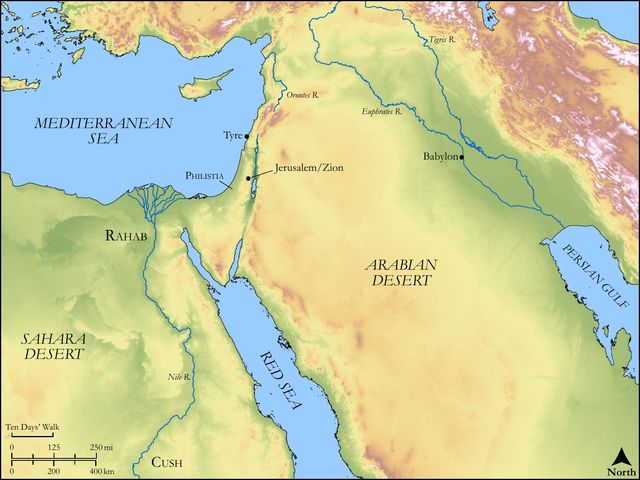
See on the biblical-era map
Study this verse
Public-domain commentary
Matthew Henry
From his Commentary on the Whole Bible. Henry comments on passages, not single verses — this entry covers Psalms 87:4–7.
Zion is here compared with other places, and preferred before them; the church of Christ is more glorious and excellent than the nations of the earth. 1. It is owned that other places have their glories (Psa 87:4): "I will make mention of Rahab" (that is, Egypt) "and Babylon, to those that know me and are about me, and with whom I discourse about public affairs; behold Philistia and Tyre, with Ethiopia" (or rather Arabia), "we will observe that this man was born there; here and there one famous man, eminent for knowledge and virtue, may be produced, that was a native of these countries; here and there one that becomes a proselyte and worshipper of the true God." But some give another sense of it, supposing that it is a prophecy or promise of bringing the Gentiles into the church and of uniting them in one body with the Jews. God says, "I will reckon Egypt and Babylon with those that know me. I will reckon them my people as much as Israel when they shall receive the gospel of Christ, and own them as born in Zion, born again there, and admitted to the privileges of Zion as freely as a true-born Israelite." Those that were strangers and foreigners became fellow-citizens with the saints, Eph 2:19. A Gentile convert shall stand upon a level with a native Jew; compare Isa 19:23-25. The Lord shall say, Blessed be Egypt my people, and Assyria the work of my hands, and Israel my inheritance. 2. It is proved that the glory of Zion outshines them all, upon many accounts; for, (1.) Zion shall produce many great and good men that shall be famous in their generation, Psa 87:5. Of Zion it shall be said by all her neighbours that this and that man were born in her, many men of renown for wisdom and piety, and especially for acquaintance with the words of God and the visions of the Almighty - many prophets and kings, who should be greater favourites of heaven, and greater blessings to the earth, than ever were bred in Egypt or Babylon. The worthies of the church far exceed those of heathen nations, and their names will shine brighter than in perpetual records. A man, a man was born in her, by which some understand Christ, that man, that son of man, who is fairer than the children of men; he was born at Bethlehem near Zion, and was the glory of his people Israel. The greatest honour that ever was put upon the Jewish nation was, that of them, as concerning the flesh, Christ came, Rom 9:5. Or this also may be applied to the conversion of the Gentiles. Of Zion it shall be said that the law which went forth out of Zion, the gospel of Christ, shall be an instrument to beget many souls to God, and the Jerusalem that is from above shall be acknowledged the mother of them all. (2.) Zion's interest shall be strengthened and settled by an almighty power. The Highest himself shall undertake to establish her, who can do it effectually; the accession of proselytes out of various nations shall be so far from occasioning discord and division that it shall contribute greatly to Zion's strength; for, God himself having founded her upon an everlasting foundation, whatever convulsions and revolutions there are of states and kingdoms, and however heaven and earth may be shaken, these are things which cannot be shaken, but must remain. (3.) Zion's sons shall be registered with honour (Psa 87:6): "The Lord shall count, when he writes up the people, and takes a catalogue of his subjects, that this man was born there, and so is a subject by birth, by the first birth, being born in his house - by the second birth, being born again of his Spirit." When God comes to reckon with the children of men, that he may render to every man according to his works, he will observe who was born in Zion, and consequently enjoyed the privileges of God's sanctuary, to whom pertained the adoption, and the glory, and the covenants, and the service of God, Rom 9:4; Rom 3:1, Rom 3:2. For to them much was given, and therefore of them much will be required, and the account will be accordingly; five talents must be improved by those that were entrusted with five. I know thy works, and where thou dwellest, and where thou was born. Selah. Let those that dwell in Zion mark this, and live up to their profession. (4.) Zion's songs shall be sung with joy and triumph: As well the singers as the players on instruments shall be there to praise God, Psa 87:7. It was much to the honour of Zion, and is to the honour of the gospel-church, that there God is served and worshipped with rejoicing: his work is done, and done cheerfully; see Psa 68:25. All my springs are in thee, O Zion! So God says; he has deposited treasures of grace in his holy ordinances; there are the springs from which those streams take rise which make glad the city of our God, Psa 46:4. So the psalmist says, reckoning the springs from which his dry soul must be watered to lie in the sanctuary, in the word and ordinances, and in the communion of saints. The springs of the joy of a carnal worldling lie in wealth and pleasure; but the springs of the joy of a gracious soul lie in the word of God and prayer. Christ is the true temple; all our springs are in him, and from him all our streams flow. It pleased the Father, and all believers are well pleased with it too, that in him should all fulness dwell.
Historical interpretation
Historical reception
1 surviving comment on this verse from the historical church.
So thus, after drawing together and mingling every source of joyous exultation, how does he conclude? "The dwelling as of all that shall be made joyous is in You" [Psalm 87:7]. As if all made joyous, all rejoicing, shall dwell in that city. Amid our journeyings here we suffer bruises: our last home shall be the home of joy alone. Toil and groans shall perish: prayers pass away, hymns of praise succeed. There shall be the dwelling of the happy; no longer shall there be the groans of those that long, but the gladness of those who enjoy. For He will be present for whom we sigh: we shall be like Him, as we shall see Him as He is: [1 John 3:2] there it will be our whole task to praise and enjoy the presence of God: and what beyond shall we ask for, when He alone satisfies us, by whom all things were made? We shall dwell and be dwelt in; and shall be subject to Him, that God may be all in all. [1 Corinthians 15:28] "Blessed," then, "are they that dwell in Your house." How blessed? Blessed in their gold, and silver, their numerous slaves, and multiplied offspring? "Blessed are they that dwell in Your house: for ever and ever they will be praising You." Blessed in that sole labour which is rest! Let this then be the one and only object of our desire, my brethren, when we shall have reached this pass. Let, us prepare ourselves to rejoice in God: to praise Him. The good works which conduct us there, will not be needed there. I described, as far as I could, only yesterday, our condition there: works of charity there will be none, where there will be no misery: you shall not find one in want, one naked, no one will meet you tormented with thirst, there will be no stranger, no sick to visit, no dead to bury, no disputants to set at peace. What then will you find to do? Shall we plant new vines, plough, traffic, make voyages, to support the necessities of the body? Deep quiet shall be there; all toilsome work, that necessity demands, will cease: the necessity being dead, its works will perish too. What then will be our state? As far as possible, the tongue of a man thus told us. "As it were, the dwelling of all who shall be made perfect is in You." Why does he say, "as it were"? Because there shall be such joy there as we know not here. Many pleasures do I behold here, and many rejoice in this world, some in one thing, others in another; but there is nothing to compare with that delight, but it shall be "as it were" being made joyful. For if I say joyfulness, men at once think of such joyfulness as men use to have in wine, in feasting, in avarice, and in the world's distinctions. For men are elated by these things, and mad with a kind of joy: but "there is no joy, says the Lord, unto the wicked." [Isaiah 48:22] There is a sort of joyfulness which the ear of man has not heard, nor his eye seen, nor has it entered into his heart to conceive. [1 Corinthians 2:9] "As it were, the dwelling of all who shall be made joyful is in You." Let us prepare for other delights: for a kind of shadow is what we find here, not the reality: that we may not expect to enjoy such things there as here we delight in: otherwise our self-denial will be avarice. Some persons, when invited to a rich banquet, where there are many and costly dishes yet to come on, abstain from breaking their fast: if you ask the reason, they tell you that they are fasting: which is indeed a great work, a Christian work. Yet be not hasty in praising them: examine their motives: it is their belly, not religion, that they are consulting. That their appetite may not be palled by ordinary dishes, they abstain till more delicate food is set before them. This fast then is for the gullet's sake. Fasting is undoubtedly important: it fights against the belly and the palate; but sometimes it fights for them. Thus, my brethren, if you imagine that we shall find any such pleasures in that country to which the heavenly trumpet urges us on, and on that account abstain from present enjoyments, that you may receive the like more plentifully there, you imitate those I have described, who fast only for greater feasting, and abstain only for greater indulgence. Do not ye like this: prepare yourselves for a certain ineffable delight: cleanse your hearts from all earthly and secular affections. We shall see something, the sight of which will make us blessed: and that alone will suffice for us. What then? Shall we not eat? Yes: we shall eat: but that shall be our food, which will ever refresh, and never fail. "In You is the dwelling of all who shall be, as it were, made joyful." He has already told us how we shall be made joyful. "Blessed are they that dwell in your house: for ever and ever they will be praising You." Let us praise the Lord as far as we are able, but with mingled lamentations: for while we praise we long for Him, and as yet have Him not. When we have, all our sorrows will be taken from us, and nothing will remain but praise, unmixed and everlasting. Now let us pray.
Continue studying Psalms 87:7 across the web’s major study libraries — every link below opens this exact verse, chapter, or book on the destination site.
Read & Compare
 BibleGatewayThis verse in more than 200 translations and 70 languages.
 Bible.comThe YouVersion reader — hundreds of translations, reading plans, and highlights.
 ESV.orgCrossway's official English Standard Version reader.
 NET BibleThe NET translation with 60,000+ translators' notes on every rendering decision.
 STEP BibleTyndale House's free study tool — original text, vocabulary, and scholarly resources.
 BibliaLogos Bible Software's free web reader.
 USCCBThe New American Bible (Revised Edition) with the U.S. bishops' study notes.
Commentaries
 BibleHub CommentariesDozens of classic commentaries on this verse, gathered on one page.
 StudyLightMore than 100 commentary sets — the largest collection on the web.
 BibleRefPlain-English commentary on what this verse means, verse by verse.
 Enduring WordDavid Guzik's free commentary on this chapter, widely used by Bible teachers.
 Bible Study ToolsVerse commentary alongside Greek and Hebrew study aids.
Original Language & Research
- BibleHub InterlinearThe verse word by word — original language, transliteration, and English.
- BibleHub LexiconEvery word's original-language definition and Strong's entry.
 Blue Letter BibleDeep-study tools — Strong's numbers, concordance, and word studies.
 SefariaThe Hebrew text with Rashi and centuries of Jewish commentary.
Sermons, Hymns & Audio


TrulyRandomVerse is not affiliated with these sites and doesn’t control their content. They’re linked because they’re genuinely useful.
Summary
Psalms 87:7 serves as a profound and climactic declaration within a psalm celebrating Zion, the city of God, as the spiritual birthplace of all nations. This verse masterfully weaves together the imagery of joyous, instrumental worship with the foundational truth that God Himself is the singular, inexhaustible, and ultimate source of all life, refreshment, and spiritual vitality. It culminates the psalm's vision of universal inclusion and celebration in God's presence, asserting that every believer finds their deepest satisfaction, purpose, and very existence rooted entirely and exclusively in Him.
Context
ShowHideLiterary Context
Psalms 87 is a "Song of Zion," a unique composition that elevates Jerusalem (Zion) beyond a mere geographical location to a theological symbol of God's chosen dwelling and the spiritual mother of all peoples. The preceding verses, particularly Psalms 87:4-6, present a revolutionary vision: nations previously considered outside the covenant, such as Rahab (Egypt), Babylon, Philistia, Tyre, and Cush (Ethiopia), are astonishingly declared as "born" in Zion. This radical inclusion, transcending ethnic and national boundaries, sets the stage for the climactic declaration of verse 7. The psalm progresses from God's foundational establishment of Zion (Psalms 87:1-3) to its universal spiritual impact, culminating in the joyous worship and the profound acknowledgment of God as the ultimate source of life for all who are spiritually "born" within its symbolic embrace.
Historical & Cultural Context
Ancient Jerusalem, often synonymous with Zion, was not merely a city but the divinely chosen spiritual and political heart of Israel, where God established His Temple and manifested His presence (2 Chronicles 6:6). In the arid land of Israel, springs were indispensable for survival, symbolizing life, sustenance, and blessing. The imagery of "springs" would have resonated deeply with the original audience, representing the life-giving presence and provision of God. Furthermore, music and instrumental praise were integral and vibrant components of Israelite worship, especially within the Temple liturgy, as extensively documented in the Psalms and historical accounts (1 Chronicles 25:1). Thus, the verse evokes a scene of dynamic, divinely inspired celebration within the sacred space of God's dwelling.
Key Themes
ShowHideThis verse encapsulates several profound theological themes. Firstly, it underscores the Divine Source of All Life and Joy. The declaration "all my springs are in thee" powerfully asserts that God is the exclusive, complete, and inexhaustible origin of all true refreshment, vitality, joy, and satisfaction. This echoes the consistent biblical truth that God is the fountain of living waters, standing in stark contrast to the futility of seeking fulfillment elsewhere. Secondly, it highlights Universal Worship and Celebration. The mention of "singers" and "players on instruments" paints a vivid picture of exuberant, communal praise, indicating that musical expression is a natural and essential response to the blessings found in God's presence. This aligns with the broader biblical call to praise God with all forms of music and artistry (Psalms 150). Lastly, it subtly reinforces Zion's Enduring Significance as the symbolic locus where God's presence makes these "springs" accessible. While "thee" primarily refers to God, the immediate context of Zion implies that it is through God's dwelling in His chosen city (symbolizing His accessible grace and spiritual authority) that believers find their ultimate source of life and joy.
Exposition and Analysis
ShowHideKey Word Analysis
ShowHideDerived from H7891, a primitive root meaning "to sing." This word encapsulates the act of vocal praise and musical expression. In the context of ancient Israelite worship, singers, often Levites, played a crucial role in leading communal worship, giving voice to the congregation's adoration, lament, and thanksgiving. The presence of singers in this verse signifies a vibrant, active, and joyful participation in worship, where the human voice is offered in praise to God.
A primitive root that, among its various meanings, includes "to play (the flute)" or "player on instruments." While the root has broader connotations, in this context, it specifically refers to those who produce music using instruments, likely wind instruments like flutes or pipes, which were common in the celebrations and religious ceremonies of Israel. Their inclusion alongside singers emphasizes the comprehensive nature of musical worship, where both vocal and instrumental expressions are united in glorifying God.
Meaning "a fountain (also collectively)" or "a spring." Figuratively, it denotes a source of satisfaction, life, or blessing. In the KJV text, the word is plural ("springs"), emphasizing the abundance and multiplicity of life-giving provisions. In an arid land where water was synonymous with life, "springs" powerfully symbolize the inexhaustible source of all vitality, refreshment, joy, and spiritual sustenance. To declare "all my springs are in thee" is to affirm that every aspect of one's being, every need, and every true satisfaction originates solely and completely from God, making Him the singular, ultimate, and unfailing wellspring of existence.
Verse Breakdown
ShowHide"As well the singers as the players on instruments [shall be there]:"
This clause vividly portrays a scene of exuberant, communal worship. "Singers" and "players on instruments" represent the full spectrum of musical and expressive praise within the Temple or in Zion. The implied "shall be there" refers to Zion, the city of God, where these diverse worshippers, now spiritually "born" into God's kingdom, gather in joyful celebration. It underscores the inclusive and celebratory nature of God's presence, where all are invited to actively participate in glorifying Him through their artistic and spiritual gifts. This is not merely a passive presence but an active, joyful outpouring of praise.
"all my springs [are] in thee."
This is the climactic and deeply personal declaration of the verse. The possessive "my springs" indicates a profound, personal relationship and absolute reliance. The "thee" refers directly and exclusively to God, the ultimate subject of the psalm's praise, even within the celebratory context of Zion. This phrase is a powerful theological statement: every source of life, every drop of spiritual refreshment, every moment of true joy, every answer to deep longing, and every aspect of one's well-being—all originate from God alone. It signifies a complete and utter dependence on God for all that truly sustains and satisfies, contrasting sharply with any attempt to find fulfillment in worldly or human sources.
Literary Devices
ShowHidePsalms 87:7 employs several powerful literary devices to convey its profound message. The most prominent is Metaphor, where "springs" are used to represent the ultimate source of life, joy, and spiritual sustenance. This metaphor is particularly potent in an arid Middle Eastern context, making the imagery of God as the ultimate "spring" deeply resonant and tangible. The verse also utilizes vivid Imagery, painting a sensory picture of joyous musical worship ("singers" and "players on instruments") combined with the abstract concept of life-giving water, creating a holistic scene of spiritual vitality and divine provision. Furthermore, the phrase "singers as the players on instruments" can be seen as a form of Merism, where two complementary parts are used to represent the whole of musical praise, emphasizing the comprehensive and all-encompassing nature of worship offered to God.
Theological and Thematic Connections
ShowHidePsalms 87:7 profoundly articulates God's self-sufficiency and His role as the ultimate, sole, and inexhaustible source of all life, blessing, and true satisfaction. It seamlessly connects the psalm's vision of the universal spiritual birthright of believers in Zion with the deeply personal experience of finding complete sustenance in God alone. This declaration resonates with the broader biblical narrative of God as the giver of living water, satisfying the deepest thirsts of the human soul. It underscores that authentic worship flows from a recognition of God's boundless and inexhaustible provision and His centrality in the lives of His people, whether experienced individually or corporately within the community of faith.
Reflection and Application
ShowHidePsalms 87:7 challenges believers to critically examine the true source of their satisfaction, joy, and spiritual vitality. In a world that relentlessly offers fleeting pleasures, temporary fixes, and superficial sources of fulfillment, this verse powerfully redirects our gaze to God as the one true, inexhaustible wellspring. For those spiritually "born" in Zion—that is, those brought into God's kingdom through faith in Christ—it serves as a profound reminder to continually draw from Him through prayer, diligent engagement with His Word, heartfelt worship, and genuine communion with His people. When we truly acknowledge and live as though "all our springs are in Him," our lives become profoundly centered on His divine presence, leading to an authentic and lasting joy, peace, and spiritual vitality that the world cannot provide or take away. This verse inspires a life of profound gratitude, active worship, and unwavering dependence, recognizing that every good and perfect gift, every drop of true refreshment, flows from His boundless grace.
Questions for Reflection
ShowHideFAQ
ShowHideWho is "thee" in "all my springs are in thee"?
ShowHideWhile the immediate literary context of Psalm 87 celebrates Zion, the "thee" in "all my springs are in thee" refers ultimately and primarily to God Himself. The psalm exalts Zion as God's chosen city and dwelling place, but it is God's presence in Zion that makes it the symbolic source of spiritual life and blessing. The psalmist is declaring a personal, absolute, and exclusive dependence on God as the fount of all true life, satisfaction, and sustenance. This theme is consistent throughout the Psalms, where God is repeatedly praised as the ultimate provider and sustainer (Psalms 36:9).
What does the imagery of "springs" signify in this verse?
ShowHideThe imagery of "springs" (מַעְיָנִים, maʻyânim) is highly significant, especially in the arid land of Israel where reliable water sources were crucial for survival. It metaphorically represents the source of all life, vitality, refreshment, sustenance, and blessing. To say "all my springs are in thee" means that every aspect of one's well-being—physical, emotional, and spiritual—every source of joy, every moment of true satisfaction, and every answer to deep longing originates solely and completely from God. It emphasizes God's role as the inexhaustible provider of everything truly essential for life and flourishing, echoing promises like Isaiah 58:11 where God promises to satisfy the soul and make one like a well-watered garden.
Christ-Centered Fulfillment
ShowHidePsalms 87:7 finds its ultimate and glorious fulfillment in the person and work of Jesus Christ. While the psalm celebrates Zion as the spiritual birthplace and the place where God's life-giving "springs" are found, the New Testament reveals that Jesus Himself is the true and ultimate "spring" of living water. He declared, "If anyone thirsts, let him come to me and drink" (John 7:37), and to the Samaritan woman, He offered water that would become "a spring of water welling up to eternal life" within her (John 4:14). The universal inclusion envisioned in Psalms 87:4-6—where people from all nations are "born" in Zion—is profoundly realized in Christ's Church, His body, which is the new spiritual Zion where believers from every tribe and tongue are united as fellow citizens with the saints and members of God's household (Ephesians 2:19-22). The joyous worship of "singers and players on instruments" points forward to the eternal praise offered to the Lamb of God by a great multitude from every nation, standing before the throne (Revelation 7:9-10), whose ultimate source of life, comfort, and sustenance is God Himself, who will lead them to "springs of living water" (Revelation 7:17). Thus, in Christ, all our springs—every source of life, joy, and eternal satisfaction—are truly and eternally found, for He is the Alpha and the Omega, the beginning and the end, who gives freely from the spring of the water of life (Revelation 21:6).